Chapter 16: Financing a Company’s Financial Needs
Learning Objectives
At the completion of this chapter the student should be able to:
• Explain the difference between simple interest and compound interest and explain how
they work.
• Convert an annual percentage rate to an annual percentage yield and an annual percentage
yield to an annual percentage rate.
Instructional Hints
• Many of my students have mortgages, so I like to relate these principles to mortgages
because it really hits home for them. The principles of mortgages easily transfer to long–
term loans.
Activities
• Prepare an amortization schedule for a 30-year mortgage in class. Compare the amount of
interest paid and the principal reduction during the first, second, fifth, tenth, twentieth,
Instruction Resources
• The figures, sidebars, and tables from this chapter in electronic format and PowerPoint
slides can be found at the instructor’s website.
Solutions to the Textbook Problems
1. Simple interest does not pay interests on the previous period’s interest; whereas compound
2. The interest rate that would be paid if the interest was compounded annually.
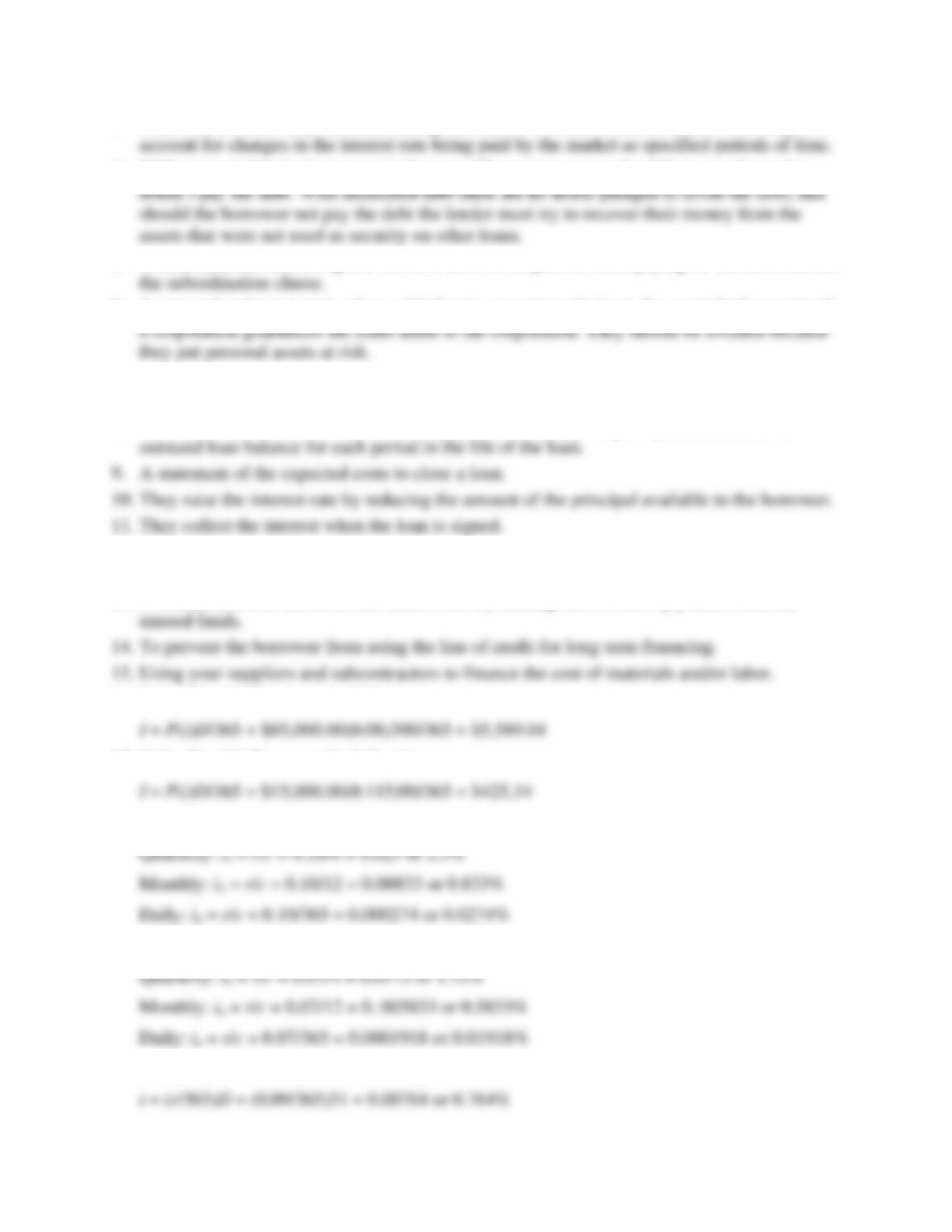
3. Fixed interest rates stay the same through the life of the loan. Variable interest rates adjust to
4. With secured debt the borrower pledges specific assets to cover the debt in case he or she
5. A subordination clause requires all other debts to be paid off after paying off the debt that has
6. A personal endorsement is where a third party guarantees the loan, for example the owner of
7. Where the life of the financial instrument (for example the loan) is matched to the financial
need.
8. An amortization schedule identified the payment, interest paid, principle reduction, and
12. A compensating balance reduces the available funds and increases the interest rate by having
the borrower pay interest on both the amount borrowed and the compensating balance.
13. A commitment fee increases the interest rate by making the borrower pay interest on the
16. Using Eq. (16-2) we get the following:
17. Using Eq. (16-2) we get the following:
18. Using Eq. (16-3) we get the following:
19. Using Eq. (16-3) we get the following:
20. Using Eq. (16-4) we get the following:
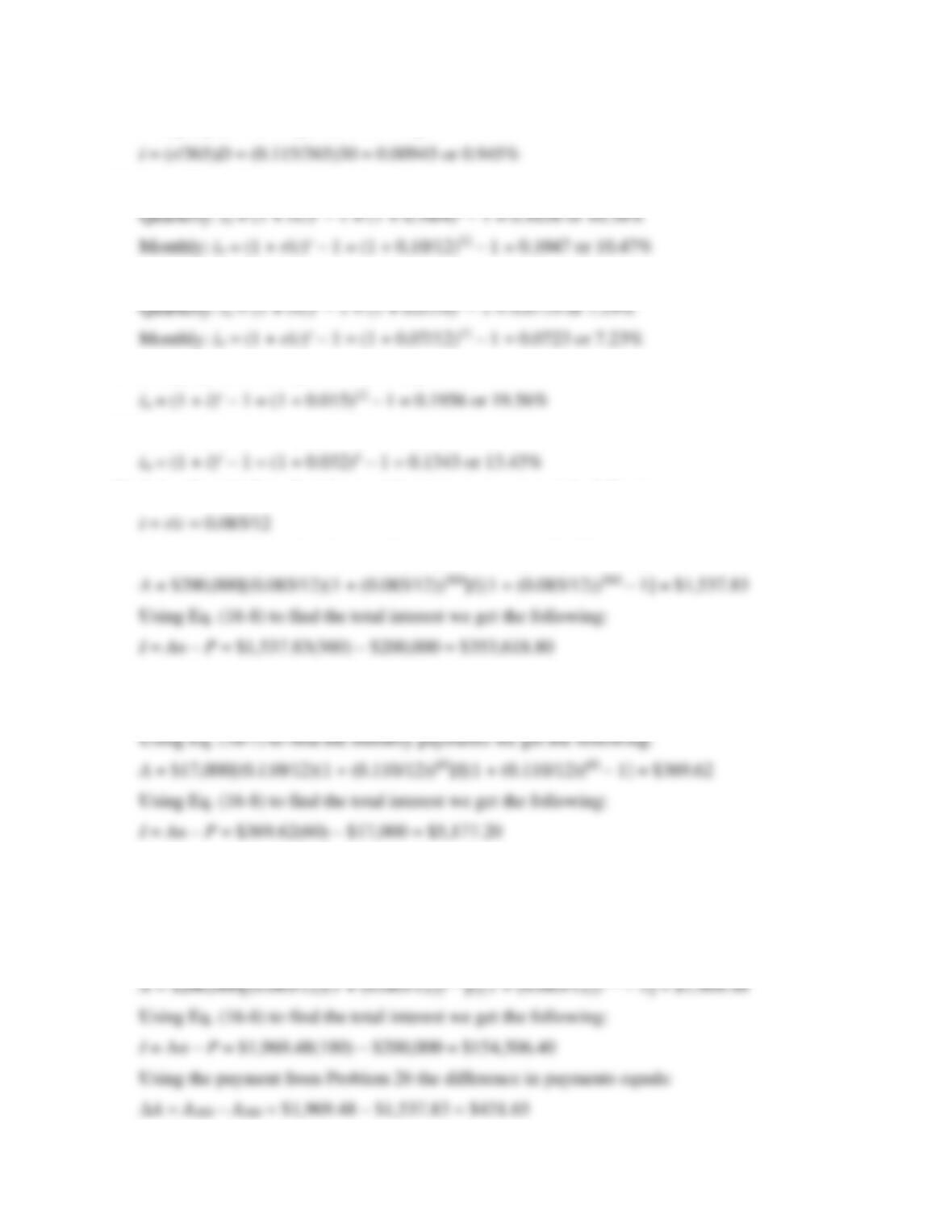
21. Using Eq. (16-4) we get the following:
22. Using Eq. (16-5) we get the following:
23. Using Eq. (16-5) we get the following:
24. Using Eq. (16-6) we get the following:
25. Using Eq. (16-6) we get the following:
26. Using Eq. (16-3) to find the monthly interest rate we get the following:
Using Eq. (16-7) to find the monthly payments we get the following:
27. Using Eq. (16-3) to find the monthly interest rate we get the following:
i = r/c = 0.110/12
28. Using Eq. (16-3) to find the monthly interest rate we get the following:
i = r/c = 0.085/12
Using Eq. (16-7) to find the monthly payments we get the following:
29. Using Eq. (16-3) to find the monthly interest rate we get the following:
i = r/c = 0.110/12
Using Eq. (16-7) to find the monthly payments we get the following:
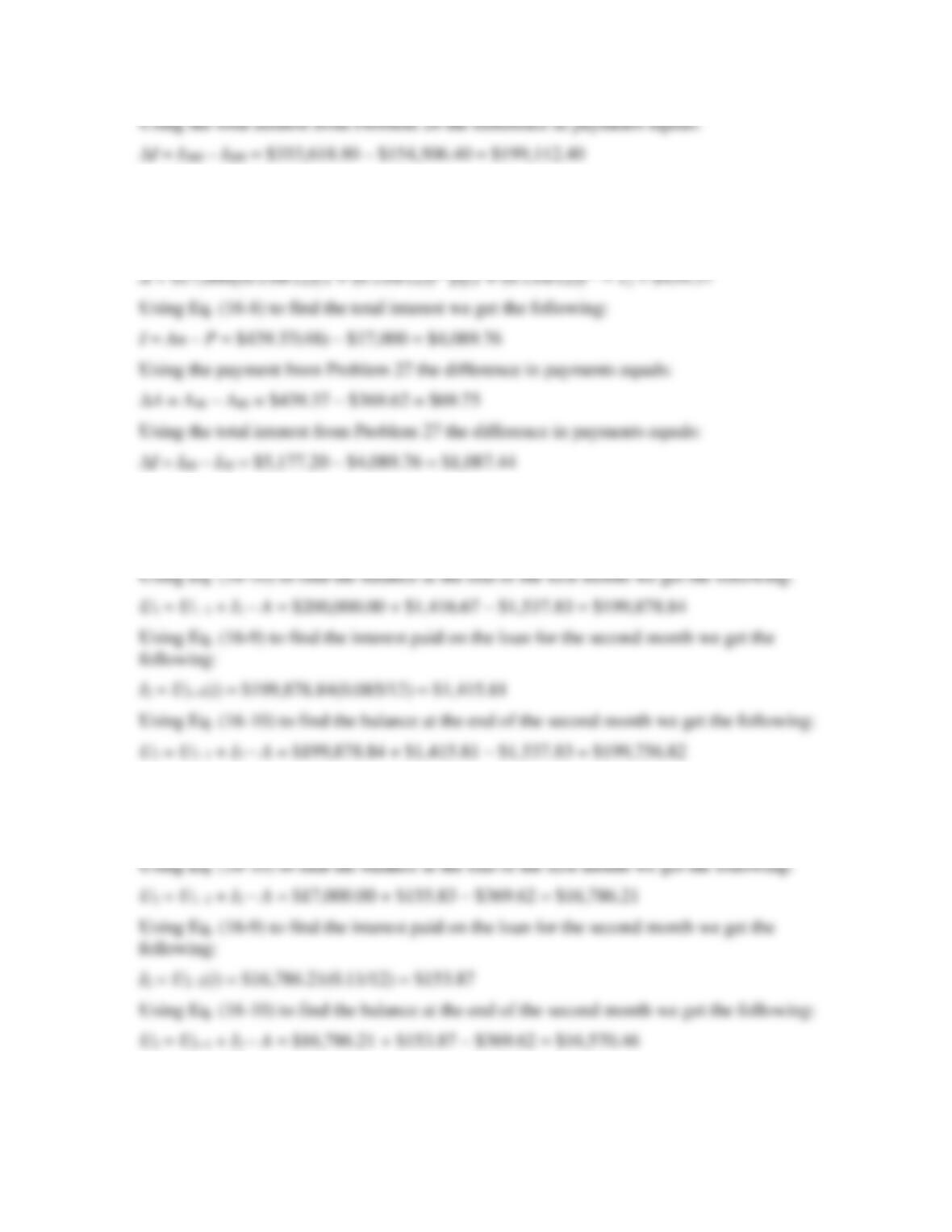
30. From Problem 26: A = $1,537.83 and i = 0.085/12. Using Eq. (16-9) to find the interest paid
on the loan for the first month we get the following:
I1 = U1–1(i) = $200,000(0.085/12) = $1,416.67
31. From Problem 27: A = $369.62 and i = 0.11/12. Using Eq. (16-9) to find the interest paid on
the loan for the first month we get the following:
I1 = U1–1(i) = $17,000(0.11/12) = $155.83
32. From Problem 26: A = $1,537.83 and i = 0.085/12. Using Eq. (16-13) to find the value of the
remaining 240 payments we get the following:
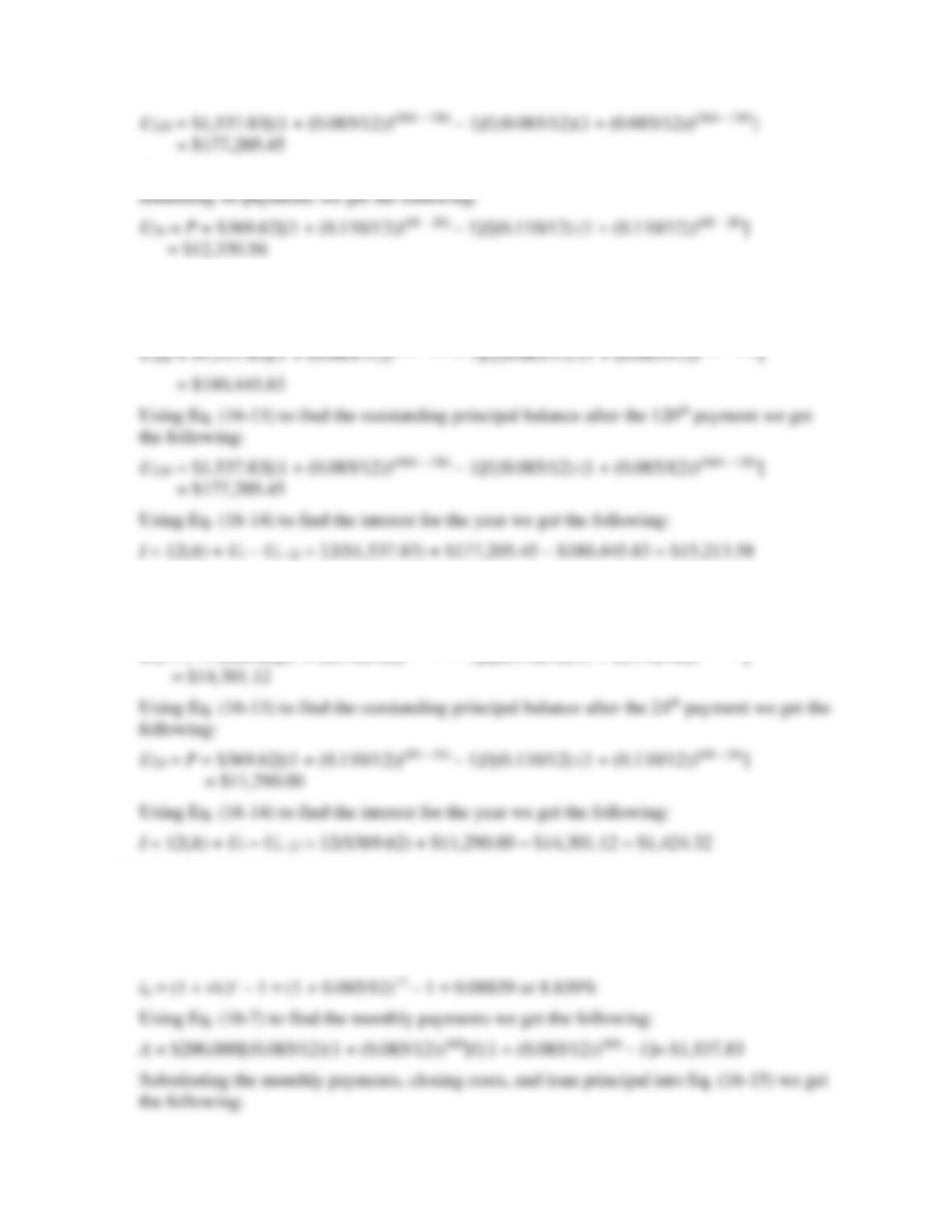
33. From Problem 27: A = $369.62 and i = 0.11/12. Using Eq. (16-13) to find the value of the
34. From Problem 26: A = $1,537.83 and i = 0.085/12. The 10th year includes payments 109
through 120. Using Eq. (16-13) to find the outstanding principal balance after the 108th
payment we get the following:
35. From Problem 27: A = $369.62 and i = 0.11/12. The 2nd year includes payments 13 through
24. Using Eq. (16-13) to find the outstanding principal balance after the 12th payment we get
the following:
U12 = P = $369.62[(1 + (0.110/12))(60 – 12) – 1]/[(0.110/12) (1 + (0.110/12))(60 – 12)]
36. Using Eq. (16-3) to find the monthly interest rate we get the following:
i = r/c = 0.085/12
Using Eq. (16-5) to find the effective annual interest rate without closing costs we get the
following:
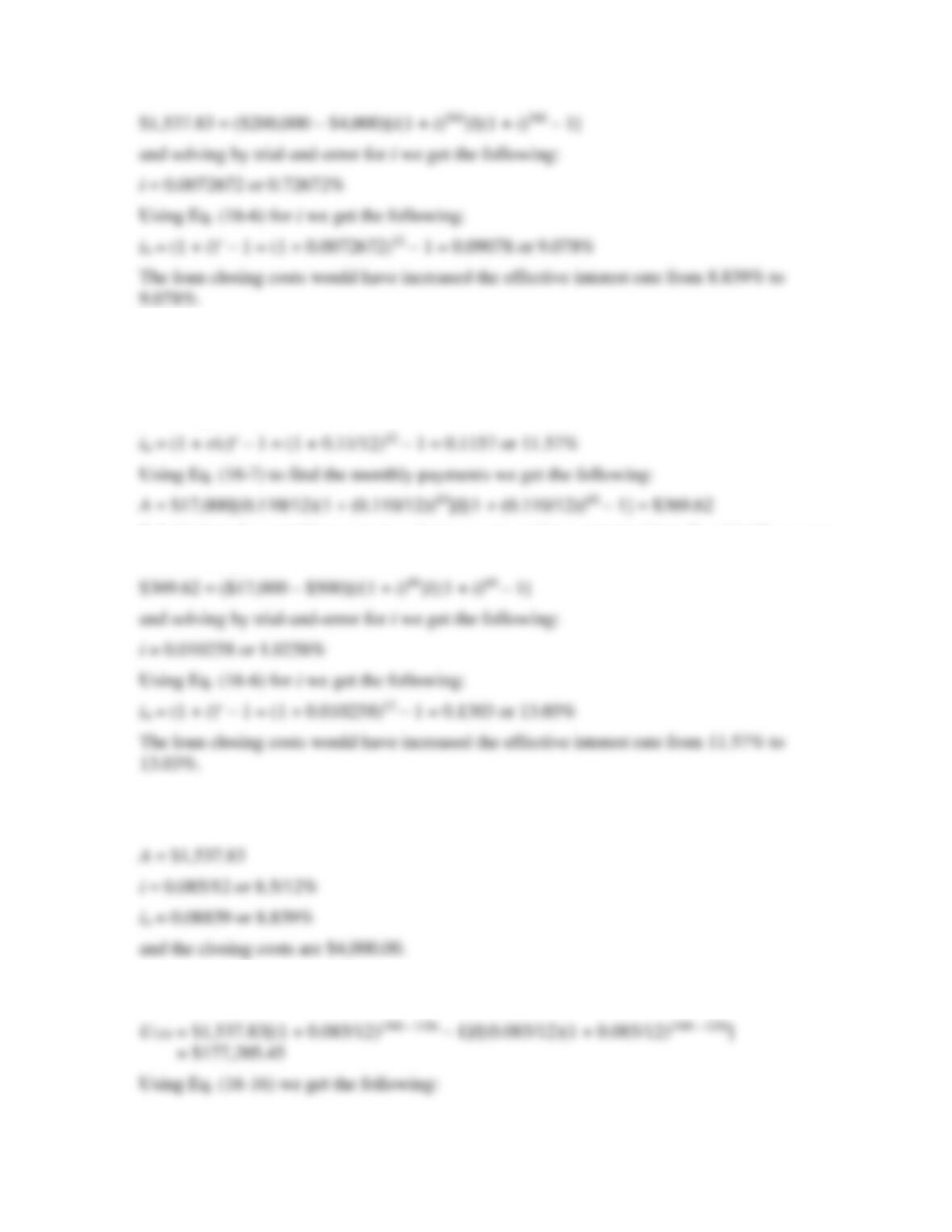
37. Using Eq. (16-3) to find the monthly interest rate we get the following:
i = r/c = 0.110/12
Using Eq. (16-5) to find the effective annual interest rate without closing costs we get the
following:
Substituting the monthly payments, closing costs, and loan principal into Eq. (16-15) we get
the following:
38. From Problem 36 we find that:
P = $200,000.00
Using Eq. (16-13) to find the outstanding principal balance after the 120th payment we get
the following:
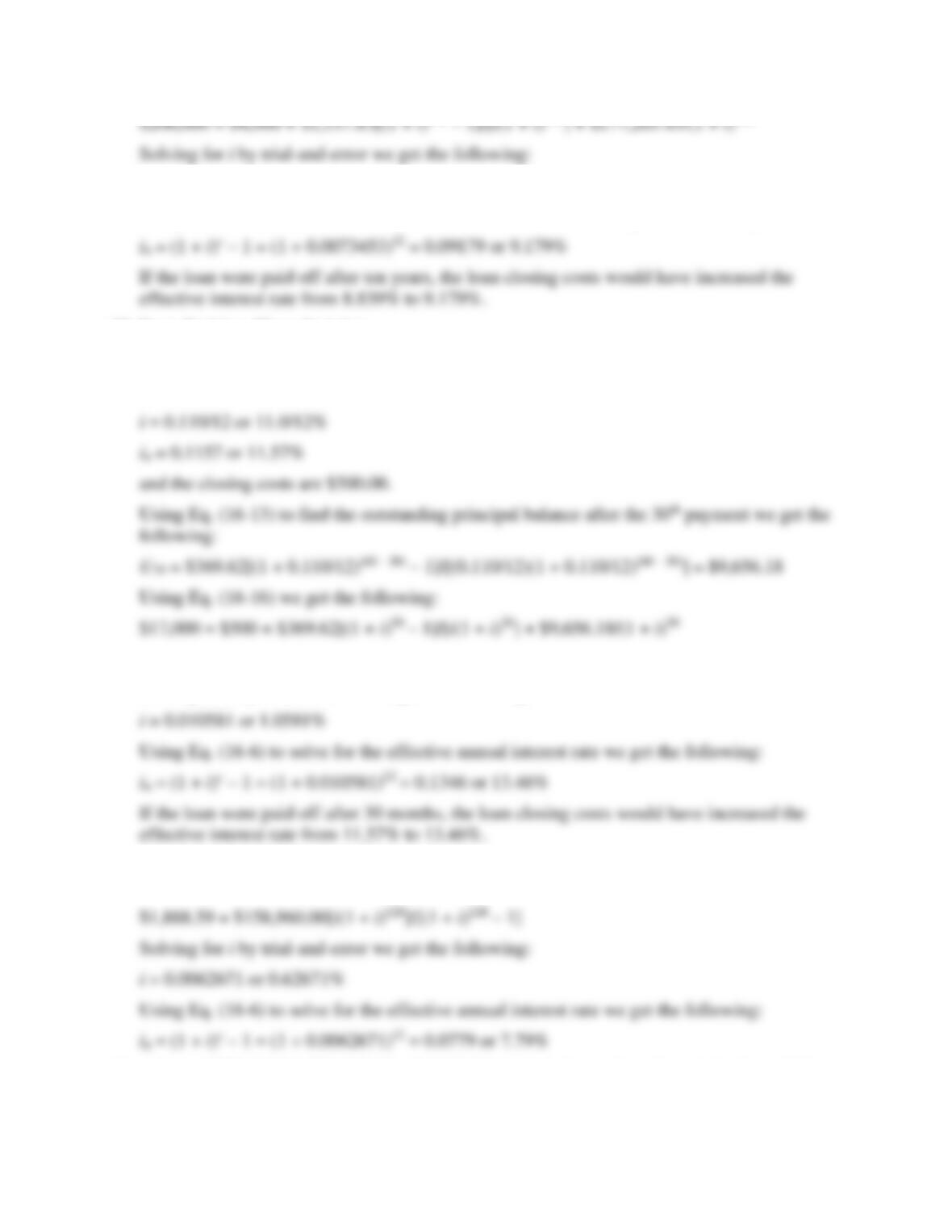
i = 0.0073453 or 0.73453%
Using Eq. (16-6) to solve for the effective annual interest rate we get the following:
39. From Problem 37 we find that:
P = $17,000.00
A = $369.62
Solving for i by trial-and-error we get the following:
40. A loan of $158,960.00 ($155,660.00 + $3,300.00) is needed to replace the existing loan.
Using Eq. (16-7) we get the following:
41. A loan of $76,169.00 ($74,269.00 + $1,900.00) is needed to replace the existing loan. Using
Eq. (16-7) we get the following:
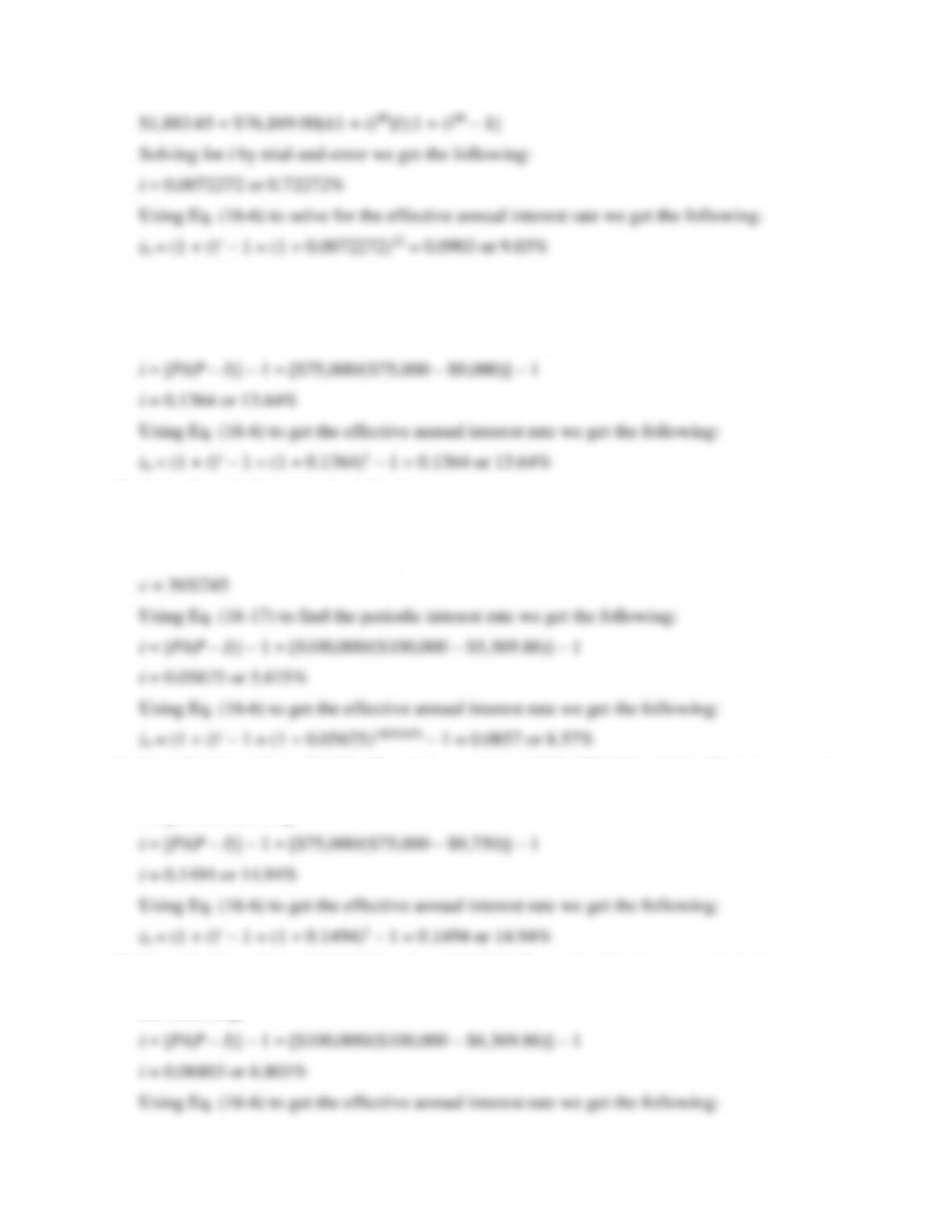
42. Using Eq. (16-1) we get the following:
I = P(i)n = $75,000.00(0.12)1 = $9,000.00
Using Eq. (16-17) to find the periodic interest rate we get the following:
43. Using Eq. (16-2) we get the following:
I = P(i)D/365 = $100,000.00(0.08)245/365 = $5,369.86
Find the number of periods in one year:
44. From Problem 42, I = $9,000. The closing costs are $750 ($75,000 × 0.01). The interest and
closing costs is $9,750 ($9,000 + $750). Using Eq. (16-17) to find the periodic interest rate
we get the following:
45. From Problem 43: I = $5,369.86 and c = 365/245. The total of the interest and closing costs
is $6,369.86 ($5,369.86 + $1,000). Using Eq. (16-17) to find the periodic interest rate we get
the following:
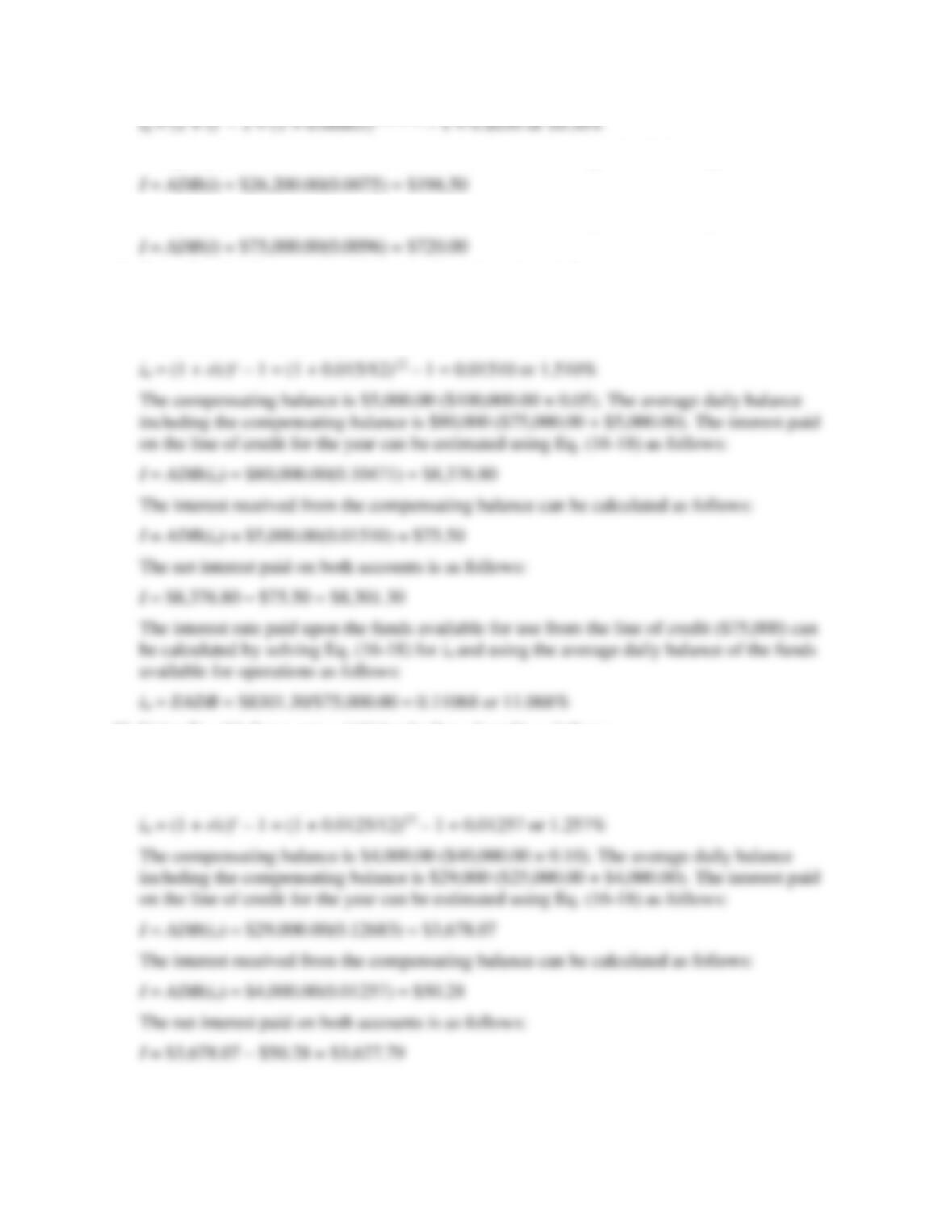
46. Using Eq. (16-18) to calculate the interest for the month we get the following:
47. Using Eq. (16-18) to calculate the interest for the month we get the following:
48. Using Eq. (16-5) we get a yield for the line of credit as follows:
ia = (1 + r/c)c – 1 = (1 + 0.10/12)12 – 1 = 0.10471 or 10.471%
Using Eq. (16-5) we get a yield for the interest bearing account as follows:
49. Using Eq. (16-5) we get a yield for the line of credit as follows:
ia = (1 + r/c)c – 1 = (1 + 0.12/12)12 – 1 = 0.12683 or 12.683%
Using Eq. (16-5) we get a yield for the interest bearing account as follows:
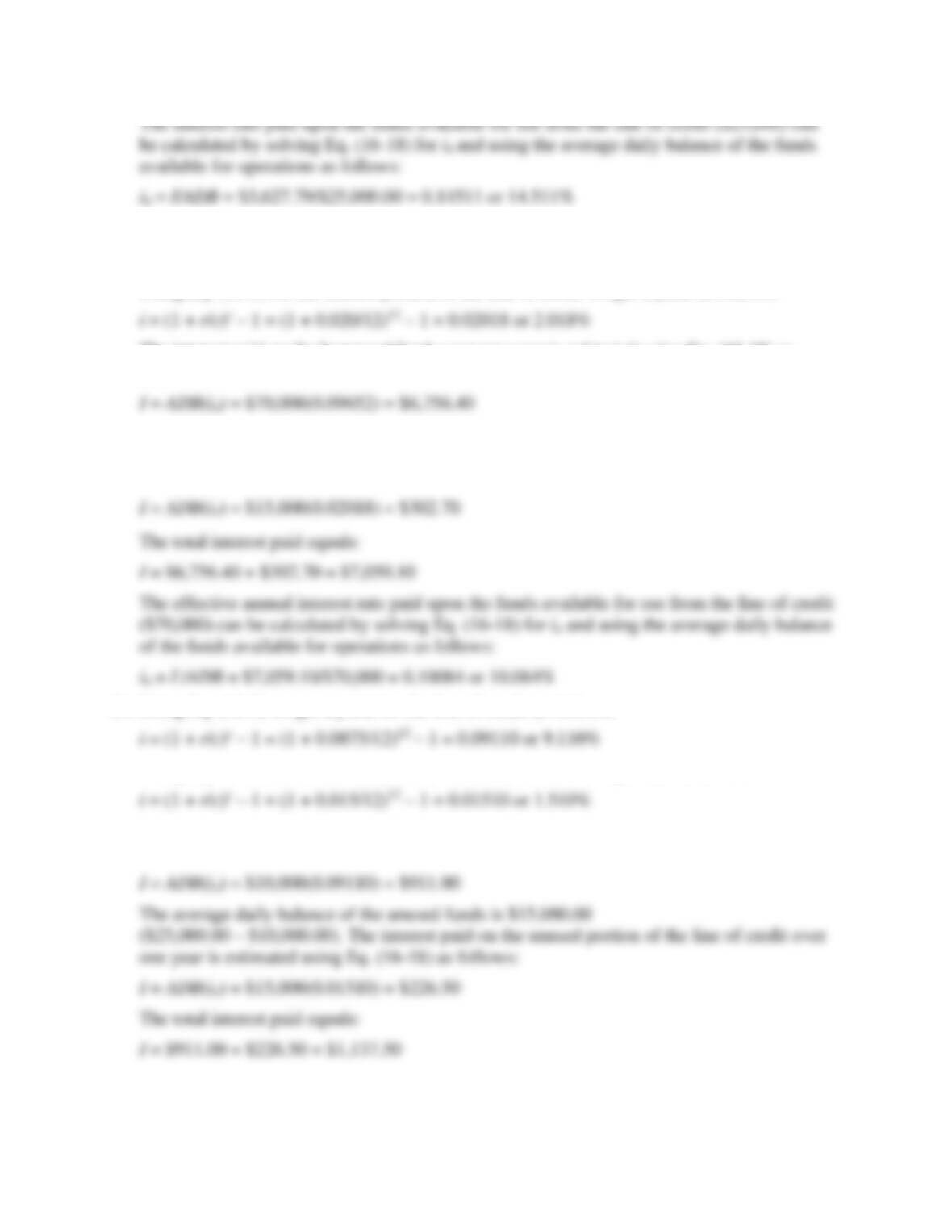
50. Using Eq. (16-5) we get a yield for the line of credit as follows:
i = (1 + r/c)c – 1 = (1 + 0.0925/12)12 – 1 = 0.09652 or 9.652%
Using Eq. (16-5) for the unused portion of the line of credit we get a yield as follows:
The interest paid on the borrowed funds over one year is estimated using Eq. (16-18) as
follows:
The average daily balance of the unused funds is $15,000.00 ($85,000.00 – $70,000.00). The
interest paid on the unused portion of the line of credit over one year is estimated using Eq.
(16-18) as follows:
51. Using Eq. (16-5) we get a yield for the line of credit as follows:
Using Eq. (16-5) for the unused portion of the line of credit we get a yield as follows:
The interest paid on the borrowed funds over one year is estimated using Eq. (16-18) as
follows:
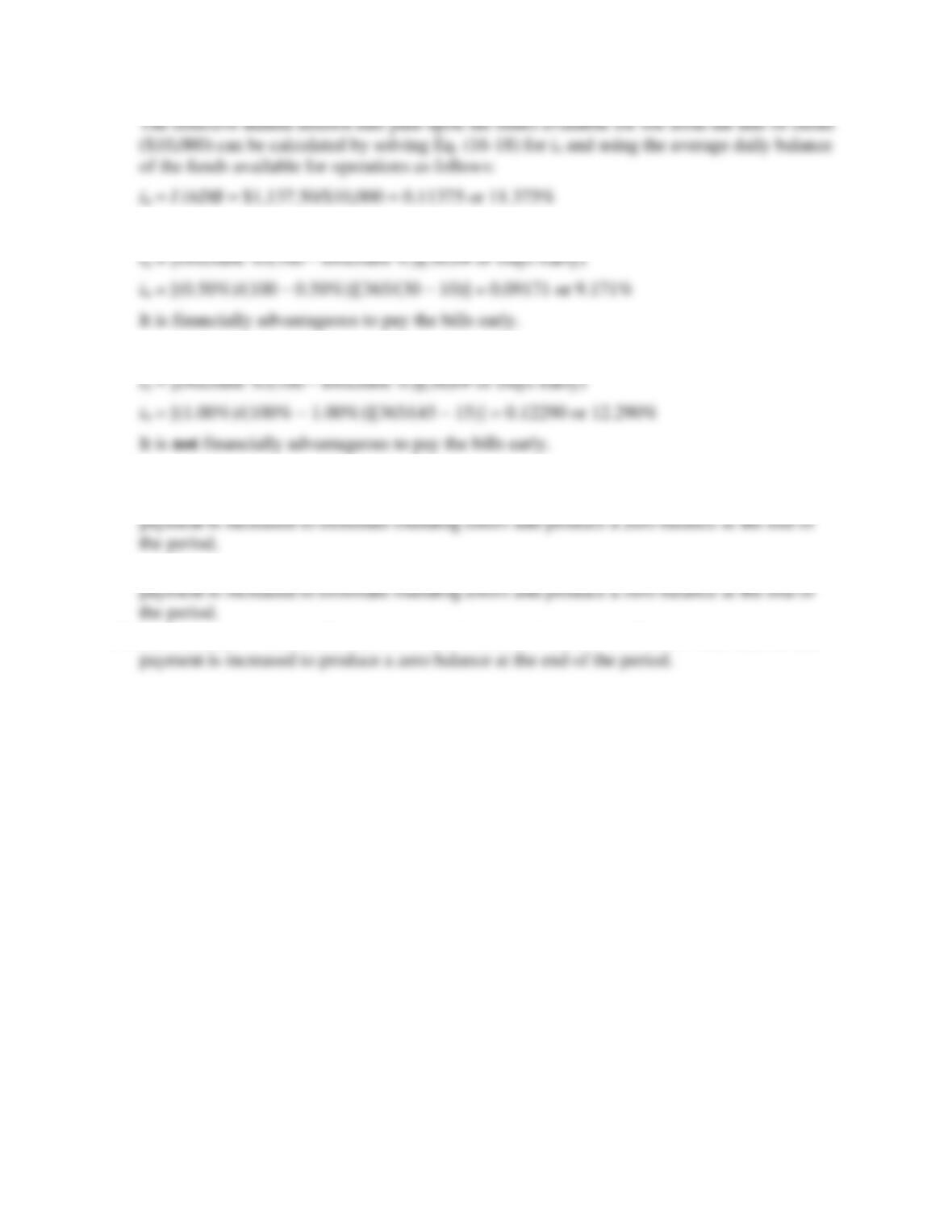
52. The effective annual interest rate is calculated using Eq. (16-19) as follows:
53. The effective annual interest rate is calculated using Eq. (16-19) as follows:
54. See Instructor’s website\Homework Excel Problems\Problem 16-54.xlsx.
55. See Instructor’s website\Homework Excel Problems\Problem 16-55.xlsx. Note that the last
56. See Instructor’s website\Homework Excel Problems\Problem 16-56.xlsx. Note that the last
57. See Instructor’s website\Homework Excel Problems\Problem 16-57.xlsx. Note that the last