Chapter 15: Time Value of Money
Learning Objectives
At the completion of this chapter the student should be able to:
• Explain the concept of equivalence.
• Define and give examples of a present value (P), future value (F), a uniform series of cash
Instructional Hints
• The concept of equivalence is the bases for the equations used in calculate loan payments,
compare loans, and compare financial alternatives. Students must understand the concept
of equivalence if they are to understand Chapters 16 through 18.
Activities
• Find a home that was purchased in Year Y and sold in Year Z. Using the purchase price in
Year Y as the present value and the sales price in Year Z as the future value, find i. Next,
find the inflation rate (f) for the same period of time. This may be done using the consumer
price index (http://www.bls.gov/cpi/) or the inflation calculator at http://data.bls.gov/cgi-
Instruction Resources
• The figures, sidebars, and tables from this chapter in electronic format and PowerPoint
slides can be found at the instructor’s website.
Solutions to the Textbook Problems
2. In a uniform series (1) the cash flows all have the same amount, (2) they occur at the end of
3. You write an algebraic equation and solve for the interest rate.
4. We can choose any time period for the analysis, whether it is some time in the past or future,
5. Interest increases the amount of money. At the same time inflation is decreasing the
6. Taxes decrease the rate at which the money grows.
7. Using Eq. (15-1) we get the following:
8. Using Eq. (15-1) we get the following:
9. Using Eq. (15-3) we get the following:
10. Using Eq. (15-3) we get the following:
12. Using Eq. (15-5) we get the following:
13. Using Eq. (15-7) we get the following:
14. Using Eq. (15-7) we get the following:
15. Using Eq. (15-9) we get the following:
16. Using Eq. (15-9) we get the following:
17. Using Eq. (15-11) we get the following:
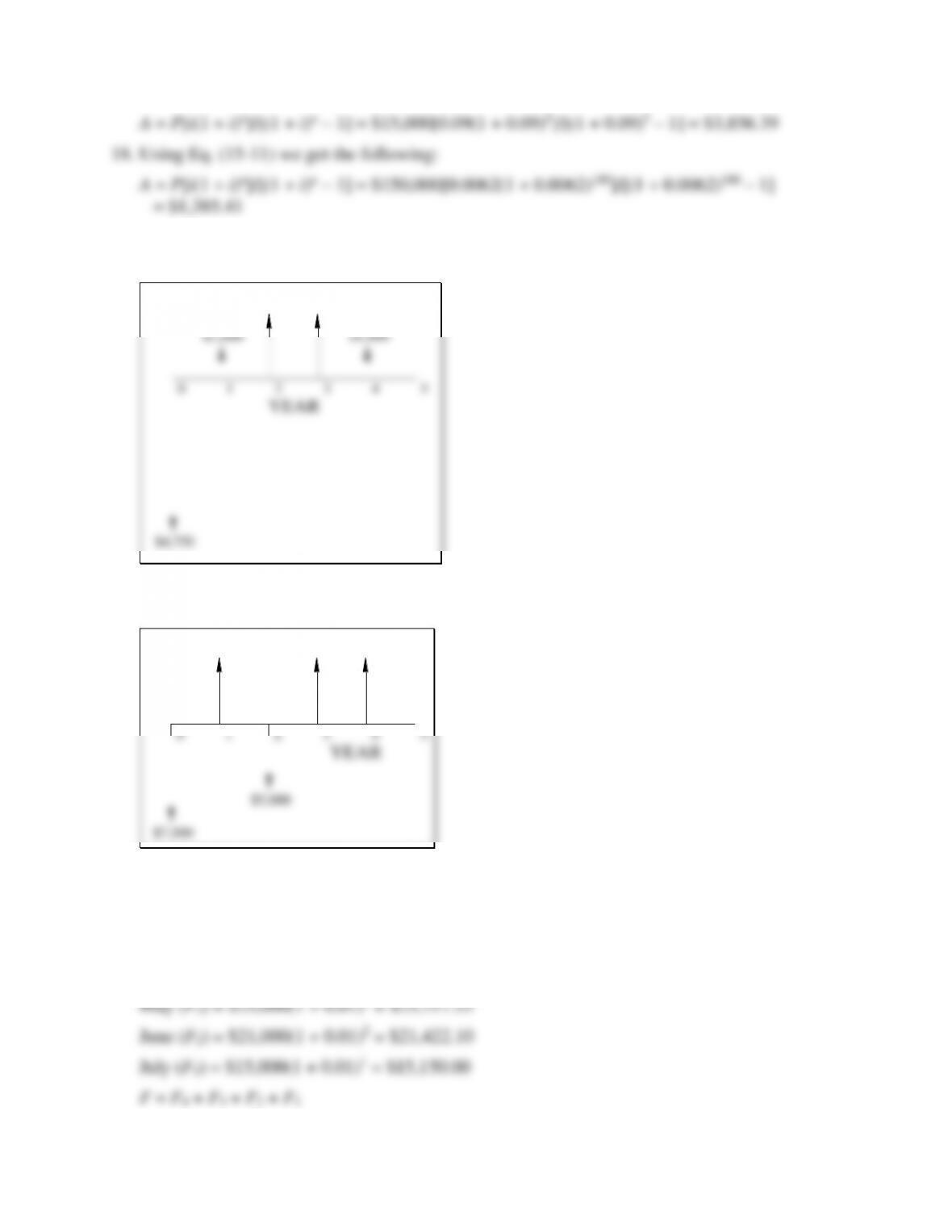
19.
$4,750
0
$1,000
1
$2,000
2
$2,000
3
$1,000
4 5
YEAR
20.
$7,500
0
$5,000
1 2
$5,000
3
$5,000
4 5
YEAR
$5,000
21. Using Eq. (15-1) we get the following:
April (F4) = $15,000(1 + 0.01)4 = $15,609.06
22. Using Eq. (15-1) we get the following:
December (F6) = $15,000(1 + 0.01)6 = $15,922.80
January (F5) = $22,000(1 + 0.01)5 = $23,122.22
23. Split the cash flows in years 3 and 5 into a $3,000 cash flow and a $2,000 cash flow. Using
Eq. (15-9) for the $3,000 cash flow we get the following:
24. Split the cash flows in year 3 into a positive $5,000 cash flow and a negative $10,000 cash
flow. Using Eq. (15-9) for the positive cash flow we get the following:
25. Using Eq. (15-9) the present value in year four is as follows:
26. Using Eq. (15-9) the present value in year ten is as follows:
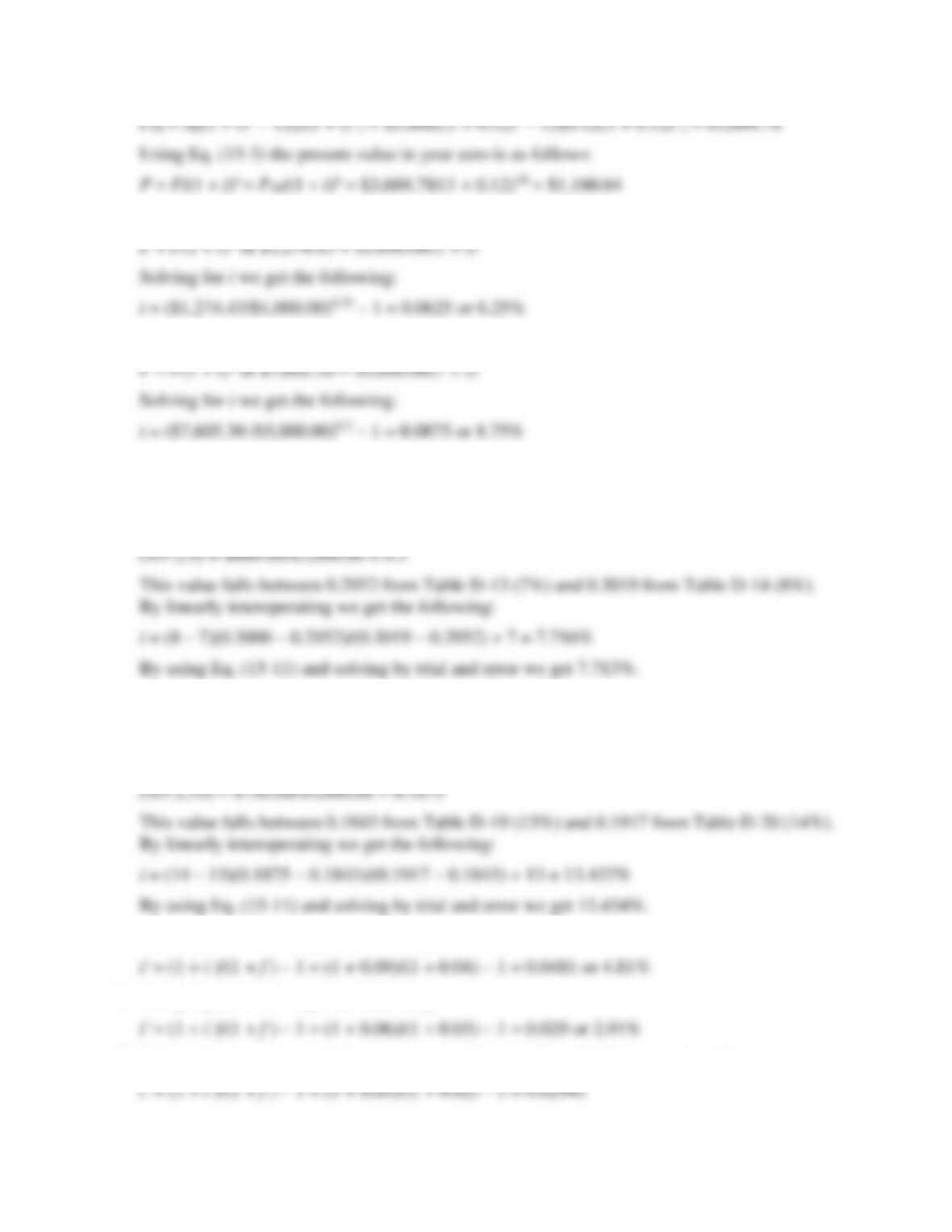
27. Substituting the present and future values into Eq. (15-1) we get the following:
28. Substituting the present and future values into Eq. (15-1) we get the following:
29. This cash flow corresponds to Eq. (15-12) and is written:
$600.00 = $2,000.00(A/P,i,4)
Solving for (A/P,i,n) we get the following:
30. This cash flow corresponds to Eq. (15-12) and is written:
$750.00 = $4,000.00(A/P,i,10)
Solving for (A/P,i,n) we get the following:
31. Using Eq. (15-14) we get the following:
32. Using Eq. (15-14) we get the following:
33. Solving for the constant-dollar interest rate (i’) using Eq. (15-15) we get the following:
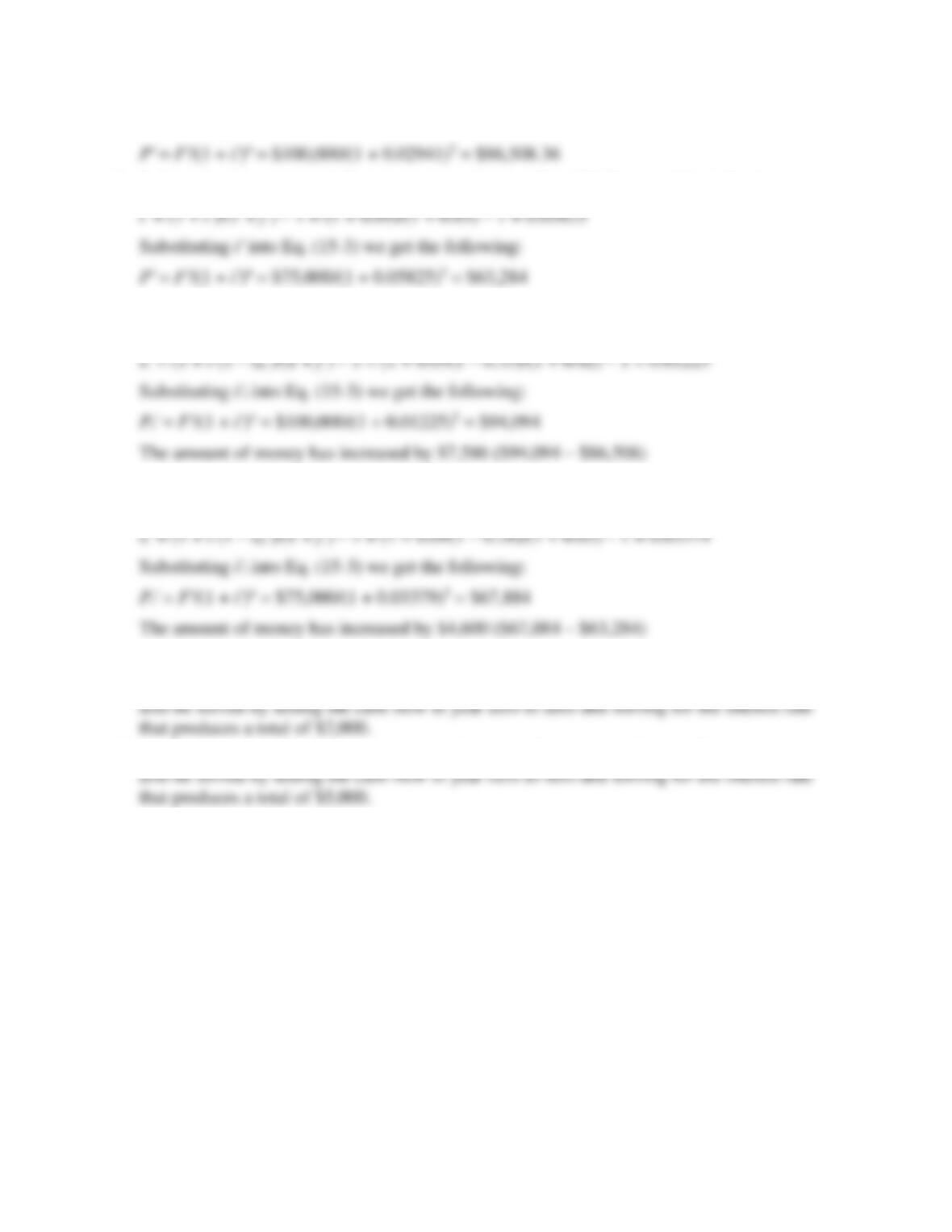
Substituting i’ into Eq. (15-3) we get the following:
34. Solving for the constant-dollar interest rate (i’) using Eq. (15-15) we get the following:
35. Solving for the constant-dollar, after-tax interest rate (i’t) using Eq. (15-17) we get the
following:
36. Solving for the constant-dollar, after-tax interest rate (i’t) using Eq. (15-17) we get the
following:
37. See Instructor’s website\Homework Excel Problems\Problem 15-37.xlsx.
38. See Instructor’s website\Homework Excel Problems\Problem 15-38.xlsx. This problem may
39. See Instructor’s website\Homework Excel Problems\Problem 15-39.xlsx. This problem may