
Problem 13.1
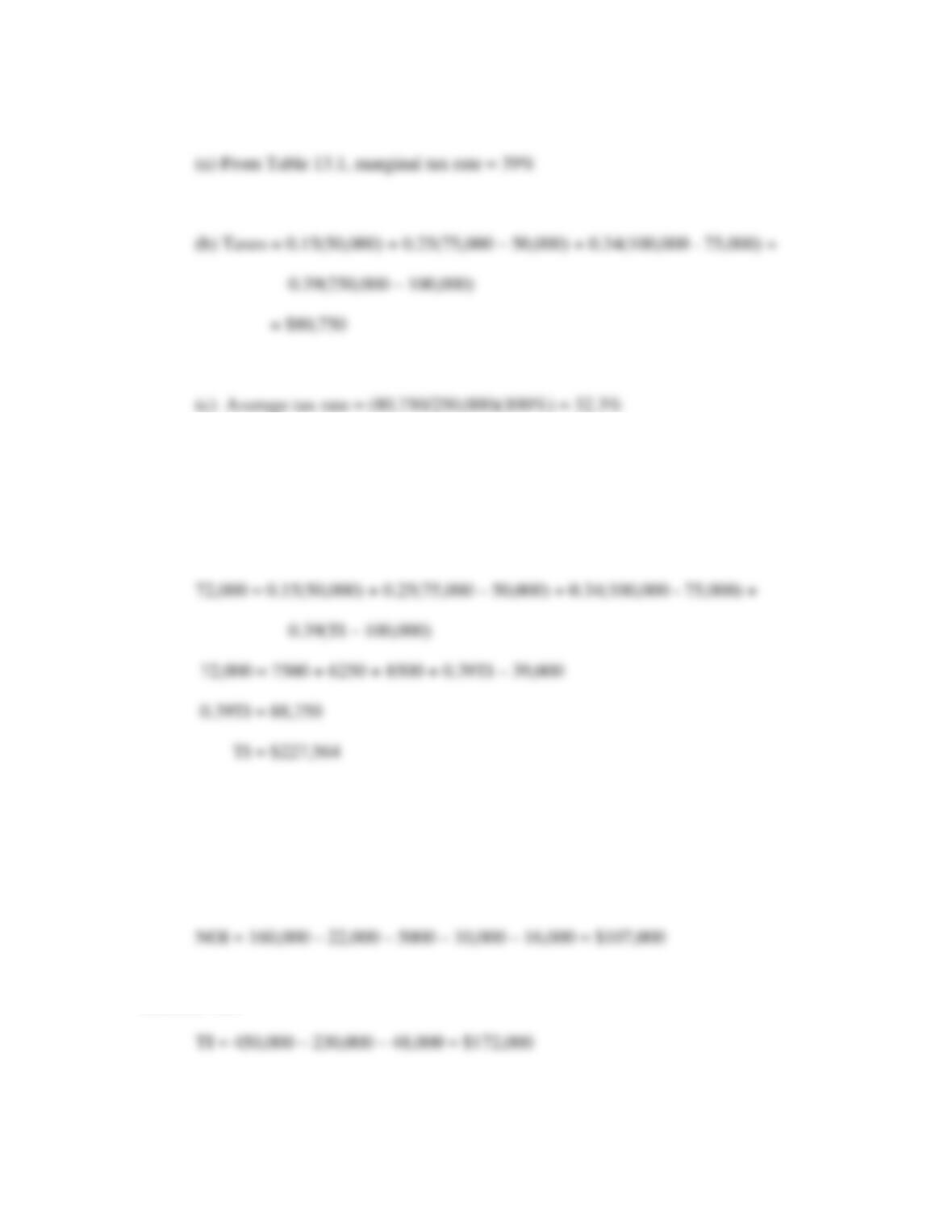
For a corporation that has a taxable income of $250,000 for federal tax computation,
determine (a) the marginal tax rate, (b) the total taxes, and (c) the average tax rate.
Problem 13.2
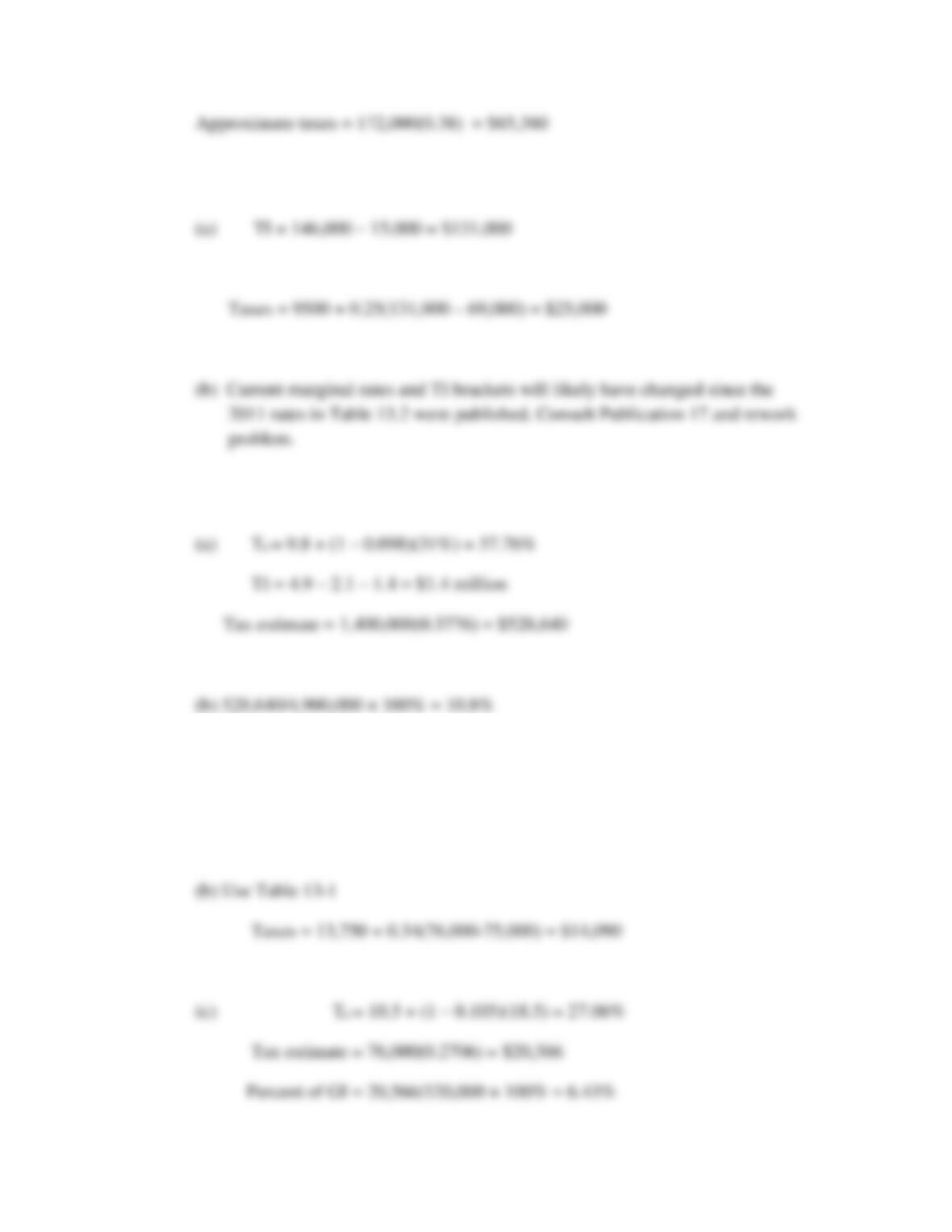
In its first year of operation, Borsberry Construction had a total tax bill of $72,000. What
was the company’s taxable income?
Problem 13.3
Last year, an investor in rental property had gross income of $160,000 with the following
expenses: maintenance $22,000, insurance $5000, management $10,000, utilities
$16,000, and debt service (interest) $19,000. Income taxes totaled $8000. What was the
net operating income for the year?
Problem 13.4
Helical Products makes machined springs with elastic redundant elements so that a
broken spring will continue to function. The company has gross income of $450,000
with expenses of $230,000 and depreciation of $48,000. Approximate the company’s
total taxes for an effective tax rate of 38%.
Problem 13.5
In 2011, a married couple (both professionals) have a total annual income of $146,000.
Their exemptions and deductions totaled $15,000. (a) Determine their federal tax
liability. (b) Using the same TI for the couple, determine their tax liability using the most
current tax rates found in Publication 17 (taken from www.irs.gov). Has the tax amount
gone up or down for this couple?
Problem 13.6
Carl read the annual report of Harrison Engineering’s 3-D Imaging Division. From it he
deduced that sales revenue generated a GI of $4.9 million. Other information was
E = $2.1 million, and D = $1.4 million. If the average federal tax rate was 31% and
state/local tax rates totaled 9.8%, estimate (a) federal income taxes, and (b) the percent of
sales revenue that the federal government required in income taxes.
Problem 13.7
Last year, Marylynn opened Baron’s Appliance Sales and Service. Her tax accountant
provided the year’s results.
Gross income = $320,000
Business expenses = $149,000
MACRS depreciation = $95,000
Average federal tax rate = 18.5%
Average state tax rate = 6%
City and county flat tax rates combined = 4.5%
Determine the following for Marylynn.
(a) Taxable income.
(b) Exact amount of federal income taxes.
(c) Estimate of percent of the GI needed to pay all income taxes — federal, state,
city and county.
Problem 13.8
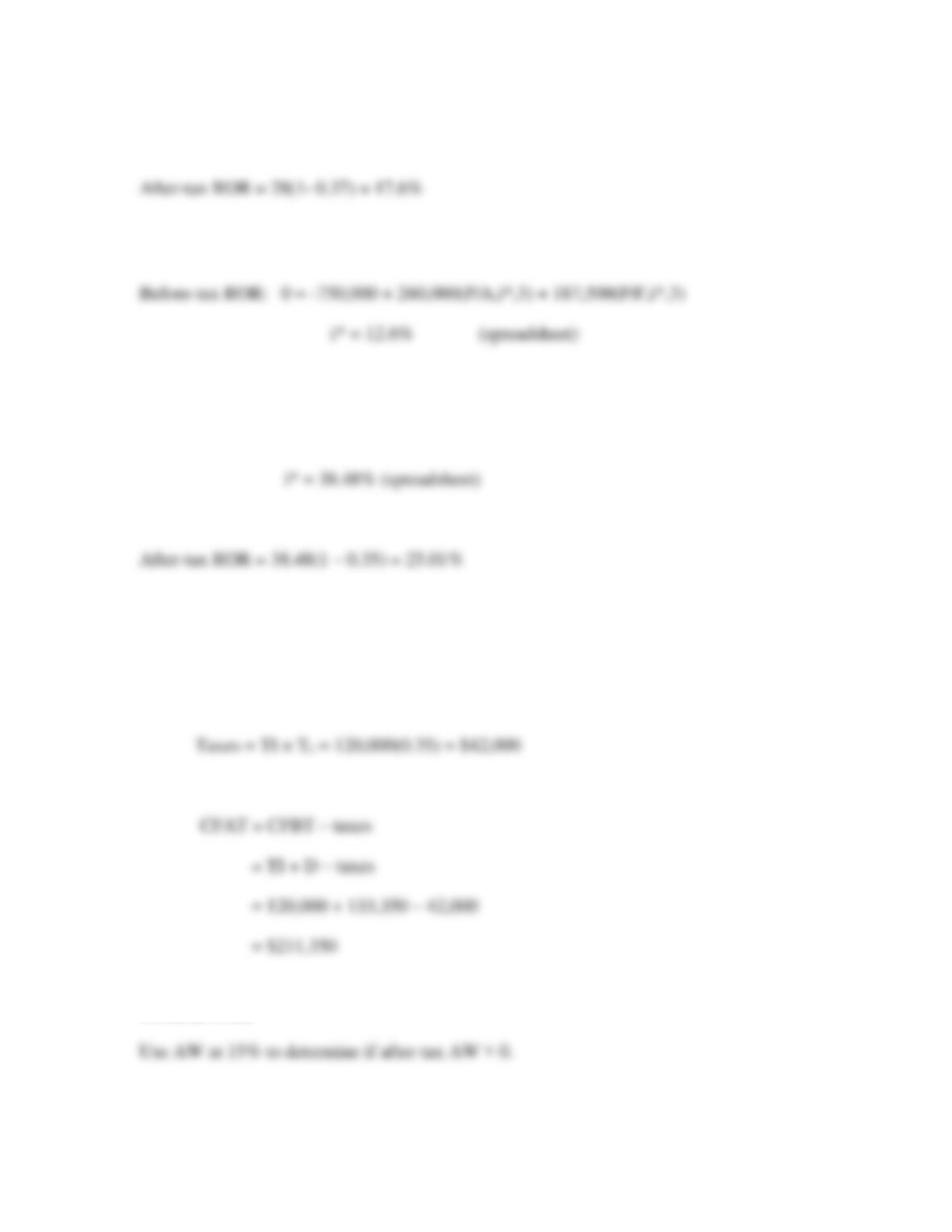
Estimate the approximate after-tax rate of return (ROR) for a project that has a before-
tax ROR of 28%. Assume the company has Te = 37% and it uses 5-year MACRS
depreciation for project assets.
Problem 13.9
Estimate the approximate before-tax rate of return (ROR) for a project that has a first
cost of $750,000 and a salvage value of 25% of the first cost after three years. The
project’s NOI is $260,000. Assume an effective tax rate of 37%.
Problem 13.10
Approximate the after-tax ROR on a project that had a first cost of $500,000, a salvage
value of 20% of the first cost after five years, and annual CFBT of $230,000. Assume the
company had a 35% effective tax rate.
Problem 13.11
Estimate the CFAT for a company that has taxable income of $120,000, depreciation of
$133,350, and an effective tax rate of 35%.
Problem 13.12
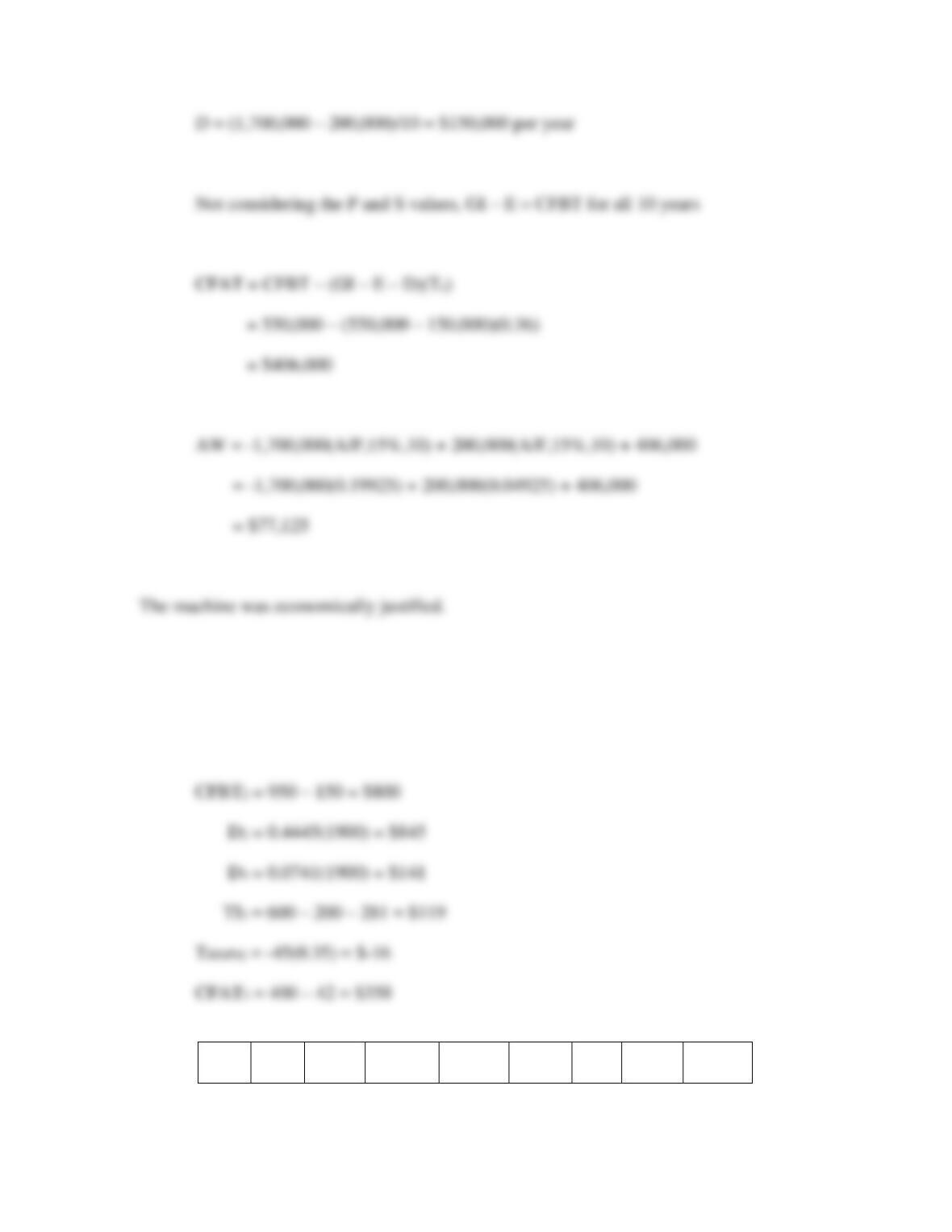
A dynamic measurement machine used by Renshaw Instruments had an annual cash flow
before taxes of $550,000 over its life of 10 years. Its first cost was $1.7 million, it was
straight-line depreciated with n = 10 years, and it was sold today for the estimated
salvage of $200,000. The company’s Te = 36% and after-tax MARR = 15%. Was the
purchase and use of the machine economically justified?
Problem 13.13
Fill in the missing values in the table below for the CFBT, D, TI, Taxes, and CFAT
columns. Depreciation amounts are based on 3-year MACRS depreciation and the
effective tax rate is 35%.

Year
GI, $
E, $
P and S, $
CFBT, $
D, $
TI, $
Taxes, $
CFAT, $
0
-1900
-1900
-1900
1
800
–100
0
700
633
67
23
677
2
950
–150
0
–45
816
3
600
–200
0
400
281
42
4
300
–250
700
750
–91
–32
782
Problem 13.14
Estimate the gross income for Bling Enterprises, which reports a CFAT of $2.5 million,
$900,000 in expenses, $900,000 in depreciation charges, and has an effective tax rate of
26.4%.
Problem 13.15
Your brother, who owns a chemical processing company, has complained about the
company’s high tax rate of 42% for federal and state taxes, comprised of a 34% federal
rate and a state 8% flat rate. Determine his company’s average federal income tax rate if
the annual gross income is $4,000,000, cash flow after taxes is $2,250,000, expenses are
$850,000, and depreciation is $650,000.
Problem 13.16
Advanced Anatomists, Inc., researchers in medical science, is contemplating a
commercial venture concentrating on proteins based on the new X-ray technology of
free-electron lasers. To recover the huge investment needed, an annual $2.5 million
CFAT is needed. A favored average federal tax rate of 20% is expected, however, state
taxing authorities will levy an 8% tax on TI. Over a 3-year period, the deductible
expenses and depreciation are estimated to total $1.3 million the first year, increasing by
$500,000 per year thereafter. Of this, 50% is expenses and 50% is depreciation. What is
the required gross income each year?
Problem 13.17
The information shown is for a marginally successful project. Use hand computations or
a spreadsheet as requested by the instructor to do the following:
(a) Determine the CFBT and CFAT series. The effective tax rate is 32%.
(b) Obtain before-tax and after-tax i* values to evaluate the effect of depreciation and
taxes. (Assume that tax savings are used to offset taxes in other parts of the
corporation.)
(c) Determine the project’s economic success if the after-tax MARR is 5%

Gross Operating First Cost
Year Income, $ Expenses, $ Depreciation, $ and Salvage, $
0 -130,000
1 60,000 -55,000 35,000
2 75,000 -50,000 35,000
3 90,000 -45,000 35,000
4 105,000 -40,000 35,000 10,000
.
Problem 13.18
Elias wants to perform an after-tax evaluation of equivalent methods to electrostatically
remove airborne particulate matter from clean rooms used to package liquid
pharmaceutical products. Using the information shown, MACRS depreciation with
n = 3 years, a 5-year study period, after-tax MARR = 7% per year, a Te of 34% and a
spreadsheet, he obtained the results AWA = $-2176 and AWB = $3545. Any tax effects
when the equipment is salvaged were neglected. Method B is the better method.
Use classical SL depreciation with n = 5 years to select the better method. Is the
decision different from that reached using MACRS?
Method A Method B
First cost, $ -100,000 -150,000
Salvage value, $ 10,000 20,000
Savings, $ per year 35,000 45,000
AOC, $ per year -15,000 -6,000
Expected life, years 5 5
Problem 13.19
An asset that had a first cost of $80,000 was depreciated according to the MACRS
method over a 5-year period. At the end of year 4, it was replaced with a more-advanced
system and sold for $15,000. Determine if depreciation recapture or a capital loss was
present and, if so, how much.
Problem 13.20
An automated assembly robot that cost $300,000 has a recovery period of five years with
an expected $50,000 salvage value. If the MACRS depreciation rates for years 1, 2, and
3 are 20.0%, 32.0%, and 19.2%, respectively, what is the depreciation recapture, capital
gain, or capital loss, provided the robot was sold after 3 years for $80,000?
Problem 13.21
A machine that had a first cost of $120,000 was depreciated by the MACRS method over
a 3-year period. The machine was sold for $60,000 at the end of year 2, because the
company decided to import the component made using the machine. If the company’s
gross income was $1.4 million with operating expenses of $500,000, what was the tax
liability in year 2 for an effective tax rate of 35%?
Problem 13.22
A manufacturing company is considering the purchase of one of two material handling
systems. The estimates are as follows:
System 1 — P = $370,000; S = $100,000; n = 3 years
System 2 — P = $490,000; S = $150,000; n = 3 years
The plant manager (who has a real desire to reduce corporate taxes) asked you to
determine which system offers the bigger tax advantage over a 3-year recovery period.
The company’s annual gross income is projected to be $5.8 million with operating
expenses of $1.6 million. Use a spreadsheet to determine the difference in taxes between
the two systems if Te = 38% and MACRS depreciation is applied.
Problem 13.23
Last month, a company specializing in wind power plant design and engineering made a
large capital investment of $400,000 in physical simulation equipment that will be used
for at least 5 years, then sold for approximately 25% of the first cost. By law, the assets
are MACRS depreciated using a 3-year recovery period. (a) Explain why there is a
predictable tax implication when the assets are sold. (b) By how much will the sale cause
TI and taxes to change in year 5?
Problem 13.24
Cheryl, a EE student who is working on a business minor, is studying depreciation and
finance in her engineering management course. The assignment is to demonstrate that
shorter recovery periods require the same total taxes, but they offer a time value of taxes
advantage for depreciable assets. Help her using asset estimates developed for a 6-year
study period: P = $65,000, S = $5000 whenever it is sold, GI = $32,000 per year,
AOC = $10,000 per year, SL depreciation, i = 12% per year, Te = 31%. The recovery
period is either 3 or 6 years.
Problem 13.25
A bioengineer is evaluating methods used to apply an adhesive to microporous paper tape
that is commonly used after surgery. The machinery costs $200,000, has no salvage
value, and the CFBT estimate is $75,000 per year for up to 10 years. The Te = 38% and
i = 8% per year. The two depreciation methods to consider are: MACRS with
n = 5 years and SL with n = 8 years (neglect the half-year convention effect). For a study
period of 8 years, (a) determine which depreciation method and recovery period offers
the better tax advantage, and (b) demonstrate that the same total taxes are paid for
MACRS and SL depreciation.

Problem 13.26
Thomas completed a study of a $1 million 3-year old DNA analysis and modeling
system that DynaScope Enterprises wants to keep for 1 more year or dispose of now. His
table (in $1000 units) details the analysis, including an anticipated $100,000 selling price
(SP) next year, SL depreciation, taxes at the all-inclusive rate of Te = 52%, and PW at
the after-tax MARR of 5% per year. Thomas recommends retention since PW > 0.
Critique the analysis to determine if he made the correct recommendation.
Year CFBT SP Depreciation TI Taxes CFAT
0 $-1000 $-1000
1 275 $250 $25 $13 262
2 275 250 25 13 262
3 275 250 25 13 262
4 275 $100 250 25 13 362
PW @ 5% $11.3
Problem 13.27
The defender in a multiple-effect solar still manufacturing plant has a market value of
$130,000 and expected annual operating costs of $70,000 with no salvage value after its
remaining life of three years. The depreciation charges for the next three years will be
$69,960, $49,960, and $35,720. Assume the company’s effective tax rate is 35% and its
after-tax MARR is 12%. A present worth equation for comparing the defender against a
challenger that also has a 3-year life is being developed. Determine the after-tax cash
flow for year 2 only used in the PW relation.
Problem 13.28
A 2-year old injection molding machine was expected to serve out its projected life of
5 years, but a challenger promises to be more efficient and have lower operating costs.
You have been asked to perform an AW evaluation to determine if it is economically
attractive to replace the defender now or keep it for 3 more years as originally planned.
The defender had a first cost of $300,000, but its market value now is only $100,000. It
has chargeable expenses of $120,000 per year and no expected salvage value. To simplify
calculations, assume that SL depreciation was charged at $60,000 per year, and that it
will continue at that rate for the next 3 years. The challenger will cost $420,000; have no
salvage value after its 3-year life; have chargeable expenses of $30,000 per year, and be
SL–depreciated at $140,000 per year (again, for simplicity). Assume the company’s
effective tax rate is 35% and its after-tax MARR is 15% per year. Since GI is not
estimated, all taxes are negative and considered “savings” to the alternative.

(a) Determine the CFAT in year 0 for the challenger and defender. (Hint: Check for DR,
CG and CL.)
(b) Determine the CFAT in years 1, 2 and 3 for the challenger and defender.
(c) Conduct the replacement study to determine if the defender should be kept for 3 more
years or replaced now.
Problem 13.29
Justyne needs assistance with the information shown. The defender can be replaced now
or kept for 4 more years. (Notes: All monetary values are in $1000 units. Assume that
either asset is salvaged in the future at its original salvage estimate. Since no revenues are
estimated, all taxes are negative and considered “savings” to the alternative. Neglect any
capital gains or losses.)
Defender Challenger
First cost, $ -45 -24
Estimated S at purchase, $ 5 0
Market value now, $ 35 —
AOC, $ per year -7 -8
Depreciation method SL MACRS
Recovery period, years 8 3
Useful life, years 8 5
Years owned 3 —
( a) Perform a PW-based replacement study using an after-tax MARR =12% per
Year and Te = 35%. Do this using hand calculations.
(b) Verify your results using a spreadsheet-based replacement study.
Problem 13.30
After 8 years of use, the heavy truck engine overhaul equipment at Pete’s Truck Repair
was evaluated for replacement. Pete’s accountant used an after-tax MARR of 8% per
year, Te = 30%, and a current market value of $25,000 to determine AWD = $2100. The
new equipment costs $75,000, uses SL depreciation over a 10-year recovery period, and
has a $15,000 salvage estimate. Estimated CFBT is $15,000 per year. Pete asked his
engineer son Ramon to determine if the new equipment should replace what is owned
currently. From the accountant, Ramon learned the current equipment cost $20,000 when
purchased and reached a zero book value several years ago. Help Ramon answer his
father’s question.
Problem 13.31
Nucor Corp manufactures generator coolers for nuclear and gas turbine power plants.
The company completed a plant expansion through financing that had a debt/equity mix
of 40-60. If $15 million came from mortgages and bond sales, what was the total amount
of the financing?
Problem 13.32
Nano-Technologies bought out RT-Micro using financing as follows: $16 million from
mortgages, $4 million from retained earnings, $12 million from cash on hand, and
$30 million from bonds. Determine the debt-to-equity mix.
Problem 13.33
Master Bond Inc. makes a no-mix single component adhesive that cures at temperatures
between 250 and 300 0F and meets the low-outgassing requirements specified by NASA.
Determine the weighted average cost of capital for financing and interest rates as
follows: $4 million in stock sales at 12%, $6 million in bonds at 8%, and $5 million in
retained earnings at 6% per year.
Problem 13.34
Alpha Engineering invested $30 million in a project that has a D-E mix of 65-35.
Determine the return on the company’s equity, if the net income is $4 million from
revenue of $6 million.
Problem 13.35
Two public corporations, First Engineering and Midwest Development, each show
capitalization of $175 million in their annual reports. The balance sheet for First indicates
total debt of $87 million, and that of Midwest indicates net worth of $62 million.
Determine the D-E mix for each company.
Problem 13.36
Oriental Motor reported a WACC of 10.4% in its recent report to stockholders. Their
common stock has averaged a total return of 8% per year over the last three years. If
projects within the corporation are 70% funded by its own capital, estimate the
company’s cost of debt capital.
Problem 13.37
Fruit Transgenics Engineering is contemplating the purchase of its rival. One of FTE’s
genetics engineers is interested in the financing strategy of the buyout. He learned of two
plans. Plan A requires 50% equity funds from FTE retained earnings that currently earn
9% per year, with the balance borrowed externally at 6%, based on the company’s
excellent stock rating. Plan B requires only 20% equity funds with the balance borrowed
at a higher rate of 8% per year. (a) Which plan has the lower average cost of capital?
(b) If the current corporate WACC of 8.2% will not be exceeded, what is the maximum

cost of debt capital allowed for each plan? Are these rates higher or lower than the
current estimates?
Problem 13.38
Deavyanne Johnston, the engineering manager at TZO Chemicals, wants to complete an
alternative evaluation study. She asked the finance manager for the corporate MARR.
The finance manager gave her some data on the project and stated that all projects must
clear their average (pooled) cost by at least 4%.
Funds Source Amount, $ Cost, %
Retained earnings 4 million 7.4
Stock sales 6 million 4.8
Long-term loans 5 million 9.8
Budgeted funds for project 15 million
(a) Use the data to determine the minimum MARR.
(b) The study is after-taxes and part (a) provided the before-tax MARR. Determine the
correct MARR to use if Te was 32% last year and the finance manager meant that the 4%
above the cost is for after-tax evaluations.
Problem 13.39
Dougherty Construction has worked on several international housing projects during the
last year. The D-E mixes and rates are shown. Plot the WACC curve and identify the D-E
mix that had the lowest WACC.
Debt Equity____
Project Percent Rate Percent Rate
203 100 10.9 0 0
206 50 7.0 50 8.5
306 65 11.6 35 7.5
367 25 8.2 75 6.0
456 0 0 100 8.9
913 10 5.5 90 7.2
914 75 11.4 25 8.4
987 80 10.5 20 8.1
Problem 13.40
Bow Chemical will invest $14 million this year to upgrade its ethylene glycol processes.
This chemical is used to produce polyester resins to manufacture products varying from
construction materials to aircraft, and from luggage to home appliances. Equity capital

costs 14.5% per year and will supply 65% of the capital funds. Debt capital costs 10% per
year before taxes. The effective tax rate is 36%.
(a) Determine the amount of annual revenue after taxes that is consumed in covering the
interest on the project’s initial cost.
(b) If the corporation does not want to use 65% of its own funds, the financing plan may
include 75% debt capital. Determine the amount of annual revenue needed to cover the
interest with this plan, and explain the effect it may have on the corporation’s ability to
borrow in the future.
Problem 13.41
While an engineering manager may prefer to use CFAT estimates to evaluate the AW of
a project, a financial manager may select AW of EVA estimates. Why are these
preferences predictable?
Problem 13.42
An asset with a first cost of $300,000 is depreciated by the MACRS method using a
5-year recovery period. Determine the monetary value added to the corporation by the
asset in year two of its service, if the net operating profit after taxes is $70,000 and the
company uses an after-tax interest rate of 15%. The MACRS depreciation rates for years
1 and 2 are 20% and 32%, respectively.
Problem 13.43
In conducting an EVA analysis for year two for a newly-introduced product line,
Bethune, Inc., which manufactures pre-assembled blower packages and other water
treatment components, determined the EVA to be $28,000. Bethune’s CEO knew that the
gross income was $700,000, but he asked you to find out how much expense was
associated with the new product line for year 2. The company uses an after-tax interest
rate of 14% and a Te of 35%. The initial investment capital required for the new product
was $550,000 and all equipment is 3-year MACRS depreciated.
Problem 13.44
Triple Play Innovators Corporation (TPIC) plans to offer IPTV (Internet Protocol TV)
service to North American customers starting soon. Perform an AW analysis of the EVA
series for the two alternative suppliers that bid for hardware and software contracts. Let
Te = 30% and after-tax MARR = 8%; use SL depreciation (for simplicity) and a study
period of 8 years. Use a spreadsheet, unless requested to perform hand calculations.
Bidder’s country United States Malaysia___
First cost, $ 4.2 million 3.6 million
Recovery period, years 8 5
Salvage value, $ 0 0
NOI, $ per year 1,500,000 in year 1; increasing
by 300,000 per year up to 8 years
Problem 13.45
If the after-tax rate of return for a cash flow series is 13.3% and the corporate effective
tax rate is 39%, the approximated before-tax rate of return is closest to:
a. 6.8%
b. 15.4%
c. 18.4%
d. 21.8%
Problem 13.46
For a state tax rate of 8% and a federal tax rate of 34%, the effective tax rate is closest to:
a. 41.7%
b. 39.3%
c. 36.4%
d. 31.8%
Problem 13.47
If all values carry a + sign, cash flow before taxes is represented by the following
equation:
a. gross income – expenses – depreciation – initial investment + salvage value
b. gross income – expenses – depreciation + salvage value
c. gross income – expenses – initial investment + salvage value
d. gross income – expenses + initial investment + salvage value
Problem 13.48
Depreciation recapture occurs when a depreciable asset is sold for:
a. more that the current book value.
b. more that the current market value.
c. more that the estimated salvage value.
d. more than the first cost.
Problem 13.49
A capital gain is calculated as:
a. book value – selling price
b. book value – first cost
c. market value – selling price
d. selling price – first cost
Problem 13.50
A small manufacturing company with a gross income of $360,000 has the following
expenses: M&O $76,000, insurance $7000, labor $110,000, utilities $29,000. If debt
service is $37,000 and taxes are $9000, the net operating income is closest to:
a. $92,000
b. $101,000
c. $138,000
d. $174,000
Problem 13.51

An after-market auto parts company just received $16,000 for a robot that has
been depreciated to zero. If the company’s effective tax rate is 36%, the sale will:
(a) increase the company’s taxes by $16,000
(b) increase the company’s taxes by $5760
(c) reduce the company’s taxes by $16,000
(d) reduce the company’s taxes by $5760
Problem 13.52
The after-tax analysis for a $60,000 investment with associated gross income minus
expenses (GI – E) is shown below for only the first 2 years. If the effective tax rate is
40%, the values for depreciation (D), taxable income (TI), and taxes for year 1 are closest
to:
a. D = $ 5,000; TI = $25,000; Taxes = $10,000
b. D = $30,000; TI = $30,000; Taxes = $4000
c. D = $20,000; TI = $50,000; Taxes = $20,000
d. D = $20,000; TI = $10,000; Taxes = $4000
Year Investment GI – E D TI Taxes CFAT_
0 $-60,000 $-60,000
1 $30,000 26,000
2 35,000 $15,000 $6000 29,000
Problem 13.53
Huntsman Corp completed a plant expansion using financing as follows: $9 million from
mortgages, $3 million from retained earnings, and $4 million from cash on hand, The
debt-to-equity mix was closest to:
a. 56-44
b. 75-25
c. 44-56
d. 25-75
Problem 13.54
A contractor with an effective tax rate of 35% has the following for a tax year:
gross income of $155,000, other income of $4000, expenses of $45,000, and other
deductions and exemptions of $12,000. The income tax due is closest to:
a. $35,700
b. $42,700
c. $51,750
d. $55,750
Problem 13.55
An asset purchased for $100,000 with S = $20,000 after 5 years was depreciated using
the 5-year MACRS rates. Expenses average $18,000 per year and the effective tax rate is
30%. The asset is actually sold after 5 years of service for $22,000. MACRS rates in
years 5 and 6 are 11.52% and 5.76%, respectively. The after-tax cash flow from the sale
is closest to:
a. $27,760
b. $17,130
c. $26,870
d. $20,585
Problem 13.56
The Wilkins Company has maintained a 50-50 D-E mix for capital investments. Equity
capital costs 11%; however, debt capital that historically costs 9% has now increased by
20%. If Wilkins does not want to exceed its past weighted average cost of capital
(WACC) and it is forced to go to a D-E mix of 75-25, the maximum cost of equity capital
that Wilkins can accept is closest to:
a. 9.8%
b. 10.9%
c. 7.6%
d. 9.2%
Problem 13.57
Net operating income (NOI) is defined as the difference between gross income and
operating expenses. Of other ways to express the meaning of NOI, correct one(s) are:
1 — corporate earnings before interest and taxes
2 – same as net cash flow (NCF = cash inflow – cash outflow)
3 – Net operating profit after taxes (NOPAT)
a. 1
b. 2
c. 3
d. 1 and 2
Solution 13.1
Solution 13.2
TI is in the range of $100,000 to $335,000
Solution 13.3
Interest and taxes are not included in NOI.
Solution 13.4
Solution 13.5
Solution 13.6
Solution 13.7
(a) TI = 320,000 – 149,000 – 95,000 = $76,000
Solution 13.8
Solution 13.9
Solution 13.10
Before-tax ROR: 0 = -500,000 + 230,000(P/A,i*,5) + 100,000(P/F,i*,5)
Solution 13.11
Use the following relations: TI = GI – E – D and CFBT = GI – E = TI + D
Solution 13.12
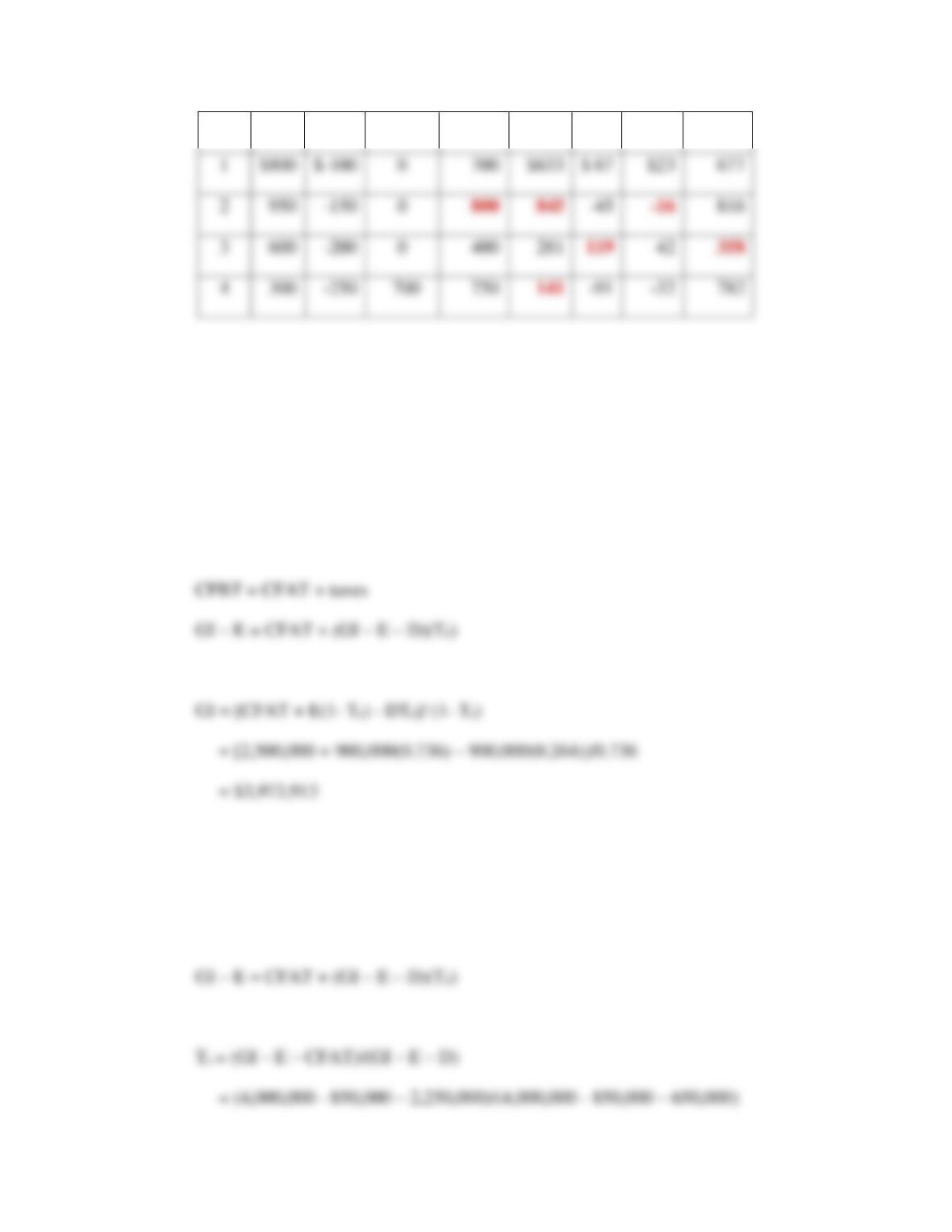
Solution 13.13
Missing values are shown in bold red.
Year
GI
E
P and S
CFBT
D
TI
Taxes
CFAT
Solution 13.14
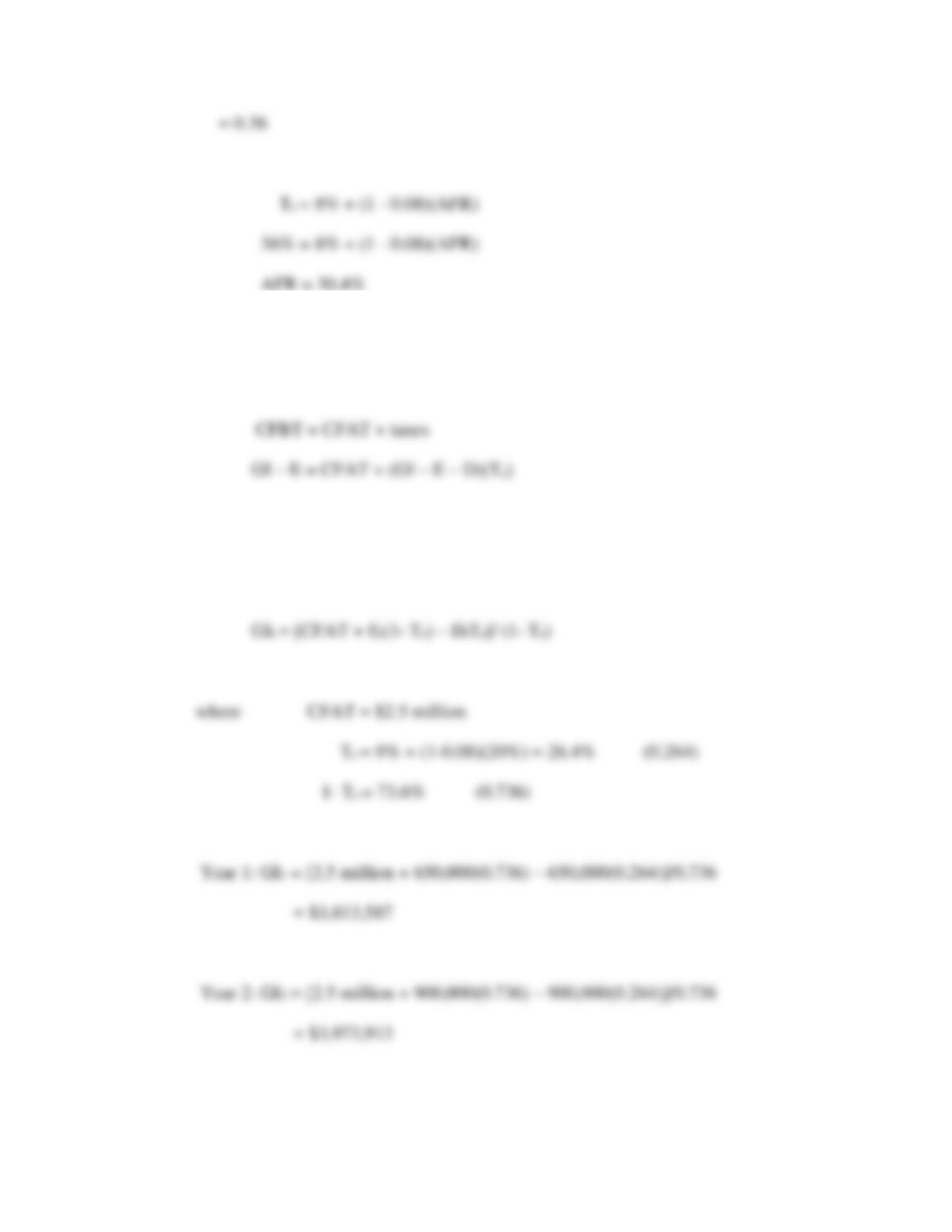
Solve relations for GI.
Solution 13.15
Solve for Te and then the average federal rate (AFR)
0
$-1900
$-1900
$-1900
1
$800
$-100
700
$633
$ 67
3
600
-200
400
281
4
300
-250
700
750
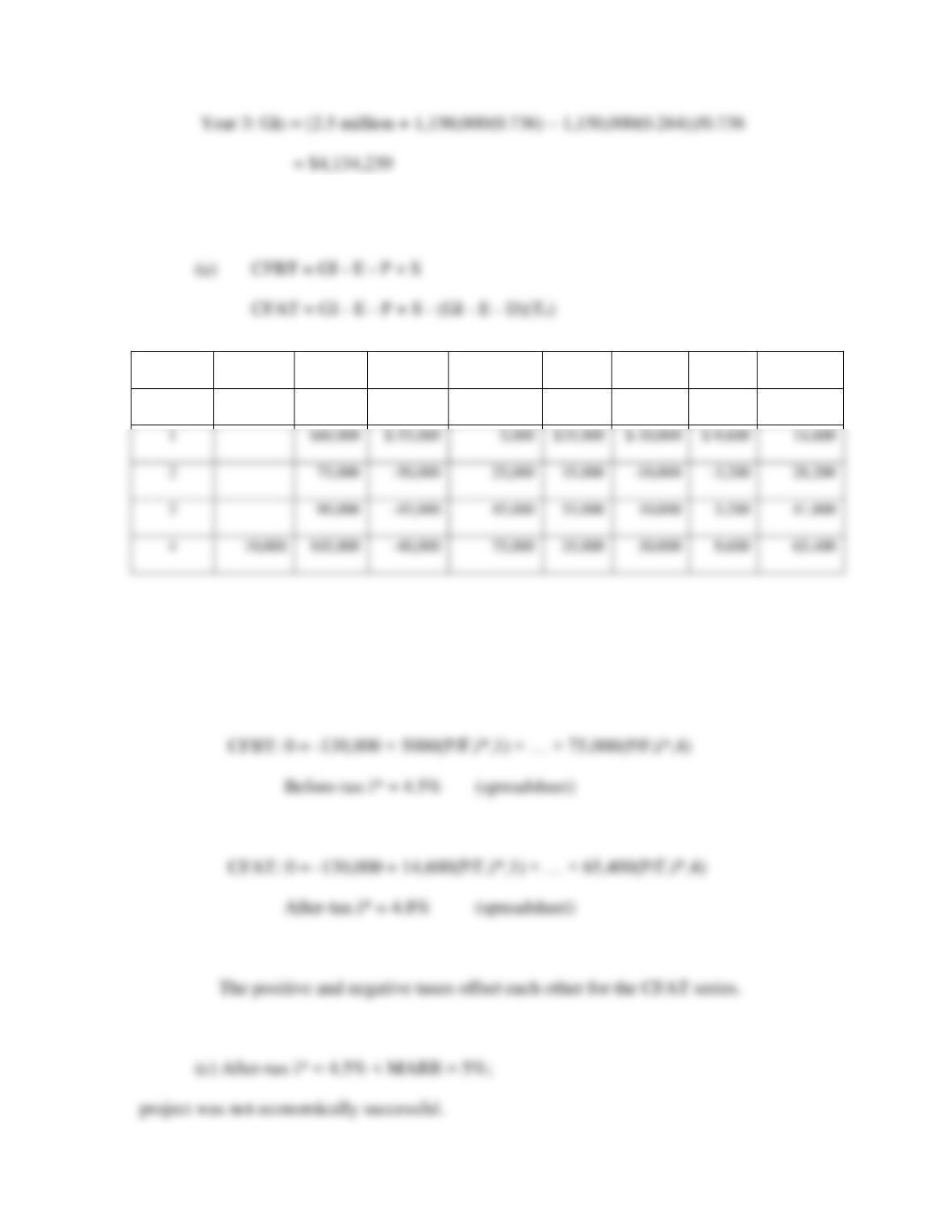
Solution 13.16
GI can be determined from the data provided.
Solve for GI to obtain a general relation for each year t.
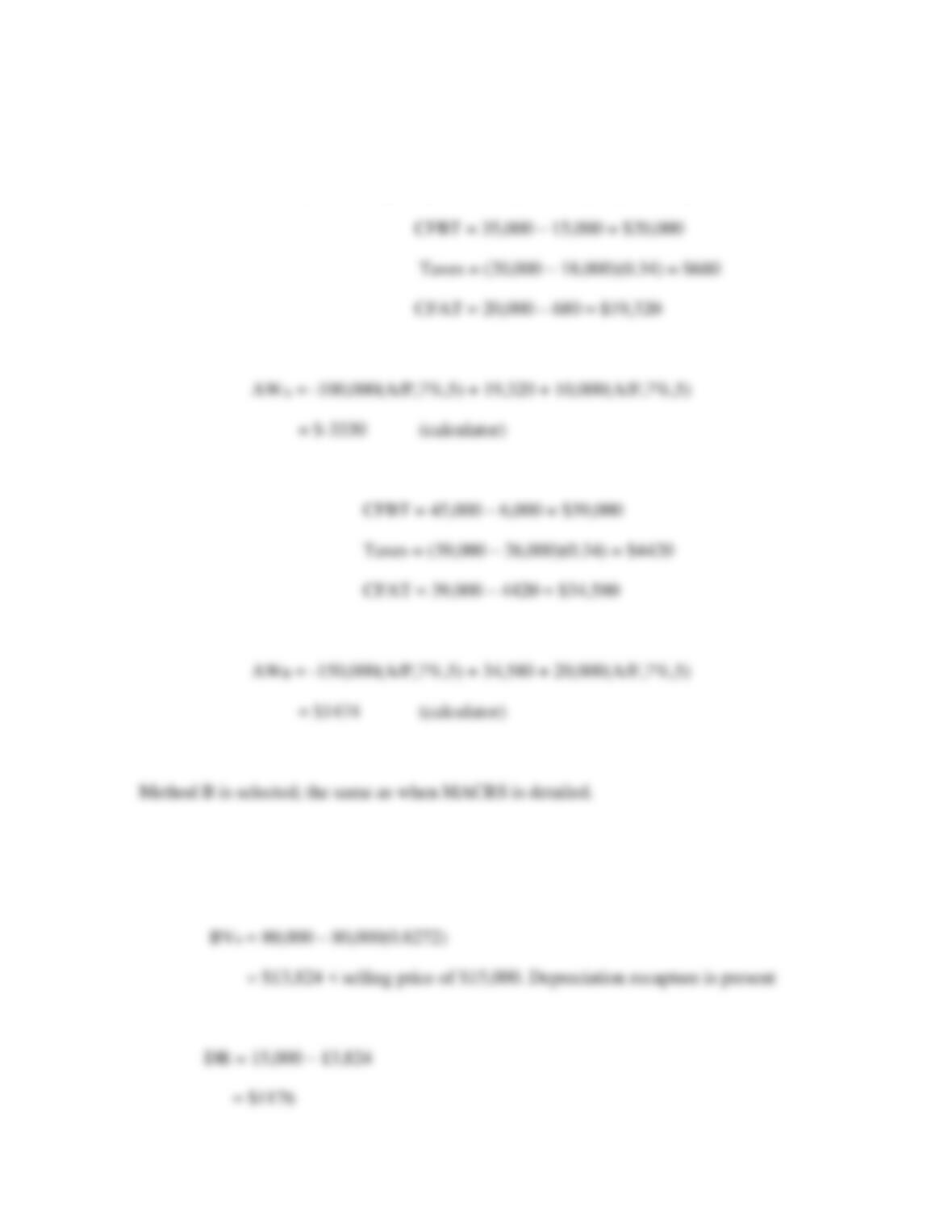
Solution 13.17
(b) Find i* for the PW = 0 relations for CFBT and CFAT series.
Year
P and S
GI
E
CFBT
D
TI
Taxes
CFAT
0
$-130,000
$-130,000
$-130,000
1
$60,000
$-55,000
2
75,000
3
90,000
4
10,000
105,000
Solution 13.18
Method A: Years 1-5, Depreciation = (100,000 – 10,000)/5 = $18,000
Method B: Years 1-5, Depreciation = (150,000 – 20,000)/5 = $26,000
Solution 13.19
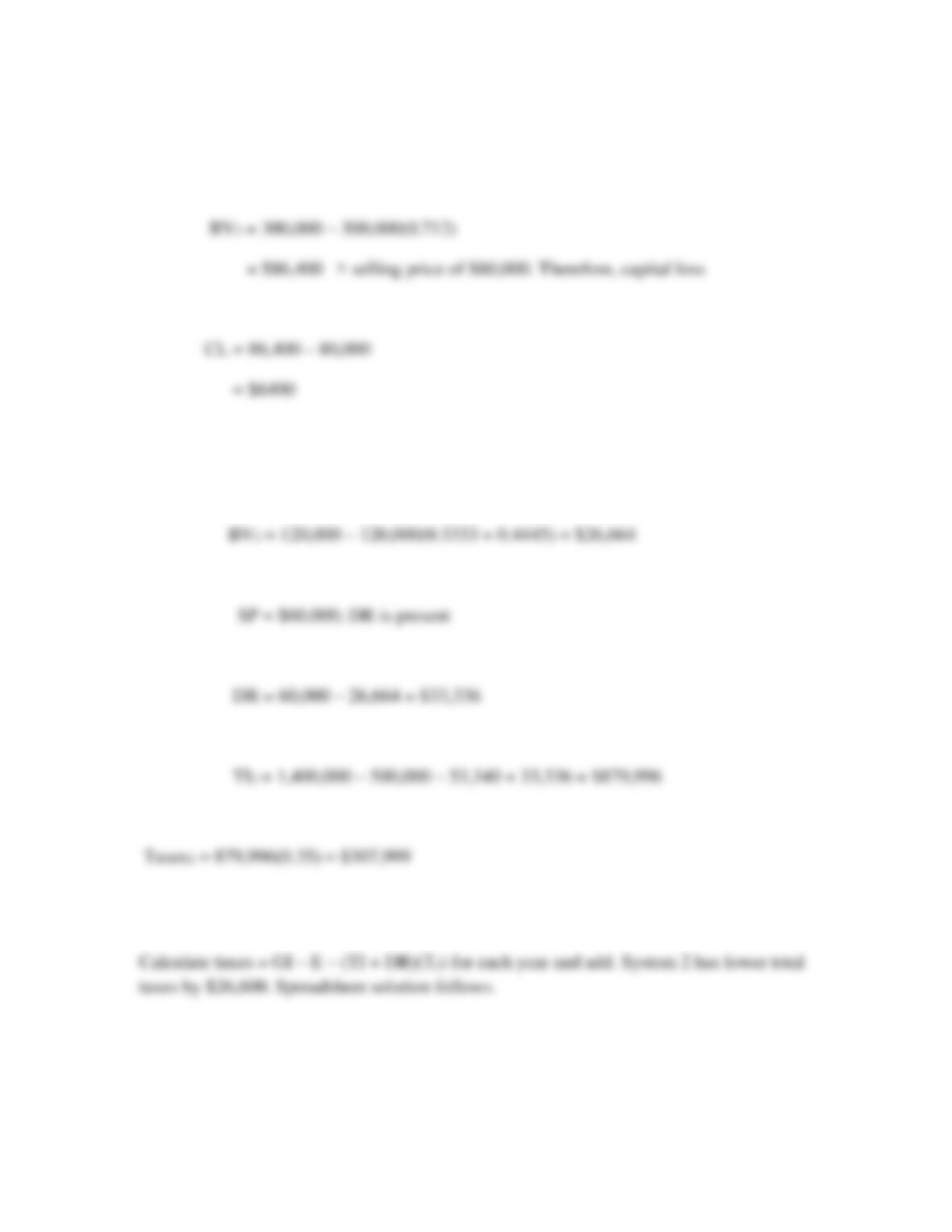
Total depreciation was 20% + 32% + 19.2% + 11.52% = 82.72%
Solution 13.20
Total depreciation was 20% + 32% + 19.2% = 71.2%
Solution 13.21
Solution 13.22
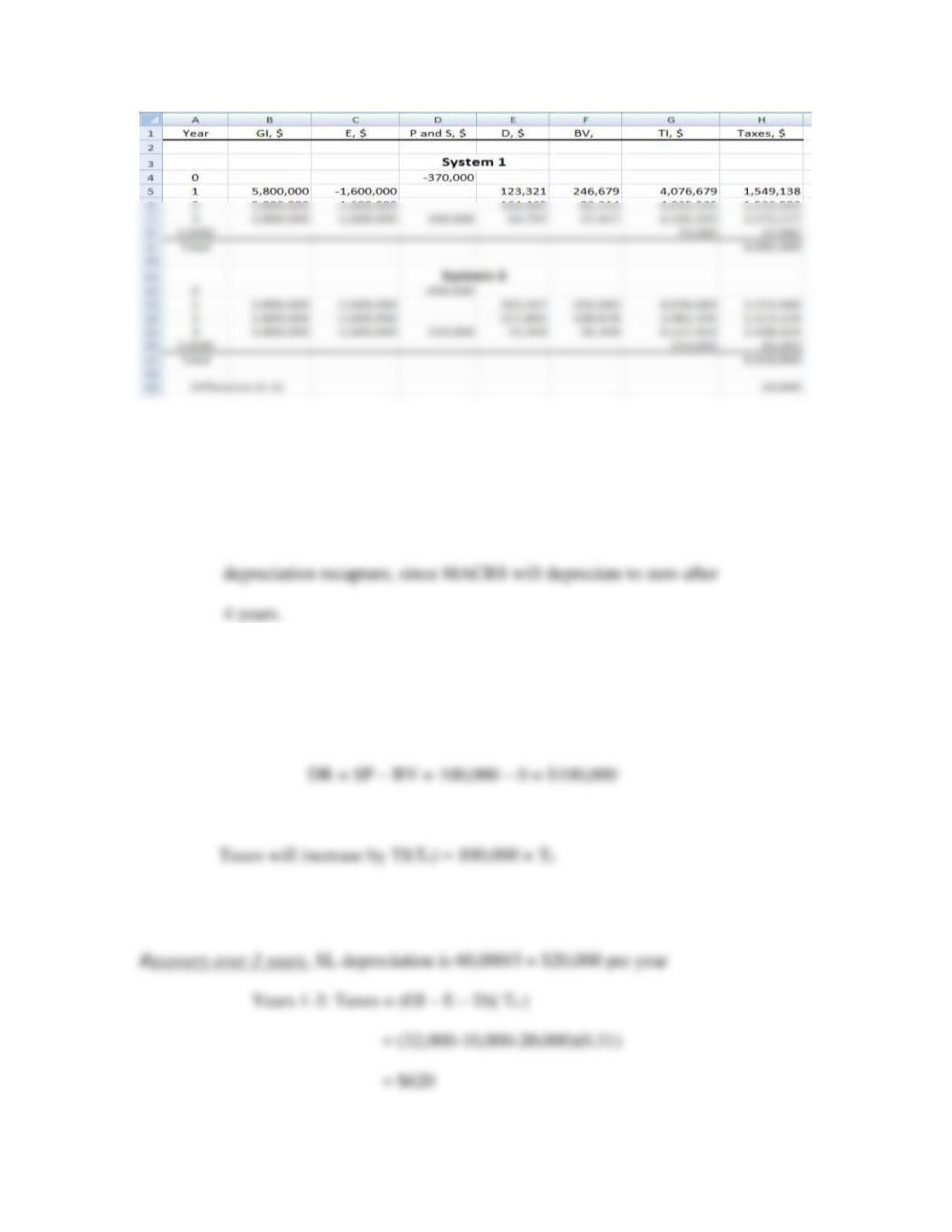
Solution 13.23
(a) When the asset is salvaged for $100,000 after 5 years, there will be
(b) TI will increase by the DR amount
Solution 13.24
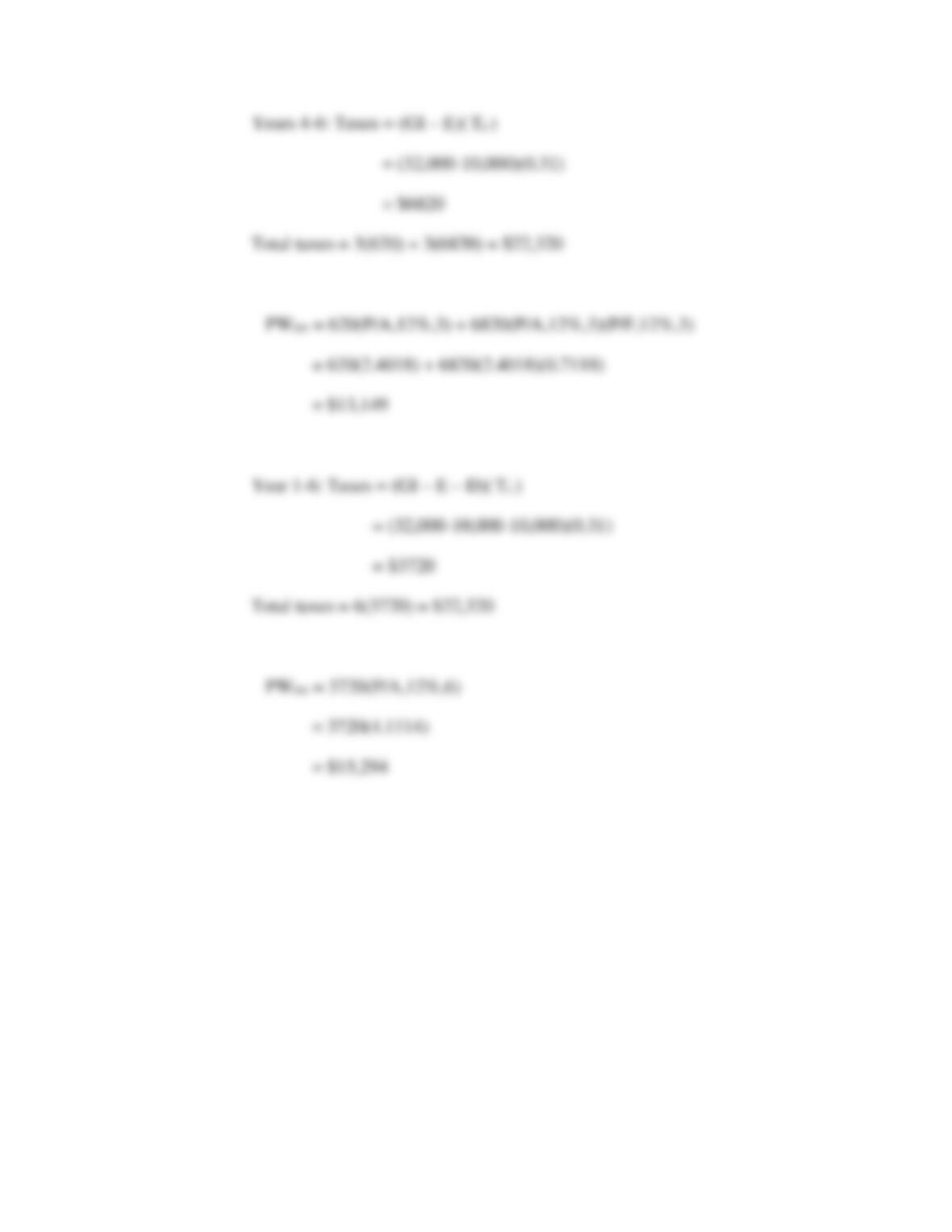
Recovery over 6 years. SL depreciation is 60,000/6 = $10,000 per year
Recovery in 3 years has a lower PWtax value; total taxes are the same for both.
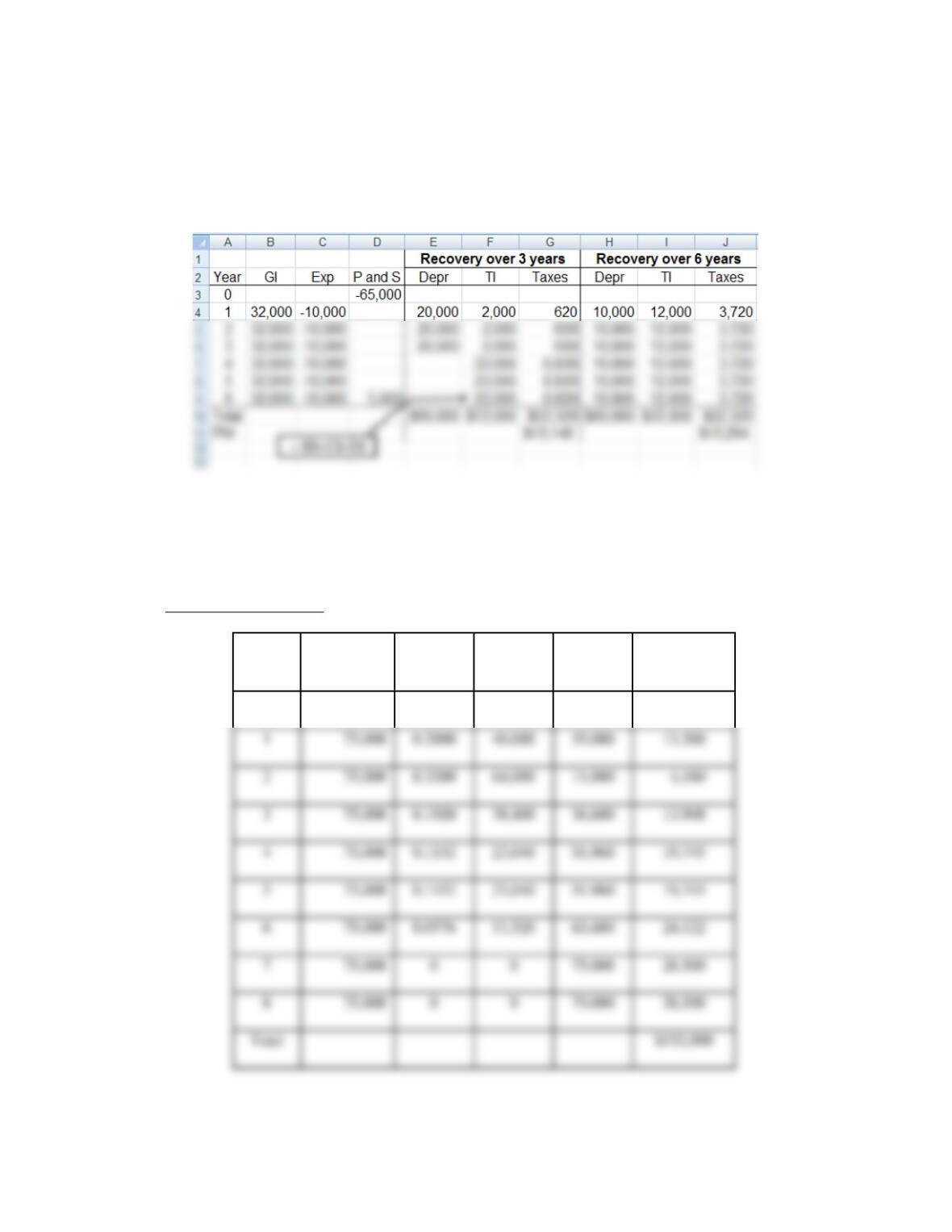
Solution 13.24 continued
Spreadsheet solution follows.
Solution 13.25
(a) MACRS depreciation
Year
P and
CFBT, $
Rate
D, $
TI, $
Taxes, $
0
-200,000
1
13,300
2
3
13,908
4
19,745
5
19,745
6
24,122
7
28,500
8
28,500
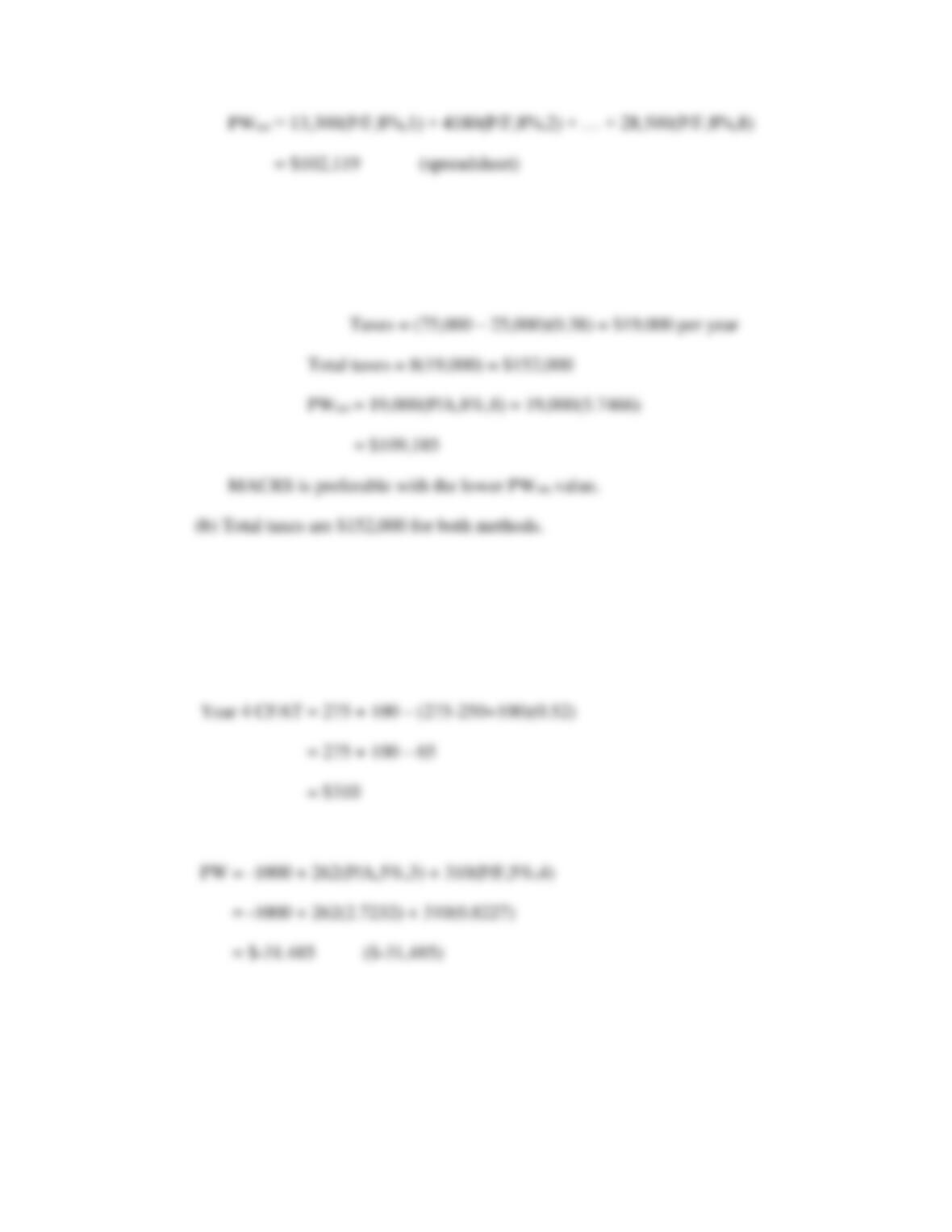
Straight line depreciation D = 200,000/8 = $25,000 per year
Solution 13.26
Thomas omitted the $100,000 depreciation recapture in year 4. If included, in $1000
units, the CFAT is
Economically, Thomas made a wrong recommendation, since PW < 0 at 5% per year.
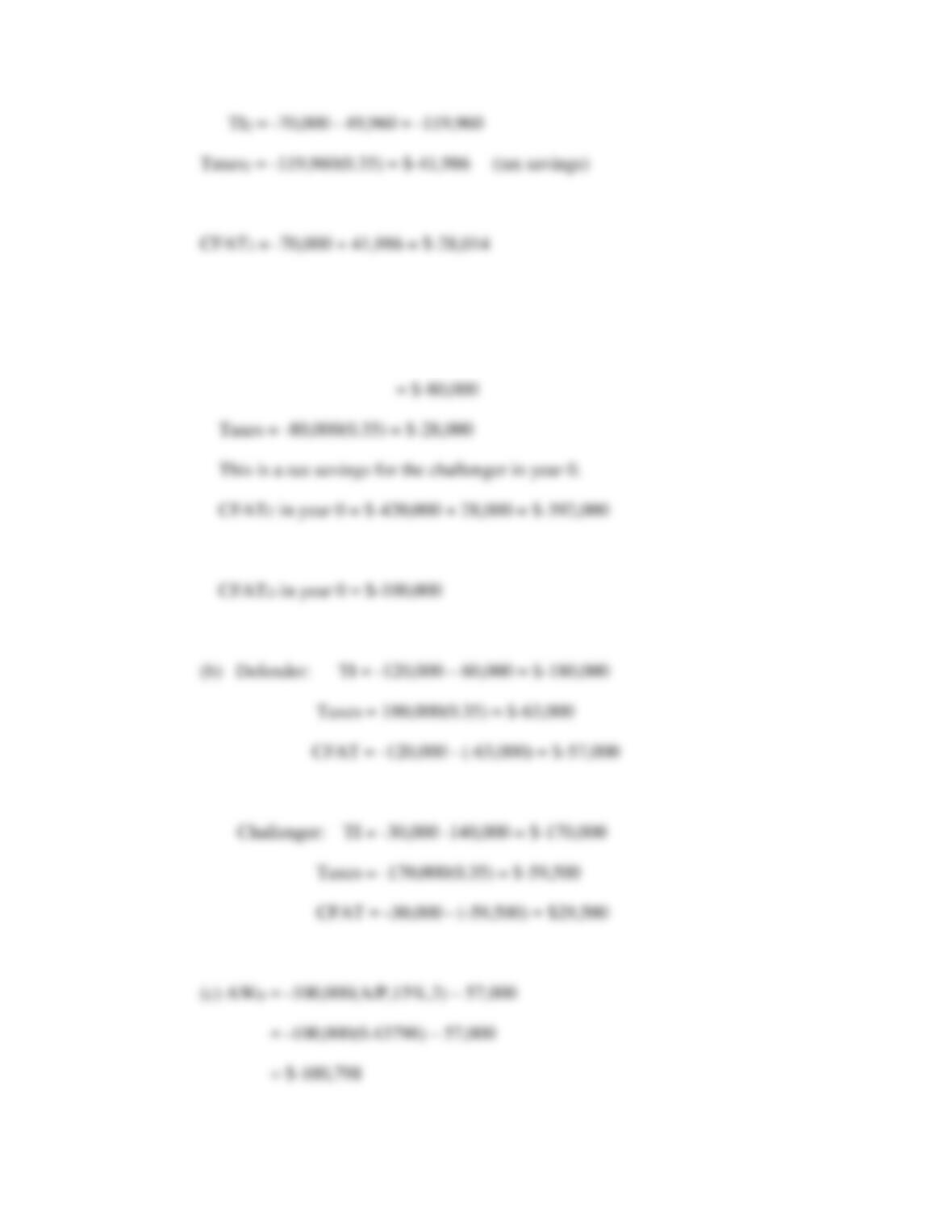
Solution 13.27
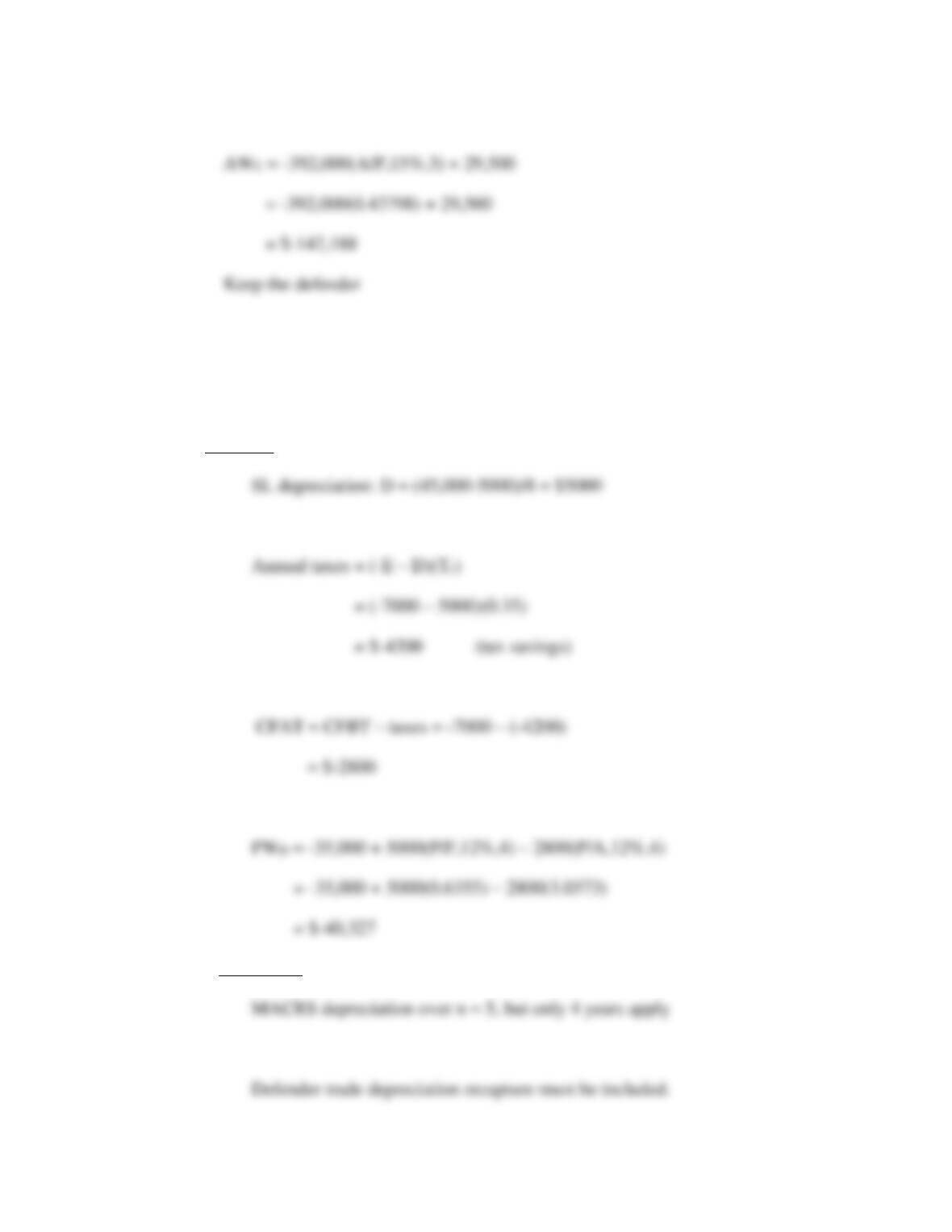
Solution 13.28
(a) Defender: Capital loss = BV – Sales price = [300,000 – 2(60,000)] – 100,000
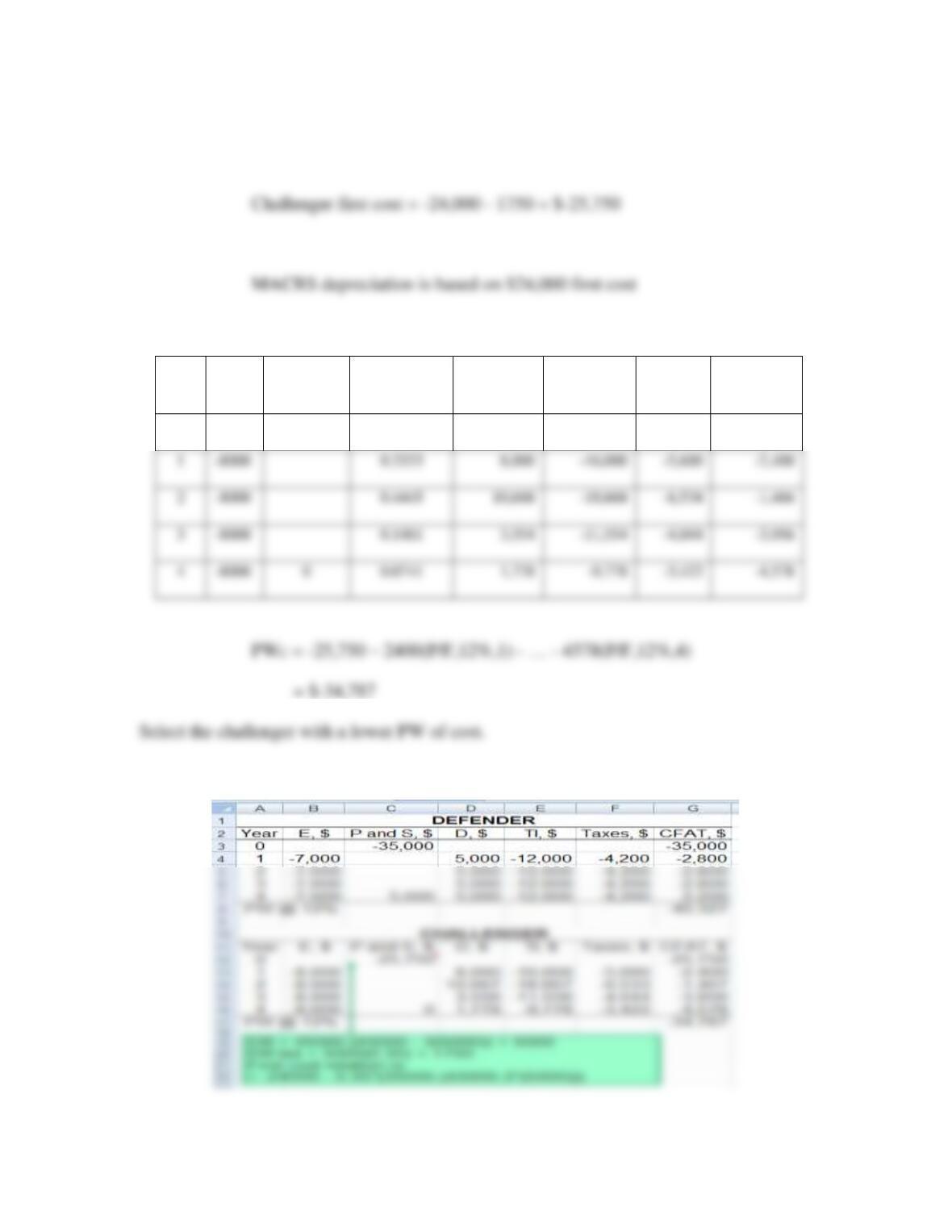
Solution 13.29
(a) Find after-tax PW of costs over 4-year time frame. DR is involved on the
defender trade.
Defender
Challenger

1
-8000
3
-8000
4
-8000
Solution 13.29 continued
(b) Spreadsheet solution follows. Hand solution is verified.
Year
E, $
P and S, $
MACRS
Rate
D, $
TI, $
Taxes, $
CFAT, $
0
-25,750
-25,750
Solution 13.30
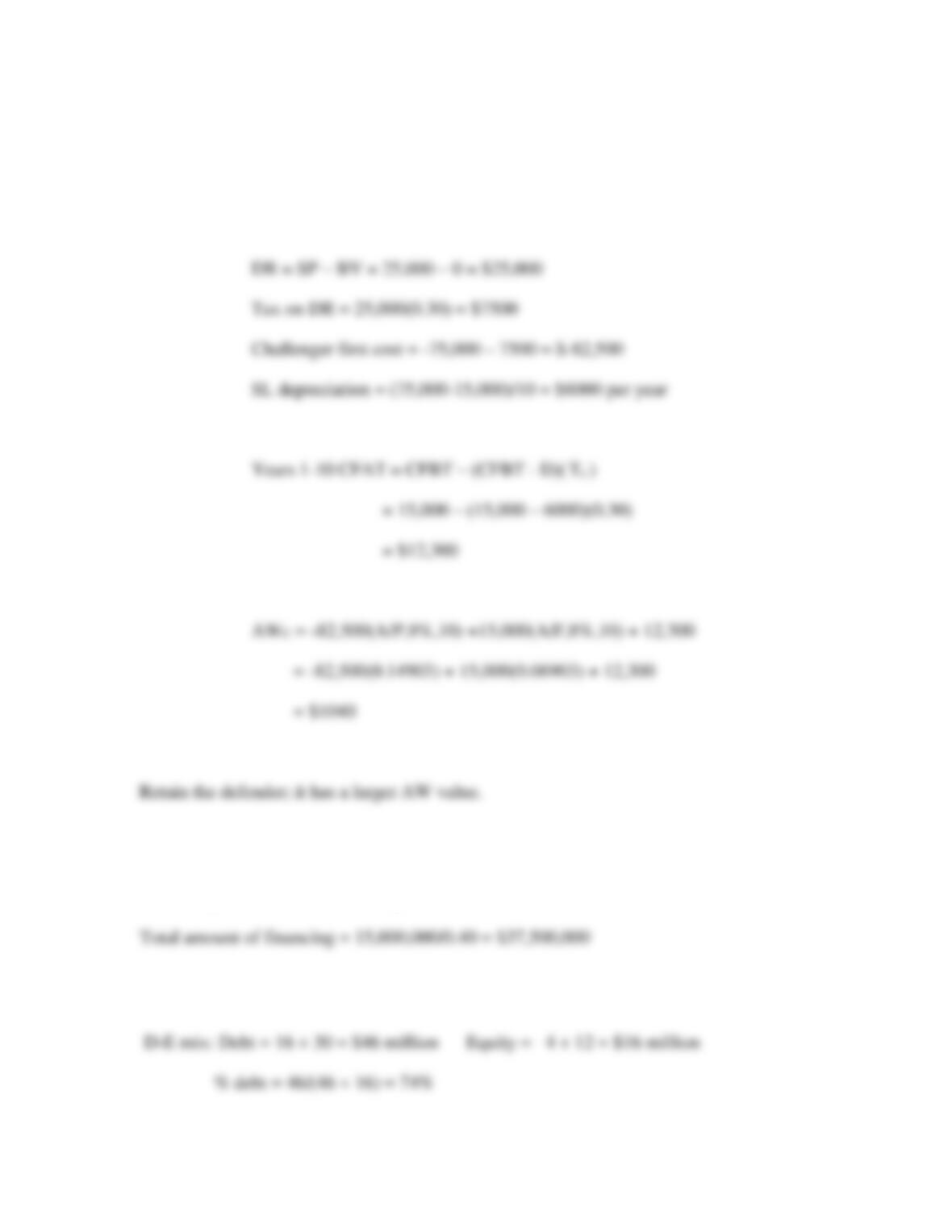
Determine AWC and compare it with AWD = $2100. Defender has DR on trade since
BV = 0 now.
Solution 13.31
The debt portion of $15 million represents 40% of the total.
Solution 13.32
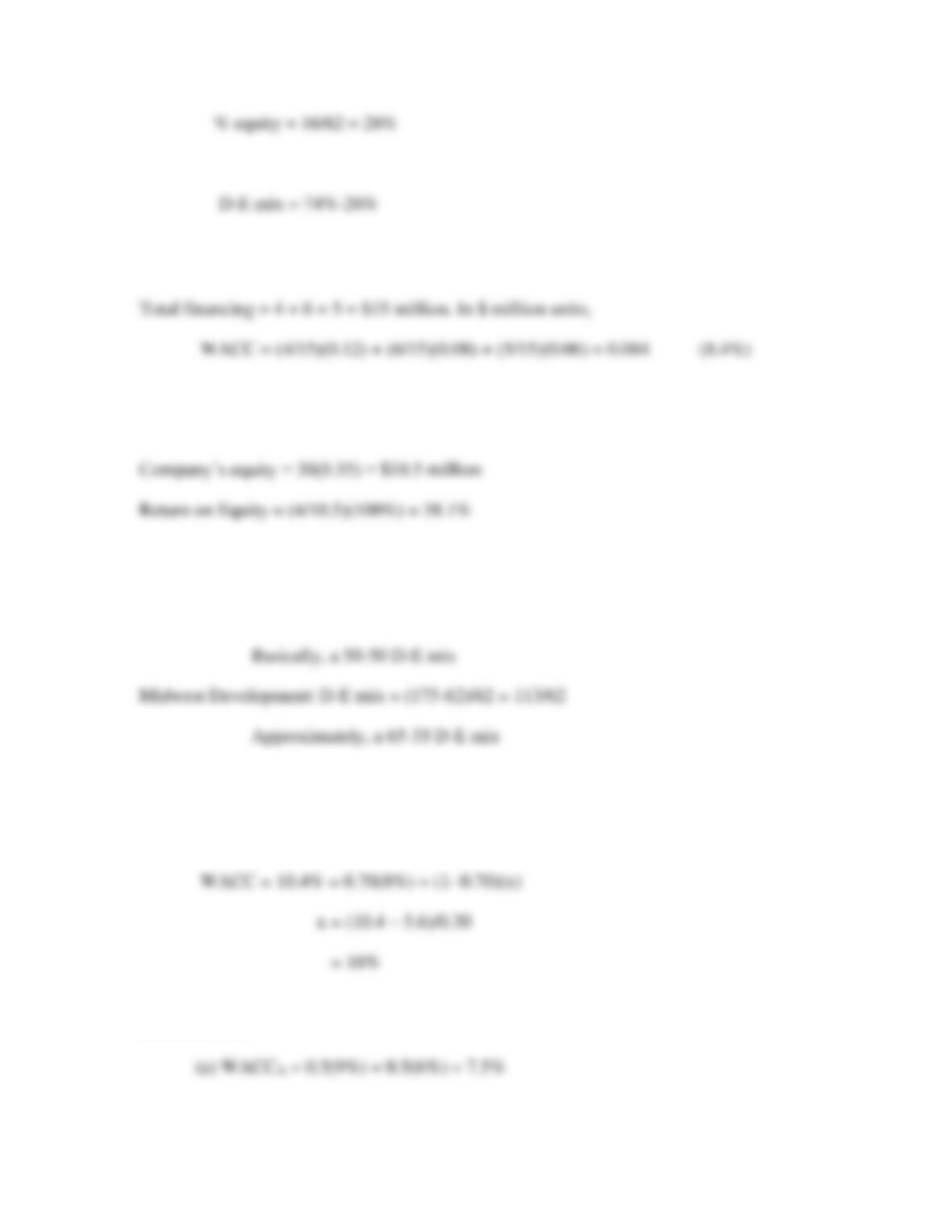
Solution 13.33
Solution 13.34
Solution 13.35
First Engineering: D-E mix = 87/(175-87) = 87/88
Solution 13.36
Solve for the cost of debt capital, x
Solution 13.37
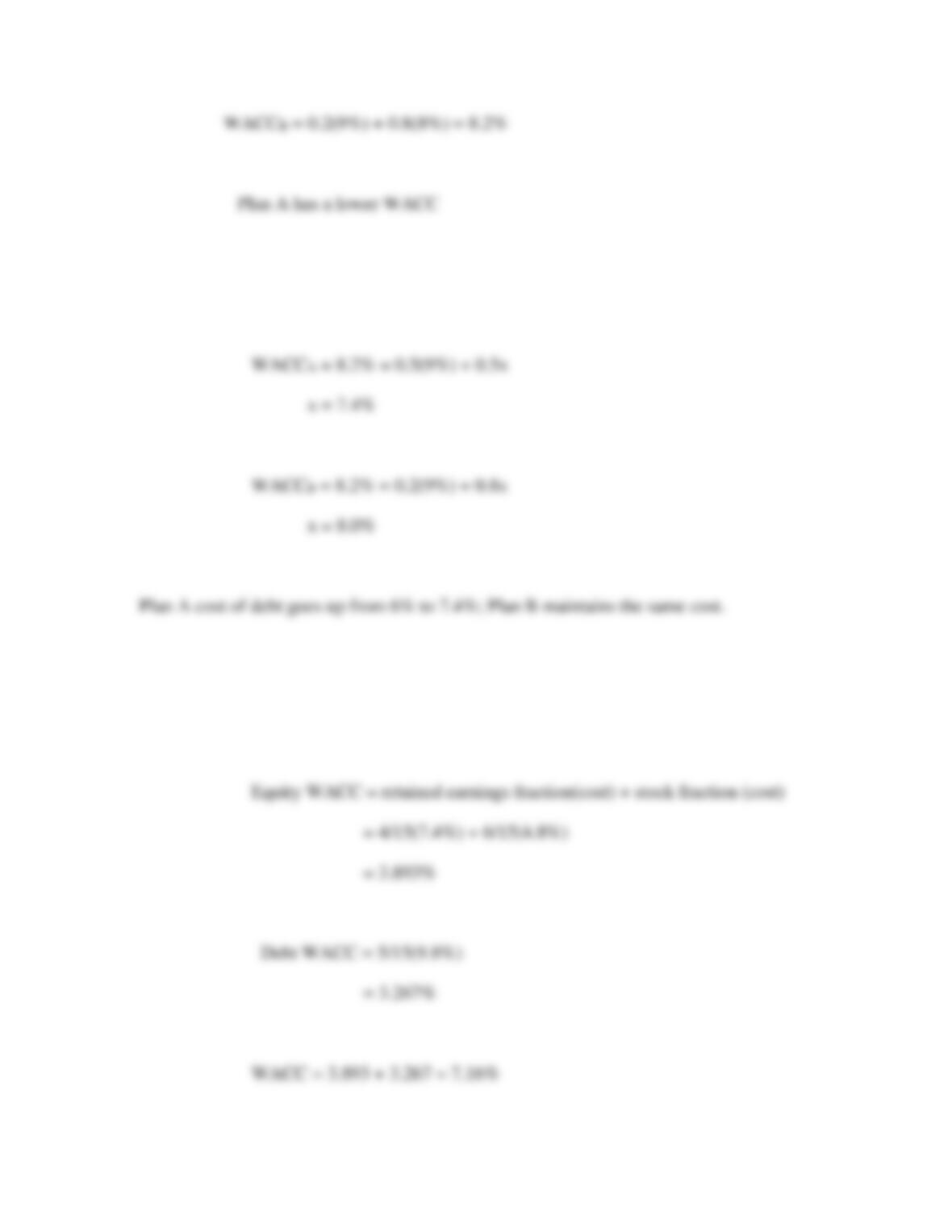
(b) Let x = cost of debt capital
Solution 13.38
(a) MARR = WACC + 4%. Total equity and debt fund is $15 million.
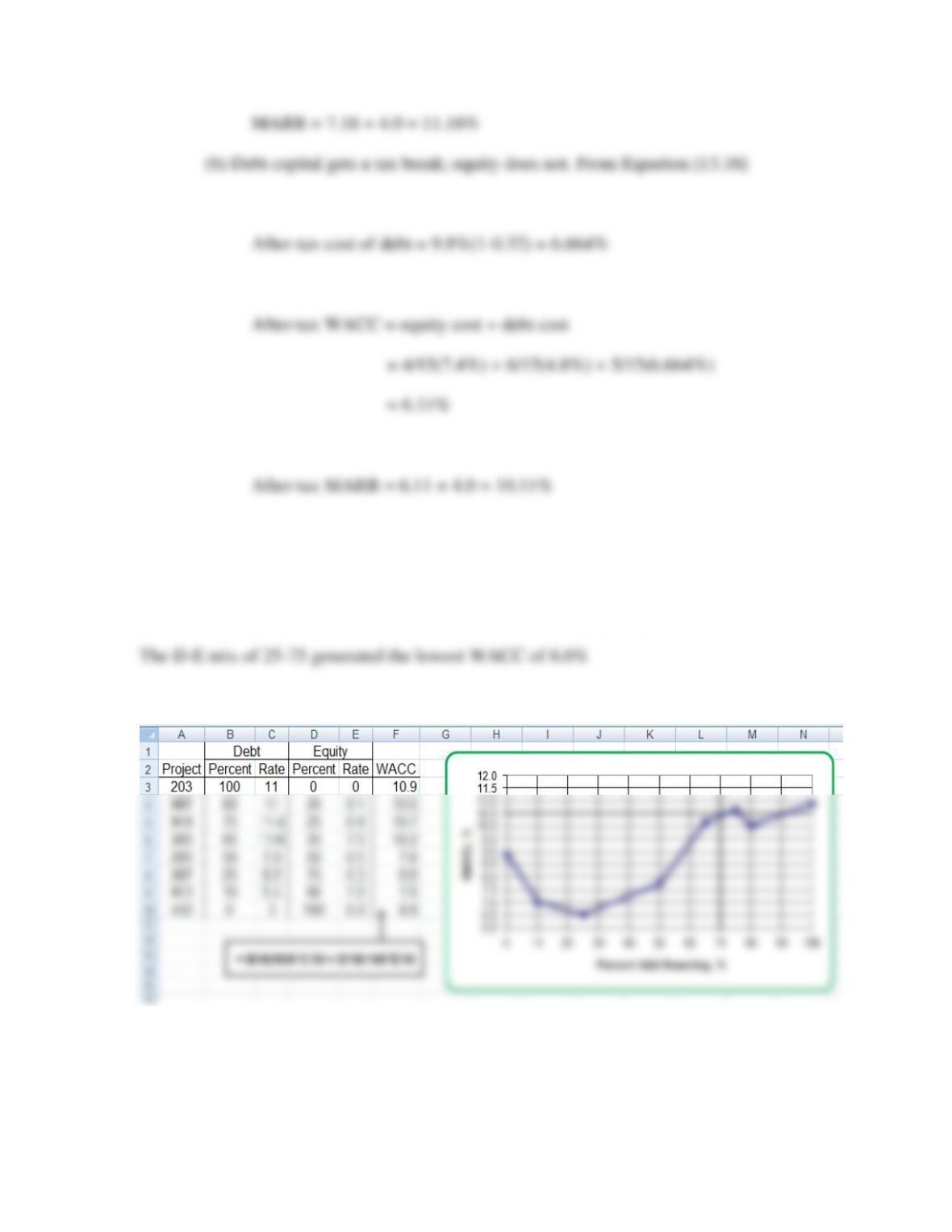
Solution 13.39
Calculate WACC and plot % debt financing versus WACC. A spreadsheet rendition is
presented. The projects are ordered by percent to facilitate graphing.
Solution 13.40
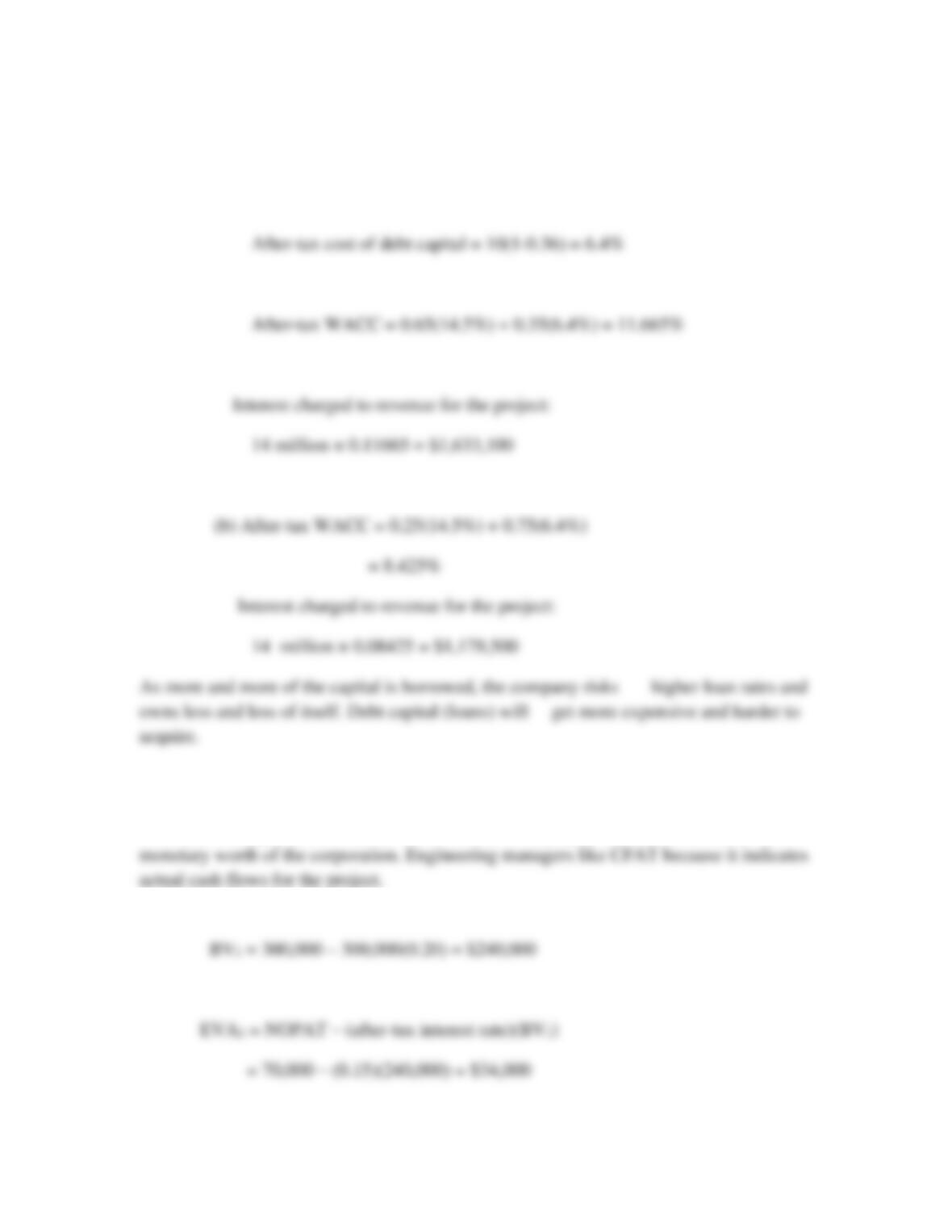
(a) Determine the after-tax cost of debt capital and WACC.
Solution 13.41
A finance manager likes EVA because it indicates the project’s enhancement to the
Solution 13.42
Solution 13.43
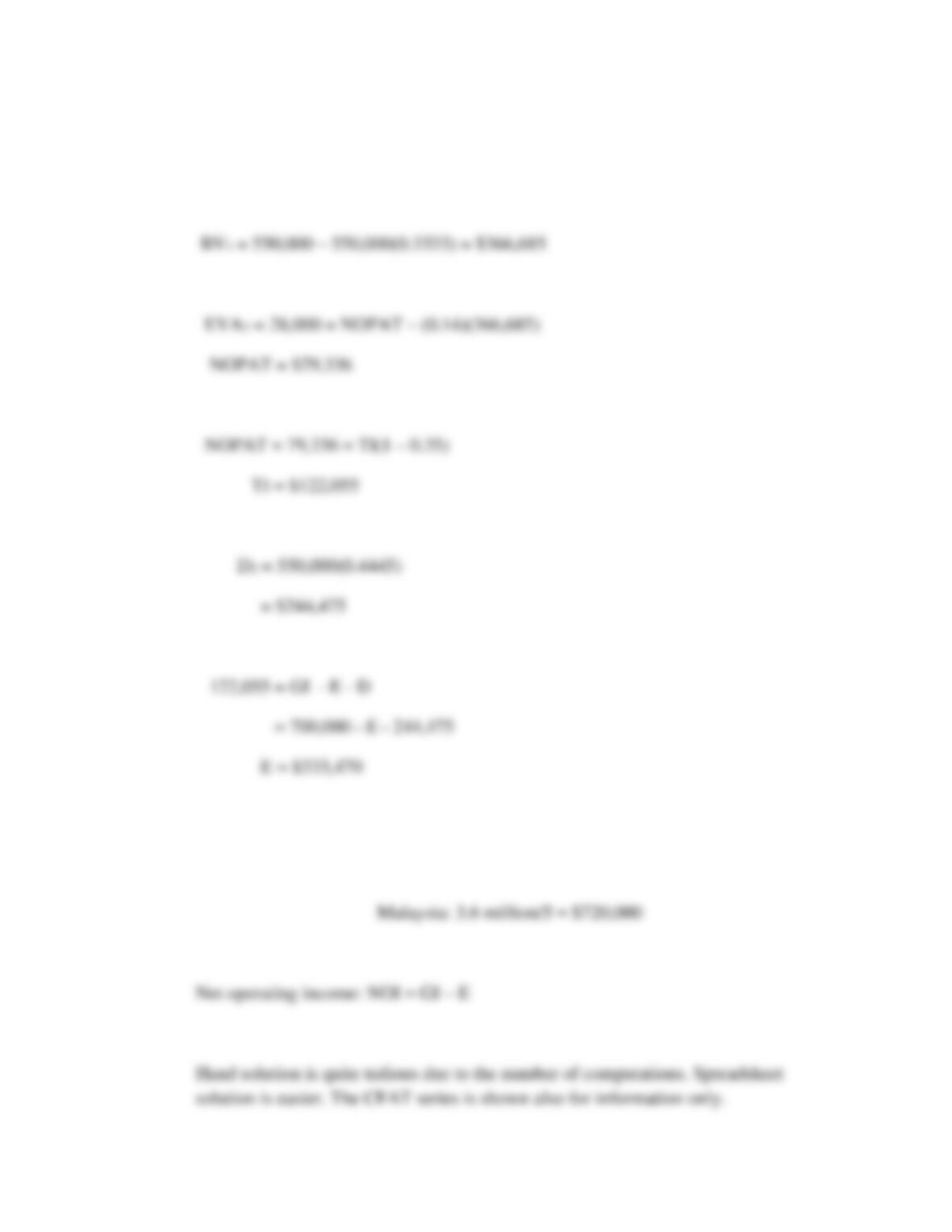
Find BVt -1 = BV1; solve for NOPAT; find TI from NOPAT; solve for E from TI.
Solution 13.44
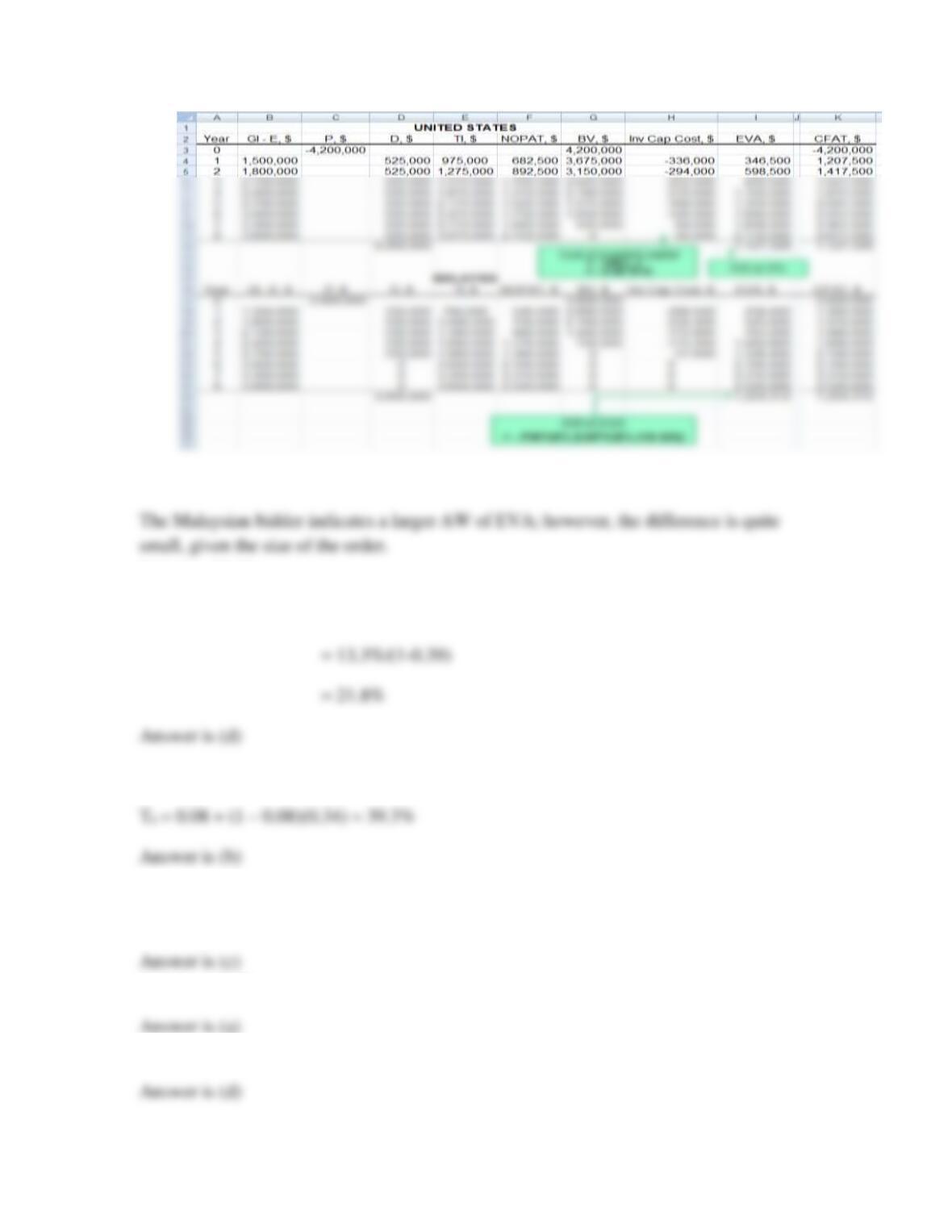
Depreciation is SL: United States: 4.2 million/8 = $525,000
Solution 13.45
Before-tax ROR = After-tax ROR/(1- Te)
Solution 13.46
Solution 13.47
Solution 13.48
Solution 13.49
Solution 13.50
Solution 13.51
Answer is (b)
Solution 13.52
CFAT = GI – E – TI(Te)
Solution 13.53
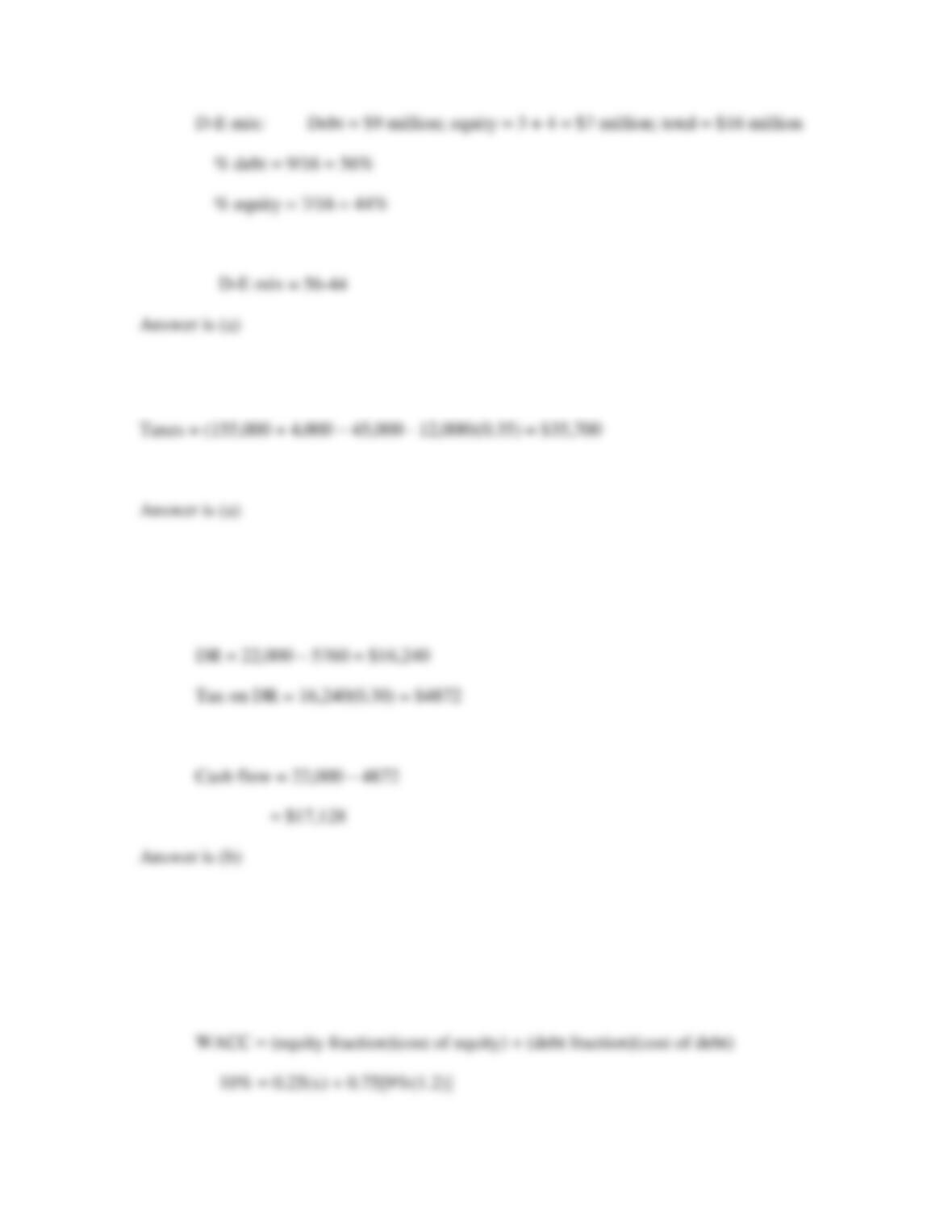
Solution 13.54
Solution 13.55
BV5 = 100,000(0.0576) = $5760
Solution 13.56
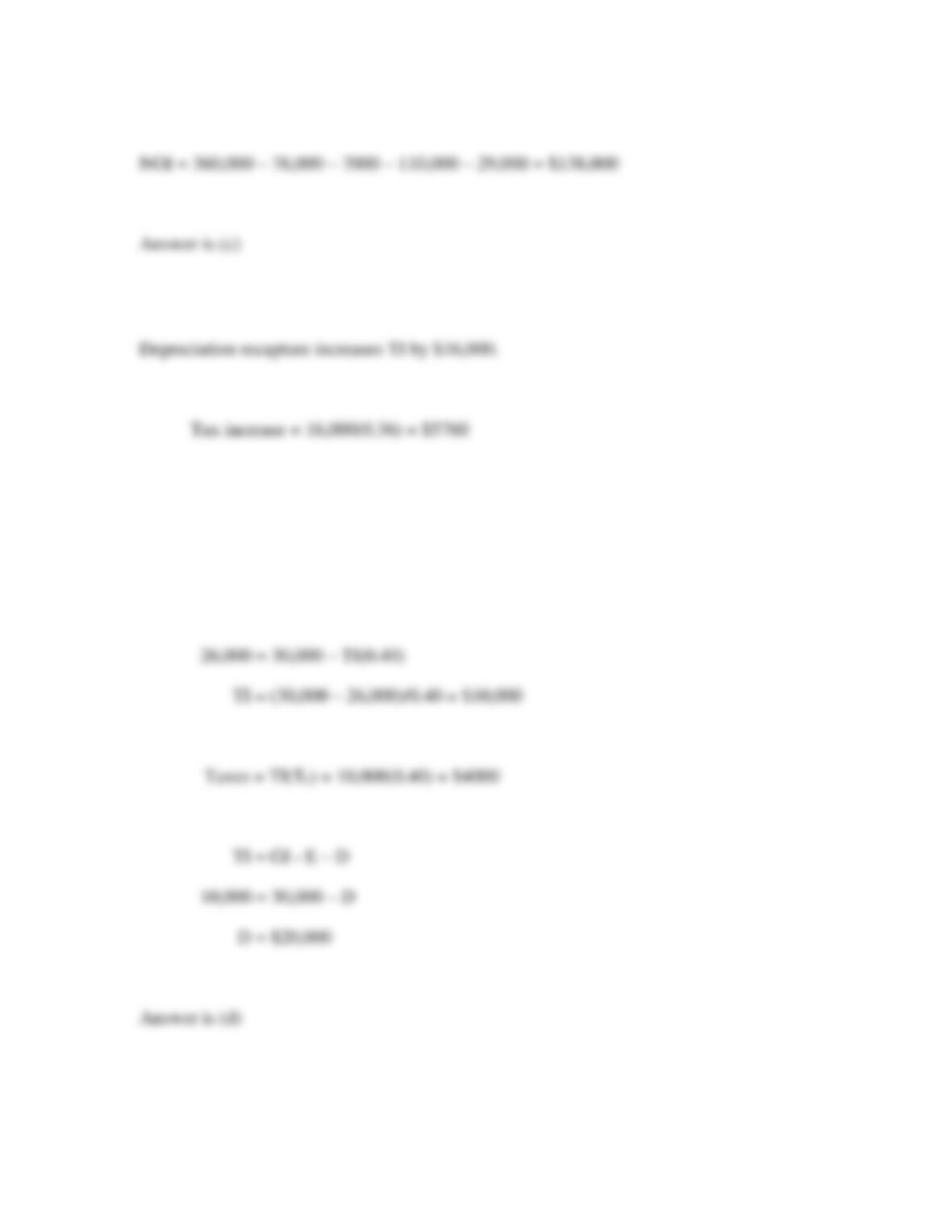
Let x = cost of equity capital

Solution 13.57