
Problem 12.1
How does depreciation affect income taxes?
Problem 12.2
What are three depreciable costs that are included in an asset’s basis?
Problem 12.3
What is the difference between book value and market value?
Problem 12.4
There are 3 different life values (recovery periods) associated with a depreciable asset.
Identify each by name and explain how it is correctly used.
Problem 12.5
Cyber Manufacturing is purchasing a complete video borescope system for applications
that require work in places that eyes cannot see. The purchase price is $8000, shipping
and delivery is $300, installation cost is $1200, tax recovery period is 5 years, book
depreciation period is 10 years, salvage value is estimated to be $500, operating cost
(with technician) will be $45,000 per year. For MACRS depreciation of the system, what
are the values of B, S, and n?
Problem 12.6
Jobe Concrete Products placed a new sand sifter into production 3 years ago. It had an
installed cost of $100,000, a life of 5 years, and an anticipated salvage of $20,000. Book
depreciation charges for the 3 years are $40,000, $24,000, and $14,000, respectively.
(a) Determine the book value after 2 years. (b) If the sifter’s market value today is
$20,000, determine the difference between its current book value and its market value,
and state which is lower. (c) Determine the total percentage of installed cost written off
through year 3.
Problem 12.7
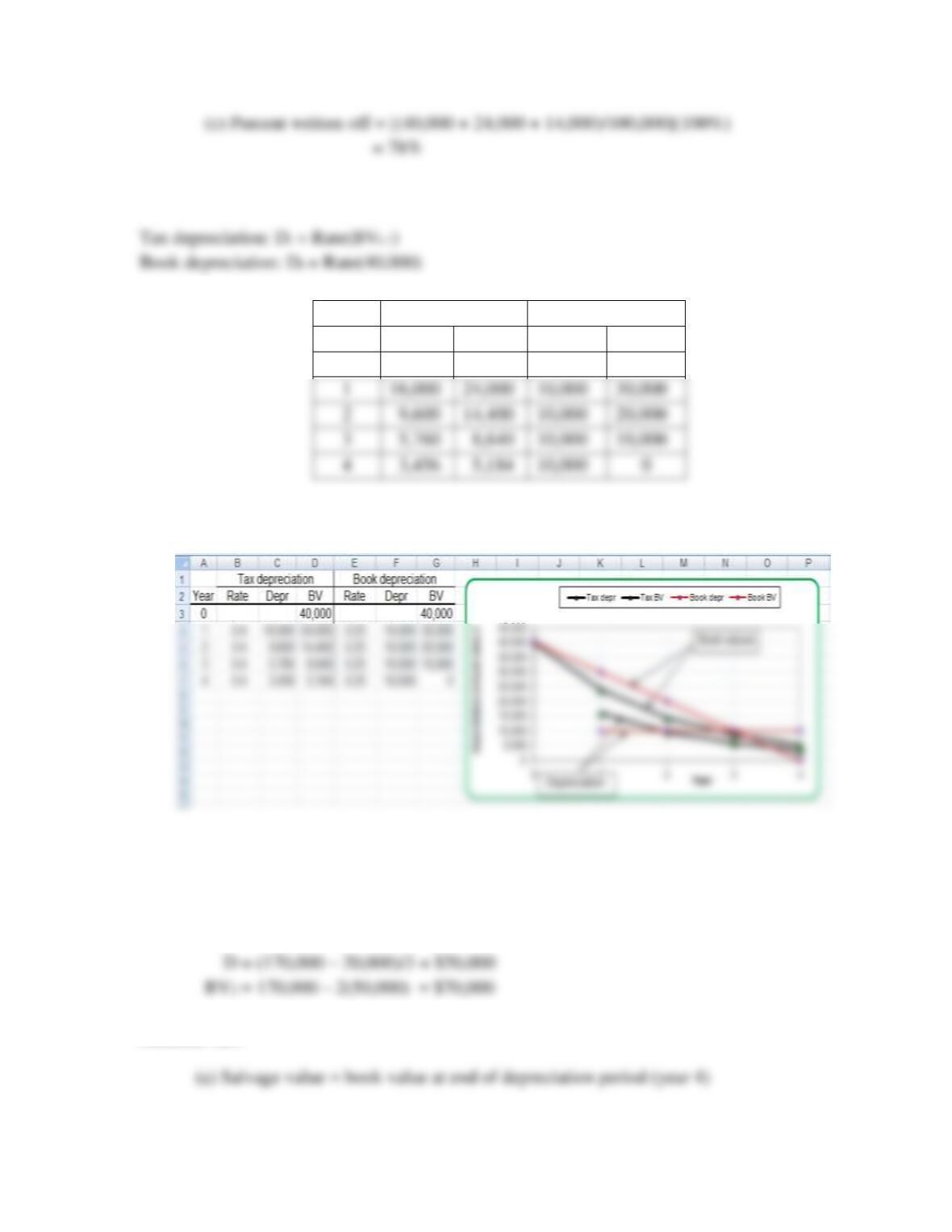
Quantum Electronic Services paid P = $40,000 for its networked computer system. Both
tax and book depreciation accounts are maintained. The annual tax depreciation rate is
based on the previous year’s book value (BV), while the book depreciation rate is based
on the original first cost (P). Use the rates listed to plot annual depreciation and book
values for each method. Develop the graphs using hand calculations or a spreadsheet, as
directed by your instructor.
Year of Ownership__
1 2 3 4_
Tax depreciation rate, % of BV 40 40 40 40
Book depreciation rate, % of P 25 25 25 25
Problem 12.8
A company that manufactures pulse Doppler insertion flow meters uses the straight line
method for book depreciation purposes. Newly-acquired equipment has a first cost of
$170,000 with 3-year life and $20,000 salvage value. Determine the depreciation charge
and book value for year two.
Problem 12.9
Kobi Technologies book depreciated an asset at $27,500 per year for four years using the
straight line method. If the book value in year two is $65,000, what was (a) the asset’s
salvage value, and (b) its basis?
Problem 12.10
An asset owned by Photon Environmental was book depreciated by the straight line
method over a 5-year period with book values of $296,000 and $224,000 in years two
and three, respectively. Determine (a) the salvage value used in the calculation, and
(b) the asset’s basis.
Problem 12.11
Carl is curious about the original cost of the digital imaging equipment he uses at the
First National Bank. Accounting cannot tell him the cost, but they know the annual
depreciation over an 8-year period is $18,900 per year. If all items are straight-line
depreciated and the salvage is always 25% of the first cost, estimate the original cost.
Problem 12.12
Butler Buildings purchased semi-automated assembly and riveting robotics equipment for
constructing its modular warehouse buildings. The first cost was $475,000 and
installation costs were $75,000; life is estimated at 10 years with a salvage of 15% of first
cost. Use the SL method to determine (a) annual recovery rate, (b) annual depreciation,
(c) book value after 5 years, and (d) book value after 10 years.
Problem 12.13
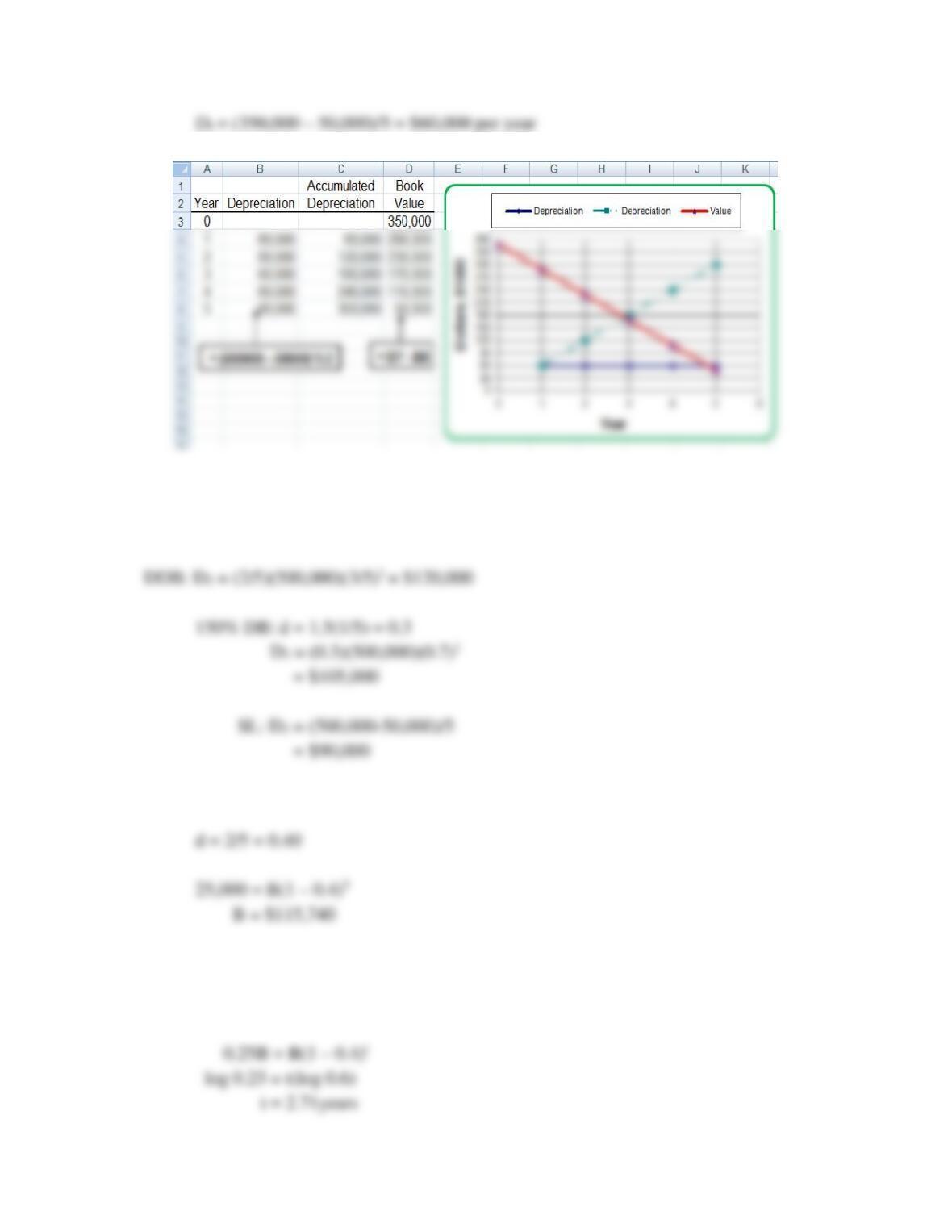
Columbia Construction purchased new equipment for its project to transform an existing,
vacant facility into a milk and butter processing plant. For the equipment, B = $350,000,
and S = $50,000. Book depreciation will use the SL method with n =5 years. Use
calculator or spreadsheet-based computations (or both, as directed) to plot annual
depreciation, accumulated depreciation, and book value on one graph.
Problem 12.14
Halcrow Yolles purchased equipment for new highway construction in Manitoba,
Canada, costing $500,000 Canadian. Estimated salvage at the end of the expected life of
5 years is $50,000. Various acceptable depreciation methods are being studied currently.
Determine the depreciation for year 2 using the DDB, 150% DB and SL methods.
Problem 12.15
Determine the original basis of a machine that is used for making spill containment
pallets if its book value in year 3 is $25,000. The machine has a 5 year life and the
double declining balance method is applied.
Problem 12.16
If an asset is book depreciated by the DDB method over a 5-year period, how long will it
take to reach its salvage value, provided the estimated salvage is 25% of the first cost?
Problem 12.17
If the salvage value of an asset is nil and it is depreciated by the double declining balance
method, what percentage of the asset’s first cost will remain after its 5-year life?
Problem 12.18
An engineer with Accenture Middle East BV in Dubai was asked by her client to help
understand the difference between 150% DB and DDB depreciation. Answer the
questions if B = $180,000, n = 12 years, and S = $30,000. (a) What are the book values
after 12 years for both methods? (b) How do the estimated salvage and the two book
values after 12 years compare in value? (c) Which of the two methods, when calculated
correctly considering S = $30,000, writes off more of the first cost over the 12 years?
Problem 12.19
Exactly 10 years ago, Boyditch Professional Associates purchased $100,000 in
depreciable assets with an estimated salvage of $10,000. For tax depreciation the SL
method with n = 10 years was used, but for book depreciation, Boyditch applied the DDB
method with n = 7 years and neglected the salvage estimate. The company sold the assets
today for $12,500. (a) Compare this sales amount with the book values using SL and
DDB methods. (b) If a salvage of $12,500 had been estimated exactly 10 years ago,
determine the depreciation for each method in year 10.
Problem 12.20
Shirley is studying depreciation in her engineering management course. The instructor
asked her to graphically compare the total percent of first cost depreciated for an asset
costing B dollars over a life of n = 5 years for DDB and 125% DB depreciation. Help her
by developing the plots of percent of B depreciated versus years. Use a spreadsheet
unless instructed otherwise.
Problem 12.21
Del Norte Brick Co. is located near the intersection of Texas, New Mexico, and Mexico.
Improved access to the company’s property is via a small, privately-owned bridge across
the Rio Grande River. The cost was $770,000 and it has a recovery period of 15 years.
Determine the depreciation and book value for year three according to the MACRS
method.
Problem 12.22
An automated assembly robot that cost $400,000 has a depreciable life of five years with
a $100,000 salvage value. If the MACRS depreciation rates for years 1, 2, and 3 are
20.00, 32.00, and 19.20%, respectively, what is the book value of the robot at the end of
year three?
Problem 12.23
The manager of a plant that manufactures stepper drives knows that MACRS and DDB
are both accelerated depreciation methods, but out of curiosity, he wants to determine
which one offers faster write-off in the first three years for equipment that has a first cost
of $300,000, a 5-year life, and a $60,000 salvage value. Determine which method yields
the lower book value and by how much.
Problem 12.24
Bison Gear and Engineering of St Charles, IL makes sensorless and brushless dc gear
motors suited for foodservice equipment, factory automation, alternative energy systems,
and other specialty machinery applications. The company purchased an asset 2 years ago
that has a 5-year recovery period. If the depreciation charge by the MACRS method for
year 3 is $14,592, what was (a) the first cost of the asset, and (b) the depreciation charge
in year 1?
Problem 12.25
A plant manager for a large cable company knows that the real value of certain types of
cable-maintenance equipment is more closely approximated when the equipment is
depreciated linearly by the SL method rather than with the more rapid write-off method
MACRS. Therefore, he keeps two sets of books, one using MACRS for taxes and a
second using SL for equipment-management purposes. For an asset that has a first cost
of $80,000, a depreciable life of 5 years, and a salvage value equal to 25% of the first
cost, determine the difference in the book values shown in the two sets of books at the
end of year 4, and identify the method that has a lower BV after 4 years?
Problem 12.26
A 120-metric-ton telescoping crane that cost $320,000 is owned by Upper State Power.
Salvage is estimated at $75,000. (a) Compare book values for MACRS and classical SL
depreciation over a 7-year recovery period. (b) Explain how the estimated salvage is
treated using MACRS.
Problem 12.27
Youngblood Shipbuilding Yard just purchased $800,000 in capital equipment for ship
repairing functions on dry-docked ships. Estimated salvage is $150,000 for any year after
5 years of use. Compare the depreciation and book value for year 3 for each of the
following depreciation methods:
(a) GDS MACRS where the recovery period is 10 years
(b) Double declining balance with a recovery period of 15 years.
(c) ADS SL, as an alternative to MACRS, with a recovery period of 15 years
Problem 12.28
Fairfield Properties owns real property that is MACRS depreciated with n = 39 years.
They paid $3.4 million for the apartment complex and hope to sell it after 10 years of
ownership for 50% more than the book value at that time. Compare the expected selling
price with the amount that Fairfield paid for the property.
Problem 12.29
Blackwater Spring and Metal utilizes the same computerized spring forming machinery
in its U.S. and Malaysian plants. Purchased in 2010, the first cost was $750,000 with
S = $150,000 after n = 10 years. MACRS depreciation with n = 5 years is applied in the
United States and SL depreciation with n = 10 years is used by the Malaysian facility.
(a) Develop and graph the book value curves for both plants. (b) If the equipment is sold
after 6 years for $100,000, calculate the over or under depreciation amounts for each
method.
Problem 12.30
Aaron Pipeline has the service contract for part of the Black Mesa slurry coal pipeline in
Arizona. The company placed $500,000 worth of depreciable capital equipment into
operation. Use the VDB spreadsheet function to calculate the MACRS depreciation and
book value schedules for a 5-year recovery period.
Problem 12.31
For a country that allows switching between declining balance (not DDB) and straight
line, determine the difference in depreciation for year 2 between the two methods and
determine if a switch is advisable. The asset has a first cost of $100,000, a 5-year
recovery period, and a $10,000 salvage value.
Problem 12.32

Henry has an assignment from his boss at Czech Glass and Wood Sculpting to evaluate
depreciation methods for writing off the $200,000 first cost of a newly acquired Trotec
CO2 laser system for engraving and cutting. Productive life is 8 years and salvage is
estimated at $10,000. Henry wants to compare the PW of depreciation at i = 10% per year
for DDB-to-SL switching with MACRS for n = 7 years to determine which is the
preferred method. Perform the analysis using a table or a spreadsheet, as requested by the
instructor.
Problem 12.33
ConocoPhillips alkylation processes are licensed to produce high-octane, low-sulphur
blendstocks domestically and internationally. Halliburton Industries has newly-licensed
alkylation equipment costing $1 million per system at its Moscow, Houston, and Abu
Dhabi refinery service operations. Russia requires a 10-year, straight line recovery with a
10% salvage value. The United States allows a 7-year MACRS recovery with no salvage
considered. The United Arab Emirates allows a 7-year recovery with switching from
DDB to SL method and no salvage considered. Which of the country’s methods has the
largest PW of depreciation at i = 15% per year?
Problem 12.34
To determine the MACRS rates in Table 12.2, the switching procedure in Section 12.5
must be altered slightly to accommodate the half-year convention imposed by MACRS.
The first difference is in year 1, where the DDB rate is only one-half of the DDB rate.
The second difference is in the denominator for the SL depreciation. The term is
(n – t + 1.5), instead of the (n – t + 1) shown. The third and final change is that one-half of
the SL depreciation allowed in year n is taken in the year n + 1. Use the switching
procedure and three changes to verify the MACRS rates for n = 5.
Problem 12.35
What is the difference between depreciation and depletion?
Problem 12.36
A relatively small privately-owned coal-mining company has the sales results
summarized below. Determine the annual percentage depletion for the coal mine.
Assume the company’s taxable income is $140,000 each year.
Sales, Spot Sales Price,
Year tons $/ton____
1 34,300 9.68
2 50,100 10.50
3 71,900 11.23

Problem 12.37
Chaparral Sand and Gravel purchased a pit for $900,000 that is expected to yield
6000 tons of gravel and 7000 tons of sand per year. If the gravel will sell for $6 per ton
and the sand for $9 per ton, determine the annual depletion charge according to the
percentage depletion method.
Problem 12.38
Vesco Mineral Resources purchased mineral rights to land in the foothills of the Santa
Cristo mountains. The cost of the purchase was $9 million. Vesco originally estimated
that 200,000 tons of lignite coal was removable. However, further exploration during the
second year of operation revealed that a total of 280,000 tons could be economically
removed. If the company sold 20,000 tons in year 1 and 30,000 tons in year 2, what are
the depletion charge each year according to the cost depletion method?
Problem 12.39
Carrolton Oil and Gas, an independent oil and gas producer, is approved to use a 20% of
gross income depletion allowance. The write-off last year was $700,000 on its horizontal
directional drill wells. Determine the estimated total reserves in barrels, if the volume
pumped last year amounted to 1% of the total and the delivered-product price averaged
$75 per barrel.
Problem 12.40
Ederly Quarry sells a wide variety of cut limestone for residential and commercial
building construction. A recent quarry expansion cost $2.9 million and added an
estimated 100,000 tons of reserves. (a) Estimate the cost depletion allowance for the next
5 years for these new reserves, using the projections made by John Ederly. (b) Will the
depletion charge be limited in any year due to restrictions placed on the cost depletion
method?
Year 1 2 3 4 5
Volume, 1000 tons 10 12 15 15 18
Price, $ per ton 85 90 90 95 95
Problem 12.41
For the last 10 years, Am-Mex Coal has used the cost depletion factor of $2500 per
100 tons to write off the investment of $35 million in its Pennsylvania anthracite coal
mine. Depletion thus far totals $24.8 million. A new study to appraise mine reserves
indicates that no more than 800,000 tons of salable coal remain. Determine next year’s
percentage and cost depletion amounts, if estimated gross income is expected to be
between $6.125 and $8.50 million on a production level of 72,000 tons.
Problem 12.42
All of the following assets can be depreciated, except:
a. a bulldozer.
b. a copper mine.
c. a surgical robot.
d. a conveyor belt.
Problem 12.43
Classical straight line depreciation of a $100,000 asset takes place over a 5-year recovery
period. If the salvage value is 20% of first cost, the depreciation charge for year 3 is
closest to:
a. $16,000
b. $20,000
c. $24,000
d. $28,000
Problem 12.44
An asset with a first cost of $50,000 is to be depreciated by the straight line method over
a 5-year period. The asset will have annual operating costs of $35,000 and a salvage
value of $10,000. According to the straight line method, the book value at the end of year
3 will be closest to:
a. $8000
b. $20,000
c. $24,000
d. $26,000
Problem 12.45
A motorized cultivator with a first cost of $28,000 and salvage value of 25% of the first
cost is depreciated by the DDB method over a 5-year period. If the operating cost is
$43,000 per year, the depreciation charge for year 2 is closest to:
a. $18,000
b. $11,200
c. $6700
d. $4030
Problem 12.46
An assembly line conveyor system with a 5-year life is to be depreciated by the DDB
method. The conveyor units had a first cost of $30,000 with a $9000 salvage value. The
annual operating cost allocated to the conveyor is $7000 per year. The book value at the
end of year 2 is closest to:
a. $6,480
b. $10,800
c. $12,400
d. $18,000
Problem 12.47
Gisele is performing a make/buy study involving the retention or disposal of a 4-year-old
machine that was to be in production for 8 years. It cost $500,000 originally. Without a
market value estimate, she decided to use the current book value plus 20%. If DDB
depreciation is applied, the market value estimate is closest to:
a. $158,200
b. $253,125
c. $217,900
d. $189,800
Problem 12.48
A MACRS-depreciated asset has B = $100,000, S = $40,000, and a 10-year recovery
period. (The dt values for years t = 1, 2, 3, 4 and 5 are 10.00%, 18.00%, 14.40%, 11.52%,
and 9.22%, respectively.) The depreciation charge for year 4 according to the MACRS
method is closest to:
a. $58,700
b. $62,400
c. $11,500
d. $46,100
Problem 12.49
An industrial robot depreciated by the MACRS method has B = $60,000 and a 5-year
depreciable life. The MACRS dt values for years 1, 2, 3, 4 and 5 are 10.00%, 18.00%,
14.40%, 11.52%, and 9.22%, respectively. If the depreciation charge in year 3 is $8640,
the salvage value that was used in the depreciation calculation is closest to:
a. $0
b. $10,000
c. $20,000
d. $30,000
Problem 12.50
South African Gold Mines, Inc. is writing off its $210 million investment using the cost
depletion method. An estimated 700,000 ounces of gold are available in its developed
mines. This year 35,000 ounces were produced and sold at an average price of $1400 per
ounce. Taxable income for the year is estimated at $4.8 million. The cost depletion for
the year is closest to:
a. $7.35 million, which is 15% of the gross income of $49.0 million.
b. $2.4 million, which is 50% of estimated taxable income.
c. $10.5 million.
d. $42 million.
Problem 12.51
Rayonier Forrest Resources purchased a small tract of timber land for $70,000 that
contained 25,000 trees. The value of the land was estimated to be $20,000. In the first
year of operation, the lumber company cut down 7,000 trees. According to the cost
depletion method, the depletion deduction for year 1 is closest to: (Hint: Value of land
cannot be depreciated or depleted.)
a. $2000
b. $7000
c. $10,000
d. $14,000
Problem 12.52
A stone and gravel quarry in Texas can use a percentage depletion rate of 5% of gross
income, or a cost depletion rate of $1.28 per ton. Quarry first cost = $3.2 million;
Estimated total tonnage = 2.5 million tons; Tonnage this year = 65,000;
Gross income = $40 per ton. Of the two depletion charges, the method and larger amount
are:
a. percentage at $83,200.
b. percentage at $130,000.
c. cost at $80,000.
d. cost at $130,000.
Solution 12.1
Solution 12.2
The basis includes original purchase price (P), installation costs, training costs and any
Solution 12.3
Solution 12.4
Productive life – Time the asset is actually expected to provide useful service.
Solution 12.5
Solution 12.6
(a) BV2 = 100,000 – (40,000 + 24,000)
Solution 12.7
Tax Depreciation
Book Depreciation
Year, t
Dt
BVt
Dt
BVt
0
40,000
40,000
1
16,000
24,000
10,000
30,000
2
9,600
14,400
10,000
20,000
5,760
8,640
10,000
10,000
3,456
5,184
10,000
Spreadsheet solution with graphs follows.
Solution 12.8
Depreciation charge is the same each year
Solution 12.9
Solution 12.10
(a) Depreciation charge is determined from the change in book value
Solution 12.11
Solution 12.12
Solution 12.13
Spreadsheet solution uses SL depreciation.
Solution 12.14
Solution 12.15
Solution 12.16
Substitute 0.25B for BV. Depreciation rate is d = 2/5 = 0.4
Solution 12.17
Solution 12.18
Solution 12.19
(a) SL: BV10 = $10,000 by definition
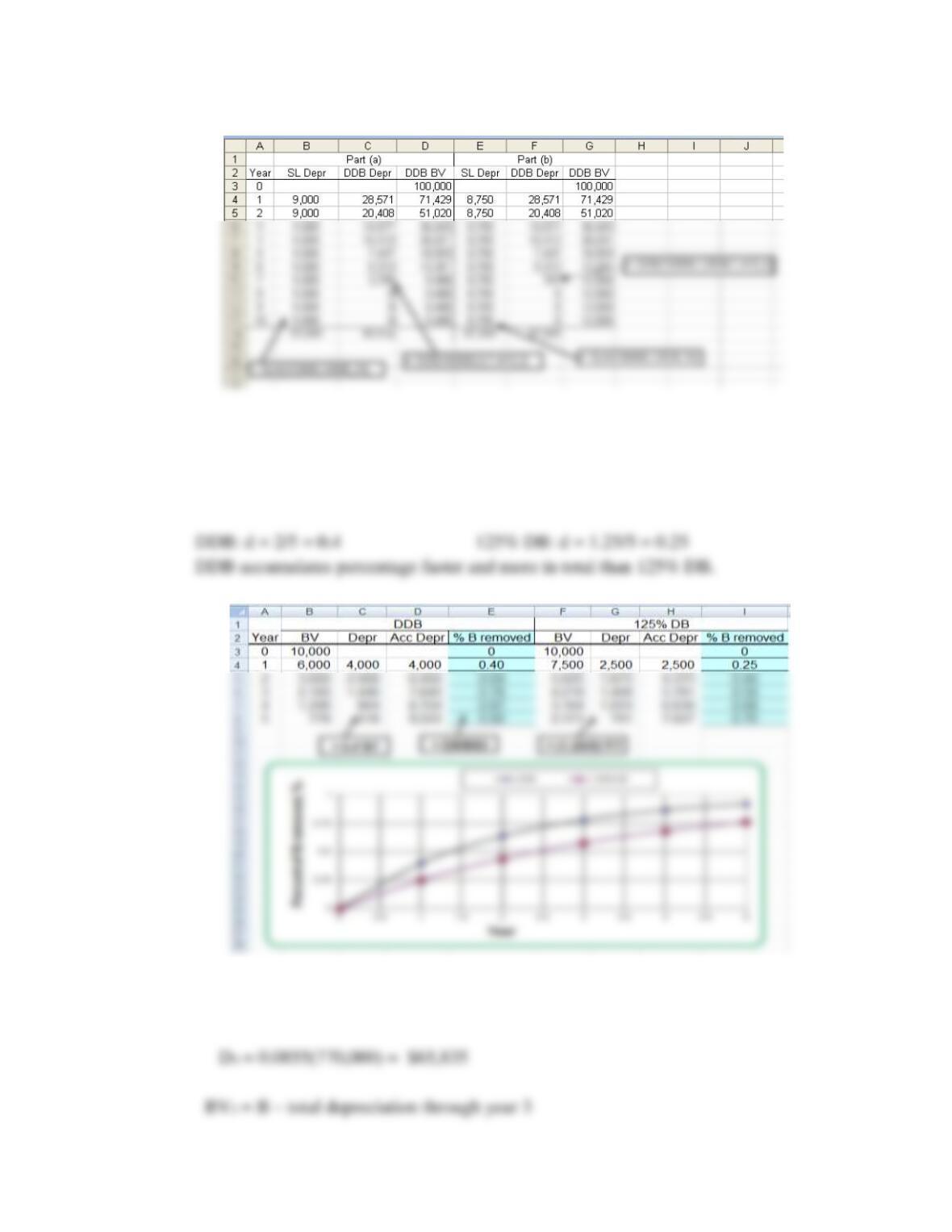
A spreadsheet solution for both parts follows.
Solution 12.20
Select any first cost value to use for B. The spreadsheet below uses $10,000.
Solution 12.21
Solution 12.22
Solution 12.23
Solution 12.24
(a) From MACRS depreciation rate table, d3 = 0.192
Solution 12.25
Solution 12.26
Straight line
MACRS
Year
Depreciation
BV
Rate
Depreciation
BV
0
320,000
320,000
1
35,000
285,000
0.1429
45,728
274,272
2
35,000
250,000
0.2449
78,368
195,904
215,000
0.1749
55,968
139,936
180,000
0.1249
39,968
99,968
5
35,000
145,000
0.0893
28,576
6
35,000
110,000
0.0892
28,544
7
35,000
0.0893
28,576
75,000
0.0446
14,272
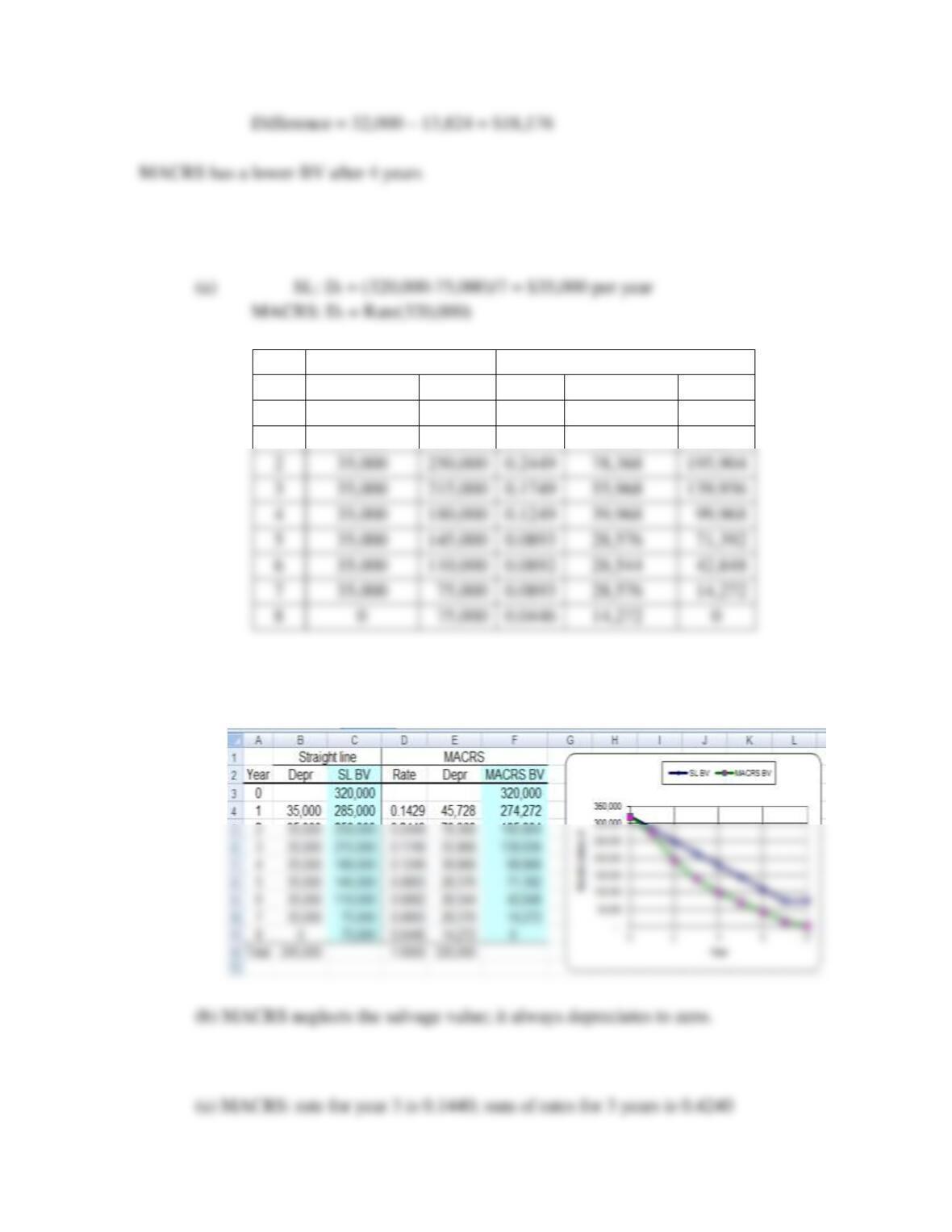
Spreadsheet solution with BV plots.
Solution 12.27
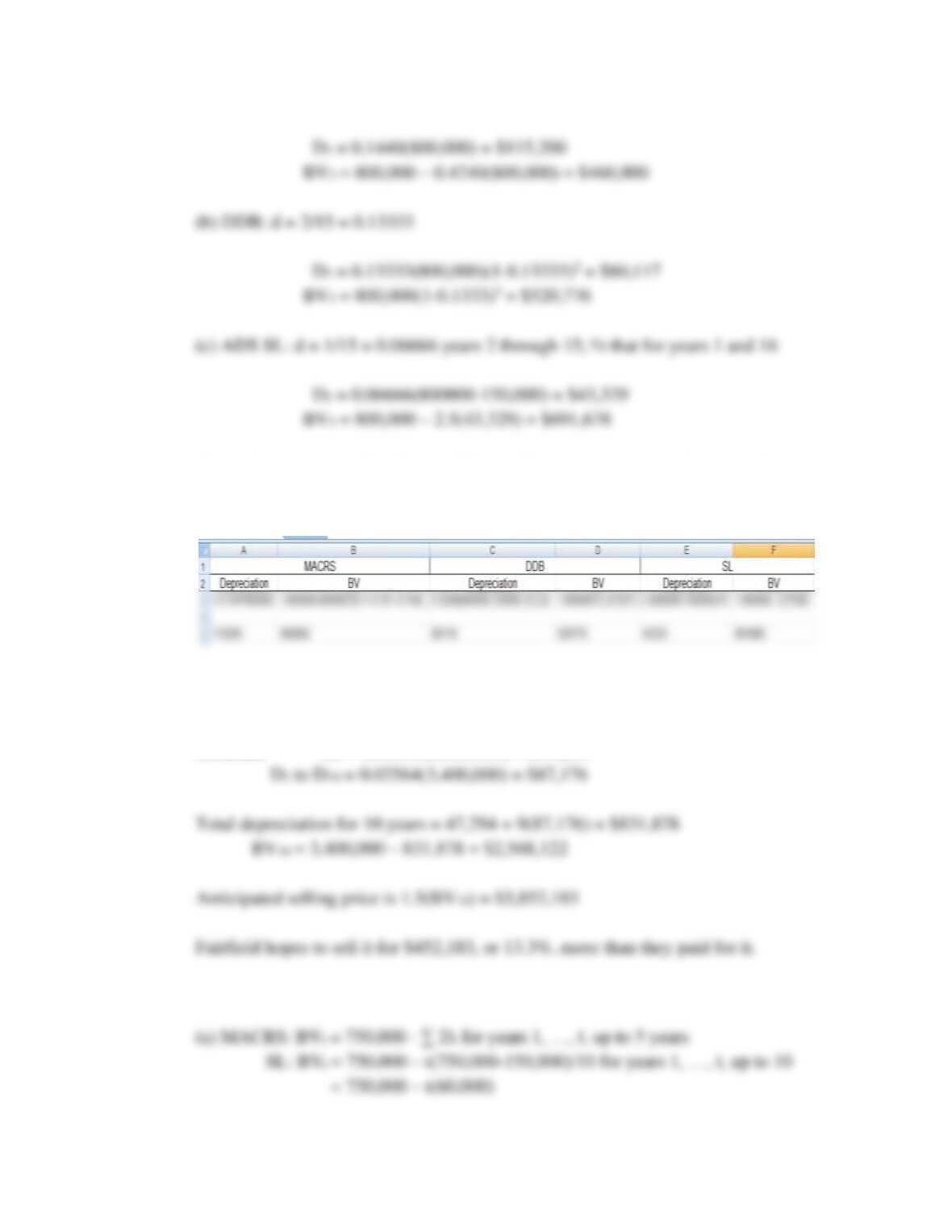
Spreadsheet solution for all parts follows. The relations used to determine the
values in row 5 are indicated in row 3.
Solution 12.28
MACRS: D1 = 0.01391(3,400,000) = $47,294
Solution 12.29
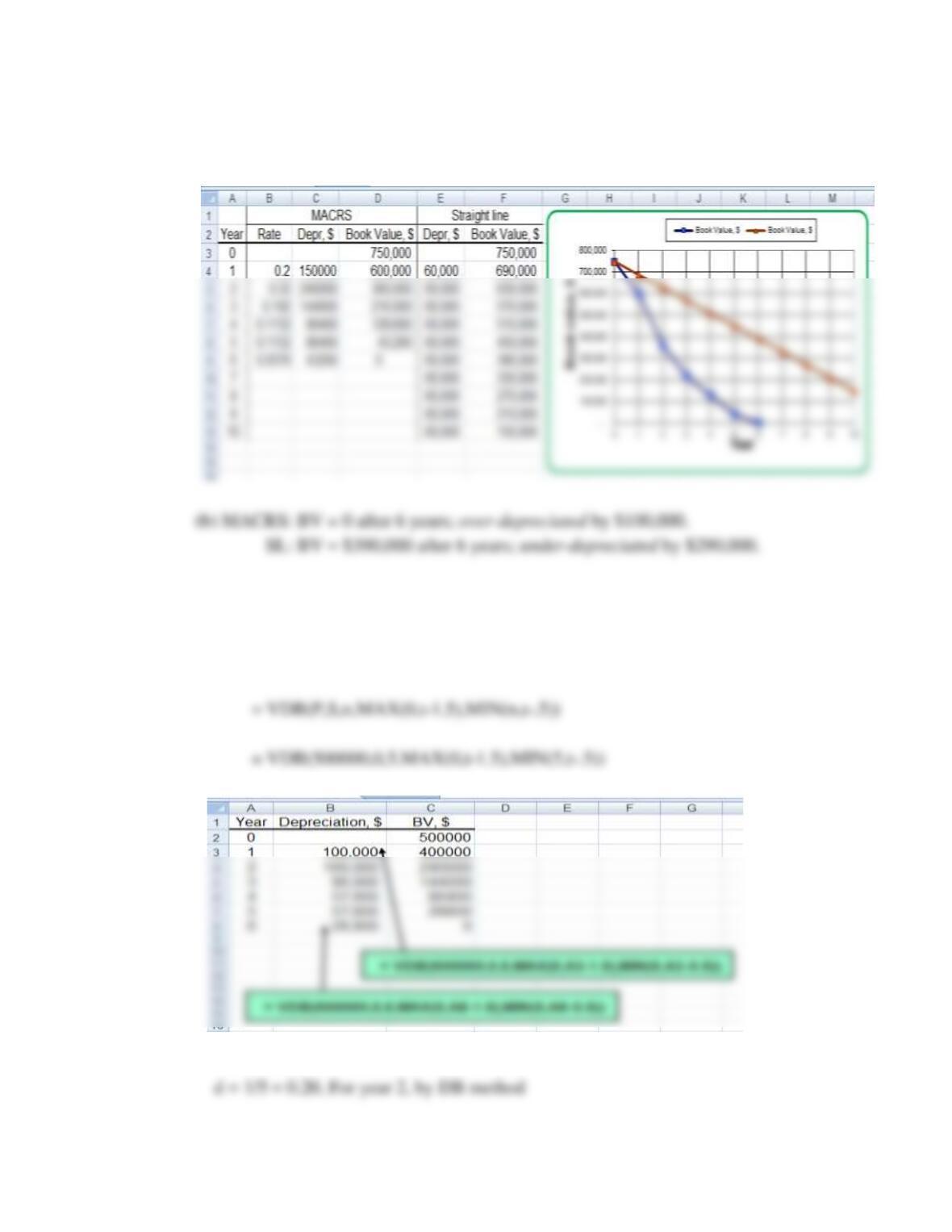
Book values and curves are detailed in the spreadsheet below.
Solution 12.30
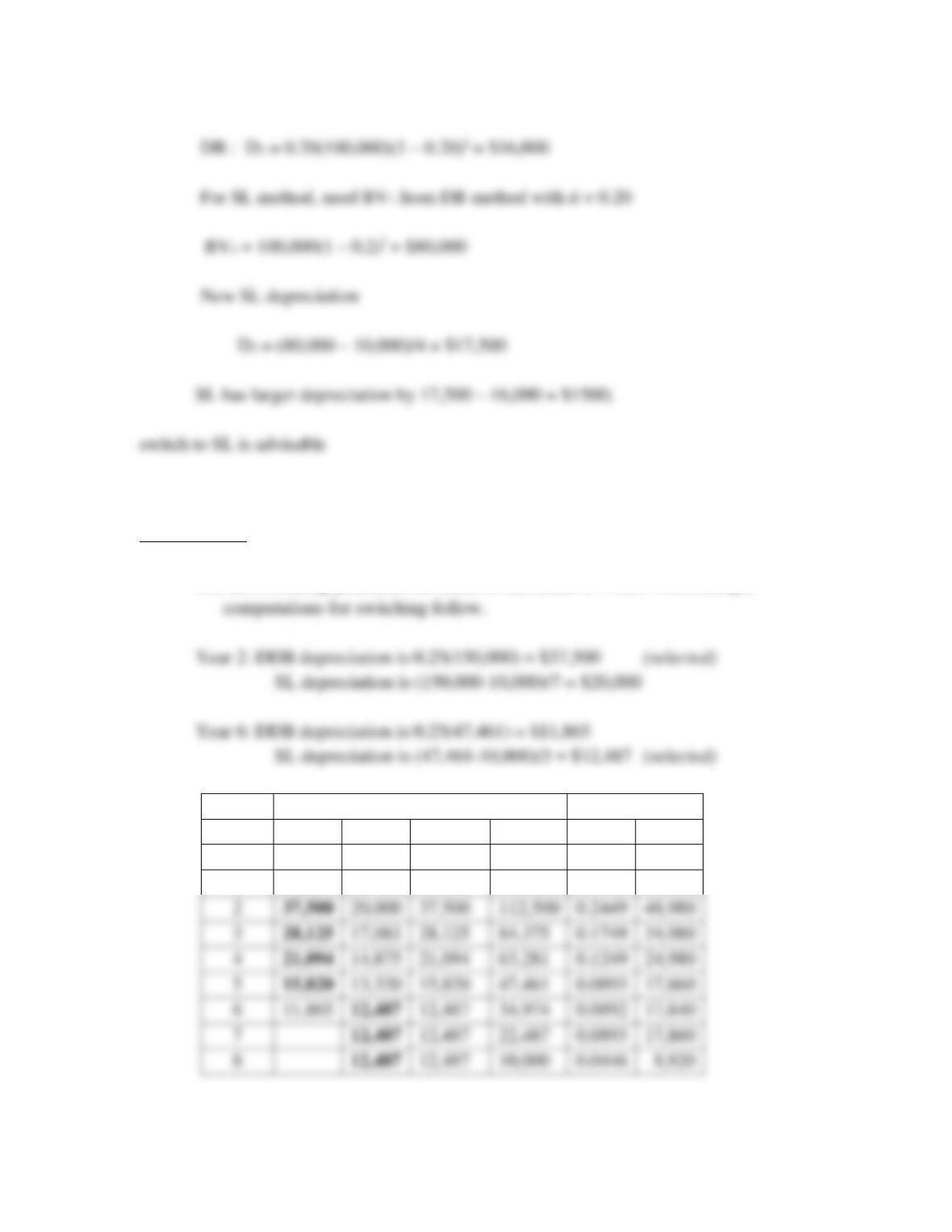
Spreadsheet solution uses VDB function in general form for each year t.
Solution 12.31
Solution 12.32
Table solution:
Use the switching procedure for DDB-to-SL. DDB d = 0.25. Two example
DDB–to-SL switch
MACRS
Year
DDB
SL
Selected
BV
Rate
Depr
0
200,000
1
50,000
23,750
50,000
150,000
0.1429
28,580
2
37,500
20,000
37,500
112,500
0.2449
48,980
3
17,083
28,125
84,375
0.1749
34,980
4
14,875
21,094
63,281
0.1249
24,980
5
13,320
15,820
47,461
0.0893
17,860
6
11,865
12,487
12,487
34,974
0.0892
17,840
7
12,487
12,487
22,487
0.0893
17,860
8
12,487
10,000
0.0446
8,920
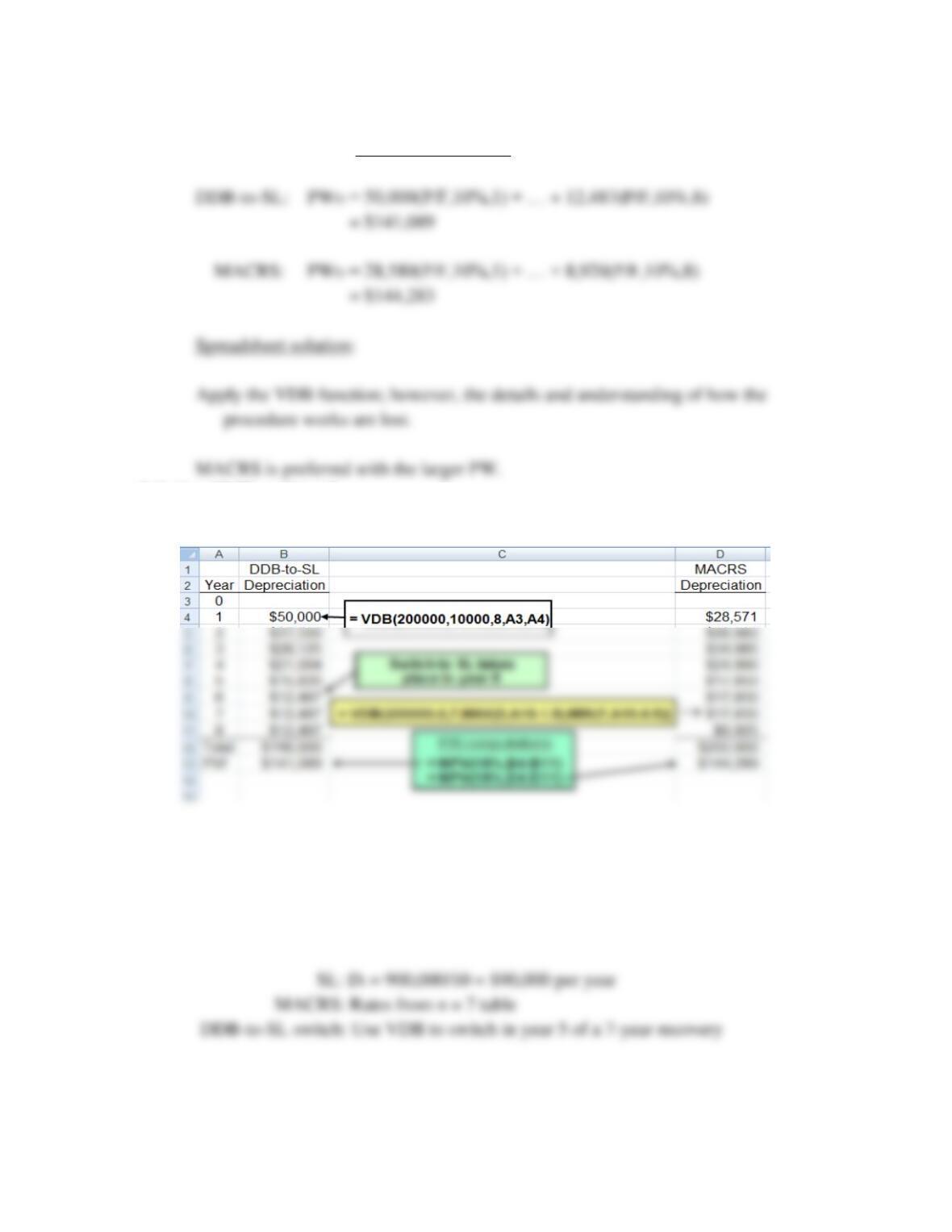
Compare PW of selected and MACRS depreciation values. MACRS has the
larger present worth; MACRS is preferred.
Solution 12.32 continued
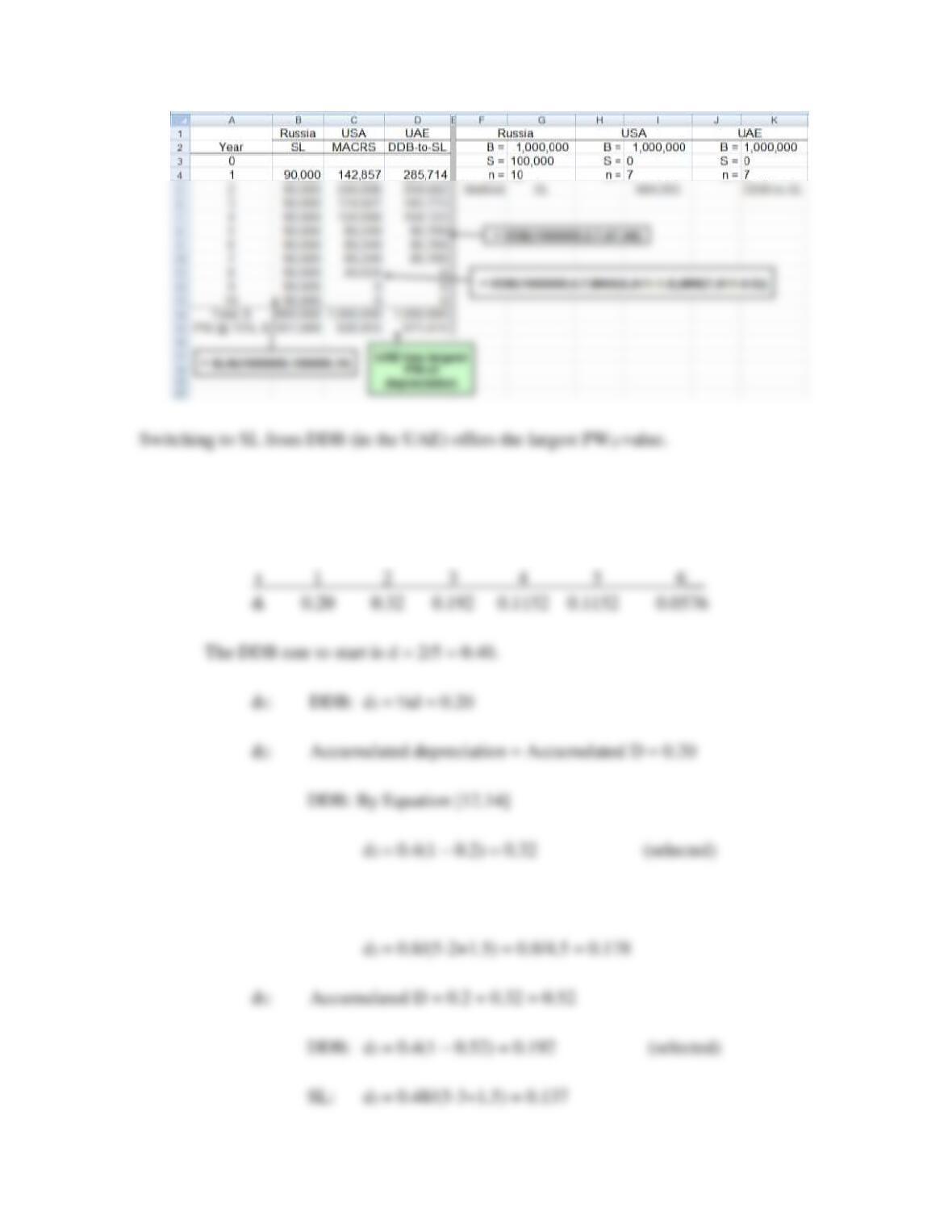
Solution 12.33
This problem is best worked using a spreadsheet. Hand solution is relatively easy, but
quite time consuming.
Solution 12.34
Verify the following MACRS rates using the modified DDB-to-SL switching.
SL: Modify Equation [12.15] to have denominator (n-t+1.5)
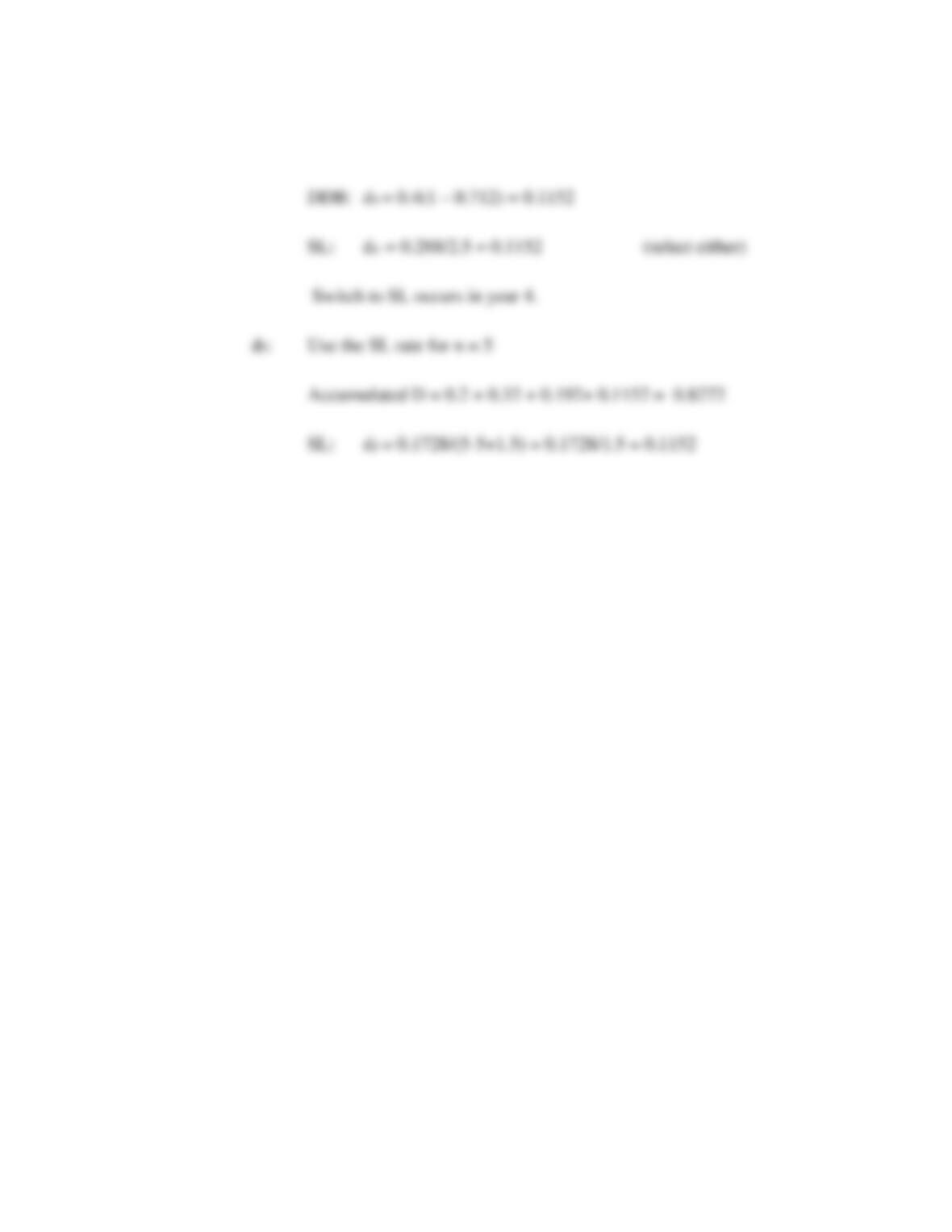
d4: Accumulated D = 0.2 + 0.32 + 0.192 = 0.712
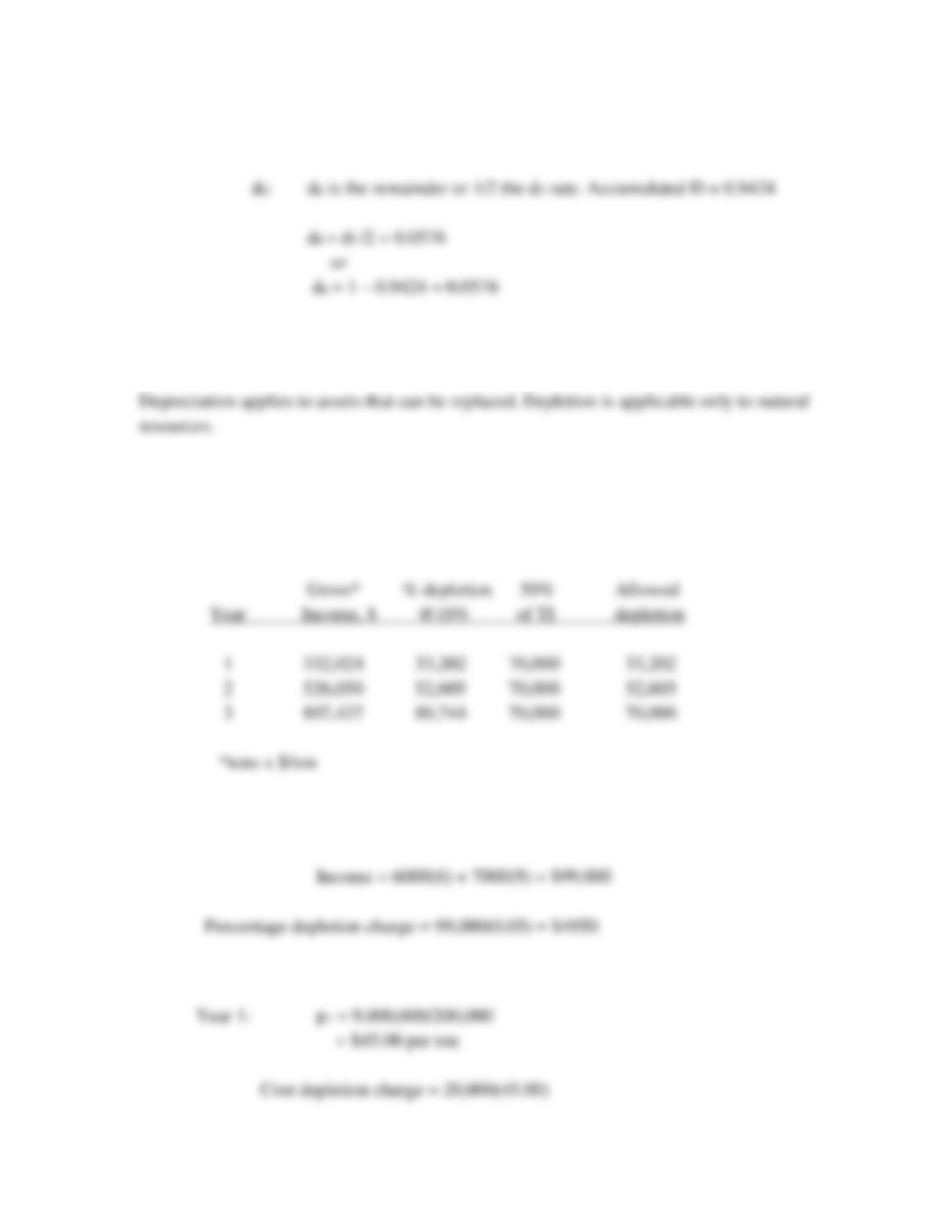
Solution 12.34 continued
Solution 12.35
Solution 12.36
Percentage depletion for coal is 10% of gross income, provided it does not exceed 50%
of taxable income (TI).
Solution 12.37
Solution 12.38
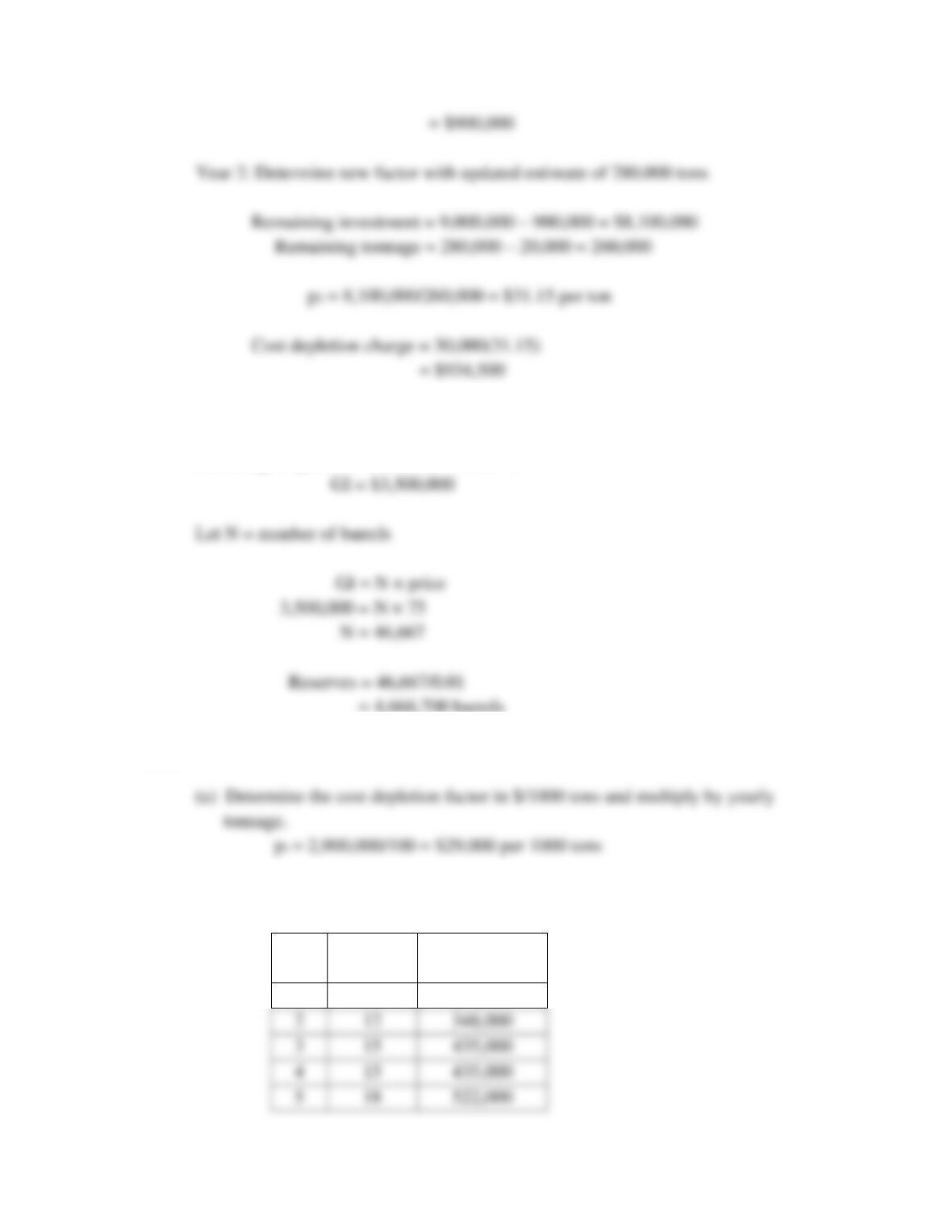
Solution 12.39
Percentage depletion = 0.20(GI) = 700,000
Solution 12.40
Annual cost depletion = volume × $29,000
Year
Volume,
1000 tons
Cost depletion,
$ per year
1
10
290,000
2
12
348,000
5
18
522,000
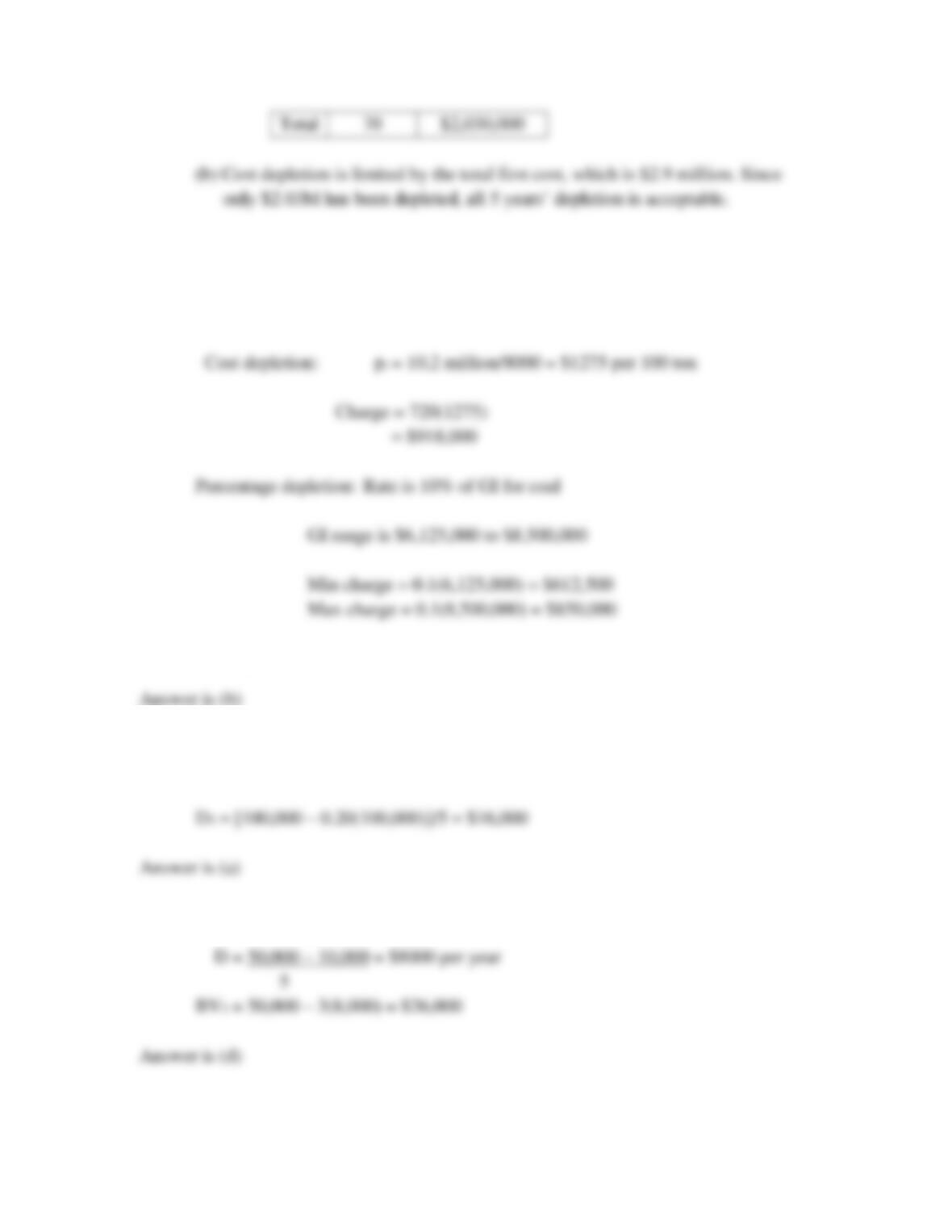
Solution 12.41
Remaining investment = 35.0 – 24.8 million = $10.2 million
Solution 12.42
Solution 12.43
Depreciation is same for all years in straight line method.
Solution 12.44
Solution 12.45
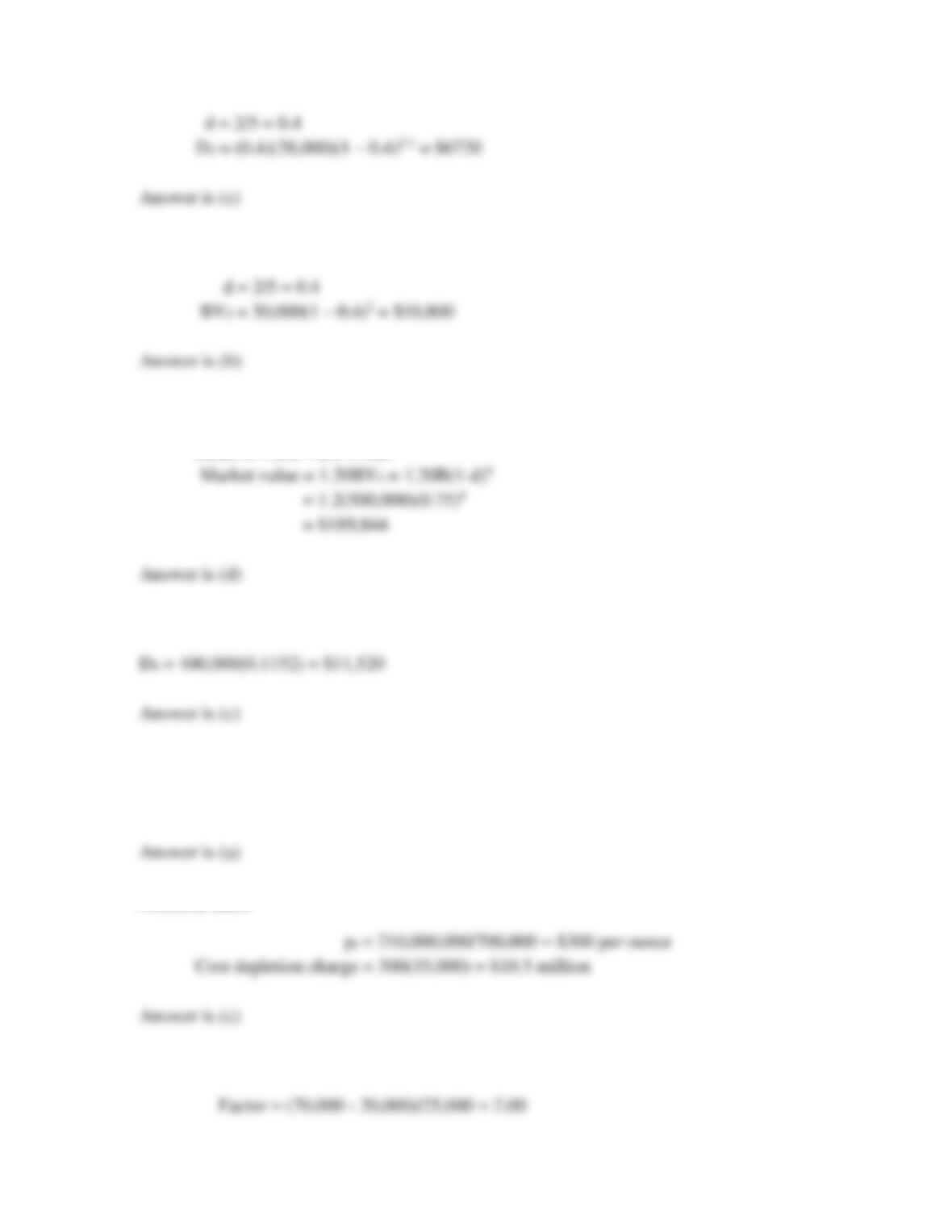
Solution 12.46
Solution 12.47
DDB: d = 2/n = 2/8 = 0.25
Solution 12.48
Solution 12.49
Salvage value is always $0 for the MACRS method.
Solution 12.50
Solution 12.51
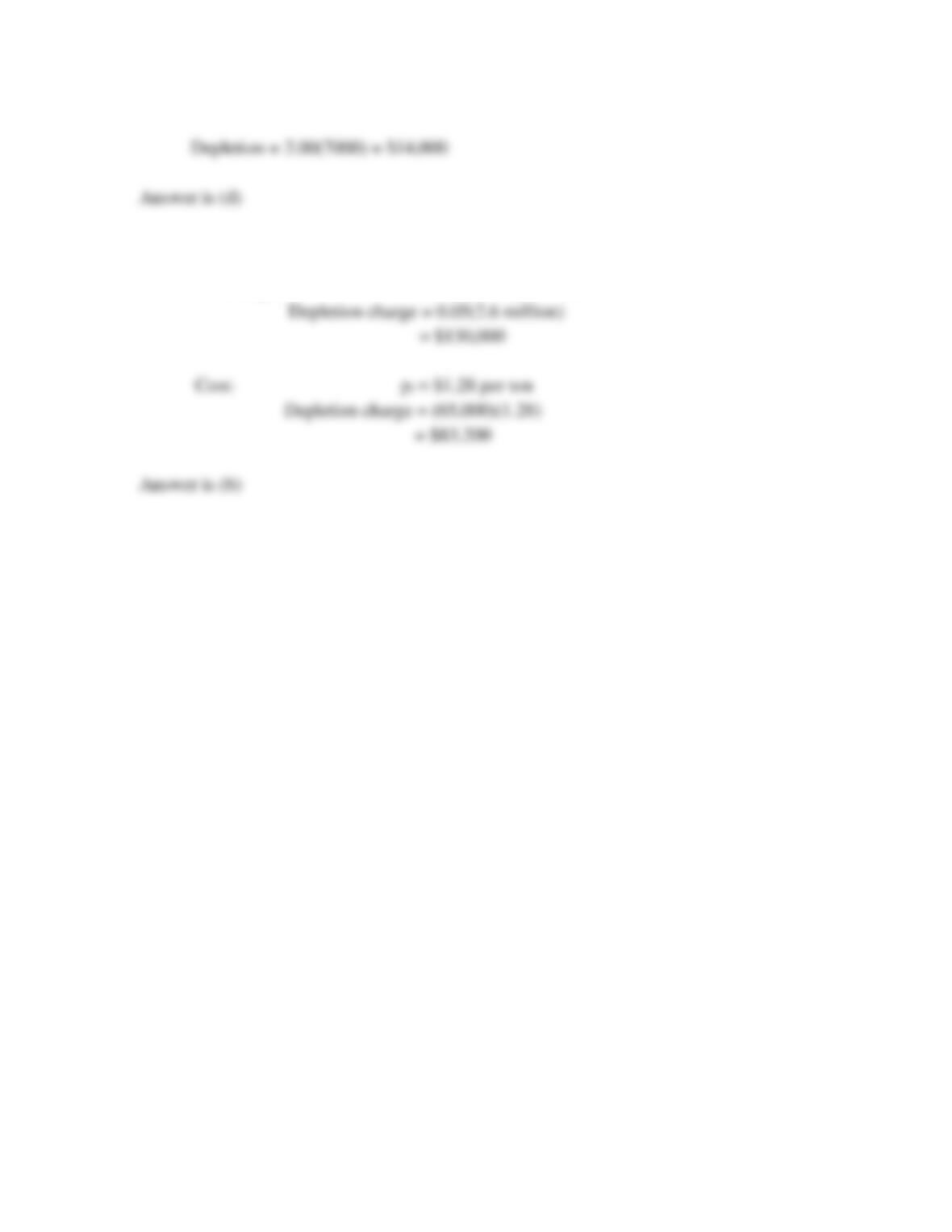
Solution 12.52
Percentage: GI = 65,000(40) = $2.6 million