Chapter 12: Cash Flows For Construction Projects
Learning Objectives
At the completion of this chapter the student should be able to:
• Prepare a cash flow for a construction project.
• Explain how subcontracting, in-house labor, and retention affect the amount of cash
Instructional Hints
• Emphasize that more companies fail because of inadequate cash flow than fail due to lack
of profitability. When a company runs short on cash it becomes difficult to get materials
from supplier, pay labor, and get subcontractors to work on the job. It is also hard to get a
loan because the company is in poor financial condition.
Activities
• Using the spreadsheet from Sidebar 12-1, make the following changes and see how they
affect the amount of cash (Total Cash Before Payment) needed for the construction
project:
o In month 2, replace $20,000 of the subcontractor costs with $9,000 of materials and
$10,000 of labor. Make these changes to other months.
Instruction Resources
• The figures, sidebar, and tables from this chapter in electronic format and PowerPoint
slides can be found at the instructor’s website.
Solutions to the Textbook Problems
1. The company may run out of cash. When a company runs out of cash they find it hard to
2. Rather than using its cash to pay for the labor, the contractor uses the subcontractor to
3. The profit and overhead markup is (1) needed to cover the project’s portion of the general
4. Just before payment is received from the project’s owners.
5. The faster the rate of progress the more cash that is needed.
6. Retention is a form of financing a construction project, as well as a means to ensure that the
7. The cash needs of a project can be reduced by (1) using more subcontractors rather than in-
hour labor, (2) reduce the retention rate, (3) increase profit and overhead markup, (4) place
8. The cash flow for the first month is calculated using Eq. (12-1) as follows:
Cash Flow1 = $0 – ($0 + $8,100 + $0) = –$8,100
The total cash for the first month is calculated using Eq. (12-2) as follows:
The cash flow just before the first payment is received is calculated using Eq. (12-1) as
follows:
The cash flow and total cash just before the second payment is received is calculated as
follows:
Cash4′ = –$13,685 + (–$7,600) = –$21,285
The cash flow and total cash for the fourth month is calculated as follows:
The cash flow and total cash just before the fifth payment is received is calculated as follows:
The cash flow and total cash for the sixth month is calculated as follows:
Receipt6 = $33,000(1 – 0.05) = $31,350
Receipt7 = $31,990
The subcontractor payments for the seventh month are the entire subcontractor costs for the
sixth month plus all retention held and is calculated as follows:
9. The cash flow for the first month is calculated using Eq. (12-1) as follows:
Because payment is received in the middle of the month following the month the work is
performed we use 50% of the monthly labor to calculate the maximum amount of cash
needed during the month. The cash flow just before the first payment is received is calculated
using Eq. (12-1) as follows:
The subcontractor payments for the second month are as follows:
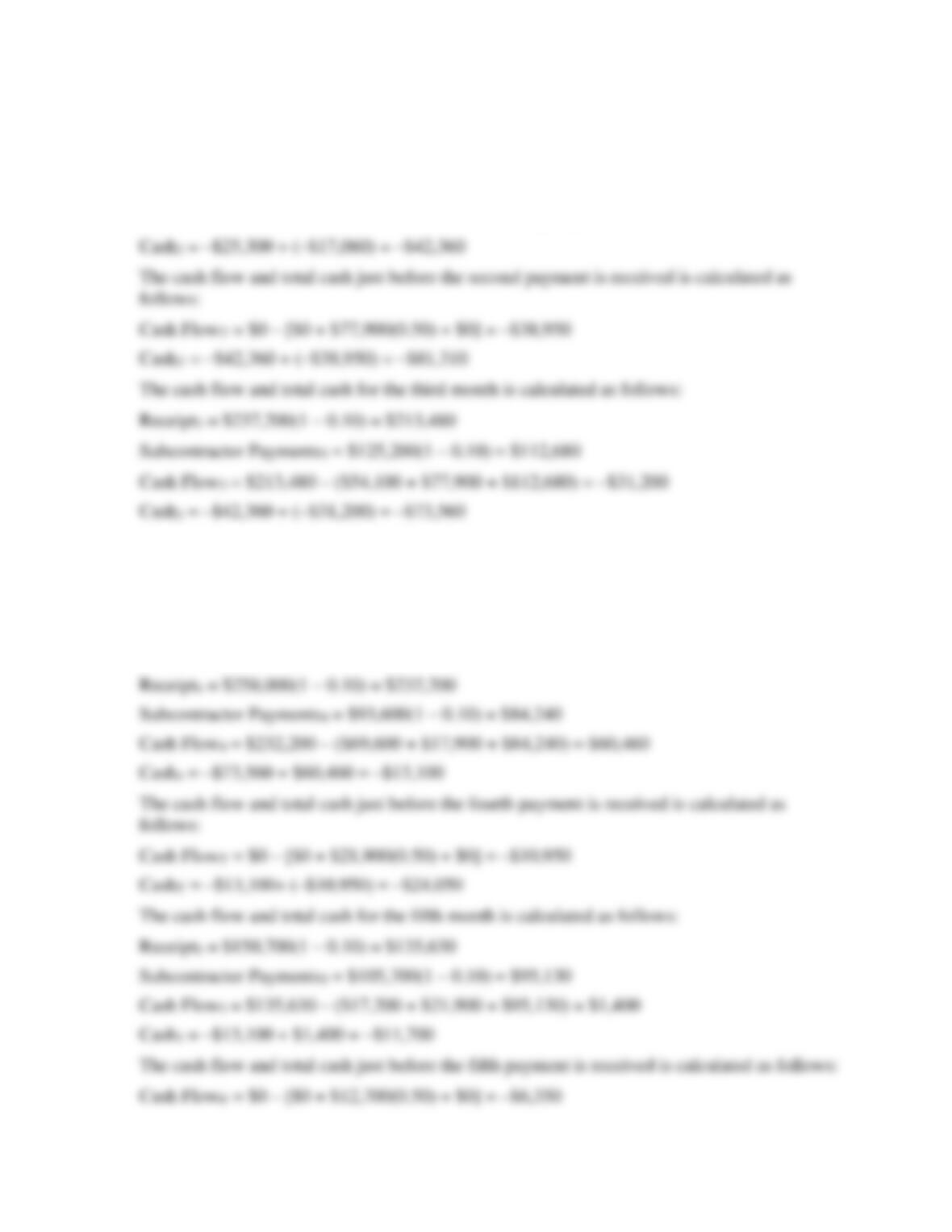
Subcontractor Payments2 = $35,600(1 – 0.10) = $32,040
The cash flow for the second month is calculated using Eq. (12-1) as follows:
Cash Flow2 = $91,080 – ($33,700 + $42,400 + $32,040) = –$17,060
The total cash for the second month is calculated using Eq. (12-2) as follows:
The cash flow and total cash just before the third payment is received is calculated as
follows:
Cash Flow4′ = $0 – [$0 + $17,900(0.50) + $0] = –$8,950
Cash4′ = –$73,560 + (–$8,950) = –$82,510
The cash flow and total cash for the fourth month is calculated as follows:
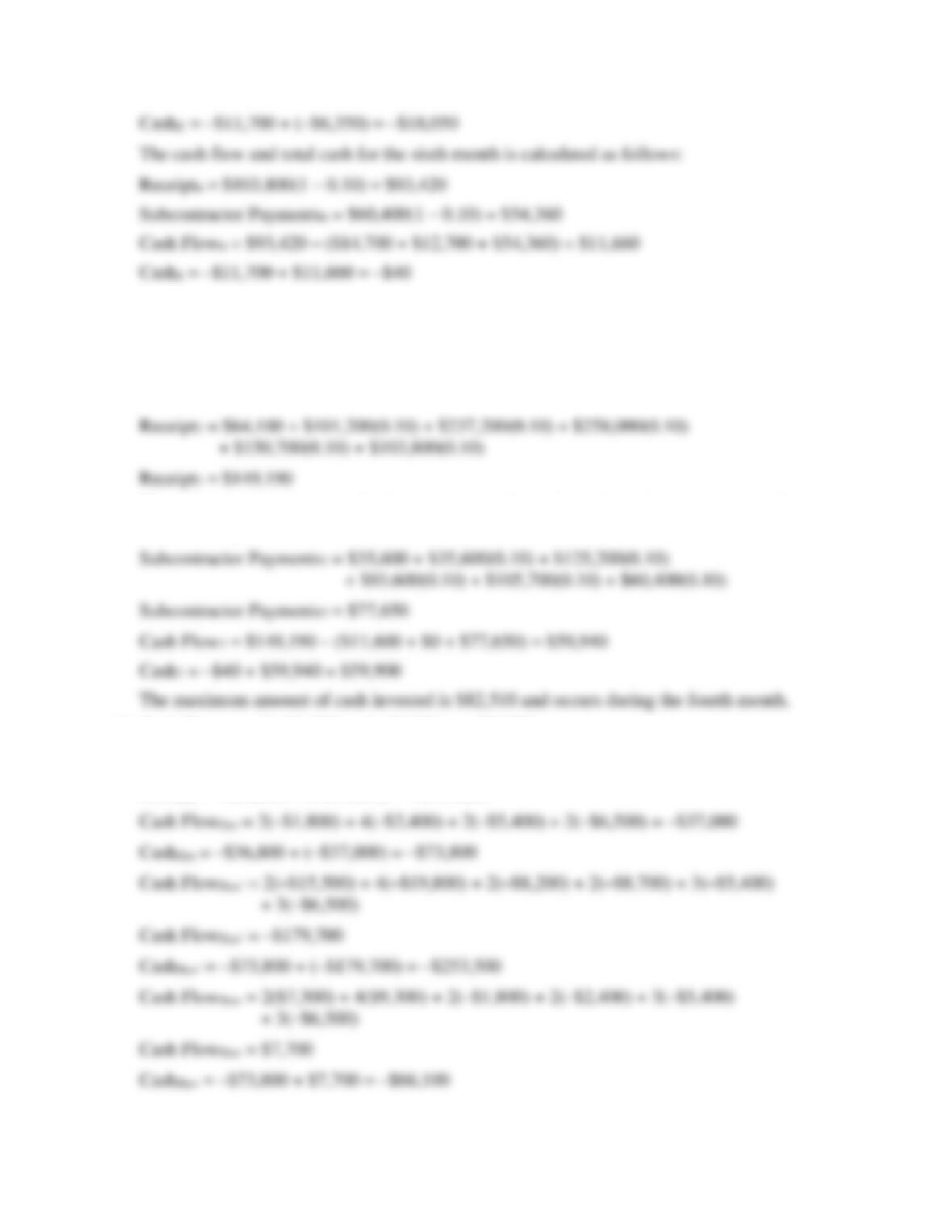
Because no additional labor payments have been made, the total cash generated just before
the sixth payment is received is the same as the total cash generated at the end of the sixth
month.
The payment received from the owner during the seventh month is the entire bill from month
six plus all retention held and is calculated as follows:
The subcontractor payments for the seventh month are the entire subcontractor costs for the
sixth month plus all retention held and is calculated as follows:
10. Cash Flowsept = 2(–$5,400) + 4(–$6,500) = –$36,800
Cash FlowOct’ = 2(–$8,200) + 4(–$8,700) + 2(–$5,400) + 2(–$6,500) = –$75,000
CashOct’ = –$36,800 + (–$75,000) = –$111,800
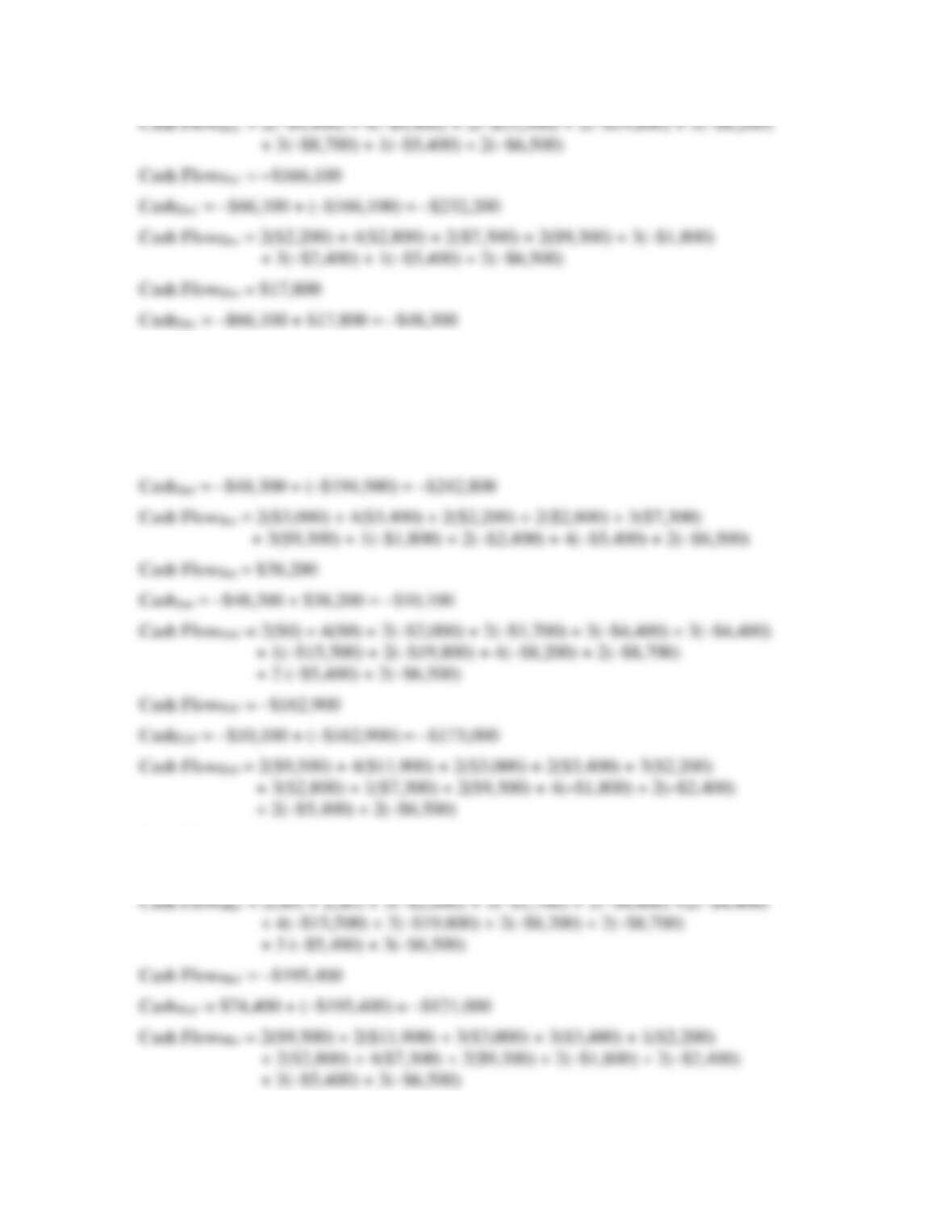
11. To solve this problem we must include the uncompleted housing starts from last year, as well
as the end of the year balance of –$48,300.
Cash FlowJan’ = 2(–$2,000) + 4(–$1,700) + 2(–$4,400) + 2(–$4,400) + 3(–$15,500)
+ 3 (–$19,800) + 1(–$8,200) + 2(–$8,700) + 4(–$5,400) + 2(–$6,500)
Cash FlowJan’ = –$194,500
Cash FlowFeb = $84,500
CashFeb = –$10,100 + $84,500 = $74,400
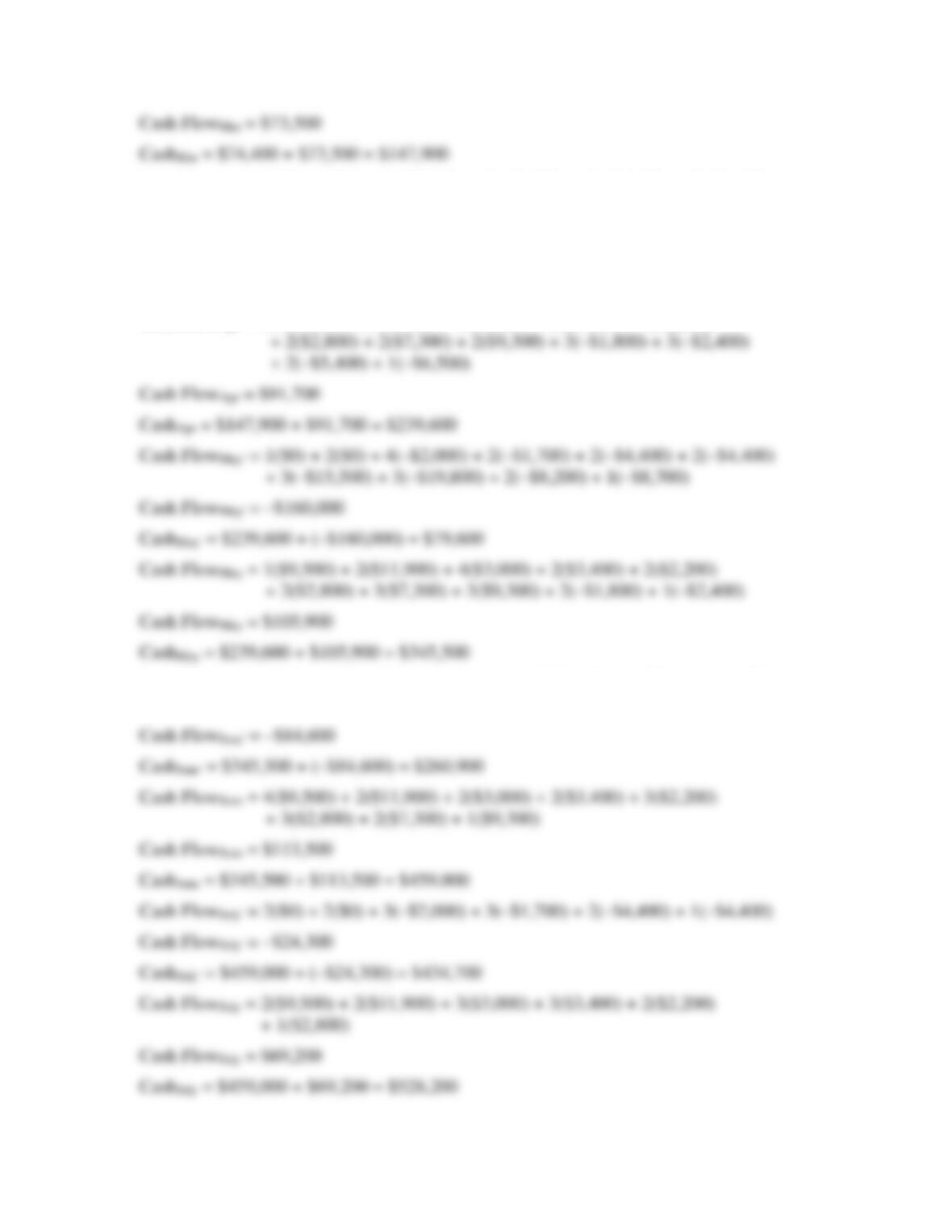
Cash FlowApr’ = 3($0) + 3($0) + 1(–$2,000) + 2(–$1,700) + 4(–$4,400) + 2(–$4,400)
+ 2(–$15,500) + 2(–$19,800) + 3(–$8,200) + 3(–$8,700)
+ 2(–$5,400) +1(–$6,500)
Cash FlowApr’ = –$170,400
CashApr‘ = $147,900 + (–$170,400) = –$22,500
Cash FlowApr = 3($9,500) + 3($11,900) + 1($3,000) + 2($3,400) + 4($2,200)
Cash FlowJune’ = 4($0) + 2($0) + 2(–$2,000) + 2(–$1,700) + 3(–$4,400) + 3(–$4,400)
+ 2(–$15,500) + 1(–$19,800)
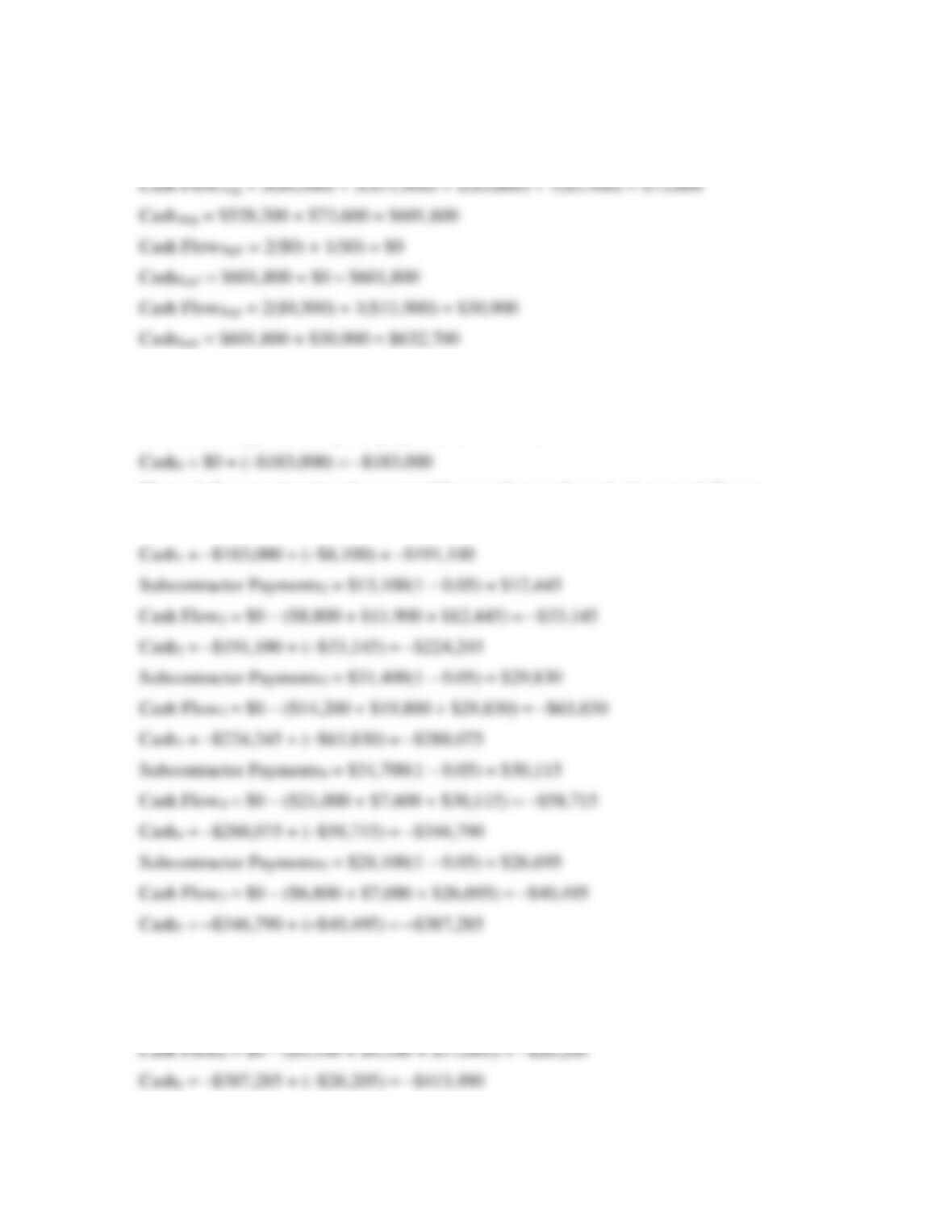
Cash FlowAug’ = 3($0) + 3($0) +2(–$2,000) + 1(–$1,700) = –$5,700
CashAug’ = $528,200 + (–$5,700) = $522,500
12. The cash flow for month zero is as follows:
Cash Flow0 = $0 – ($150,000 + $15,000 + $3,000 + $5,000 + $10,000) = –$183,000
The total cash generated by the project at the end of month zero is as follows:
The cash flows and total cash generated for months one through six are as follows:
Cash Flow1 = $0 – ($0 + $8,100 + $0) = –$8,100
Subcontractor Payments6 = $17,900(1 – 0.05) = $17,005
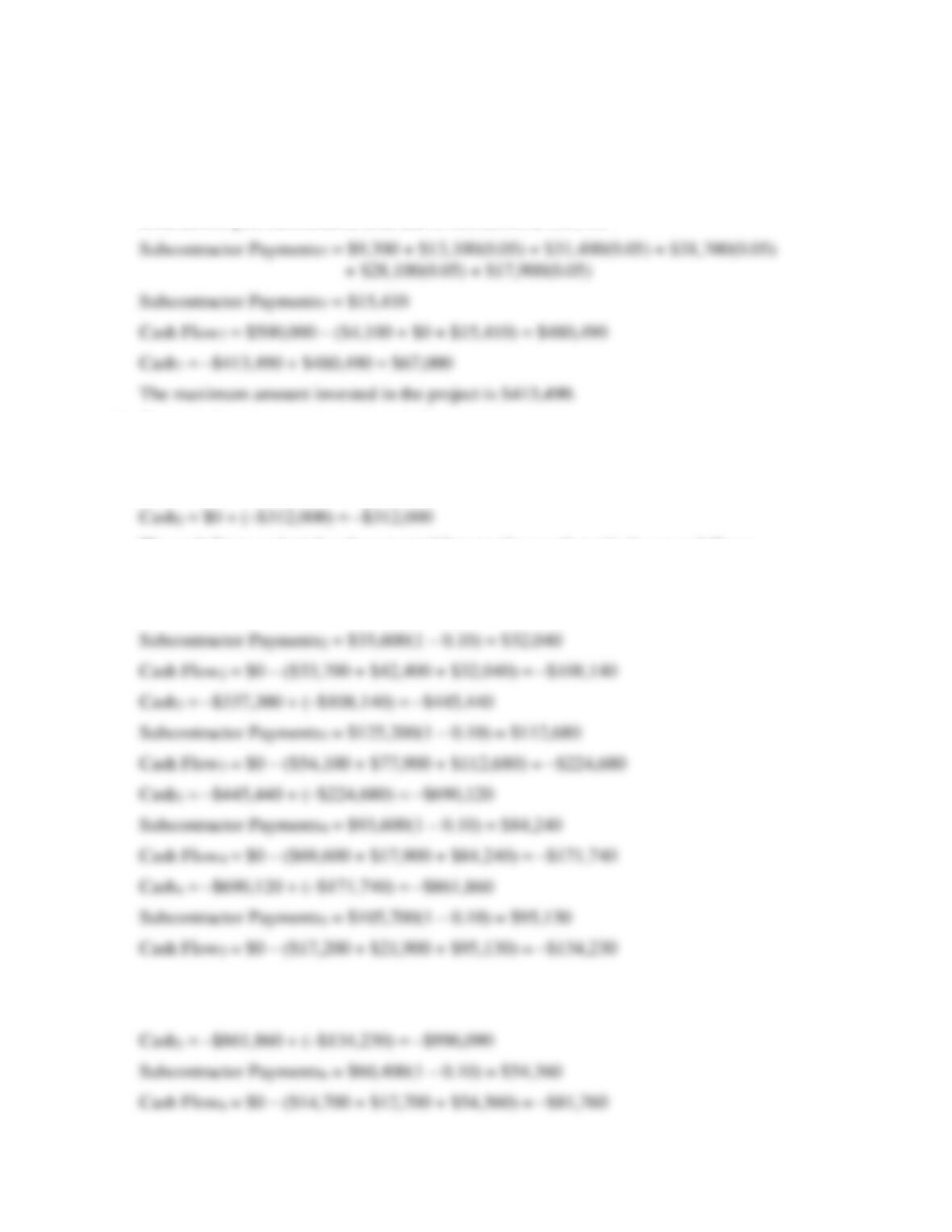
Because no additional payments are made between the end of the sixth month and the time
the project is paid for, the total cash generated just before the payment is received is the same
as it is for the end of month six.
The subcontractor payments for the seventh month are the entire subcontractor costs for the
sixth month plus all retention held and is calculated as follows:
13. The cash flow for month zero is as follows:
Cash Flow0 = $0 – ($250,000 + $30,000 + $7,000 + $15,000 + $10,000) = –$312,000
The total cash generated by the project at the end of month zero is as follows:
The cash flows and total cash generated for months one through six are as follows:
Cash Flow1 = $0 – ($0 + $25,300 + $0) = –$25,300
Cash1 = –$312,000 + (–$25,300) = –$337,300
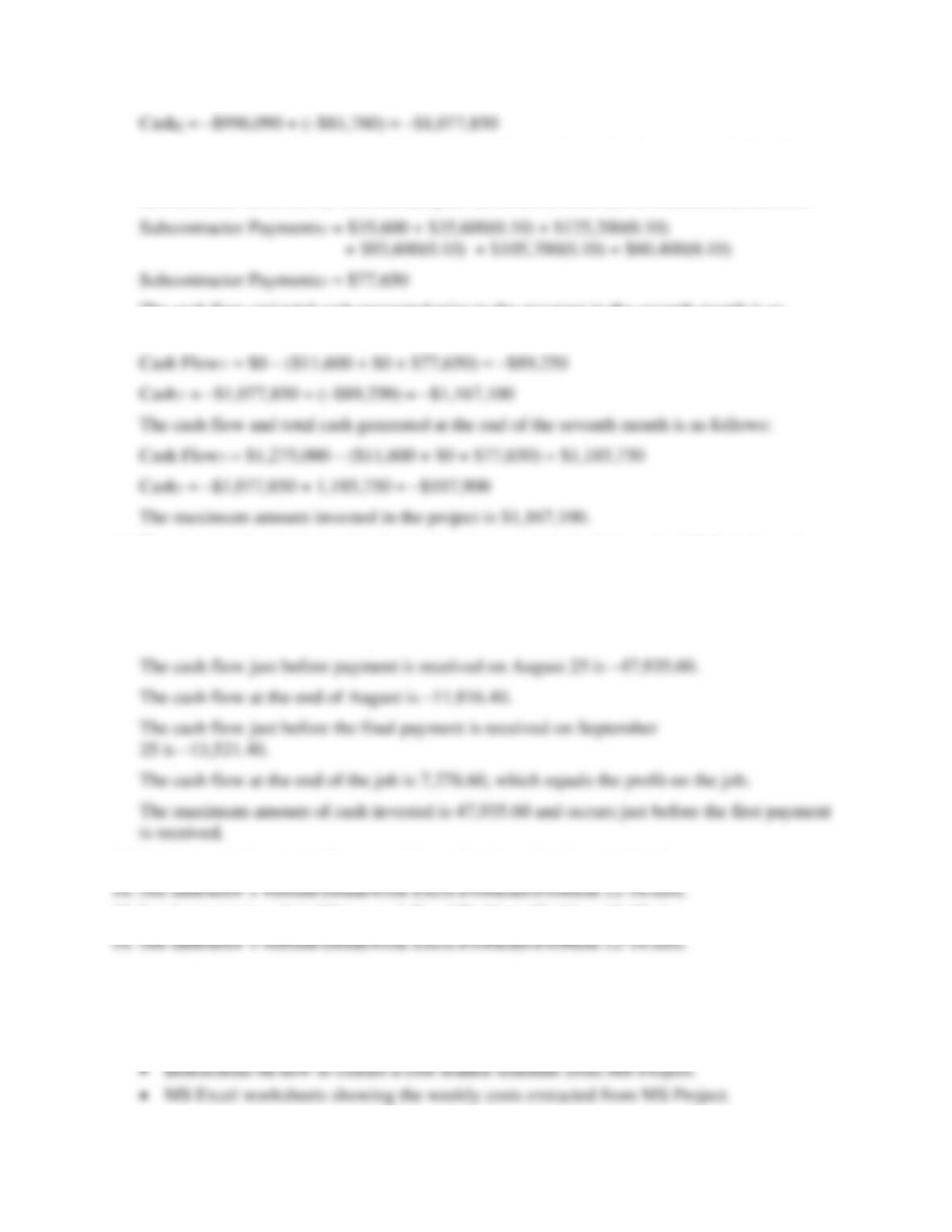
In the seventh month payments will be made to the supplier and subcontractor before the
project is sold. The subcontractor payments for the seventh month are the entire
subcontractor costs for the sixth month plus all retention held and is calculated as follows:
The cash flow and total cash generated prior to the payment in the seventh month is as
follows:
14. The amount of cash invested in the project at any time is the balance in 110 Cash from the
solution to Problem 20 of Chapter 3. From this solution we get the following amounts:
The project starts on July 13 and the cash flow is zero.
The cash flow at the end of July is –21,246.40.
15. See Instructor’s website\Homework Excel Problems\Problem 12-15.xlsx.
17. See Instructor’s website\Homework Excel Problems\Problem 12-17.xlsx.
19. The Instructor’s website\Homework Excel Problems\Problem 12-9 folder which includes
• MS Project schedules for the materials, labor, subcontract, and other costs from which the
weekly costs can be extracted.