123
Chapter 11: Temperature and Temperature-Related Variables in
Engineering
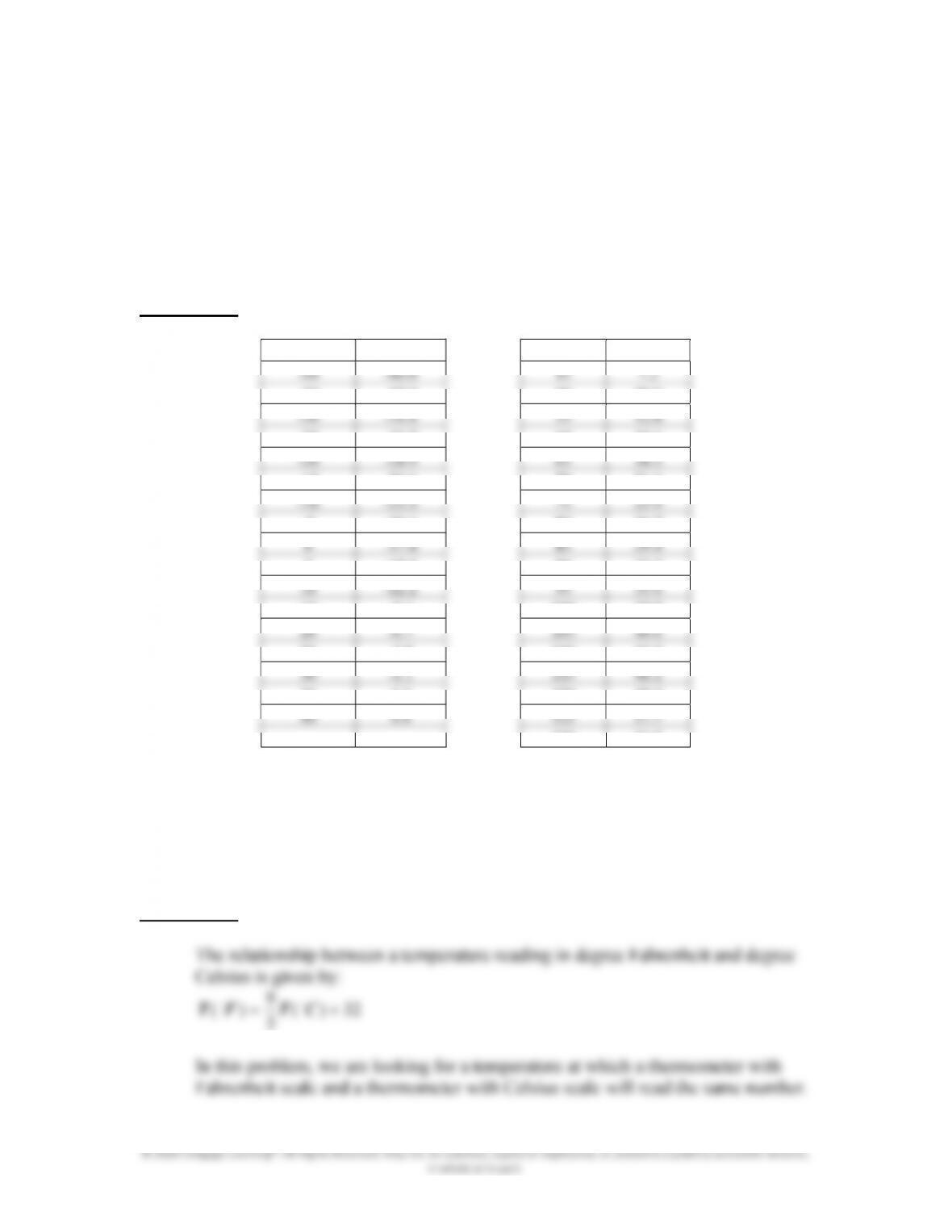
11.2 Using Excel, or a spreadsheet of your choice, create a degrees Fahrenheit to
degrees Celsius conversion table for the following temperature range: from –40
F to 130F in increments of 5F.
SOLUTION
Temp. (°F)
Temp. (°C)
Temp. (°F)
Temp. (°C)
–
40
–
40.0
45
7.2
–
35
–
37.2
50
10.0
–
30
–
34.4
55
12.8
–
25
–
31.7
60
15.6
–
20
–
28.9
65
18.3
–
15
–
26.1
70
21.1
–
10
–
23.3
75
23.9
–
5
–
20.6
80
26.7
0
–
17.8
85
29.4
5
–
15.0
90
32.2
10
–
12.2
95
35.0
15
–
9.4
100
37.8
20
–
6.7
105
40.6
25
–
3.9
110
43.3
30
–
1.1
115
46.1
35
1.7
120
48.9
40
4.4
125
51.7
130
54.4
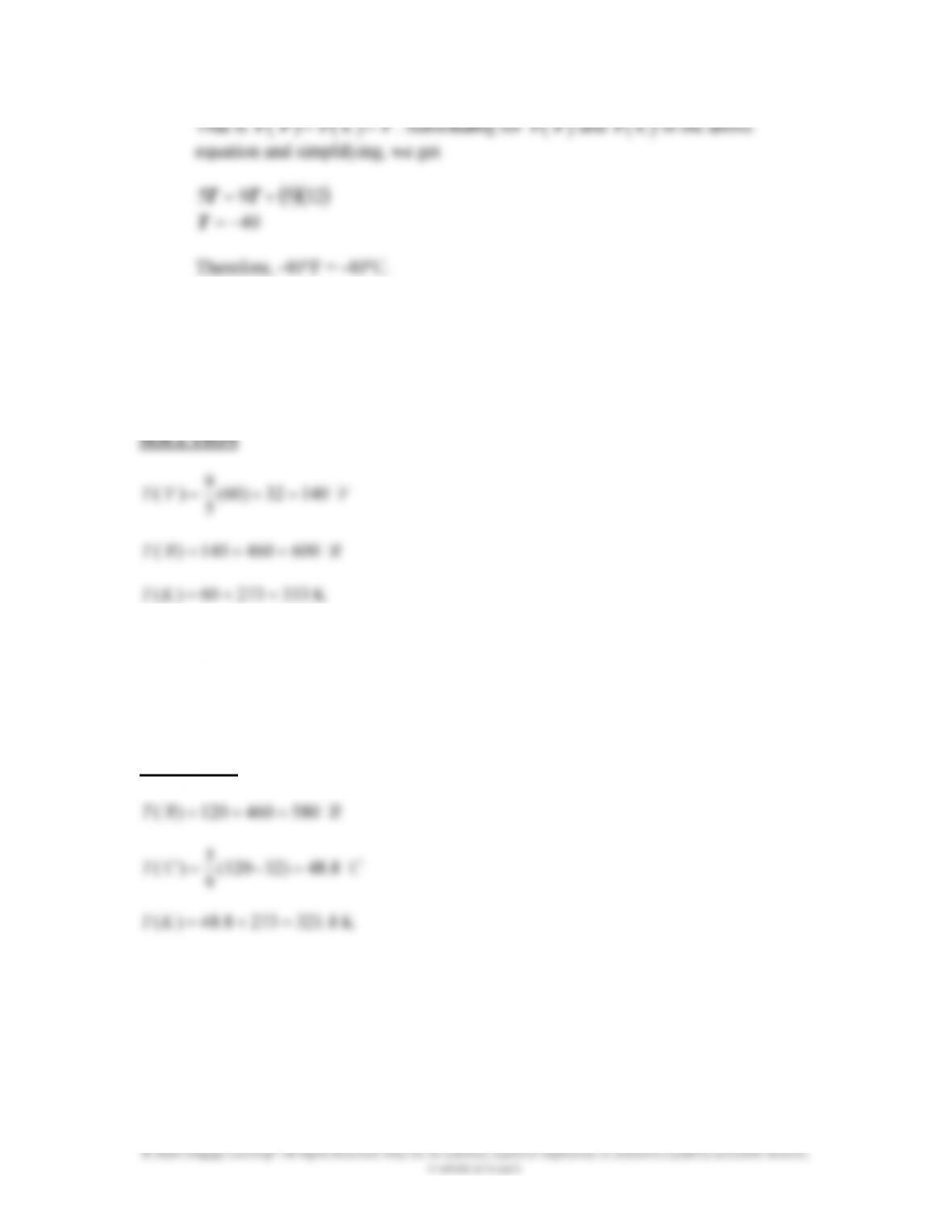
11.3 Alcohol thermometers can measure temperatures in the range of –100 F to 200
F. Determine the temperature at which an alcohol thermometer with a Fahrenheit
scale will read the same number as a thermometer with a Celsius scale will.
SOLUTION
124
© 2020 Cengage Learning®. All Rights Reserved. May not be scanned, copied or duplicated, or posted to a publicly accessible website,
in whole or in part.
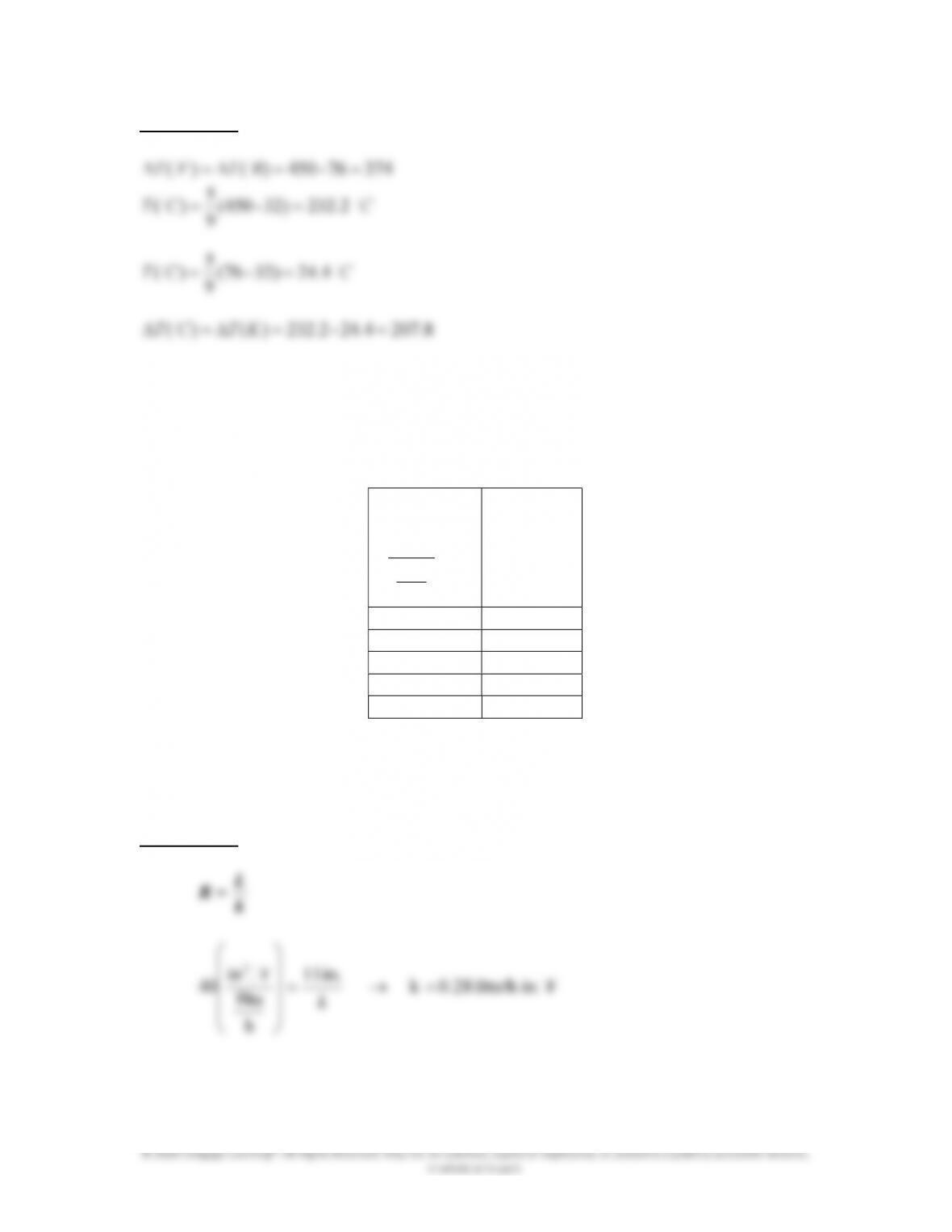
11.4 What is the equivalent value of T = 60ºC in degrees Fahrenheit, Rankine, and
Kelvin?
11.5 What is the equivalent value of T = 120ºF in degrees Rankine, Celsius, and
Kelvin?
SOLUTION
11.6 The inside temperature of an oven is maintained at 450 ºF while the kitchen air
temperature is 76 ºF. What is oven/kitchen air temperature difference in (a) degree
Fahrenheit, (b) degree Rankine, (c) degree Celsius, and (d) Kelvin?
125
SOLUTION
11.8 A manufacturer of loose-fill cellulose insulating material provides a table showing
the relationship between the thickness of the material and its R-value. The
manufacturer’s data is shown in the accompanying table.
R-value
h
Btu
F.in2
Thickness
(in.)
R
–
40
11
R
–
32
9
R
–
24
6.5
R
–
19
5.25
R
–
13
3.5
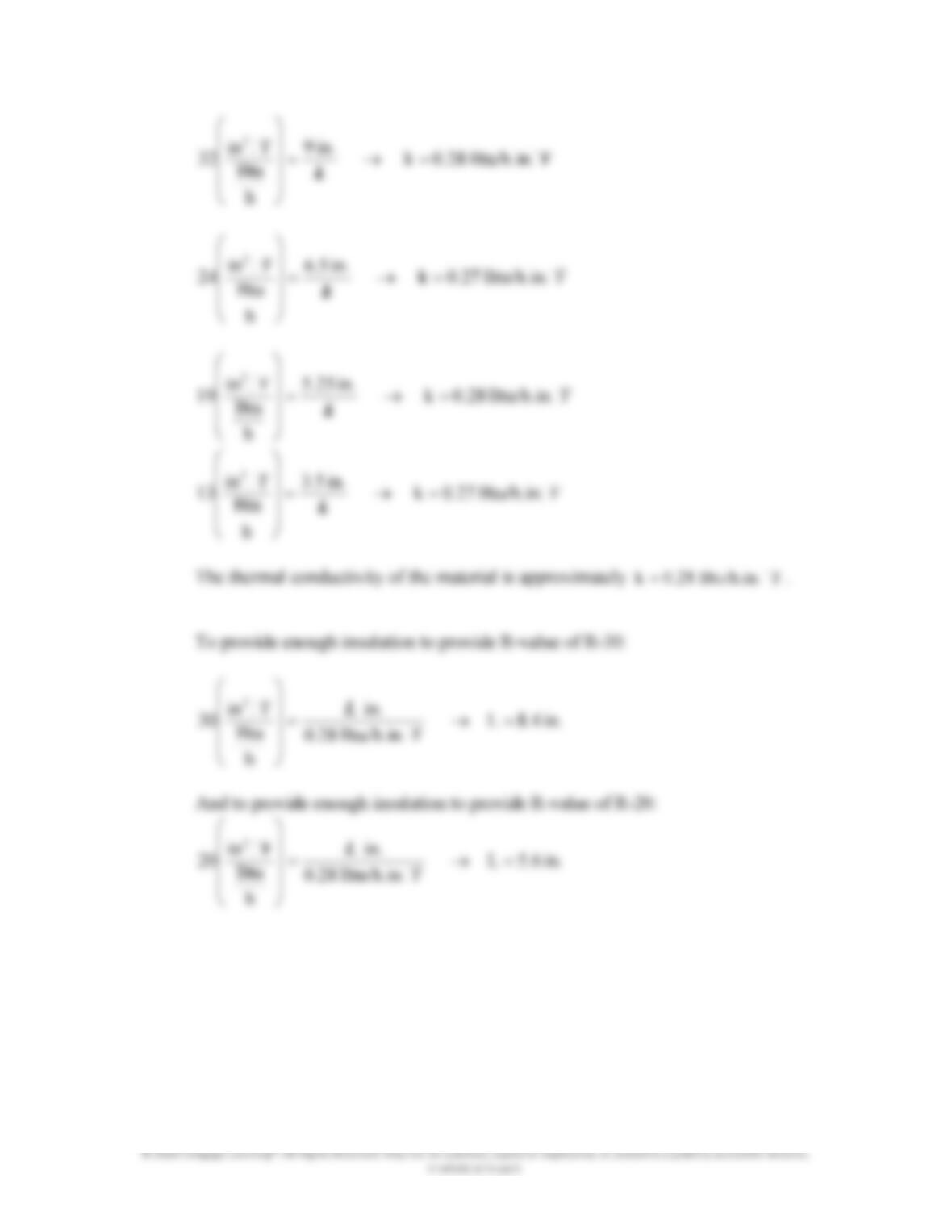
Calculate the thermal conductivity of the insulating material. Also, determine how
thick the insulation should be to provide R-value of: (a) R-30, (b) R-20.
SOLUTION
126
© 2020 Cengage Learning®. All Rights Reserved. May not be scanned, copied or duplicated, or posted to a publicly accessible website,
in whole or in part.
F Btu/h.in.0.28 k
in. 9
h
Btu
F.in
32
2
k
F Btu/h.in.0.27 k
in. .56
h
Btu
F.in
24
2
k
F Btu/h.in.0.28 k
in. 5.25
h
Btu
F.in
19
2
k
F Btu/h.in.0.27 k
in. .53
h
Btu
F.in
13
2
k
The thermal conductivity of the material is approximately F Btu/h.in.0.28 k
.
To provide enough insulation to provide R-value of R-30:
in. 8.4 L
F Btu/h.in.28.0
in.
h
Btu
F.in
30
2
L
And to provide enough insulation to provide R-value of R-20:
in. 5.6 L
F Btu/h.in.28.0
in.
h
Btu
F.in
20
2
L
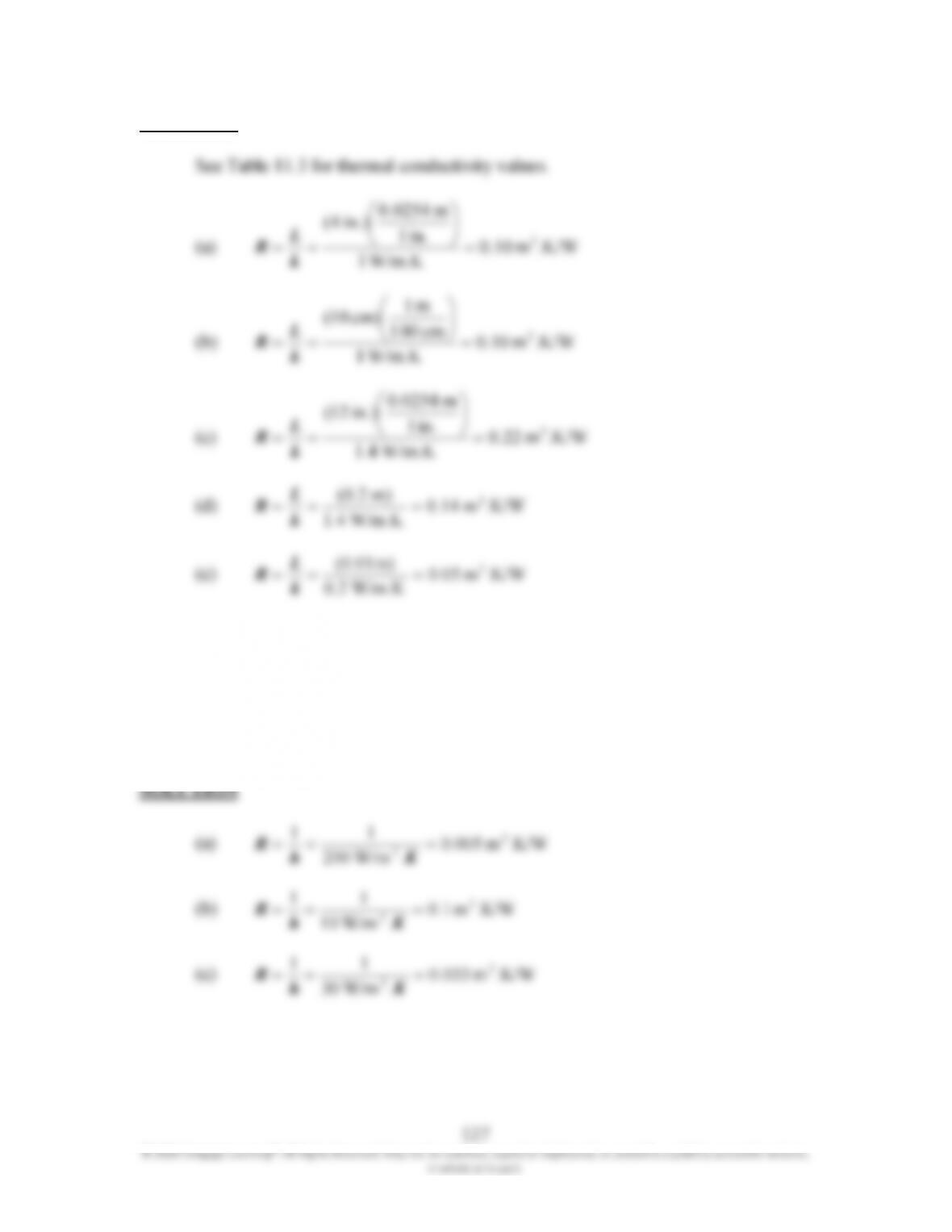
11.9 Calculate the R-value for the following materials:
(a) 4-in.-thick brick
(b) 10-cm-thick brick
(c) 12-in.-thick concrete slab
(d) 20-cm-thick concrete slab
(e) 1-cm-thick human fat layer
SOLUTION
W/m.K
1.4
W/m.K
0.2
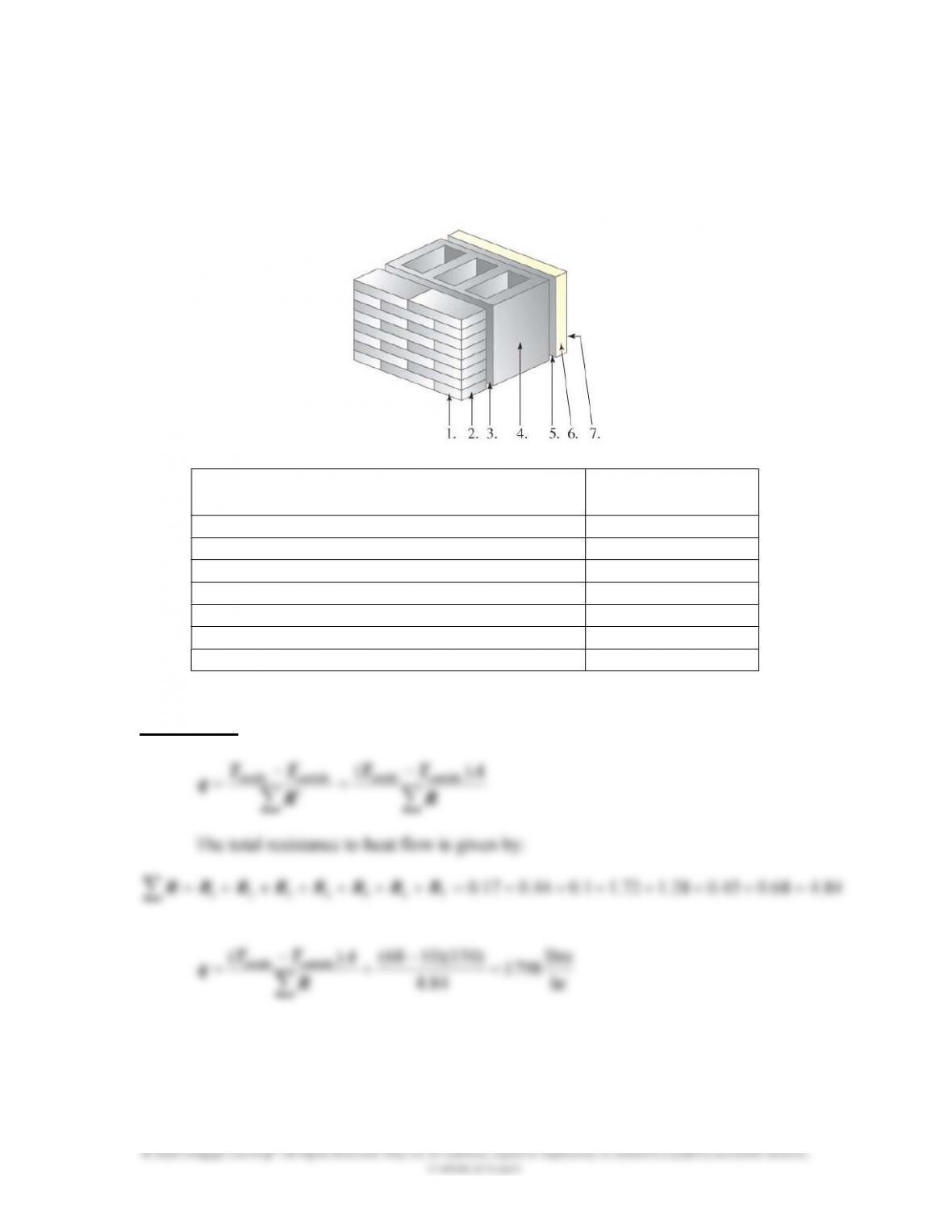
11.10 Calculate the thermal resistance due to convection for the following situations:
(a) warm water with h = 200 W/m2·K
(b) warm air with h = 10 W/m2·K
(c) warm moving air (windy situation) h = 30 W/m2·K
.
W/m
200
.
W/m
0
1
.
W/m
30
128
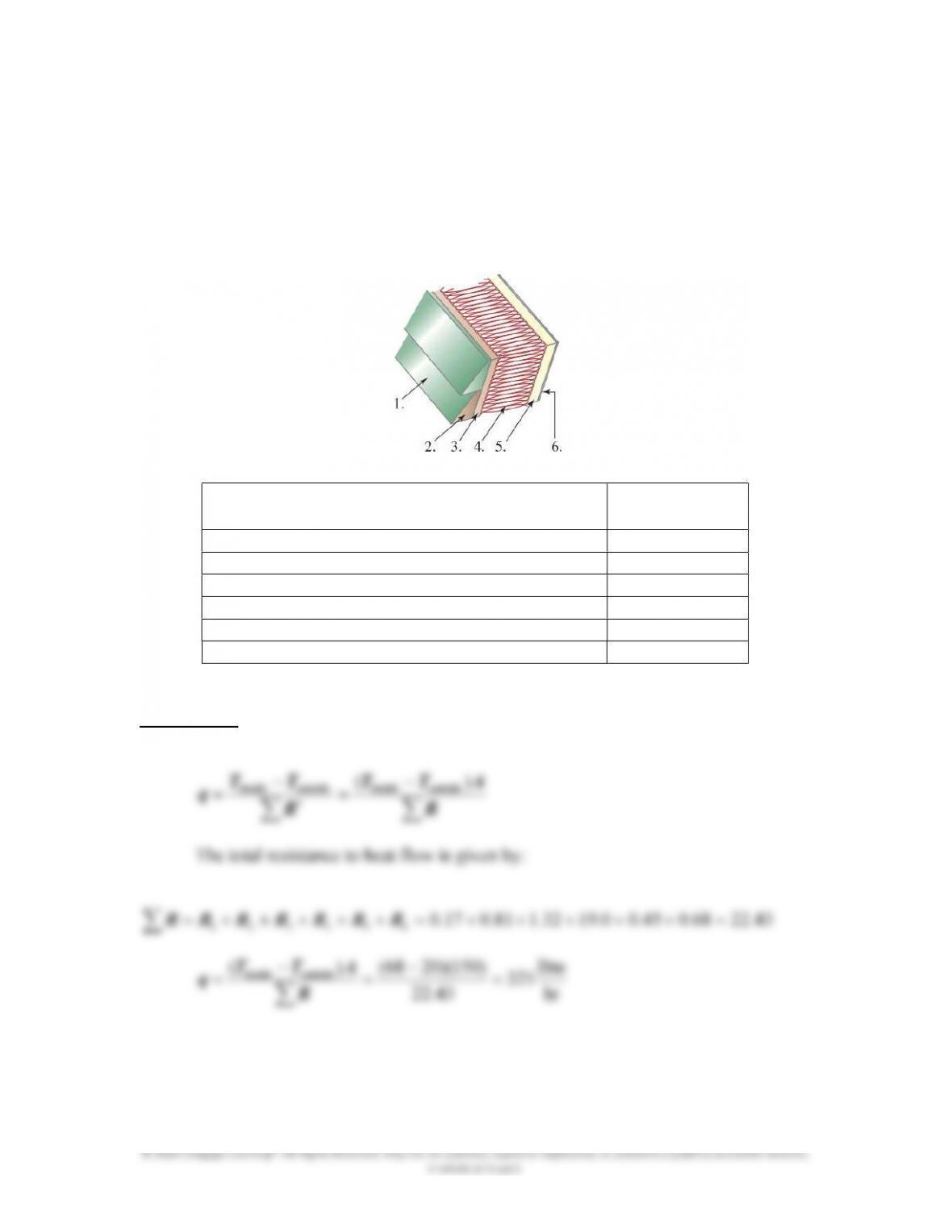
11.11 A typical exterior masonry wall of a house, shown in the accompanying figure,
consists of the items in the accompanying table. Assume an inside room
temperature of 68F and an outside air temperature of 10F, with an exposed area
of 150 ft2. Calculate the heat loss through the wall.
Items Resistance
(hr·ft2·F/Btu)
1. Outside film
resistance (winter, 15 mph wind)
0.17
2. Face brick (4 in.)
0.44
3.
Cement mortar (1/2 in.)
0.1
4. Cinder block (8 in.)
1.72
5. Air space (3/4 in.)
1.28
6. Gypsum
wall
board (1/2 in.)
0.45
7. Inside film resistance (
winter)
0.68
SOLUTION
129
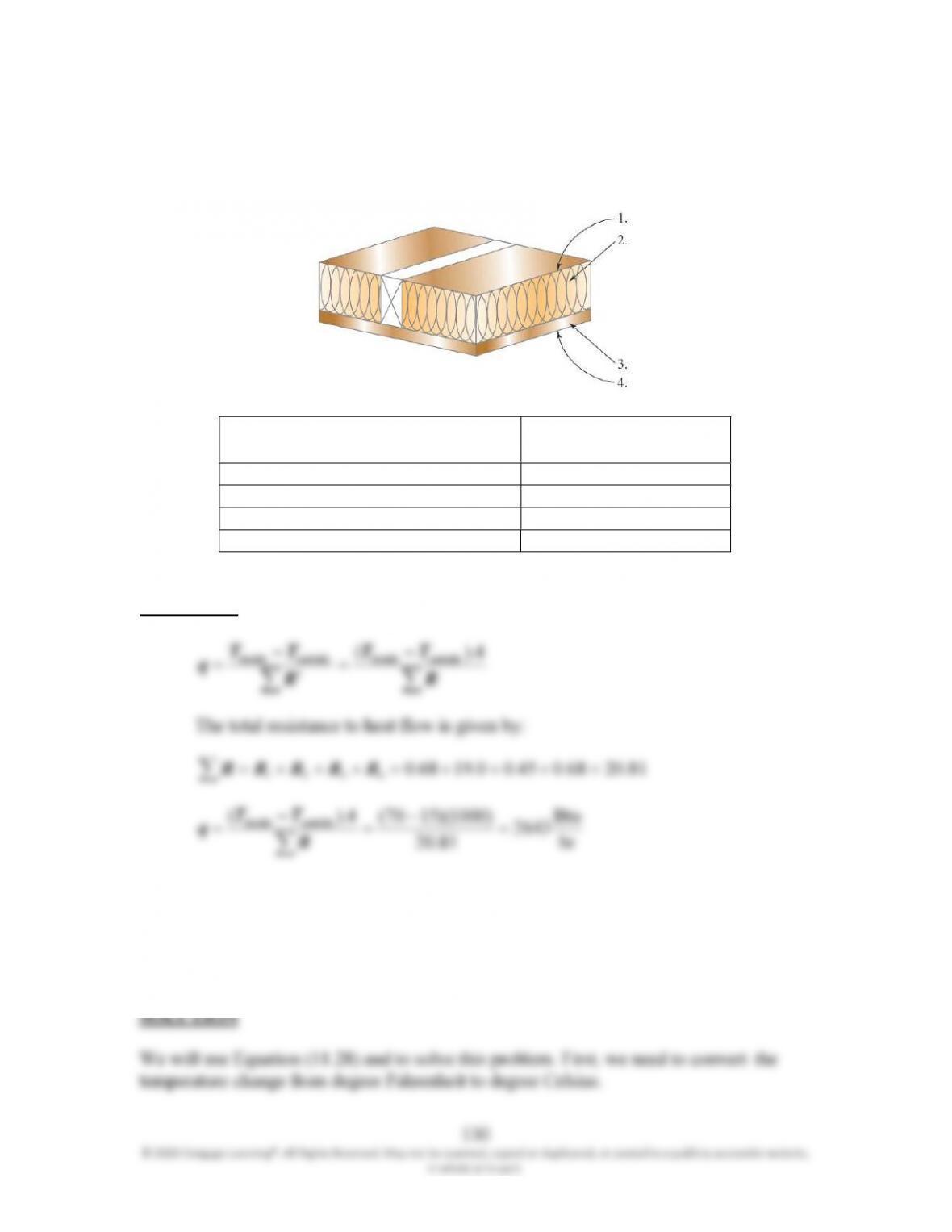
11.12 In order to increase the thermal resistance of a typical exterior frame wall, such as
the one shown in Example 11.11, it is customary to use 2 × 6 studs instead of 2
× 4 studs to allow for placement of more insulation within the wall cavity. A
typical exterior (2 × 6) frame wall of a house consists of the materials shown in
the accompanying figure. Assume an inside room temperature of 68F and an
outside air temperature of 20F with an exposed area of 150 ft2. Determine the
heat loss through this wall.
Items
Resistance
(hr·ft2·F/Btu)
1.
O
utside film resistance (winter, 15 mph wind)
0.17
2.
S
iding, wood ( ½ x 8 lapped)
0.81
3.
S
heathing ( ½ in. regular)
1.32
4.
I
nsulation batt (5 ½ in.)
19.0
5.
G
ypsum wall
board (1/2 in.)
0.45
6.
I
nside film resistance (
winter)
0.68
SOLUTION
11.13 A typical ceiling of a house consists of items shown in the accompanying table.
Assume an inside room temperature of 70F and an attic air temperature of 15F,
with an exposed area of 1000 ft2. Calculate the heat loss through the ceiling.
Items Resistance
(hr·ft2·F/Btu)
1.
I
nside attic film resistance
0.68
2.
I
nsulation batt (6 in.)
19.0
3.
G
ypsum wall board (1/2 in.)
0.45
4.
I
nside film resistance (
winter)
0.68
SOLUTION
ATT
TT
81.20
R
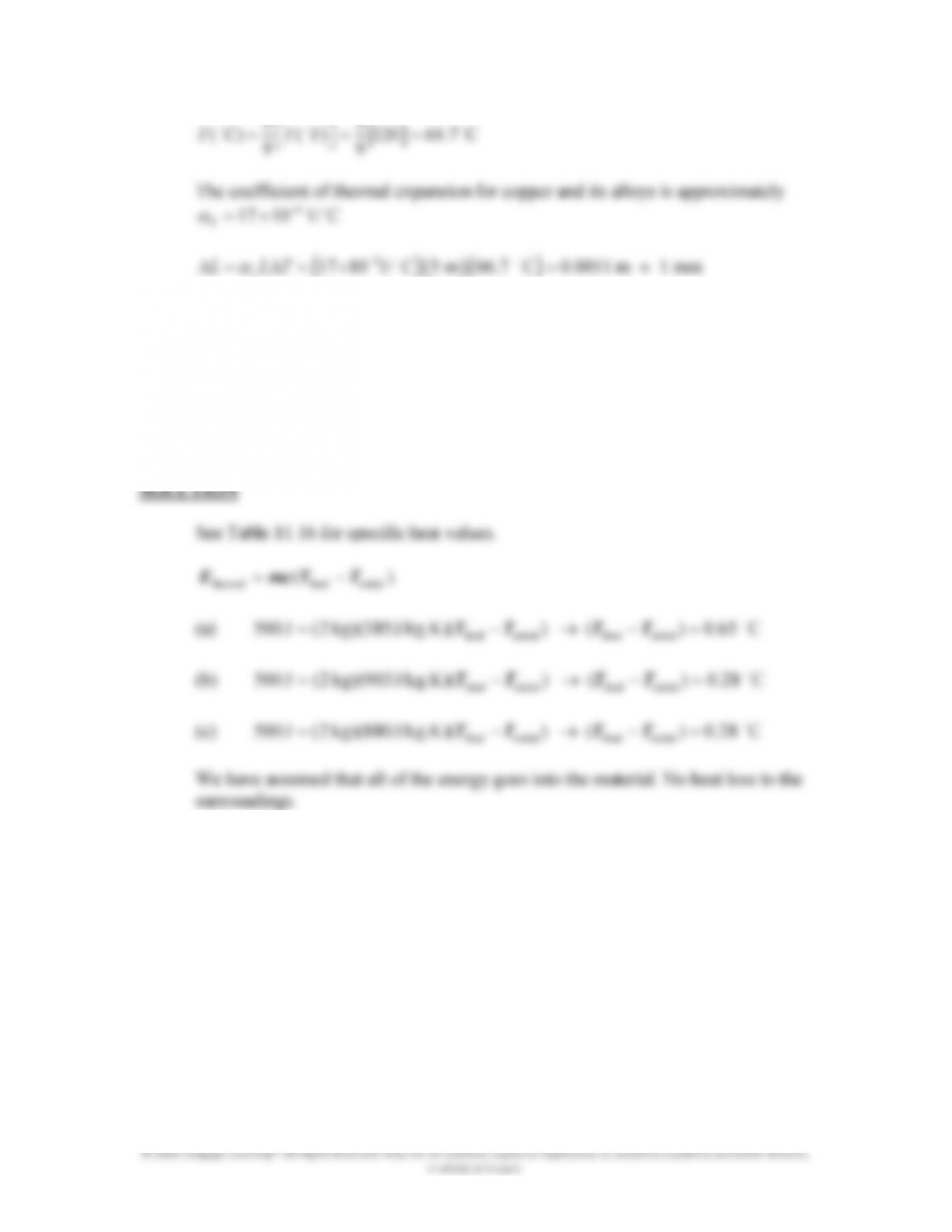
11.15 Calculate the change in 5-m-long copper wire when its temperature changes by
120F.
131
5 5
( C) ( F) 120 66.7 C
9 9
T T
The coefficient of thermal expansion for copper and its alloys is approximately
C1/ 1017 6
L
6
17 10 1/ C 5 m 66.7 C 0.0011 m 1 mm
L
L L T
11.16 Determine the temperature rise that would occur when 2 kg of the following
materials are exposed to a heating element putting out 500 J. Discuss your
assumptions.
(a) The material is copper. (b) The material is aluminum. (c) The material is
concrete.
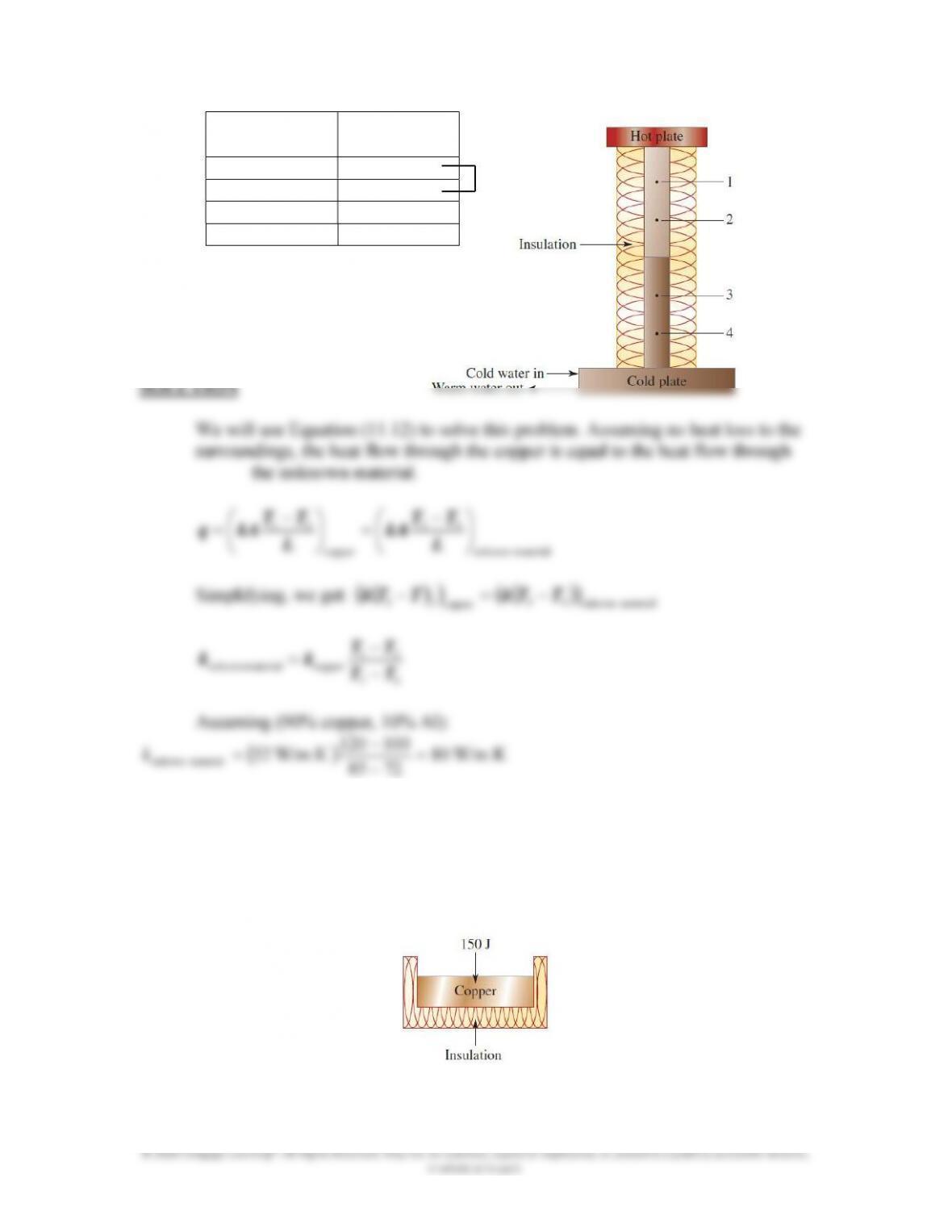
11.17 The thermal conductivity of a solid material can be determined using a setup
similar to the one shown in the accompanying figure. The thermocouples are
placed at 2.5 cm- intervals in the known material (copper alloy, K=52W/m·K)
and the unknown sample as shown. The known material is heated on the top by a
heating element, and the bottom surface of the sample is cooled by running water
through the heat sink shown. Determine the thermal conductivity of the unknown
sample for the set of data given in the accompanying table. Assume no heat loss
to the surroundings and perfect thermal contact at the common interface of the
sample and the copper.
132
Thermocouple
Location
Temperature
(
C)
1
120
2
100
3
85
4
72
72
85
materialunkown
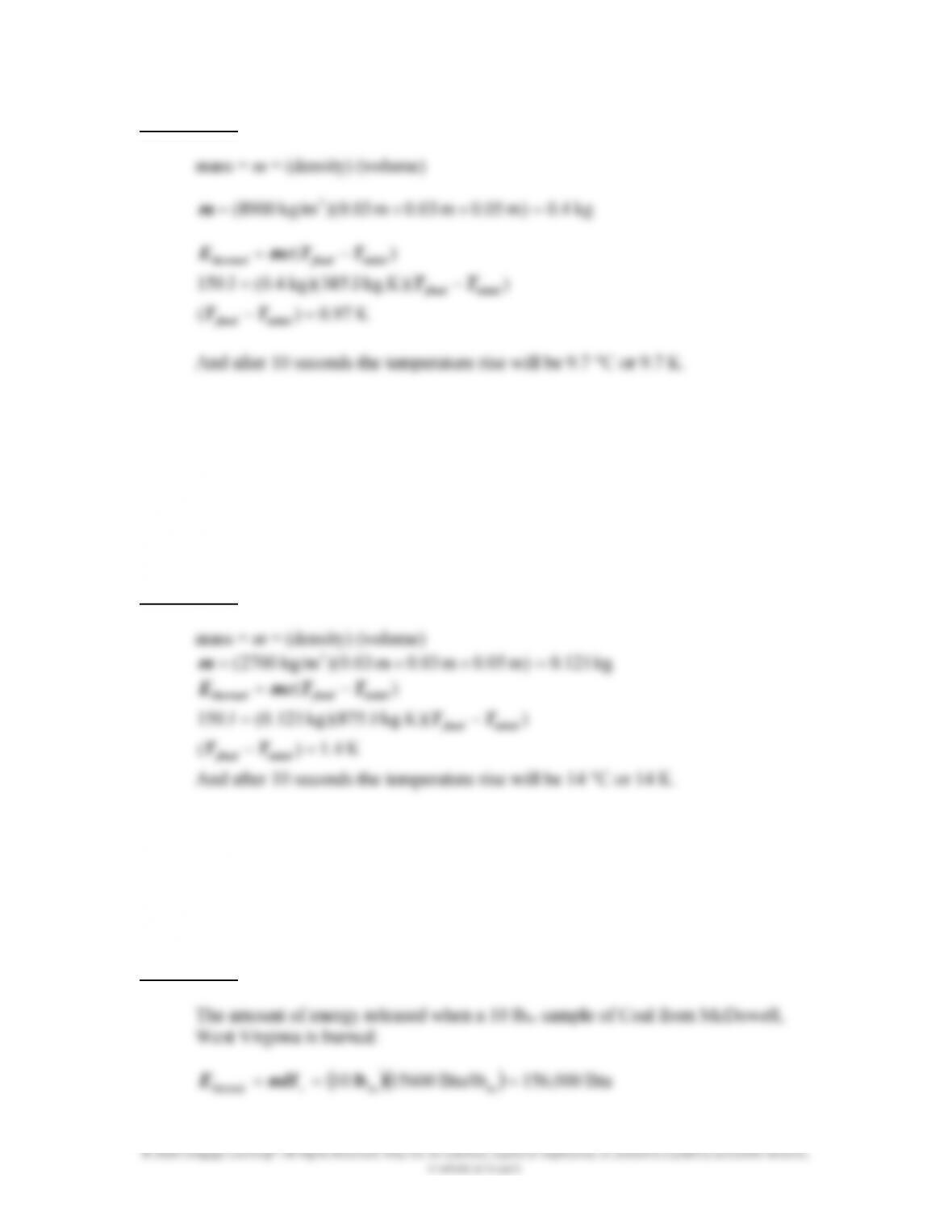
11.19 A copper plate, with dimensions of 3 cm × 3 cm × 5 cm (length, width, and
thickness respectively), is exposed to a thermal energy source that puts out 150 J
every second, as shown in the accompanying figure. The density of copper is
8900 kg/m3. Assuming no heat loss to the surrounding block, determine the
temperature rise in the plate after 10 seconds.
Copper
133
SOLUTION
11.20 An aluminum plate, with dimensions of 3 cm × 3 cm × 5 cm (length, width, and
thickness respectively), is exposed to a thermal energy source that puts out 150 J
every second as shown in the accompanying figure. The density of aluminum is
2700 kg/m3. Assuming no heat loss to the surrounding block, determine the
temperature rise in the plate after 10 seconds.
SOLUTION
11.24 Refer to Tables 11.9 and 11.10 to answer this question. What is the maximum
amount of energy released when a 10-lbm sample of coal from McDowell, West
Virginia is burned? Also calculate the amount of energy released when 15 ft3 of
natural gas from Oklahoma is burned.
SOLUTION
134
© 2020 Cengage Learning®. All Rights Reserved. May not be scanned, copied or duplicated, or posted to a publicly accessible website,
in whole or in part.
The amount of energy released when 15 ft3 of natural gas from Oklahoma is
burned:
Btu610,14 Btu/ft974ft 15 33
thermal E
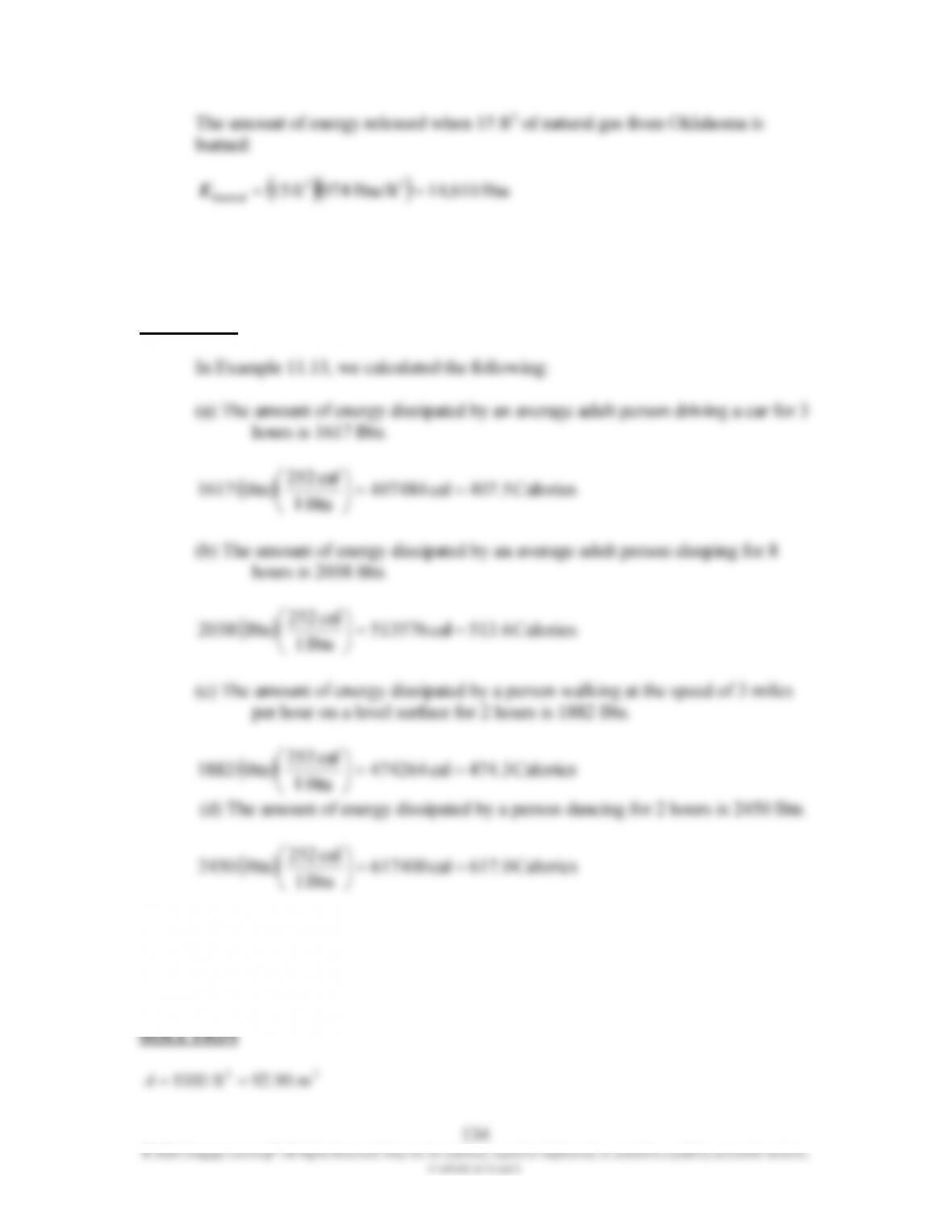
11.26 Convert the results of Example 11.13 from Btu to calories.
SOLUTION
Calories 617.0 cal 617400
Btu1
Btu 4502
11.27 Calculate the heat transfer rate from a 1000 ft2, 6-in-thick concrete wall with
inside and outside surface temperatures of 20 ºC and 0 ºC.