109
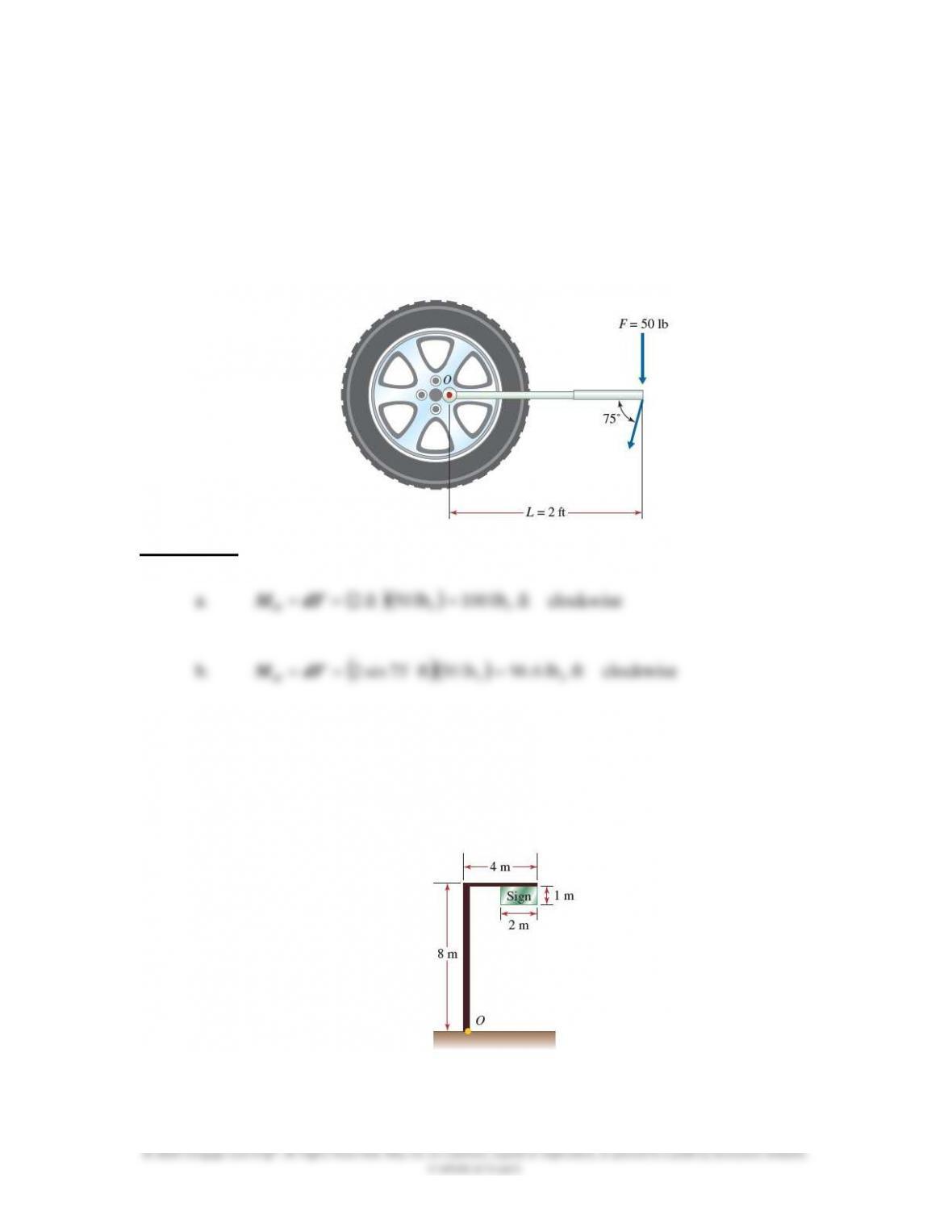
10.30 The tire wrench shown in the accompanying figure is used to tighten the bolt on a
wheel. Given the information on the diagram, determine the moment about point
O for the two loading situations shown:
a. pushing perpendicular to the wrench arm, and
b. pushing at a 75 angle, as shown.
SOLUTION
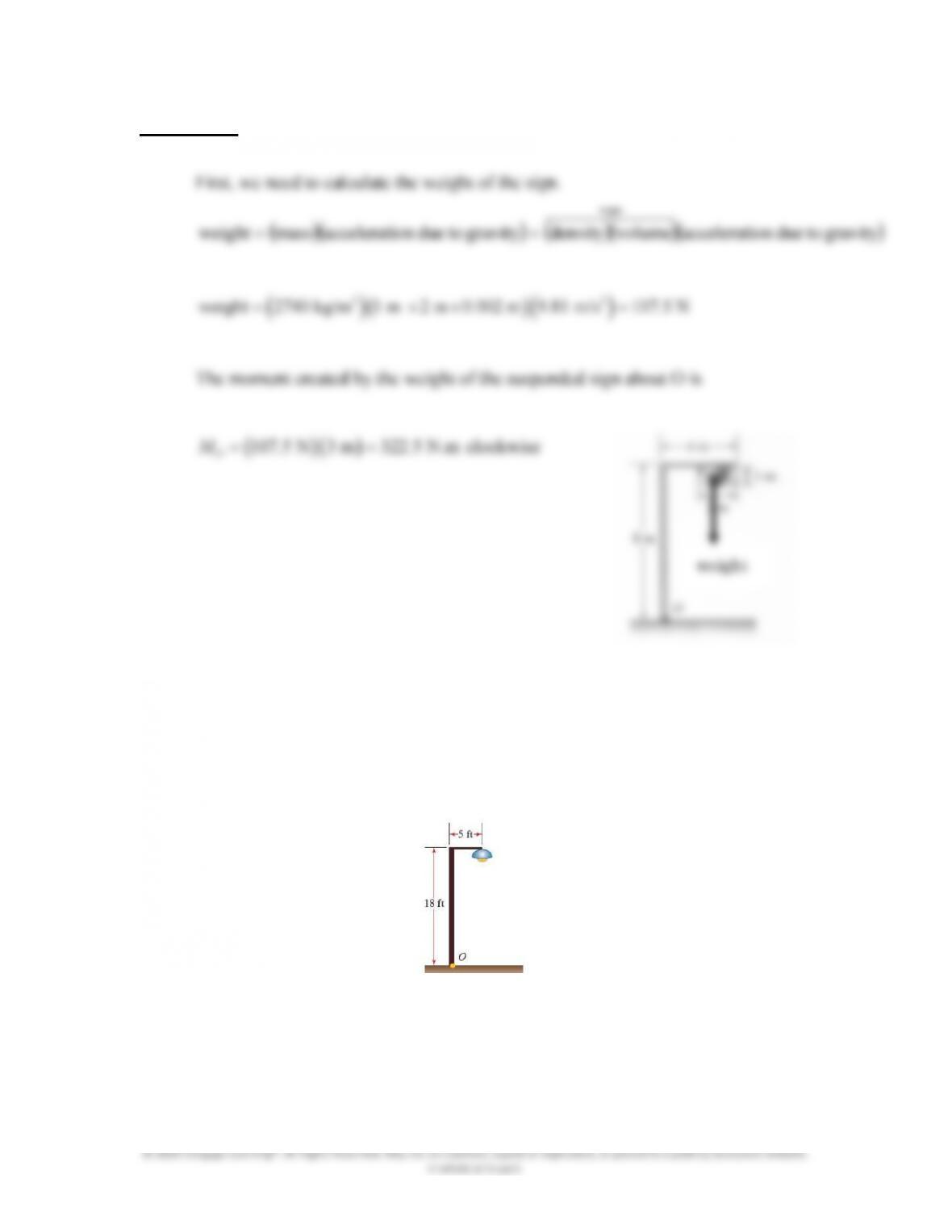
10.31 Determine the moment created by the weight of the suspended sign about point O.
Dimensions of the sign and the support are shown in the accompanying figure.
The sign is 2-mm thick and is made of aluminum.
110
SOLUTION
10.32 Determine the moment created by the weight of the lamp about point O. The
dimensions of the street light post and arm are shown in the accompanying figure.
The lamp weighs 15 lb.
SOLUTION
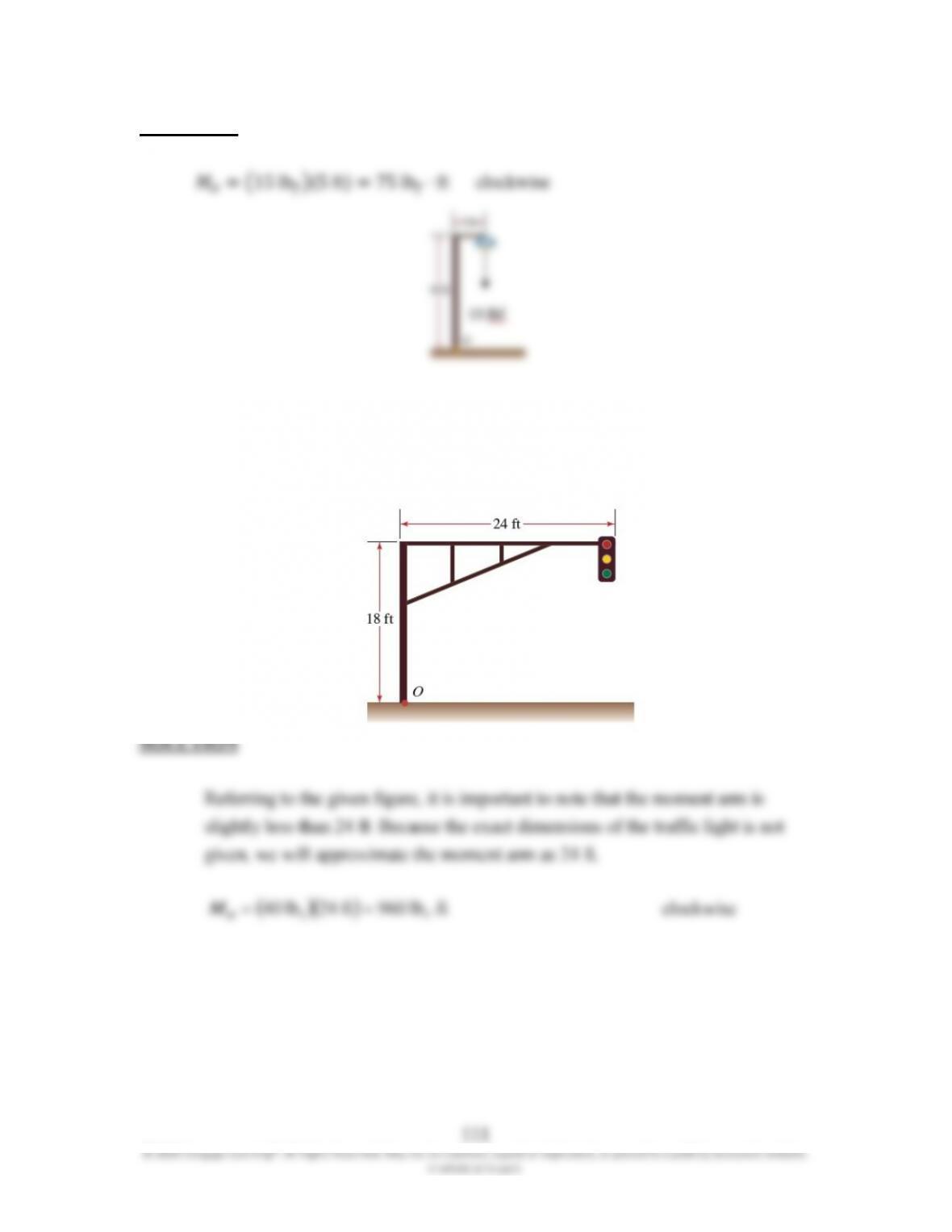
10.33 Determine the moment created by the weight of the traffic light about point O. The
dimensions of the traffic light post and arm are shown in the accompanying figure.
The traffic light weighs 40 lb.
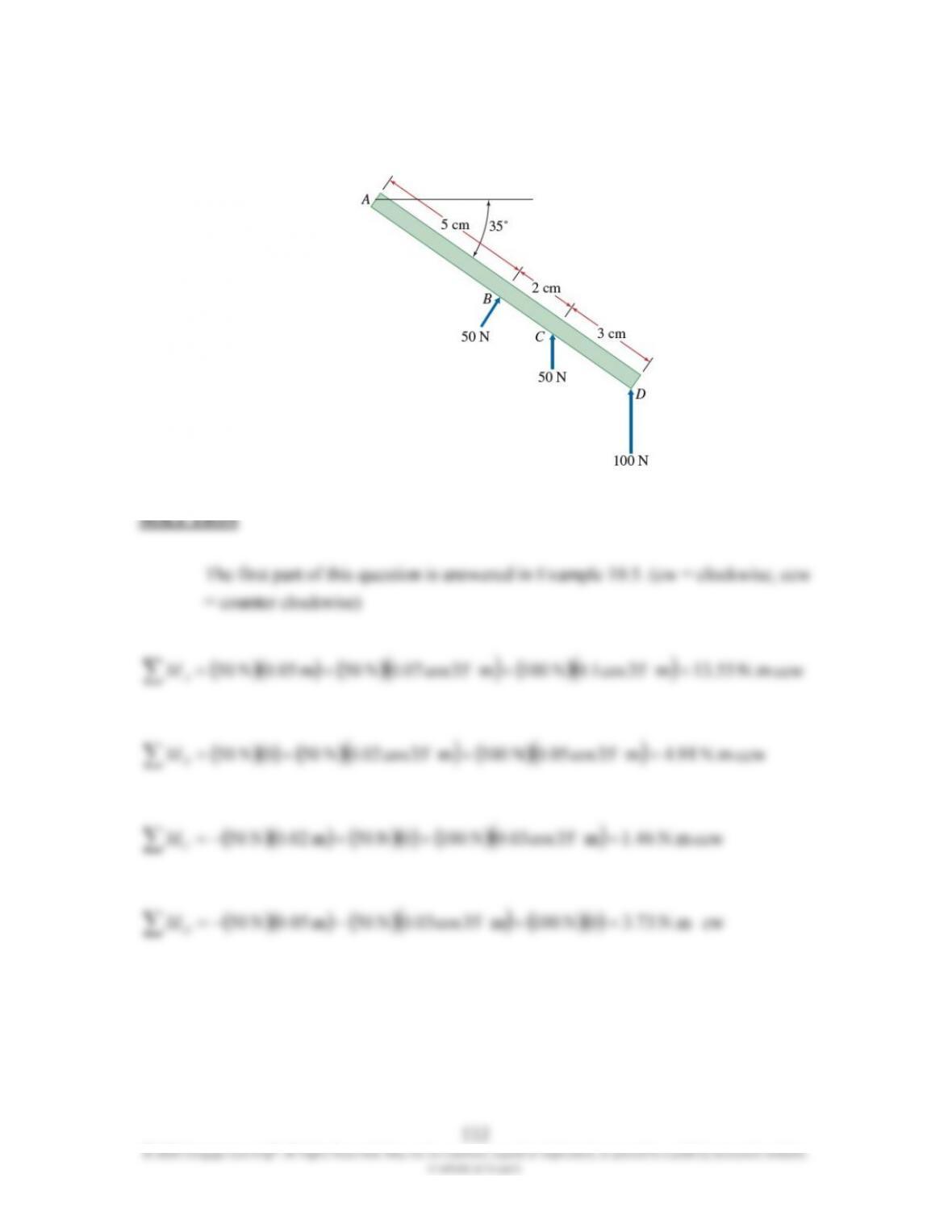
10.34 Determine the sum of the moments created by the forces shown in the
accompanying figure about points A, B, C, and D.
113
10.35 The coefficient of static friction between a concrete block and a surface is 0.8. The
block weighs 20 lbf. If a horizontal force of 15 lbf is applied to the block, would
the block move? And if not, what is the magnitude of friction force? What should
be the magnitude of the horizontal force to set the block in motion?
10.36 Calculate the shear modulus for a given cylindrical metal specimen and test
results of T = 1500 N·m, L = 20 cm, D = 5cm, φ= 0.02 rad. Can you tell what the
material is?
SOLUTION
32
TL
10.38 Determine the work done by an electric motor lifting an elevator and its occupants
weighing 2200 lb through five floors; assume a distance of 15 ft between each floor.
Compute the power requirements for the motor to go from the first to the fifth floor
in
a. 5 s
b. 8 s
Express your results in horsepower (1 hp=550 ft lb/s).
114
SOLUTION
10.39 If a laptop computer weighting 22 N is dropped from a distance of 1 m onto a floor,
determine the average reaction force from the floor if the time of contact is changed
by using different cushion materials as shown in the accompany table.
Time of Contact
(Seconds)
The Average
Reaction Force
(N)
0.01
0.05
0.1
1.0
2.0
115
SOLUTION
m/s 9.81
Time of Contact
(Seconds)
The Average
Reaction Force
(N)
0.01
904
0.05
181
0.1
90.4
1.0
9.0
2.0
4.5
10.40 Obtain the vapor pressures of alcohol, water, and glycerin at a room temperature of
20C.
SOLUTION
116
10.41 When learning to play some sports such as tennis, golf, or baseball, often you
are told to follow through with your swing. Using Equation (10.31), explain why
follow through is important.
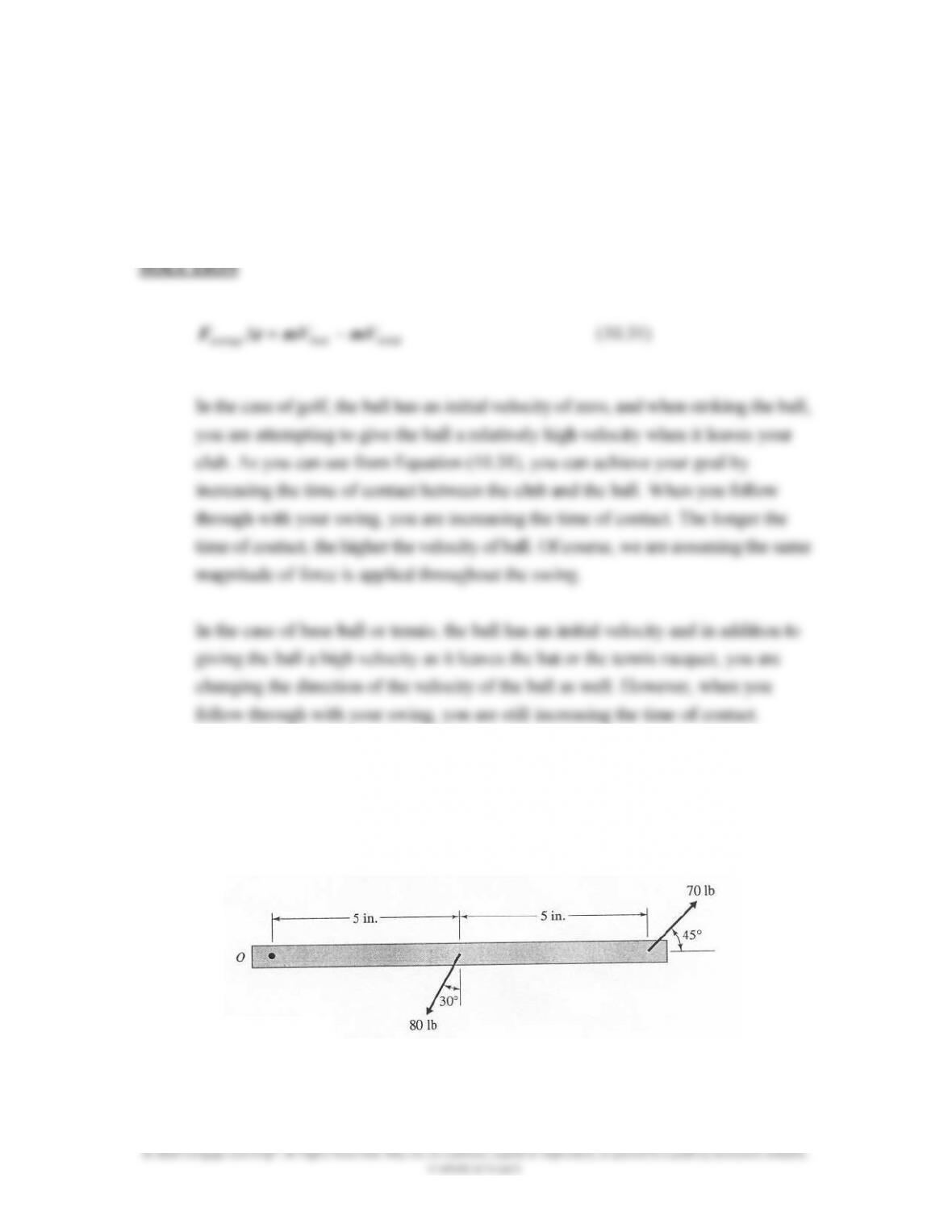
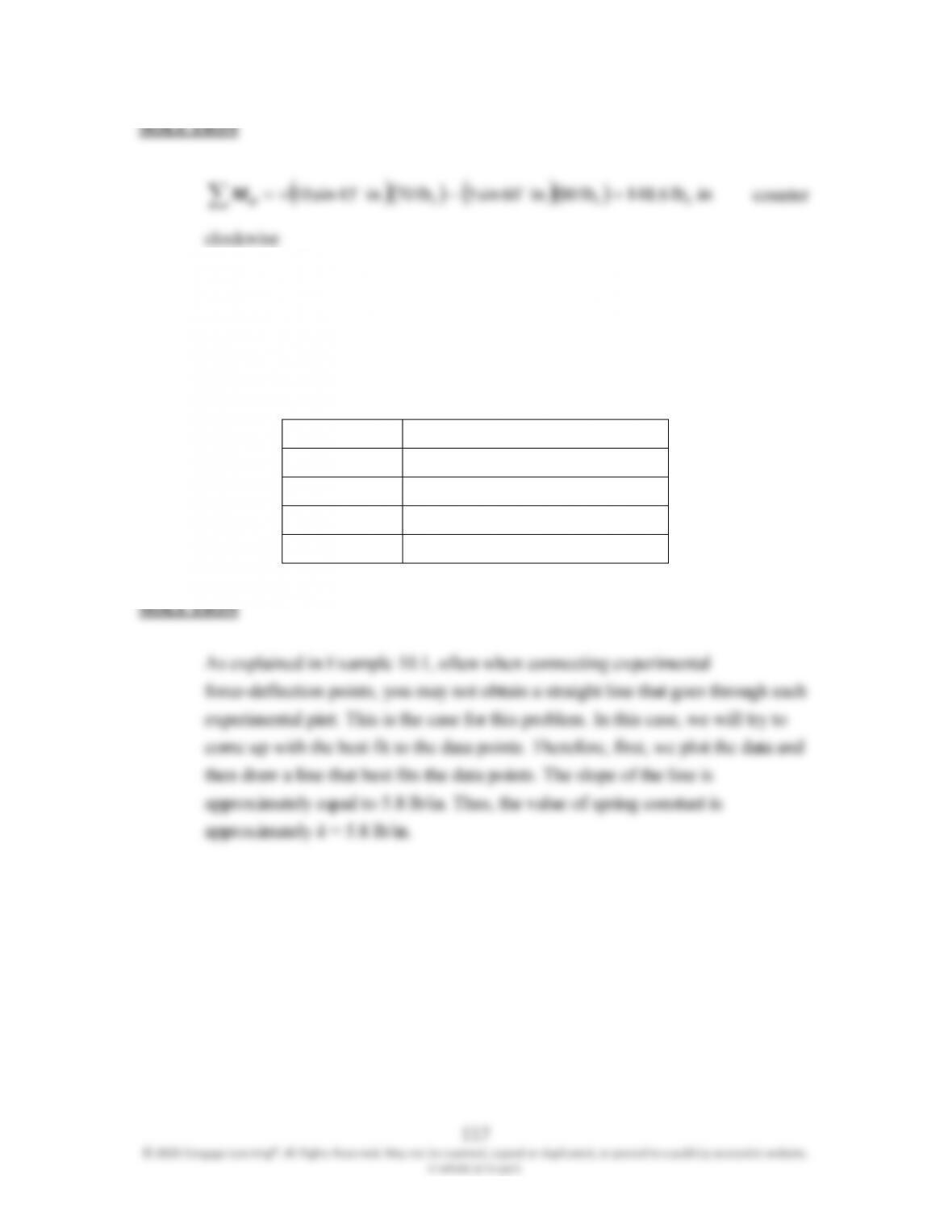
10.43 Calculate the moment created by the forces, shown in the accompanying figure,
about point O.
117
© 2020 Cengage Learning®. All Rights Reserved. May not be scanned, copied or duplicated, or posted to a publicly accessible website,
in whole or in part.
SOLUTION
.inlb 6.148lb 80in. 60sin5lb 70in. 45sin10 fff
O
M counter
clockwise
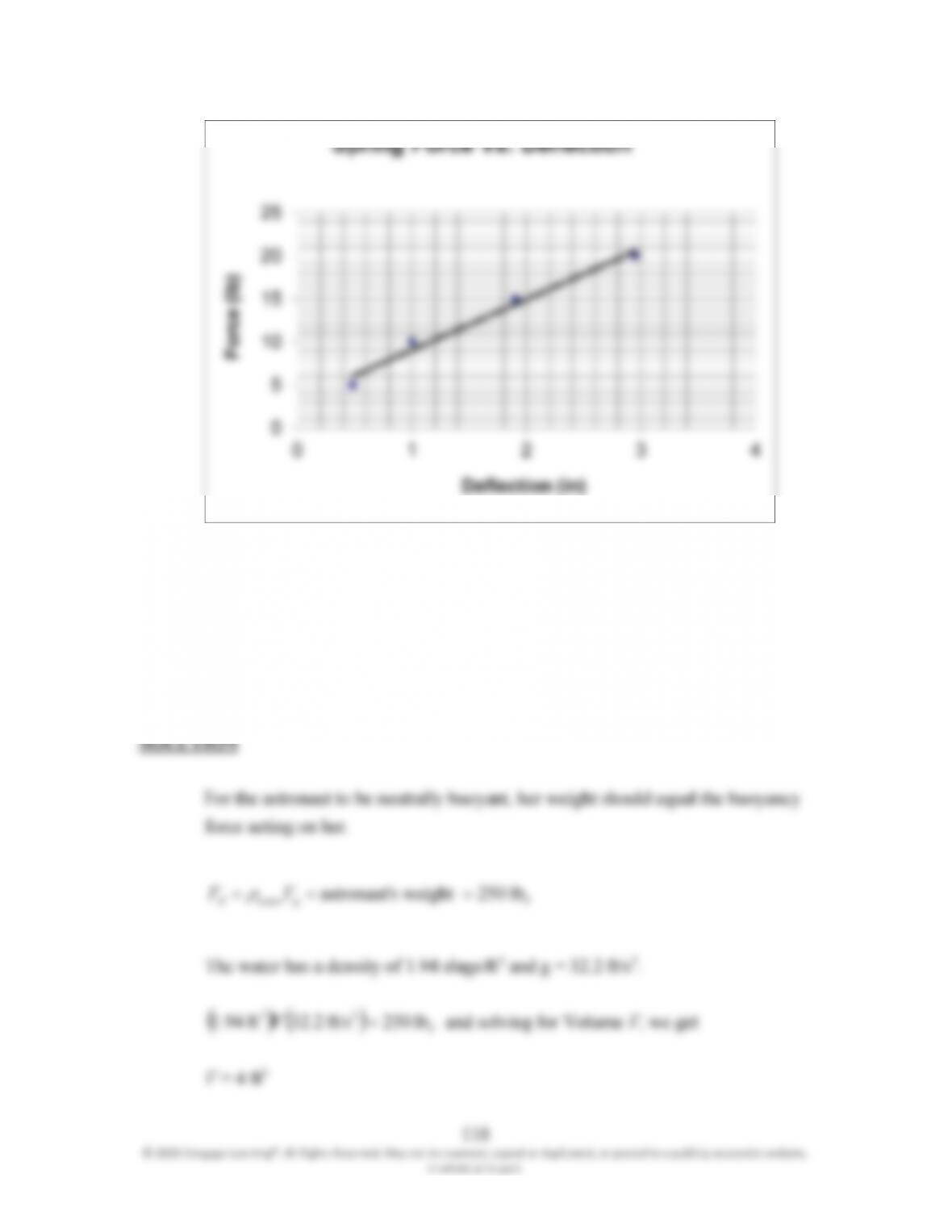
10.44 We have used an experimental setup similar to Example 10.1 to determine the
value of a spring constant. The deflection caused by the corresponding weights are
given in the accompanying table. What is the value of the spring constant?
Weight (lb) The Deflection of the Spring (in.)
5.0 0.48
10.0 1.00
15.0 1.90
20.0 2.95
10.45 If an astronaut and her space suit weigh 250 lb on Earth, what should be the
volume of her suit if she is to practice for weightless conditions in an underwater
neutral buoyant simulator similar to the one used by NASA shown in Chapter 7.
SOLUTION
For the astronaut to be neutrally buoyant, her weight should equal the buoyancy
force acting on her.
f
astronaut’s weight 250 lb
B water g
F V
The water has a density of 1.94 slugs/ft3 and g = 32.2 ft/s2.
f
23 lb 250 ft/s 32.2ft 94.1 V and solving for Volume V, we get
V = 4 ft3
0
5
10
15
20
25
01234
Force (lb)
Deflection (in)
Spring Force Vs. Deflection
119
© 2020 Cengage Learning®. All Rights Reserved. May not be scanned, copied or duplicated, or posted to a publicly accessible website,
in whole or in part.
Note that the density of water was expressed using units of slugs/ft3. If we were to
express the density of water in lbm/ft3 (water = 62.4 lbm/ft3), the value of density
must be divided by the correction factor gc = 32.2ft.lbm/lbf.s2 to have consistent
units in the given relationship.
10.46 Calculate the work required to bench press a 200-lb weight, at a distance of
20 in.
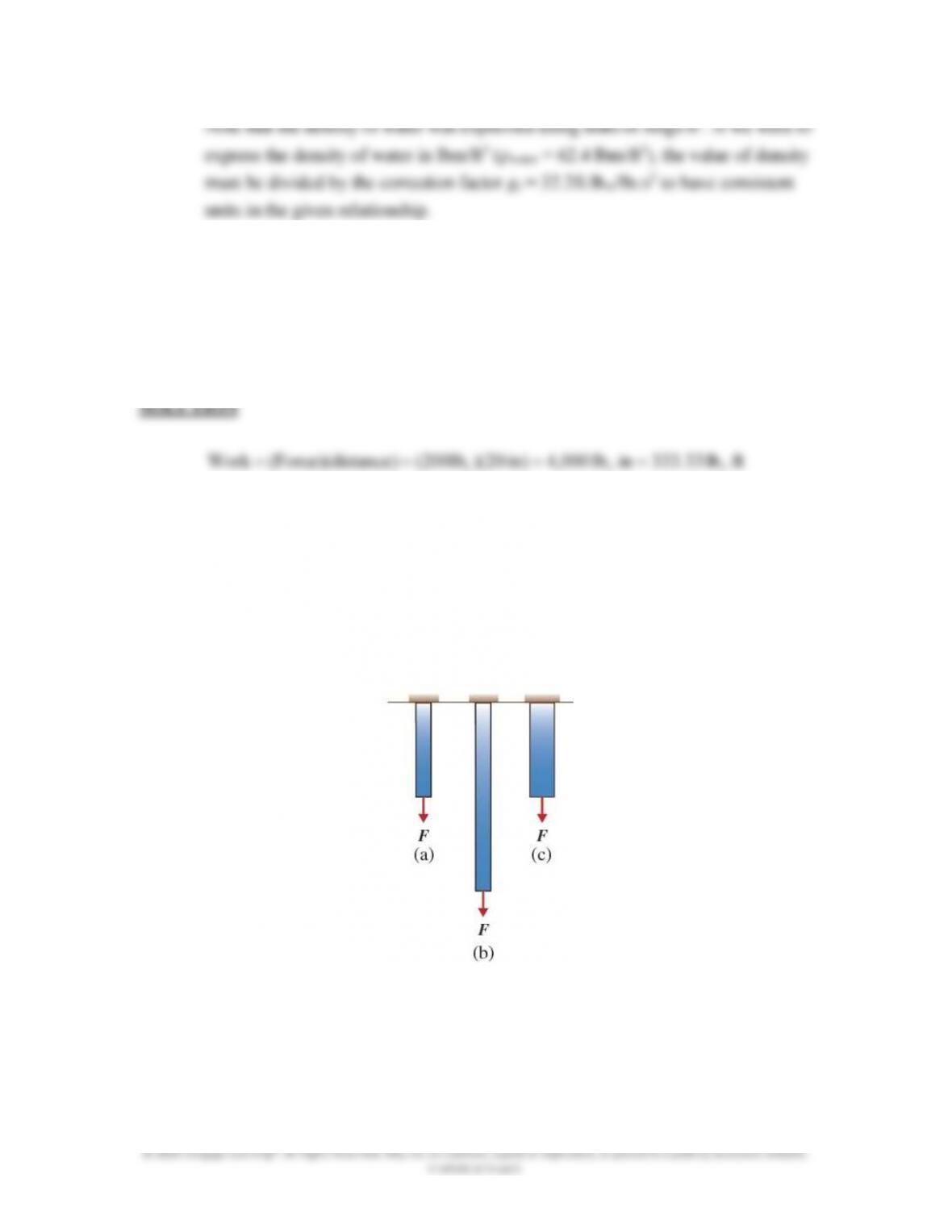
10.47 Given that the three bars shown in the accompanying figure are made of the same
material, comparing bar (a) to bar (b) which bar will stretch more, when subjected
to the same force F? Bar (a) and (b) have the same cross-sectional area but
different length. Comparing bar (a) to bar (c) having the same length but different
cross-sectional areas, which bar will stretch more? Explain.
120
SOLUTION
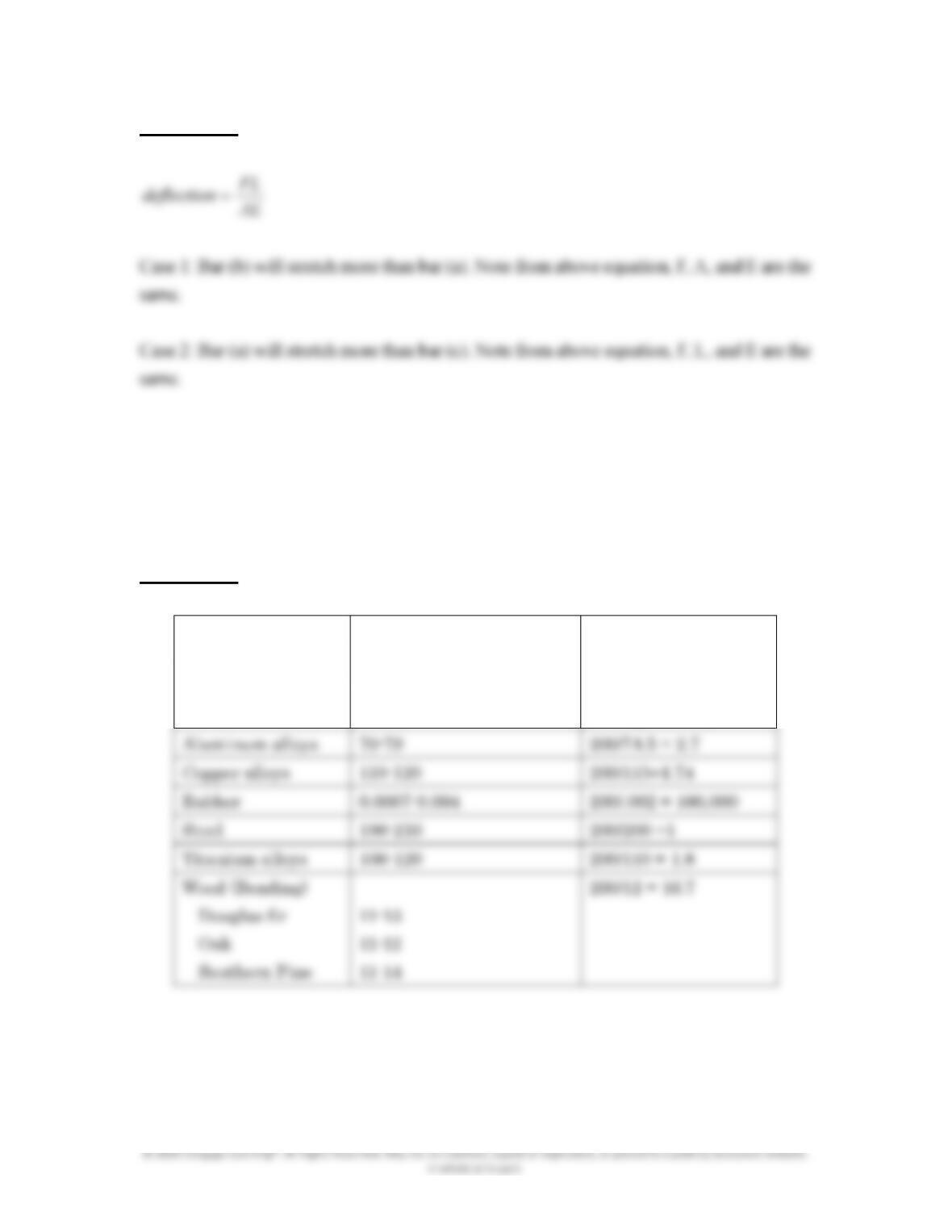
10.48 Create a table that shows the relative magnitudes of modulus of elasticity of steel
to aluminum alloys, copper alloys, titanium alloys, rubber, and wood.
SOLUTION
Material Modulus of Elasticity (GPa)
Relative magnitude of
elasticity of steel to the
given material (using
average values)
121
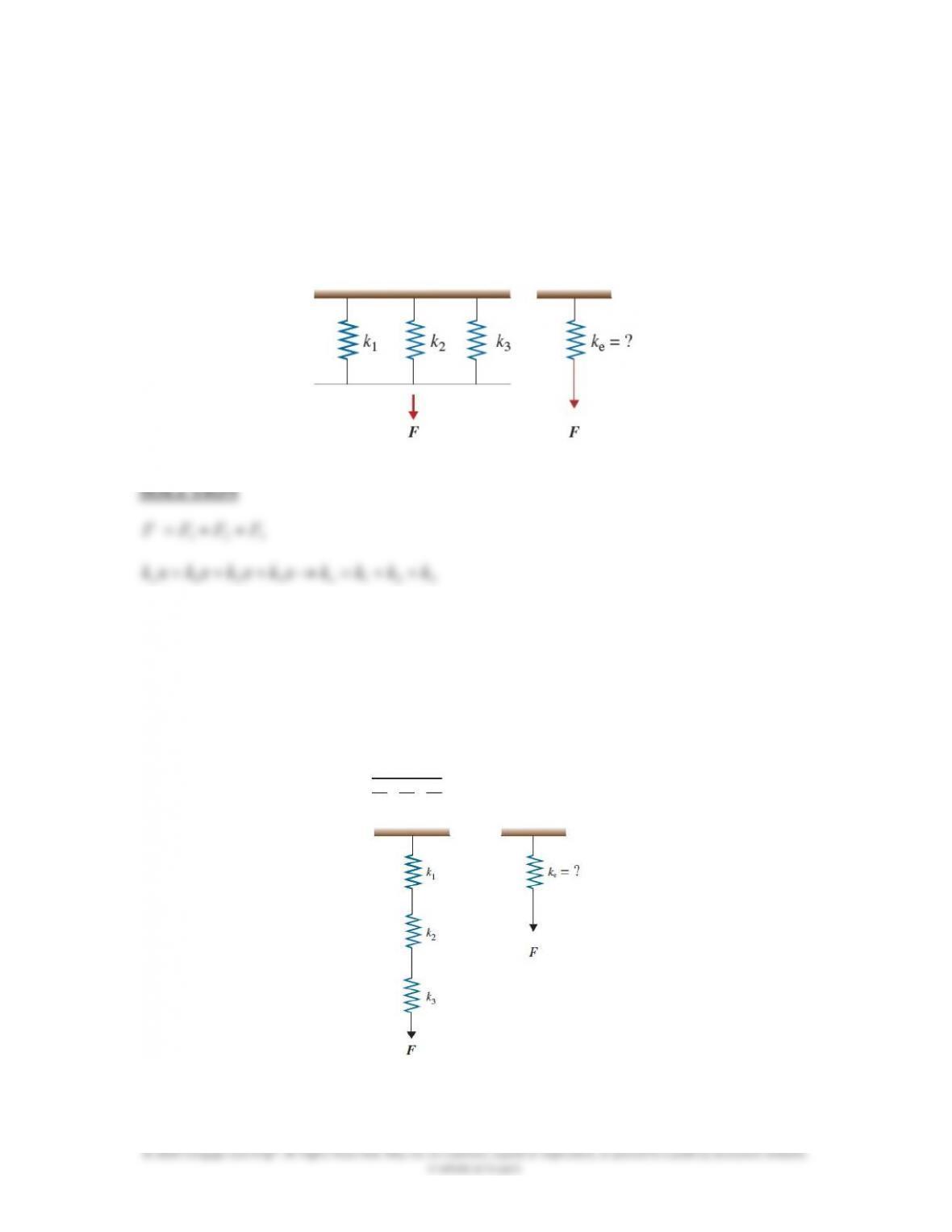
10.49 Consider the parallel springs shown in the accompanying figure. Realizing that
the deflection of each spring in parallel is the same and the applied force must
equal the sum of forces in individual springs, show that for springs in parallel the
equivalent spring constant ke is
ke = k1 + k2 + k3
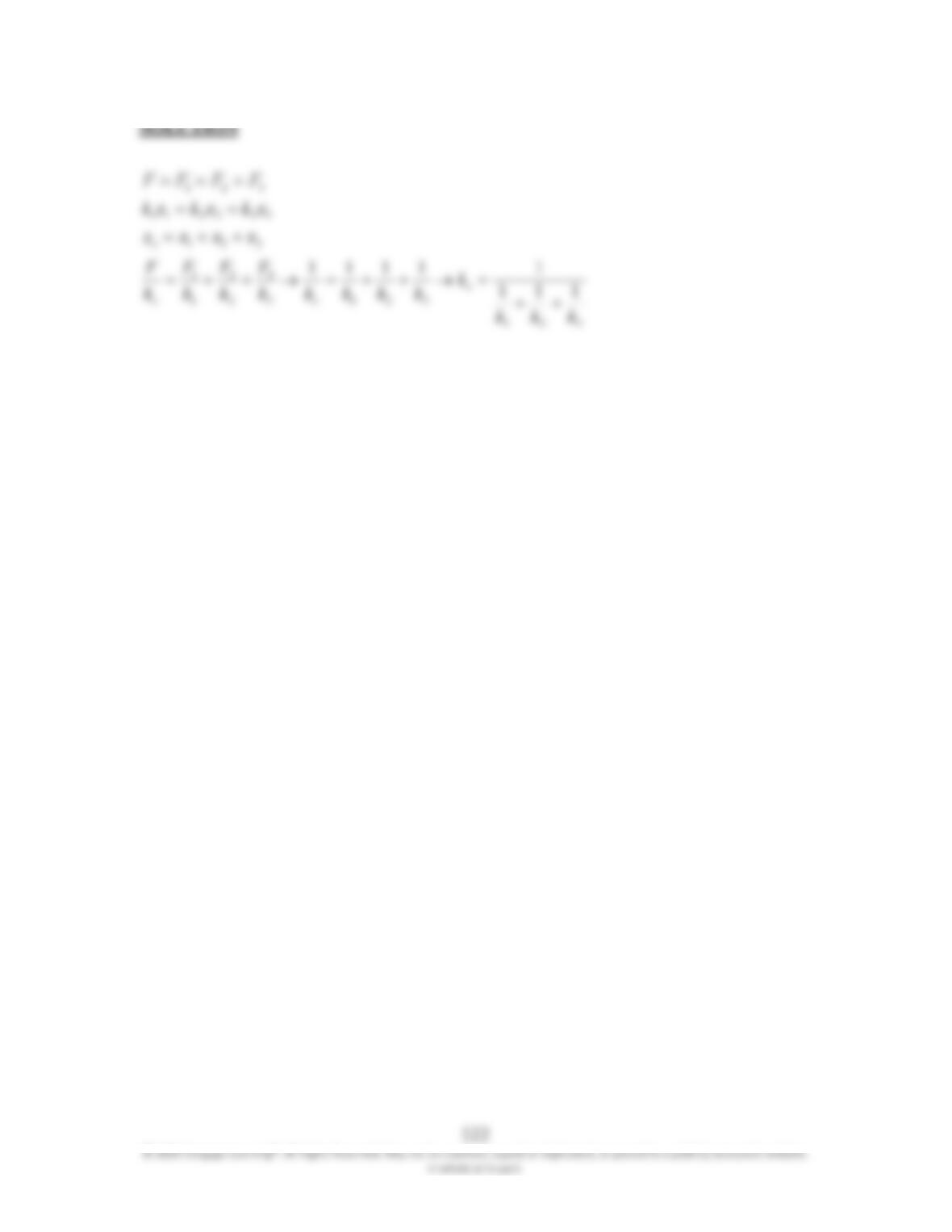
10.50 Consider the series springs shown in accompanying figure. Realizing that the total
deflection of the springs is the sum of the deflections of the individual springs, and
the force in each spring equals the applied force, show that for the springs in series,
the equivalent spring constant ke is
ke =
122
© 2020 Cengage Learning®. All Rights Reserved. May not be scanned, copied or duplicated, or posted to a publicly accessible website,
in whole or in part.
SOLUTION
321 FFFF
332211 xkxkxk
321 xxxxe
321
3213
3
2
2
1
1
111
11111
kkk
k
kkkkk
F
k
F
k
F
k
F
e
ee