Chapter 10: Setting Profit Margins for Bidding
Learning Objectives
At the completion of this chapter the student should be able to:
• Determine the breakeven points for a construction company.
• Explain how profits, costs, and sales price (revenue from a job) are interrelated and how a
Instructional Hints
• Discuss how strong cost controls and specialization within the industry can allow a
company to bid cheaper than their competitors while maintaining a high profit margin.
Instruction Resources
• The figures from this chapter in electronic format and PowerPoint slides can be found at
the instructor’s website.
Solutions to the Textbook Problems
1. The contribution margin may be increased by increasing revenues (raising prices), by
2. From Chapter 6, the pretax profit margin is the percentage of revenues that become profit
after deducting construction costs and overhead and before accounting for taxes. The pretax
3. When you raise prices the contribution margin from the project increases which in turn
4. Specializing allows a company to become very good at a specific type of work and often
5. Using Eq. (10-2) to find the profits for the year we get the following:
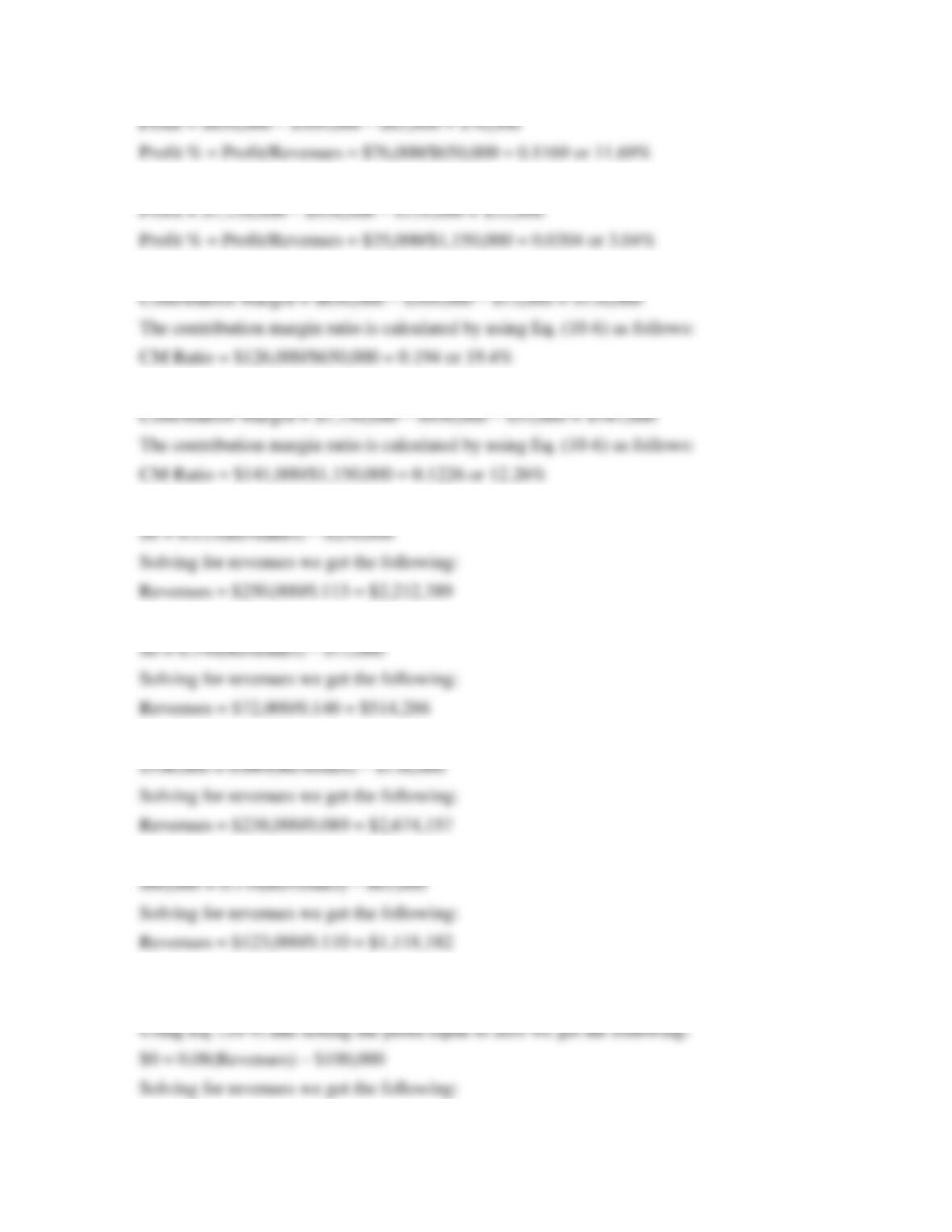
6. Using Eq. (10-2) to find the profits for the year we get the following:
7. Using Eq. (10-5) to get the contribution margin we get the following:
8. Using Eq. (10-5) to get the contribution margin we get the following:
9. Using Eq. (10-9) and setting the profit equal to zero we get the following:
10. Using Eq. (10-9) and setting the profit equal to zero we get the following:
11. Using Eq. (10-9) and setting the profit equal to $100,000 we get the following:
12. Using Eq. (10-9) and setting the profit equal to $60,000 we get the following:
13. Using Eq. (10-7) to find the contribution margin ratio we get the following:
CM Ratio = 1 – 0.90 – 0.02 = 0.08 or 8%
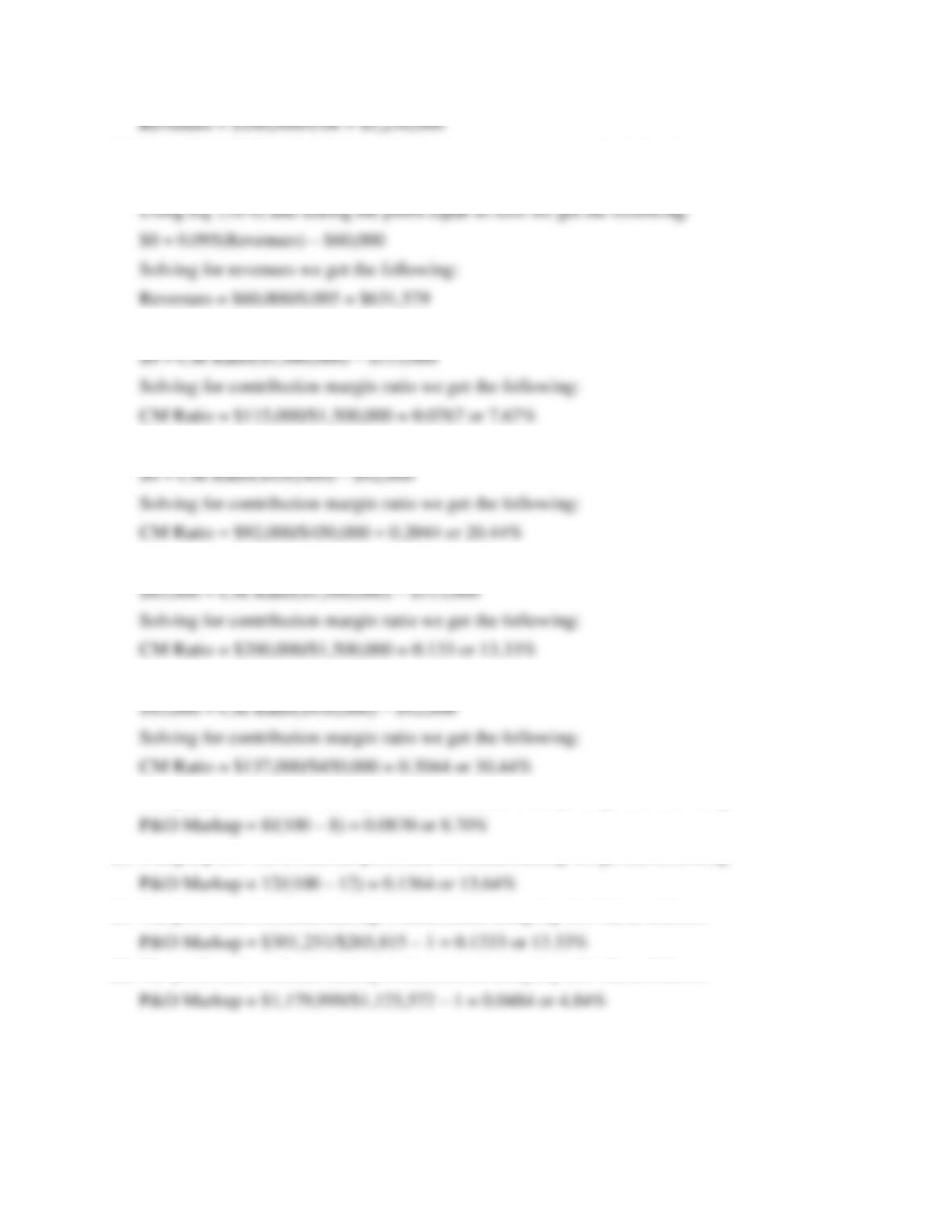
14. Using Eq. (10-7) to find the contribution margin ratio we get the following:
CM Ratio = 1 – 0.88 – 0.025 = 0.095 or 9.5%
15. Using Eq. (10-9) and setting the profit equal to zero we get the following:
16. Using Eq. (10-9) and setting the profit equal to zero we get the following:
17. Using Eq. (10-9) and setting the profit equal to $85,000 we get the following:
18. Using Eq. (10-9) and setting the profit equal to $45,000 we get the following:
19. Using Eq. (10-10) to find the profit and overhead markup we get the following:
20. Using Eq. (10-10) to find the profit and overhead markup we get the following:
21. The profit and overhead markup is determined using Eq. (10-12) as follows:
22. The profit and overhead markup is determined using Eq. (10-12) as follows:
23. This answer will vary from class to class.