Problem 10.1
How do you convert inflated dollars into constant-value dollars?
Problem 10.2
Find the inflation rate necessary for something to cost exactly twice as much as it did
10 years earlier.
Problem 10.3
In an inflationary period for a dollar-based currency, what is the difference between
(a) inflated dollars and ’then–current’ dollars, and (b) ‘then–current’ (future) dollars and
constant-value dollars?
Problem 10.4
For many years, college cost increases have been about twice the inflation rate,
averaging 5% to 8% per year. According to the College Board’s Trends in College
Pricing, the 2011-2012 average annual total costs (including tuition, fees, room and
board) were $17,131 for students attending four-year public colleges and universities in-
state, $29,657 out-of-state, and $38,589 at four-year private colleges and universities. Use
a 7% per year inflation rate. (a) Determine how much a sophomore high-school student
can expect to spend on in-state tuition, fees, room and board when he or she starts at a
four-year public college in 3 years. (b) Determine the total annual cost if textbooks,
supplies, etc. currently average $4000 per year and they also increase at 7% per year.
Problem 10.5
The Pell Grant program of the federal government provides financial aid to needy
college students. A supplemental grant of $690 per recipient in the 2012-2013 school
year (toward the maximum total of $5550) will increase annually until 2017 to account
for inflation. Beginning in 2018, grants will no longer increase with inflation. If the
maximum total Pell Grant award increases to $5645 in the 2013-2014 school year, what
inflation rate per year was used in the calculation?
Problem 10.6
For 2012, the USDA determined that “The Twelve Days of Christmas” with partridges
and pear trees cost index was $101,120, based on prices of the 364 items listed in the
classic carol. If the “True Cost of Christmas” index rose by 4.4%, (a) what was the value
of the index in 2011, and (b) if seven swans-a-swimming increased by $700 to $6300,
what was their percentage increase?
Problem 10.7
Midstate Independent School District signed an agreement with a local law firm that
increased the firm’s hourly billing rate of $185 per hour, established in 2008, to $225 per

hour beginning in April of 2013. What was the percent increase per year in the hourly
billing rate?
Problem 10.8
Emissions of heat-trapping carbon dioxide (CO2) reached an all-time high of
31.6 gigatons (giga = 109) in 2011, a 3.2% increase over 2010. The International Energy
Agency said this further reduces the chance that the world can avoid a dangerous rise in
global average temperature by 2020. (a) If the discharge increase continues at the same
3.2% rate per year for the next 9 years, how many gigatons will be released in 2020?
(b) What will be the total percent increase between 2011 and 2020?
Problem 10.9
When the inflation rate is 4% per year, how many inflated dollars will be required
20 years from now to buy the same things that $10,000 buys now?
Problem 10.10
According to data from the National Association of Colleges and Employers (NACE),
engineering graduates’ average salaries of $61,872 were among the highest of the class of
2011. What will the average starting amount be in 2017, if salaries increase at a rate of
(a) 2% per year, and (b) twice the assumed inflation rate of 3.5% per year.
Problem 10.11
The inflation rate over a 10-year period for an item that now costs $1000 is shown in the
following table. (a) What will be the cost at the end of year 10? (b) Do you get the same
cost using an average inflation rate of 5% per year through the 10- year period? Why?
Year Inflation Rate
1 10%
2 0%
3 10%
4 0%
5 10%
6 0%
7 10%
8 0%
9 10%
10 0%
Problem 10.12
An engineer who is now 65 years old began planning for retirement 40 years ago. At that
time, he thought that if he had $1 million when he retired, he would have more than
enough money to live his remaining life in luxury. Use an average inflation rate of 4%
per year over the 40-year time period. (a) What is the constant-value dollar amount of his

$1 million now at age 65? Use the day he started 40 years ago as the base year. (b) How
many then-current (future) dollars should he have accumulated over the 40 years to have
a constant-value purchasing power equal to $1 million at retirement age?
Problem 10.13
In 2012, every dollar (100¢) spent on grocery items was broken down as follows:
Labor = 38.5¢
Farm value of food products = 19.5¢
Advertising and packaging = 12¢
Transportation = 7.5¢
Rent and insurance = 7¢
Taxes = 6¢
Depreciation and repairs = 5¢
Profit = 4.5¢
Assume the transportation cost increases by 10% per year and the labor cost increases by
4% per year for five years, with all other costs remaining constant. Determine the
resulting percent represented by profit in the years 2012 and 2017, assuming the profit
amount remains at 4.5¢.
Problem 10.14
For a young, growing company that has a required ROR of a real 25% per year, what is
the inflated-adjusted ROR for an inflation rate of 5% per year?
Problem 10.15
The CEO of a high-tech incubator company wants to entice venture capitalists by
promising a growth rate of 40% per year for at least 3 years. Therefore, the company’s
MARR was set at 40%. If the company did get a 40% ROR over that time period, but it
didn’t account for the 8% per year inflation rate that occurred during that time, what was
the real growth rate of the company?
Problem 10.16
For a nominal inflation-adjusted interest rate of 24% per year compounded monthly,
calculate the real interest rate per month when the inflation rate is 0.5% per month.
Problem 10.17
Find the present worth of the following estimated cash flows. As indicated, some are
expressed in then-current (future) terms and others in today’s dollars. Use a real interest
rate of 10% per year and an inflation rate of 6% per year.
Year Cash Flow, $ Expressed as___
0 16,000 Today’s
3 40,000 Then-current
4 12,000 Then-current

7 26,000 Today’s
Problem 10.18
The company you work for is considering a new product line that is projected to have the
net cash flows below (in $1000). The values are in future dollars which have been
inflated by 5% per year. The plant manager isn’t sure about how the present worth of the
cash flows should be calculated, so he asked you to do it two ways over the 4-year
planning horizon: (1) using an inflation-adjusted rate of 20% per year, and (2) converting
all of the cash flows to current-value dollars and using a real interest rate. You said both
ways will provide the same answer, but he asked you to show him the calculations.
Prepare the present worth computations by methods (1) and (2).
Year Cash Flow, $
0 -10,000
1 2,000
2 5,000
3 5,000
4 5,000
Problem 10.19
Find the present worth of a piece of equipment that has a first cost of $150,000, an annual
operating cost of $60,000, and a salvage value of 20% of the first cost after 5 years.
Assume that the real interest rate is 10% per year, that the inflation rate is 7% per year,
and that inflation is to be accounted for. Also, assume that all costs are future dollar
estimates.
Problem 10.20
A very generous grandfather is planning to leave his only granddaughter well off when
she reaches the age of 25. He plans to deposit a lump sum now, which is her 2nd birthday,
such that she will have enough money to live comfortably without working for a salary.
He wants her to receive an amount that will have the same purchasing power as
$2 million today. If he can invest the money andearn an average market interest rate of
8% per year while the inflation rate averages 4% per year, how much must he deposit
now?
Problem 10.21
The president of a medium-sized oil company wants to buy a private plane to reduce the
total travel time between cities where refineries are located. The company can buy a used
Lear jet now or wait for a new very light jet (VLJ) that will be available 3 years from
now. The cost of the VLJ will be $1.5 million, payable when the plane is delivered in

3 years. The president has asked you to determine the present worth of the plane so that
he can decide whether to buy the used Lear now or wait for the VLJ. If the company’s
uses a market MARR of 18.45% per year and inflation is projected to be 3% per year,
what is the present worth of the VLJ with inflation considered?
Problem 10.22
A salesman from vendor A, who is trying to get his foot in the door at Filerbee, Inc.,
offered water desalting equipment for $2.1 million. This is $400,000 more than the price
that a saleswoman from vendor B offered, if purchased and paid for now. However, as a
special offer, vendor A said Filerbee won’t have to pay until the warranty runs out. If the
equipment has a 2-year warranty, determine which offer is better. The company’s real
MARR is 12% per year and the inflation rate is 4% per year.
Problem 10.23
How much can the manufacturer of superconducting magnetic energy storage systems
afford to spend now on new equipment in lieu of spending $75,000 four years from now?
The company’s real MARR is 12% per year and the inflation rate is 3% per year.
Problem 10.24
Explain the difference between a future worth amount calculated using case 1 and case 2
if the inflation-adjusted interest rate if and inflation rate f are the same for both
computations.
Problem 10.25
An engineer planning for her son’s college education made deposits into a separate
brokerage account every time she earned extra money from side consulting jobs. The
amounts and timing of the deposits are shown below.
Year Amount, $
0 5,000
3 8,000
4 9,000
7 15,000
11 16,000
17 20,000
If the account increased at a market rate of 15% per year and inflation averaged 3% per
year over the entire deposit period, determine the purchasing power in terms of year-zero
dollars immediately after the last deposit in year 17.
Problem 10.26
A plant manager is not sure whether he will get the approval to buy new equipment for
automating an engine assembly line now or some future time within the next three years.
In order to have the money whenever he is given the go-ahead, he has asked you to tell
him what the equipment is likely to cost in each of the next three years. The cost of the
equipment today is $300,000. How much will it cost at the end of years 1, 2, and 3, if the
cost increases only by the inflation rate of 4% per year. Use a market interest rate of 15%
per year.
Problem 10.27
With hopes to retire at a decent age and move to Hawaii, an engineer plans to turn her
investment account over to a professional management firm that promises to make a real
return of 10% per year when the inflation rate is 4% per year. The account currently is
valued at $422,000 and she wants to retire in 15 years. (a) How much in future-dollar
terms will have to be in the account to realize the promised 10% per year return? (b) Is
this an example of case 1 or case 2 as described in the text?
Problem 10.28
An engineer deposits $10,000 into an account when the market interest rate is 10% per
year and the inflation rate is 5% per year. If the account is left undisturbed for 5 years,
(a) how much money will be in the account?
(b) what will be the purchasing power in terms of today’s dollars?
(c) what is the real rate of return earned?
Problem 10.29
A Division of Dow Chemical wants to set aside money now so that it can purchase new
air fin coolers three years from now. The total cost now is $45,000. The price of the
coolers is expected to increase only by the inflation rate of 3.7% per year for each of the
next three years. Dow earns interests at a market rate of 8% per year on its investments.
(a) What is the coolers’ cost expected to be three years from now? (b) How much will the
company have to set aside now to buy the coolers in 3 years? (c) If the $45,000 is set
aside now, how much money will be available in 3 years to pay for the coolers?
Problem 10.30
The cost of constructing a roundabout in a low-traffic residential neighborhood five
years ago was $625,000. A civil engineer designing another one that is almost exactly the
same estimates the cost today will be $740,000. (a) If the cost had increased only by the
inflation rate over the five years, what was the actual inflation rate per year? (b) What is
the interest rate involved in this computation?
Problem 10.31
If you make an investment in an insurance policy that is guaranteed to pay you
$1.8 million 20 years from now, provided you live that long, what will be the buying
power of that money with respect to today’s dollars? The market interest rate is 8% per
year and the inflation rate stays at 3.8% per year?
Problem 10.32
Colgate-Palmolive can purchase a piece of equipment now for $80,000 or buy it 3 years
from now for an estimated $128,000. The MARR requirement is a real return of 15% per
year. If an inflation rate of 4% per year must be accounted for, should the company buy
the machine now or later?
Problem 10.33
An offshore services company is considering the purchase of equipment that has a cost
today of $96,000. In a period of 5% per year inflation, how much will the equipment cost
3 years from now in terms of constant-value dollars? The manufacturer plans to raise the
price exactly in accordance with the inflation rate.
Problem 10.34
In a period of 4% per year inflation, how much will a machine cost 3 years from now in
terms of constant-value dollars, if the cost today is $40,000 and the price increases such
that the manufacturer will make a real rate of return of 5% per year over the 3 years?
Problem 10.35
A pulp and paper company is planning to set aside $150,000 now for possibly replacing
its large synchronous refiner motors. If the replacement isn’t needed for 5 years, how
much will the company have in the account if it earns a market rate of 10% per year and
the inflation rate is 4% per year?
Problem 10.36
Well-managed companies set aside money to pay for emergencies that inevitably arise in
the course of doing business. If a commercial solid waste recycling and disposal company
puts 0.5% of its after-tax income into such an account, how much will the company have
after 7 years, provided the company’s after-tax income averages $15.2 million per year?
The inflation and market rates are 5% per year and 9% per year, respectively.
Problem 10.37
A small mechanical consulting company is examining its future cash flow requirements.
The president expects to replace office machines and IT equipment at various times over
a 6-year planning period. Specifically, the company expects to spend $6000 two years
from now, $9000 three years from now, and $5000 six years from now. What is the
purchasing power (with respect to today’s dollars) of each expenditure in its respective
year, if the inflation rate is 4% per year?
Problem 10.38

The strategic plan of a solar energy company that manufactures high-efficiency solar
cells includes an expansion of its physical plant in 4 years. The engineer in charge of
planning estimates the expenditure required now to be $8 million, but in 4 years, the cost
will be higher by an amount equal to the inflation rate. If the company sets aside
$7,000,000 now into an account that earns interest at an advertised 7% per year, what can
the annual inflation rate be to have exactly the right amount of money for the expansion?
Solve (a) by hand, and (b) using a spreadsheet.
Problem 10.39
An entrepreneur engaged in wildcat oil well drilling is seeking investors who will put up
$500,000 for an opportunity to reap high returns, if the venture is successful. The
prospectus states that a real return of at least 22% per year for 5 years is likely, but not
promised. How much will the investors have to receive each year to recover their money
and the 22% return, if an inflation rate of 5% per year is to be included in the calculation?
Problem 10.40
Veri-Trol, Inc. manufactures in-situ calibration verification systems that confirm flow
measurement accuracies without removing the meters. The company is considering
modifying the main assembly line with one of the enhancements shown below. If the
company’s real MARR is 15% per year, which process has the lower annual cost?
Include an inflation rate of 5% per year in the analysis?
Process X Process Y
First cost, $ -65,000 -90,000
Operating cost, $ per year -40,000 -34,000
Salvage value, $ 0 10,000
Life, years 5 5
Problem 10.41
Aquatech Microsystems spent $183,000 for a communications protocol to achieve
interoperability among its utility systems. If the company uses a real interest rate of 15%
per year on such investments and a recovery period of 5 years, what is the equivalent
annual worth of the expenditure in then-current dollars at an inflation rate of 6% per
year?
Problem 10.42
A European-based cattle genetics engineering research lab is planning for a major
expenditure on research equipment. The lab needs $5 million of today’s dollars so it can
make the acquisition 4 years from now. The inflation rate is steady at 5% per year.
(a) How many future dollars will be needed when the equipment is purchased, if
purchasing power is maintained? (b) What is the required amount of the annual deposit
into a fund that earns the market rate of 10% per year to ensure that the amount
calculated in part (a) is accumulated?
Problem 10.43
The costs associated with a small X-ray inspection system are $40,000 now and $24,000
per year, with a $6000 salvage value after 3 years. Determine the equivalent annual cost
of the system if the real interest rate is 10% per year and the inflation rate is 4% per year.
Problem 10.44
Maintenance costs for pollution control equipment on a pulverized coal cyclone furnace
are expected to be $80,000 now and another $90,000 three years from now. The CFO of
Monongahela Power wants to know the equivalent annual cost of the equipment in years
1 through 5. If the company uses a real interest rate of 12% per year and the inflation rate
averages 4% per year, what is the equivalent annual cost of the equipment?
Problem 10.45
In wisely planning for your retirement, you invest $12,000 per year for 20 years into a
401(k) account. How much can you withdraw each year for 10 years, starting one year
after your last deposit, if you obtain a real return of 10% per year? Assume the inflation
rate averages 2.8% per year.
Problem 10.46
When all future cash flows are expressed in constant-value dollars, the rate that should
be used to find the present worth is the:
a. real MARR.
b. inflation rate.
c. inflated interest rate.
d. inflated MARR.
Problem 10.47
In order to convert inflated dollars into constant-value dollars, it is necessary to:
a. divide by (1 + if)n
b. divide by (1 + f )n
c. divide by (1 + i)n
d. multiply by (1 + f )n
Problem 10.48
For a real interest rate of 12% per year and an inflation rate of 7% per year, the market
interest rate per year is closest to:
a. 4.7%
b. 7%
c. 12%
d. 19.8%
Problem 10.49
If the market interest rate is less than the real interest rate, then:
a. the inflated interest rate is higher than the real interest rate.
b. the real interest rate is zero.
c. a deflationary condition exists.
d. an inflationary condition exists.
Problem 10.50
If the market interest rate is 16% per year when the inflation rate is 9% per year, the real
interest rate is closest to:
a. 6.4%
b. 7.3%
c. 9.4%
d. 16.1%
Problem 10.51
The cost of an F-150 pick-up truck was $29,350 three years ago. If the cost increased
only by the inflation rate and the price today is $33,015, the inflation rate was closest to:
a. 3%
b. 4%
c. 5%
d. 6%
Problem 10.52
If the market interest rate is 12% per year and the inflation rate is 5% per year, the
number of future dollars in year 7 that will be equivalent to $2000 now can be
determined by the relation:
a. F = 2000(1 + 0.176)7
b. F = 2000/(1 + 0.176)7
c. F = 2000(1 + 0.120)7
d. F = 2000(1 + 0.198)7
Problem 10.53
The number of dollars that have been accumulated now from an investment of $1000
twenty-five years ago if the market interest rate was 5% per year and the inflation rate
averaged 2% per year is closest to:
a. $1640
b. $3385
c. $5430
d. $5556
Problem 10.54
If you are promised $50,000 six years from now, the present worth at a real rate of return
of 4% per year and an inflation rate of 3% per year is closest to:
a. $27,600
b. $29,800
c. $33,100
d. $37,200
Problem 10.55
For a real interest rate of 1% per month and an inflation rate of 1% per month, the
nominal inflated interest rate per year is closest to:
a. 1%
b. 2.0%
c. 24.1%
d. 25.4%
Problem 10.56
Provided the inflation rate is f percent per year, to determine the purchasing power of
$10,000 ten years from now, the $10,000 must be:
a. divided by (1 + f)10
b. multiplied by (1 + f)10
c. divided by (1+ 0.10)f
d. divided by (1 + f)
Solution 10.1
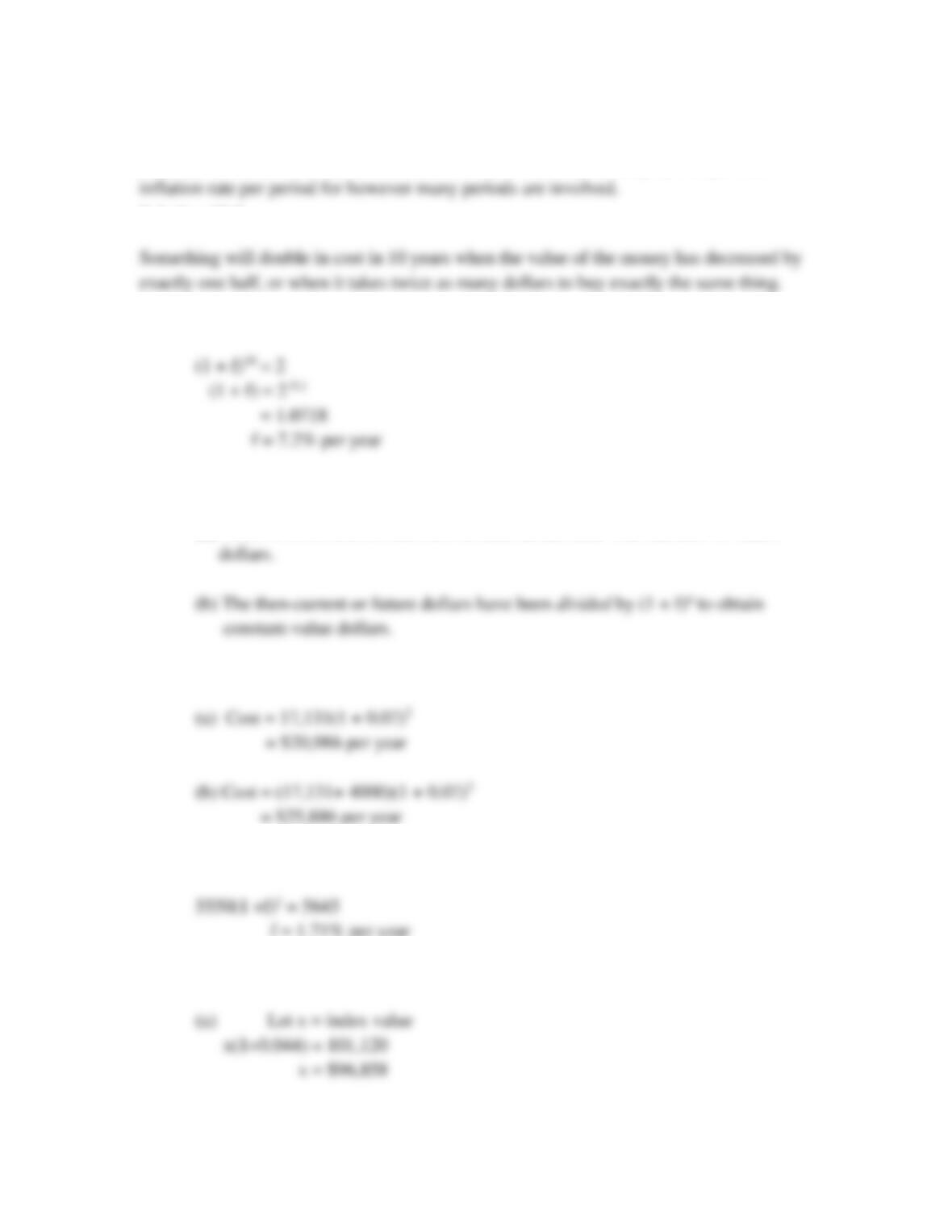
Inflated dollars are converted into constant value dollars by dividing by one plus the
Solution 10.2
Thus:
Solution 10.3
(a) There is no difference between inflated dollars and ‘then–current’ or future
Solution 10.4
Solution 10.5
f = 1.71% per year
Solution 10.6
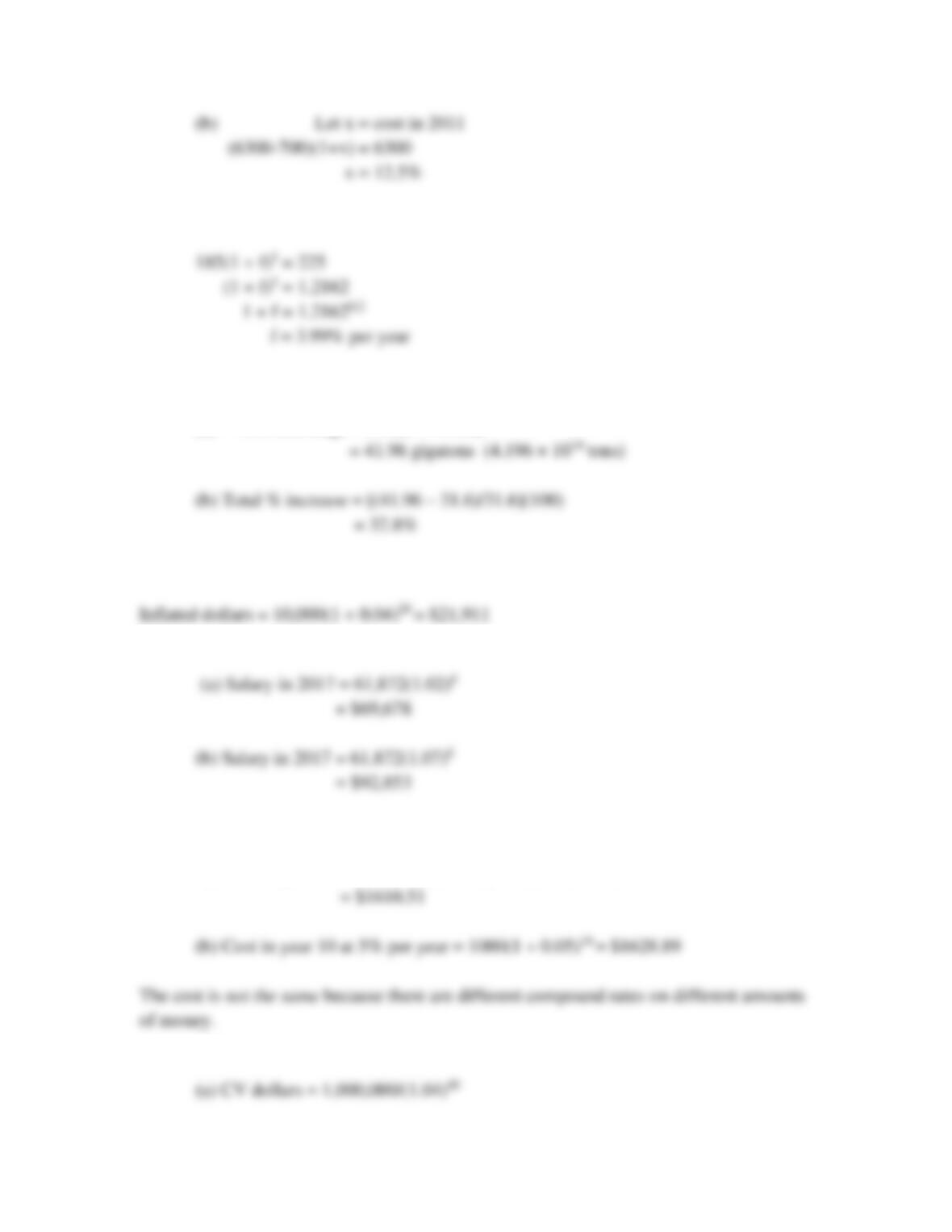
Solution 10.7
Solution 10.8
(a) CO2 discharge = 31.6(1 + 0.032)9
Solution 10.9
Solution 10.10
Solution 10.11
(a) Cost in year 10 = 1000(1.10)(1.10)(1.10)(1.10)(1.10)
Solution 10.12
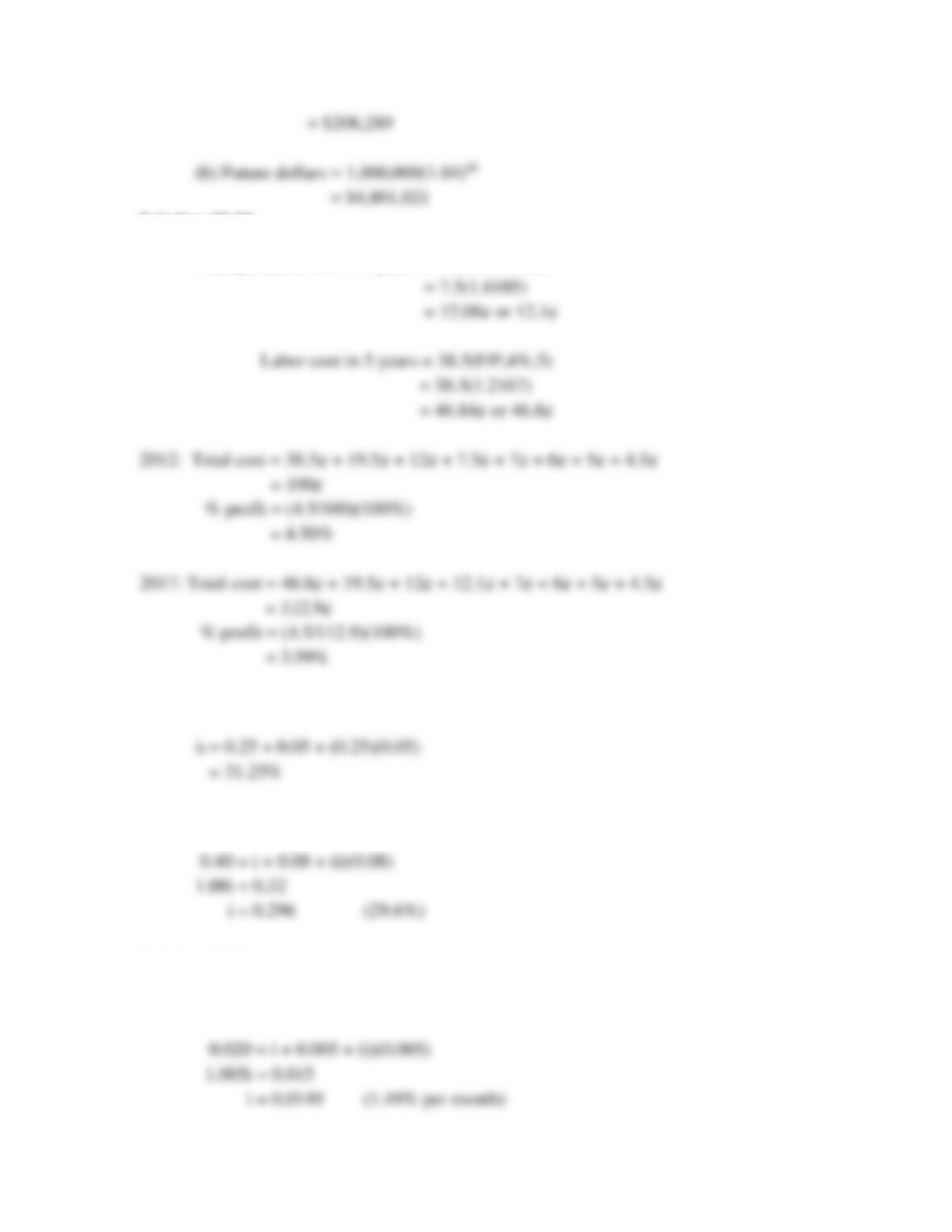
Solution 10.13
Transportation cost in 5 years = 7.5(F/P,10%,5)
Solution 10.14
Solution 10.15
Solution 10.16
if per month = 24/12 = 2%. Use inflated rate equation to solve for real rate i.
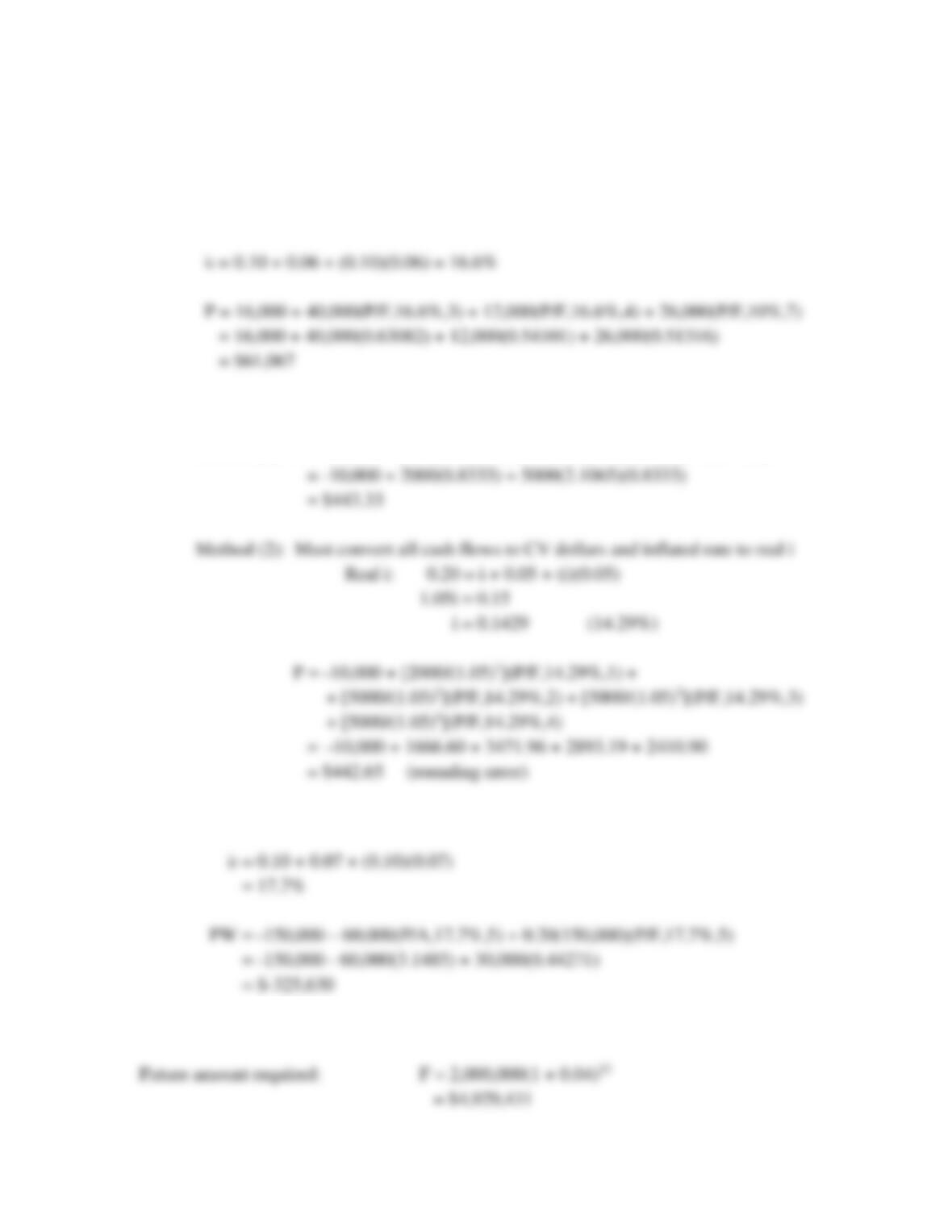
Solution 10.17
Use if for then-current dollars and i for current-value dollars
Solution 10.18
Method (1): P = -10,000 + 2000(P/F,20%,1) + 5000(P/A,20%,3)(P/F,20%,1)
Solution 10.19
Solution 10.20
Solution 10.21
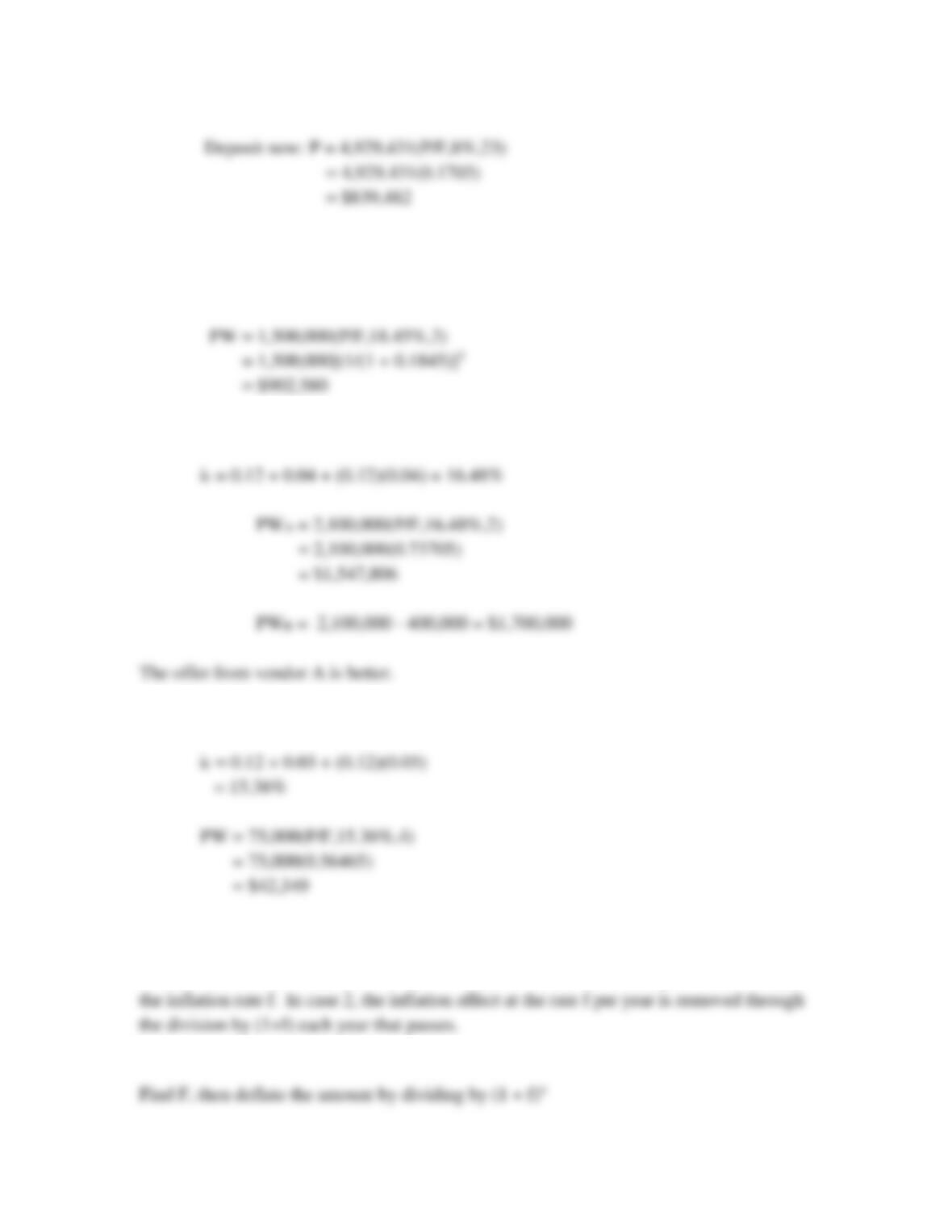
The $1.5 million is in ‘then–current’ dollars. Use MARRf to find PW.
Solution 10.22
Solution 10.23
Solution 10.24
In case 1, the actual amount of money in the future is determined using if, which includes
Solution 10.25
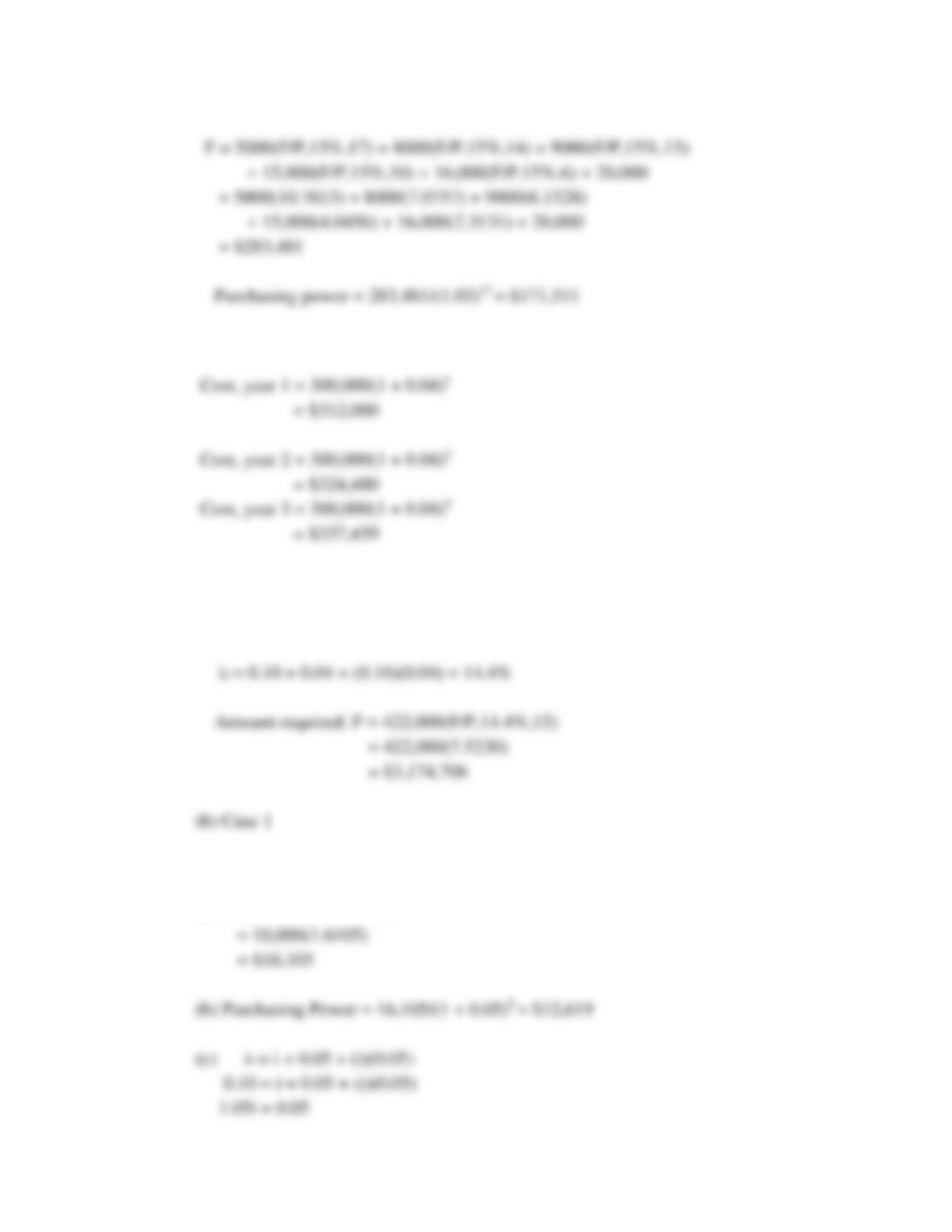
Solution 10.26
Solution 10.27
(a) Account would have to grow at rate of if
Solution 10.28
(a) F = 10,000(F/P,10%,5)
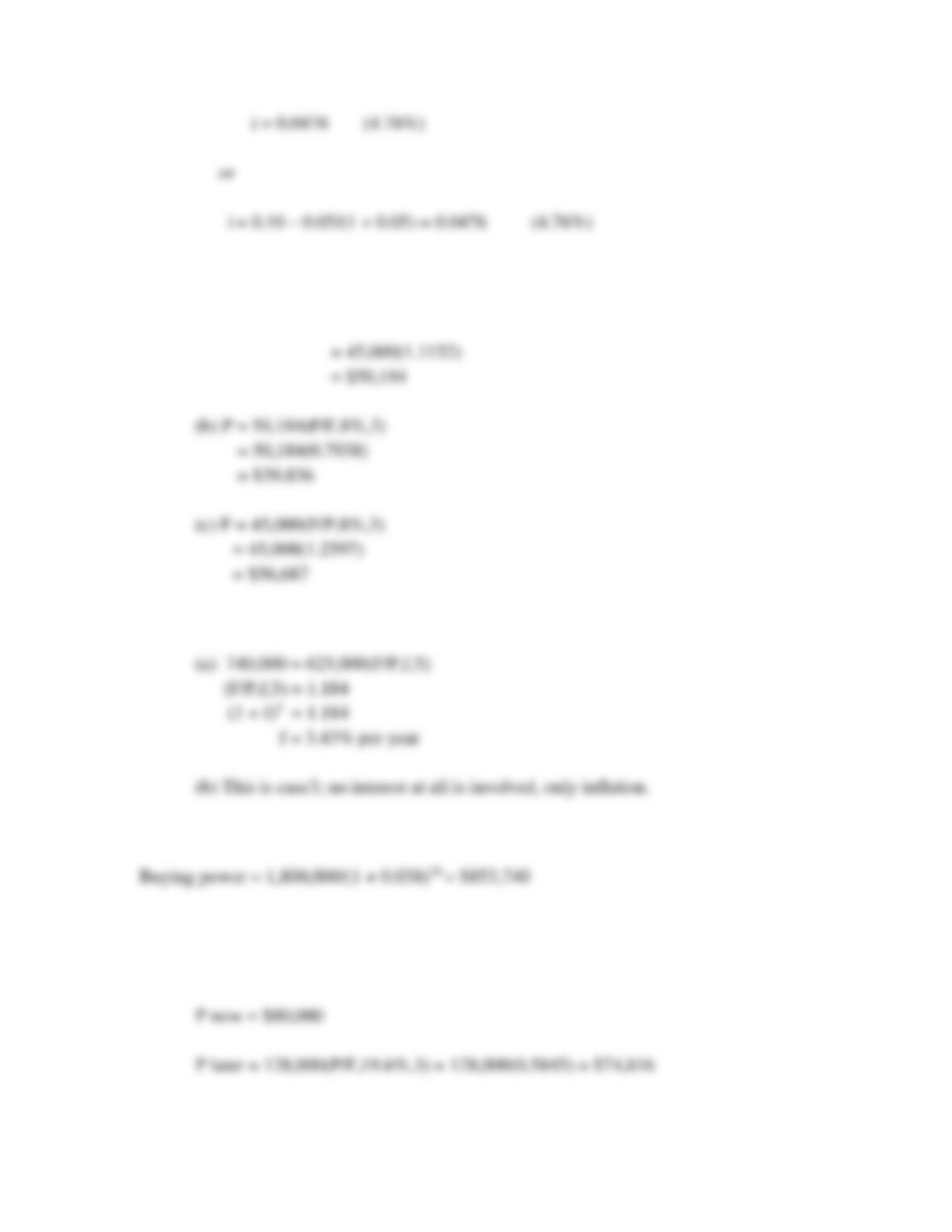
Solution 10.29
(a) Cost, year 3: F = 45,000(F/P,3.7%,3)
Solution 10.30
Solution 10.31
Solution 10.32
if = 0.15 + 0.04 + (0.15)(0.04) = 19.6%
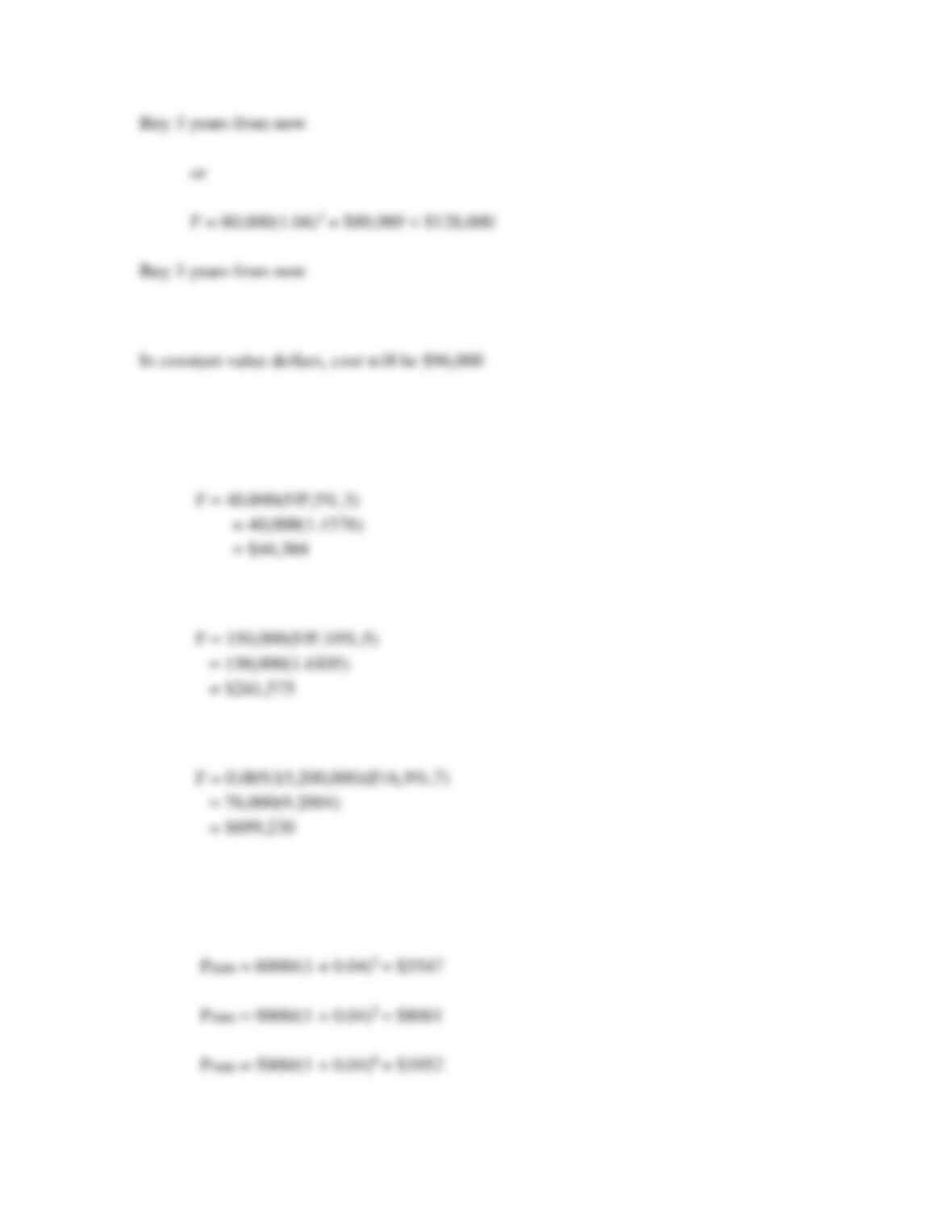
Solution 10.33
Solution 10.34
Cost in terms of constant-value dollars at real i = 5%
Solution 10.35
Solution 10.36
Solution 10.37
Buying power is P value with inflation removed
Solution 10.38
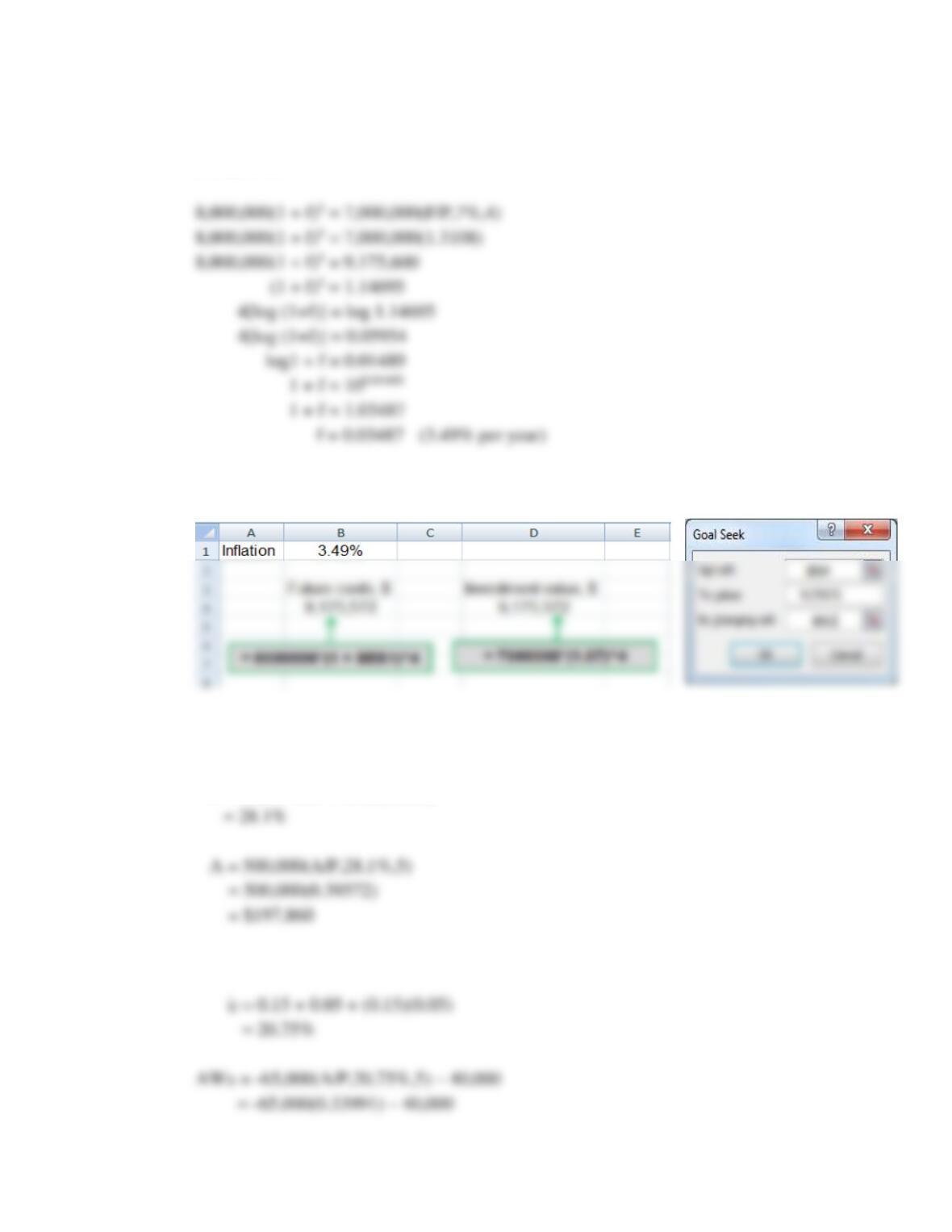
(a) By hand
(b) By spreadsheet using GOAL SEEK to find f = 3.49% per year
Solution 10.39
if = 0.22 + 0.05 + (0.22)(0.05)
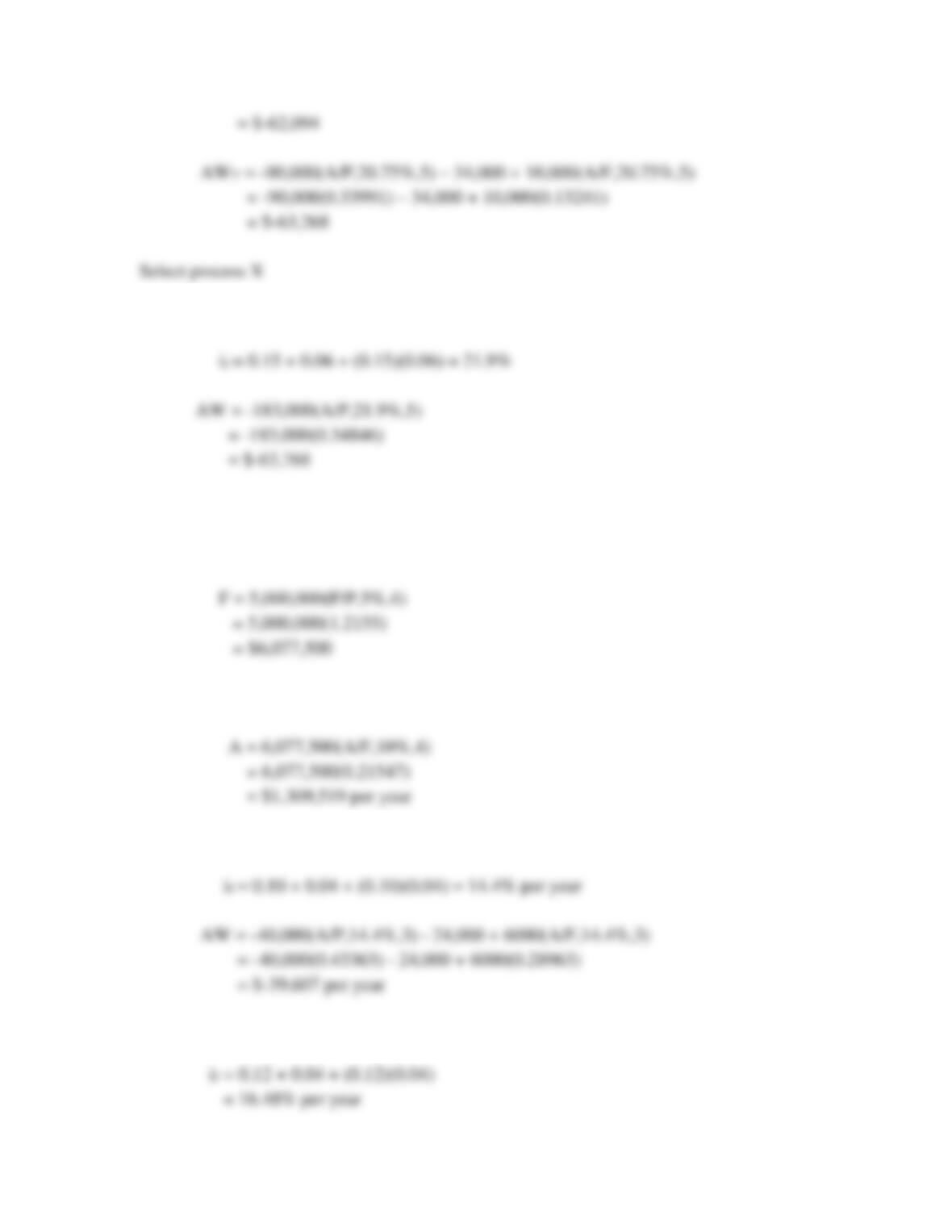
Solution 10.40
Solution 10.41
Solution 10.42
(a) To maintain purchasing power, use f to find future dollars.
(b) Use market rate to find A.
Solution 10.43
Solution 10.44
Solution 10.45
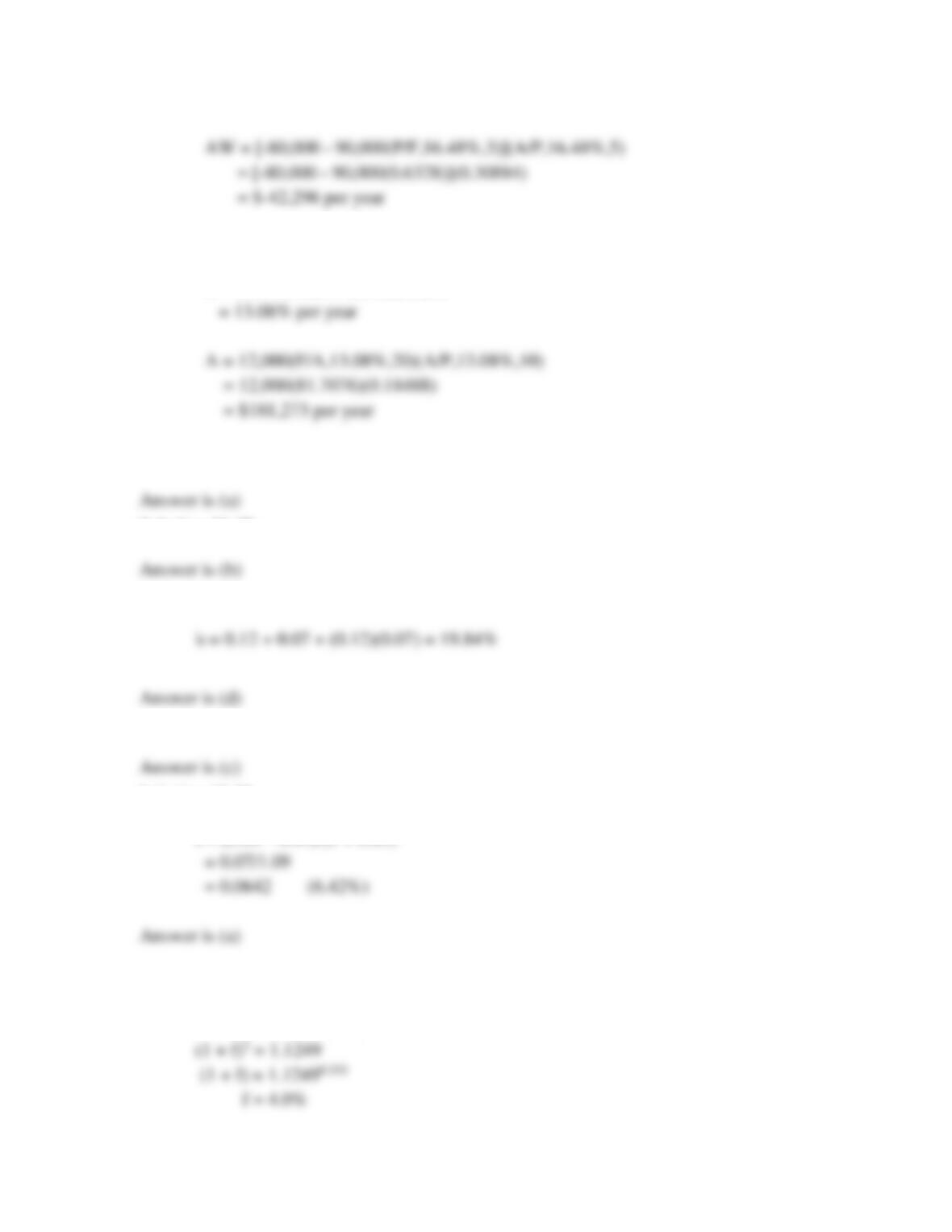
if = 0.10 + 0.028 + (0.10)(0.028)
Solution 10.46
Solution 10.47
Solution 10.48
Solution 10.49
Solution 10.50
i = (0.16 – 0.09)/(1 + 0.09)
Solution 10.51
33,015 = 29,350(1 + f)3
Solution 10.52
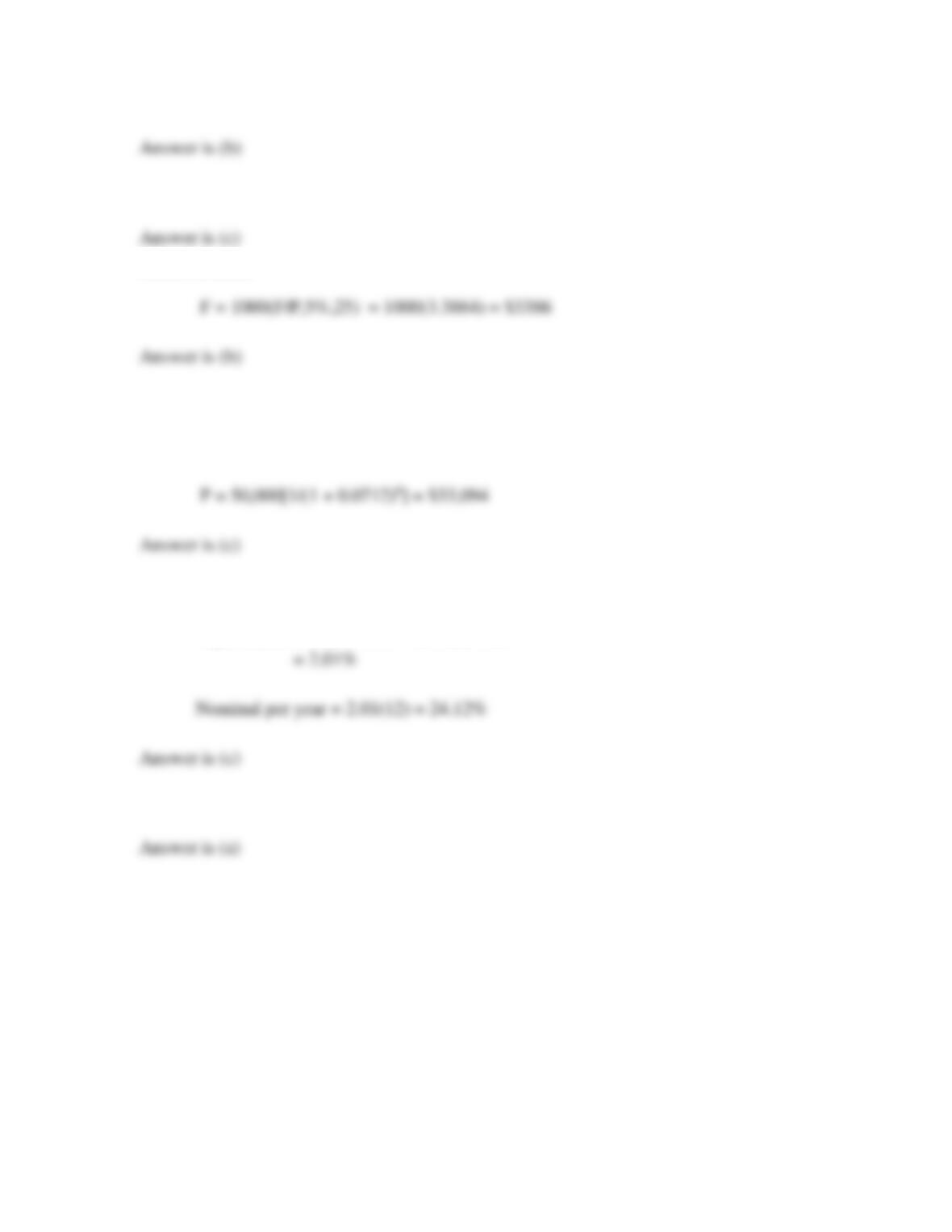
Solution 10.53
Solution 10.54
if = 0.04 + 0.03 + (0.04)(0.03) = 7.12%
Solution 10.55
if per month = 0.01 + 0.01 + (0.01)(0.01)
Solution 10.56