
Chapter 9
The Periodic Table and Some Atomic Properties
Exercises
The Periodic Law
1. Use data from Figure 9-1 and equation (9.1) to estimate the density of the recently discovered
2. Suppose that lanthanum
( )
57Z=
were a newly discovered element having a density of
3
6 145 g/cm
Estimate its molar mass.
3. The following densities, in grams per cubic centimeter, are for the listed elements in their
standard states at 298 K. Show that density is a periodic property of these elements: Al,
2.699; Ar, 0.0018; As, 5.778; Br, 3.100; Ca, 1.550; Cl, 0.0032; Ga, 5.904; Ge, 5.323; Kr,
0.0037; Mg, 1.738; P, 1.823; K, 0.856; Se, 4.285; Si, 2.336; Na, 0.968; S, 2.069.
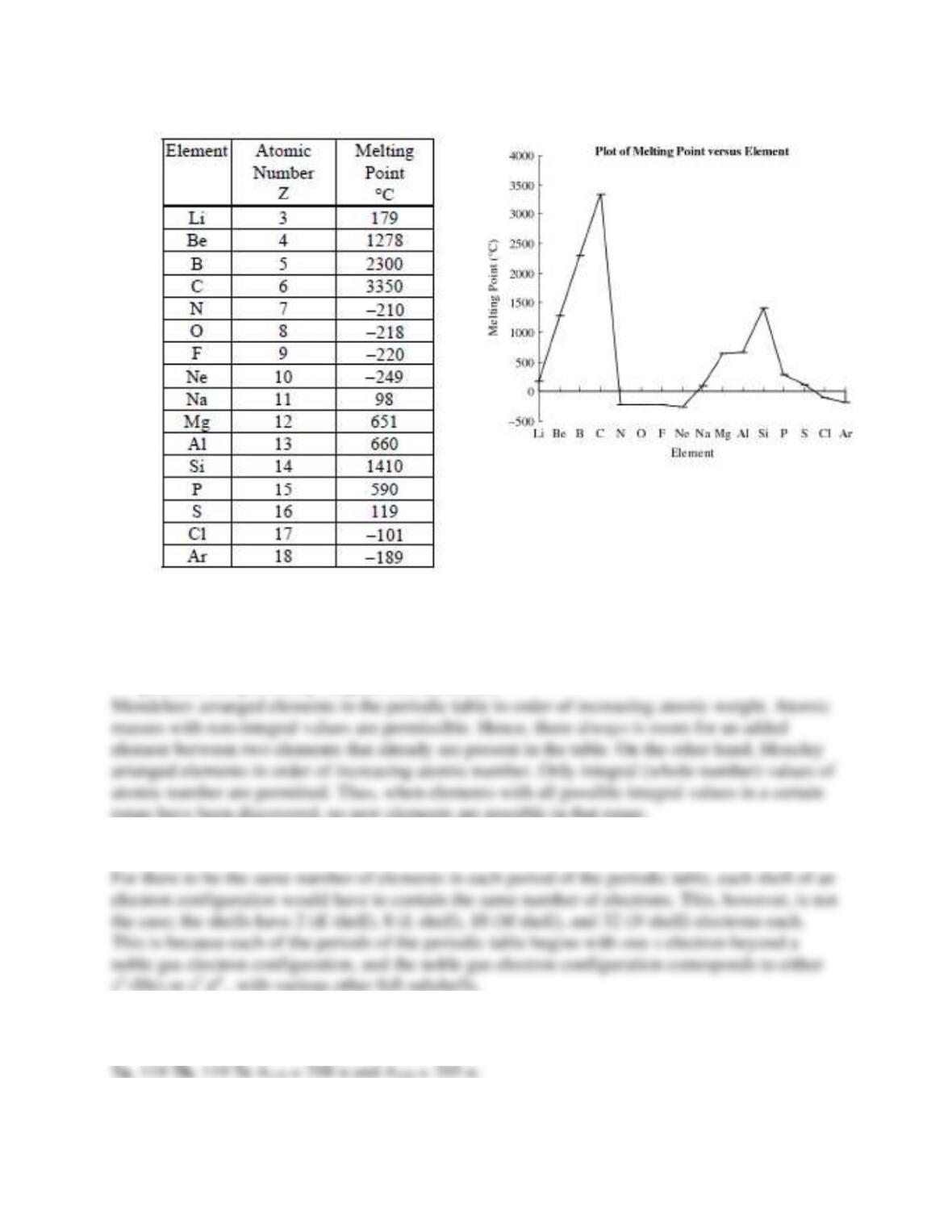
4. The following melting points are in degrees Celsius. Show that melting point is a periodic
property of these elements: Al, 660; Ar,
189;−
Be, 1278; B, 2300; C, 3350; Cl,
101;−
F,
249;−
210;−
218;−
The Periodic Table
5. Mendeleev’s periodic table did not preclude the possibility of a new group of elements that
would fit within the existing table, as was the case with the noble gases. Moseley’s work did
preclude this possibility. Explain this difference.
range have been discovered, no new elements are possible in that range.
6. Explain why the several periods in the periodic table do not all have the same number of
members.
7. Assuming that the seventh period is 32 members long, what should be the atomic number of
the noble gas following radon (Rn)? Of the alkali metal following francium (Fr)? What
would you expect their approximate atomic masses to be?
8. Concerning the incomplete seventh period of the periodic table, what should be the atomic

number of the element (a) for which the filling of the
6d
subshell is completed; (b) that
should most closely resemble bismuth; (c) that should be a noble gas?
Atomic Radii and Ionic Radii
9. For each of the following pairs, indicate the atom that has the larger size: (a) Te or Br; (b) K
or Ca; (c) Ca or Cs; (d) N or O; (e) O or P; (f) Al or Au.
10. Indicate the smallest and the largest species (atom or ion) in the following group: Al atom, F
atom, As atom,
+
Cs
ion,
I−
ion, N atom.
11. Explain why the radii of atoms do not simply increase uniformly with increasing atomic
number.
12. The masses of individual atoms can be determined with great precision, yet there is
considerable uncertainty about the exact size of an atom. Explain why this is the case.
13. Which is (a) the smallest atom in group 13; (b) the smallest of the following atoms: Te, In, Sr,
Po, Sb? Why?
14. How would you expect the sizes of the hydrogen ion,
+
H,
and the hydride ion,
H,
−
to
compare with that of the H atom and the He atom? Explain.
15. Arrange the following in expected order of increasing radius: Br,
+
Li ,
Se,
I−
Explain your
answer.
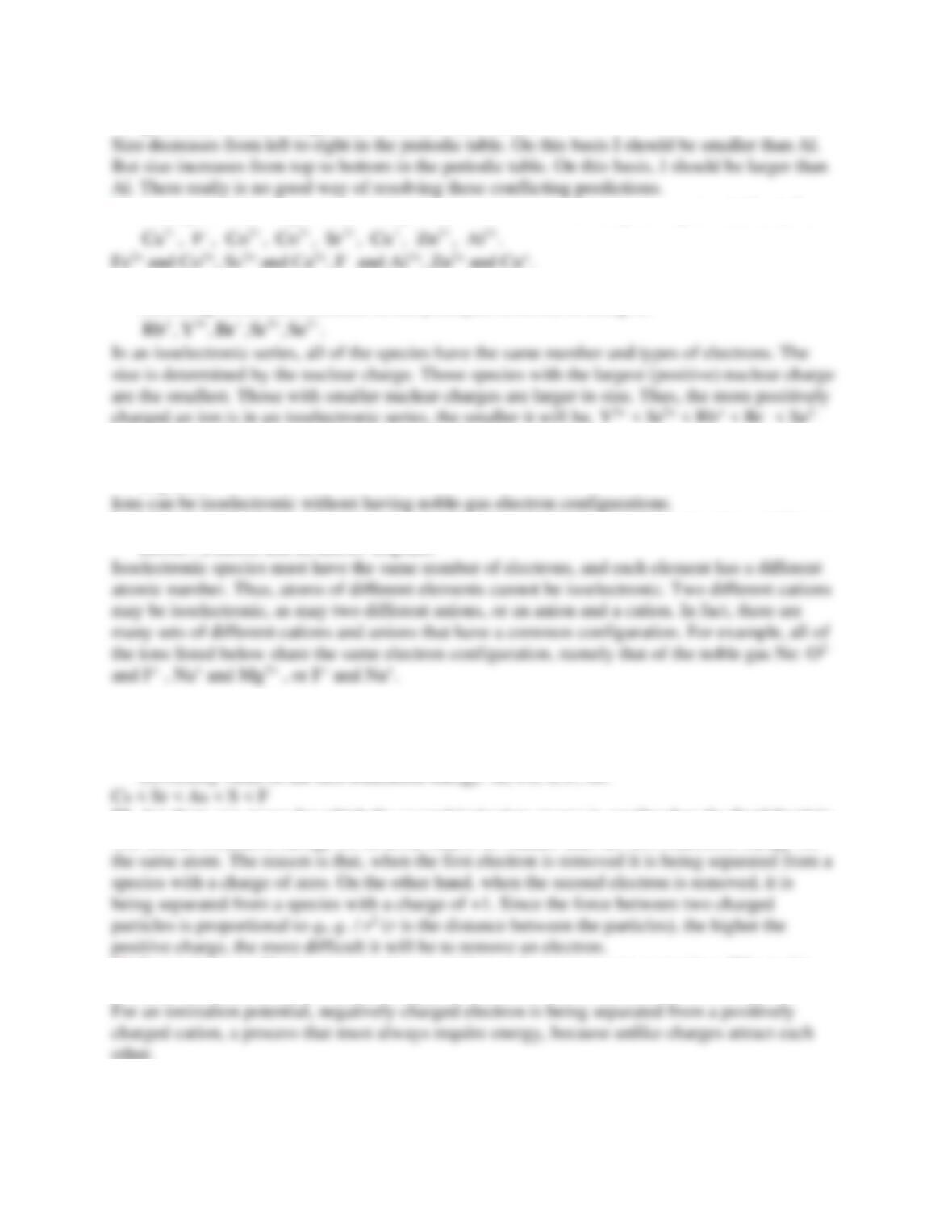
16. Explain why the generalizations presented in Figure 9-19 cannot be used to answer the
question, Which is larger, an Al atom or an I atom?
17. Among the following ions, several pairs are isoelectronic. Identify these pairs.
2
Fe ,
+
3
Sc ,
+
18. The following species are isoelectronic with the noble gas krypton. Arrange them in order of
increasing radius and comment on the principles involved in doing so:
19. All the isoelectronic species illustrated in the text had the electron configurations of noble
gases. Can two ions be isoelectronic without having noble-gas electron configurations?
Explain.
20. Is it possible for two different atoms to be isoelectronic? two different cations? two different
anions? a cation and an anion? Explain.
Ionization Energies; Electron Affinities
21. Use principles established in this chapter to arrange the following atoms in order of
increasing value of the first ionization energy: Sr, Cs, S, F, As.
22. Are there any atoms for which the second ionization energy is smaller than the first? Explain.
The second ionization energy for an atom cannot be smaller than the first ionization energy for
23. Some electron affinities are negative quantities, and some are zero or positive. Why is this
not also the case with ionization energies?
24. How much energy, in joules, must be absorbed to convert to
Na+
all the atoms present in
1.00 mg of gaseous Na? The first ionization energy of Na is
495 8 kJ/mol
25. How much energy, in kilojoules, is required to remove all the third-shell electrons in a mole
of gaseous silicon atoms?
26. What is the maximum number of
Cs+
ions that can be produced per joule of energy absorbed
by a sample of gaseous Cs atoms?
27. The production of gaseous bromide ions from bromine molecules can be considered a two-
step process in which the first step is
( ) ( )
1
2r
Br g 2 Br g 193kJ molH−
→ = +
28. Use ionization energies and electron affinities listed in the text to determine whether the
following reaction is endothermic or exothermic.
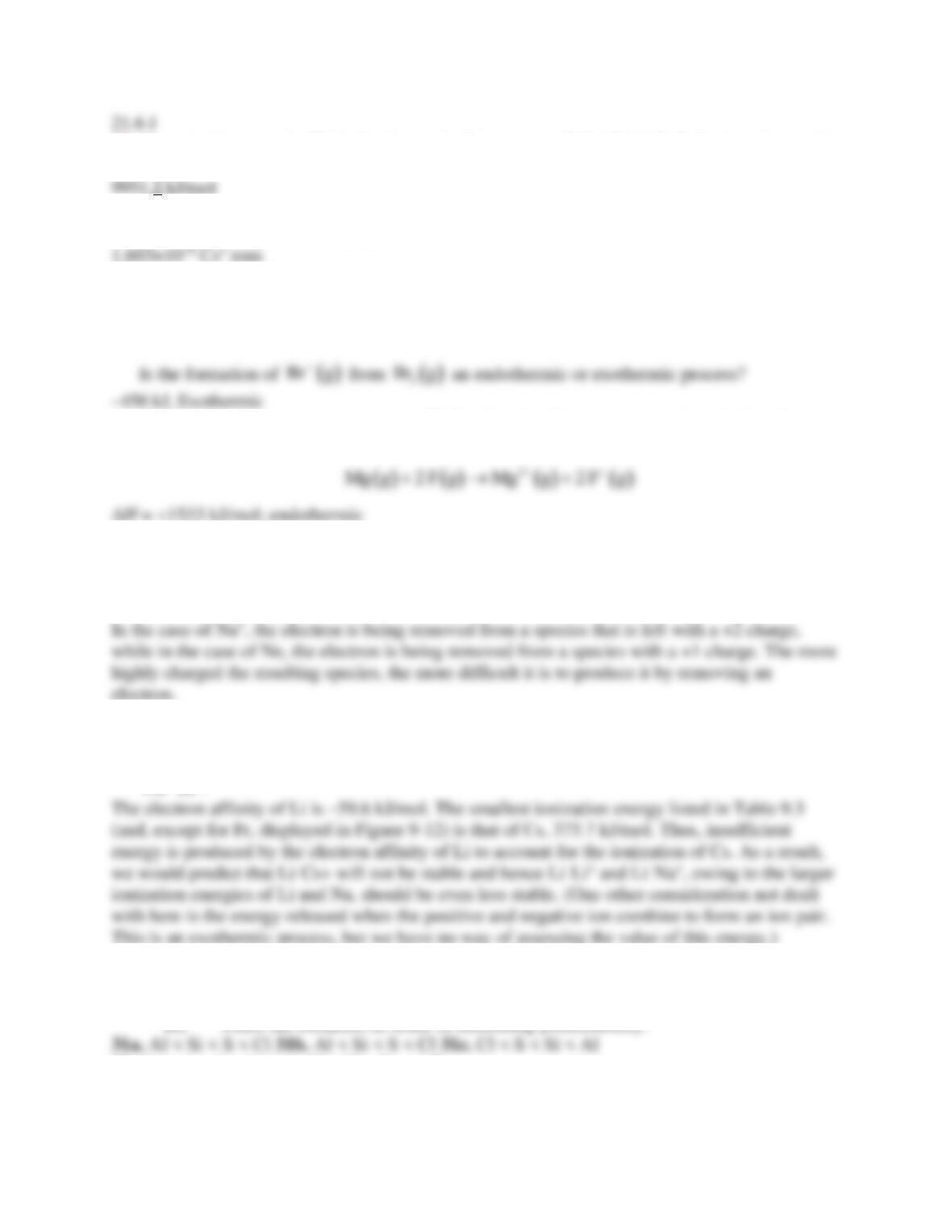
29. The
Na+
ion and the Ne atom are isoelectronic. The ease of loss of an electron by a gaseous
Ne atom, first ionization energy, has a value of
2081kJ/mol
The ease of loss of an electron
from a gaseous
Na+
ion, second ionization energy, has a value of
4562 kJ/mol
Why are
these values not the same?
30. From the data in Figure 9-12, the formation of a gaseous anion
Li−
appears energetically
favorable. That is, energy is given off when gaseous Li atoms accept electrons. Comment on
the likelihood of forming a stable compound containing the
Li−
ion, such as
Li Li
+−
or
Na Li
+−
31. Compare the elements Al, Si, S, and Cl.
(a) Place the elements in order of increasing ionization energy.
(b) Place the elements in order of increasing electron affinity.
(c) Place the elements in order of increasing polarizability.
32. Compare the elements Na, Mg, O, and P.
(a) Place the elements in order of increasing ionization energy.
(b) Place the elements in order of increasing electron affinity.
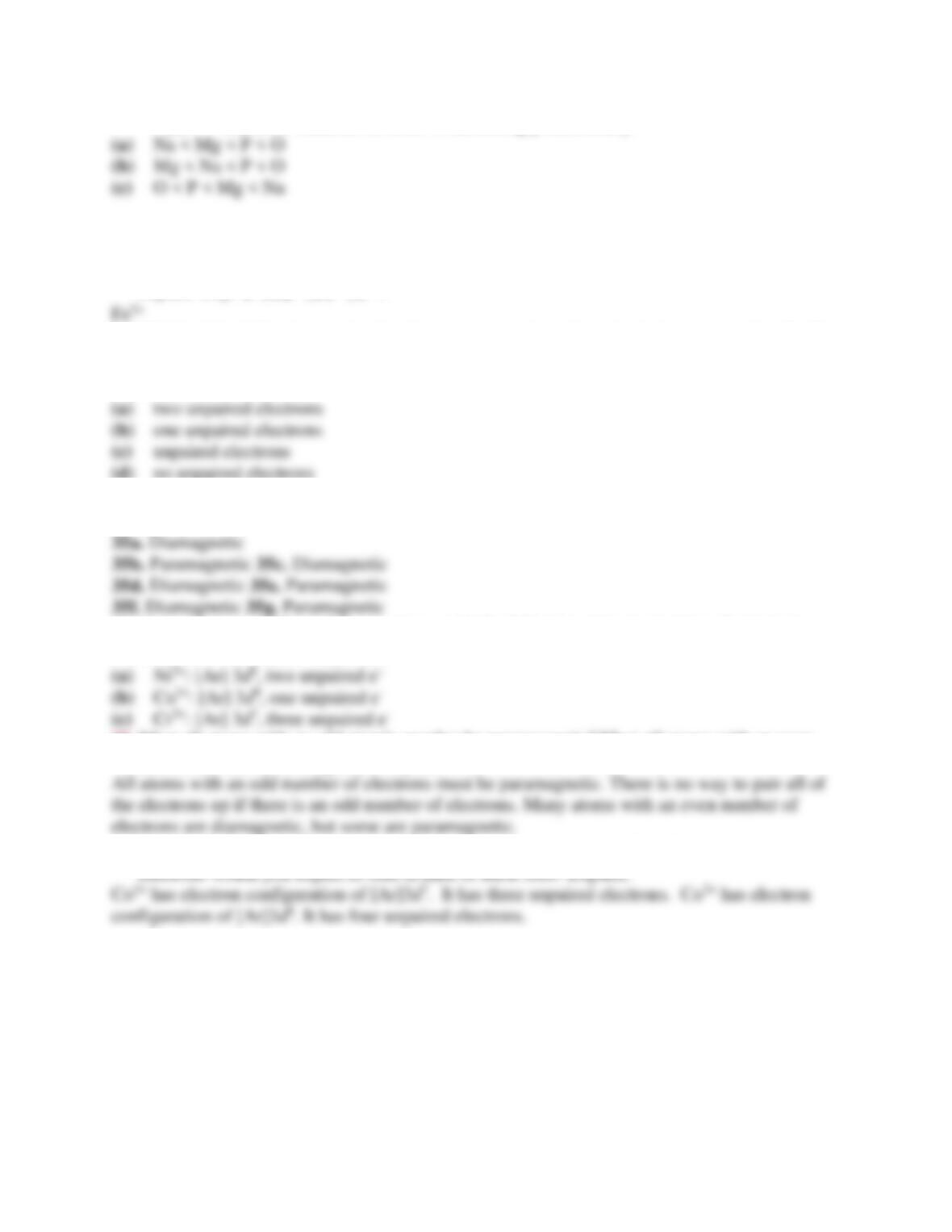
(c) Place the elements in order of increasing polarizability.
Magnetic Properties
33. Unpaired electrons are found in only one of the following species. Indicate which one, and
explain why:
2 2 2
F , Ca , Fe ,S
− + + −
34. Which of the following species has the greatest number of unpaired electrons (a) Ge; (b) Cl;
(c)
3
Cr ;
+
(d)
Br ?
−
35. Which of the following species would you expect to be diamagnetic and which
paramagnetic? (a)
K;
+
(b)
3
Cr ;
+
(c)
2
Zn ;
+
(d) Cd; (e)
3
Co ;
+
(f)
2
Sn ;
+
(g) Br.
36. Write electron configurations consistent with the following data on numbers of unpaired
electrons:
2 2 3
Ni , 2; Cu ,1; Cr , 3
+ + +
37. Must all atoms with an odd atomic number be paramagnetic? Must all atoms with an even
atomic number be diamagnetic? Explain.
38. Neither
2
Co +
nor
3
Co +
has
4s
electrons in its electron configuration. How many unpaired
Predictions Based on the Periodic Table
39. Use ideas presented in this chapter to indicate
(a) three metals that you would expect to exhibit the photoelectric effect with visible light
and three that you would not; (b) the noble gas element that should have the highest density
in the liquid state; (c) the approximate first ionization energy
i
E
of fermium
( )
Z 100 ;=
(d)
the approximate density of solid radium
( )
Z 88=

40. Arrange the following atoms in order of increasing polarizability: F, Na, P, As, Br.
Recall that polarizability decreases going from left to right across a period and increases from
42. For the following groups of elements, select the one that has the property noted:
(a) the largest atom: Mg, Mn, Mo, Ba, Bi, Br
(b) the lowest first ionization energy: B, Sr, Al, Br, Mg, Pb
(c) the most negative electron affinity: As, B, Cl, K, Mg, S
(d) the largest number of unpaired electrons:
2 2 3 3
F, N, S , Mg , Sc , Ti
− + + +
43. Of the species Cl, Cl+, and Cl–, which has the highest polarizability? Which has lowest
44. Of the species Na+, Na, F, and F–, which has the highest polarizability? Which has lowest
polarizability?
45. Match each of the lettered items on the left with an appropriate numbered item on the right.
All the numbered items should be used, and some more than once.
(a)
32Z=
(b)
8Z=
(c)
53Z=
(d)
38Z=
(e)
48Z=
(f)
20Z=
1. two unpaired p electrons
2. diamagnetic
3. more negative electron affinity than elements on either side of it in the same period
4. first ionization energy lower than that of Ca but greater than that of Cs
46. Match each of the lettered items in the column on the left with the most appropriate
numbered item(s) in the column on the right. Some of the numbered items may be used more
than once and some not at all.

(a) Tl
(b)
70Z=
(c) Ni
(d)
2
Ar 4s
(e) a metalloid
(f) a nonmetal
1. an alkaline earth metal
2. element in period 5 and group 15
3. largest atomic radius of all the elements
4. an element in period 4 and group 16
5.
8
3d
6. one p electron in the shell of highest n
7. lowest ionization energy of all the elements
8. an
f
-block element
47. Which of the following ions are unlikely to be found in chemical compounds:
4 6 2 5
K , Ga , Fe , S , Ge ,
+ + + − +
or
Br ?
−
Explain briefly.
48. Which of the following ions are likely to be found in chemical compounds:
2 4 2
Na , Li , Al , F ,
+ + + −
o r
2
Te ?
−
E x p l a i n b r i e f l y .
Integrative and Advanced Exercises
49. Four atoms and/or ions are sketched below in accordance with their relative atomic and/or
ionic radii.
Which of the following sets of species are compatible with the sketch? Explain. (a)
50. Sketch a periodic table that would include all the elements in the main body of the table.
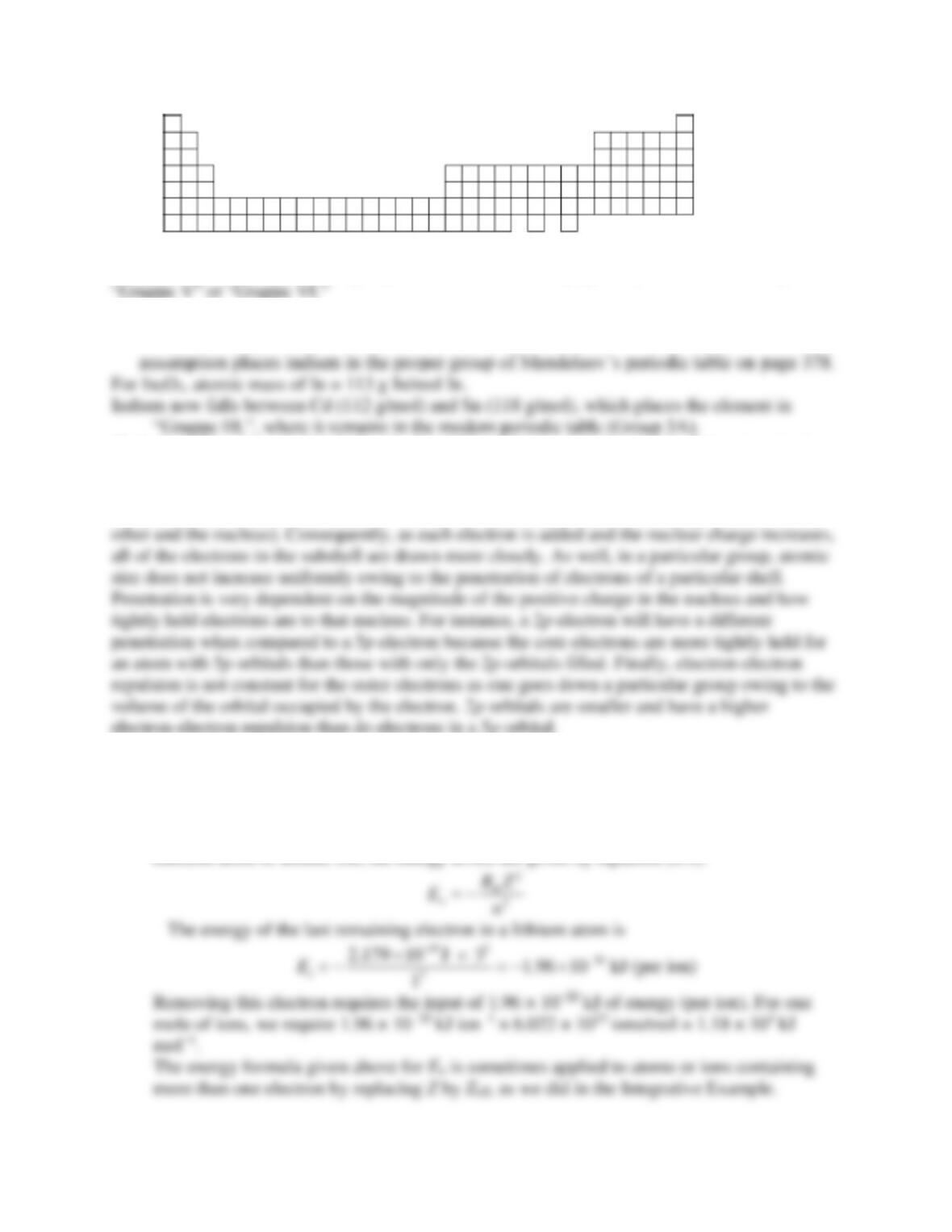
How many “numbers” wide would the table be?
51. In Mendeleev’s time, indium oxide, which is 82.5% In by mass, was thought to be InO. If
this were the case, in which group of Mendeleev’s table (page 378) should indium be placed?
52. Instead of accepting the atomic mass of indium implied by the data in Exercise 51,
Mendeleev proposed that the formula of indium oxide is
23
In O
Show that this
53. Refer to Figure 9-11 and explain why the difference between the ionic radii of the
1−
and
2−
anions does not remain constant from top to bottom of the periodic table.
Sizes of atoms do not simply increase uniformly with atomic number because electrons do not
effectively screen each other from the nuclear charge (they do not effectively get between each
54. Explain why the third ionization energy of Li(g) is an easier quantity to calculate than
either the first or second ionization energies. Calculate the third ionization energy for Li,
and express the result in
kJ/mol
The ground-state electron configuration of Li is 1s2 2s1. The third ionization energy of Li(g)
corresponds to the removal of the last remaining electron (from the 1s orbital). For a one-
electron atom or atomic ion, the energy levels are given by equation (8.9).
55. Two elements, A and B, have the electron configurations shown.
1 10 2 3
A Ar 4 B Ar 3 4 4s d s p==
(a) Which element is a metal?
(b) Which element has the greater ionization energy?
(c) Which element has the larger atomic radius?
(d) Which element has the greater electron affinity?
56. Two elements, A and B, have the electron configurations shown.
2 10 2 5
A Kr 4 B Ar 3 4 4s d s p==
(a) Which element is a metal?
(b) Which element has the greater ionization energy?
(c) Which element has the larger atomic radius?
(d) Which element has the greater electron affinity?
57. Studies done in 1880 showed that a chloride of -uranium had 37.34% Cl by mass and an
approximate formula mass of 382 u. Other data indicated the -specific heat of uranium to be
0.0276 cal
11
gC
−−
Are these data in agreement with the atomic mass of -uranium assigned
by Mendeleev, 240 u? [Hint: Refer to Feature Problem 124 of Chapter 7.]
58. Assume that atoms are hard spheres, and use the metallic radius of 186 pm for Na to estimate
the volumes of one Na atom and of one mole of Na atoms. How does your result compare with
the atomic volume found in Figure 9-1? Why is there so much disagreement between the two
values?
59. When sodium chloride is strongly heated in a flame, the flame takes on the yellow color
associated with the emission spectrum of sodium atoms. The reaction that occurs in the
gaseous state is
( ) ( ) ( ) ( )
Na g Cl g Na g Cl g
+−
+ → +
60. Use information from Chapters 8 and 9 to calculate the second ionization energy for the He
atom. Compare your result with the tabulated value of
1
5251 kJ mol−
61. Refer only to the periodic table on the inside front cover, and arrange the following
ionization energies in order of increasing value: the first ionization energy of F; the second
ionization energy of Ba; the third ionization energy of Sc; the second ionization energy of
Na; the third ionization energy of Mg. Explain the basis of any uncertainties.
62. Refer to the footnote on page 393. Then use values of basic physical constants and other data
from the appendices to show that
1
1eV/atom 96 49 kJ mol−
=
63. The ionization energies of Li, Be+, B2+, and C3+ are, respectively, 520, 1757, 3659, and 6221
kJ mol–1. The ionization energies Na, Mg+, Al2+, and Si3+ are (from Table 9.4) 495.8, 1451,
2745, and 4356 kJ mol–1. Plot a graph of the square roots of the ionization energies versus the
nuclear charge for these two series. Explain the observed relationship with the aid of Bohr’s
expression for the binding energy of an electron in a one-electron atom.
Ionization energy (I.E.) data is tabulated below and plotted in the graphs below.