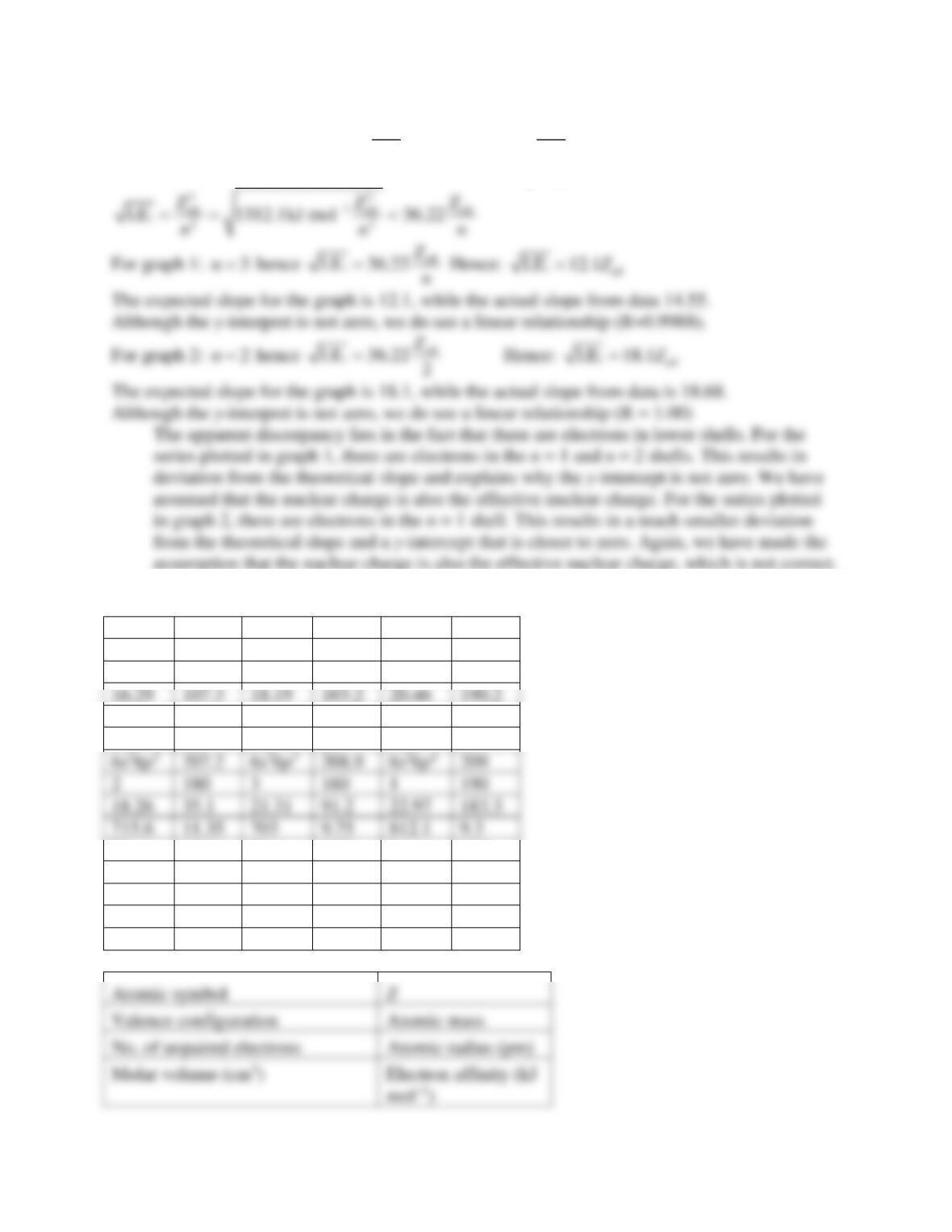
From the Bohr model:
22
1
eff eff
H22
I.E. R 1312.1kJ mol
ZZ
nn
−
= =
If we take the root of both sides, we obtain the following expression
64. Elements 114–116 have recently been reported to be synthesized. Using data given below
and the periodic law, fill in the missing data for these elements.
Sn
50
Sb
51
Te
52
5s25p2
118.7
5s25p3
121.8
5s25p4
127.6
2
145
3
145
1
140
16.29
107.3
18.19
103.2
20.46
190.2
708.6
7.31
834
6.69
869.3
6.24
Pb
82
Bi
83
Po
84
6s26p2
207.2
6s26p3
208.9
6s26p4
209
2
180
3
160
1
190
18.26
35.1
21.31
91.2
22.97
183.3
715.6
11.35
703
9.75
812.1
9.3
Fl
114
Unp
115
Lv
116
?
?
?
?
?
?
?
?
?
?
?
?
?
?
?
?
?
?
?
?
?
?
?
?
The entries for each element are organized as follows:
Atomic symbol
Valence configuration
Atomic mass
No. of unpaired electrons
Atomic radius (pm)
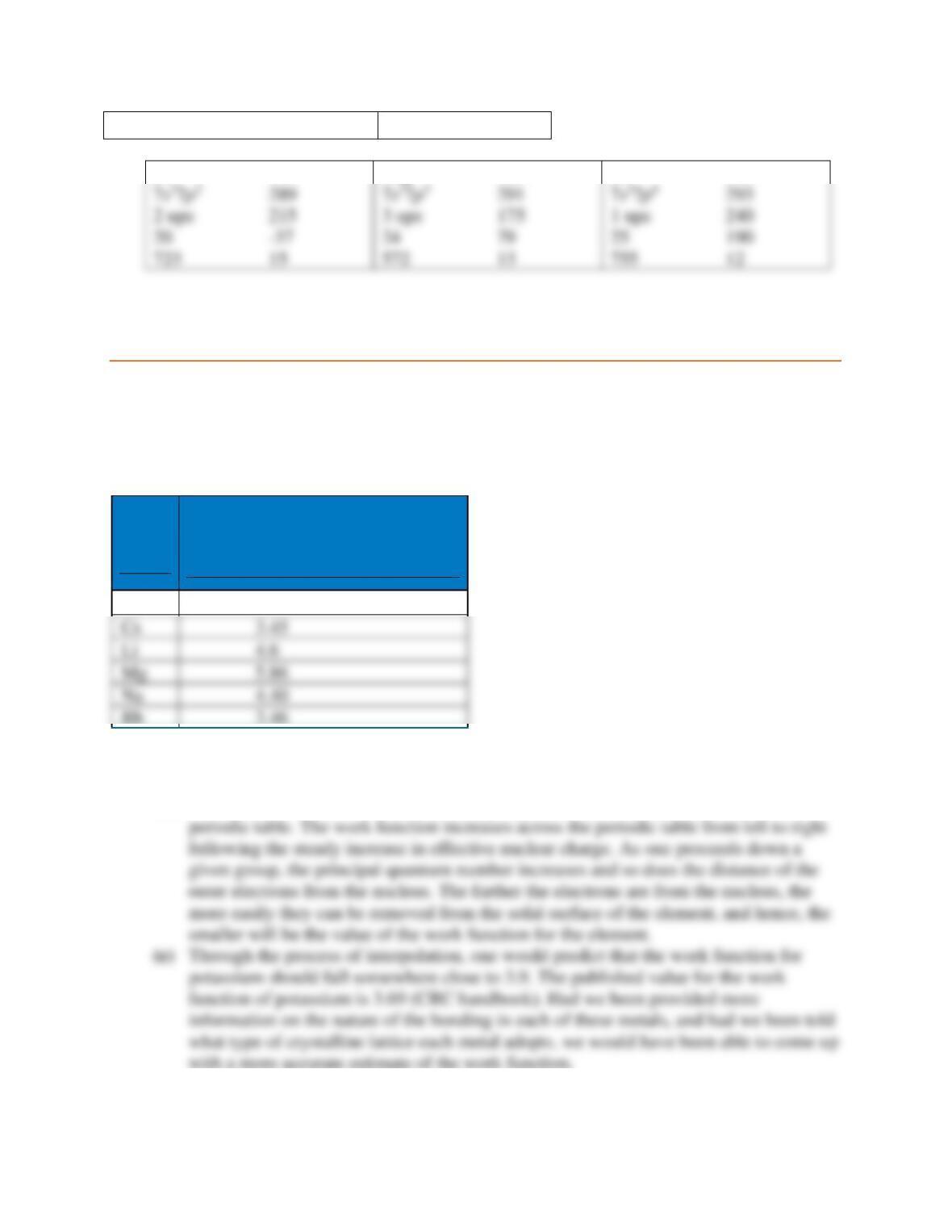
First ionization energy (kJ mol–1)
Density (g cm–3)
Fl
114
Unp
115
Lv
116
Feature Problems
65. The work functions for a number of metals are given in the following table. How do the work
functions vary
(a) down a group?
(b) across a period?
(c) Estimate the work function for potassium and compare it with a published value.
(d) What periodic property is the work function most like?
Metal
Work Function,
19
J 10
Al
6.86
(a) The work function is the energy required for an electron to escape from the solid
surface of an element.
(b) Work functions tend to decrease down a group and increase across a period in the

66. The following are a few elements and their characteristic X-ray wavelengths:
Element
X-ray Wavelength,
pm
Mg
987
S
536
Ca
333
Cr
229
Zn
143
Rb
93
Use these data to determine the constants A and b in Moseley’s relationship (page 379).
Compare your value of A with the value obtained from Bohr’s theory for the frequencies
emitted by one-electron atoms. Suggest a reasonable interpretation of the quantity b.
67. Gaseous sodium atoms absorb quanta with the energies shown in the table below.
Energy of Quanta,
1
kJ mol−
Electron
Configuration
0
1
Ne 3s
H
203
1
Ne 3p
308
1
Ne 4s
349
1
Ne 3d
362
1
Ne 4 p
(a) The ionization energy of the ground state is
1
496 kJ mol−
Calculate the ionization
energies for each of the states given in the table.
(b) Calculate
eff
Z
for each state.
(c) Calculate
n
r
for each state.
(d) Interpret the results obtained from parts (b) and (c) in terms of penetration and
screening.

68. A method for estimating electron affinities is to extrapolate
eff
Z
values for atoms and ions
that contain the same number of electrons as the negative ion of interest. Use the data in the
table to answer the questions that follow.
Atom or Ion:
( )
1
i
E kJ mol−
Atom or Ion:
( )
1
i
E kJ mol−
Atom or Ion:
( )
1
i
E kJ mol−
Ne: 2080
F: 1681
O: 1314
Na : 4565
+
Ne : 3963
+
F : 3375
+
2
Mg : 7732
+
2
Na : 6912
+
è
2
Ne : 6276
+
3
Al :11 577,
+
3
Mg :10 548,
+
3
Na : 9540
+
(a) Estimate the electron affinity of F, and compare it with the experimental value.
(b) Estimate the electron affinities of O and N.
(c) Examine your results in terms of penetration and screening.
69. We have seen that the wave functions of hydrogen-like atoms contain the nuclear charge Z for
hydrogen-like atoms and ions, but modified through equation (9.3) to account for the
phenomenon of shielding or screening. In 1930, John C. Slater devised the following set of
( )
0.35 each.
(iv) All electrons in the
1n−
shell shield to the extent of 0.85 each.
(v) All electrons in the
2n−
shell, or lower, shield completely—their contributions to the
shielding constant are 1.00 each.
When the designated electron being shielded is in an nd or nf group, rules (ii) and (iii) remain
the same but rules (iv) and (v) are replaced by
(vi) Each electron in a group lying to the left of the nd or nf group contributes 1.00 to the
shielding -constant.
These rules are a simplified generalization based on the average behavior of different types
of electrons. Use these rules to do the following:
(a) Calculate
eff
Z
for a valence electron of oxygen.
(b) Calculate
eff
Z
for the
4s
electron in Cu.
(c) Calculate
eff
Z
for a
3d
electron in Cu.
(d) Evaluate the
eff
Z
for the valence electrons in the group 1 elements (including H),
and show that the
ionization energies observed for this group are accounted for by using the Slater rules.
[Hint: Do not overlook the effect of n on the orbital energy.]
(e) Evaluate
eff
Z
for a valence electron in the elements Li through Ne, and use the
results to explain the observed trend in first ionization energies for these elements.
(f) Using the radial functions given in Table 8.2 and
eff
Z
estimated with the Slater
rules, compare plots of the radial probability for the
33s, p,
and
3d
orbitals for the H
atom and the Na atom. What do you observe from these plots regarding the effect of
shielding on radial probability distributions?
(d) Zeff = 2.20; Based upon Slater’s rules, we have found that the effective nuclear charge
( )
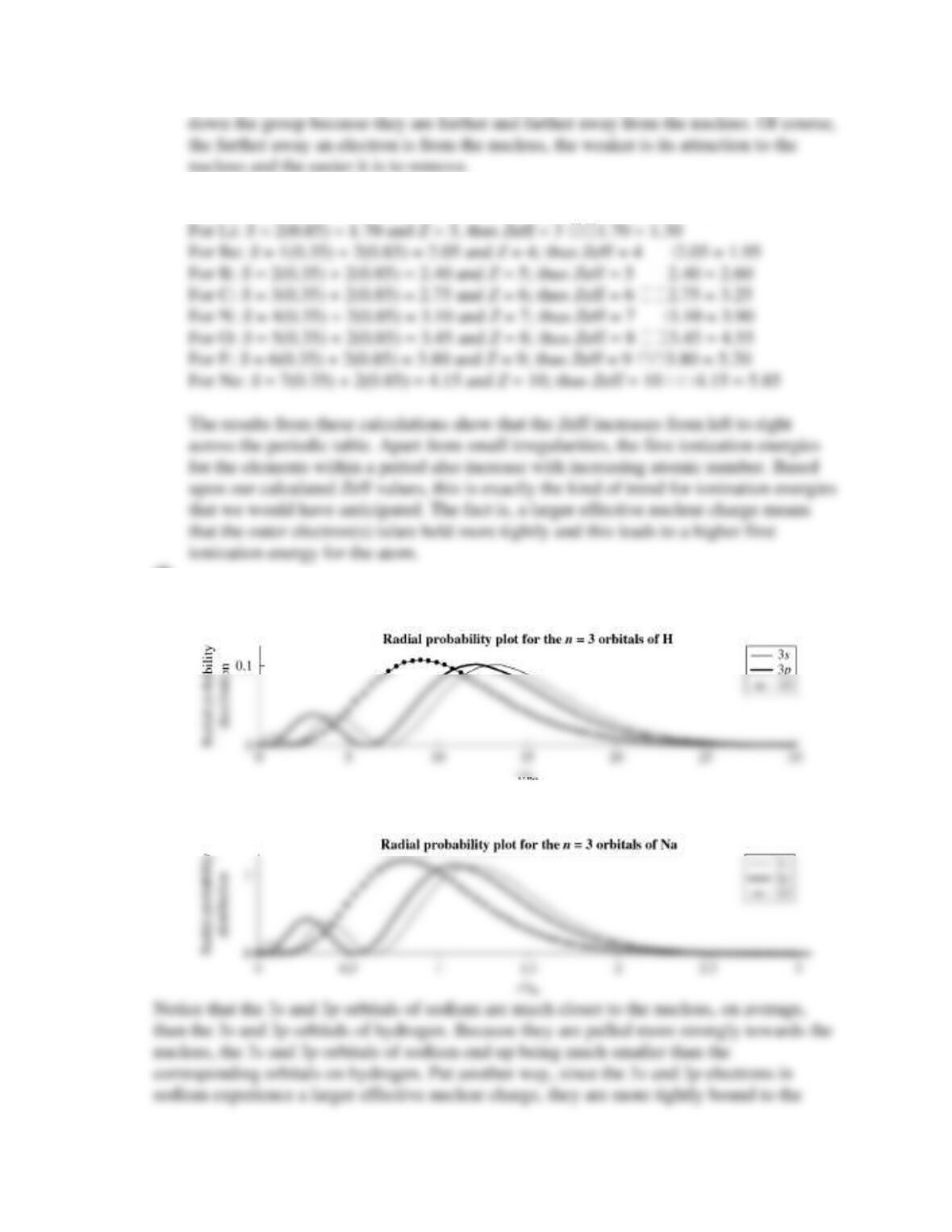
(e) As was the case in part (d), to evaluate Zeff for a valence electron in each atom, we
must first calculate the screening experienced by the electron with Slater’s rules
(f)
Self-Assessment Exercises
70. In your own words, define the following terms:
(a) isoelectronic; (b) valence-shell electrons; (c) metal; (d) nonmetal; (e) metalloid.
71. Briefly describe each of the following ideas or phenomena: (a) the periodic law; (b)
ionization energy; (c) electron affinity; (d) paramagnetism.
(a) The periodic law: The original law by Mendeleev and Meyer stated that “When the
72. Explain the important distinctions between each pair of terms: (a) actinide and
lanthanide element; (b) covalent and metallic radius; (c) atomic number and effective
nuclear charge; (d) ionization energy and electron affinity; (e) paramagnetic and
diamagnetic.
(a) Actinide and lanthanide element: Both rare earth elements. Lanthanides have a 4f
73. The element whose atoms have the electron configuration
10 2 3
Kr 4 5 5d s p
(a) is in group
74. The fourth-period element with the largest atom is (a) K; (b) Br; (c) Pb; (d) Kr.
75. Which of the following has the largest radius (a) an Ar atom; (b) a
K+
ion; (c) a
2
Ca +
ion;
(d) a
Cl−
ion?
76. The highest first ionization energy of the following is that of (a) Cs; (b) Cl; (c) I; (d) Li.
77. The most negative electron affinity of the following elements is that of (a) Br; (b) Sn; (c) Ba;
78. An ion that is isoelectronic with
2
Se −
is (a)
2
S;
−
(b)
I;
−
(c) Xe; (d)
2
Sr +
79. Write electron configurations to show the first two ionizations for Cs. Explain why the
80. Explain why the first ionization energy of Mg is greater that of Na, whereas the second
ionization of Na is greater than that of Mg.
81. Answer each of the following questions:
(a) Which of the elements P, As, and S has the largest atomic radius?
(b) Which of the following has the smallest radius:
23
Xe, O , N , or F ?
− − −
(c) Which should have the largest difference between the first and second ionization
energy: Al, Si, P, or Cl?
(d) Which has the largest ionization energy: C, Si, or Sn?
(e) Which has the largest electron affinity: Na, B, Al, or C?
82. The first ionization energies of Si, P, S, and Cl are given in Table 9.4. Briefly provide an
explanation for this trend.
83. Find three pairs of elements that are out of order in the periodic table in terms of their atomic
masses. Why is it necessary to invert their order in the table?
84. For the atom
119
50Sn,
indicate the number of (a) protons in the nucleus; (b) neutrons in the
nucleus; (c)
4d
electrons; (d)
3s
electrons; (e)
5p
electrons; (f) electrons in the valence
shell.
85. Refer to the periodic table on the inside front cover and indicate (a) the most nonmetallic
element; (b) the transition metal with lowest atomic number; (c) a metalloid whose atomic
number is exactly midway between those of two noble gas elements.
86. Give the symbol of the element (a) in group 14 that has the smallest atoms; (b) in period 5
that has the largest atoms; (c) in group 17 that has the lowest first ionization energy.
87. Refer only to the periodic table on the inside front cover and indicate which of the atoms, Bi,
S, Ba, As, and Ca, (a) is most metallic; (b) is most nonmetallic; (c) has the intermediate
value when the five are arranged in order of increasing first ionization energy.
88. Arrange the following elements in order of decreasing metallic character: Sc, Fe, Rb, Br, O,
Ca, F, Te.
89. In multielectron atoms many of the periodic trends can be explained in terms of
eff
Z
Consider the following statements and discuss whether or not the statement is true or false.
(a)
Electrons in a p orbital are more effective than electrons in the s orbitals in shielding
other electrons from the nuclear charge.
(b)
eff
Z
for an electron in an s orbital is lower than that for an electron in a p orbital in the
same shell.
(c)
eff
Z
is usually less than Z.
(d)
Electrons in orbitals having
1=
penetrate better than those with
2=
(e)
eff
Z
for the orbitals of the elements
( )
Na 3 ,s
( )
Mg 3 ,s
( )
Al 3 ,p
( )
P 3 ,p
and
( )
S3p
are in
the order
( ) ( ) ( ) ( ) ( )
eff eff eff eff eff
Na Z Mg Z Al Z P Z SZ
90. Consider a nitrogen atom in the ground state and comment on whether the following
statements are true or false.
(a)
eff
Z
for an electron in a
2s
orbital is greater than that for the
1s
orbital.
(b)
The
eff
Z
for the
2p
and
2s
orbitals is the same.

(c) More energy is required to remove an electron from a
2s
orbital than from the
2p
orbital.
(d)
The
2s
electron is less shielded than the
2p
electron.
91. Describe how the ionization energies of the ions
He , Li , Be , B , C , N , O , and F
− − − − − − − −
vary
with atomic number.
92. Describe how the ionization energies of the ions
Be , B , C , N , O , F , Ne , and Na
+ + + + + + + +
vary with atomic number.
93. Which element Na or Mg is likely to have
ea H
greater than zero?
94. Why, in general, is the addition of an electron to an atom an exothermic process?
95. When compared to a nonmetal of the same period, a metal will have a larger (a) atomic
radius; (b) ionization energy; (c) electron affinity; (d) atomic number; (e) none of these.
96. Which of the following is an example of a metalloid? (a) S; (b) Zn; (c) Ge; (d) Re; (e) none
of these.
97. Which of the following has a smaller radius than a neon atom? (a) Mg2+; (b)
F−
; (c) O2–;
98. Which electron is lost when an atom ionizes? (a) the electron with the highest principal
quantum number; (b) the electron with lowest principal quantum number; (c) an outer-shell
electron with the highest value of the orbital angular momentum quantum number; (d) the
electron with highest orbital angular momentum quantum number; (e) none of these.
99. The electrons lost when Fe ionizes to Fe2+ are (a) 4f; (b) 3d; (c) 4s; (d) 3p; (e) none of these.
The answer is (c) 4s. The electron configuration of Fe is 1s22s22p63s23p63d64s2, whereas the
electron configuration for Fe2+ is 1s22s22p63s23p63d6.

100. Construct a concept map (see Appendix E) connecting the ideas that govern the periodic
law and the periodic variation of atomic properties.
To construct a concept map, one must first start with the most general concepts. These concepts