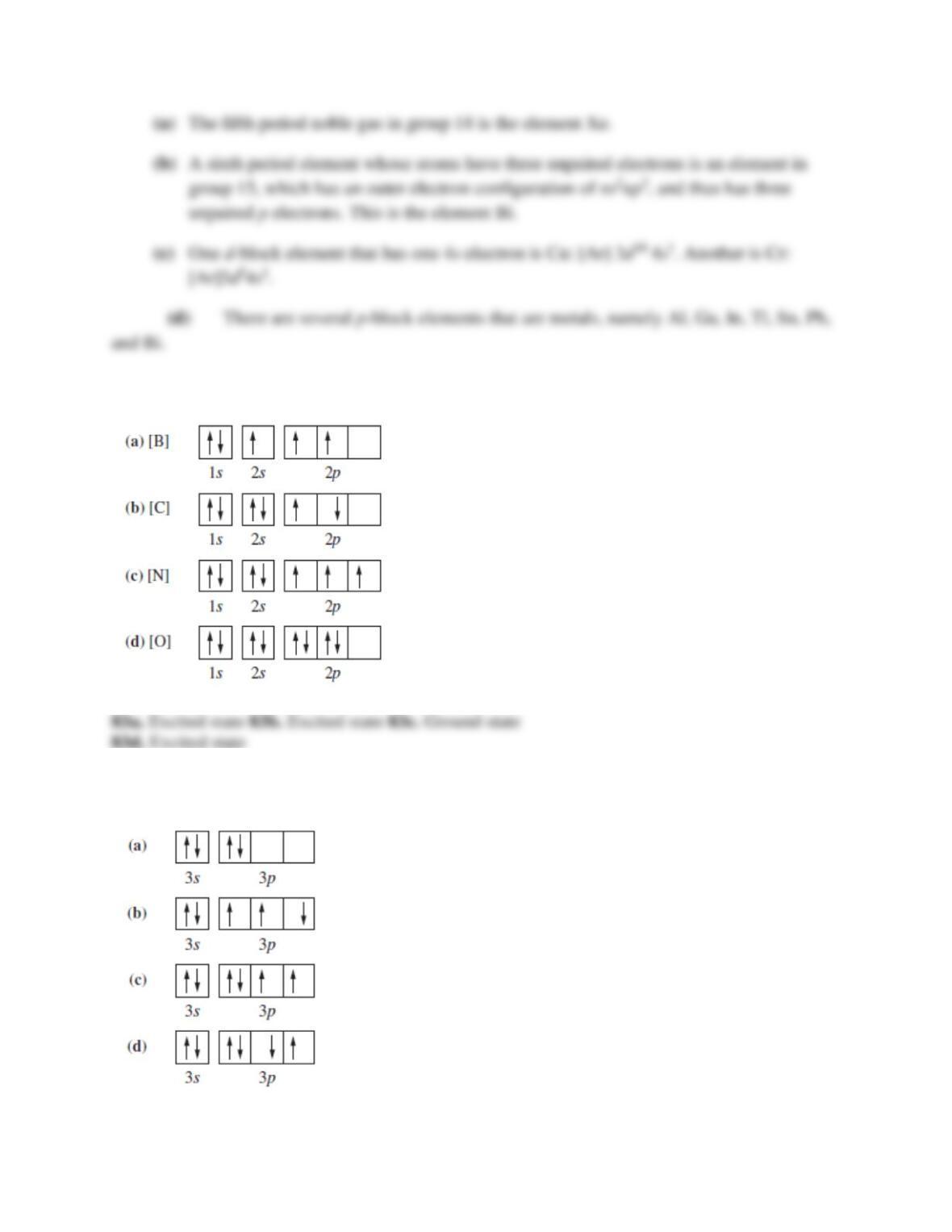
83. Which of the following electron configurations corresponds to the ground state and which to
an excited state?
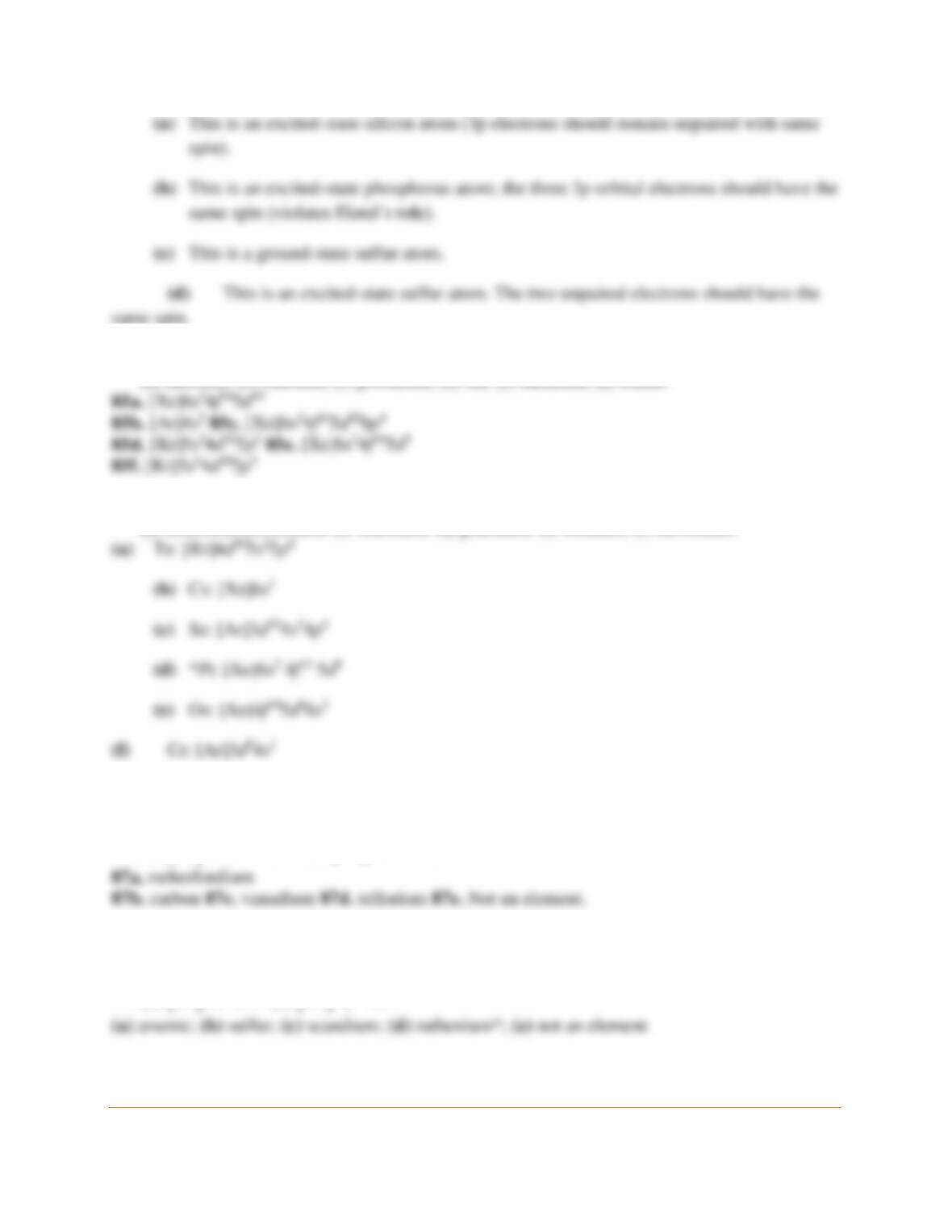
84. To what neutral atom do the following valence-shell configurations correspond? Indicate
whether the configuration corresponds to the ground state or an excited state.
85. What is the expected ground-state electron configuration for each of the following elements?
(a) mercury; (b) calcium; (c) polonium; (d) tin; (e) tantalum; (f) iodine.
86. What is the expected ground-state electron configuration for each of the following elements?
(a) tellurium; (b) cesium; (c) selenium; (d) platinum; (e) osmium; (f) chromium.
87. The following electron configurations correspond to the ground states of certain elements.
Name each element. (a)
22
Rn 6 7d s ;
(b)
22
He 2 2s p ;
(c)
32
Ar 3 4d s ;
(d)
10 2 4
Kr 4 5 5d s p ;
(e)
2 2 1
Xe 4 6 6f s p
88. The following electron configurations correspond to the ground states of certain elements.
Name each element. (a)
10 2 3
Ar 3 4 4d s p ;
(b)
24
Ne 3 3s p ;
(c)
12
Ar 3 4d s ;
(d)
62
Kr 4 5d s ;
(e)
12 2
Xe 4 6fs
Integrative and Advanced Exercises
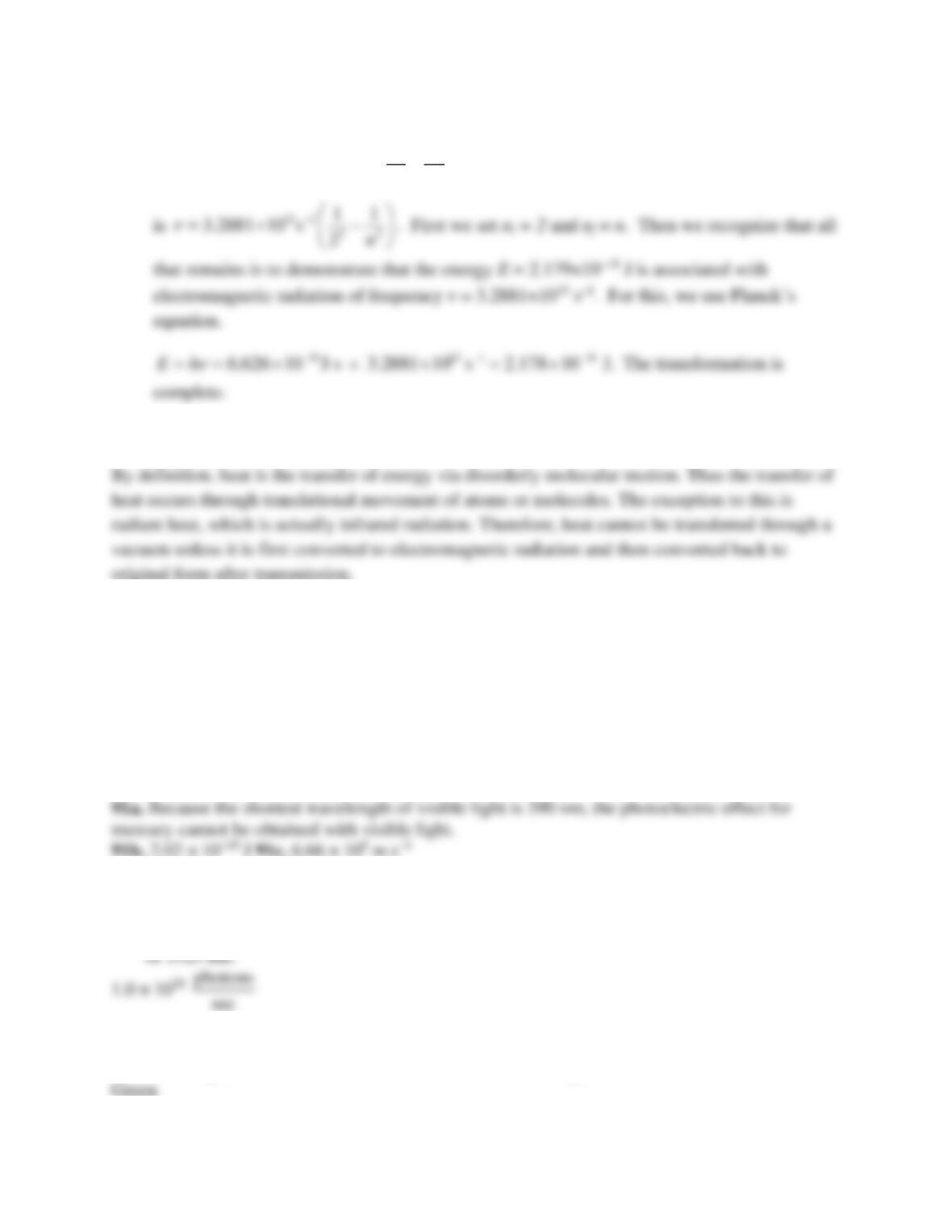
89. Derive the Balmer and Rydberg equations from equation (8.6).
We begin with
18
22
11
2.179 10 J
if
Enn
−
= −
and wish to produce the Balmer equation, which
90. Electromagnetic radiation can be transmitted through a vacuum or empty space. Can heat be
similarly transferred? Explain.
91. The work function is the energy that must be supplied to cause the release of an electron
from a photoelectric material. The corresponding photon frequency is the threshold
frequency. The higher the energy of the incident light, the more kinetic energy the electrons
have in moving away from the surface. The work function for mercury is equivalent to
435 kJ/mol
photons.
(a) Can the photoelectric effect be obtained with mercury by using visible light? Explain.
(b)
What is the kinetic energy, in joules, of the ejected electrons when light of 215 nm
strikes a mercury surface?
(c) What is the velocity, in meters per second, of the ejected electrons in part (b)?
92. Infrared lamps are used in cafeterias to keep food warm. How many photons per second are
produced by an infrared lamp that consumes energy at the rate of 95 W and is 14% efficient
in converting this energy to infrared radiation? Assume that the radiation has a wavelength
93. In 5.0 s, a 75 watt light source emits
20
9 91 10
photons of a monochromatic (single
wavelength) radiation. What is the color of the emitted light?
94. Determine the de Broglie wavelength of the electron ionized from a He+ ion in its ground
state using light of wavelength 208 nm.
95. The Pfund series of the hydrogen spectrum has as its longest wavelength component a line
at 7400 nm. Describe the electron transitions that produce this series. That is, give a
quantum number that is common to this series.
96. Between which two levels of the hydrogen atom must an electron fall to produce light of
wavelength 1876 nm?
97. Use appropriate relationships from the chapter to determine the wavelength of the line in the
emission spectrum of
produced by an electron transition from
to
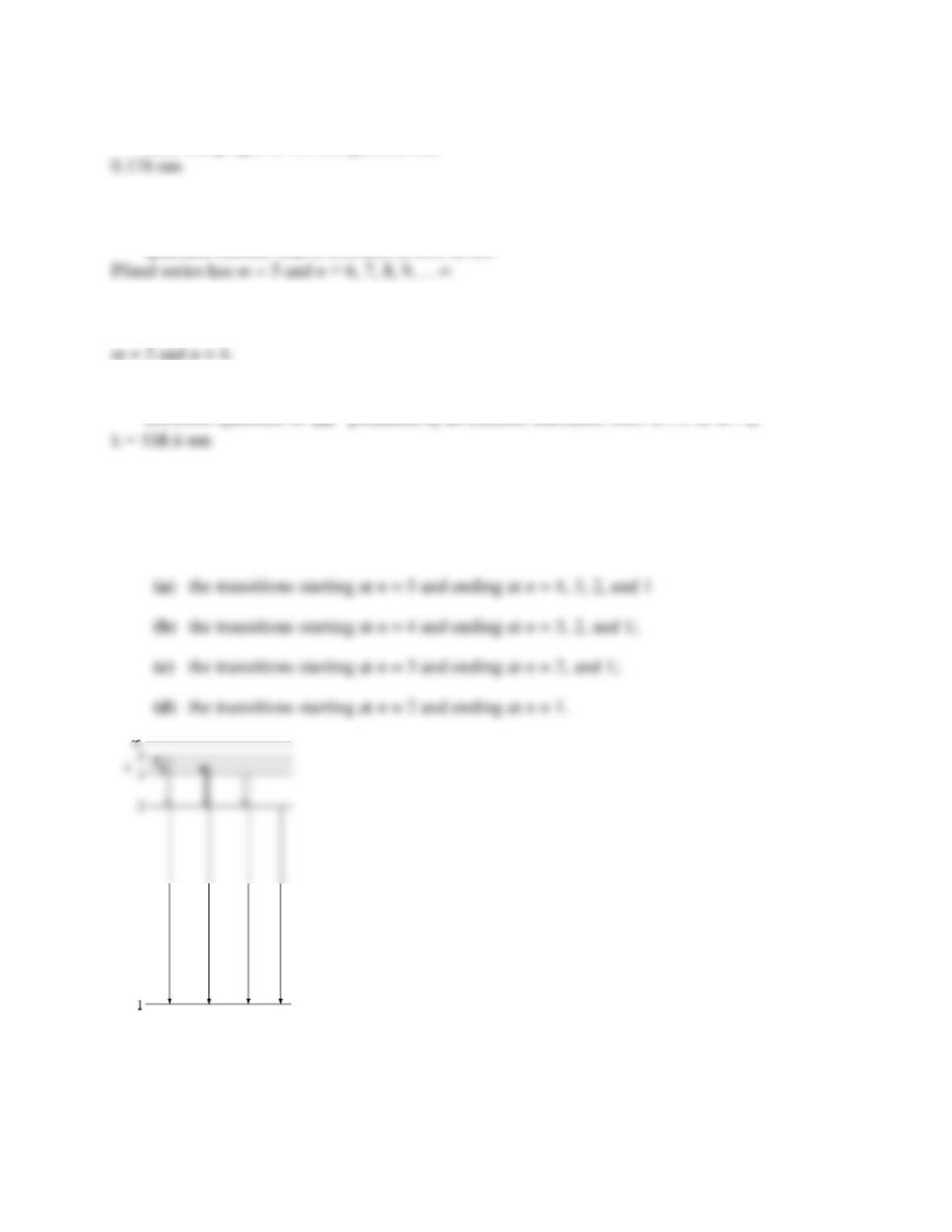
98. Draw an energy-level diagram that represents all the possible lines in the emission spectrum
of hydrogen atoms produced by electron transitions, in one or more steps, from
5n=
to
1n=
The lines observed consist of
99. An atom in which just one of the outer-shell electrons is excited to a very high quantum
level
n
is called a “high Rydberg” atom. In some ways, all these atoms resemble a hydrogen
atom with its electron in a high n level. Explain why you might expect this to be the case.
100. If all other rules governing electron configurations were valid, what would be the electron
configuration of cesium if (a) there were three possibilities for electron spin; (b) the
quantum number could have the value n?
101. Ozone,
3
O,
absorbs ultraviolet radiation and dissociates into
2
O
molecules and O atoms:
3
Oh+ →
2
OO+
A 1.00 L sample of air at
22 C
and 748 mmHg contains 0.25 ppm of
3
O
How much energy, in joules, must be absorbed if all the
3
O
molecules in the sample of
air are to dissociate? Assume that each photon absorbed causes one
3
O
molecule to
dissociate, and that the wavelength of the radiation is 254 nm.
102. Radio signals from Voyager 1 in the 1970s were broadcast at a frequency of 8.4 GHz. On
Earth, this radiation was received by an antenna able to detect signals as weak as
21
4 10 W
−
How many photons per second does this detection limit represent?
103. Certain metal compounds impart colors to flames—sodium compounds, yellow; lithium,
red; barium, green—and flame tests can be used to detect these elements. (a) At a flame
temperature of
800 C,
can collisions between gaseous atoms with average kinetic energies
supply the energies required for the emission of visible light? (b) If not, how do you account
for the excitation energy?

104. The angular momentum of an electron in the Bohr hydrogen atom is mur, where m is the
mass of the electron, u, its velocity, and r, the radius of the Bohr orbit. The angular
momentum can have only the values
2nh / ,
where n is an integer (the number of the Bohr
orbit). Show that the circumferences of the various Bohr orbits are integral multiples of the
de Broglie wavelengths of the electron treated as a matter wave.
105. A molecule of chlorine can be dissociated into atoms by absorbing a photon of sufficiently
high energy. Any excess energy is translated into kinetic energy as the atoms recoil from
one another. If a molecule of chlorine at rest absorbs a photon of 300 nm wavelength, what
will be the velocity of the two recoiling atoms? Assume that the excess energy is equally
divided between the two atoms. The bond energy of
2
Cl
is
1
242 6 kJ mol−
106. Refer to the Integrative Example. Determine whether or not
138n=
is a bound state. If it is,
what sort of state is it? What is the radius of the orbit and how many revolutions per second
does the electron make about the nucleus?
108. Use a graphical method or some other means to determine the radius at which the
probability of finding a
2s
orbital is maximum.
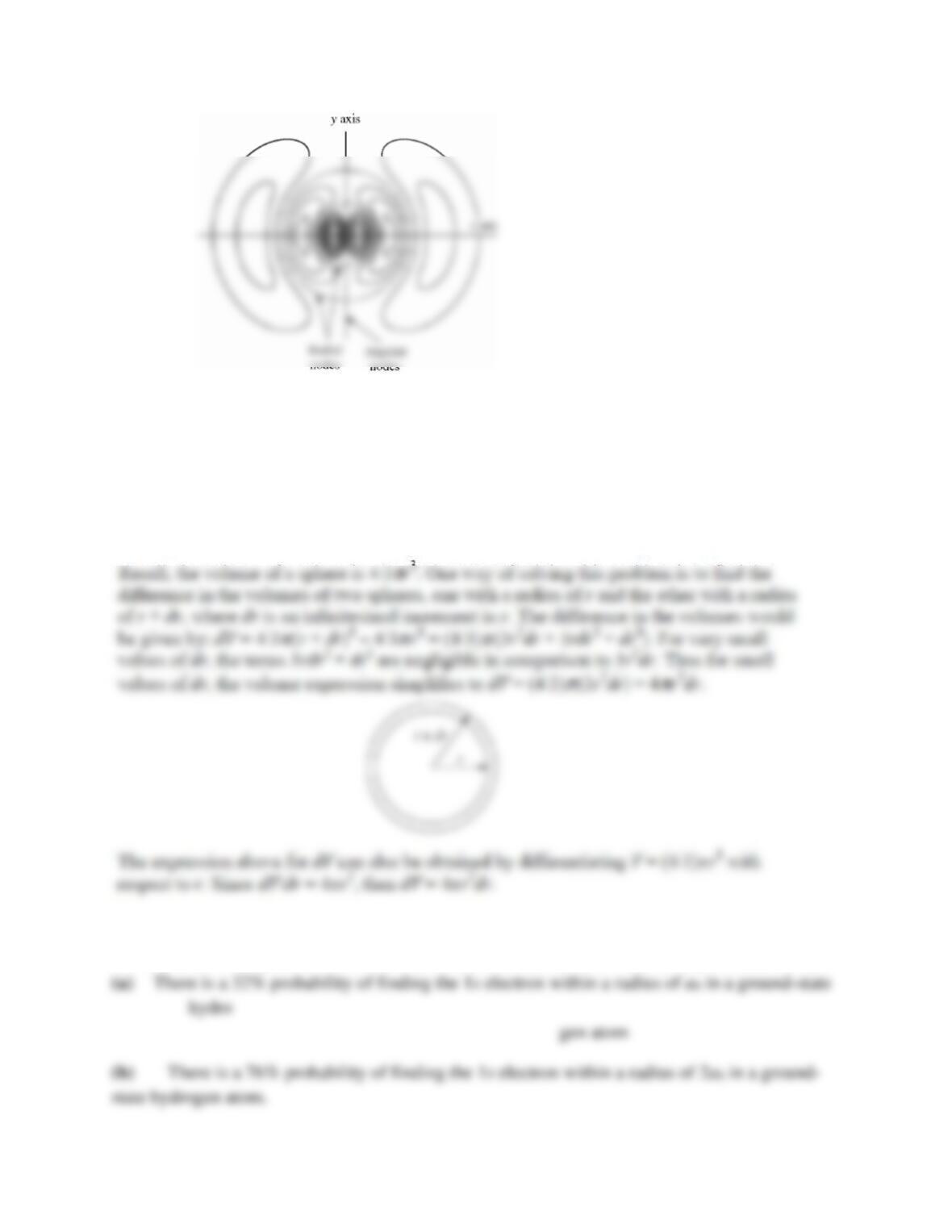
109. Using the relationships in Table 8.2, prepare a sketch of the 95% probability surface of a
4x
p
orbital.
110. Given that the volume of a sphere is
( )
3
43V / r=
, show that the volume, dV, of a thin
spherical shell of radius r and thickness dr is
2
4r dr
. [Hint: This exercise can be done
easily and elegantly by using calculus. It can also be done without using calculus by
expressing the volume of a thin spherical shell as a volume difference,
( ) ( ) ( )
33
4 3 4 3/ r dr / r + −
, and simplifying the expression. To obtain the correct result
by using the latter approach, you must remember that dr represents a very small distance.]
111. In the ground state of a hydrogen atom, what is the probability of finding an electron
anywhere in a sphere of radius (a)
0
a,
or (b)
0
2a?
[Hint: This exercise requires calculus.]
112. When atoms in excited states collide with unexcited atoms they can transfer their excitation
energy to those atoms. The most efficient energy transfer occurs when the excitation energy
matches the energy of an excited state in the unexcited atom. Assuming that we have a
collection of excited hydrogen atoms in the
1
2s
excited state, are there any transitions of
He+
that could be most efficiently excited by the hydrogen atoms?
Feature Problems
Feature Problems Principal Spectral Lines of Some Period 4 Transition Elements (nm)
V
306.64
309.31
318.40
318.54
327.11
437.92
438.47
439.00
Cr
357.87
359.35
360.53
361.56
425.44
427.48
428.97
520.45
Mn
257.61
259.37
279.48
279.83
403.08
403.31
403.45
Fe
344.06
358.12
372.00
373.49
385.99
Ni
341.48
344.63
345.85
346.17
349.30
351.51
352.45
361.94
113. We have noted that an emission spectrum is a kind of “atomic fingerprint.” The various
steels are alloys of iron and carbon, usually containing one or more other metals. Based on
the principal lines of their atomic spectra, which of the metals in the table above are likely to
be present in a steel sample whose hypothetical emission spectrum is pictured? Is it likely
that still other metals are present in the sample? Explain.
⬧ Hypothetical emission spectrum
In a real spectrum, the photographic images of the spectral lines would differ in depth and thickness depending
on the strengths of the emissions producing them. Some of the spectral lines would not be seen because of their
faintness.
By carefully scanning the diagram, we note that there are no spectral lines in the area of 304 nm
and 309 nm, nor at 318 nm and 327 nm. Likewise, there are none between 435 and 440 nm.
114. Balmer seems to have deduced his formula for the visible spectrum of hydrogen just by
manipulating numbers. A more common scientific procedure is to graph experimental data
and then find a mathematical equation to describe the graph. Show that equation (8.4)
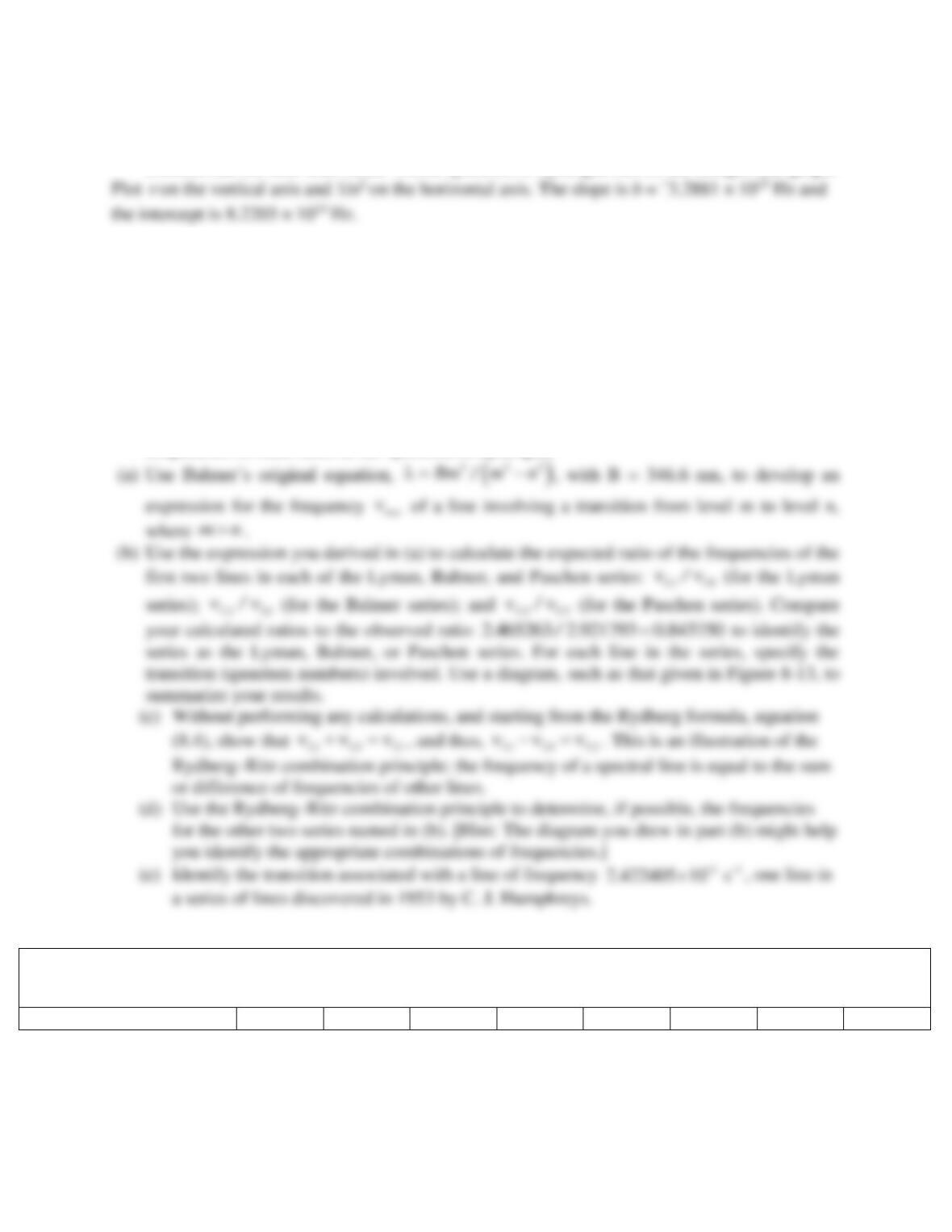
describes a straight line. Indicate which variables must be plotted, and determine the
numerical values of the slope and intercept of this line. Use data from Figure 8-12 to
confirm that the four lines in the visible spectrum of hydrogen fall on the straight-line graph.
115. The Rydberg–Ritz combination principle is an empirical relationship proposed by Walter
Ritz in 1908 to explain the relationship among spectral lines of the hydrogen atom. The
principle states that the spectral lines of the hydrogen atom include frequencies that are
either the sum or the difference of the frequencies of two other lines. This principle is
obvious to us, because we now know that spectra arise from transitions between energy
levels, and the energy of a transition is proportional to the frequency.
The frequencies of the first ten lines of an emission spectrum of hydrogen are given in the
table at the bottom of this page. In this problem, use ideas from this chapter to identify the
transitions involved, and apply the Rydberg–Ritz combination principle to calculate the
frequencies of other lines in the spectrum of hydrogen.
Frequencies (×1015 s–1) of the First Ten Lines in an Emission Spectrum of Hydrogen
2.465263
2.921793
3.081578
3.155536
3.195711
3.219935
3.235657
3.246436
3.254147
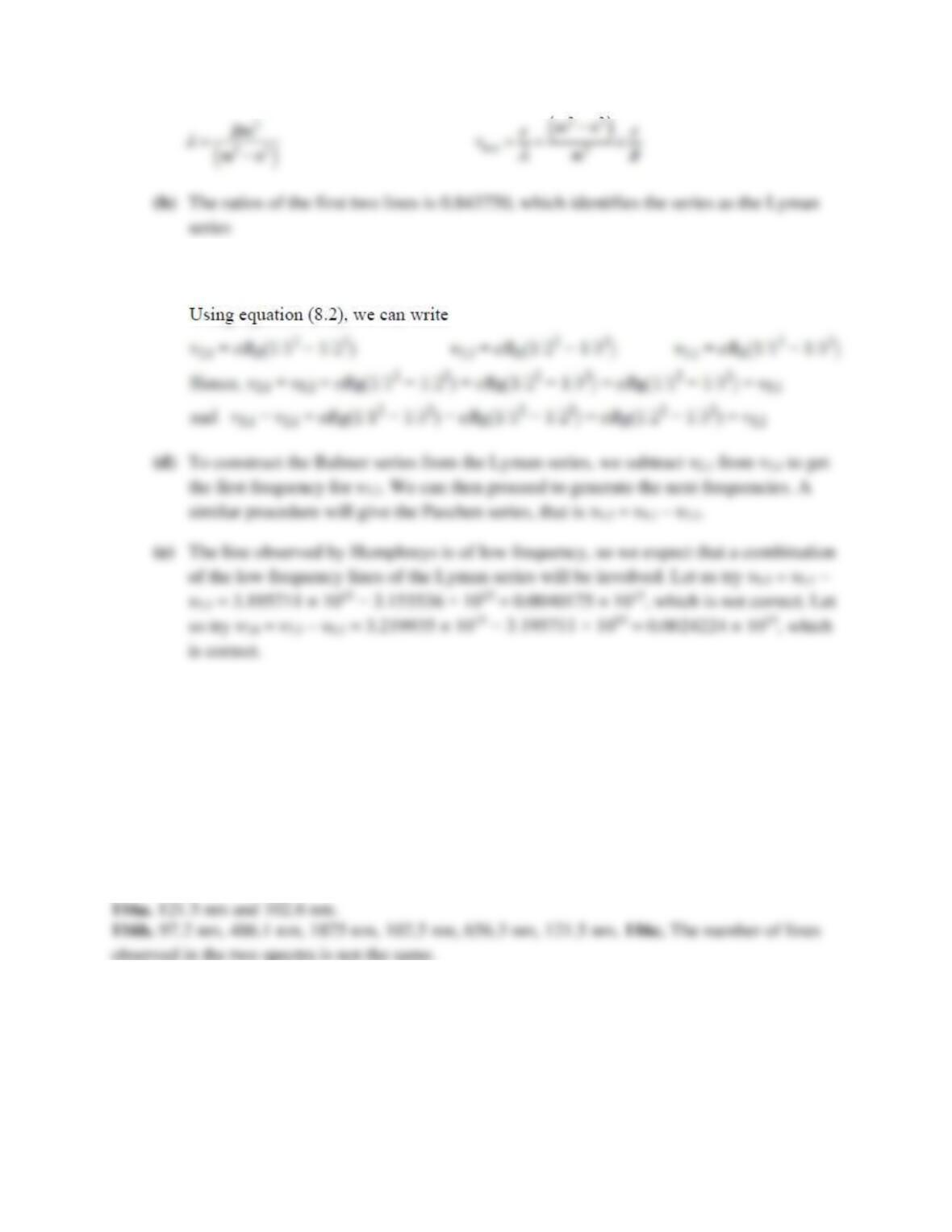
(a) Use Balmer’s original equatin, and take the ratio of the first two lines:
(c)
116. Emission and absorption spectra of the hydrogen atom exhibit line spectra characteristic of
quantized systems. In an absorption experiment, a sample of hydrogen atoms is irradiated
with light with wavelengths ranging from 100 to 1000 nm. In an emission spectrum
experiment, the hydrogen atoms are excited through an energy source that provides a range
of energies from 1230 to
1
1240 kJ mol−
to the atoms. Assume that the absorption spectrum
is obtained at room temperature, when all atoms are in the ground state.
(a) Calculate the position of the lines in the absorption spectrum.
(b)
Calculate the position of the lines in the emission spectrum.
(c) Compare the line spectra observed in the two experiments. In particular, will the number
of lines observed be the same?
117. Diffraction of radiation takes place when the distance between the scattering centers is
comparable to the wavelength of the radiation.
(a) What velocity must helium atoms possess to be diffracted by a film of silver atoms in
which the spacing is 100 pm?
(b)
Electrons accelerated through a certain potential are diffracted by a thin film of gold.
Would you expect a beam of protons accelerated through the same potential to be diffracted
when it strikes the film of gold? If not, what would you expect to see instead?
Diffraction of radiation takes place when the distance between the scattering centers is
comparable to the wavelength of the radiation.
(a) What velocity must helium atoms possess to be diffracted by a film of silver atoms in
which the spacing is 100 pm?
(b)
Electrons accelerated through a certain potential are diffracted by a thin film of gold.
Would you expect a beam of protons accelerated through the same potential to be diffracted
when it strikes the film of gold? If not, what would you expect to see instead?
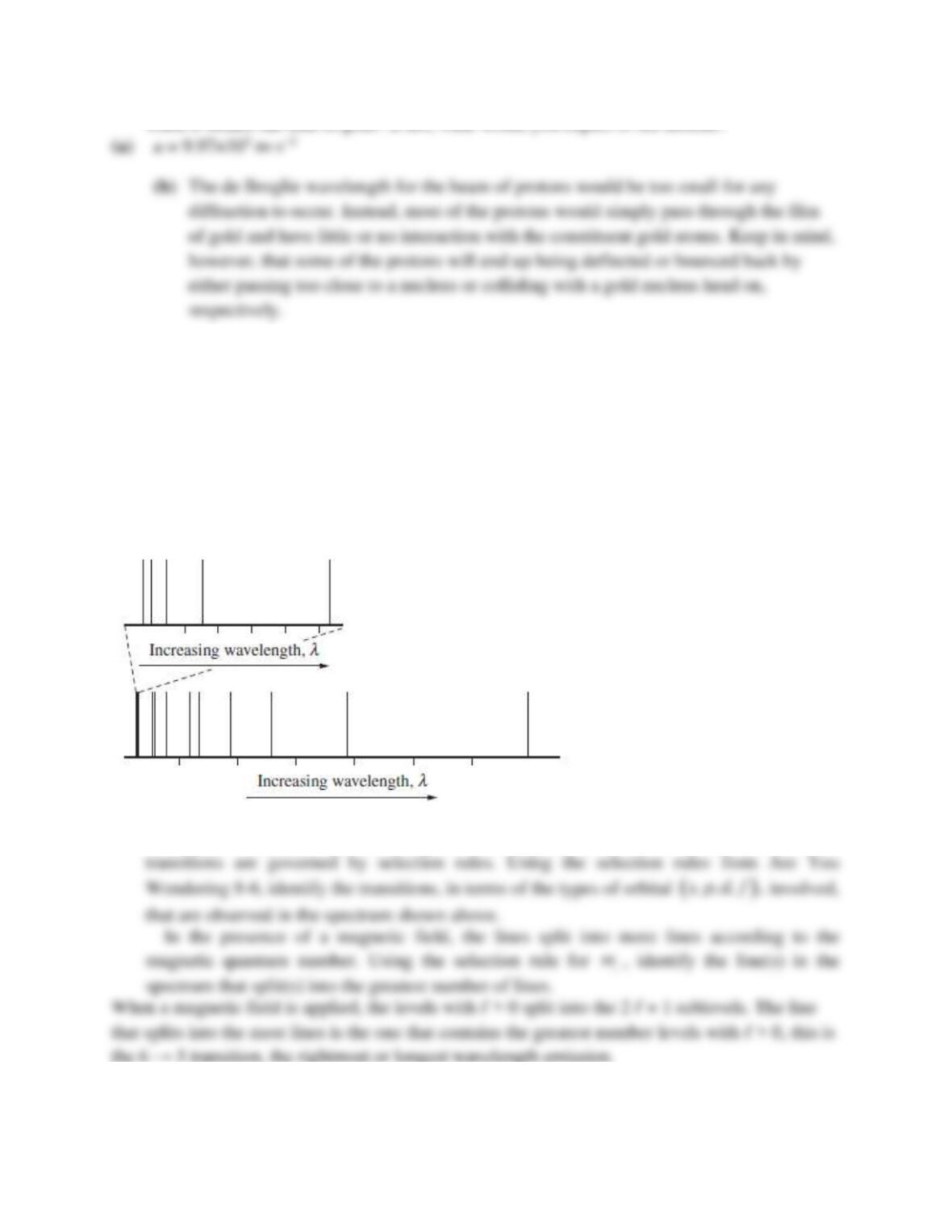
118. The emission spectrum below is for hydrogen atoms in the gas phase. The spectrum is of the
first few emission lines from principal quantum number 6 down to all possible lower levels.
As discussed in Are You Wondering 8-6, not all possible de-excitations are possible; the
119. (This exercise requires calculus.) In this exercise, use ideas from this chapter to develop the
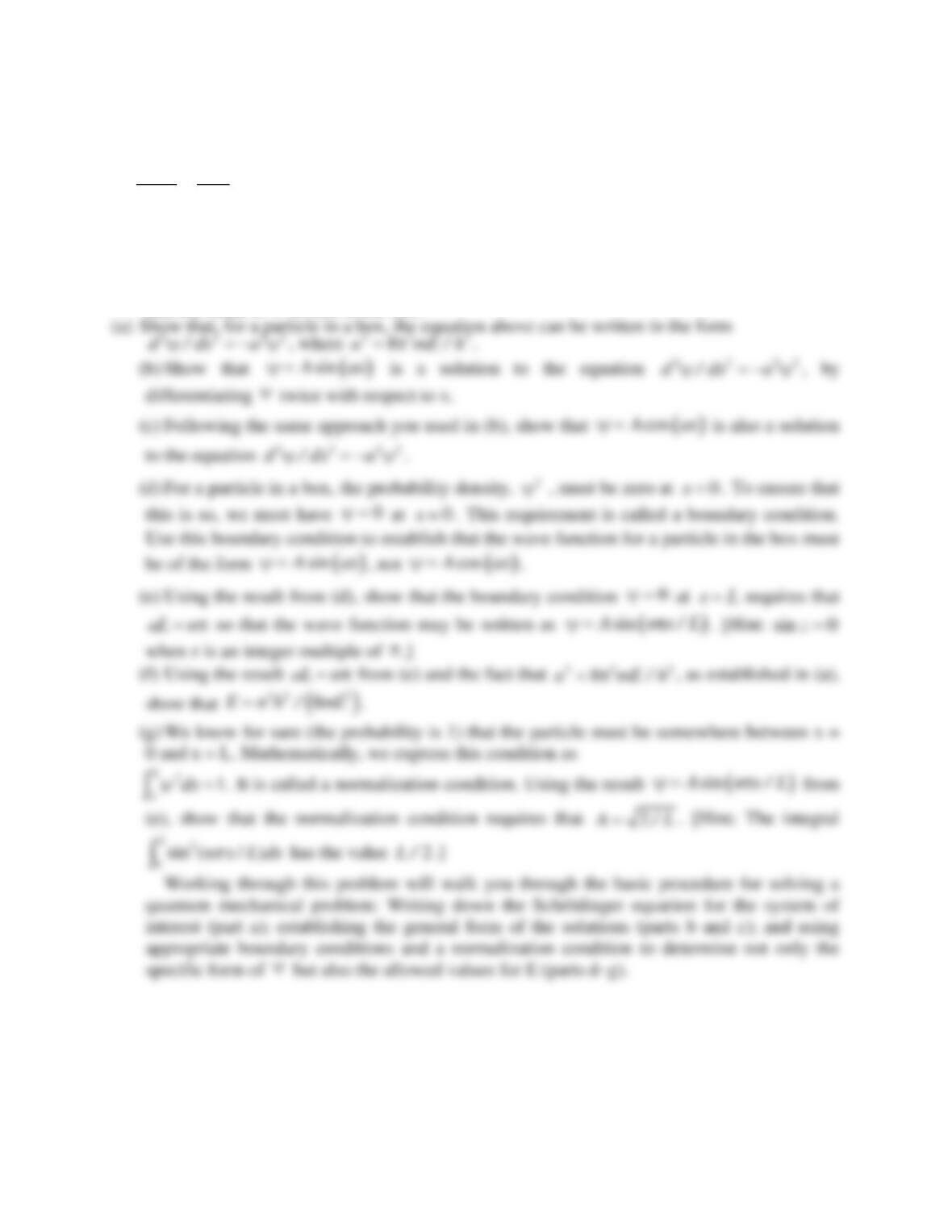
solution to the particle-in-a-box problem. We begin by writing the Schrödinger equation for
a particle of mass m moving in one dimension:
( )
22
22
8
hd
V x E
m dx
− + =
The equation above is the one-dimensional version of equation (8.15). For a particle in a
box, there are no forces acting on the particle (except at the boundaries of the box), and so
the potential energy, V, of the particle is constant. Without loss of generality, we can assume
that the value of V is zero in the box.
120. In 1913, Danish physicist Neils Bohr proposed a theory for the hydrogen atom in which the
electron is imagined to be moving around a stationary nucleus in one of many possible
circular orbits, each of which has a fixed energy and radius. By using classical physics and
imposing a quantization condition, Bohr derived equations for the energies and radii of these
orbits. Derive Bohr’s equations by using the following steps. Note: Steps (a), (b), and (d) are
based on fundamental ideas from classical physics. Step (c) introduces a new idea, a
quantization condition, that causes the energies and radii of the orbits to take on certain
well-defined values.
(a) Write down an expression for the total energy, E, of the electron (mass
e
m
) moving in a
Self-Assessment Exercises
121. In your own words, define the following terms or symbols: (a)
;
(b)
;
(c) h; (d)
;
(e)
principal quantum number, n.
122. Briefly describe each of the following ideas or phenomena: (a) atomic (line) spectrum; (b)
photoelectric effect; (c) matter wave; (d) Heisenberg uncertainty principle; (e) electron spin;
(f) Pauli exclusion principle; (g) Hund’s rule; (h) orbital diagram; (i) electron charge
density; (j) radial electron density.
123. Explain the important distinctions between each pair of terms: (a) frequency and
wavelength; (b) ultraviolet and infrared light; (c) continuous and discontinuous spectra; (d)
traveling and standing waves; (e) quantum number and orbital; (f) spdf notation and orbital
diagram; (g) s block and p block; (h) main group and transition element; (i) the ground state
and excited state of a hydrogen atom.
124. Describe two ways in which the orbitals of multielectron atoms resemble hydrogen orbitals
and two ways in which they differ from hydrogen orbitals.
125. Explain the phrase effective nuclear charge. How is this related to the shielding effect?
Effective nuclear charge is the amount of positive charge from the nucleus that the valence shell
126. With the help of sketches, explain the difference between a
xy
p , p ,
and
z
p
orbital.
127. With the help of sketches, explain the difference between a
2z
p
and
3z
p
orbital.
128. If traveling at equal speeds, which of the following matter waves has the longest
wavelength? Explain. (a) electron; (b) proton; (c) neutron; (d)
particle
( )
2
He +

129. For electromagnetic radiation transmitted through a vacuum, state whether each of the
following properties is directly proportional to, inversely proportional to, or independent of
the frequency: (a) velocity; (b) wavelength; (c) energy per mole. Explain.
130. Construct a concept map representing the ideas of quantum mechanics.
The concept map for modern quantum mechanics encompasses the second half of the chapter. To
create it, one must first start with the most general concepts. These concepts define or encompass
131. Construct a concept map representing the atomic orbitals of hydrogen and their properties.
The concept map for the atomic orbitals of hydrogen is an amalgam of many of the topics
132. Construct a concept map for the configurations of multielectron atoms.