Chapter 8
Electrons in Atoms
Exercises
Electromagnetic Radiation
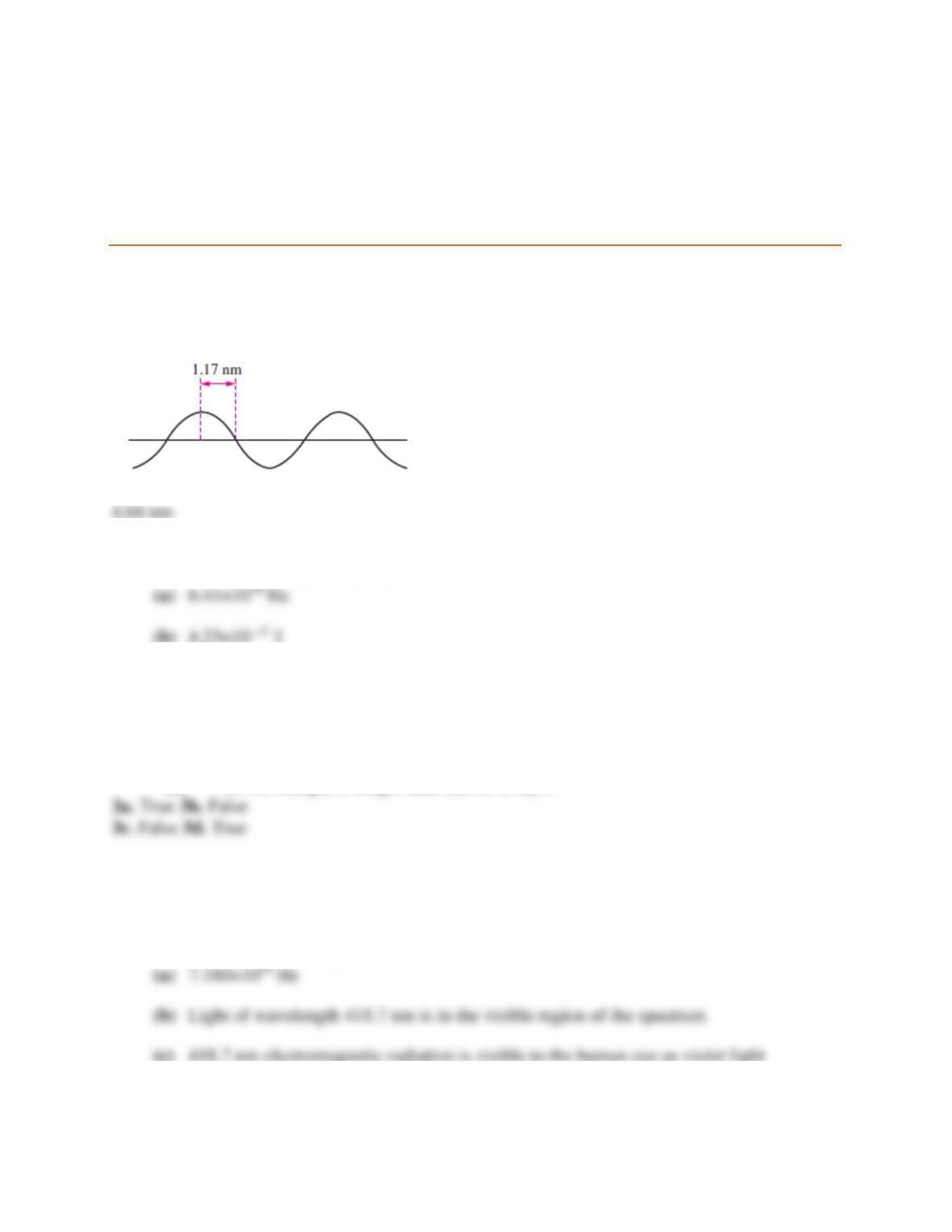
1. A hypothetical electromagnetic wave is pictured here. What is the wavelength of this
radiation?
2. For the electromagnetic wave described in Exercise 1, what are (a) the frequency, in hertz,
and (b) the energy, in joules per photon?
3. The magnesium spectrum has a line at 266.8 nm. Which of these statements about this
radiation is (are) correct? Explain.
(a) It has a higher frequency than radiation with wavelength 402 nm.
(b) It is visible to the eye.
(c) It has a greater speed in a vacuum than does red light of wavelength 652 nm.
(d) Its wavelength is longer than that of X-rays.
4. The most intense line in the cerium spectrum is at 418.7 nm.
(a) Determine the frequency of the radiation producing this line.
(b) In what part of the electromagnetic spectrum does this line occur?
(c) Is it visible to the eye? If so, what color is it? If not, is this line at higher or lower
energy than visible light?
5. Without doing detailed calculations, determine which of the following wavelengths

represents light of the highest frequency: (a)
4
6 7 10 cm;
−
(b) 1.23 mm; (c) 80 nm; (d)
6 72 m
6. Without doing detailed calculations, arrange the following electromagnetic radiation sources
in order of increasing frequency: (a) a red traffic light;
(b) a 91.9 MHz radio transmitter;
(c) light with a frequency of
14 1
3 0 10 s−
;
(d) light with a wavelength of 49 nm.
7. How long does it take light from the sun, 93 million miles away, to reach Earth?
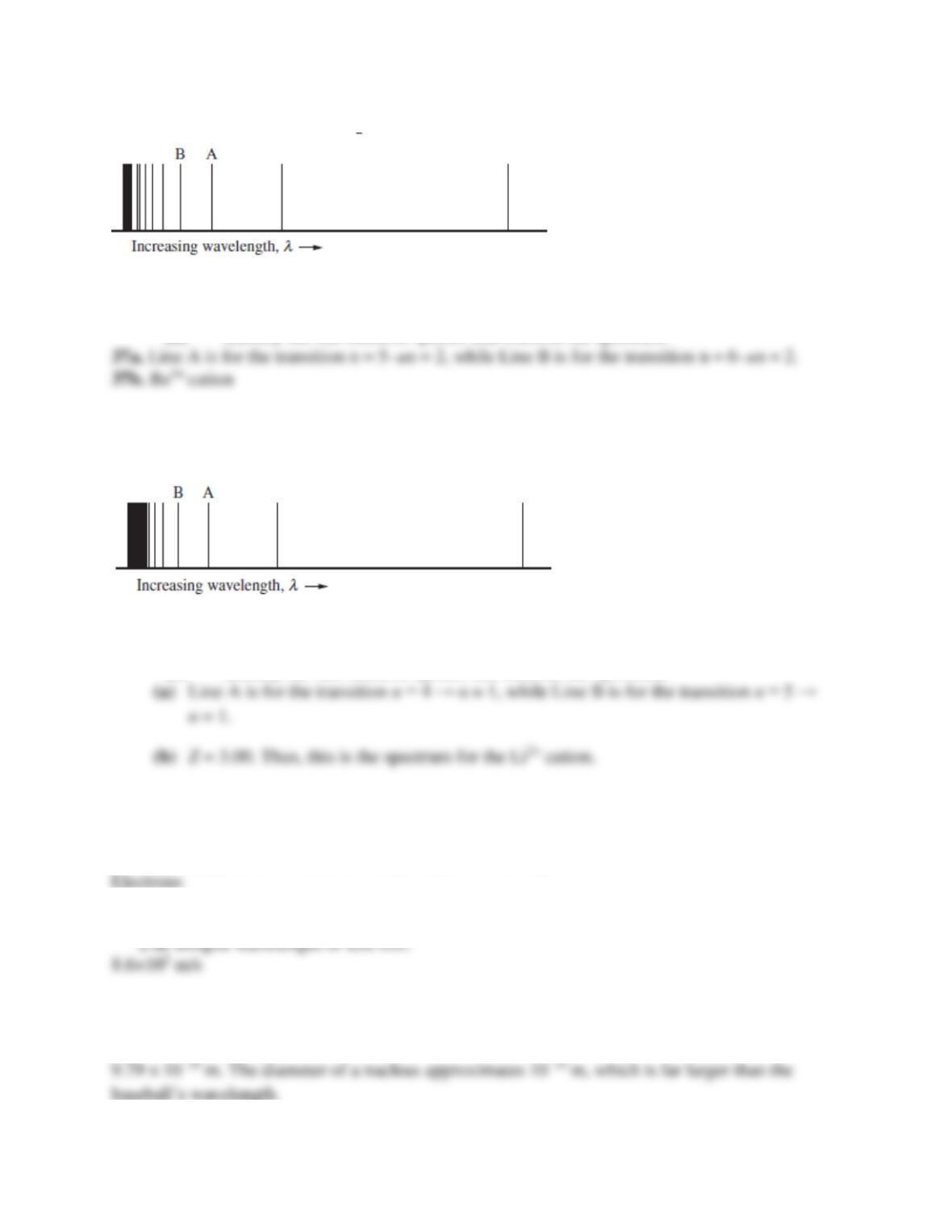
8. In astronomy, distances are measured in light-years, the distance that light travels in one
year. What is the distance of one light-year expressed in kilometers?
Photons and the Photoelectric Effect
9. Determine
(a) the energy, in joules per photon, of radiation of frequency
15 1
7 39 10 s ;
−
14 1
10. Determine
(a) the frequency, in hertz, of radiation having an energy of
21
8 62 10 J/photon;
−
11. A certain radiation has a wavelength of 574 nm. What is the energy, in joules, of (a) one
photon; (b) a mole of photons of this radiation?
12. What is the wavelength, in nanometers, of light with an energy content of
2112 kJ/mol?
In
what portion of the electromagnetic spectrum is this light?
13. Without doing detailed calculations, indicate which of the following electromagnetic
radiations has the greatest energy per photon and which has the least: (a) 662 nm; (b)
14. Without doing detailed calculations, arrange the following forms of electromagnetic radiation
in increasing order of energy per mole of photons: (a) radiation with
15 1
3 0 10 s−
=
; (b) an
infrared heat lamp; (c) radiation having
7000=
Å; (d) dental X-rays.
15. In what region of the electromagnetic spectrum would you expect to find radiation having an
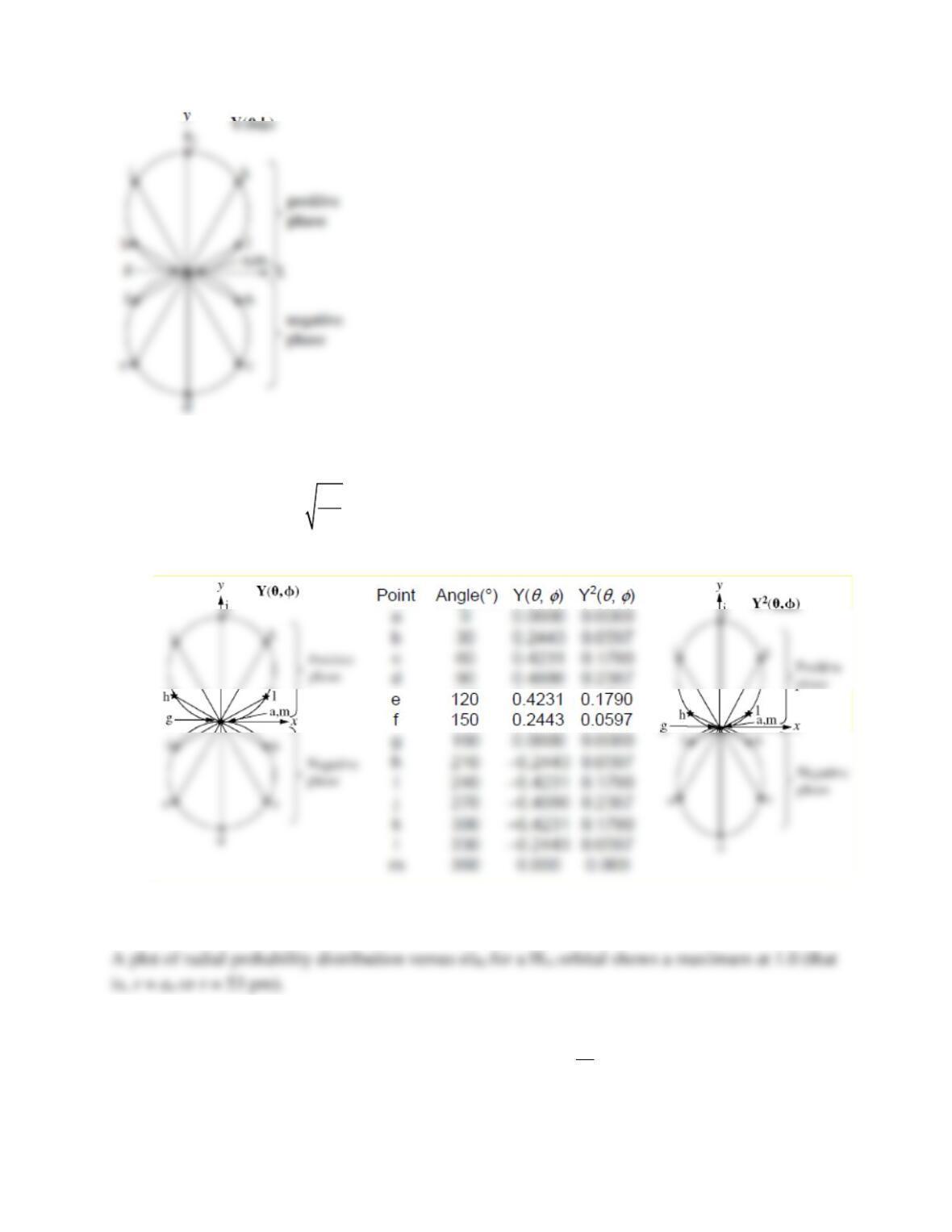
energy per photon 100 times that associated with 988 nm radiation?
16. High-pressure sodium vapor lamps are used in street lighting. The two brightest lines in the
sodium spectrum are at 589.00 and 589.59 nm. What is the difference in energy per photon
of the radiations corresponding to these two lines?
17. The lowest-frequency light that will produce the photoelectric effect is called the threshold
frequency.
(a) The threshold frequency for indium is
9 96
14 1
10 s−
What is the energy, in
joules, of a photon of this radiation?
(b) Will indium display the photoelectric effect with UV light? With infrared light?
18. The minimum energy required to cause the photoelectric effect in potassium metal is
19
3 69 10 J
−
Will photoelectrons be produced when visible light shines on the surface of
potassium? If 520 nm radiation is shone on potassium, what is the velocity of the ejected
electrons?
Atomic Spectra
19. Use the Balmer equation (8.4) to determine
(a) the frequency, in
1
s,
−
of the radiation corresponding to
5;n=
(b) the wavelength, in nanometers, of the line in the Balmer series corresponding to
7;n=
(c) the value of n corresponding to the Balmer series line at 380 nm.
20. How would the Balmer equation (8.4) have to be modified to predict lines in the infrared
spectrum of hydrogen? [Hint: Compare equations (8.4) and (8.6).]
21. What is
E
for the transition of an electron from
6n=
to
3n=
in a hydrogen atom? What
22. What is
E
for the transition of an electron from
5n=
to
2n=
in a hydrogen atom? What
is the frequency of the spectral line produced?
23. To what value of n in equation (8.4) does the line in the Balmer series at 389 nm correspond?
24. The Lyman series of the hydrogen spectrum can be represented by the equation
( )
15 1
22
11
3 2881 10 s where 2 3
1n , ,
n
−
= − =
(a) Calculate the maximum and minimum wavelength lines, in nanometers, in this
series.
(b) What value of n corresponds to a spectral line at 95.0 nm?
(c) Is there a line at 108.5 nm? Explain.
25. Calculate the wavelengths, in nanometers, of the first four lines of the Balmer series of the
hydrogen spectrum, starting with the longest wavelength component.
26. A line is detected in the hydrogen spectrum at 1880 nm. Is this line in the Balmer series?
Explain.

Energy Levels and Spectrum of the Hydrogen Atom
27. Calculate the energy, in joules, of a hydrogen atom when the electron is in the sixth energy
level.
28. Calculate the increase in energy, in joules, when an electron in the hydrogen atom is excited
from the first to the third energy level.
29. What are the (a) frequency, in
1
s,
−
and (b) wavelength, in nanometers, of the light emitted
when the electron in a hydrogen atom drops from the energy level
7n=
to
4n?=
(c) In
what portion of the electromagnetic spectrum is this light?
30. Without doing detailed calculations, indicate which of the following electron transitions
requires the greatest amount of energy to be absorbed by a hydrogen atom: from (a)
1n=
to
2n;=
(b)
2n=
to
4n;=
(c)
3n=
to
9n;=
(d)
10n=
to
1n=
(a) 0.75
(b) 0.01875
(c) 0.0988
31. For a hydrogen atom, determine
(a) the energy level corresponding to
8n=
;
(b) whether there is an energy level at
19
2 500 10 J
−
−
;
(c) the ionization energy, if the electron is initially in the
6n=
level.
32. Without doing detailed calculations, indicate which of the following electron transitions in
the hydrogen atom results in the emission of light of the longest wavelength. (a)
4n=
to
3n;=
(b)
1n=
to
2n;=
(c)
1n=
to
6n;=
(d)
3n=
to
2n=
33. What electron transition in a hydrogen atom, starting from
7n,=
will produce light of
wavelength 410 nm?
34. What electron transition in a hydrogen atom, ending in
3n,=
will produce light of
wavelength 1090 nm?
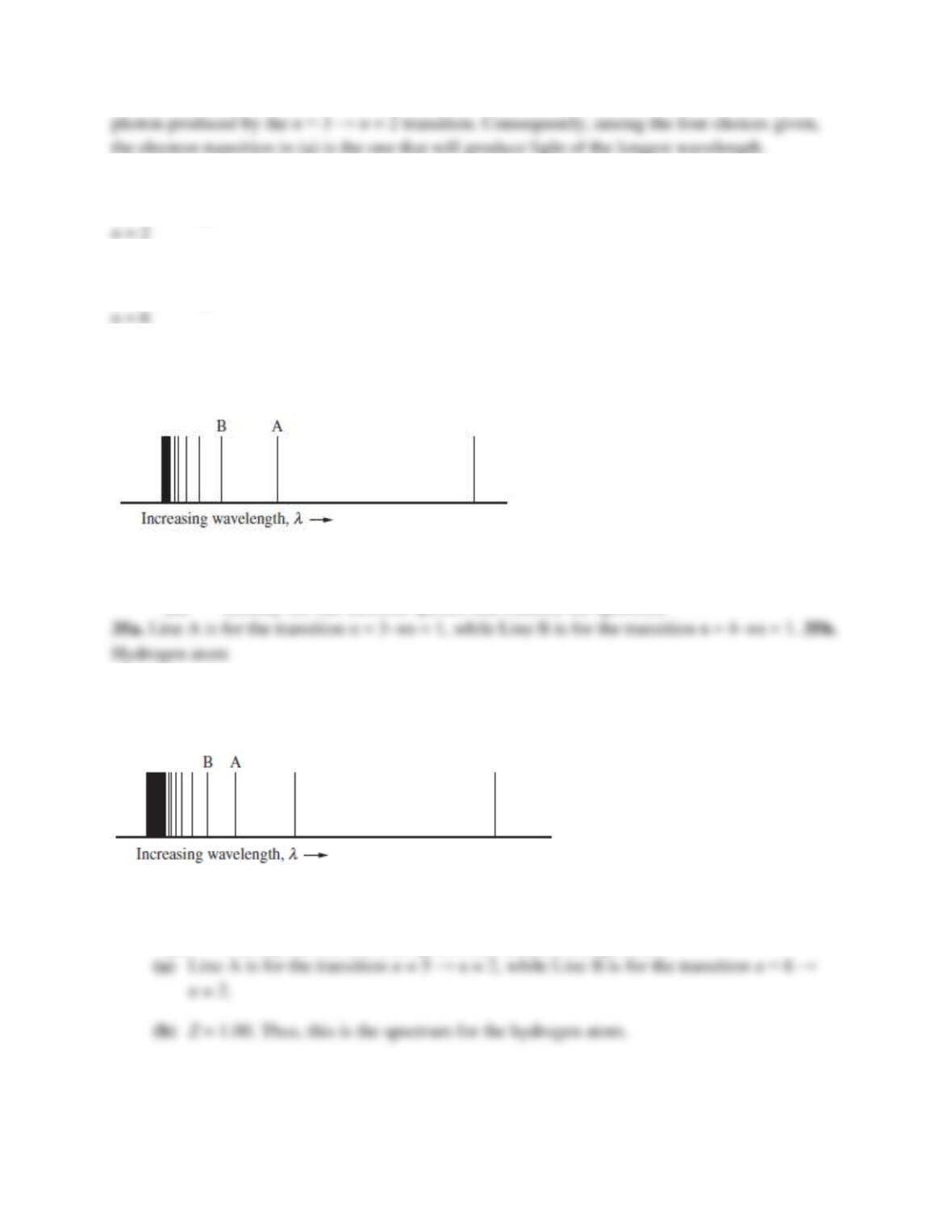
35. The emission spectrum below for a one-electron (hydrogen-like) species in the gas phase
shows all the lines, before they merge together, resulting from transitions to the ground state
from higher energy states. Line A has a wavelength of 103 nm.
(a) What are the upper and lower principal quantum numbers corresponding to the
lines labeled A and B?
(b) Identify the one-electron species that exhibits the spectrum.
36. The emission spectrum below for a one-electron (hydrogen-like) species in the gas phase
shows all the lines, before they merge together, resulting from transitions to the first excited
state from higher energy states. Line A has a wavelength of 434 nm.
(a) What are the upper and lower principal quantum numbers corresponding to the
lines labeled A and B?
(b) Identify the one-electron species that exhibits the spectrum.
37. The emission spectrum below for a one-electron (hydrogen-like) species in the gas phase
shows all the lines, before they merge together, resulting from transitions to the first excited
state from higher energy states. Line A has a wavelength of 27.1 nm.
(a) What are the upper and lower principal quantum numbers corresponding to the
lines labeled A and B?
(b) Identify the one-electron species that exhibits the spectrum.
38. The emission spectrum below for a one-electron (hydrogen-like) species in the gas phase
shows all the lines, before they merge together, resulting from transitions to the ground state
from higher energy states. Line A has a wavelength of 10.8 nm.
(a) What are the upper and lower principal quantum numbers corresponding to the
lines labeled A and B?
(b) Identify the one-electron species that exhibits the spectrum.
Wave–Particle Duality
39. Which must possess a greater velocity to produce matter waves of the same wavelength (such
as 1 nm), protons or electrons? Explain your reasoning.
40. What must be the velocity, in meters per second, of a beam of electrons if they are to display
41. Calculate the de Broglie wavelength, in nanometers, associated with a 145 g baseball
traveling at a speed of
168km/h
How does this wavelength compare with typical nuclear or
atomic dimensions?

42. What is the wavelength, in nanometers, associated with a 9.7 g bullet with a muzzle velocity
of
1
887 ms ,
−
that is, considering the bullet to be a matter wave? Comment on the feasibility
of an experimental measurement of this wavelength.
The Heisenberg Uncertainty Principle
43. The uncertainty relation
( )
4x p h /
, expression (8.11), is valid for motion in any
direction. For circular motion, the relation may be expressed as
( )
4r p h /
, where
r
is the uncertainty in radial
position and
p
is the uncertainty in the momentum along the radial direction. Describe how
Bohr’s model of the hydrogen atom violates the uncertainty relation expressed in the form
( )
4r p h /
.
44. Although Einstein made some early contributions to quantum theory, he was never able to
accept the Heisenberg uncertainty principle. He stated, “God does not play dice with the
Universe.” What do you suppose Einstein meant by this remark? In reply to Einstein’s
remark, Niels Bohr is supposed to have said, “Albert, stop telling God what to do.” What do
you suppose Bohr meant by this remark?

45. A proton is accelerated to one-tenth the velocity of light, and this velocity can be measured
with a precision of 1%. What is the uncertainty in the position of this proton?
46. Show that the uncertainty principle is not significant when applied to large objects such as
automobiles. Assume that m is precisely known; assign a reasonable value to either the
47. What must be the velocity of electrons if their associated wavelength is to equal the Bohr
48. What must be the velocity of electrons if their associated wavelength is to equal the longest
wavelength line in the Lyman series? [Hint: Refer to Figure 8-13.]
Wave Mechanics
49. A standing wave in a string 42 cm long has a total of six nodes (including those at the ends).
What is the wavelength, in centimeters, of this standing wave?
50. What is the length of a string that has a standing wave with four nodes (including those at the
ends) and
17 cm? =
51. Calculate the wavelength of the electromagnetic radiation required to excite an electron from
the ground state to the level with
4n=
in a one-dimensional box
1
5 0 10
pm long.
52. An electron in a one-dimensional box requires a wavelength of 618 nm to excite an electron
from the
2n=
level to the
4n=
level. Calculate the length of the box.
53. An electron in a 20.0 nm box is excited from the ground state into a higher energy state by
absorbing a photon of wavelength
5
8 60 10 m
−
Determine the final energy state.
54. Calculate the wavelength of the electromagnetic radiation required to excite a proton from
1
55. Describe some of the differences between the orbits of the Bohr atom and the orbitals of the
wave mechanical atom. Are there any similarities?

56. The greatest probability of finding the electron in a small-volume element of the
1s
orbital of
the hydrogen atom is at the nucleus. Yet the most probable distance of the electron from the
nucleus is 53 pm. How can you reconcile these two statements?
We must be careful to distinguish between probability density—the chance of finding the
Quantum Numbers and Electron Orbitals
57. Select the correct answer and explain your reasoning. An electron having
3n=
and
0m=
(a) must have
( ) ( )
1must have 1 may have 0 1
2
s
m ; ; , ,= + = = bc
or 2; (d) must have
2=
58. Write an acceptable value for each of the missing quantum numbers.
(a)
1
32
2
s
n , ?, m ,m= = = = +
(b)
1
21 2
s
n ?, ,m ,m= = = = −
(c)
4 2 0 ?
s
n , ,m ,m= = = =
(d)
? 0 ?
s
n , ,m ?,m= = = =
59. What type of orbital
( )
i e , 3 4s, p,
is designated by these quantum numbers?
(a)
5 1 0n , ,m= = =
(b)
4 2 2n , , m= = = −
2 0 0n , ,m= = =
60. Which of the following statements is (are) correct for an electron with
4n=
and
2?m=
Explain.
(a) The electron is in the fourth principal shell.
(b) The electron may be in a d orbital.
(c) The electron may be in a p orbital.
(d) The electron must have
1
s
m= +
61. Concerning the electrons in the shells, subshells, and orbitals of an atom, how many can have
(a)
1
4 2 1 and ?
2
s
n , ,m , m= = = = +
(b)
4 2 and 1?n , , m= = =
(c)
4and 2?n= =
(d)
4n?=
(e)
1
4 2 and ?
2
s
n , , m= = = +
62. Concerning the concept of subshells and orbitals,
(a) How many subshells are found in the
3n=
level?
(b) What are the names of the subshells in the
3n=
level?
(c) How many orbitals have the values
4n=
and
3?=
(d) How many orbitals have the values
32n , ,= =
and
2?m=−
(e) What is the total number of orbitals in the
4n=
level?
The Shapes of Orbitals and Radial Probabilities
63. Calculate the finite value of r, in terms of
0
a,
at which the node occurs in the wave function
of the
2s
orbital of a hydrogen atom.
64. Calculate the finite value of r, in terms of
0
a,
at which the node occurs in the wave function
of the
2s
orbital of a
2
Li +
ion.
65. Show that the probability of finding a
2y
p
electron in the
xz
plane is zero.
66. Show that the probability of finding a
3xz
d
electron in the
xy
plane is zero.
The angular component of the wave function for the 3dxz orbital is
67. Prepare a two-dimensional plot of
( )
Y,
for the
y
p
orbital in the
xy
plane.
68. Prepare a two-dimensional plot of
( )
2
Y,
for the
y
p
orbital in the
xy
plane.
The 2py orbital
( )
3si, n sin
4
Y
=
, however, in the xy plane θ = 90° and sin θ = 1.
Plotting in the xy plane requires that we vary only ϕ.
69. Using a graphical method, show that in a hydrogen atom the radius at which there is a
maximum probability of finding an electron is
0
a
(53 pm).
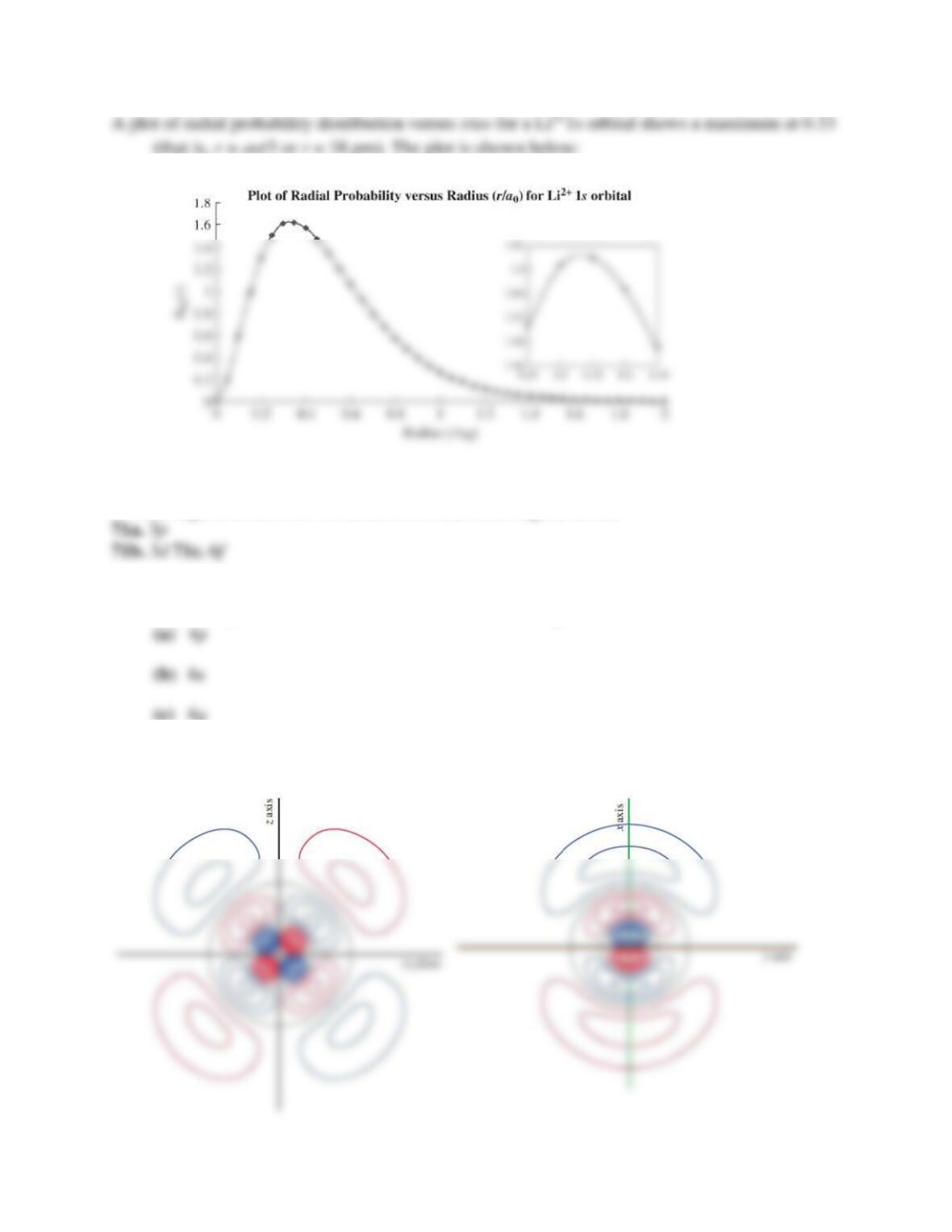
70. Use a graphical method or some other means to show that in a
2
Li +
ion, the radius at which
there is a maximum probability of finding an electron is
0
3
a
(18 pm).
71. Identify the orbital that has (a) one radial node and one angular node; (b) no radial nodes and
two angular nodes; (c) two radial nodes and three angular nodes.
72. Identify the orbital that has (a) two radial nodes and one angular node; (b) five radial nodes
and zero angular nodes; (c) one radial node and four angular nodes.
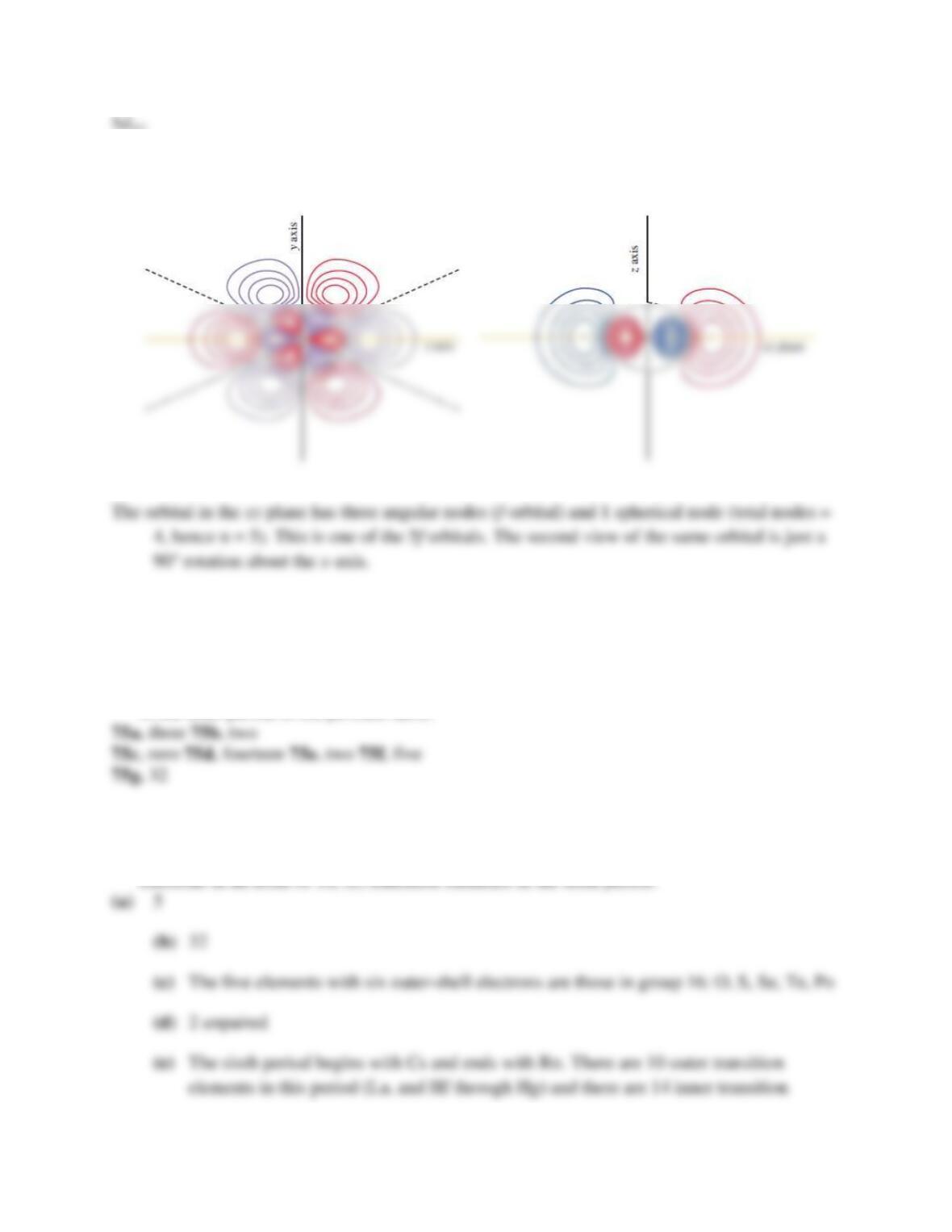
73. A contour map for an atomic orbital of hydrogen is shown at the top of page 370 for the
xy
and
xz
planes. Identify the orbital.
74. A contour map for an atomic orbital of hydrogen is shown below for the
xy
and
xz
planes.
Identify the type
( )
s, p,d, f, g
of orbital.
Electron Configurations
75. On the basis of the periodic table and rules for electron configurations, indicate the number
of (a)
2p
electrons in N; (b)
4s
electrons in Rb; (c)
4d
electrons in As; (d)
4f
electrons in
Au; (e) unpaired electrons in Pb; (f) elements in group 14 of the periodic table; (g) elements
in the sixth period of the periodic table.
76. Based on the relationship between electron configurations and the periodic table, give the
number of (a) outer-shell electrons in an atom of Sb; (b) electrons in the fourth principal
electronic shell of Pt; (c) elements whose atoms have six outer-shell electrons; (d) unpaired
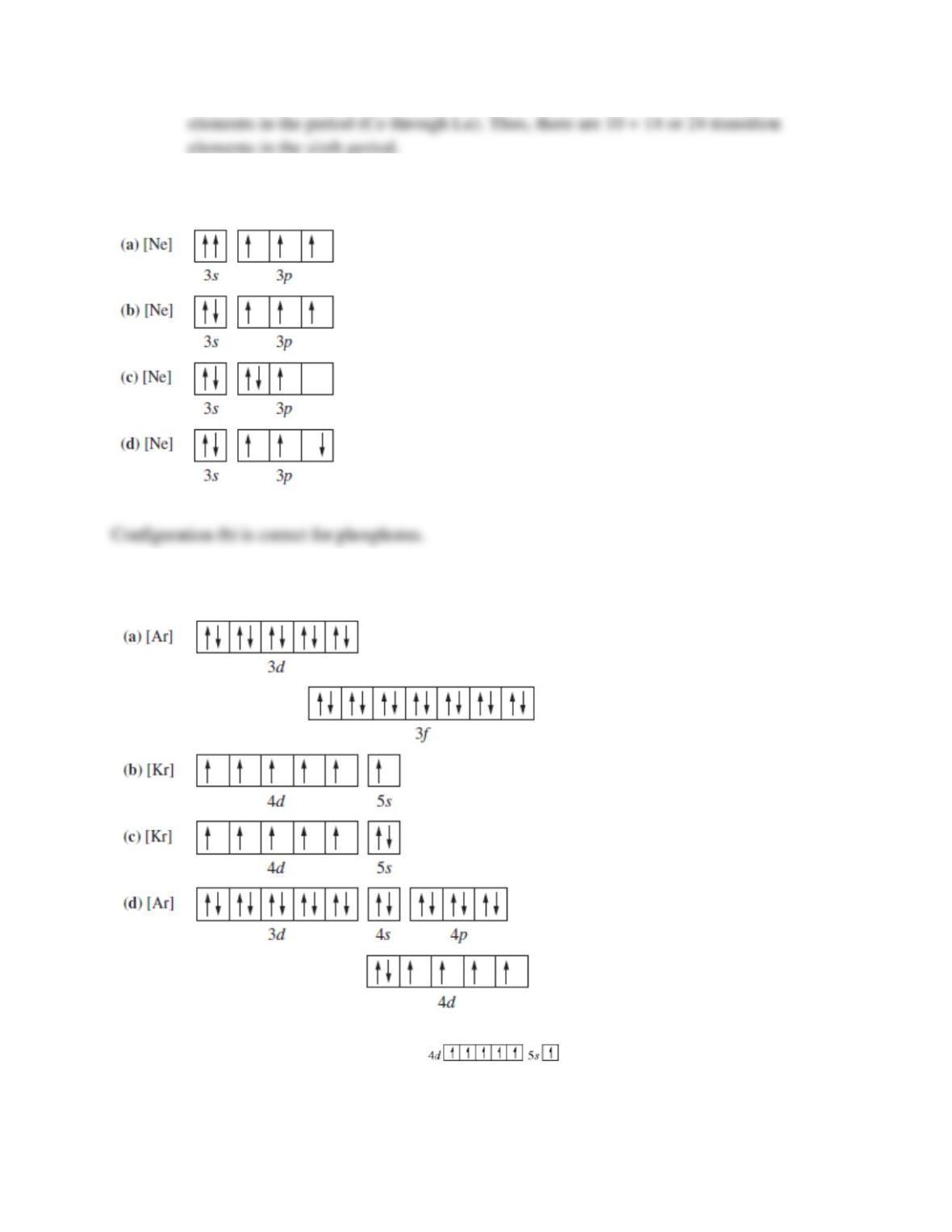
77. Which of the following is the correct orbital diagram for the ground-state electron
configuration of phosphorus? Explain what is wrong with each of the others.
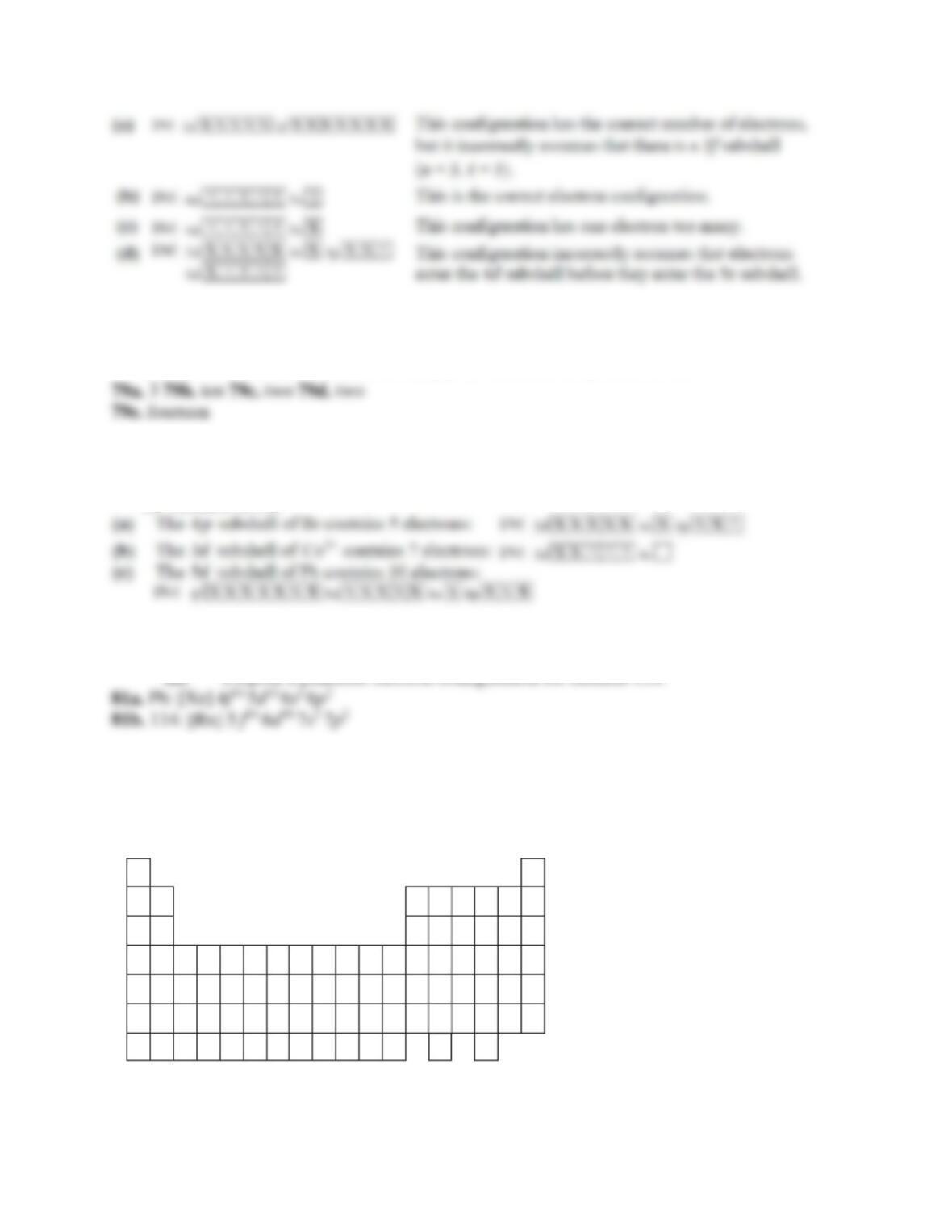
78. Which of the following is the correct orbital diagram for the ground-state electron
configuration of molybdenum? Explain what is wrong with each of the others.
The electron configuration of Mo is [Kr]
79. Use the basic rules for electron configurations to indicate the number of (a) unpaired
electrons in an atom of P; (b)
3d
electrons in an atom of Br; (c)
4p
electrons in an atom of
Ge; (d)
6s
electrons in an atom of Ba; (e)
4f
electrons in an atom of Au.
80. Use orbital diagrams to show the distribution of electrons among the orbitals in (a) the
4p
subshell of Br; (b) the
3d
subshell of
2
Co ,
+
given that the two electrons lost are
4s;
(c) the
5d
subshell of Pb.
81. The recently discovered element 114, Flerovium, should most closely resemble Pb.
(a) Write the electron configuration of Pb.
82. Without referring to any tables or listings in the text, mark an appropriate location in the
blank periodic table provided for each of the following: (a) the fifth-period noble gas; (b) a
sixth-period element whose atoms have three unpaired p electrons; (c) a d-block element
having one
4s
electron; (d) a p-block element that is a metal.