Chapter 7
Thermochemistry
Exercises
Heat Capacity (Specific Heat Capacity)
1. Calculate the quantity of heat, in kilojoules, (a) re-quired to raise the temperature of 9.25 L
of water from 22.0 to
29 4 C;
(b) associated with a
33 5 C
decrease in temperature in a
5.85 kg aluminum bar (specific heat capacity of
11
aluminum 0 903 J g C
− −
=
).
2. Calculate the final temperature that results when (a) a 12.6 g sample of water at
22 9 C
absorbs 875 J of heat; (b) a 1.59 kg sample of platinum at
78 2 C
gives off 1.05 kcal of heat
(
11
0 032 cal g C
p
c− −
=
).
3. Refer to Example 7-2. The experiment is repeated with several different metals substituting
for the lead. The masses of metal and water and the initial temperatures of the metal and
water are the same as in Figure 7-3. The final temperatures are (a)
Zn, 38 9 C;
(b)
Pt, 28 8 C;
(c)
Al, 52 7 C
What is the specific heat capacity of each metal, expressed in
11
J g C ?
− −
4. A 75.0 g piece of Ag metal is heated to
80 0 C
and dropped into 50.0 g of water at
23 2 C
The final temperature of the
2
Ag H O−
mixture is
27 6 C
What is the specific heat capacity
of silver?
5. A 465 g chunk of iron is removed from an oven and plunged into 375 g water in an insulated
container. The temperature of the water increases from 26 to
87 C
If the specific heat
capacity of iron is
11
0 449 J g C ,
− −
what must have been the original temperature of the iron?
6. A piece of stainless steel (
11
0 50 J g C
p
c−−
=
) is transferred from an oven at
201 C
into 150
mL of water at
23 2 C
The water temperature rises to
55 4 C
What is the mass of the
s t e e l ? H o w p r e c i s e i s t h i s m e t h o d o f m a s s d e t e r m i n a t i o n ? E x p l a i n .
2.8×10² g stainless steel.
7. A 1.00 kg sample of magnesium at
40 0 C
is added to 1.00 L of water maintained at
20 0 C
in an -insulated container. What will be the final temperature of the
2
Mg H O−
m i x t u r e ( s p e c i f i c h e a t c a p a c i t y o f
11
Mg 1 024 J g C
− −
=
)?
8. Brass has a density of
3
8 40 g/cm
and a specific heat capacity of
11
0 385 J g C
− −
A
3
15 2 cm
piece of brass at an -initial temperature of
163 C
is dropped into an insulated
container with 150.0 g water initially at
22 4 C
What will be the final temperature of the
brass–water mixture?
9. A 74.8 g sample of copper at
143 2 C
is added to an insulated vessel containing 165 mL of
glycerol,
( )( )
3 8 3
C H O l 1 26 g/mLd, =
at
24 8 C
The final temperature is
31 1 C
The
specific heat capacity of copper is
11
0 385 J g C
− −
What is the heat capacity of glycerol in
11
J mol C ?
− −
10. A 69.0 g sample of gold at 127.1 °C is added to an insulated vessel containing 543.0 mL of
water at 25.0 °C. The final temperature is 25.4 °C. What is the specific heat capacity of gold
in
1 1
J g C ?
−−
The specific heat capacity of water is 4.18
1 1
J g C
−−
, and its density (at 25.0
°C) is 0.997
1
g mL−
.
11. In the form of heat, 6.052 J of energy is transferred to a 1.0 L sample of air
( )
3
1 204 mg/cmd=
at
20 0 C
The final temperature of the air is
25 0 C
What is the heat
capacity of air in J/K?
12. What is the final temperature
( )
in C
of 1.24 g of water with an initial temperature of
20 0 C
after 6.052 J of heat is added to it?
Heats of Reaction
13. How much heat, in kilojoules, is associated with the production of 283 kg of slaked lime,
( )
2
Ca OH ?
( ) ( ) ( ) ( )
22
CaO s H O l Ca OH s+→
1
r65 2 kJ molH−
= −
14. The standard enthalpy of reaction for the combustion of octane is
3
r5 48 10 kJ/molH = −
( )
8 18
C H l
H o w m u c h h e a t , i n k i l o j o u l e s , i s l i b e r a t e d p e r g a l l o n
o f o c t a n e b u r n e d ?
(Density of octane 0 703 g/mL; =
1gal 3 785 L ) =
15. How much heat, in kilojoules, is evolved in the -complete combustion of (a)
( )
4 10
1 325 g C H g
at
25 C
and 1 atm; (b)
( )
4 10
28 4 L C H g
at STP; (c)
( )
4 10
12 6 L C H g
at
23 6 C
and 738 mmHg? Assume that the enthalpy of reaction does not change significantly
with temperature or pressure. The complete combustion of butane,
( )
4 10
C H g ,
is -represented
by the equation
( ) ( ) ( ) ( )
4 10 2 2 2
13
C H g O g 4 CO g 5 H O l
2
+ → +
1
r2877 kJ molH−
= −
16. Upon complete combustion, the indicated substances evolve the given quantities of heat.
Write a balanced equation for the combustion of 1.00 mol of each -substance, including the
enthalpy of reaction,
rH,
for the reaction.
(a) 0.584 g of propane,
( )
38
C H g ,
yields 29.4 kJ
(b) 0.136 g of camphor,
( )
10 16
C H O s ,
yields 5.27 kJ
(c) 2.35 mL of acetone,
3 2
(CH ) CO(l) ( 0 791 g/mL)d, =
yields 58.3 kJ
17. The combustion of methane gas, the principal constituent of natural gas, is represented by the
equation
( ) ( ) ( ) ( )
4 2 2 2
CH g 2 O g CO g 2 H O l+ → +
1
r890 3 kJ molH−
= −
(a) What mass of methane, in kilograms, must be burned to liberate
7
2 80 10 kJ
of
heat?
(b) What quantity of heat, in kilojoules, is liberated in the complete combustion of
4
1 65 10 L
of
( )
4
CH g ,
measured at
18 6 C
and 768 mmHg?
(c) If the quantity of heat calculated in part (b) could be transferred with 100%
efficiency to water, what volume of water, in liters, could be heated from 8.8 to
60 0 C
as a result?
18. Refer to the Integrative Example. What volume of the synthesis gas, measured at STP and
burned in an open flame (constant-pressure process), is required to heat 40.0 gal of water
19. The combustion of hydrogen–oxygen mixtures is used to produce very high temperatures
(approximately
2500 C
) needed for certain types of welding operations. Consider the
reaction to be
( ) ( ) ( )
1
2 2 2 r
1
H g O g H O g 241 8 kJ mol
2H−
+ → = −
What is the quantity of heat evolved, in kilojoules, when a 180 g mixture containing equal
parts of
2
H
and
2
O
by mass is burned?
20. Thermite mixtures are used for certain types of welding, and the thermite reaction is highly
exothermic.
( ) ( ) ( ) ( )
2 3 2 3
Fe O s 2 Al s Al O s 2 Fe s+ → +
1
r852 kJ molH−
= −
1.00 mol of granular
23
Fe O
and 2.00 mol of granular Al are mixed at room temperature
( )
25 C ,
and a reaction is initiated. The liberated heat is retained within the products, whose
21. A 0.205 g pellet of potassium hydroxide, KOH, is added to 55.9 g water in a Styrofoam coffee
cup. The water temperature rises from 23.5 to
24 4 C
[Assume that the specific heat capacity
of dilute KOH(aq) is the same as that of water.]
(a) What is the approximate heat of solution of KOH, expressed as kilojoules per
mole of KOH?
(b) How could the precision of this measurement be improved without modifying the
apparatus?
22. The heat of solution of KI(s) in water is
20 3kJ/mol+
KI. If a quantity of KI is added to
sufficient water at
24 3 C
in a Styrofoam cup to produce 175.0 mL of 2.50 M KI, what will
be the final temperature? (Assume a density of
1 30 g/mL
and a specific heat capacity of
11
2 7 J g C
− −
for 2.50 M KI.)
23. You are planning a lecture demonstration to illustrate an endothermic process. You want to lower

the tem-perature of 1400 mL water in an insulated container from 25 to
10 C
Approximately
what mass of
( )
4
NH Cl s
should you dissolve in the water to achieve this result? The heat of
solution of
4
NH Cl
is
14 7 kJ/mol+
4
NH Cl
24. Care must be taken in preparing solutions of solutes that liberate heat on dissolving. The heat
of solution of NaOH is
44 5 kJ/mol NaOH−
To what maximum temperature may a sample of
water, originally at
24 C,
be raised in the preparation of 500 mL of 4.0 M
NaOH? Assume the solution has a density of
1 08 g/mL
and specific heat capacity of
11
4 00 J g C
− −
25. Refer to Example 7-4. The product of the neutralization is 0.500 M NaCl. For this solution,
assume a density of
1 02 g/mL
and a specific heat capacity of
11
4 02 J g C
− −
Also, assume a
heat capacity for the Styrofoam cup of
10 J/ C,
and recalculate the heat of neutralization.
26. The heat of neutralization of HCl(aq) by NaOH(aq) is
2
55 84 kJ/mol H O−
produced. If 50.00
mL of 1.05 M NaOH is added to 25.00 mL of 1.86 M HCl, with both solutions originally at
24 72 C,
what will be the final solution temperature? (Assume that no heat is lost to the
surrounding air and that the solution produced in the neutralization reaction has a density of
1 02 g/mL
and a specific heat capacity of
11
3 98 J g C
− −
)
27. Acetylene
( )
22
CH
torches are used in welding. How much heat (in kJ) evolves when 5.0 L of
22
CH
( )
3
1 0967 kg/md=
is mixed with a stoichiometric amount of oxygen gas? The
combustion reaction is
( ) ( ) ( ) ( )
2 2 2 2 2
5
C H g O g 2 CO g H O l
2
+ → +
1
r1299 5 kJ molH−
= −
28. Propane
( )
38
CH
gas
( )
3
1 83 kg/md=
is used in most gas grills. What volume (in liters) of
propane is needed to generate 273.8 kJ of heat?
( ) ( ) ( ) ( )
3 8 2 2 2
C H g 5 O g 3CO g 4 H O l+ → +
1
r2219 9 kJ molH−
= −
Enthalpy Changes and States of Matter
29. What mass of ice can be melted with the same quantity of heat as required to raise the
temperature of
( )
2
3 50 mol H O l
by
fus
50 0 C 6 01kJ/mol?H =
( )
2
H O s
30. What will be the final temperature of the water in an insulated container as the result of

passing 5.00 g of steam,
( )
2
H O g ,
at
100 0 C
into 100.0 g of water at
( )
vap 2
25 0 C 40 6 kJ/mol H O?H =
31. A 125 g stainless steel ball bearing
11
( =0 50 J g C )
p
c−−
at
525 C
is dropped into 75.0 mL
of water at
28 5 C
in an open Styrofoam cup. As a result, the water is brought to a boil
when the temperature reaches
100 0 C
What mass of water vaporizes while the boiling
c o n t i n u e s ?
( )
2
40 6 kJ/mol H O
vap H =
32. If the ball bearing described in Exercise 31 is dropped onto a large block of ice at
0C,
what
mass of liquid water will form?
( )
fus 2
6 01kJ/mol H OH =
33. The enthalpy of sublimation
( )
solid gas→
for dry ice
( )
2
i e , CO
is
sub 571kJ/kgH =
at
78 5 C−
If 125.0 J of heat is transferred to a block of dry ice that is
78 5 C,−
what volume
of
( )
2
CO gas 1 98 g/Ld =
will be generated?
34. The enthalpy of vaporization for
( )
2
Nl
is 5.56 kJ/mol. How much heat (in J) is required to
produce 1.0 L of
( )
Ng
at 77.36 K and 1.0 atm?
Calorimetry
35. A sample gives off 5228 cal when burned in a bomb calorimeter. The temperature of the
calorimeter assembly increases by
4 39 C
Calculate the heat capacity of the calorimeter, in
kilojoules per degree Celsius.
36. The following substances undergo complete combustion in a bomb calorimeter. The
calorimeter assembly has a heat capacity of
5 136 kJ/ C
In each case, what is the final
temperature if the initial water temperature is
22 43 C
?
(a) 0.3268 g caffeine,
8 10 2 4
C H O N
(heat of combustion
1014 2 kcal/mol= −
caffeine);
(b) 1.35 mL of methyl ethyl ketone,
( )
48
C H O l ,
0 805 g/mLd=
(heat of
combustion 2444 kJ/mol= −
methyl ethyl ketone).
37. A bomb calorimetry experiment is performed with xylose,
( )
5 10 5
C H O s ,
as the combustible
substance. The data obtained are
mass of xylose burned: 1.183 g
heat capacity of calorimeter:
4 728 kJ/ C
initial calorimeter temperature:
23 29 C

final calorimeter temperature:
27 19 C
(a) What is the heat of combustion of xylose, in kilojoules per mole? (b) Write the chemical
equation for the complete combustion of xylose, and represent the value of
rH
in this
equation. (Assume for this reaction that
r
UH
)
38. A coffee-cup calorimeter contains 100.0 mL of 0.300 M HCl at
20 3 C
When 1.82 g Zn(s)
is added, the temperature rises to
30 5 C
What is the heat of reaction per mol Zn? Make the
same assumptions as in Example 7-4, and also assume that there is no heat lost with the
( )
2
Hg
that escapes.
( ) ( ) ( ) ( )
2
2
Zn s 2 H aq Zn aq H g
++
+ → +
39. A 0.75 g sample of KCl is added to
2
35 0 g H O
in a Styrofoam cup and stirred until it
dissolves. The temperature of the solution drops from 24.8 to
23 6 C
(a) Is the process endothermic or exothermic?
(b) What is the heat of solution of KCl expressed in kilojoules per mole of KCl?
40. The heat of solution of potassium acetate in water is
3
15 3 kJ/mol KCH COO−
What will be
the final -temperature when
3
0 241mol KCH COO
is dissolved in 815 mL water that is
initially at
25 1 C
?
41. A 1.620 g sample of naphthalene,
( )
10 8
C H s ,
is completely burned in a bomb calorimeter
assembly and a temperature increase of
8 44 C
is noted. If the heat of combustion of
naphthalene is
10 8
5156 kJ/mol C H ,−
what is the heat capacity of the bomb calorimeter?
42. Salicylic acid,
7 6 3
C H O ,
has been suggested as a -calorimetric standard. Its heat of
combustion is
3
7 6 3
3 023 10 kJ/mol C H O−
From the following data determine the heat
capacity of a bomb calorimeter assembly (that is, the bomb, water, stirrer, thermometer,
wires, and so forth).
mass of salicylic acid burned: 1.201 g
initial calorimeter temperature:
23 68 C
final calorimeter temperature:
29 82 C
43. Refer to Example 7-3. Based on the heat of combustion of sucrose established in the example,
what should be the temperature change
( )
T
produced by the combustion of
1 227 g C H O
44. A 1.397 g sample of thymol,
( )
10 14
C H O s
(a preservative and a mold and mildew preventative),
is burned in a bomb calorimeter assembly. The temperature increase is
11 23 C,
and the heat
capacity of the bomb calorimeter is
4 68 kJ/ C
What is the heat of combustion of thymol,
expressed in kilojoules per mole of
10 14
C H O?
45. A 5.0 g sample of NaCl is added to a Styrofoam cup of water, and the change in water
temperature is
5 0 C
The heat of solution of NaCl is 3.76 kJ/mol. What is the mass (in g) of
water in the Styrofoam cup?
46. We can determine the purity of solid materials by using calorimetry. A gold ring (for pure
gold, specific heat capacity
11
0 1291J g K
−−
=
) with mass of 10.5 g is heated to
78 3 C
and
immersed in 50.0 g of
23 7 C
water in a constant-pressure calorimeter. The final
temperature of the water is
31 0 C
Is this a pure sample of gold?
Pressure–Volume Work
47. Calculate the quantity of work associated with a 3.5 L expansion of a gas
( )
V
against a
pressure of 748 mmHg in the units (a) atm L; (b) joules (J);
(c) calories (cal).
48. Calculate the quantity of work, in joules, associated with the compression of a gas from 5.62
L to 3.37 L by a constant pressure of 1.23 atm.
49. A 1.00 g sample of Ne(g) at 1 atm pressure and
27 C
is allowed to expand into an
evacuated vessel of 2.50 L volume. Does the gas do work? Explain.
50. Compressed air in aerosol cans is used to free electronic equipment of dust. Does the air do
any work as it escapes from the can?
51. In each of the following processes, is any work done when the reaction is carried out at
constant pressure in a vessel open to the atmosphere? If so, is work done by the reacting
system or on it? (a) Neutralization of
( ) ( )
2
Ba OH aq
by HCl(aq); (b) conversion of gaseous
nitrogen dioxide to gaseous dinitrogen tetroxide; (c) decomposition of calcium carbonate to
calcium oxide and carbon dioxide gas.
52. In each of the following processes, is any work done when the reaction is carried out at
constant pressure in a vessel open to the atmosphere? If so, is work done by the reacting
system or on it? (a) Reaction of nitrogen monoxide and oxygen gases to form gaseous
nitrogen dioxide; (b) precipitation of magnesium hydroxide by the reaction of aqueous
solutions of NaOH and
2
MgCl ;
(c) reaction of copper(II) sulfate and water vapor to form
copper(II) sulfate pentahydrate.
53. If 325 J of work is done by a system at a pressure of 1.0 atm and 298 K, what is the change in
the volume of the system?
54. A movable piston in a cylinder holding 5.0 L
( )
2
Ng
is used to lift a 2.41 kg object to a
First Law of Thermodynamics
55. What is the change in internal energy of a system if the system (a) absorbs 58 J of heat and
does 58 J of work; (b) absorbs 125 J of heat and does 687 J of work; (c) evolves 280 cal of
heat and has 1.25 kJ of work done on it?
56. What is the change in internal energy of a system if the surroundings (a) transfer 235 J of heat
and 128 J of work to the system; (b) absorb 145 J of heat from the system while doing 98 J of
work on the system; (c) exchange no heat, but receive 1.07 kJ of work from the system?
57. The internal energy of a fixed quantity of an ideal gas depends only on its temperature. A
sample of an ideal gas is allowed to expand at a constant temperature (isothermal expansion).
(a) Does the gas do work? (b) Does the gas exchange heat with its surroundings? (c) What
happens to the temperature of the gas? (d) What is
U
for the gas?
58. In an adiabatic process, a system is thermally insulated—there is no exchange of heat between
system and surroundings. For the adiabatic expansion of an ideal gas (a) does the gas do work?
(b) Does the internal energy of the gas increase, decrease, or remain constant? (c) What happens
to the temperature of the gas? [Hint: Refer to Exercise 57.]
59. Do you think the following observation is in any way possible? An ideal gas is expanded
isothermally and is observed to do twice as much work as the heat absorbed from its
surroundings. Explain your answer.
[Hint: Refer to Exercises 57 and 58.]
60. Do you think the following observation is any way possible? A gas absorbs heat from its
surroundings while being compressed. Explain your answer. [Hint: Refer to Exercises 55 and
56.]
61. There are other forms of work besides P–V work. For example, electrical work is defined as
the
potential
change
in charge,
wq
=
If a charge in a system is changed from 10 C to
5 C in a potential of 100 V and 45 J of heat is liberated, what is the change in the internal
energy? (Note: 1 V
=
1 J
/
C)
62. Another form of work is extension, defined as the
tension change
in length,
w f l=
A
piece of DNA has an approximate tension of
10 pNf=
What is the change in the internal
energy of the adiabatic stretching of DNA by 10 pm?
Relating H and U
63. Only one of the following quantities is equal to the heat of a chemical reaction, regardless of
how the reaction
is carried out. Which one and why? (a)
V
q;
(b)
P
q;
(c)
U w;−
(d)
U;
(e)
rH
64. Determine whether
H
is equal to, greater than, or less than
U
for the following
processes. Keep in mind that “greater than” means more positive or less negative, and “less
than” means less positive or more negative. Assume that the only significant change in
volume during a constant pressure process is that associated with changes in the amounts of
gases.
(a) The complete combustion of one mole of
butan-1-ol.
(b) The complete combustion of one mole of glucose,
( )
6 12 6
C H O s
(c) The decomposition of solid ammonium nitrate to produce liquid water and
gaseous dinitrogen monoxide.
65. The heat of combustion of propan-2-ol at 298.15 K, determined in a bomb calorimeter, is

33 41kJ/g−
For the combustion of one mole of propan-2-ol, determine (a)
U,
and (b)
rH
66. Write an equation to represent the combustion of -thymol referred to in Exercise 44. Include
in this -equation the values for
U
and
H
Hess’s Law
67. The standard enthalpy of formation of
( )
3
NH g
is
46 11kJ/mol−
What is
rH
for the
following reaction?
( ) ( ) ( )
3 2 2 r
21
NH g N g H g
33 H→ + =
68. Use Hess’s law to determine
rH
for the reaction
( ) ( ) ( )
22
1
CO g O g CO g
2,+→
given that
( ) ( ) ( )
2
1
C graphite O g CO g
2
+ →
1
r110 54 kJ molH−
= −
( ) ( ) ( )
22
C graphite O g CO g+→
1
r393 51kJ molH−
= −
69. Use Hess’s law to determine
rH
for the reaction
( ) ( ) ( )
3 4 2 3 8
C H g 2 H g C H g ,+ →
given
that
( ) ( ) ( )
2 2 2
1
H g O g H O l
2
+→
1
r285 8 kJ molH−
= −
( ) ( ) ( ) ( )
3 4 2 2 2
C H g 4 O g 3CO g 2 H O l+ → +
1
r1937 kJ molH−
= −
( ) ( ) ( ) ( )
3 8 2 2 2
C H g 5 O g 3 CO g 4 H O l+ → +
1
r2219 1kJ molH−
= −
70. Given the following information:
( ) ( ) ( )
2 2 3
13
N g H g NH g
22
+→
r1
H
( ) ( ) ( ) ( )
3 2 2
53
NH g O g NO g H O l
42
+ → +
r2
H
( ) ( ) ( )
2 2 2
1
H g O g H O l
2
+→
r3
H
Determine
rH
for the following reaction, expressed in terms of
r 1 r 2
H , H ,
and
r3
H
( ) ( ) ( )
2 2 r
N g O g 2 NO g H?+ → =
71. For the reaction
( ) ( ) ( )
2 4 2 2 4 2
C H g Cl g C H Cl l ,+→
determine
rH,
given that
( ) ( ) ( ) ( )
2 2 2
4 HCl g O g 2 Cl g 2 H O l + → +
1
r202 4 kJ molH−
= −
( ) ( ) ( )
2 4 2
1
2 HCl g C H g O g
2
+ + →
( ) ( )
1
2 4 2 2 r
C H Cl l H O l 318 7 kJ molH−
+ = −
72. Determine
rH
for this reaction from the data below.
( ) ( ) ( ) ( )
2 4 2 2 2 2
N H l 2 H O l N g 4 H O l+ → +
( ) ( ) ( ) ( )
2 4 2 2 2
N H l O g N g 2 H O l+ → +
1
r622 2 kJ molH−
= −
73. Substitute natural gas (SNG) is a gaseous mixture containing
( )
4
CH g
that can be used as a
fuel. One reaction for the production of SNG is
( ) ( )
2
4 CO g 8 H g + →
( ) ( ) ( )
4 2 2 r
3CH g CO g 2 H O l H? + + =
Use appropriate data from the following list to determine
rH
for this SNG reaction.

1
r110 5 kJ molH−
= −
( ) ( ) ( )
22
1
CO g O g CO g
2
+→
1
r283 0 kJ molH−
= −
( ) ( ) ( )
2 2 2
1
H g O g H O l
2
+→
1
r285 8 kJ molH−
= −
( ) ( ) ( )
24
C graphite 2 H g CH g+ →
1
r74 81kJ molH−
= −
( ) ( ) ( ) ( )
4 2 2 2
CH g 2 O g CO g 2 H O l+ → +
1
= −
74.
4
CCl ,
an important commercial solvent, is prepared by the reaction of
( )
2
Cl g
with a carbon
compound. Determine
rH
for the reaction
( ) ( ) ( ) ( )
2 2 4 2 2
CS l 3 Cl g CCl l S Cl l+ → +
Use appropriate data from the following listing.
( ) ( ) ( ) ( )
2 2 2 2
CS l 3 O g CO g 2SO g+ → +
1
r1077 kJ molH−
= −
( ) ( ) ( )
1
2 2 2 r
2S s Cl g S Cl l 58 2 kJ molH−
+ → = −
( ) ( ) ( )
1
2 4 r
C s 2 Cl g CCl l 135 4 kJ molH−
+ → = −
( ) ( ) ( )
1
2 2 r
S s O g SO g 296 8 kJ molH−
+ → = −
( ) ( ) ( )
1
2 2 2 2 r
SO g Cl g SO Cl l 97 3 k molH−
+ → = +
( ) ( ) ( )
1
2 2 r
C s O g CO g 393 5 kJ molH−
+ → = −
( ) ( ) ( ) ( )
1
4 2 2 2 r
CCl l O g COCl g Cl O g 5 2 kJ molH−
+ → + = −
75. Use Hess’s law and the following data
( ) ( ) ( ) ( )
4 2 2 2
CH g 2 O g CO g 2 H O g+ → +
1
r802 kJ molH−
= −
( ) ( ) ( ) ( )
4 2 2
CH g CO g 2 CO g 2 H g+ → +
1
r247 kJ molH−
= +
( ) ( ) ( ) ( )
4 2 2
CH g H O g CO g 3 H g+ → +
1
r206 kJ molH−
= +
to determine
rH
for the following reaction, an important source of hydrogen gas
( ) ( ) ( ) ( )
4 2 2
1
CH g O g CO g 2 H g
+ → +
76. The standard heats of combustion
( )
rH
of buta-1,3-diene,
( )
46
C H g ;
butane,
( )
4 10
C H g ;
and
( )
2
Hg
are
2540 2 2877 6,,− −
and
1
285 8 kJ mol ,− 2
respectively. Use these data to
c a l c u l a t e t h e h e a t o f h y d r o g e n a t i o n o f b u t a – 1,3– d i e n e t o b u t a n e .
( ) ( ) ( )
4 6 2 4 10 r
C H g 2 H g C H g H?+ → =
77. One glucose molecule,
( )
6 12 6
C H O s ,
is converted to two lactic acid molecules,
3
CH CH
( ) ( )
OH COOH s
during glycolysis. Given the combustion reactions of glucose and
lactic acid, determine the standard enthalpy for glycolysis.
( ) ( ) ( ) ( )
6 12 6 2 2 2
C H O s 6 O g 6 CO g 6 H O l+ → +
1
r2808 kJ molH−
= −
( ) ( ) ( )
32
CH CH OH COOH s 3O g+ →
( ) ( )
1
2 2 r
3 CO g 3 H O l 1344 kJ molH−
+ = −
78. The standard enthalpy of fermentation of glucose to ethanol is
( ) ( ) ( )
6 12 6 3 2 2
C H O s 2 CH CH OH l 2 CO g→ +
1
r72 kJ molH−
= −
Standard Enthalpies of Formation
79. Use standard enthalpies of formation from Table 7.2 and equation (7.22) to determine the
standard enthalpy of reaction in the following reactions.
(a)
( ) ( ) ( ) ( )
3 8 2 2 6 4
C H g H g C H g CH g ;+ → +
(b)
( ) ( ) ( ) ( )
2 2 2 2
2 H S g 3O g 2SO g 2 H O l + → +
80. Use standard enthalpies of formation from Tables 7.2 and 7.3 and equation (7.22) to
determine the standard enthalpy of reaction in the following reaction.
( ) ( ) ( ) ( )
4 2 3
NH aq OH aq H O l NH g
+−
+ → +
81. Use the information given here, data from Appendix D, and equation (7.22) to calculate the
standard enthalpy of formation per mole of ZnS(s).
82. Use the data in Figure 7-18 and information from Section 3-7 to establish possible
relationships between the molecular structure of the hydrocarbons and their standard
enthalpies of formation.
83. Use standard enthalpies of formation from Table 7.2 to determine
rH
at
25 C
for the
-following reaction.
( ) ( ) ( ) ( )
2 2 2
2 Cl g 2 H O l 4 HCl g O g + → +
rH? =
84. Use data from Appendix D to calculate
rH
for the following reaction at
25 C
( ) ( ) ( ) ( )
2 3 2
Fe O s 3CO g 2 Fe s 3CO g+ → +
rH? =
85. Use data from Table 7.2 to determine the standard heat of combustion of
( )
25
C H OH l ,
if
reactants and products are maintained at
25 C
and 1 bar.
86. Use data from Table 7.2, together with the fact that
1
r3509 kJ molH−
= −
for the complete

combustion of pentane,
( )
5 12
C H l ,
to calculate
rH
for the reaction below.
( ) ( ) ( ) ( )
2 5 12 2
5 CO g 11H g C H l 5 H O l + → +
rH? =
87. Use data from Table 7.2 and
rH
for the following reaction to determine the standard
enthalpy of formation of
( )
4
CCl g
at
25 C
and 1 bar.
( ) ( ) ( ) ( )
4 2 4
CH g 4 Cl g CCl g 4 HCl g+ → +
1
r397 3 kJ molH−
= −
88. Use data from Table 7.2 and
rH
for the following reaction to determine the standard
enthalpy of formation of hexane,
( )
6 14
C H l ,
at
25 C
and 1 bar.
( ) ( ) ( ) ( )
6 14 2 2 2
2 C H l 19 O g 12 CO g 14 H O l + → +
89. Use data from Table 7.3 and Appendix D to determine the standard enthalpy change in the
following reaction.
( ) ( ) ( ) ( )
3
r
3
Al aq 3 OH aq Al OH s H?
+−
+ → =
90. Use data from Table 7.3 and Appendix D to determine
rH
the following reaction.
( ) ( ) ( )
4
2
Mg OH s 2 NH aq
+
+ →
( ) ( ) ( )
2
2 3 r
Mg aq 2 H O l 2 NH g H?
++ + =
91. The decomposition of limestone,
( )
3
CaCO s ,
into quicklime, CaO(s), and
( )
2
CO g
is carried
out in a gas-fired kiln. Use data from Appendix D to determine how much heat is required to
decompose
( )
3
3
1 35 10 kg CaCO s
(Assume that heats of reaction are the same as at
25 C
and 1 bar.)
92. Use data from Table 7.2 to calculate the volume of butane,
( )
4 10
C H g ,
measured at
24 6 C
and 756 mmHg, that must be burned to liberate
4
of heat.
93. Ants release formic acid (HCOOH) when they bite. Use the data in Table 7.2 and the
standard enthalpy of combustion for formic acid
( )
r255 kJ/molH = −
to calculate the
standard enthalpy of formation for formic acid.
94. Calculate the enthalpy of combustion for lactic acid by using the data in Table 7.2 and the
standard enthalpy of formation for lactic acid
( ) ( )
3
CH CH OH COOH s
:
Integrative and Advanced Exercises
95. A British thermal unit (Btu) is defined as the quantity of heat required to change the
temperature of 1 lb of water by
1 F
Assume the specific heat capacity of water to be
independent of temperature. How much heat is required to raise the temperature of the water
in a 40 gal water heater from 48 to
145 F
in (a) Btu; (b) kcal; (c) kJ?
96. What volume of
18 5 C
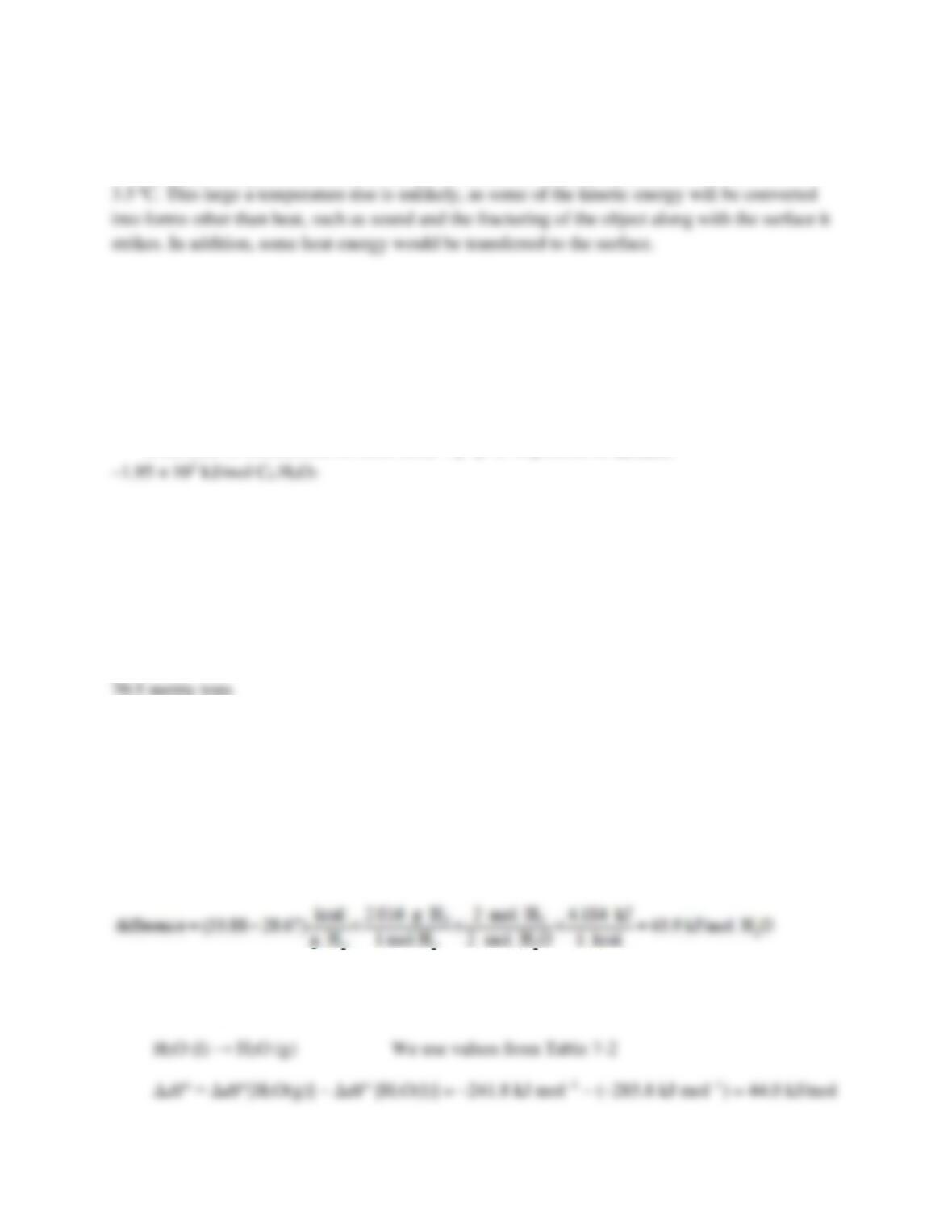
water must be added, together with a 1.23 kg piece of iron at
68 5 C,
so that the temperature of the water in the insulated -container shown in the figure
remains constant at
25 6 C
?
97. A 7.26 kg shot (as used in the sporting event, the shot put) is dropped from the top of a
building 168 m high. What is the maximum temperature increase that could occur in the
shot? Assume a specific heat capacity of
1 1
0 47 J g C
−−
for the shot. Why would the actual
measured temperature increase likely be less than the calculated value?
98. An alternative approach to bomb calorimetry is to establish the heat capacity of the
calorimeter, exclusive of the water it contains. The heat absorbed by the water and by the rest
of the calorimeter must be calculated separately and then added together. A bomb calorimeter
assembly containing 983.5 g water is calibrated by the combustion of 1.354 g anthracene. The
temperature of the calorimeter rises from 24.87 to
35 63 C
When 1.053 g citric acid is
burned in the same assembly, but with 968.6 g water, the temperature increases from 25.01 to
27 19 C
The heat of combustion of anthracene,
( )
14 10
C H s ,
is
7067 kJ/mol−
14 10
CH
What
is the heat of combustion of citric acid,
6 8 7
C H O ,
expressed in
kJ/mol?
99. The method of Exercise 98 is used in some bomb calorimetry experiments. A 1.148 g sample
of benzoic acid is burned in excess
( )
2
Og
in a bomb immersed in 1181 g of water. The
temperature of the water rises from 24.96 to
30 25 C
The heat of combustion of benzoic
acid is
26 42 kJ/g−
In a second experiment, a 0.895 g powdered coal sample is burned in the
same calorimeter assembly. The temperature of 1162 g of water rises from 24.98 to
29 81 C
How many metric tons
( )
1metric ton 1000 kg =
of this coal would have to be
burned to release
9
2 15 10 kJ
of heat?
100. A handbook lists two different values for the heat of combustion of hydrogen:
33 88 kcal/g
if
( )
2
H O l
is formed, and
28 67 kcal/g
if
( )
2
H O g
is formed. Explain why these two values
are different, and indicate what property this difference represents. Devise a means of
verifying your conclusions.
The difference is due to the enthalpy of vaporization of water. Less heat is evolved when steam
is formed because some of the heat of combustion is used to vaporize the water. The
difference between these two heats of vaporization is computed first.
This difference should equal the heat of vaporization, that is, the enthalpy change for the
following reaction.