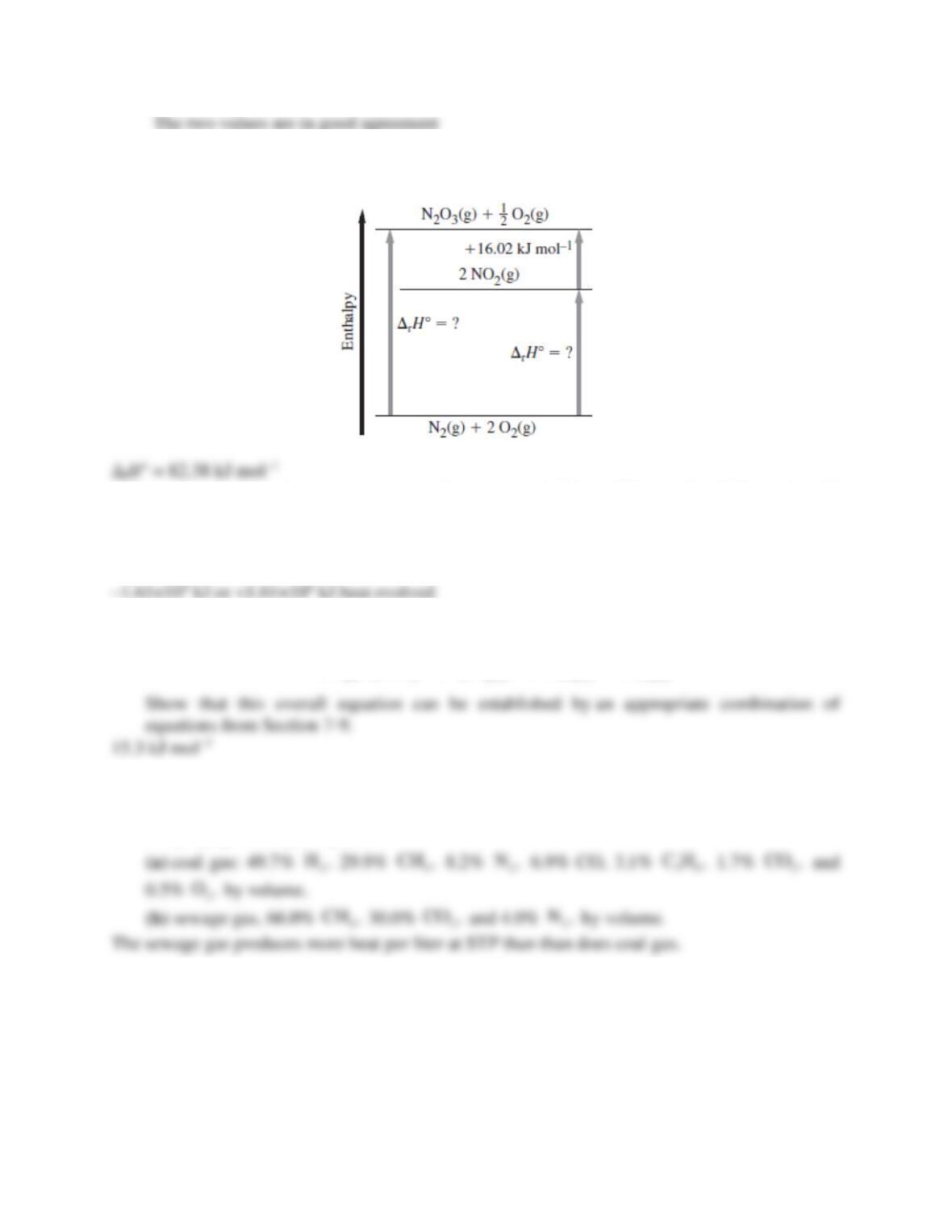
101. Determine the missing values of
rH
in the diagram shown below.
102. A particular natural gas consists, in mole percents, of 83.0%
4
CH ,
11.2%
26
CH,
and 5.8%
38
CH
A 385 L sample of this gas, measured at
22 6 C
and 739 mmHg, is burned at
constant pressure in an excess of oxygen gas. How much heat, in kilojoules, is evolved in the
combustion reaction?
103. An overall reaction for a coal gasification process is
( ) ( ) ( ) ( )
2 4 2
2 C graphite 2 H O g CH g CO g + → +
104. Which of the following gases has the greater fuel value on a per liter (STP) basis? That is,
which has the greater heat of combustion? [Hint: The only combustible gases are
4 3 8
CH C H,,
CO,
and
2
H
]
105. A calorimeter that measures an exothermic heat of reaction by the quantity of ice that can be
melted is called an ice calorimeter. Now consider that 0.100 L of methane gas,
( )
4
CH g ,
at
25 0 C
and 744 mmHg, is burned at constant pressure in air. The heat liberated is captured
and used to melt 9.53 g ice at
0 C
fus
( of ice 6 01kJ/mol)H =
(a) Write an equation for the complete combustion of
4
CH ,
and show that combustion is
incomplete in this case.
(b) Assume that CO(g) is produced in the incomplete combustion of
4
CH ,
and represent the
combustion as best you can through a single equation with small whole numbers as
coefficients. (
( )
2
H O l
is another product of the combustion.)
106. For the reaction
( ) ( ) ( ) ( )
2 4 2 2 2
C H g 3 O g 2 CO g 2 H O l+ → +
1
r1410 9 kJ molH−
= −
if the
2
HO
were obtained as a gas rather than a liquid, (a) would the heat of reaction be
greater (more negative) or smaller (less negative) than that indicated in the equation? (b)
Explain your answer.
(c) Calculate the value of
rH
in this case.
107. Some of the butane,
( )
4 10
C H g ,
in a 200.0 L cylinder at
26 0 C
is withdrawn and burned at
a constant pressure in an excess of air. As a result, the pressure of the gas in the cylinder
falls from 2.35 atm to 1.10 atm. The liberated heat is used to raise the temperature of 132.5 L
of water in a heater from 26.0 to
62 2 C
Assume that the combustion products are
( )
2
CO g
and
( )
2
H O l
exclusively, and determine the efficiency of the water heater. (That is,
what percent of the heat of combustion was absorbed by the water?)
108. The metabolism of glucose,
6 12 6
C H O ,
yields
( )
2
CO g
and
( )
2
H O l
as products. Heat
released in the process is converted to useful work with about 70% efficiency. Calculate the
mass of glucose metabolized by a 58.0 kg person in climbing a mountain with an elevation
gain of 1450 m. Assume that the work performed in the climb is about four times that
required to simply lift 58.0 kg by 1450 m.
f
(H
of
( )
6 12 6
C H O s
is
1273 3 kJ/mol )−
109. An alkane hydrocarbon has the formula
22
CH
nn+
The enthalpies of formation of the alkanes
decrease (become more negative) as the number of C atoms increases. Starting with butane,
( )
4 10
C H g ,
for each additional
2
CH
group in the formula, the enthalpy of formation,
fH,
changes by about
21kJ/mol−
Use this fact and data from Table 7.2 to estimate the heat of
combustion of heptane,
( )
7 16
C H l
110. Upon complete combustion, a 1.00 L sample (at STP) of a natural gas gives off 43.6 kJ of
heat. If the gas is a mixture of
( )
4
CH g
and
( )
26
C H g ,
what is its percent composition, by
volume?
111. Under the entry
24
H SO ,
a reference source lists many values for the standard enthalpy of
formation. For
ex-ample, for pure
( )
2 4 f
H SO l 814 0 kJ/mol, H ; = −
for a solution with 1 mol
2
HO
per mole
of
24
H SO ,
841 8;−
with
2
10 mol H O 880 5;, −
with
2
50 mol H O,
886 8;−
with
2
100 mol H O 887 7;, −
with
2
500 mol H O,
890 5;−
with
2
1000 mol H O 892 3;, −
with
10,000 mol
2
HO,
900 8;−
and with
2
100,000 mol H O 907 3, −
( a ) E x p l a i n w h y t h e s e v a l u e s a r e n o t a l l t h e s a m e .
(b) The value of
( )
f 2 4
H SO aqH
in an infinitely dilute solution is
909 3kJ/mol−
What
d a t a f r o m t h i s c h a p t e r c a n y o u c i t e t o c o n f i r m t h i s v a l u e ? E x p l a i n .
(c) If 500.0 mL of 1.00
( )
24
M H SO aq
is prepared from pure
( )
24
H SO l ,
what is the
approximate change in temperature that should be observed? Assume that the
( )
24
H SO l
and
( )
2
H O l
are at the same temperature initially and that the specific heat capacity of the
( )
24
H SO aq
is about
11
4 2 J g C
− −

112. Refer to the discussion of the gasification of coal (page 283), and show that some of the heat
required in the gasification reactions (equations 7.26 and 7.27) can be supplied by the
methanation reaction. This fact contributes to the success of modern processes that produce
synthetic natural gas (SNG).
113. A 1 . 1 0 3 g s a m p l e o f a g a s e o u s c a r b o n –hydrogen–
oxygen compound that occupies a volume of 582 mL at 765.5 Torr and
25 00 C
is burned
in an excess of
( )
2
Og
in a bomb calorimeter. The products of the combustion are
( ) ( )
22
2 108 g CO g 1 294 g H O l,,
and enough heat to raise the temperature of the calorimeter
assembly from 25.00 to
31 94 C
The heat capacity of the calorimeter is
5 015 kJ/ C
Write
an equation for the combustion reaction, and indicate
rH
for this reaction at
25 00 C
114. Several factors are involved in determining the cooking times required for foods in a
microwave oven. One of these factors is specific heat capacity. Determine the approximate
time required to warm 250 mL of chicken broth from
4 C
(a typical refrigerator temperature)
to
50 C
in a 700 W microwave oven. Assume that the density of chicken broth is about
1g/mL
and that its specific heat capacity is approximately
1 1
4 2 J g C
−−
115. Suppose you have a setup similar to the one depicted in Figure 7-8 except that there are two
different weights rather than two equal weights. One weight is a steel cylinder 10.00 cm in
diameter and 25 cm long, the other weight produces a pressure of 745 Torr. The temperature
of the gas in the cylinder in which the expansion takes place is
25 0 C
The -piston
restraining the gas has a diameter of 12.00 cm, and the height of the piston above the base of
the gas expansion cylinder is 8.10 cm. The density of the steel is
3
7 75 g/cm
How much
work is done when the steel cylinder is suddenly removed from the piston?
116. When one mole of sodium carbonate decahydrate (washing soda) is gently warmed, 155.3 kJ
of heat is absorbed, water vapor is formed, and sodium carbonate heptahydrate remains. On
more vigorous heating, the heptahydrate absorbs 320.1 kJ of heat and loses more water vapor
to give the monohydrate. Continued heating gives the anhydrous salt (soda ash) while 57.3 kJ
of heat is absorbed. Calculate
H
for the conversion of one mole of washing soda into soda
ash. Estimate
U
for this process. Why is the value of
U
only an estimate?
117. The oxidation of
( )
3
NH g
to NO(g) in the Ostwald process must be very carefully
controlled in terms of temperature, pressure, and contact time with the catalyst. This is
because the oxidation of
( )
3
NH g
can yield any one of the products
( ) ( ) ( )
22
N g N O g NO g, , ,
and
( )
2
NO g ,
depending on conditions. Show that oxidation of
( )
3
NH g
to
( )
2
Ng
is the most exothermic of the four possible reactions.
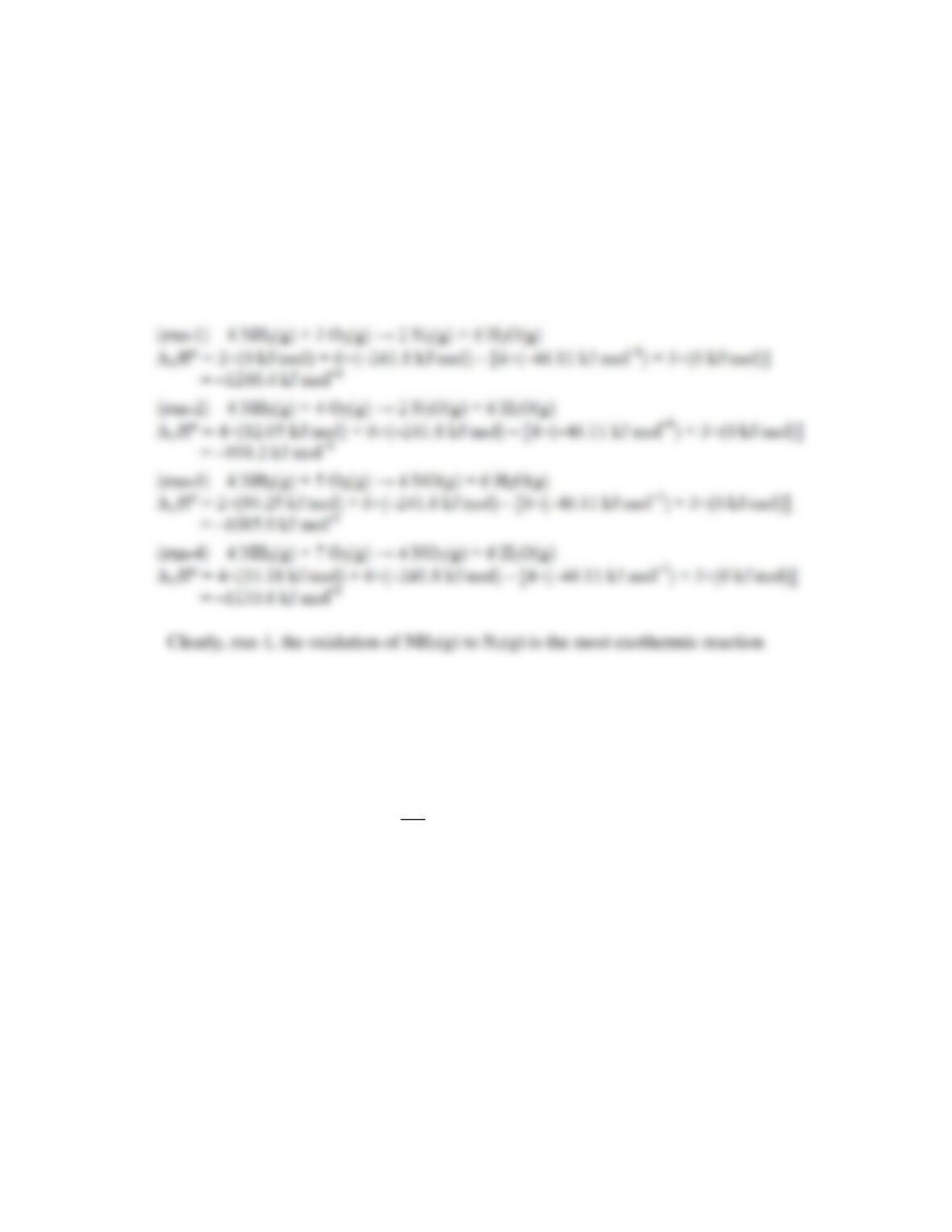
First, list all of the pertinent reactions, normalizing them so that each uses the same amount of
NH3:
118. In the Are You Wondering 7-1 box, the tempera-ture variation of enthalpy is discussed, and
the equation
heat capacity temperature
P
q=
change p
CT=
was introduced to show
how enthalpy changes with temperature for a constant-pressure process. Strictly speaking,
the heat capacity of a -substance at constant pressure is the slope of the line representing the
variation of enthalpy (H) with -temperature, that is
( )
p
dH
C at constant pressure
dT
=
where
p
C
is the heat capacity of the substance in question. Heat capacity is an extensive
quantity and heat capacities are usually quoted as molar heat capacities
mp,
C,
the heat
capacity of one mole of substance, which is an intensive property. The heat capacity at
constant pressure is used to estimate the change in enthalpy due to a change in temperature.
For infinitesimal changes in temperature,
( )
at constant pressure
p
dH C dT=
To evaluate the change in enthalpy for a particular temperature change, from
1
T
to
2
T,
we
write
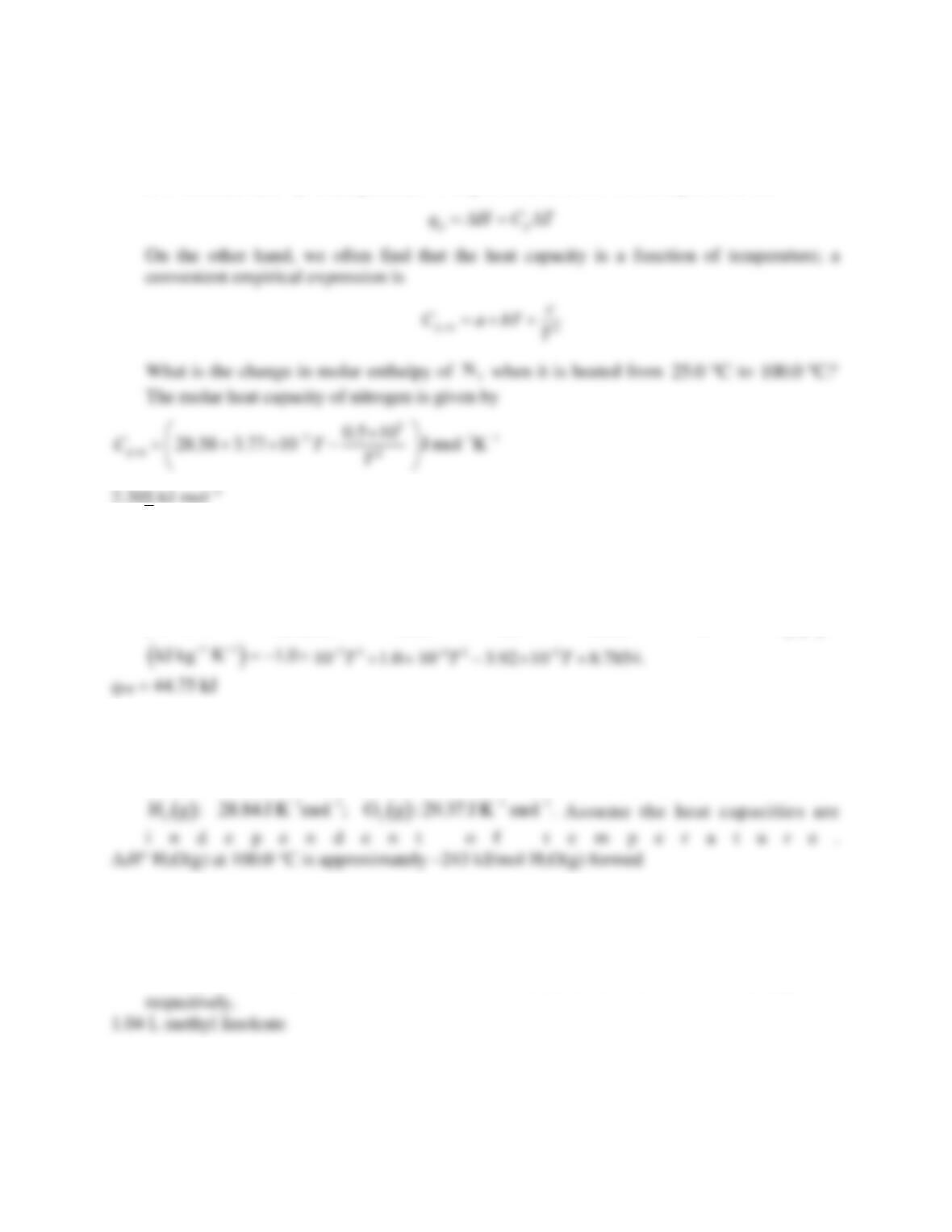
22
11
()
21
() ( ) ( )
H T T
p
H T T
dH H T H T C dT= − =
If we assume that
p
C
is independent of temperature, then we recover equation (7.5)
119. How much heat is required to convert 10.0 g of ice at
5 0 C−
to steam at 100.0
C? The
temperature-
dependent constant–pressure specific heat capacity of ice
is
( )
( )
11
kJ kg K
p
c T / −−
=
1 0187T
2
1 49 10−
−
The temperature-dependent constant–
pressure specific heat for water is
( )
p
c T /
120. The standard enthalpy of formation of gaseous
2
HO
at 298.15 K is
1
241 82 kJ mol−
−
Using
the ideas -contained in Figure 7-16, estimate its value at
100 0 C
given the following values
of the mola r heat capacities at constant pressure:
( )
2
H O g :
11
33 58 J K mol ;
−−
121. Cetane, C16H34, is a typical petrodiesel with a standard enthalpy of combustion of
1
10 699 1 kJ mol,−
−
. Methyl linoleate, C19H34O2, is a biodiesel with a standard enthalpy of
combustion of
1
11 690 1 kJ mol,−
−
. What volume of methyl linoleate provides the same energy
as one liter of cetane? The densities of cetane and methyl linoleate are 0.773 and
1
0 885 g mL−
,
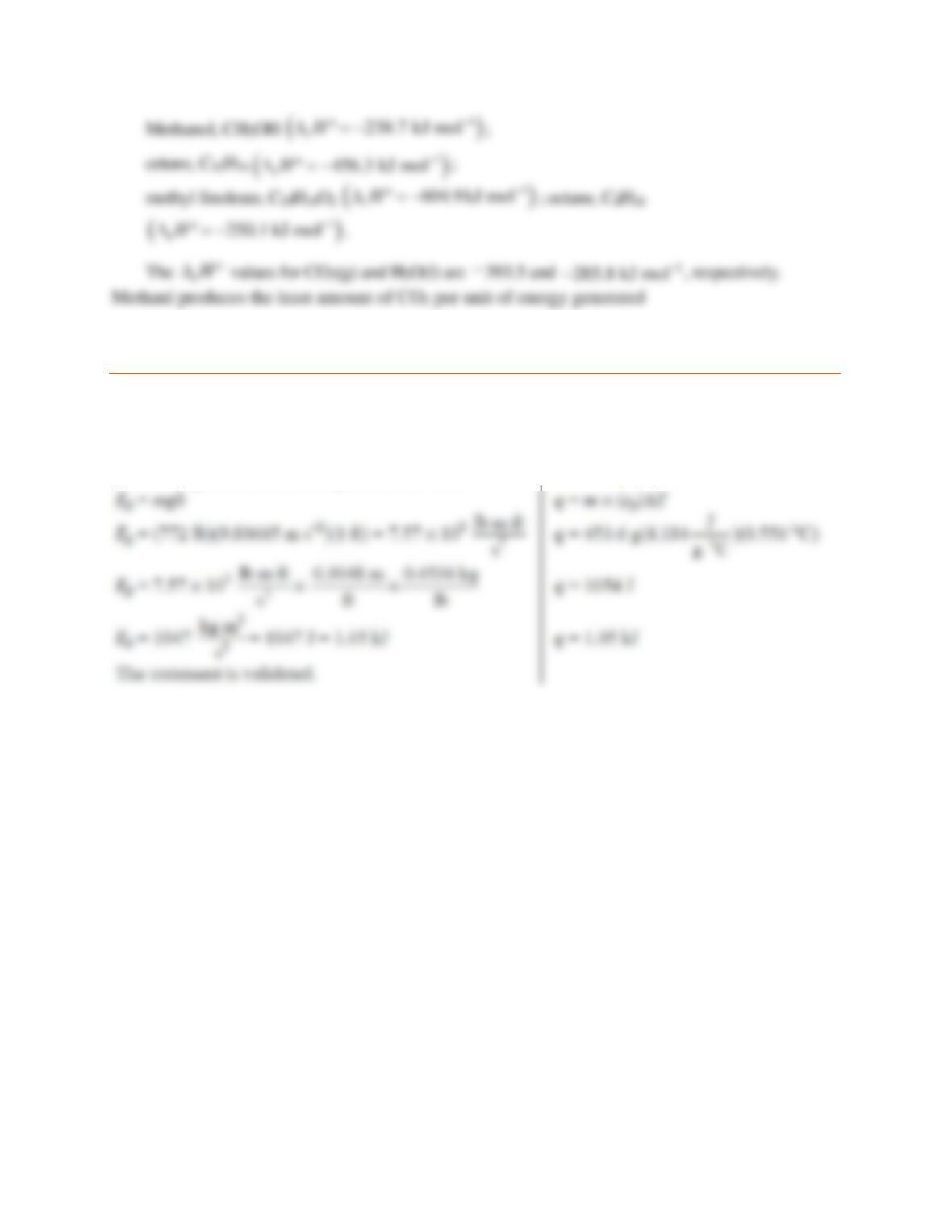
122. Carbon dioxide emissions have been implicated as a major factor in climate change. Which of the
following liquid fuels, when burned completely in oxygen at
25 °C, generates the smallest amount of CO2 per kilojoule of energy output?
Feature Problems
123. James Joule published his definitive work related to the first law of thermodynamics in
1850. He stated that “the quantity of heat capable of increasing the temperature of one
pound of water by
1 F
requires for its evolution the expenditure of a mechanical force
represented by the fall of 772 lb through the space of one foot.” Validate this statement by
relating it to information given in this text.
124. Based on specific heat capacity measurements, Pierre Dulong and Alexis Petit proposed in
1818 that the specific heat capacity of an element is inversely related to its atomic weight
(atomic mass). Thus, by measuring the specific heat capacity of a new element, its atomic
weight could be readily established.
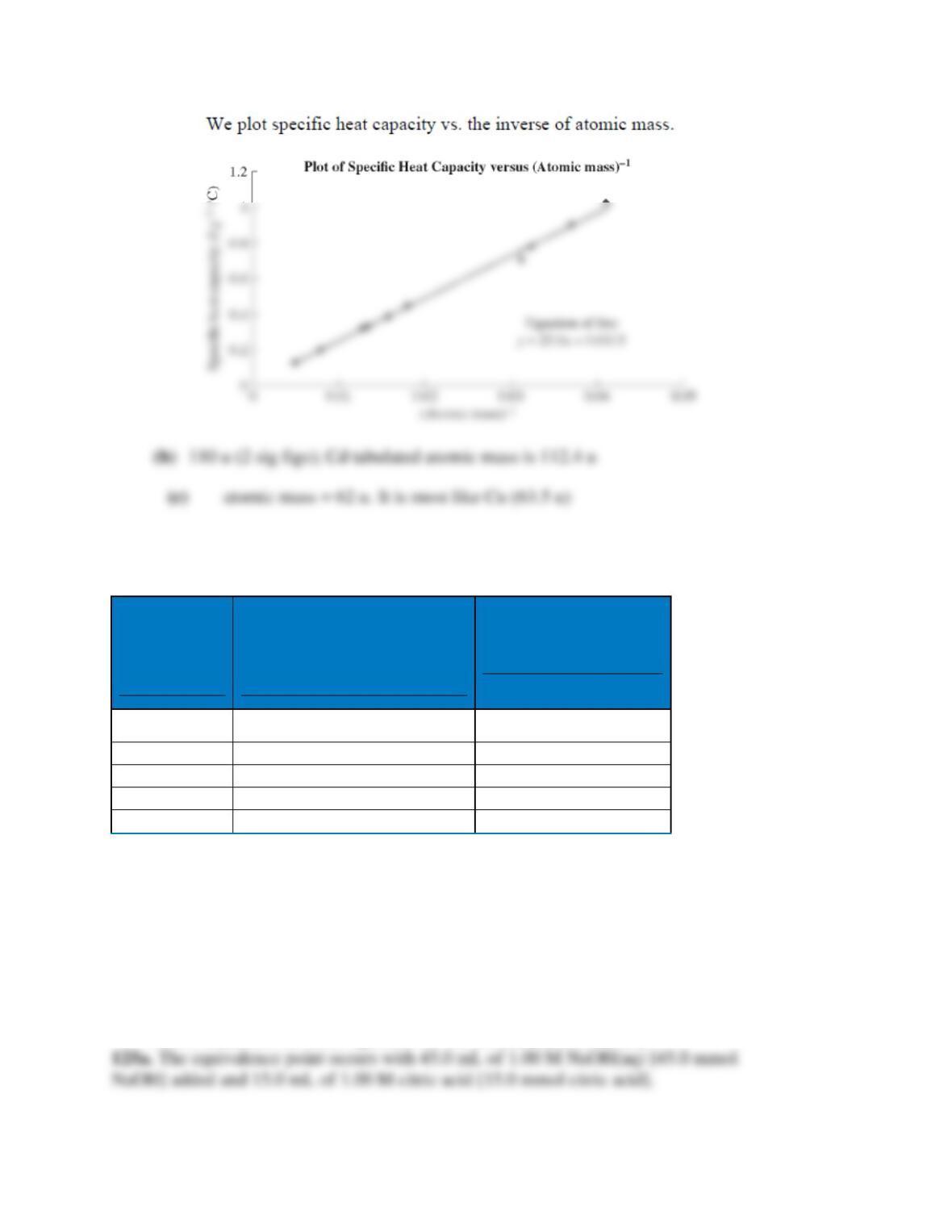
(a) Use data from Table 7.1 and inside the front cover to plot a straight-line graph relating
atomic mass and specific heat capacity. Write the equation for this straight line.
(b) Use the measured specific heat capacity of
11
0 23 J g C
−−
and the equation derived in
part (a) to obtain an approximate value of the atomic mass of cadmium, an element
discovered in 1817.
(c) To raise the temperature of 75.0 g of a particular metal by
15 C
requires 450 J of heat.
What might this metal be?
(a)
125. We can use the heat liberated by a neutralization reaction as a means of establishing the
stoichiometry of the reaction. The data in the table are for the reaction of 1.00 M NaOH with
1.00 M citric acid,
6 8 7
C H O ,
in a total solution volume of 60.0 mL.
mL 1.00 M
NaOH Used
mL 1.00 M
Citric Acid Used G
T,
C
20.0
40.0
4.7
30.0
30.0
6.3
40.0
20.0
8.2
50.0
10.0
6.7
55.0
5.0
2.7
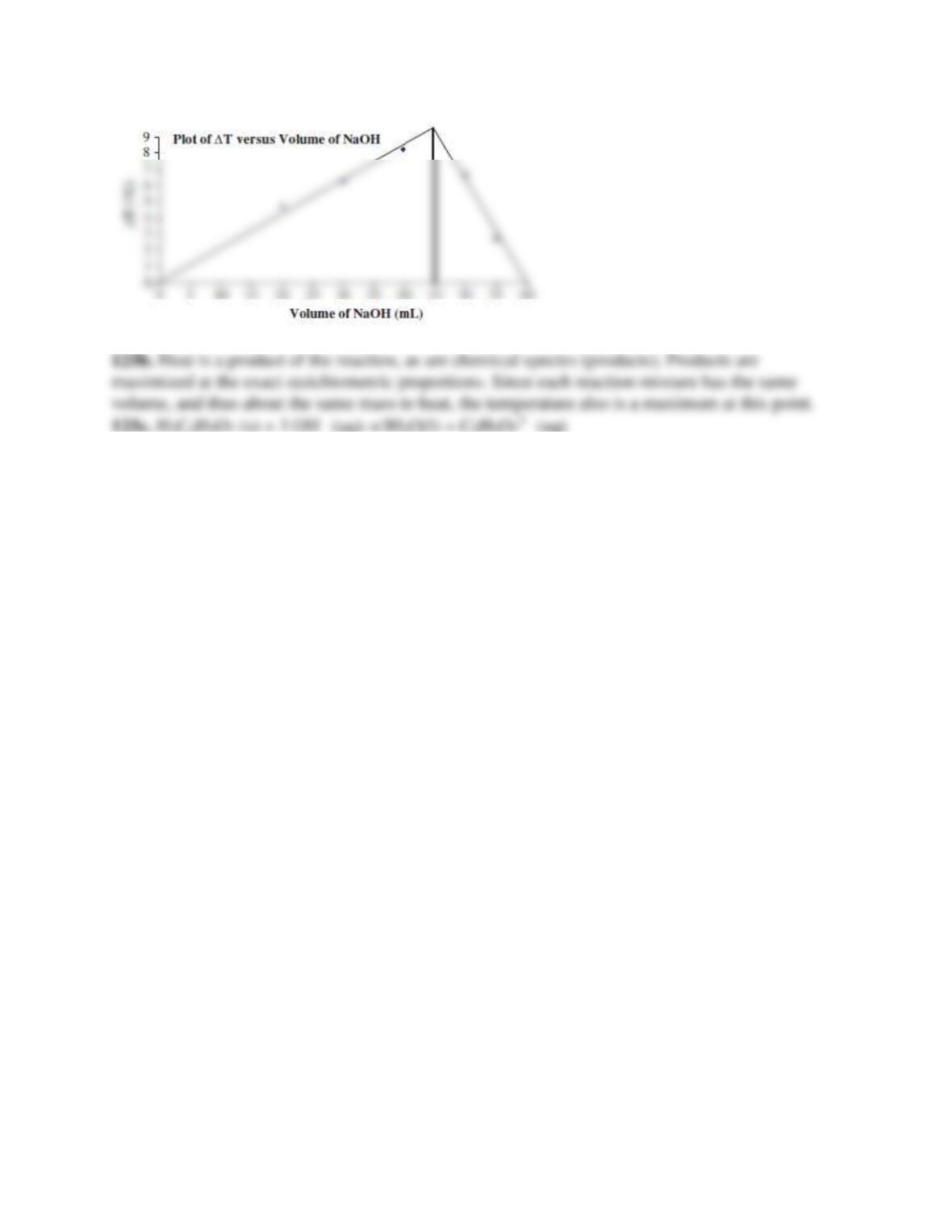
(a) Plot
T
versus mL 1.00 M NaOH, and identify the exact stoichiometric proportions of
NaOH and citric acid at the equivalence point of the neutralization reaction.
(b) Why is the temperature change in the neutralization greatest when the reactants are in
their exact stoichiometric proportions? That is, why not use an excess of one of the
reactants to ensure that the neutralization has gone to completion to achieve the maximum
temperature increase?
(c) Rewrite the formula of citric acid to reflect more precisely its acidic properties. Then
write a balanced net ionic equation for the neutralization reaction.
126. In a student experiment to confirm Hess’s law, the reaction
( ) ( ) ( )
34
NH concd aq HCl aq NH Cl aq + →
was carried out in two different ways. First, 8.00 mL of concentrated
( )
3
NH aq
was added
to 100.0 mL of 1.00 M HCl in a calorimeter. (The
( )
3
NH aq
was slightly in excess.) The
reactants were initially at
23 8 C,
and the final temperature after neutralization was
35 8 C
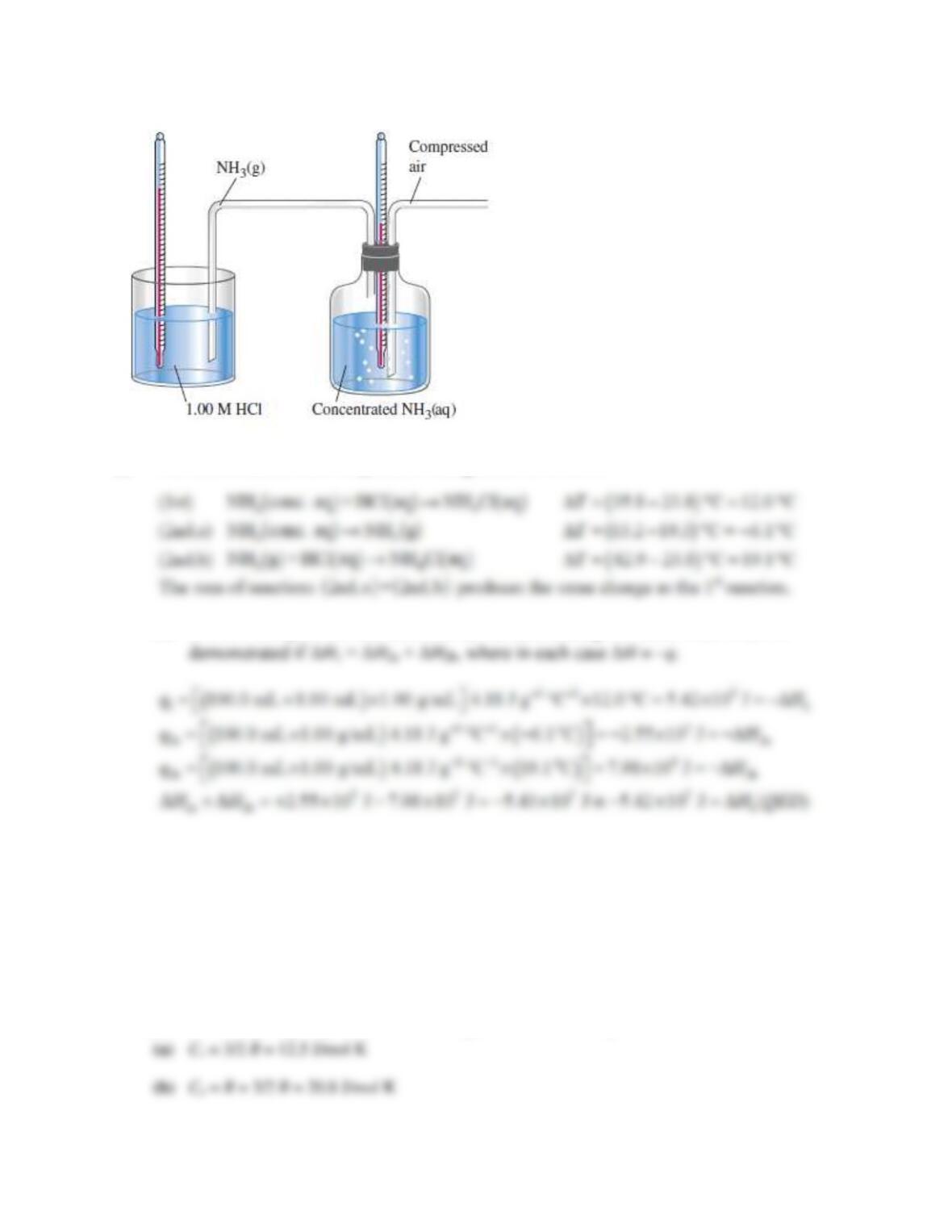
In the second experiment, air was bubbled through 100.0 mL of concentrated
( )
3
NH aq ,
sweeping out
( )
3
NH g
(see sketch). The
( )
3
NH g
was neutralized in 100.0 mL
of 1.00 M HCl. The temperature of the concentrated
( )
3
NH aq
fell from 19.3 to
13 2 C
At the same time, the temperature of the 1.00 M HCl rose from 23.8 to
42 9 C
as it was
neutral-ized by
( )
3
NH g
Assume that all solutions have densities of
1 00 g/mL
and
specific heat capacities of
1 1
4 18 J g C
−−
(a) Write the two equations and
rH
values for the processes occurring in the second
experiment. Show that the sum of these two equations is the same as the equation for the
reaction in the first experiment.
(b) Show that, within the limits of experimental error,
rH
for the overall reaction is the
same in the two experiments, thereby confirming Hess’s law.
(a) The reactions, and their temperature changes, are as follows.
(b) We now compute the heat absorbed by the surroundings for each. Hess’s law is
127. When an ideal gas is heated, the change in internal energy is limited to increasing the average
translational kinetic energy of the gas molecules. Thus, there is a simple relationship between
U
of the gas and the change in temperature that occurs. Derive this relationship with the
help of ideas about the kinetic–molecular theory of gases developed in Chapter 6. After doing
so, obtain numerical values (in
11
J mol K
−−
) for the following molar heat capacities.
(a) the heat capacity,
V
C,
for one mole of gas under constant-volume conditions
(b) the heat capacity,
p
C,
for one mole of gas under constant-pressure conditions
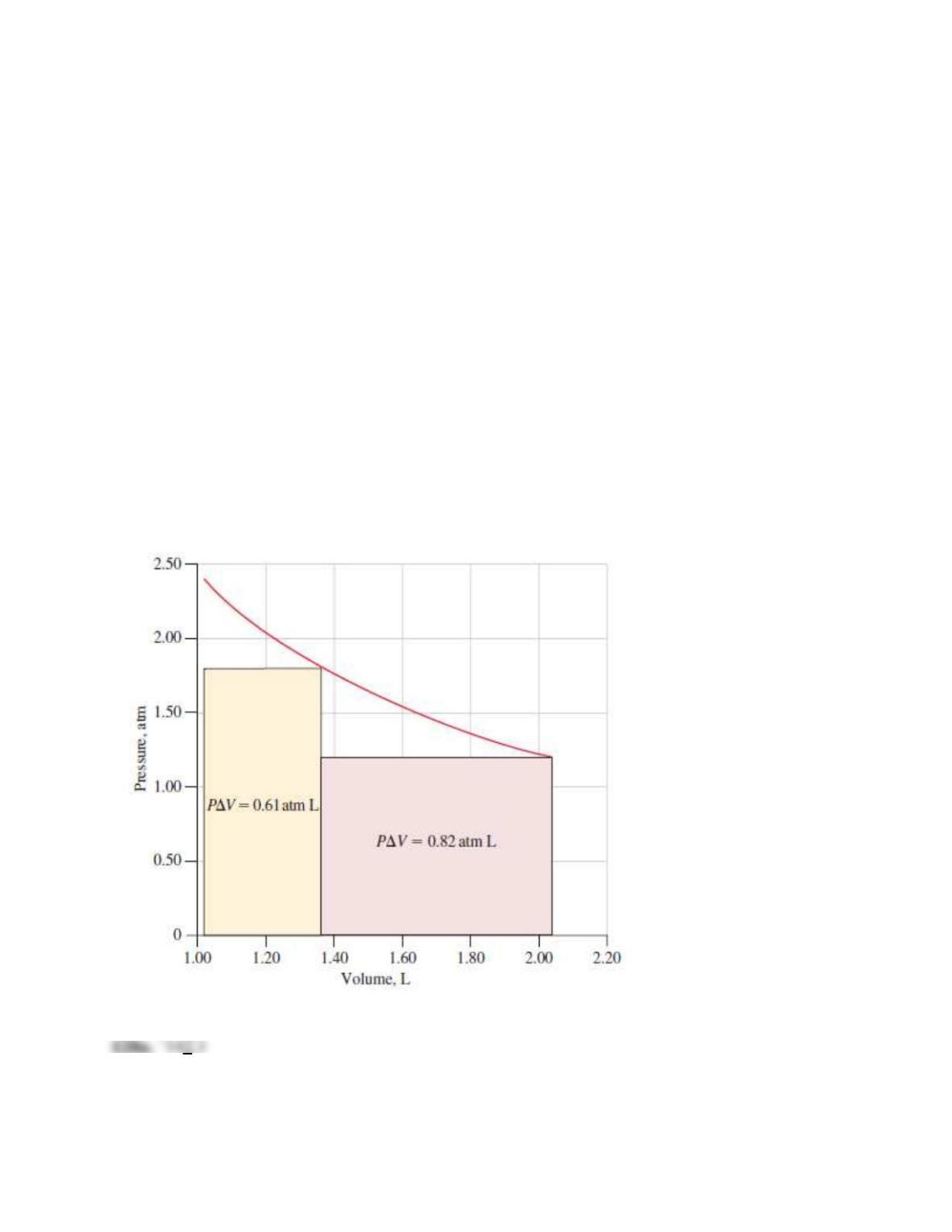
128. Refer to Example 7-5 dealing with the work done by 0.100 mol He at 298 K in expanding in
a single step from 2.40 to 1.20 atm. Review also the two-step expansion
( )
2 40 atm 1 80 atm 1 20 atm → →
described on page 261 (see Figure 7-11).
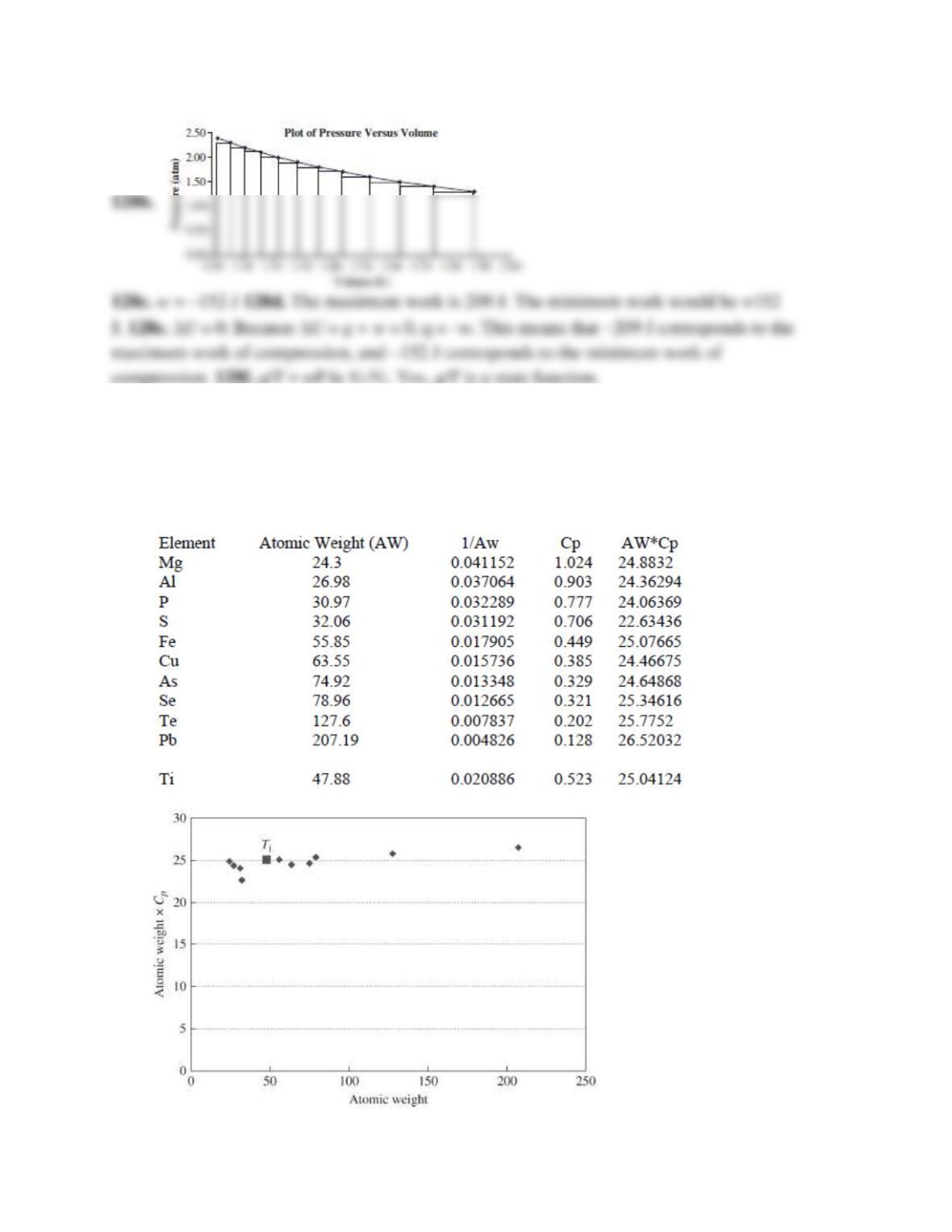
(a) Determine the total work that would be done if the He expanded in a series of steps, at
0.10 atm intervals, from 2.40 to 1.20 atm.
(b) Represent this total work on the graph below, in which the quantity of work done in the
two-step expansion is represented by the sum of the colored rectangles.
(c) Show that the maximum amount of work would occur if the expansion occurred in an
infinite number of steps. To do this, express each infinitesimal quantity of work as
dw P dV=−
and use the methods of integral calculus (integration) to sum these quantities.
Assume ideal behavior for the gas.
(d) Imagine reversing the process, that is, compressing the He from 1.20 to 2.40 atm. What
are the maximum and minimum amounts of work required to produce this compression?
Explain.
(e) In the isothermal compression described in
part (d), what is the change in internal energy assuming ideal gas behavior? What is the
value of q?
(f) Using the formula for the work derived in
part (c), obtain an expression for
q / T
Is this new function a state function? Explain.
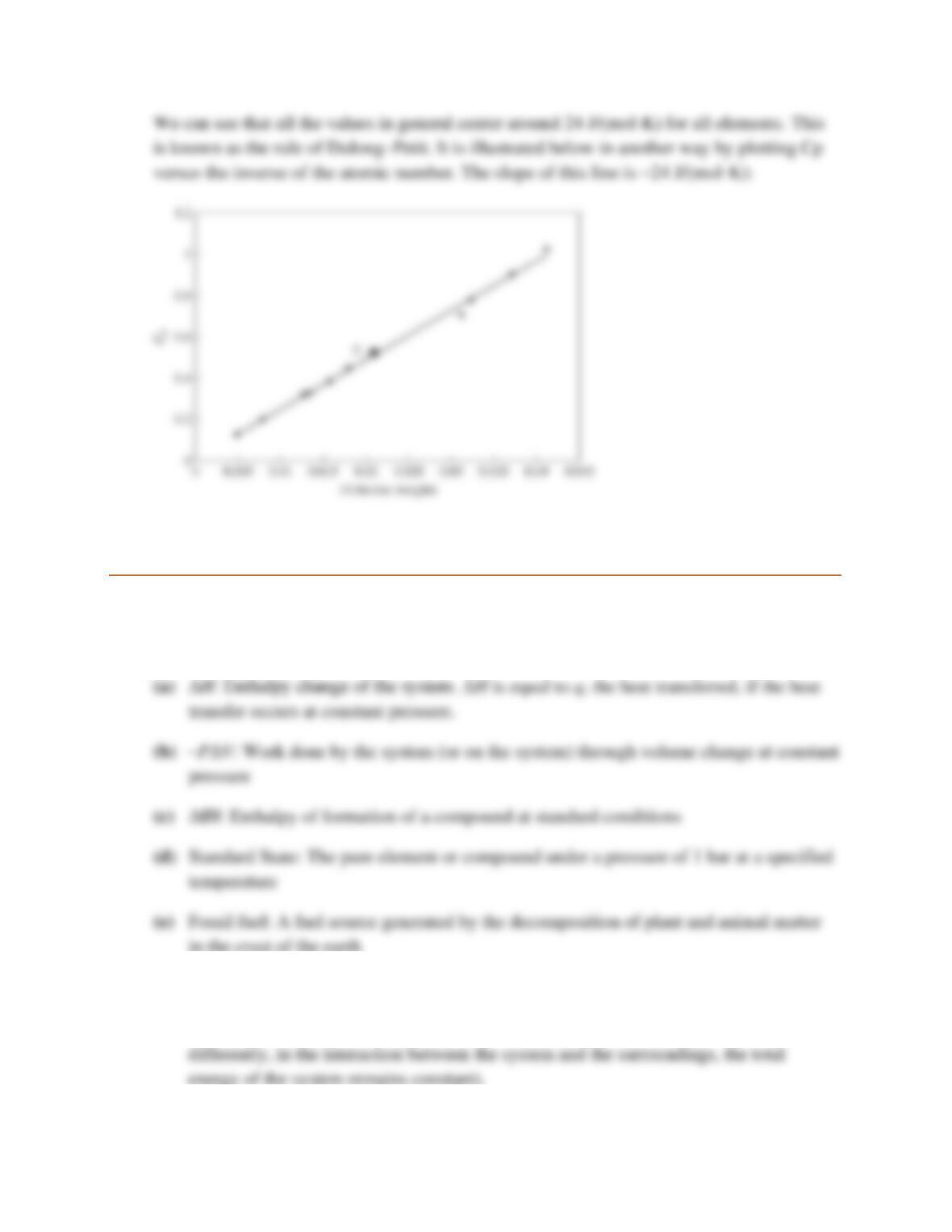
129. Look up the specific heat capacity of several elements, and plot the products of the specific
heat capacities and atomic masses as a function of the atomic masses. Based on the plot,
develop a hypothesis to explain the data. How could you test your hypothesis?
We use the data in Table 7.1 to generate the plot, with the cp of Ti added in to demonstrate how it fits in
with the data. Below are the data table and the plot
Self-Assessment Exercises
130. In your own words, define or explain the following terms or symbols: (a)
rH;
(b) ––
P V;
(c)
fH;
(d) standard state; (e) fossil fuel.
131. Briefly describe each of the following ideas or methods: (a) law of conservation of energy;
(b) bomb calorimetry; (c) function of state; (d) enthalpy diagram; (e) Hess’s law.
(a) Law of conservation of energy: Energy is neither created nor destroyed (or stated
132. Explain the important distinctions between each pair of terms: (a) system and surroundings;
(b) heat and work; (c) specific heat capacity and heat capacity;
(d) endothermic and exothermic; (e) constant-volume process and constant-pressure process.
133. The temperature increase of 225 mL of water at
25 C
contained in a Styrofoam cup is
noted when a 125 g sample of a metal at
75 C
is added. With reference to Table 7.1, the
134. A plausible final temperature when 75.0 mL of water at
80 0 C
is added to 100.0 mL of
water at
20 C
is
135.
100 JU =
for a system that gives off 100 J of heat and (a) does no work; (b) does 200 J of
work; (c) has 100 J of work done on it; (d) has 200 J of work done on it.
136. The heat of solution of NaOH(s) in water is
41 6 kJ/mol NaOH−
When NaOH(s) is
dissolved in water the solution temperature (a) increases;
(b) decreases; (c) remains constant; (d) either increases or decreases, depending on how
much NaOH is dissolved.
137. The standard molar enthalpy of formation of
( )
2
CO g
is equal to (a) 0; (b) the standard
molar heat of combustion of graphite; (c) the sum of the standard molar enthalpies of
formation of CO(g) and
( )
Og;
(d) the standard molar heat of combustion of CO(g).
138. Write the formation reaction for each of the following compounds: (a) SnCl2(s); (b)
C6H5COOH(s);
(c) COCl2(g).
139. Compute
rH
for the following reactions. The value of
fH
in kJ mol-
1−
is given for each
substance below its formula.
(a) SiO2 (s) + 4 HF(g)
→
SiF4(g) + 2 H2O(g)
–910.9 –271.1 –1615.0 –241.8
(b) 2 CuS(s) + 3 O2(g)
→
2 CuO(s) + 2 SO2(g)
–53.1 0.0 –157.3 –296.8
140. When dissolved in water, 1.00 mol LiCl produces
37.l2 kJ of heat. What is the final temperature in (in °C) when 5.00 g LiCl dissolves in 110.0 g
of water at
20.00 °C? Assume that the solution produced has a specific heat capacity of 4.00 J g−1 °C−1.
141. When an element is involved in a formation reaction, it does not have to be (a) pure; (b) at
1.00 M concentration; (c) at 1.00 bar pressure; (d) in its most stable form; (e) none of these.
142. The standard state of a substance is (a) the pure form at 1 bar; (b) the most stable form at 25
°C and 1 bar; (c) the most stable form at 0 °C; (d) the pure gaseous form at 25 °C; (e) none of
143. Which two of the following statements are false?
(a)
VP
qq=
for the reaction
( ) ( )
22
N g O g+→
( )
2 NO g ;
(b)
r0H
for an endothermic
reaction;
(c) By convention, the most stable form of an element must always be chosen as the reference
form and assigned the value
f0H; =
(d)
U
and
rH
for a reaction can never have the
same value; (e)
for the neutralization of a strong acid by a strong base.
144. A 1.22 kg piece of iron at
126 5 C
is dropped into
981 g water at
22 1 C
The temperature rises to
34 4 C
What will be the final
temperature if this same piece of iron at
99 8 C
is dropped into 325 mL of glycerol,
2
HOCH
CH(OH)
2
CH
OH
( )
l
at
26 2 C?
For glycerol,
11
1 26 g/mL 219 J mol K
p
d ;C −−
= =
145. Write the balanced chemical equations for reactions that have the following as their standard
enthalpy changes.
(a)
( )
2
82 05 kJ/mol N O g
fH = +
(b)
( )
f 2 2
394 1kJ/mol SO Cl lH = −
(c)
( )
c 3 2
1527 kJ/mol CH CH COOH lH = −
146. The standard molar heats of combustion of C(graphite) and CO(g) are
393 5−
and
283 kJ/mol,−
respectively. Use those data and that for the following reaction
( ) ( ) ( )
22
CO g Cl g COCl g+→
1
r108 kJ molH−
= −
to calculate the standard molar enthalpy of formation of
( )
2
COCl g
147. Can a chemical compound have a standard enthalpy of formation of zero? If so, how likely
is this to occur? Explain.
148. Is it possible for a chemical process to have
0U
and
0H?
Explain.
149. Use principles from this chapter to explain the observation that professional chefs prefer to
cook with a gas stove rather than an electric stove.
150. Hot water and a piece of cold metal come into contact in an isolated container. When the
final temperature of the metal and water are identical, is the total energy change in this
process (a) zero; (b) negative; (c) positive; (d) not enough information.
151. A clay pot containing water at
25 C
is placed in the shade on a day in which the
temperature is
30 C
The outside of the clay pot is kept moist. Will the temperature of the
water inside the clay pot (a) increase; (b) decrease; (c) remain the same?
152. Construct a concept map encompassing the ideas behind the first law of thermodynamics.
To construct a concept map, one must first start with the most general concepts. These concepts
are not defined by or in terms of other concepts discussed in those sections. In this case, we are
153. Construct a concept map to show the use of enthalpy for chemical reactions.
The concept map of the use of enthalpy in chemical reactions has several major subheadings.
After the definition of enthalpy, there should be three major subheadings: (1) expressing
154. Construct a concept map to show the inter–
relationships between path-dependent and path-independent quantities in thermodynamics.