Chapter 6
Gases
Exercises
Pressure and Its Measurement
1. Convert each pressure to an equivalent pressure in atmospheres. (a) 736 mmHg; (b) 0.776
bar;
2. Calculate the height of a mercury column required to produce a pressure (a) of 0.984 atm; (b)
of 928 Torr;
(c) equal to that of a column of water 142 ft high.
3. Calculate the height of a column of liquid benzene
( )
3
0 879 g/cmd,=
in meters, required to
exert a pressure of 0.970 atm.
4. Calculate the height of a column of liquid glycerol
( )
3
1 26 g/cmd,=
in meters, required to
exert the same pressure as 3.02 m of
( )
( )
3
4
CCl l 1 59 g/cmd =
5. What is the pressure (in mmHg) of the gas inside the apparatus below if
bar 1
740 mmHg, 30 mmP h ,
= =
and
250 mmh?=
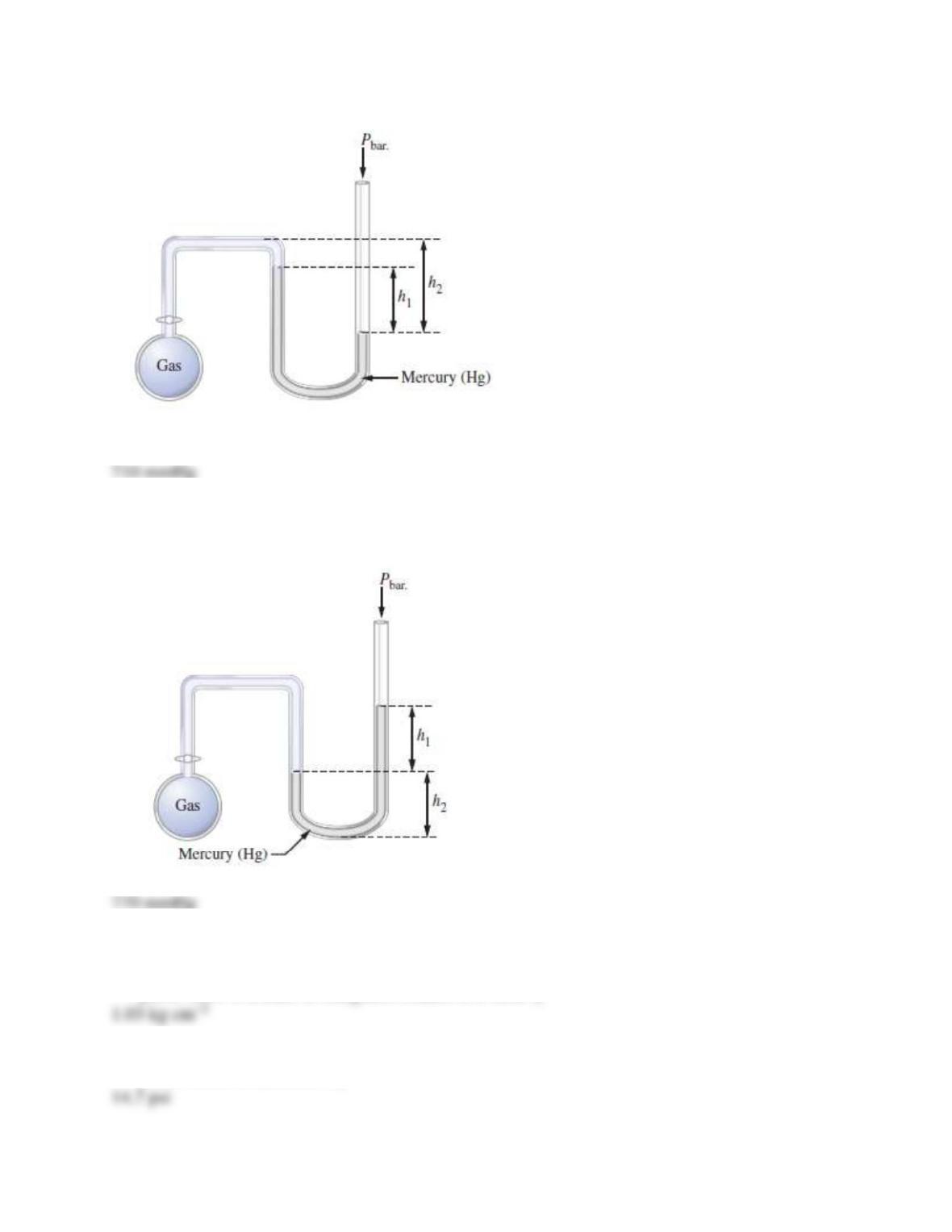
6. What is the pressure (in mmHg) of the gas inside the apparatus below if
bar 1
740 mmHg 30 mmP ,h ,
= =
and
240 mmh?=
7. At times, a pressure is stated in units of mass per unit area rather than force per unit area.
Express
1atmP=
in the unit
2
kg/cm
[Hint: How is a mass in kilograms related to a force?]
8. Express
1atmP=
in pounds per square inch (psi).
[Hint: Refer to Exercise 7.]
The Simple Gas Laws
9. A sample of
( )
2
Og
has a volume of 26.7 L at 762 Torr. What is the new volume if, with the
temperature and amount of gas held constant, the pressure is (a) lowered to 385 Torr; (b)
increased to 3.68 atm?
10. An 886 mL sample of Ne(g) is at 752 mmHg and
26 C
What will be the new volume if,
with the pressure and amount of gas held constant, the temperature is
(a) increased to
98 C;
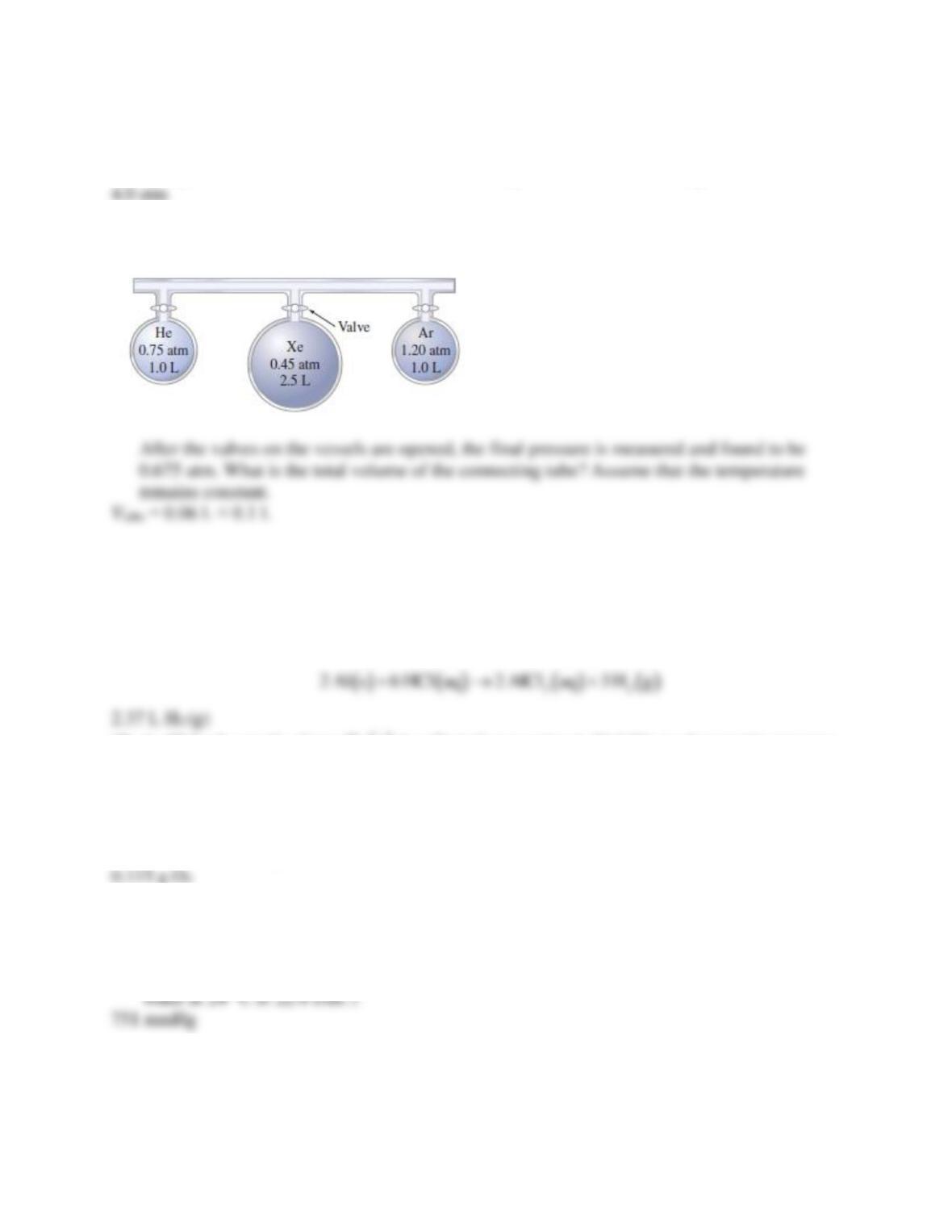
(b) lowered to
20 C?−
11. If 3.0 L of oxygen gas at
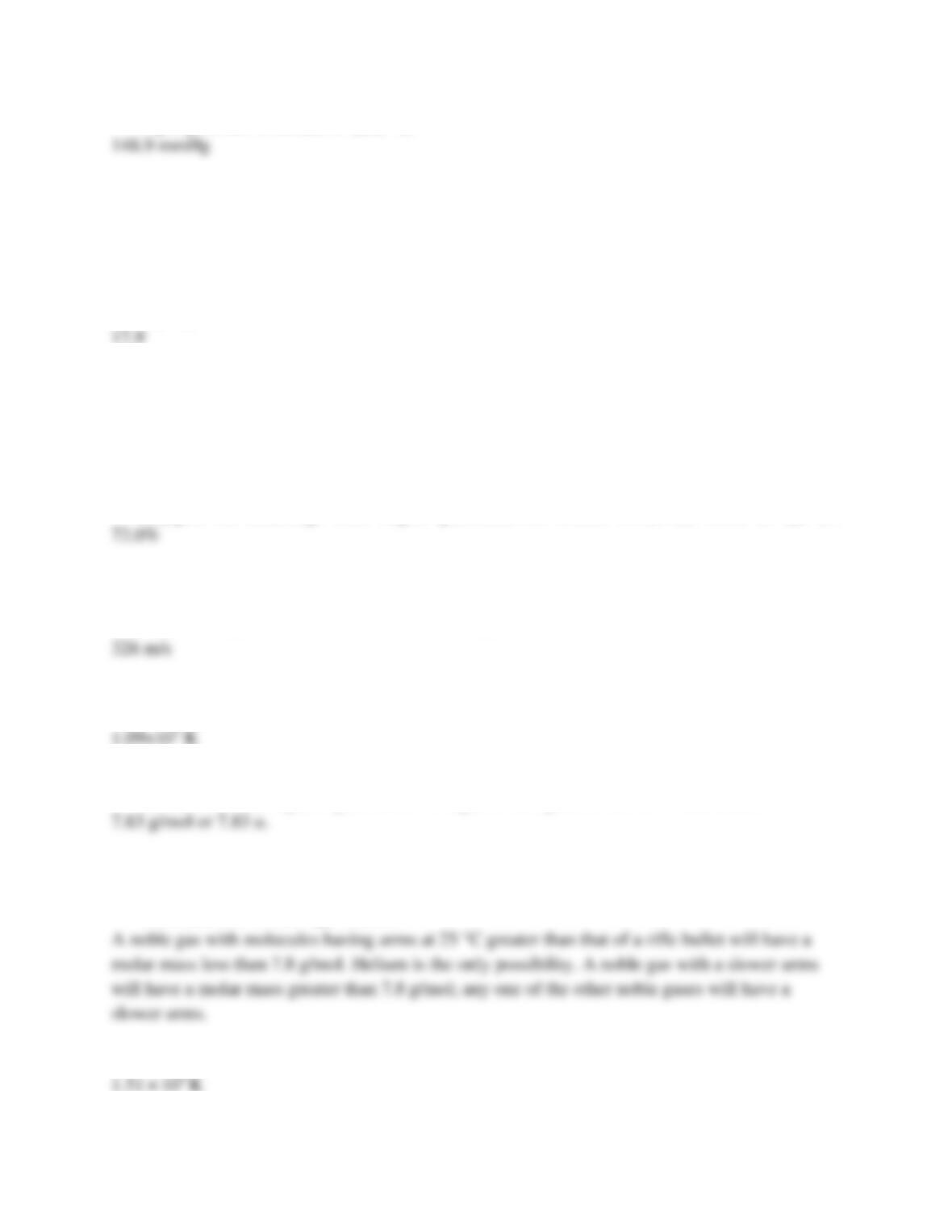
177 C
is cooled at constant pressure until the volume becomes
1.50 L, then what is the final temperature?
12. We want to change the volume of a fixed amount of gas from 725 mL to 2.25 L while
holding the temperature constant. To what value must we change the pressure if the initial
pressure is 105 kPa?
13. A 35.8 L cylinder of Ar(g) is connected to an evacuated 1875 L tank. If the temperature is
held constant and the final pressure is 721 mmHg, what must have been the original gas
pressure in the cylinder, in atmospheres?
14. A sample of
( )
2
Ng
occupies a volume of 42.0 mL under the existing barometric pressure.
Increasing the pressure by 85 mmHg reduces the volume to 37.7 mL. What is the prevailing
barometric pressure, in millimeters of mercury?
15. A weather balloon filled with He gas has a volume of
33
2 00 10 m
at ground level, where
the atmospheric pressure is 1.000 atm and the temperature
27 C
After the balloon rises
high above Earth to a point where the atmospheric pressure is 0.340 atm, its volume
increases to
33
5 00 10 m
What is the temperature of the atmosphere at this altitude?
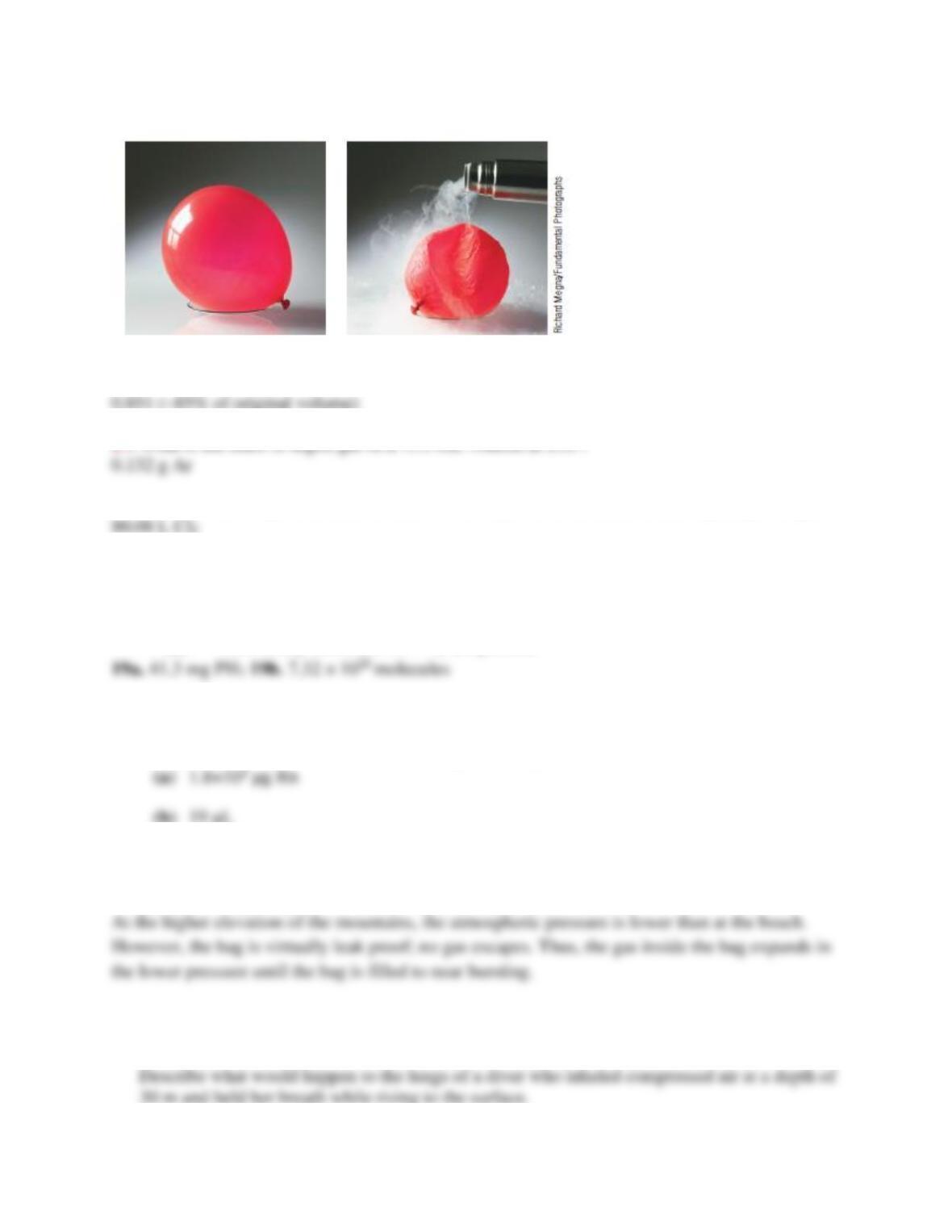
16. The photographs show the contraction of an argon-filled balloon when it is cooled by liquid
nitrogen. To what approximate fraction of its original volume will the balloon shrink when it is
cooled from a room temperature of
22 C
to a final temperature of about
22 C?−
18. What volume of gaseous chlorine at STP would you need to obtain a 250.0 g sample of gas?
19. A 27.6 mL sample of
( )
3
PH g
(used in the manufacture of flame-retardant chemicals) is
obtained at STP.
(a) What is the mass of this sample, in milligrams?
(b) How many molecules of
3
PH
are present?
20. A
17
5 0 10 atom
sample of radon gas is obtained.
(a) What is the mass of this sample, in micrograms?
(b) What is the volume of this sample at STP, in microliters?
21. You purchase a bag of potato chips at an ocean beach to take on a picnic in the mountains. At
the picnic, you notice that the bag has become inflated, almost to the point of bursting. Use
your knowledge of gas behavior to explain this phenomenon.
22. Scuba divers know that they must not ascend quickly from deep underwater because of a
condition known as the bends, discussed in Chapter 14. Another concern is that they must
constantly exhale during their ascent to prevent damage to the lungs and blood vessels.
General Gas Equation
23. A sample of gas has a volume of 4.25 L at
25 6 C
and 748 mmHg. What will be the volume
of this gas at
26 8 C
and 742 mmHg?
24. A 10.0 g sample of a gas has a volume of 5.25 L at
25 C
and 102 kPa. If 2.5 g of the same
gas is added to this constant 5.25 L volume and the temperature raised to
62 C,
what is the
new gas pressure?
25. A constant-volume vessel contains 12.5 g of a gas at
21 C
If the pressure of the gas is to
remain constant as the temperature is raised to
210 C,
how many grams of gas must be
released?
26. A 34.0 L cylinder contains
( )
2
305 g O g
at
22 C
How many grams of
( )
2
Og
must be
released to reduce the pressure in the cylinder to 1.15 atm if the temperature remains
constant?
Ideal Gas Equation
27. What is the volume, in liters, occupied by
( )
2
89 2 g CO g
at
37 C
and 98.3 kPa?
28. A 12.8 L cylinder contains
2
35 8 g O
at
46 C
What is the pressure of this gas, in
kilopascals?
29. Kr(g) in a 18.5 L cylinder exerts a pressure of 11.2 atm at
28 2 C
How many grams of gas
are present?
30. A 72.8 L constant-volume cylinder containing 7.41 g He is heated until the pressure reaches
3.50 atm. What is the final temperature in degrees Celsius?
31. A laboratory high vacuum system is capable of evacuating a vessel to the point that the
amount of gas remaining is
9
5 0 10
molecules per cubic meter. What is the residual pressure in
pascals?
32. What is the pressure, in pascals, exerted by
1242 g
( )
2
CO g
when confined at
25 C−
to a
c y l i n d r i c a l t a n k 2 5 . 0 c m i n d i a m e t e r a n d 1 . 7 5 m h i g h ?
33. What is the molar volume of an ideal gas at (a)
25 C
and 1.00 atm; (b)
100 C
and 748
Torr?
34. At what temperature is the molar volume of an ideal gas equal to 22.4 L, if the pressure of the
gas is 2.5 atm?
Determining Molar Mass
35. A 0.418 g sample of gas has a volume of 115 mL at
66 3 C
and 99.0 kPa. What is the molar
mass of this gas?
36. What is the molar mass of a gas found to have a density of
0 841g/L
at 415 K and 96.7 kPa?
37. What is the molecular formula of a gaseous fluoride of sulfur containing 70.4% F and having
a density of approximately
4 5 g/L
at
20 C
and 1.0 atm?
38. A 2.650 g sample of a gaseous compound occupies 428 mL at
24 3 C
and 742 mmHg. The
compound consists of 15.5% C, 23.0% Cl, and 61.5% F, by mass. What is its molecular
formula?
39. A gaseous hydrocarbon weighing 0.231 g occupies a volume of 102 mL at
23 C
and 749
mmHg. What is the molar mass of this compound? What conclusion can you draw about its
molecular formula?
40. A 132.10 mL glass vessel weighs 56.1035 g when evacuated and 56.2445 g when filled with
the gaseous hydrocarbon acetylene at 749.3 mmHg and
20 02 C
What is the molar mass of
acetylene? What conclusion can you draw about its molecular formula?
Gas Densities
41. A particular application calls for
( )
2
Ng
with a density of
1 80 g/L
at
32 C
What must be
the pressure of the
( )
2
Ng
in millimeters of mercury? What is the molar volume under these
conditions?
42. Monochloroethylene gas is used to make polyvinylchloride (PVC). It has a density of 2.56
g/L
at
22 8 C
and 101 kPa. What is the molar mass of monochloro-ethylene? What is the molar
volume under these -conditions?
43. In order for a gas-filled balloon to rise in air, the density of the gas in the balloon must be less
than that of air.
(a) Consider air to have a molar mass of
28 96 g/mol;
determine the density of air at
25 C
and 1.00 atm, in
g/L
(b) Show by calculation that a balloon filled with carbon dioxide at
25 C
and 1 atm
could not be expected to rise in air at
25 C
44. Refer to Exercise 43, and determine the minimum temperature to which the balloon
described in part (b) would have to be heated before it could begin to rise in air. (Ignore the
mass of the balloon itself.)
45. The density of phosphorus vapor is
2 64 g/L
at
310 C
and 1.03 bar. What is the molecular
formula of the phosphorus under these conditions?
46. A particular gaseous hydrocarbon that is 82.7% C and 17.3% H by mass has a density of 2.33
g/L
at
23 C
and 746 mmHg. What is the molecular formula of this hydrocarbon?
Gases in Chemical Reactions
47. What volume of
( )
2
Og
is consumed in the combustion of
( )
38
75 6 L C H g
if both gases are
measured at STP?
48. How many liters of
( )
2
Hg
at STP are produced per gram of Al(s) consumed in the following
reaction?
( ) ( ) ( ) ( )
32
2 Al s 6 HCl aq 2 AlCl aq 3 H g + → +
49. A particular coal sample contains 3.28% S by mass. When the coal is burned, the sulfur is
converted to
( )
2
SO g
What volume of
( )
2
SO g ,
measured at
23 C
and 738 mmHg, is
produced by burning
6
1 2 10 kg
of this coal?
50. One method of removing
( )
2
CO g
from a spacecraft is to allow the
2
CO
to react with LiOH.
How many liters of
( )
2
CO g
at
25 9 C
and 1.00 bar can be removed per kilogram of LiOH
consumed?
( ) ( ) ( ) ( )
2 2 3 2
2 LiOH s CO g Li CO s H O l + → +
51. A 3.57 g sample of a
3
KCl KClO−
mixture is decomposed by heating and produces 119 mL
( )
2
Og,
-measured at
22 4 C
and 98.3 kPa. What is the mass percent of
3
KClO
in the
mixture?
( ) ( ) ( )
32
2 KClO s 2 KCl s 3O g → +
52. Hydrogen peroxide,
22
HO,
is used to disinfect contact lenses. How many milliliters of
( )
2
Og
at
22 C
and 1.00 bar can be liberated from 10.0 mL of an aqueous solution
containing 3.00%
22
HO
by mass? The density of the aqueous solution of
22
HO
is
1 01g/mL
53. Calculate the volume of
( )
2
Hg,
measured at
26 C
and 751 Torr, required to react with
( )
28 5 L CO g ,
measured at
0 C
and 760 Torr, in this reaction.
54. The Haber process is the principal method for fixing nitrogen (converting
2
N
to nitrogen
compounds).
( ) ( ) ( )
2 2 3
N g 3H g 2 NH g+ →
Assume that the reactant gases are completely converted to
( )
3
NH g
and that the gases
behave ideally.
(a) What volume of
( )
3
NH g
can be produced from
( )
2
152 L N g
and 313 L of
( )
2
Hg
if the gases are measured at
315 C
and 5.25 atm?
(b) What volume of
( )
3
NH g ,
measured at
25 C
and 727 mmHg, can be produced
f r o m
( )
2
152 L N g
a n d
( )
2
313 L H g ,
m e a s u r e d a t
315 C
a n d 5 . 2 5 a t m ?
Mixtures of Gases
55. What is the volume, in liters, occupied by a mixture of
( )
15 2 g Ne g
and
( )
34 8 g Ar g
at
7.24 bar pressure and
26 7 C?
56. A balloon filled with
( )
2
Hg
at
0 0 C
and 1.00 atm has a volume of 2.24 L. What is the
final gas volume if
( )
0 10 mol He g
is added to the balloon and the temperature is then raised
to
100 C
while the pressure and amount of gas are held constant?
57. A gas cylinder of 53.7 L volume contains
( )
2
Ng
at a pressure of 28.2 atm and
26 C
How
many grams of
( )
Ne g
must we add to this same cylinder to raise the total pressure to 75.0
atm?
58. A 2.35 L container of
( )
2
Hg
at 762 mmHg and
24 C
is connected to a 3.17 L container of
( )
He g
at 728 mmHg and
24 C
After mixing, what is the total gas pressure, in millimeters
of mercury, with the temperature remaining at
24 C?
59. Which actions would you take to establish a pressure of 2.00 atm in a 2.24 L cylinder
containing
( )
2
1 60 g O g
at
0 C?
(a) add
2
1 60 g O ;
(b) release
2
0 80 g O ;
(c) add 2.00 g
He; (d) add 0.60 g He.
60. A mixture of
( )
2
4 0 g H g
and
( )
10 0 g He g
in a 5.2 L flask is maintained at
0 C
(a) What is the total pressure in the container?
(b) What is the partial pressure of each gas?
61. A 2.00 L container is filled with Ar(g) at 752 mmHg and
35 C
A 0.728 g sample of
66
CH
vapor is then added.
(a) What is the total pressure in the container?
(b) What is the partial pressure of Ar and of
66
CH?
62. The chemical composition of air that is exhaled (expired) is different from ordinary air. A
typical analysis of expired air at
37 C
and 1.00 atm, expressed as percent by volume, is
2
74 2%N ,
2
15 2%O ,
2
3 8%CO ,
2
5 9%H O,
and 0.9% Ar. The composition of ordinary air is
given in Practice Example 6-12B.
(a) What is the ratio of the partial pressure of
( )
2
CO g
in expired air to that in
ordinary air?
(b) Would you expect the density of expired air to be greater or less than that of
ordinary air at the same temperature and pressure? Explain.
(c) Confirm your expectation by calculating the -densities of ordinary air and expired
air at
37 C
and 1.00 atm.
63. In the drawing below,
( )
2
1 00 g H g
is maintained at 1 atm pressure in a cylinder closed off by
a freely moving piston. Which sketch, (a), (b), or (c), best rep-resents the mixture obtained
when
( )
1 00 g He g
is added? Explain.
64. In the drawing above,
( )
2
1 00 g H g
at 300 K is maintained at 1 atm pressure in a cylinder
closed off by a freely moving piston. Which sketch, (a), (b), or (c), best represents the
mixture obtained when
( )
2
0 50 g H g
is added and the temperature is reduced to 275 K?
Explain your answer.
65. A 4.0 L sample of
2
O gas
has a pressure of 1.0 bar. A 2.0 L sample of
2
N gas
has a pressure
of 2.0 bar. If these two samples are mixed and then compressed in a 2.0 L vessel, what is the
final pressure of the mixture? Assume that the temperature remains unchanged.
66. The following figure shows the contents and pressures of three vessels of gas that are joined
by a connecting tube.
Collecting Gases over Liquids
67. A 1.65 g sample of Al reacts with excess HCl, and the liberated
2
H
is collected over water at
25 C
at a barometric pressure of 744 mmHg. What volume of gaseous mixture, in liters, is
collected?
68. An 89.3 mL sample of wet
( )
2
Og
is collected over water at
21 3 C
at a barometric pressure
of 756 mmHg (vapor pressure of water at
21 3 C 19 mmHg =
).
(a) What is the partial pressure of
( )
2
Og
in the sample collected, in millimeters of mercury?
(b) What is the volume percent
2
O
in the gas collected? (c) How many grams of
2
O
are
present in the sample?
69. A sample of
( )
2
Og
is collected over water at
24 C
The volume of gas is 1.16 L. In a
subsequent experiment, it is determined that the mass of
2
O
present is 1.46 g. What must
have been the barometric pressure at the time the gas was collected? (The vapor pressure of
70. A 1.072 g sample of
( )
He g
is found to occupy a volume of 8.446 L when collected over
hexane at
25 0 C
and 738.6 mmHg barometric pressure. Use these data to determine the
vapor pressure of hexane at
25 0 C
71. At elevated temperatures, solid sodium chlorate
( )
3
NaClO
decomposes to produce sodium
chloride, NaCl, and
2
O
gas. A 0.8765 g sample of impure sodium chlorate was heated until
the production of oxygen ceased. The oxygen gas was collected over water and occupied a
volume of 57.2 mL at
23 0 C
and 734 Torr. Calculate the mass percentage of
3
NaClO
in
the original sample. Assume that none of the impurities produce oxygen on heating. The
vapor pressure of water is 21.07 Torr at
23 0 C
72. When solid
3
KClO
is heated strongly, it decomposes to form solid potassium chloride, KCl,
and
2
O gas
A 0.415 g sample of impure
3
KClO
is heated strongly and the
2
O
gas produced
by the decomposition is -collected over water. When the wet
2
O
gas is cooled back to
26 C,
the total volume is 229 mL and the total pressure is 323 Torr. What is the mass
percentage of
3
KClO
in the original sample? Assume that none of the impurities produce
ox yg en o n h e a t i n g. T he v ap o r pr es su r e o f w a te r is 2 5. 2 2 T o r r a t
26 C
.
Kinetic–Molecular Theory
73. Calculate
rms ,u
in meters per second, for
( )
2
Cl g
molecules at
30 C
74. The
rms
u
of
2
H
molecules at 273 K is
3
1 84 10 m/s
At what temperature is
rms
u
for
2
H
twice this value?
75. Refer to Example 6-14. What must be the molecular mass of a gas if its molecules are to
have a root-mean-square speed at
25 C
equal to the speed of the M-16 rifle bullet?
76. Refer to Example 6-14. Noble gases (group 18) exist as atoms, not molecules (they are
monatomic). Cite one noble gas whose
rms
u
at
25 C
is higher than the speed of the rifle
bullet and one whose
rms
u
is lower.
77. At what temperature will
rms
u
for
( )
Ne g
be the same as
rms
u
for He at 300 K?
78. Determine
m,u u,
and
rms
u
for a group of ten automobiles clocked by radar at speeds of 38,
44, 45, 48, 50, 55, 55, 57, 58, and 60 respectively.
79. Calculate the average kinetic energy,
for
( )
Og
at 298 K and 1.00 atm.
80. Calculate the total kinetic energy, in joules, of
( )
2
155 g N g
at
25 C
and 1.00 atm. [Hint:
Diffusion and Effusion of Gases
81. If 0.00484 mol
( )
2
N O g
effuses through an orifice in a certain period of time, how much
( )
2
NO g
would effuse in the same time under the same conditions?
82. A sample of
( )
2
Ng
effuses through a tiny hole in 38 s. What must be the molar mass of a
gas that requires 64 s to effuse under identical conditions?
83. What are the ratios of the diffusion rates for the pairs of gases (a)
2
N
and
2
O;
(b)
2
HO
and
DO
(
D deuterium,=
i.e.,
2
); (c)
14
CO
and
12
CO ;
(d)
235
UF
and
238
UF ?
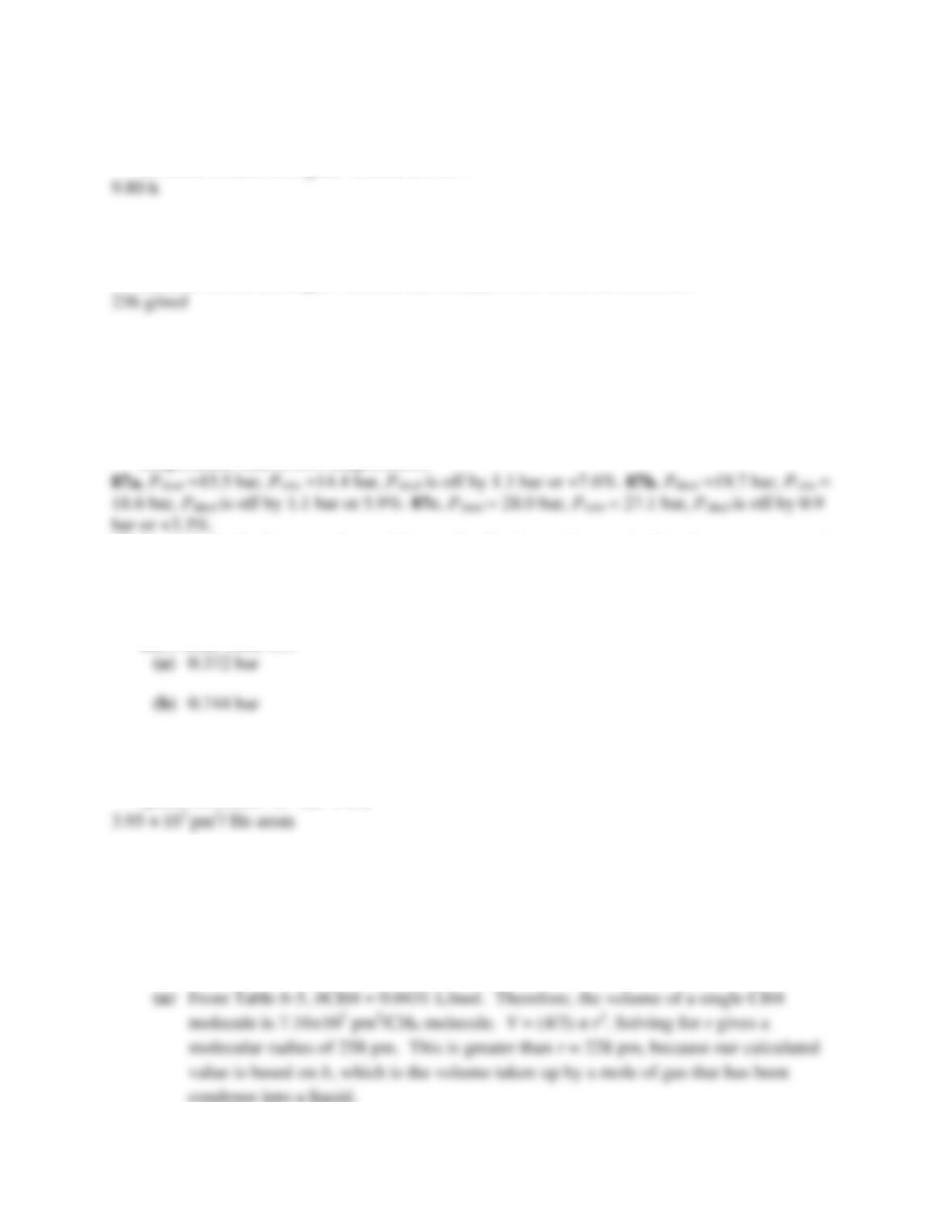
84. Which of the following visualizations best represents the distribution of
2
O
and molecules
near an orifice some time after effusion occurs in the direction indicated by the arrows? The
initial condition was one of equal numbers of
2
O
molecules ( ) and
2
SO
molecules ( ) on
the left side of the orifice. Explain.
85. It takes 22 hours for a neon-filled balloon to shrink to half its original volume at STP. If the
same balloon had been filled with helium, then how long would it have taken for the balloon
to shrink to half its original volume at STP?
86. The molar mass of radon gas was first estimated by comparing its diffusion rate with that of
mercury vapor,
( )
Hg g
What is the molar mass of radon if mercury vapor diffuses 1.082
times as fast as radon gas? Assume that Graham’s law holds for diffusion.
Nonideal Gases
87. Refer to Example 6-17. Recalculate the pressure of
( )
2
Cl g
by using both the ideal gas
equation and the van der Waals equation at the temperatures (a)
100 C;
(b)
200 C;
(c)
400 C
From the results, confirm the statement that a gas tends to be more ideal at high
temperatures than at low temperatures.
88. Use both the ideal gas equation and the van der Waals equation to calculate the pressure exerted
by 1.50 mol of
( )
2
SO g
when it is confined at 298 K to a volume of (a) 100.0 L; (b) 50.0 L; (c)
20.0 L; (d) 10.0 L. Under which of these conditions is the pressure calculated with the ideal gas
equation within a few percent of that calculated with the van der Waals equation? Use values of a
and b from Table 6.5.
89. Use the value of the van der Waals constant b for
( )
He g ,
given in Table 6.5, to estimate the
radius, r, of a single helium atom. Give your answer in pico-meters. [Hint: The volume of a
sphere of radius r is
3
43r/
]
90. (a) Use the value of the van der Waals constant b for
( )
4
CH g ,
given in Table 6.5, to
estimate the radius of the
4
CH molecule
(See Exercise 89.) How does your estimate of the
radius compare with the value
228 pmr,=
obtained experimentally from an analysis of the
structure of solid methane? (b) The density of
( )
4
CH g
is
1
66 02 g mL−
at 100 bar and 325
K. What is the value of the compressibility factor at this temperature and pressure?
Integrative and Advanced Exercises
91. Explain why it is necessary to include the density of
( )
Hg l
and the value of the acceleration
due to gravity, g, in a precise definition of a millimeter of mercury (page 196).
92. Assume the following initial conditions for the graphs labeled A, B, and C in Figure 6-7. (A)
10.0 mL at 400 K; (B) 20.0 mL at 400 K; (C) 40.0 mL at 400 K. Use Charles’s law to
calculate the volume of each gas at 0,
100 200 250,,,− − −
and
270 C−
Show that the
volume of each gas becomes zero at
273 15 C−
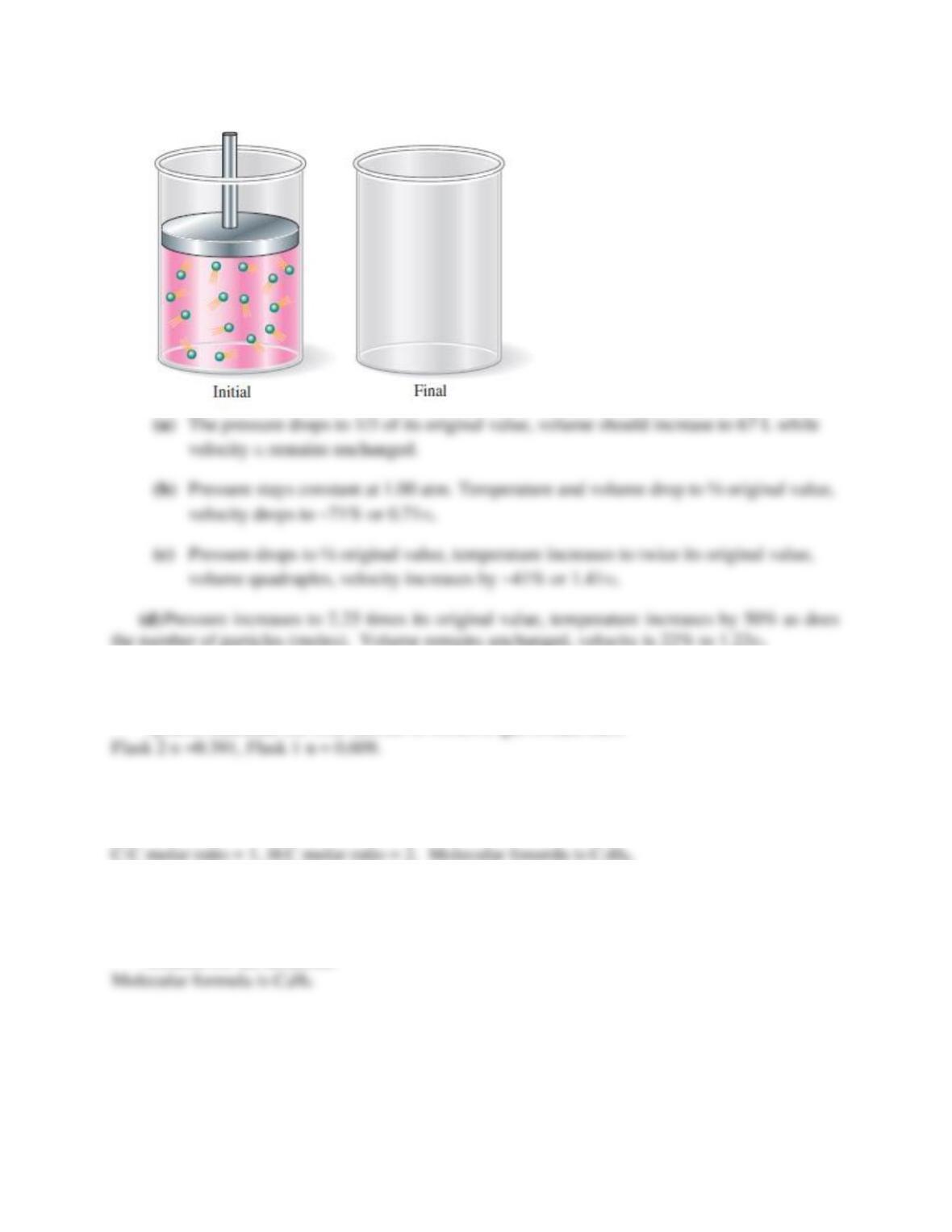
93. Consider the diagram to the right. The “initial” sketch illustrates, both at the macroscopic and
molecular levels, an initial condition: 1 mol of a gas at 273 K and
1.00 bar. With as much detail as possible, illustrate the final condition after each of the
following changes.
(a) The pressure is changed to 250 mmHg while -standard temperature is maintained.
(b) The temperature is changed to 140 K while -standard pressure is maintained.
(c) The pressure is changed to 0.5 bar while the -temperature is changed to 550 K.
(d) An additional 0.5 mol of gas is introduced into the cylinder, the temperature is
changed to
135 C,
and the pressure is changed to 2.25 bar.
94. Two evacuated bulbs of equal volume are connected by a tube of negligible volume. One of
the bulbs is placed in a constant-temperature bath at 225 K and the other bulb is placed in a
constant-temperature bath at 350 K. Exactly 1 mol of an ideal gas is injected into the
system. Calculate the final number of moles of gas in each bulb.
95. A compound is 85.6% carbon by mass. The rest is hydrogen. When 10.0 g of the compound
is evaporated at
50 0 C,
the vapor occupies 6.30 L at 1.00 atm pressure. What is the
molecular formula of the compound?
96. A 0.7178 g sample of a hydrocarbon occupies a volume of 390.7 mL at 65.0
C and 99.2
kPa. When the sample is burned in excess oxygen, 2.4267 g CO2 and 0.4967 g H2O are
obtained. What is the molecular formula of the hydrocarbon? Write a plausible structural
formula for the molecule.
97. A 3.05 g sample of
( )
43
NH NO s
is introduced into an evacuated 2.18 L flask and then
heated to
250 C
What is the total gas pressure, in atmospheres, in the flask at
250 C
when the
43
NH NO
has completely decomposed?