
( ) ( ) ( )
4 3 2 2
NH NO s N O g 2 H O g→ +
98. Ammonium nitrite,
42
NH NO ,
decomposes according to the chemical equation below.
( ) ( ) ( )
4 2 2 2
NH NO s N g 2 H O g→ +
What is the total volume of products obtained when
42
128 g NH NO
decomposes at
819 C
and 101 kPa?
99. A mixture of
2
1 00 g H
and
2
8 60 g O
is introduced into a 1.500 L flask at
25 C
When the
mixture is ignited, an explosive reaction occurs in which water is the only product. What is
the total gas pressure when the flask is returned to
25 C?
(The vapor pressure of water at
25 C
is 23.8 mmHg.)
100. In the reaction of
( )
2
CO g
and solid sodium peroxide
( )
22
Na O ,
solid sodium carbonate
( )
23
Na CO
and oxygen gas are formed. This reaction is used in submarines and space
vehicles to remove expired
( )
2
CO g
and to generate some of the
( )
2
Og
required for
breathing. Assume that the volume of gases exchanged in the lungs equals
4 0 L/min,
the
2
CO
content of expired air is 3.8%
2
CO
by volume, and the gases are at
25 C
and 735
mmHg. If the
( )
2
CO g
and
( )
2
Og
in the above reaction are measured at the same
temperature and pressure, (a) how many milliliters of
( )
2
Og
are produced per minute and (b)
a t w h a t r a t e i s t h e
( )
22
Na O s
c o n s u m e d , i n g r a m s p e r h o u r ?
101. What is the partial pressure of
( )
2
Cl g ,
in millimeters of mercury, at
0 00 C
and 1.00 atm
in a gaseous mixture that consists of 46.5%
2
N,
12.7% Ne, and 40.8%
2
Cl ,
by mass?
102. A gaseous mixture of He and
2
O
has a density of
0 518 g/L
at
25 C
and 721 mmHg.
What is the mass percent He in the mixture?
103. When working with a mixture of gases, it is sometimes convenient to use an apparent molar
mass (a weighted-average molar mass). Think in terms of replacing the mixture with a
hypothetical single gas. What is the apparent molar mass of air, given that air is 78.08%
2
N,
20.95%
2
O,
0.93% Ar, and 0.036%
2
CO ,
by volume?
104. A mixture of
( )
2
N O g
and
( )
2
Og
can be used as an anesthetic. In a particular mixture, the
partial pressures of
2
NO
and
2
O
are 612 Torr and 154 Torr, respectively. Calculate (a) the
mass percentage of
2
NO
in this mixture, and (b) the apparent molar mass of this anesthetic.
[Hint: For part (b), refer to Exercise 103.]
105. Gas cylinder A has a volume of 48.2 L and contains
( )
2
Ng
at 8.35 atm at
25 C
Gas
cylinder B, of unknown volume, contains He(g) at 9.50 atm and
25 C
When the two
cylinders are connected and the gases mixed, the pressure in each cylinder becomes 8.71
atm. What is the volume of cylinder B?
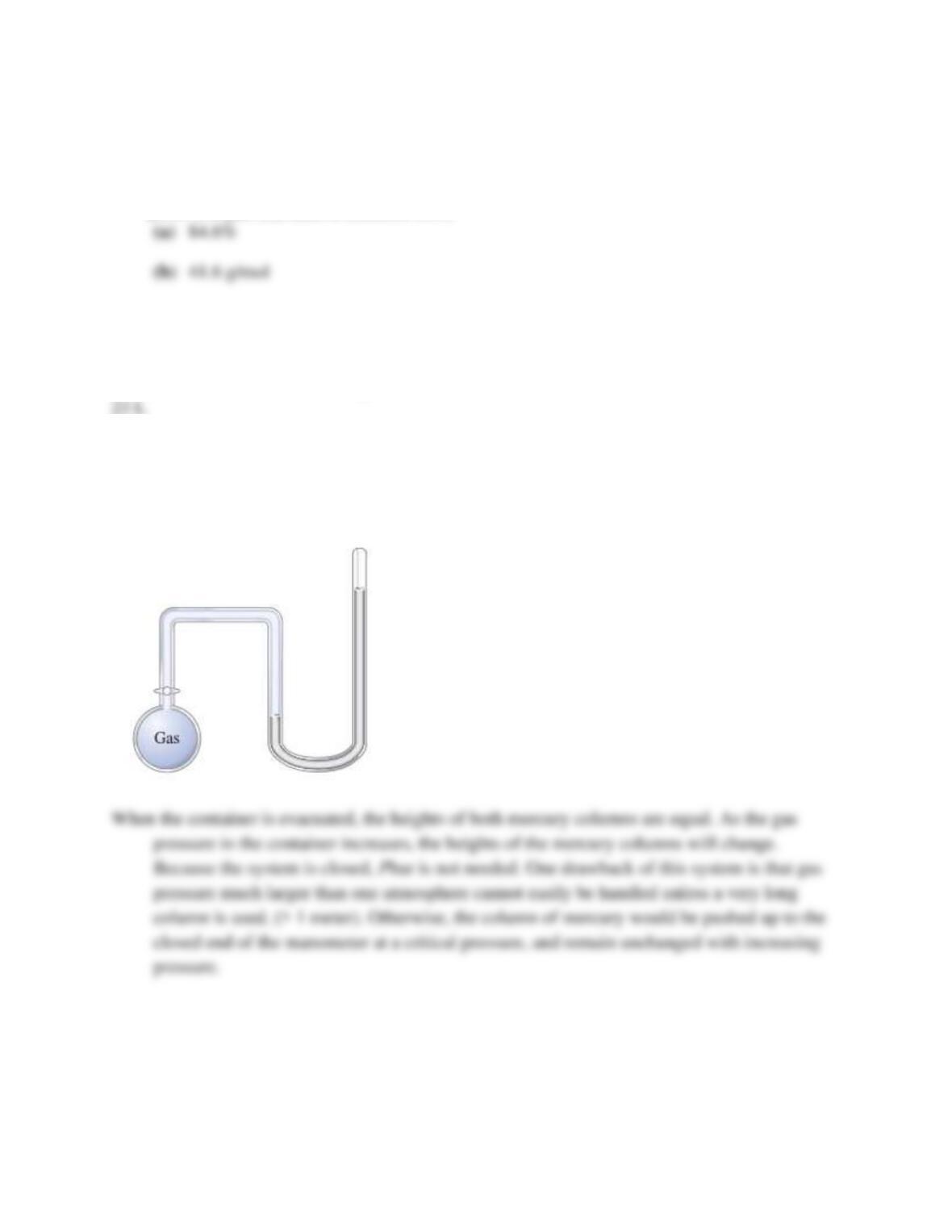
106. The accompanying sketch is that of a closed-end manometer. Describe how the gas pressure is
measured. Why is a measurement of
bar
P
not necessary when using this manometer? Explain
why the closed-end manometer is more suitable for measuring low pressures and the open-end
manometer more suitable for measuring pressures nearer atmospheric pressure.
107. Producer gas is a type of fuel gas made by passing air or steam through a bed of hot coal or
coke. A typical producer gas has the following composition in percent by volume: 8.0%
2
CO ,
23.2% CO, 17.7%
2
H,
1.1%
4
CH ,
and 50.0%
2
N
(a) What is the density of this gas at
23 C
and
763 mmHg,
in grams per liter?
(b)
What is the partial pressure of CO in this mixture at
0 00 C
and 1 atm?
(c) What volume of air, measured at
23 C
and 741 Torr, is required for the complete
combustion of
3
1 00 10 L
of this producer gas, also measured at
23 C
and 741 Torr?
108. What volume of air, measured at 298 K and 101 kPa, is required to burn
8 18
2 00 kg C H ?
Air is approximately 78.1%
2
N
and 20.9%
2
O,
by volume. Other gases make up the
remaining 1.0%.
109. A mixture of
( )
2
Hg
and
( )
2
Og
is prepared by electrolyzing 1.32 g water, and the mixture
of gases is collected over water at
30 C
and 748 mmHg. The volume of “wet” gas
obtained is 2.90 L. What must be the vapor pressure of water at
30 C?
( ) ( ) ( )
electrolysis
2 2 2
2 H O l 2 H g O g ⎯⎯⎯⎯⎯→ +
110. Aluminum (Al) and iron (Fe) each react with hydrochloric acid solution (HCl) to produce a
chloride salt and hydrogen gas,
( )
2
Hg
A 0.1924 g sample of a mixture of Al and Fe is
treated with excess HCl solution. A volume of 159 mL of
2
H gas
is collected over water at
19 0 C
and 841 Torr. What is the -percent (by mass) of Fe in the mixture? The vapor
19 0 C
111. A 0.168 L sample of
( )
2
Og
is collected over water at
26 C
and a barometric pressure of 737
mmHg. In the gas that is collected, what is the percent water vapor (a) by volume; (b) by number
of molecules; (c) by mass? (Vapor pressure of water at
26 C=
25 2 mmHg
)
112. A breathing mixture is prepared in which He is substituted for
2
N
The gas is 79% He and
21%
2
O,
by volume. (a) What is the density of this mixture in grams per liter at
25 C
and
1.00 atm? (b) At what pressure would the
2
He O−
mixture have the same density as that of
air at
25 C
and 1.00 atm? See Exercise 103 for the composition of air.
113. Chlorine dioxide,
2
ClO ,
is sometimes used as a chlorinating agent for water treatment. It
can be prepared from the reaction below:
( ) ( ) ( ) ( )
22
Cl g 4 NaClO aq 4 NaCl aq 2ClO g+ → +
In an experiment,
( )
2
1 0 L Cl g ,
measured at
10 0 C
and 4.66 atm, is dissolved in 0.750 L of
2 00 M
( )
NaClO aq
If 25.9 g of pure
2
ClO
is obtained, then what is the percent yield for
this experiment?
114. The amount of ozone,
3
O,
in a mixture of gases can be determined by passing the mixture
through a solution of excess potassium iodide, KI. Ozone reacts with the iodide ion as
follows:
( ) ( ) ( )
32
O g 3 I aq H O l
−
+ + →
( ) ( ) ( )
23
O g I aq 2 OH aq
−−
++
The amount of
3
I−
produced is determined by titrating with thiosulfate ion,
2
23
SO :
−
( ) ( ) ( ) ( )
22
3 2 3 4 6
I aq 2S O aq 3 I aq S O aq
− − − −
+ → +
115. A 0.1052 g sample of
( )
2
H O l
in an 8.050 L sample of dry air at
30 1 C
evaporates
completely. To what temperature must the air be cooled to give a relative humidity of
80.0%? Vapor pressures of water:
20 C,
17 54
mmHg;
19 C,
16 49
mmHg;
18 C,
15 48
mmHg;
17 C,
14 54
mmHg;
16 C,
13 63
mmHg;
15 C,
12 79
mmHg
[Hint:
Go to Focus On feature for Chapter 6 on the MasteringChemistry site,
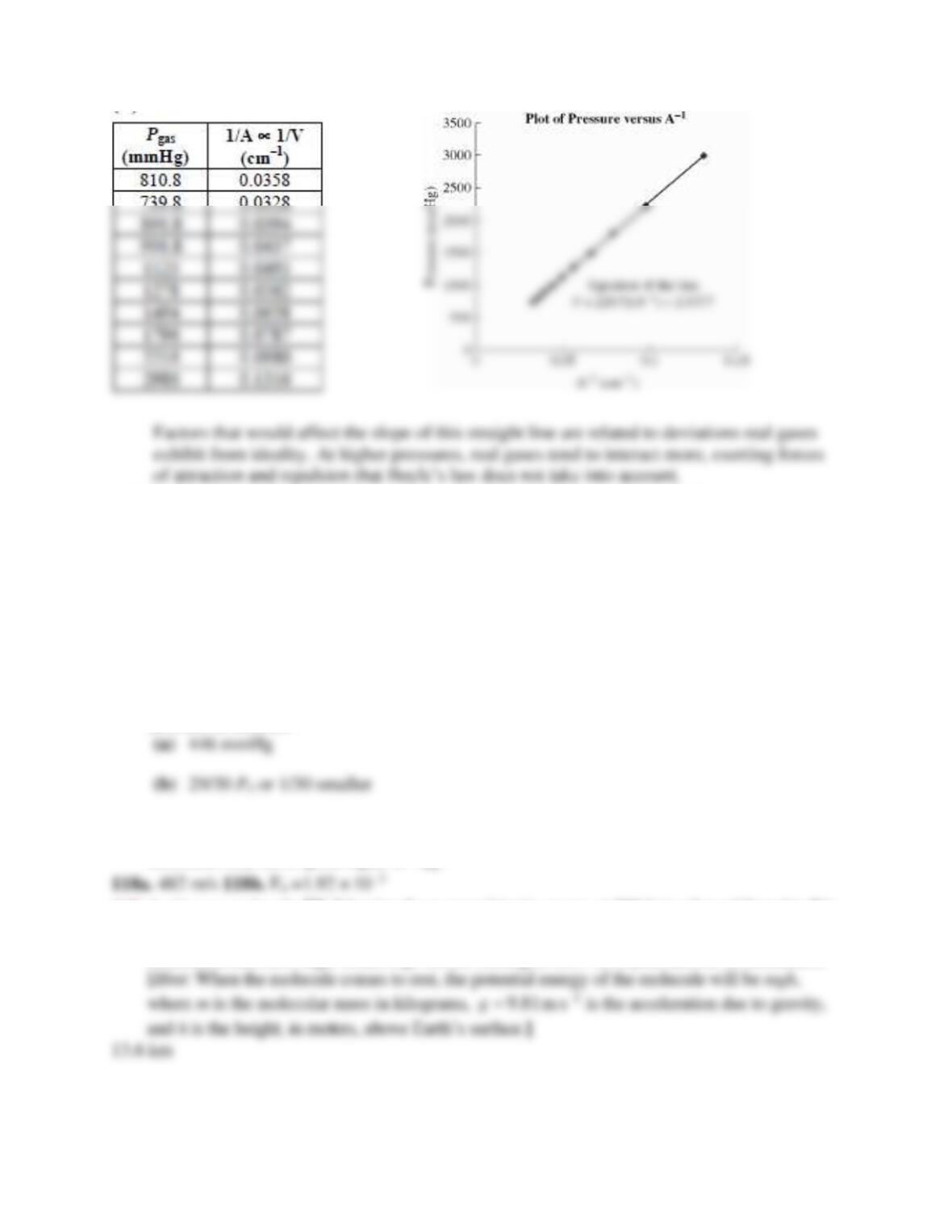
116. An alternative to Figure 6-6 is to plot P against
1/V
The resulting graph is a straight line
passing through the origin. Use Boyle’s data from Feature Problem 125 to draw such a
straight-line graph. What factors would affect the slope of this straight line? Explain.
117. We have noted that atmospheric pressure depends on altitude. Atmospheric pressure as a
function of altitude can be calculated with an equation known as the barometric formula:
2 303
010 Mgh / RT
PP
=
2
In this equation, P and
0
P
can be in any pressure units, for example, Torr.
0
P
is the pressure
at sea level, generally taken to be 1.00 atm or its equivalent. The units in the exponential
term must be SI units, however. Use the barometric formula to
(a) estimate the barometric pressure at the top of Mt. Whitney in California (altitude: 14,494
ft; assume a temperature of
10 C
);
(b)
show that barometric pressure decreases by one-thirtieth in value for every 900-ft
increase in altitude.
118. Consider a sample of
( )
2
Og
at 298 K and 1.0 atm. Calculate (a)
rms
u
and (b) the fraction of
molecules that have speed equal to
rms
u
119. A nitrogen molecule
( )
2
N
having the average kinetic energy at 300 K is released from Earth’s
surface to travel upward. If the molecule could move upward without colliding with other
molecules, then how high would it go before coming to rest? Give your answer in kilometers.
120. For
( )
2
Hg
at
0 C
and 1 atm, calculate the per-centage of molecules that have speed (a)
121. If the van der Waals equation is solved for volume, a cubic equation is obtained.
(a) Derive the equation below by rearranging equation (6.26).
23
32 0
RT bP n a n ab
V n V V
P P P
+
− + − =
(b) What is the volume, in liters, occupied by
185 g
( )
2
CO g
at a pressure of 12.5 atm and 286 K?
For
( )
2
CO g ,
22
3 61atm L mola−
=
and
1
0 0429 L molb−
=
[Hint: Use the ideal gas equation to obtain an estimate of the volume. Then refine your
estimate, either by trial and error, or using the method of successive approximations. See
Appendix A, pages A5–A6, for a description of the method of successive approximations.]
122. According to the CRC Handbook of Chemistry and Physics (95th ed.), the molar volume of
( )
2
Og
is
1
0 2168 L mol−
at 280 K and 10 MPa. (Note:
1MPa =
6
1 10 Pa
)
(a) Use the van der Waals equation to calculate the pressure of one mole of
( )
2
Og
at 280 K if
the -volume is 0.2168 L. What is the % error in the calculated pressure? The van der Waals
constants are
22
1 382 bar L mola−
=
and
1
0 0319 L molb−
=
(b) Use the ideal gas equation to calculate the volume of one mole of
( )
2
Og
at 280 K and
10 MPa. What is the % error in the calculated volume?
123. A particular equation of state for
( )
2
Og
has the form
2
1BC
PV RT VV
= + +
where
V
is the molar volume,
3
21 89 cm molB/= −
and
62
1230 cm molC/=
(a) Use the equation to calculate the pressure exerted by 1 mol
( )
2
Og
confined to a volume
of
3
500 cm
at 273 K.
(b) Is the result calculated in part (a) consistent with that suggested for
( )
2
Og
by Figure 6-
21? Explain.
124. A 0.156 g sample of a magnesium–aluminum alloy dissolves completely in an excess of
HCl(aq). The liberated
( )
2
Hg
is collected over water at
5 C
when the barometric pressure
is 752 Torr. After the gas is collected, the water and gas gradually warm to the prevailing
room temperature of
23 C
The pressure of the collected gas is again equalized against the
barometric pressure of 752 Torr, and its volume is found to be 202 mL. What is the percent
composition of the magnesium–aluminum alloy? (Vapor pressure of water: 6.54 mmHg at
5 C
and 21.07 mmHg at
23 C
).
Feature Problems
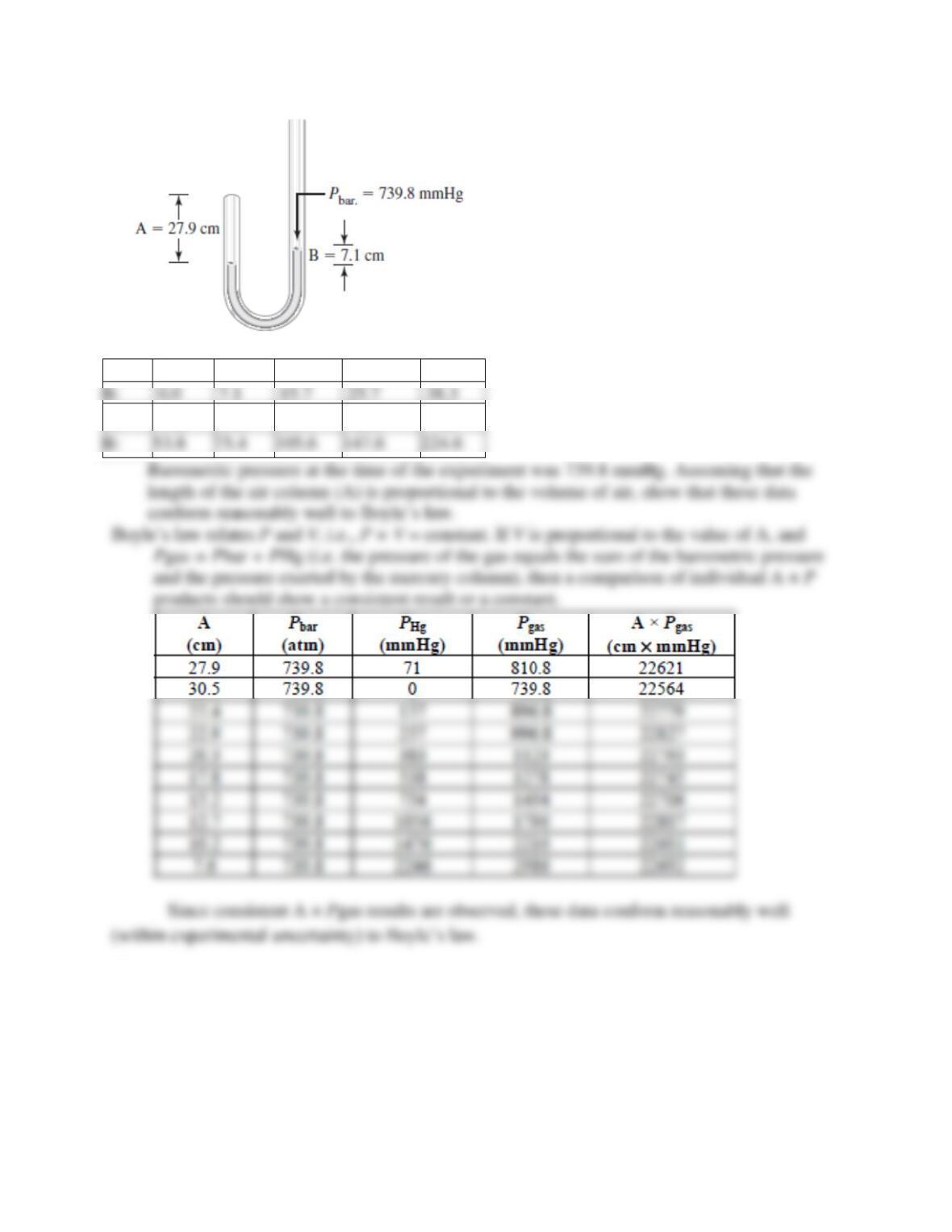
125. Shown below is a diagram of Boyle’s original apparatus. At the start of the experiment, the
length of the air column (A) on the left was 30.5 cm and the heights of mercury in the arms
of the tube were equal. When mercury was added to the right arm of the tube, a difference in
mercury levels (B) was produced, and the entrapped air on the left was compressed into a
shorter length of the tube (smaller volume) as shown in the illustration for
A 27 9 cm=
and
B 7 1cm=
Boyle’s values of A and B, in centimeters, are listed as follows:
A:
30.5
27.9
25.4
22.9
20.3
A:
17.8
15.2
12.7
10.2
7.6
126. In 1860, Stanislao Cannizzaro showed how Avogadro’s hypothesis could be used to establish
the atomic masses of elements in gaseous compounds. Cannizzaro took the atomic mass of
hydrogen to be exactly one and assumed that hydrogen exists as
2
H
molecules (molecular
mass 2=
). Next, he determined the volume of
( )
2
Hg
at
0 00 C
and 1.00 atm that has a
mass of exactly 2 g. This volume is 22.4 L. Then he assumed that 22.4 L of any other gas
would have the same number of molecules as in 22.4 L of
( )
2
Hg
(Here is where
0.0
7.1
15.7
25.7
38.3
Avogadro’s hypothesis entered in.) Finally, he reasoned that the ratio of the mass of 22.4 L
of any other gas to the mass of 22.4 L of
( )
2
Hg
should be the same as the ratio of their
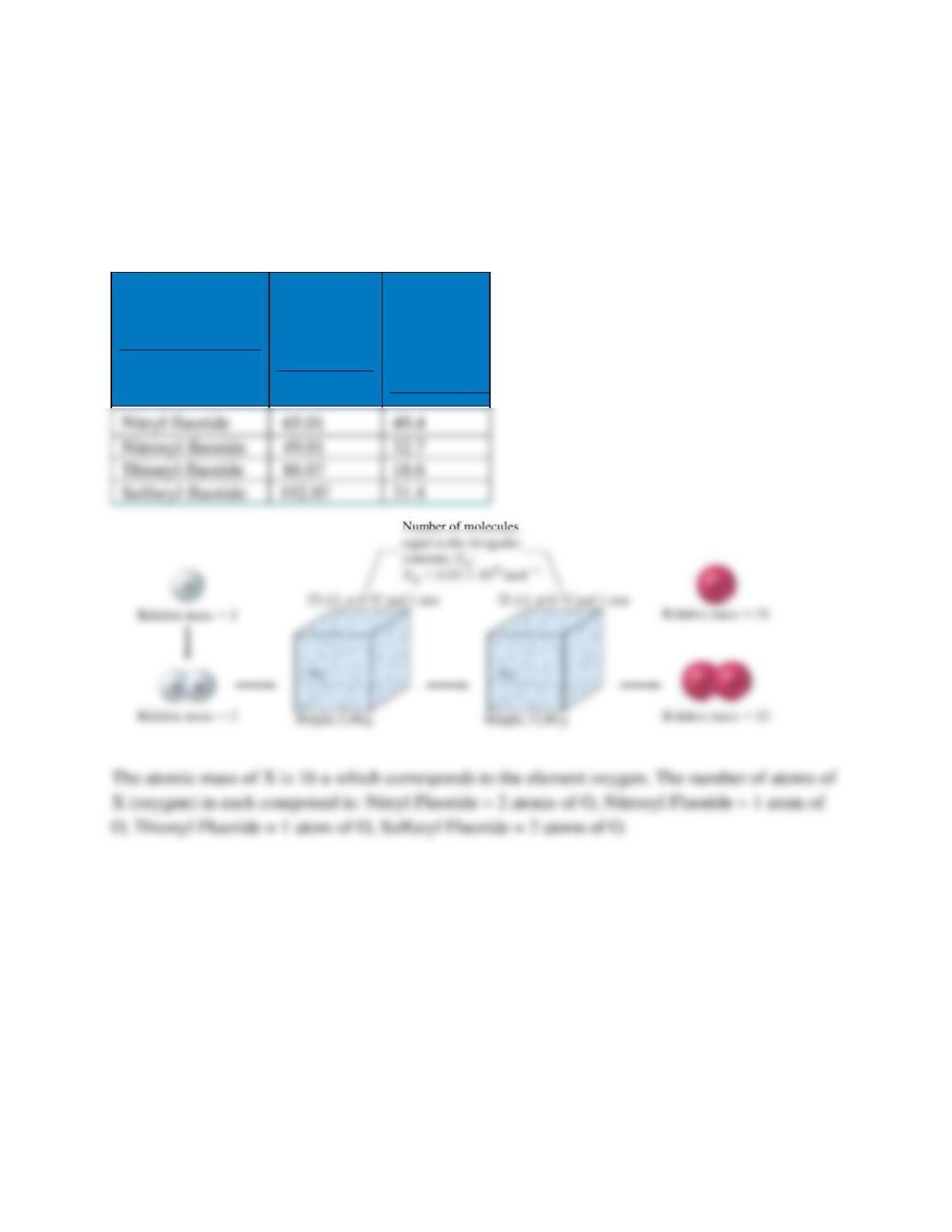
molecular masses. The sketch below illustrates Cannizzaro’s reasoning in establishing the
atomic weight of oxygen as 16. The gases in the table all contain the -element X. Their
molecular masses were determined by Cannizzaro’s method. Use the percent composition
data to deduce the atomic mass of X, the number of atoms of X in each of the gas molecules,
and the identity of X.
Compound
Molecular
Mass, u
Mass
Percent X,
%
127. In research that required the careful measurement of gas densities, John Rayleigh, a
physicist, found that the density of
( )
2
Og
had the same value whether the gas was obtained
from air or derived from one of its compounds. The situation with
( )
2
Ng
was different,
however. The density of
( )
2
Ng
had the same value when the
( )
2
Ng
was derived from any
of various compounds, but a different value if the
( )
2
Ng
was extracted from air. In 1894,
Rayleigh enlisted the aid of William Ramsay, a chemist, to solve this apparent mystery; in
t h e c o u r s e o f t h e i r w o r k t h e y d i s c o v e r e d t h e n o b l e g a s e s .
(a) Why do you suppose that the
( )
2
Ng
extracted from liquid air did not have the same
density as
( )
2
Ng
obtained from its compounds?
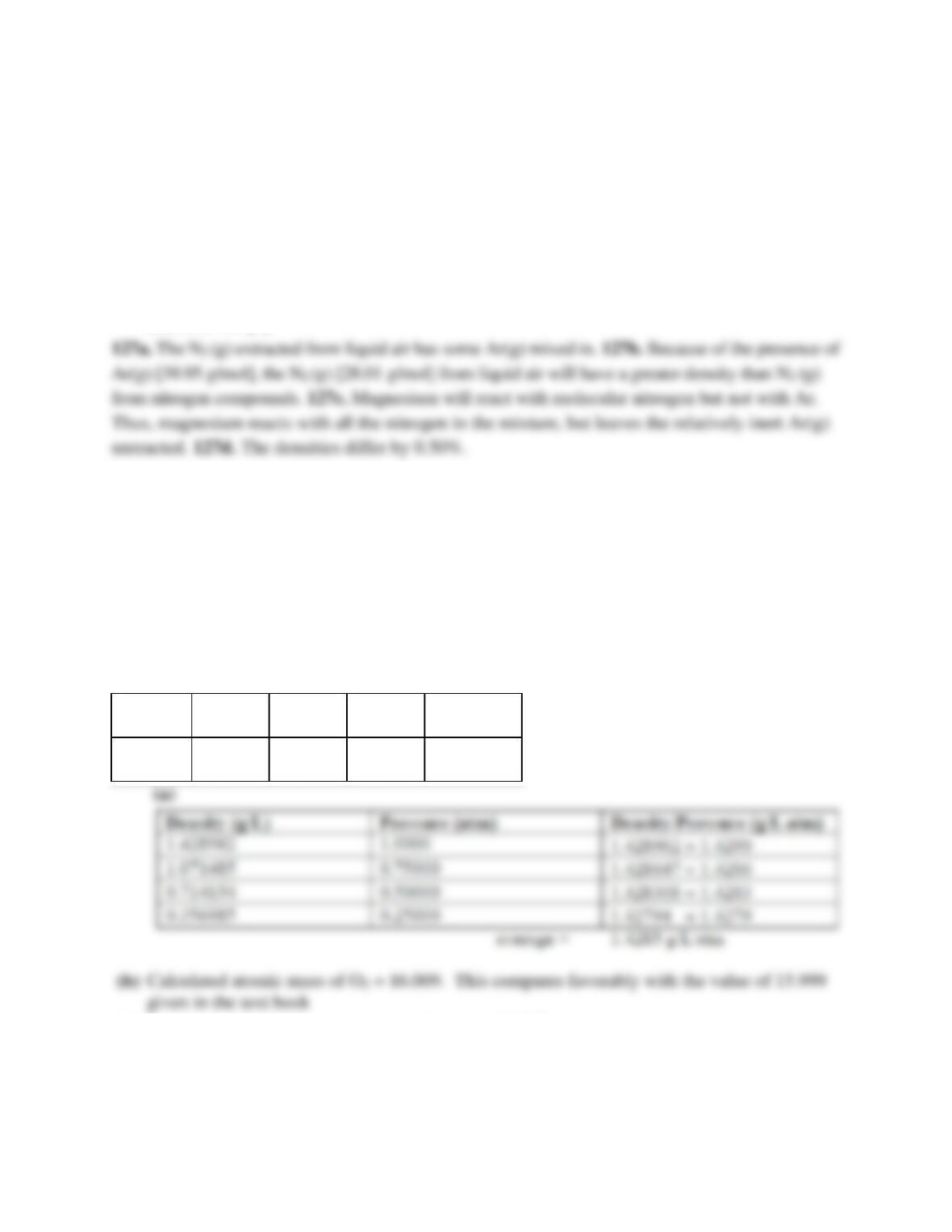
(b)
Which gas do you suppose had the greater density:
( )
2
Ng
extracted from air or
( )
2
Ng
prepared from nitrogen compounds? Explain.
(c) The way in which Ramsay proved that nitrogen gas extracted from air was itself a
mixture of gases involved allowing this nitrogen to react with magnesium metal to form
magnesium nitride. Explain the significance of this experiment.
(d)
Calculate the percent difference in the densities at 0.00 °C and 1.00 atm of Rayleigh’s
( )
2
Ng
extracted from air and
( )
2
Ng
derived from nitrogen compounds. [The volume
percentages of the major components of air are 78.084%
2
N,
20.946%
2
O,
0.934% Ar, and
0.0379%
CO
]
128. The equation
d / P M / RT,=
which can be derived from equation (6.14), suggests that the
ratio of the density (d) to pressure (P) of a gas at constant temperature should be a constant.
The gas density data at the end of this question were obtained for
( )
2
Og
at various
pressures at 273.15 K.
(a) Calculate values of
d / P,
and with a graph or by other means determine the ideal value
of the term
d / P
for
( )
2
Og
at 273.15 K.
[Hint: The ideal value is that associated with a perfect (ideal) gas.]
(b)
Use the value of
d / P
from part (a) to calculate a precise value for the atomic mass of
oxygen, and compare this value with that listed on the inside front cover.
P,
mmHg:
760.00
570.00
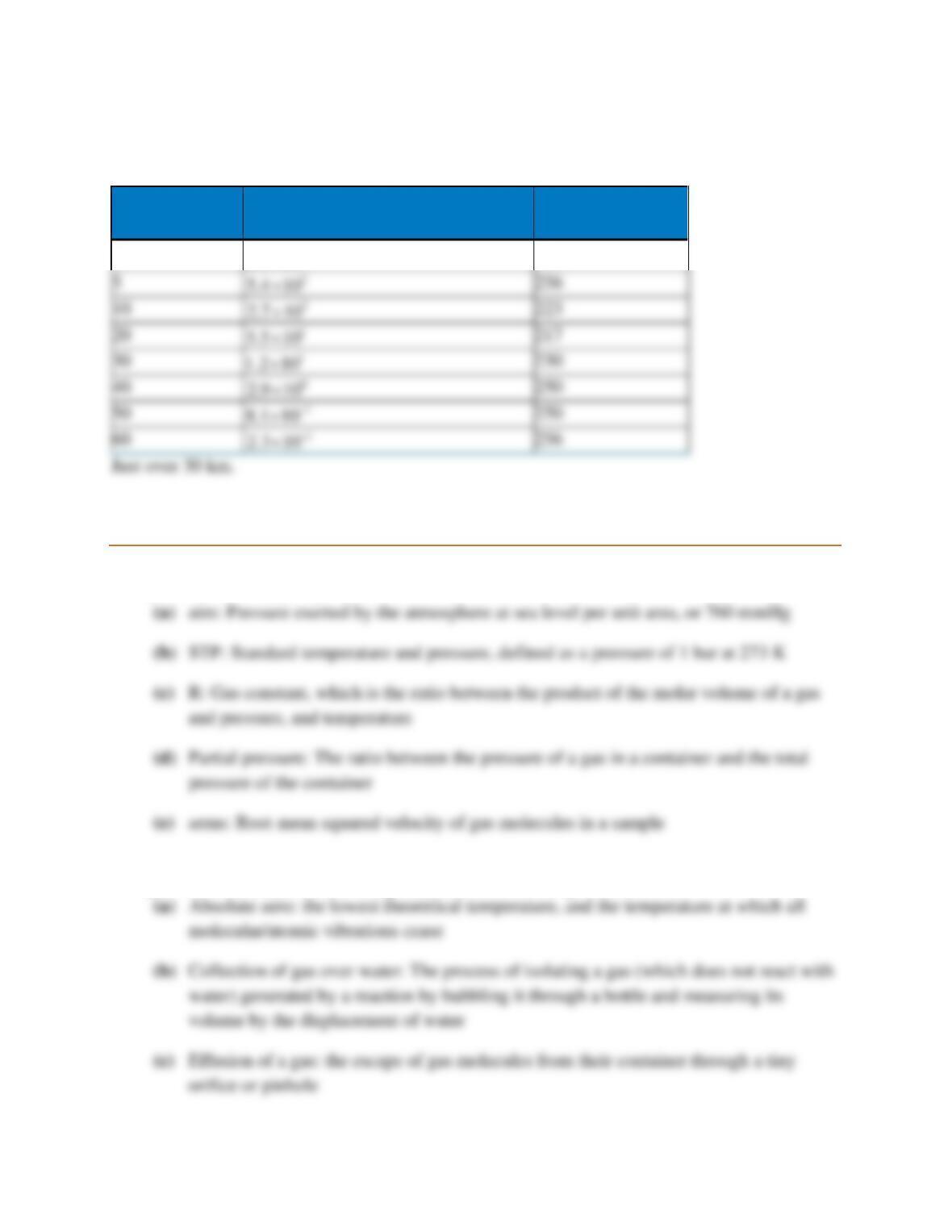
380.00
190.00 W
d, g/L: Ë
1.4289
62
1.0714
85
0.7141
54
0.356985
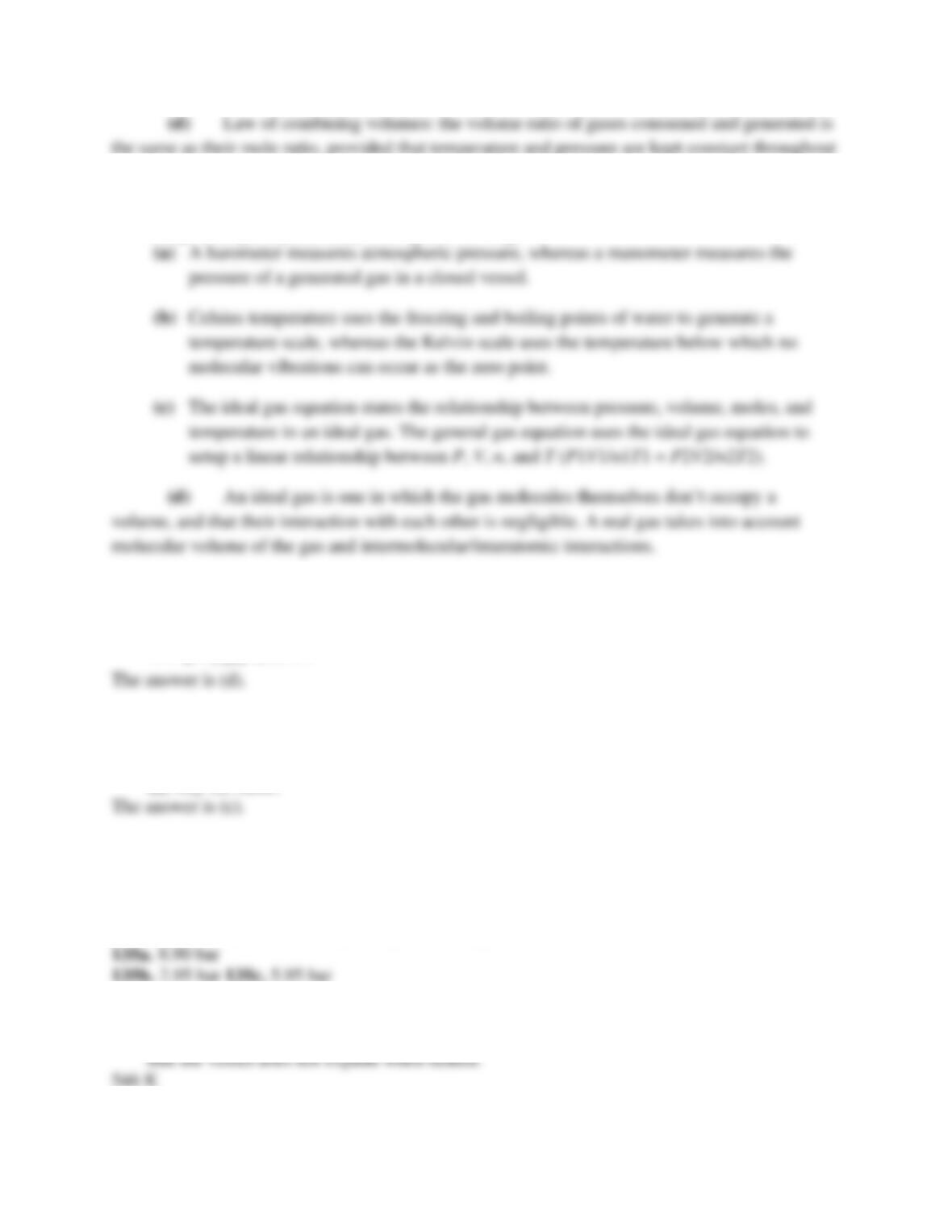
129. A sounding balloon is a rubber bag filled with
( )
2
Hg
and carrying a set of instruments (the
payload). Because this combination of bag, gas, and payload has a smaller mass than a
corresponding volume of air, the balloon rises. As the balloon rises, it expands. From the
table below, estimate the maximum height to which a spherical balloon can rise given the
mass of balloon, 1200 g; payload, 1700 g: quantity of
( )
2
Hg
in balloon,
3
120 ft
at
0 00 C
and 1.00 atm; diameter of balloon at maximum height, 25 ft. Air pressure and temperature
as functions of altitude are:
Altitude, km
Pressure, mbar
Temperature, K
0
3
1 0 10
288
Self-Assessment Exercises
130. In your own words, define or explain each term or symbol. (a) atm; (b) STP; (c) R; (d)
partial pressure; (e)
rms
u
131. Briefly describe each concept or process: (a) absolute zero of temperature; (b) collection of a
gas over water; (c) effusion of a gas; (d) law of combining –volumes.
10
223
20
217
30
230
40
250
60
256
132. Explain the important distinctions between
(a) barometer and manometer; (b) Celsius and Kelvin temperature; (c) ideal gas equation
and general gas equation; (d) ideal gas and real gas.
133. Which exerts the greatest pressure, (a) a 75.0 cm column of
( )( )
Hg l 13 6 g/mLd; =
(b) a
column of air 10 mi high; (c) a 5.0 m column of
( )( )
4
CCl l 1 59 g/mLd; =
(d)
( )
10 0 g H g
at STP?
134. For a fixed amount of gas at a fixed pressure, changing the temperature from
100 0 C
to
200 K causes the gas volume to (a) double; (b) increase, but not to twice its original value;
(c) decrease;
(d) stay the same.
135. Two gases were mixed into a 5.000 L container at 291.0 K. Gas A was originally confined
in 14.20 L at 1.081 bar and 303.1 K. Gas B was originally
confined in 1.251 L at 26.77 bar and 327.5 K.
(a) What is the final total pressure in the 5.000 L container? (b) What is the partial pressure
of gas A? (c) What is the partial pressure of gas B?
136. A fragile glass vessel will break if the internal pressure equals or exceeds 2.0 bar. If the
vessel is sealed at
0 C
and 1.0 bar, then at what temperature will the vessel break? Assume
546 K
137. Which of the following choices represents the molar volume of an ideal gas at
25 C
and
1.5 atm?
(a)
( )
298 1 5 273 22 4 L/;
(b) 22.4 L;
(c)
( )
273 1 5 298 22 4 L/;
(d)
( )
298 273 1 5 22 4 L/;
(e)
( )
273 298 1 5 22 4 L/
138. The gas with the greatest density at STP is (a)
2
NO;
(b) Kr; (c)
3
SO ;
(d)
2
Cl
139. Precisely 1 mol of helium and 1 mol of neon are mixed in a container. (a) Which gas has the
greater average molecular speed? (b) Which type of molecule strikes the wall of the
container more frequently? (c) Which gas exerts the larger pressure?
140. If the Kelvin temperature of a gas doubles, then which of the following also doubles? (a) the
average molecular speed; (b) the speed of every molecule;
(c) the kinetic energy of every molecule; (d) the average kinetic energy of the molecules; (e)
none of these.
141. The postulates of the kinetic molecular theory of gases include all those that follow except
(a) no forces exist between molecules; (b) molecules are point masses; (c) molecules are
repelled by the wall of the container; (d) molecules are in constant random motion; (e) all
are postulates.
142. Consider the statements (a) to (e) below. Assume that
( )
2
Hg
and
( )
2
Og
behave ideally.
State whether each of the following statements is true or false. For each false statement,
explain how you would change it to make it a true statement.
(a) Under the same conditions of temperature and pressure, the average kinetic energy of
2
O
molecules
is less than that of
2
H molecules
(b)
Under the same conditions of temperature and pressure,
2
H molecules
move faster, on
average, than
2
O molecules
(c) The volume of 1.00 mol of
( )
2
Hg
at
25 0 C,
1.00 atm is 22.4 L.
(d) The volume of
( )
2
2 0 g H g
is equal to the volume of
( )
2
32 0 g O g ,
at the same
temperature and pressure.
(e) In a mixture of
2
H
and
2
O gases,
with partial pressures
2
H
P
and
2
O
P,
respectively, the
total pressure is the larger of
P
and
P
143. A sample of
( )
2
Og
is collected over water at
23 C
and a barometric pressure of 751 Torr.
The vapor pressure of water at
23 C
is 21 mmHg. The partial pressure of
( )
2
Og
in the
sample collected is
(a) 21 mmHg; (b) 751 Torr; (c) 0.96 atm; (d) 1.02 atm.
144. At
0C
and 0.500 atm, 4.48 L of gaseous
3
NH
(a) contains
22
6 02 10
molecules; (b) has a
mass of 17.0 g; (c) contains 0.200 mol
3
NH ;
(d) has a mass of 3.40 g.
145. To establish a pressure of 2.00 atm in a 2.24 L cylinder containing
( )
2
1 60 g O g
at
0C,
146. Carbon monoxide, CO, and hydrogen react according to the equation below.
( ) ( ) ( ) ( )
2 3 8 2
3CO g 7 H g C H g 3H O g + → +
What volume of which reactant gas remains if
( )
12 0 L CO g
and
( )
2
25 0 L H g
are allowed
to react? Assume that the volumes of both gases are measured at the same temperature and
147. A mixture of
( )
5
2
5 0 10 mol H g
−
and
( )
5
2
5 0 10 molSO g
−
is placed in a 10.0 L container
at
25 C
The container has a pinhole leak. After a period of time, the partial pressure of
( )
2
Hg
in the container (a) is less than that of the
( )
2
SO g ;
(b) is equal to that of the
( )
SO g ;
(c) exceeds that of the
( )
SO g ;
(d) is the same as in the original mixture.
148. Under which conditions is
2
Cl
most likely to behave like an ideal gas? Explain. (a)
100 C
and 10.0 atm; (b)
0 C
and 0.50 atm; (c)
200 C
and 0.50 atm; (d)
400 C
and 10.0 atm.
149. Without referring to Table 6.5, state which species in each of the following pairs has the
greater value for the van der Waals constant a, and which one has the greater value for the
van der Waals constant b. (a) He or Ne; (b)
4
CH
or
38
CH;
(c)
2
H
or
2
Cl
150. Explain why the height of the mercury column in a barometer is independent of the diameter
151. A gaseous hydrocarbon that is 82.7% C and 17.3% H by mass has a density of
2 35 g/L
at
25 C
and 752 Torr. What is the molecular formula of this hydrocarbon?
152. Draw a box to represent a sample of air containing
2
N
molecules (represented as squares)
and
2
O
-molecules (represented as circles) in their correct proportions. How many squares
and circles would you need to draw to also represent the
( )
2
CO g
in air through a single
mark? What else should you add to the box for this more complete representation of air?
[Hint: See Exercise 103.]
153. Appendix E describes a useful study aid known as concept mapping. Using the method
presented in Appendix E, construct a concept map illustrating the different concepts to show
the relationships among all the gas laws described in this chapter.