65. An iron ore sample weighing 0.9132 g is dissolved in HCl(aq), and the iron is obtained as
( )
2
Fe aq
+
This solution is then titrated with 28.72 mL of
0 05051M
2 2 7
K Cr O
What is the
mass percent Fe in the ore -sample?
66. The concentration of
( )
2
Mn aq
+
can be determined by titration with
( )
4
MnO aq
−
in basic
solution. A
50.00 mL sample of
( )
2
Mn aq
+
requires 78.42 mL of
0 04997 M
4
KMnO
for its titration.
What is
2
Mn +
in the sample?
67. The titration of 5.00 mL of a saturated solution of sodium oxalate,
2 2 4
Na C O ,
at
25 C
requires 25.8 mL
of
4
0 02140 M KMnO
in acidic solution. What mass of
2 2 4
Na C O
in grams would be present
in 1.00 L of this saturated solution?
68. Refer to the Integrative Example. In the treatment of
2
1 00 10 L
of a wastewater solution
that is
0 0126 M
2
4
CrO ,
−
how many grams of (a)
( ) ( )
3
Cr OH s
would precipitate; (b)
2 2 4
Na S O
would be consumed?
Integrative and Advanced Exercises
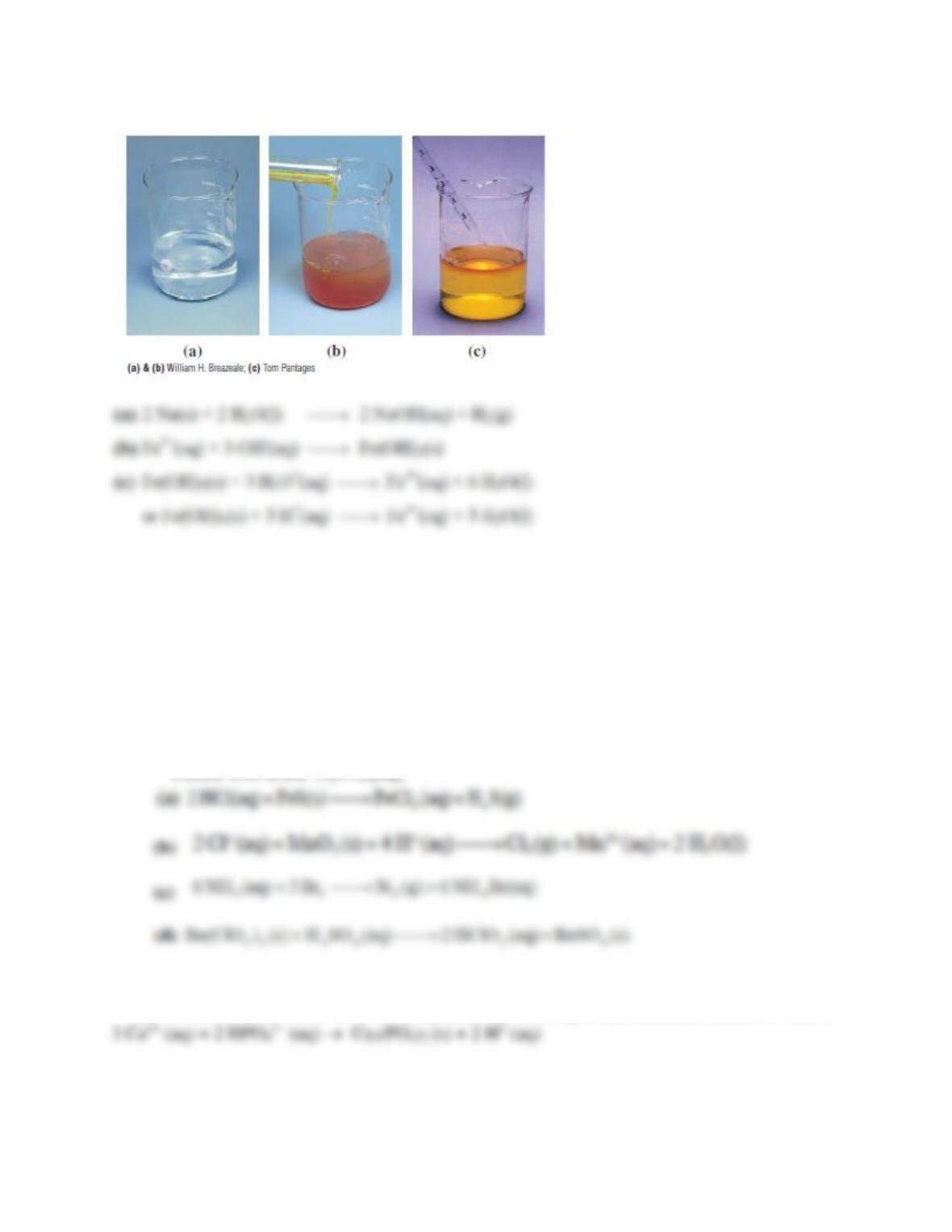
69. Write net ionic equations for the reactions depicted in photo (a) sodium metal reacts with water
to produce hydrogen; photo (b) an excess of aqueous iron(III) chloride is added to the solution
in (a); and photo (c) the precipitate from (b) is collected and treated with an excess of HCl(aq).
70. Following are some laboratory methods occasionally used for the preparation of small
quantities of chemicals. Write a balanced equation for each.
(a) preparation of
( )
2
H S g :
HCl(aq) is heated with FeS(s)
(b) preparation of
( )
2
Cl g :
HCl(aq) is heated with
( ) ( )
22
MnO s MnCl aq;
and
( )
2
H O l
are other products
(c) preparation of
( )
22
N g Br:
and
3
NH
react in aqueous solution;
4
NH Br
is another
product
(d) preparation of chlorous acid: an aqueous suspension of solid barium chlorite is
treated with dilute
( )
H SO aq
71. When concentrated
( )
2
CaCl aq
is added to
( )
24
Na HPO aq ,
a white precipitate forms that is
38.7% Ca by mass. Write a net ionic equation representing the probable reaction that occurs.
72. You have a solution that is
( )
2
0 0250 M Ba OH
and the following pieces of equipment: 1.00,
5.00, 10.00, 25.00, and 50.00 mL pipets and 100.0, 250.0, 500.0, and 1000.0 mL volumetric
flasks. Describe how you would use this equipment to produce a solution in which
OH−
is
0.0100 M.
73. Sodium hydroxide used to make standard NaOH(aq) solutions for acid–base titrations is
invariably contaminated with some sodium carbonate. (a) Explain why, except in the most
precise work, the presence of this sodium carbonate generally does not seriously affect the
results obtained, for example, when NaOH(aq) is used to titrate HCl(aq). (b) Conversely,
show that if
23
Na CO
comprises more than 1% to 2% of the solute in NaOH(aq), the titration
results are affected.
74. A 110.520 g sample of mineral water is analyzed for its magnesium content. The
2
Mg +
in
the sample is first precipitated as
44
MgNH PO ,
and this precipitate is then converted to
75. What volume of
2
0 248 M CaCl
must be added to 335 mL of 0.186 M KCl to produce a
solution with a concentration of
0 250 M Cl ?
−
Assume that the solution volumes are
additive.
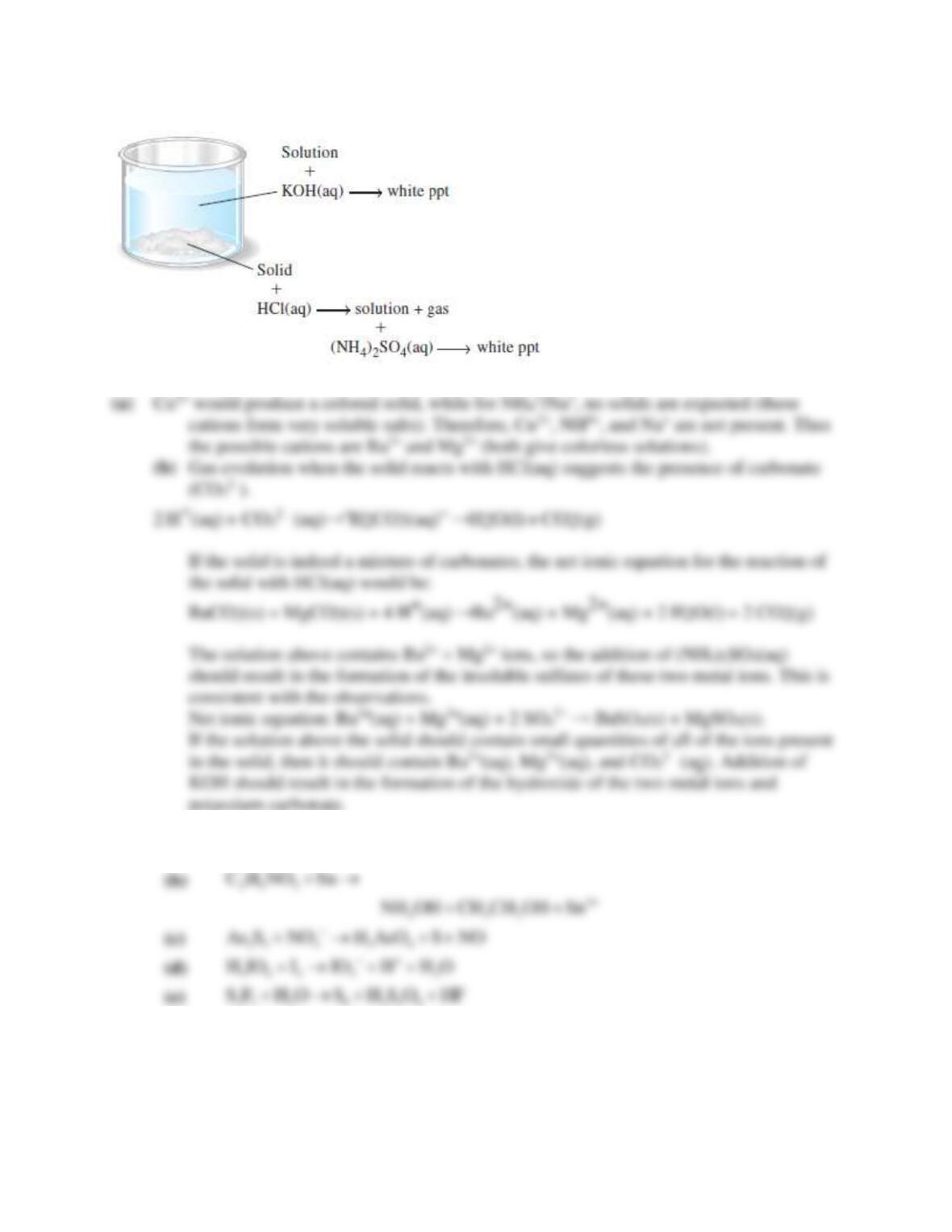
76. An unknown white solid consists of two compounds, each containing a different cation. As
suggested in the illustration, the unknown is partially soluble in water. The solution is treated
with NaOH(aq) and yields a white precipitate. The part of the original solid that is insoluble
in water dissolves in HCl(aq) with the evolution of a gas. The resulting solution is then
treated with
( ) ( )
44
2
NH SO aq
and yields a white precipitate. (a) Is it possible that any of the
cations
22
Mg Cu,,
++
2
Ba Na,,
++
or
4
NH +
were present in the original unknown? Explain
your reasoning. (b) What compounds could be in the unknown mixture (that is, what anions
might be present)?
77. Balance these equations for reactions in acidic solution.
(a)
3 3 2
IBr BrO H IO Br H O
− + − −
+ + → + +
78. Balance these equations for reactions in basic solution.
(a)
( )
2 3 2 2 3
Fe S H O O Fe OH S+ + → +
(b)
2 2 2
O H O OH O
−−
+ → +
(c)
2
3 2 2 4 4
CrI H O CrO IO
−−
+ → +
(d)
2
Ag CN O OH
−−
+ + + →
( )
2
2
Ag CN H O
−
+
(e)
2 4 2 2 2
B Cl OH BO Cl H O H
− − −
+ → + + +
79. A method of producing phosphine,
3
PH ,
from elemental phosphorus,
4
P,
involves heating
the
4
P
with
2
HO
An additional product is phosphoric acid,
34
H PO
Write a balanced
equation for this reaction.
80. Iron (Fe) is obtained from rock that is extracted from open pit mines and then crushed. The
process used to obtain the pure metal from the crushed rock produces solid waste, called
tailings, which are stored in disposal areas near the mines. The tailings pose a serious
environmental risk because they contain sulfides, such as pyrite
( )
2
FeS
, which oxidize in air
to produce metal
ions and
H+
ions that can enter into surface water or ground water. The oxidation of
2
FeS
to
3
Fe +
is described by the unbalanced chemical expression below.
( ) ( ) ( )
2 2 2
FeS s O g H O l+ + →
( ) ( ) ( ) ( )
32
4
Fe aq SO aq H aq not balanced
+ − +
+ +
Thus, the oxidation of pyrite produces
3
Fe +
and
H+
ions that can leach into surface or
ground water. The leaching of
H+
ions causes the water to become very acidic. To prevent
acidification of nearby ground or surface water, limestone
( )
3
CaCO
is added to the tailings
to neutralize the
H+
ions:
( ) ( )
3
CaCO s 2 H aq
+
+→
( ) ( ) ( )
2
22
Ca aq H O l CO g
+++
(a) Balance the equation above for the reaction of
2
FeS
and
2
O
[Hint: Start with the
h a l f – e q u a t i o n s
( )
2
FeS s →
( ) ( )
32
4
Fe aq SO aq
+−
+
and
( ) ( )
22
O g H O l→
]
(b) What is the minimum amount of
( )
3
CaCO s
required, per kilogram of tailings, to
prevent con-tamination if the tailings contain 3% S by mass? Assume that all the sulfur in
the tailings is in the form
2
FeS
81. A sample of battery acid is to be analyzed for its sulfuric acid content. A 1.00 mL sample
weighs 1.303 g. This 1.00 mL sample is diluted to 250.0 mL, and 10.00 mL of this diluted
acid requires 34.12 mL of
( )
2
0 00498 M Ba OH
for its titration. What is the mass percent of
82. A piece of marble (assume it is pure
3
CaCO
) reacts with 2.00 L of 2.52 M HCl. After
dissolution of the marble, a 10.00 mL sample of the resulting solution is withdrawn, added to
some water, and titrated with 24.87 mL of 0.9987 M NaOH. What must have been the mass
of the piece of marble? Comment on the precision of this method; that is, how many
significant figures are justified in the result?
3.6 g CaCO3 ≈ 4 g CaCO3. There are two reasons why the final result can be determined to about
83. The reaction below can be used as a laboratory method of preparing small quantities of
( )
2
Cl g
If a 62.6 g sample that is 98.5%
2 2 7
K Cr O
by mass is allowed to react with 325 mL
of HCl(aq) with a density of
1 15 g/mL
and 30.1% HCl by mass, how many grams of
( )
2
Cl g
are produced?
84. Refer to Example 5-10. Suppose that the
( )
4
KMnO aq
were standardized by reaction with
23
As O
instead of iron wire. If a 0.1304 g sample that is 99.96%
23
As O
by mass had been
used in the titration, how many milliliters of the
( )
4
KMnO aq
would have been required?
85. A new method under development for water treatment uses chlorine dioxide rather than
chlorine. One method of producing
2
ClO
involves passing
( )
2
Cl g
into a concentrated
solution of sodium chlorite.
( )
2
Cl g
and sodium chlorite are the sole reactants, and
( )
NaCl aq
and
( )
2
ClO g
are the sole products. If the reaction has a 97% yield, what mass of
2
ClO
is
produced per gallon of
( )
2
2 0 M NaClO aq
treated in this way?
86. The active component in one type of calcium dietary supplement is calcium carbonate. A
1.2450 g tablet of the supplement is added to 65.00 mL of 0.4984 M HCl and allowed to
react. After completion of the reaction, the excess HCl(aq) requires 38.45 mL of 0.2257 M
NaOH for its titration to the equivalence point. What is the calcium content of the tablet,
expressed in milligrams of
2
Ca ?
+
87. A 0.4324 g sample of a potassium hydroxide–lithium hydroxide mixture requires 28.28 mL
of 0.3520 M HCl for its titration to the equivalence point. What is the mass percent lithium
hydroxide in this mixture?
88. Chile saltpeter is a natural source of
3
NaNO ;
it also contains
3
NaIO
The
3
NaIO
can be
used as a source of iodine. Iodine is produced from sodium iodate in a two-step process
occurring under acidic conditions:
( ) ( )
33
IO aq HSO aq
−−
+→
( ) ( ) ( )
2
4
I aq SO aq not balanced
−−
+
( ) ( )
3
I aq IO aq
−−
+→
( ) ( ) ( )
22
I s H O l not balanced+
In the illustration, a 5.00 L sample of a
( )
3
NaIO aq
solution containing
3
5 80 g NaIO L/
is
treated with the stoichiometric quantity of
3
NaHSO
(no excess of either reactant). Then, a
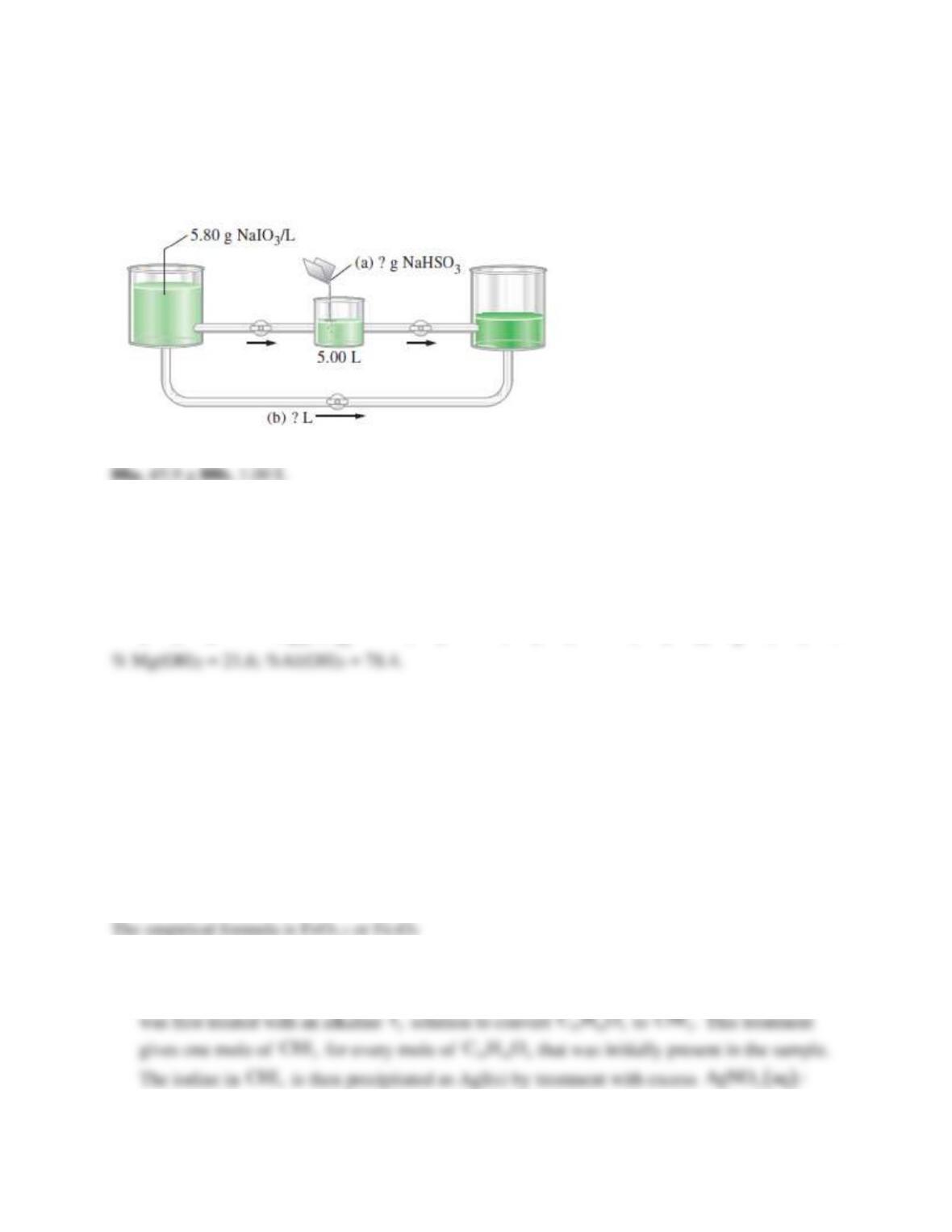
further quantity of the initial
( )
3
NaIO aq
is added to the reaction mixture to bring about the
second reaction. (a) How many grams of
3
NaHSO
are required in the first step? (b) What
additional volume of the starting solution must be added in the second step?
89. The active ingredients in a particular antacid tablet are aluminum hydroxide,
( )
3
Al OH ,
and
magnesium hydroxide,
( )
2
Mg OH
2
A 5 00 10 mg
sample of the active ingredients was
dissolved in 50.0 mL of 0.500 M HCl. The resulting solution, which was still acidic, required
16.5 mL of 0.377 M NaOH for neutralization. What are the mass percentages of
( )
3
Al OH
a n d
( )
Mg OH
i n t h e s a m p l e ?
90. A compound contains only Fe and O. A 0.2729 g sample of the compound was dissolved in
50 mL of concentrated acid solution, reducing all the iron to
2
Fe +
ions. The resulting
solution was diluted to 100 mL and then titrated with a
4
0 01621M KMnO
solution. The
unbalanced chemical expression for reaction between
2
Fe +
and
4
MnO −
is given below.
( ) ( )
2
4
MnO aq Fe aq
−+
+→
( ) ( ) ( )
23
Mn aq Fe aq not balanced
++
+
The titration required 42.17 mL of the
4
KMnO
solution to reach the pink endpoint. What is
the empirical formula of the compound?
91. Warfarin,
19 16 4
C H O ,
is the active ingredient used in some anticoagulant medications. The
amount of -warfarin in a particular sample was determined as -follows. A 13.96 g sample
( ) ( ) ( )
3 3 2
CHI aq 3 AgNO aq H O l+ + →
( ) ( ) ( )
3
3 AgI s 3 HNO aq CO g + +
If 0.1386 g solid AgI were obtained, then what is the percentage by mass of warfarin in the
sample analyzed?
92. Copper refining traditionally involves “roasting” insoluble sulfide ores (CuS) with oxygen.
Unfortunately, the process produces large quantities of
( )
2
SO g ,
which is a major contributor
to pollution and acid rain. An alternative process involves treating the sulfide ore with
( )
3
HNO aq ,
which dissolves the CuS without generating any
2
SO
The unbalanced chemical
expression for the reaction is given below.
( ) ( )
3
CuS s NO aq
−
+→
( ) ( ) ( ) ( )
2
4
Cu aq NO g HSO aq not balanced
+−
+ +
What volume of concentrated nitric acid solution is required per kilogram of CuS? Assume
that the concentrated nitric acid solution is 70%
3
HNO
by mass and has a density of 1.40
g/mL.
93. Phosphorus is essential for plant growth, but an excess of phosphorus can be catastrophic in
aqueous ecosystems. Too much phosphorus can cause algae to grow at an explosive rate and
this robs the rest of the ecosystem of oxygen. Effluent from sewage treatment plants must be
treated before it can be released into lakes or streams because the effluent contains significant
amounts of
24
H PO −
and
2
4
HPO −
(Detergents are a major contributor to phosphorus levels
in domestic sewage because many detergents contain
24
Na HPO
) A simple way to remove
24
H PO −
and
2
4
HPO −
from the effluent is to treat it with lime, CaO, which produces
2
Ca +
and
OH−
ions in water. The
OH−
ions convert
24
H PO −
and
2
4
HPO −
ions into
3
4
PO −
ions and,
finally,
2
Ca OH,,
+−
and
3
4
PO −
ions combine to form a precipitate of
( ) ( )
54
3
Ca PO OH s
(a) Write balanced chemical equations for the four reactions described above.
[Hint: The reactants are CaO and
2 2 4
H O H PO;−
and
2
4
OH HPO;
−−
and
23
4
OH Ca PO; , ,
− + −
and
OH−
]
(b) How many kilograms of lime are required to remove the phosphorus from a
4
1 00 10 L
holding tank filled with contaminated water, if the water contains 10.0 mg
of phosphorus per liter?
Feature Problems
94. Sodium cyclopentadienide,
55
NaC H ,
is a common reducing agent in the chemical laboratory,
but there is a problem in using it:
55
NaC H
is contaminated with tetrahydrofuran (THF),
48
C H O,
a solvent used in its preparation. The THF is present as
( )
55
NaC H THF x,
and it is
generally necessary to know exactly how much of this
( )
55
NaC H THF x
is present. This is
accomplished by allowing a small amount of the
( )
55
NaC H THF x
to react with water,
( )
5 5 4 8 2
NaC H C H O H O
x
+ →
( )
5 5 4 8
NaOH aq C H H C H Ox+ − +
followed by titration of the NaOH(aq) with a standard acid. From the sample data tabulated
below, determine the value of x in the formula
( )
55
NaC H THF .
x
Trial 1 B
Trial 2
95. Manganese is derived from pyrolusite ore, an impure manganese dioxide. In the procedure
used to analyze a pyrolusite ore for its
2
MnO
content, a 0.533 g sample is treated with 1.651 g
oxalic acid
( )
2 2 4 2
H C O 2 H O
in an acidic medium. Following this reaction, the excess oxalic
acid is titrated with
4
0 1000 M KMnO 30 06 mL,
being required. What is the mass percent
2
MnO
in the ore?
2 2 4 2
H C O MnO H+
+ + →
( )
2
22
Mn H O CO not balanced
++ +
2 2 4 4
H C O MnO H
−+
+ + →
( )
2
22
Mn H O CO not balanced
++ +
96. The Kjeldahl method is used in agricultural chemistry to determine the percent protein in
natural products. The method is based on converting all the protein nitrogen to ammonia and
then determining the amount of ammonia by titration. The percent nitrogen in the sample
under analysis can be calculated from the quantity of ammonia produced. Interestingly, the
majority of protein molecules in living matter contain just about 16% nitrogen.
A 1.250 g sample of meat is heated with concentrated sulfuric acid and a catalyst to
convert all the nitrogen in the meat to
( )
44
2
NH SO
Then excess NaOH(aq) is added to the
( )
55
NaC H THF x
mixture, which is heated to expel
( )
3
NH g
All the nitrogen from the sample is found in the
( )
3
NH g ,
which is then absorbed in and neutralized by 50.00 mL of dilute
( )
24
H SO aq
The
excess
( )
24
H SO aq
requires 32.24 mL of 0.4498 M NaOH for its titration. A separate 25.00
mL -sample of the dilute
( )
24
H SO aq
requires 22.24 mL of 0.4498 M NaOH for its titration.
What is the percent protein in the meat?
97. Blood alcohol content (BAC) is often reported in weight–volume percent (w/v%). For
example, a BAC of 0.10% corresponds to
32
0 10 g CH CH OH
per 100 mL
of blood. Estimates of BAC can be obtained from breath samples by using a number of
commercially available instruments, including the Breathalyzer for which a patent was issued
to R. F. Borkenstein in 1958. The chemistry behind the Breathalyzer is described by the
oxidation–reduction reaction below, which occurs in acidic solution:
( ) ( )
2
3 2 2 7
CH CH OH g Cr O aq
−
+→
ethyl alcohol
(yellow-orange)
( ) ( ) ( )
3
3
CH COOH aq Cr aq not balanced
+
+
( )
green
A Method for Balancing Equations for Oxidation–Reduction Reactions
That Occur in an Acidic or a Basic Aqueous Solution
1. Assign oxidation states to each element in the reaction and identify the species being oxidized
and reduced.
2. Write separate, unbalanced equations for the oxidation and reduction half-reactions.
3. Balance the separate half-equations, in this order:
• first with respect to the element being oxidized or reduced
• then by adding electrons to one side or the other to account for the number of electrons
produced -(oxidation) or consumed (reduction)
4. Combine the half-reactions algebraically so that the total number of electrons cancels out.
5. Balance the net charge by either adding
OH−
(for basic solutions) or
H+
(for acidic solutions).
6. Balance the O and H atoms by adding
2
HO
7. Check that the final equation is balanced with respect to each type of atom and with respect to
charge.
98. In this problem, we describe an alternative method for balancing equations for oxidation-
reduction reactions. The method is similar to the method given previously in Tables 5.5 and
5.6, but it places more emphasis on the assignment of oxidation states. (The method
summarized in Tables 5.5 and 5.6 does not require you to assign oxidation states.) An
emphasis on oxidation states is warranted because oxidation states are useful not only for
keeping track of electrons but also for predicting chemical properties. The method is
summarized in the table above.
The method offers a couple of advantages. First, the method applies to both acidic and basic
environments because we balance charges by using either
H+
(for acidic environments) or
OH−
(for basic environments). Second, the method is somewhat more efficient than the
method we described previously because, in the method described here, we balance only once
for charge and only once for hydrogen and oxygen. In the other method, we focus on the half-
equations separately and must balance twice for charge and twice for hydrogen and oxygen.
Use the alternative method described above to balance the following oxidation-reduction
equations.
Self-Assessment Exercises
99. In your own words, define or explain the terms or symbols (a) (b)
; (c) spectator ion;
(d) weak acid.
100. Briefly describe (a) half-equation method of balancing redox equations; (b)
disproportionation reaction; (c) titration; (d) standardization of a solution.
101. Explain the important distinctions between (a) a strong electrolyte and strong acid; (b) an
oxidizing agent and reducing agent; (c) precipitation reactions and neutralization reactions;
(d) half-reaction and overall reaction.
102. The number of moles of hydroxide ion in 0.300 L of 0.0050 M
( )
2
Ba OH
is (a) 0.0015; (b)
0.0030; (c) 0.0050; (d) 0.010.
103. The highest
H+
will be found in an aqueous solution that is (a) 0.10 M HCl; (b)
3
0 10 M NH ;
(c)
0 15 M
3
CH COOH;
(d)
24
0 10 M H SO
104. To precipitate
2
Zn +
from
( ) ( )
32
Zn NO aq ,
add
(a)
4
NH Cl;
(b)
2
MgBr ;
(c)
23
K CO ;
(d)
( )
44
NH SO
105. When treated with dilute HCl(aq), the solid that reacts to produce a gas is (a)
3
BaSO ;
(b)
ZnO;
(c) NaBr; (d)
24
Na SO
106. An unknown solid compound dissolves readily when added to water, forming a solution that
conducts electricity. A precipitate forms when Ba(NO3)2(aq) is added to a solution of this
compound, but not when Cu(NO3)2(aq) is added. When the unknown solid is added to
CH3COOH(aq), no gas is produced. When the solid is added to NaOH (aq), a gas with the
pungent odor of ammonia is produced. What is the possible identity of the unknown solid?
107. What is the net ionic equation for the reaction that occurs when an aqueous solution of KI is
added to an aqueous solution of
( )
32
Pb NO ?
108. When aqueous sodium carbonate,
23
Na CO ,
is treated with dilute hydrochloric acid, HCl,
the products are sodium chloride, water, and carbon dioxide gas. What is the net ionic
equation for this reaction?
109. Describe the synthesis of each of the following ionic compounds, starting from solutions of
sodium and nitrate salts. Then write the net ionic equation for each synthesis.
(a)
( )
34
2
Zn PO ;
(b)
( )
2
Cu OH ;
NiCO
110. Consider the following redox reaction:
( ) ( ) ( )
22
4 NO g 3 O g 2 H O l + + →
( ) ( )
3
4 NO aq 4 H aq
−+
+
(a) Which species is oxidized?
(b) Which species is reduced?
(c) Which species is the oxidizing agent?
(d) Which species is the reducing agent?
(e) Which species gains electrons?
(f) Which species loses electrons?
111. Balance the following oxidation–reduction equations.
(a) Cl2(aq)
→
Cl− (aq) + ClO− (aq) (basic solution)
(b) C2O42− (aq) + MnO4− (aq)
→
Mn2+(aq) + CO2(g) (acidic solution)
112. In the equation
( ) ( ) ( )
2
2
? Fe aq O g 4 H aq
++
+ + →

( ) ( )
3
2
? Fe aq 2 H O l
+
+
the missing coefficients (a) are each 2; (b) are each 4; (c) can have any values as long as
they are the same; (d) must be determined by experiment.
113. What is the simplest ratio
a : b
when the equation below is properly balanced?
( ) ( ) ( ) ( )
acidic
23
solution
ClO aq I aq Cl aq IO aqa b c d
− − −
+ ⎯⎯⎯→ +
(a) 2:5; (b) 5:2; (c) 1:5; (d) 5:1; (e) 2:3.
114. In the half-reaction in which
2
NpO +
is converted to
4
Np ,
+
the number of electrons
appearing in the half-equation is (a) 1; (b) 2; (c) 3; (d) 4.
115. Which list of compounds contains a nonelectrolyte, a weak electrolyte, and a strong
electrolyte? (a) CO2, NaCl, MnSO4; (b) H2SO4, CH3COOH, CuCl; (c) SO2, HF, FeSO4; (d)
Ba(ClO3)2, K2S2O3, NaMnO4; (e) none of these.
116. Which list of compounds contains a weak acid, a weak base, and a salt? (a) HCl, NH3,
Na2SO4;
(b) HNO2, NH3, NH4NO2; (c) HCl, Ca(OH)2, CaSO4; (d) HNO2, KOH, Cs2CrO4; (e) none
of these.
117. Which list of compounds contains two soluble compounds and an insoluble one?
(a) HgBr2, MnSO4, Na2C2O4;
(b) Na2S2O3, NH4Cl, CoI2;
(c) MnS, Cu(OH)2, Al2O3;
(d) Pb(ClO4)2, Ca(NO3)2, Hg2SO4;
(e) none of these.
118. Classify each of the following statements as true or false.
(a) Barium chloride, BaCl2, is a weak electrolyte in aqueous solution.
(b) In the reaction
( ) ( ) ( ) ( )
22
H aq H O l H g OH aq ,
−−
+ → +
water acts as both an acid and an
oxidizing agent.
(c) A precipitate forms when aqueous sodium carbonate,
( )
23
Na CO aq ,
is treated with
excess aqueous hydrochloric acid, HCl(aq).
(d) Hydrofluoric acid, HF, is a strong acid in water.
(e) Compared with a 0.010 M solution of
3
NaNO ,
a 0.010 M solution of
( )
32
Mg NO
is a
better conductor of electricity.
119. Which of the following reactions are oxidation– reduction reactions?
(a)
( ) ( ) ( )
2 3 2 2
H CO aq H O l CO g→+
(b)
( ) ( ) ( ) ( )
22
2 Li s 2 H O l 2 LiOH aq H g + → +
(c)
( ) ( ) ( ) ( )
4
4 Ag s PtCl aq 4 AgCl s Pt s + → +
(d)
( ) ( ) ( )
42
2 HClO aq Ca OH aq + →
( ) ( ) ( )
24
2 H O l Ca ClO aq +
120. Similar to Figure 5-4(c), but using the formulas
HAc, Ac ,
−
and
3
H O ,
+
give a more accurate
representation of
( )
3
CH COOH aq
in which ionization is 5% complete.
The dissociation of acetic acid in water can be expressed as follows:
HAc + H2O → Ac– + H3O+
121. Appendix E describes a useful study aid known as concept mapping. Using the method
presented in Appendix E, construct a concept map illustrating the different concepts introduced
in Sections 5-4, 5-5, and 5-6.