Chapter 5
Introduction to Reactions in Aqueous Solutions
Exercises
Strong Electrolytes, Weak Electrolytes, and Nonelectrolytes
1. Using information from this chapter, indicate whether each of the following substances in
aqueous solution is a nonelectrolyte, weak electrolyte, or strong electrolyte. (a)
65
HC H O;
(b)
24
Li SO ;
(c)
2
MgI ;
(d)
( )
32
CH CH O;
(e)
( )
Sr OH
2. Select the (a) best and (b) poorest electrical conductors from the following solutions, and
32
2. (a) The best electrical conductor is the solution of the strong electrolyte: 0.10 M NaCl. In
3. What response would you expect in the apparatus of Figure 5-4 if the solution tested were 1.0
M HCl? What response would you expect if the solution were both 1.0 M HCl and 1.0 M
3
CH COOH
?
4.
( )
3
NH aq
conducts electric current only weakly. The same is true for
( )
3
CH COOH aq
When these solutions are mixed, however, the resulting solution is a good conductor. How do
you explain this?
5. Sketches (a–c) are molecular views of the solute in an aqueous solution. For each of the
sketches, indicate whether the solute is a strong, weak, or nonelectrolyte; and which of these
substances it is: sodium chloride, propionic acid, hypochlorous acid, ammonia, barium
bromide, ammonium chloride, methanol.
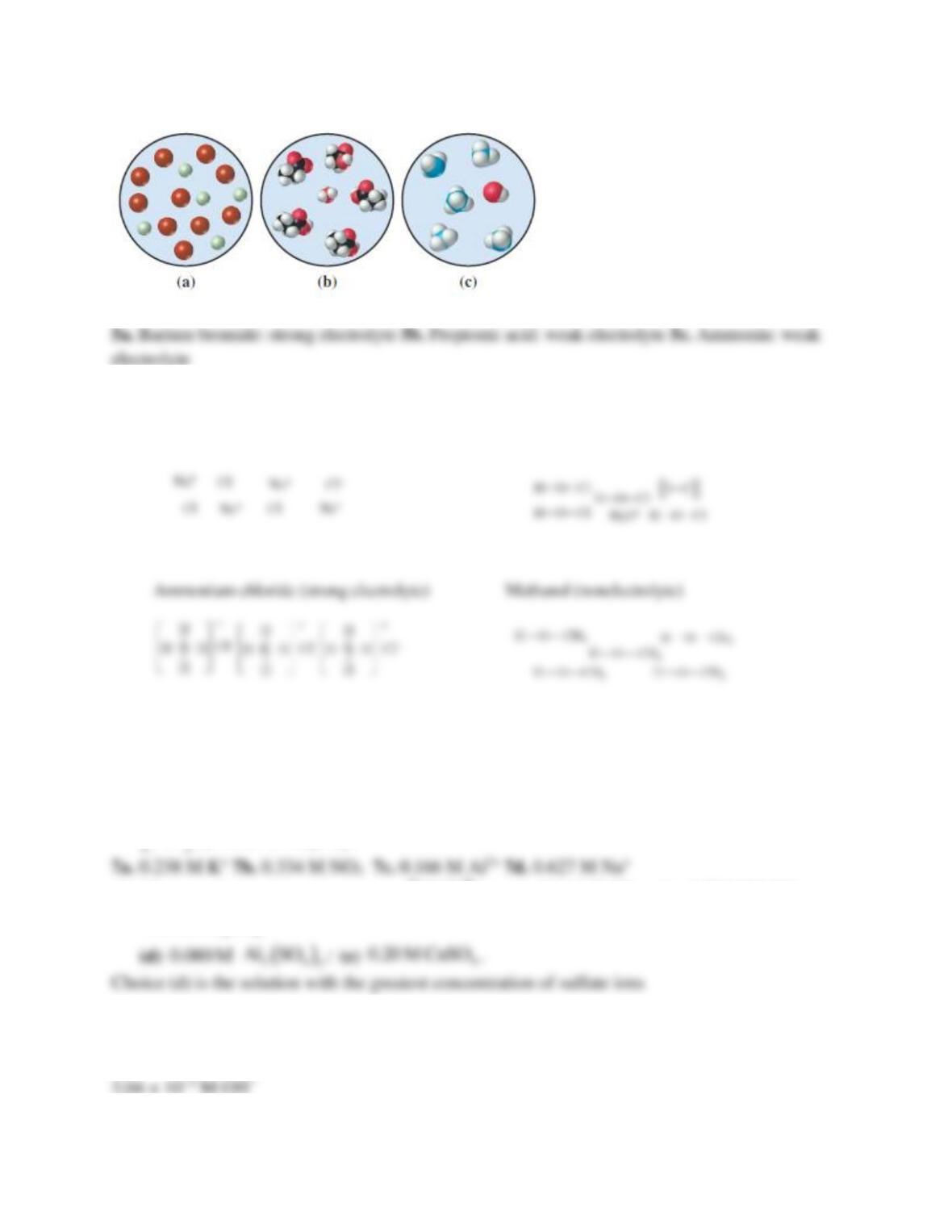
6. After identifying the three substances represented by the sketches in Exercise 5, sketch
molecular views of aqueous solutions of the remaining four substances listed.
Sodium chloride (strong electrolyte)
Hypochlorous acid (weak electrolyte)
Ammonium chloride (strong electrolyte)
Methanol (nonelectrolyte)
Ion Concentrations
7. Determine the concentration of the ion indicated in each solution. (a)
K+
in
3
0 238 M KNO ;
(b)
3
NO −
in 0.
( )
32
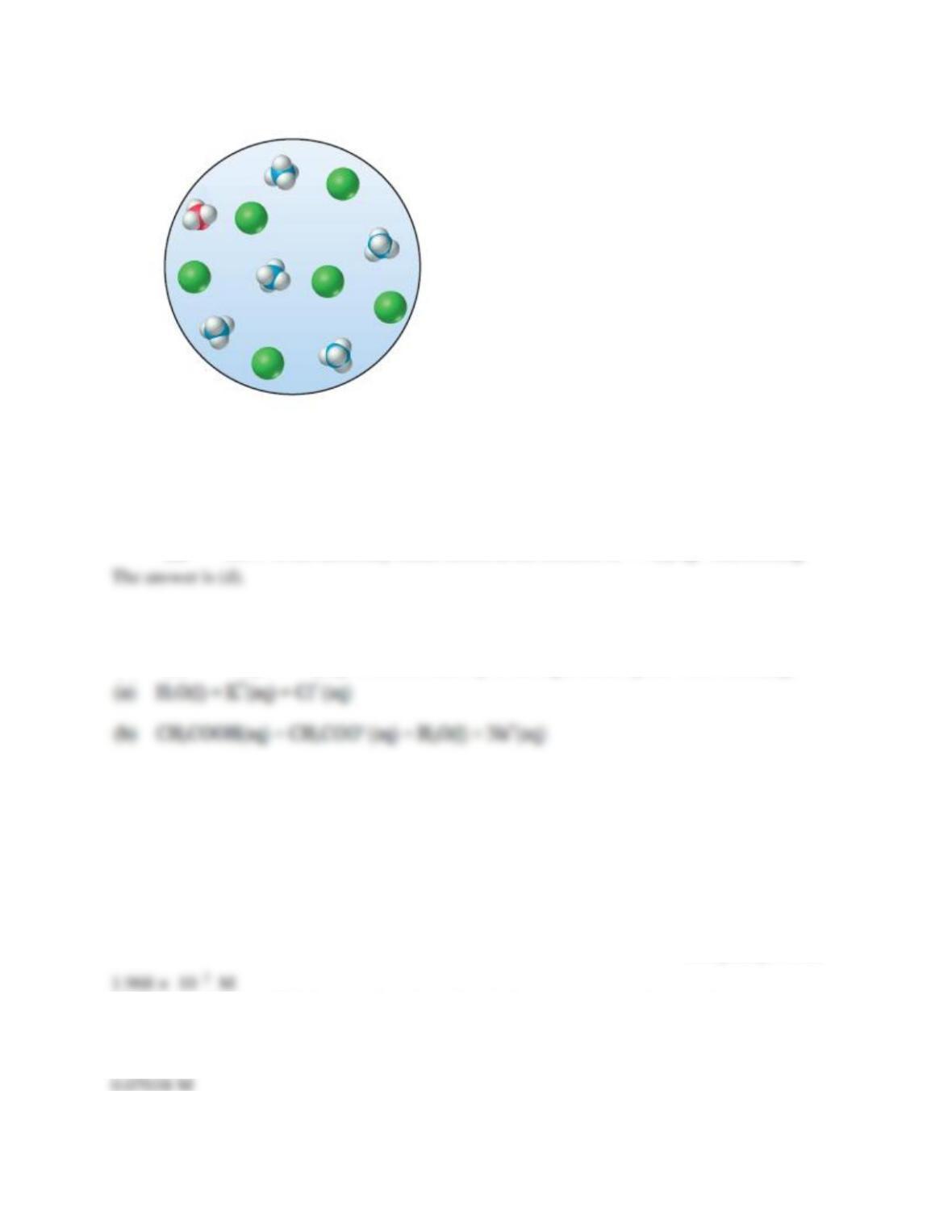
167 M Ca NO ;
(c)
3
Al +
in
( )
24
3
0 083 M Al SO ;
(d)
Na+
in
34
0 209 M Na PO
8. Which solution has the greatest
2
4
SO ?
−
(a)
0 075 M
24
H SO ;
(b)
4
0 22 M MgSO ;
(c)
24
0 15 M Na SO ;
9. A solution is prepared by dissolving
0 132 g
( )
2
2
Ba OH 8 H O
in 275 mL of water solution.
What is
OH−
in this solution?
10. A solution is 0.126 M KCl and
2
0 148 M MgCl
What are
2
K Mg,,
++
and
Cl−
in this
solution?
11. Express the following data for cations in solution as molarities. (a) 14.2 mg
2
Ca L/;
+
(b)
32 8 mg K /100 mL;
+
(c)
2
225 g Zn mL/
+
12. What molarity of NaF(aq) corresponds to a fluoride ion content of 0.9 mg
F /L,
−
the federal
government’s recommended limit for fluoride ion in drinking water?
13. Which of the following aqueous solutions has the -highest concentration of
K?
+
(a)
24
0 0850 M K SO ;
(b) a solution containing
1 25 g KBr/100 mL;
(c) a solution having
14. Which aqueous solution has the greatest
H?
+
(a)
3
0 011M CH COOH;
(b) 0.010 M HCl;
(c)
0 010 M
24
H SO ;
(d)
3
1 00 M NH
. Explain your choice.
15. How many milligrams of
2
MgI
must be added to 250.0 mL of 0.0876 M KI to produce a
solution with
I 0 1000 M?
−
=
16. If
2
18 2 mL H O
evaporates from 1.00 L of a solution containing
24
15 5 mg K SO mL/,
what
is
K+
in the solution that remains?
17. Assuming the volumes are additive, what is the
Cl−
in a solution obtained by mixing 225
mL of 0.625 M KCl and 615 mL of
2
0 385 M MgCl ?
18. Assuming the volumes are additive, what is the
3
NO −
in a solution obtained by mixing
275 mL of
0 283 M KNO 328 mL,
of
( )
0 421M Mg NO ,
and 784 mL of
HO?
Predicting Precipitation Reactions
19. Complete each of the following as a net ionic equation, indicating whether a precipitate
forms. If no reaction occurs, so state.
(a)
2
3
Na Br Pb 2 NO
+ − + −
+ + + →
(b)
2 2 2
4
Mg 2 Cl Cu SO
+ − + −
+ + + →
(c)
3
3
Fe 3 NO Na OH
+ − + −
+ + + →
20. Complete each of the following as a net ionic equation. If no reaction occurs, so state.
(a)
22
3
Ca 2 I 2 Na CO
+ − + −
+ + + →
(b)
2 2 2
4
Ba S 2 Na SO
+ − + −
+ + + →
(c)
22
2 K S Ca 2 Cl
+ − + −
+ + + →
21. Predict in each case whether a reaction is likely to occur. If so, write a net ionic equation.
(a)
( ) ( ) ( )
32
HI aq Zn NO aq+→
(b)
( ) ( )
4 2 3
CuSO aq Na CO aq+→
(c)
( ) ( ) ( )
3 3 4
2
Cu NO aq Na PO aq+→
22. Predict in each case whether a reaction is likely to occur. If so, write a net ionic equation.
(a)
( ) ( )
32
AgNO aq CuCl aq+→
(b)
( ) ( )
22
Na S aq FeCl aq+→
(c)
( ) ( )
2 3 3
Na CO aq AgNO aq+→
23. What reagent solution might you use to separate the cations in the following mixtures, that is,
with one ion appearing in solution and the other in a precipitate?
[Hint: Refer to Table 5.1, and consider water also to be a reagent.]
(a)
( )
2
BaCl s
and
( )
2
MgCl s
(b)
( )
3
MgCO s
and
( )
23
Na CO s
(c)
( )
3
AgNO s
and
( ) ( )
32
Cu NO s
24. What reagent solution might you use to separate the cations in each of the following
mixtures?
[Hint: Refer to Exercise 23.]
(a)
( )
4
PbSO s
and
( ) ( )
32
Cu NO s
(b)
( ) ( )
2
Mg OH s
and
( )
4
BaSO s
(c)
( )
3
PbCO s
and
( )
3
CaCO s
25. You are provided with
( ) ( )
24
NaOH aq K SO aq,,
( ) ( )
32
Mg NO aq ,
( ) ( )
2
BaCl aq NaCl aq,,
( ) ( )
32
Sr NO aq ,
( )
3
AgNO aq ,
and
( )
4
BaSO s
Write net ionic equations to show how you
would use one or more of those reagents to obtain (a)
( )
4
SrSO s ;
(b)
( ) ( )
2
Mg OH s ;
(c)
26. Write net ionic equations to show how you would use one or more of the reagents in Exercise
25 to obtain
(a)
( )
4
BaSO s ;
(b) AgCl(s); (c)
( )
3
KNO aq
Acid–Base Reactions
27. Complete each of the following as a net ionic equation. If no reaction occurs, so state.
(a)
2
3
Ba 2 OH CH COOH
+−
+ + →
(b)
32
H Cl CH CH COOH
+−
+ + →
(c)
( )
FeS s H I
+−
+ + →
(d)
3 3
K HCO H NO
+ − + −
+ + + →
(e)
( )
Mg s H+
+→
28. Every antacid contains one or more ingredients capable of reacting with excess stomach
acid (HCl). The essential neutralization products are
2
CO
and/or
2
HO
Write net ionic
equations to represent the neutralizing action of the following popular antacids.
(a) Alka-Seltzer (sodium bicarbonate)
(b) Tums (calcium carbonate)
(c) milk of magnesia (magnesium hydroxide)
(d) Maalox (magnesium hydroxide, aluminum hydroxide)
(e) Rolaids
( )
3
2
NaAl OH CO
29. In this chapter, we described an acid as a substance capable of producing
H+
and a salt as the
ionic compound formed by the neutralization of an acid by a base. Write ionic equations to
show that sodium hydrogen sulfate has the characteristics of both a salt and an acid
(sometimes called an acid salt).
30. A neutralization reaction between an acid and a base is a common method of preparing
useful salts. Give net ionic equations showing how the following salts could be prepared in
this way: (a)
( )
NH HPO ;
(b)
NH NO ;
and (c)
( )
NH SO
31. Which solutions would you use to precipitate
2
Mg +
from an aqueous solution of
2
MgCl ?
32. Determine which of the following react(s) with HCl(aq) to produce a gas, and write a net ionic
equation(s) for the reaction(s). (a)
24
Na SO ;
(b)
3
KHSO ;
(c)
( )
2
Zn OH ;
(d)
2
CaCl
Oxidation–Reduction (Redox) Equations
33. Assign oxidation states to the elements involved in the following reactions. Indicate which
are redox reactions and which are not.
(a)
( ) ( )
3
MgCO s 2 H aq
+
+ →
( ) ( ) ( )
2
22
Mg aq H O l CO g
+++
(b)
( ) ( ) ( ) ( )
22
Cl aq 2 Br aq 2 Cl aq Br aq
−−
+ → +
(c)
( ) ( ) ( )
3
Ag s 2 H aq NO aq
+−
+ + →
( ) ( ) ( )
22
Ag aq H O l NO g
+++
(d)
( ) ( ) ( )
2
4 2 4
2 Ag aq CrO aq Ag CrO s
+−
+→
34. Explain why these reactions cannot occur as written.
(a)
( ) ( ) ( )
3
4
Fe aq MnO aq H aq
+ − +
+ + →
( ) ( ) ( )
22
2
Mn aq Fe aq H O l
++
++
(b)
( ) ( )
2 2 2
H O aq Cl aq+→
( ) ( ) ( )
2
ClO aq O g H aq
−+
++
35. Complete and balance these half-equations.
(a)
22
3 2 3
SO S O
−−
→
(acidic solution)
(b)
( )
32
HNO N O g→
(acidic solution)
(c)
( ) ( )
4
Al s Al OH −
→
(basic solution)
Indicate whether oxidation or reduction is involved.
36. Complete and balance these half-equations.
(a)
2
2 4 2
C O CO
−→
(acidic solution)
(b)
23
27
Cr O Cr
−+
→
(acidic solution)
(c)
42
MnO MnO
−→
(basic solution)
37. Balance these equations for redox reactions occurring in acidic solution.
(a)
( )
2
42
MnO I Mn I s
− − +
+ → +
(b)
( )
3 2 4 2
BrO N H Br N g
−−
+ → +
(c)
3 2 2 3
4
VO Fe VO Fe
− + + +
+ → +
(d)
( )
22
32
UO NO UO NO g
+ − +
+ → +
38. Balance these equations for redox reactions occurring in acidic solution.
(a)
( ) ( )
4 3 2 4
P s NO H PO NO g
−−
+ → +
(b)
2 2 2
2 3 4 4
S O MnO SO Mn
− − − +
+ → +
(c)
2
3 2 3
HS HSO S O
− − −
+→
(d)
( )
32
32
Fe NH OH Fe N O g
+ + +
+ → +
39. Balance these equations for redox reactions in basic solution.
(a)
( )
2 3 4
MnO s ClO MnO Cl
− − −
+ → +
(b)
( ) ( )
2
4
3
Fe OH s OCl FeO Cl
− − −
+ → +
(c)
23
ClO ClO Cl
−−
→+
(d)
( ) ( ) ( )
2
43
Ag s CrO Ag Cr OH s
−+
+ → +
40. Balance these equations for redox reactions occurring in basic solution.
(a)
( ) ( )
2 2 2
4 2 4 3
3
CrO S O Cr OH s SO
− − −
+ → +
(b)
( ) ( ) ( )
34
2 4 2
66
Fe CN N H Fe CN N g
−−
+ → +
(c)
( ) ( ) ( ) ( ) ( )
2
23
Fe OH s O g Fe OH s+→
(d)
3 2 4
CH CH OH MnO −
+→
( )
32
CH COO MnO s
−+
41. Balance these equations for disproportionation -reactions.
(a)
( )
23
Cl g Cl ClO
−−
→+
(basic solution)
(b)
22
2 4 2 3 3
S O S O HSO
− − −
→+
(acidic solution)
42. Balance these equations for disproportionation -reactions.
(a)
( )
2
4 2 4
MnO MnO s MnO
−−
→+
(basic solution)
(b)
( ) ( )
4 2 2 3
P s H PO PH g
−
→+
(basic solution)
(c)
( )
22
8 2 3
S s S S O
−−
→+
(basic solution)
(d)
32
2 3 2 2 4 4
As S H O AsO SO
−−
+ → +
43. Write a balanced equation for these redox reactions.
(a) The oxidation of nitrite ion to nitrate ion by permanganate ion,
4
MnO ,
−
in acidic
s o l u t i o n (
4
MnO −
i o n i s r e d u c e d t o
2
Mn +
).
(b) The reaction of manganese(II) ion and permanganate ion in basic solution to form
solid manganese dioxide.
(c) The oxidation of ethanol by dichromate ion in acidic solution, producing
chromium(III) ion, acetaldehyde
( )
3
CH CHO ,
and water as products.
44. Write a balanced equation for the redox reactions.
(a) The reaction of aluminum metal with hydroiodic acid.
(b) The reduction of vanadyl ion
( )
2
VO +
to vanadic ion
( )
3
V+
in acidic solution with
zinc metal as the reducing agent.
(c) The oxidation of methanol by chlorate ion in acidic solution, producing carbon
dioxide gas, water, and chlorine dioxide gas as products.
45. The following reactions do not occur in aqueous solutions. Balance their equations by the
half-equation method, as suggested in Are You Wondering 5-2.
(a)
( ) ( )
4
CH g NO g+→
( ) ( ) ( )
2 2 2
CO g N g H O g++
(b)
( ) ( ) ( ) ( )
2 2 8 2
H S g SO g S s H O g+ → +
(c)
( ) ( )
23
Cl O g NH g+→
46. The following reactions do not occur in aqueous solutions. Balance their equations by the
half-equation method, as suggested in Are You Wondering 5-2.
(a)
( ) ( ) ( )
4 3 2
CH g NH g O g+ + →
( ) ( )
2
HCN g H O g+
(b)
( ) ( ) ( ) ( )
2 3 2
NO g H g NH g H O g+ → +
(c)
( ) ( ) ( )
22
Fe s H O l O g+ + →
( ) ( )
3
Fe OH s
Oxidizing and Reducing Agents
47. What are the oxidizing and reducing agents in the following redox reactions?
(a)
2
34
5 SO 2 MnO 6 H
− − +
+ + →
22
42
5 SO 2 Mn 3 H O
−+
+ +
(b)
( ) ( )
22
2 NO g 7 H g + →
( ) ( )
32
2 NH g 4 H O g +
(c)
( )
4
22
6
2 Fe CN H O 2 H
−+
+ + →
3
2 Fe CN 2 H O
−
+
48. Thiosulfate ion,
2
23
SO ,
−
is a reducing agent that can be oxidized to different products,
depending on the strength of the oxidizing agent and other conditions. By adding
2
H H O,,
+
and/or
OH−
as necessary, write redox equations to show the oxidation of
2
23
SO −
to
(a)
2
46
SO −
by
2
I
(iodide ion is another product)
(b)
4
HSO −
by
2
Cl
(chloride ion is another product)
(c)
2
4
SO −
by
OCl−
in basic solution (chloride ion is another product)
Neutralization and Acid–Base Titrations
49. What volume of 0.0962 M NaOH is required to exactly neutralize 10.00 mL of 0.128 M
HCl?
50. The exact neutralization of 10.00 mL of
0 1012 M
( )
24
H SO aq
requires 23.31 mL of NaOH.
What must be the molarity of the NaOH(aq)?
51. How many milliliters of 2.155 M KOH are required to titrate 25.00 mL of
32
0 3057 M CH CH COOH
(propionic acid)?
52. How many milliliters of
( )
2
0 0750 M Ba OH
are required to titrate 200.0 mL of
3
0 0165 M HNO ?
53. An NaOH(aq) solution cannot be made up to an exact concentration simply by weighing out
the required mass of NaOH, because the NaOH is not pure. Also, water vapor condenses on
the solid as it is being weighed. The solution must be standardized by titration. For this
purpose, a 25.00 mL sample of an NaOH(aq) solution requires 28.34 mL of 0.1085 M HCl.
What is the molarity of the NaOH(aq)?
( ) ( ) ( ) ( )
2
HCl aq NaOH aq NaCl aq H O l+ → +
54. Household ammonia, used as a window cleaner and for other cleaning purposes, is
( )
3
NH aq
The
3
NH
present in a 5.00 mL sample is neutralized by 28.72 mL of 1.021 M HCl. The net ionic
equation for the neutralization is
( ) ( ) ( )
34
NH aq H aq NH aq
++
+→
What is the molarity of
NH
in the sample?
55. We want to determine the acetylsalicyclic acid content of a series of aspirin tablets by titration
with NaOH(aq). Each of the tablets is expected to contain about 0.32 g of
9 7 4
HC H O
What
molarity of NaOH(aq) should we use for titration volumes of about 23 mL? (This procedure
ensures good precision and allows the titration of two samples with the contents of a 50 mL
buret.)
( ) ( )
9 7 4
HC H O aq OH aq
−
+→
( ) ( )
9 7 4 2
C H O aq H O l
−+
56. For use in titrations, we want to prepare 20 L of HCl(aq) with a concentration known to four
significant figures. This is a two-step procedure beginning with the preparation of a solution
of about 0.10 M HCl. A sample of this dilute HCl(aq) is titrated with a NaOH(aq) solution of
known concentration.
(a) How many milliliters of concentrated
( )
HCl aq
( )
1 19 g/mL 38 HCl, by massd;= ,
must be diluted with water to 20.0 L to
prepare 0.10 M HCl?
(b) A 25.00 mL sample of the approximately 0.10 M HCl prepared in part (a) requires
20.93 mL of 0.1186 M NaOH for its titration. What is the molarity of the HCl(aq)?
(c) Why is a titration necessary? That is, why not prepare a standard solution of
0.1000 M HCl simply by an appropriate dilution of the concentrated HCl(aq)?
57. A 25.00 mL sample of
3
0 132 M HNO
is mixed with 10.00 mL of 0.318 M KOH. Is the
resulting solution acidic, basic, or exactly neutralized?
58. A 7.55 g sample of
( )
23
Na CO s
is added to 125 mL of a vinegar that is
3
0 762 M CH COOH
Will the resulting solution still be acidic? Explain.
59. Refer to Example 5-9. Suppose the analysis of all vinegar samples uses 5.00 mL of the
vinegar and 0.1000 M NaOH for the titration. What volume of the 0.1000 M NaOH would
60. The electrolyte in a lead storage battery must have a concentration between 4.8 and
24
5 3 M H SO
if the battery is to be most effective. A 5.00 mL sample of a battery acid requires
49.74 mL of 0.935 M NaOH for its complete reaction (neutralization). Does the concentration
of the battery acid fall within the desired range?
61. Which of the following points in a titration is represented by the molecular view shown in the
sketch?
(a) 20% of the necessary titrant added in the titration of
( )
4
NH Cl aq
with HCl(aq)
(b) 20% of the necessary titrant added in the titration of
( )
3
NH aq
with HCl(aq)
(c) the equivalence point in the titration of
( )
3
NH aq
with HCl(aq)
(d) 120% of the necessary titrant added in the titration of
( )
3
NH aq
with HCl(aq)
62. Using the sketch in Exercise 61 as a guide, sketch the molecular view of a solution in which
(a) HCl(aq) is titrated to the equivalence point with KOH(aq)
(b)
( )
3
CH COOH aq
is titrated halfway to the equivalence point with NaOH(aq).
Stoichiometry of Oxidation–Reduction Reactions
63. A
( )
4
KMnO aq
solution is to be standardized by titration against
( )
23
As O s
A 0.1078 g
sample of
23
As O
requires 22.15 mL of the
( )
4
KMnO aq
for its titration. What is the
molarity of the
( )
4
KMnO aq ?
2 3 4 2
5 As O 4 MnO 9 H O 12 H
−+
+ + + →
2
34
10 H AsO 4 Mn +
+
64. Refer to Example 5-6. Assume that the only reducing agent present in a particular wastewater
is
2
3
SO −
If a 25.00 mL sample of this wastewater requires 31.46 mL of
4
0 02237 M KMnO
for its titration, what is the molarity of
2
3
SO −
in the wastewater?