90. The following set of reactions is to be used as the basis of a method for producing nitric acid,
HNO3. Calculate the minimum masses of N2, H2, and O2 required per kilogram of HNO3.
N2(g)
+
3 H2(g)
→
2 NH3(g)
4 NH3(g)
+
5 O2(g)
→
4 NO(g)
+
6 H2O(g)
2 NO(g)
+
O2(g)
→
2 NO2(g)
3 NO2(g)
+
H2O(l)
→
2 HNO3(aq)
+
NO(g)
91. When a solid mixture of MgCO3 and CaCO3 is heated strongly, carbon dioxide gas is given off
and a solid mixture of MgO and CaO is obtained. If a 24.00 g sample of a mixture of MgCO3
and CaCO3 produces 12.00 g CO2, then what is the percentage by mass of MgCO3 in the
original mixture?
92. A mixture of Fe2O3 and FeO was analyzed and found to be 72.0% Fe by mass. What is the
percentage by mass of Fe2O3 in the mixture?
Integrative and Advanced Exercises
93. Write chemical equations to represent the following reactions.
(a) Limestone rock (calcium carbonate) is heated (calcined) and decomposes to calcium
oxide and carbon dioxide gas.
(b)
Zinc sulfide ore is heated in air (roasted) and is converted to zinc oxide and sulfur dioxide
gas. (Note that oxygen gas in the air is also a reactant.)
(c) Propane gas reacts with gaseous water to -produce a mixture of carbon monoxide and
hydrogen gases. (This mixture, called synthesis gas, is used to produce a variety of organic
chemicals.)
(d)
Sulfur dioxide gas is passed into an aqueous solution containing sodium sulfide and
sodium carbonate. The reaction products are carbon dioxide and an aqueous solution of
95. The three astronauts aboard Apollo 13, which was launched in 1970 on April 11 and returned
to Earth on April 17, were kept alive during their mission, in part, because of lithium
hydroxide (LiOH) canisters that were designed to remove exhaled CO2 from the air. Solid
lithium hydroxide reacts with CO2(g) to give solid Li2CO3 and water. With the assumption
that an astronaut exhales approximately 1.00 kg CO2 per day, what mass of LiOH was
required to remove all of the CO2 exhaled by the three-member crew on their six-day
mission?
96. Chalkboard chalk is made from calcium carbonate and calcium sulfate, with minor impurities
such as
2
SiO
Only the
3
CaCO
reacts with dilute HCl(aq). What is the mass percent
3
CaCO
in a piece of chalk if a 3.28 g sample yields 0.981 g
( )
CO g ?
97. Hydrogen gas,
( )
2
Hg,
is passed over
( )
23
Fe O s
at
98. A sulfide of iron, containing 36.5% S by mass, is heated in
( )
2
Og,
and the products are
sulfur dioxide and an oxide of iron containing 27.6% O, by mass. Write a balanced chemical
99. Water and ethanol, CH3CH2OH(l), are miscible, that is, they can be mixed in all proportions.
However, when these liquids are mixed, the total volume of the resulting solution is not equal
to the sum of the pure liquid volumes, and we say that the volumes are not additive. For
example, when 50.0 mL of water and 50.0 mL of CH3CH2OH(l), are mixed at 20 °C, the total
volume of the solution is 96.5 mL, not 100.0 mL. (The volumes are not additive because the
interactions and packing of water molecules are slightly different from the interactions and
packing of CH3CH2OH molecules.) Calculate the molarity of CH3CH2OH in a solution
prepared by mixing 50.0 mL of water and 50.0 mL of CH3CH2OH(l) at 20 °C. At this
temperature, the densities of water and ethanol are 0.99821 g/mL and 0.7893 g/mL,
respectively.
100. When water and methanol, CH3OH(l), are mixed, the total volume of the resulting solution is
not equal to the sum of the pure liquid volumes. (Refer to Exercise 99 for an explanation.)
When 72.061 g H2O and 192.25 g CH3OH are mixed at 25 °C, the resulting solution has a
density of 0.86070 g/mL. At 25 °C, the densities of water and methanol are 0.99705 g/mL and
0.78706 g/mL, respectively.
(a) Calculate the volumes of the pure liquid samples and the solution, and show that the pure
liquid volumes are not additive. [Hint: Although the volumes are not additive, the masses
are.]
(b)
Calculate the molarity of CH3OH in this solution.
101. What volume of 0.149 M HCl must be added to 1.00
102 mL of 0.285 M HCl so that the
resulting solution has a molarity of 0.205 M? Assume that the volumes are additive.
102. What volume of 0.0175 M CH3OH must be added to 50.0 mL of 0.0248 M CH3OH so
that the resulting solution has a molarity of exactly 0.0200 M? Assume that the volumes are
additive.
103. What is the molarity of NaCl(aq) if a solution has 1.52 ppm Na? Assume that NaCl is the
only source of Na and that the solution density is
1 00 g/mL
(The unit ppm is parts per
million; here it can be taken to mean g Na per million grams of solution.)
104. How many milligrams
( )
32
Ca NO
must be present in 50.0 L of a solution containing 2.35
ppm Ca?
[Hint: See also Exercise 103.]
105. A drop (0.05 mL) of 12.0 M HCl is spread over a sheet of thin aluminum foil. Assume
that all the acid reacts with, and thus dissolves through, the foil. What will be the area, in
2
cm ,
of the cylindrical hole produced? (Density of
3
Al 2 70 g/cm ;=
foil
thickness 0 10 mm=
)
( ) ( ) ( ) ( )
32
2 Al s 6 HCl aq 2 AlCl aq 3 H g+ → +
106. A small piece of zinc is dissolved in 50.00 mL of 1.035 M HCl. At the conclusion of the
reaction, the concentration of the 50.00 mL sample is rede-termined and found to be 0.812 M
HCl. What must have been the mass of the piece of zinc that dissolved?
107. How many milliliters of 0.715 M
43
NH NO
solution must be diluted with water to
produce 1.00 L of a solution with a concentration of 2.37 mg N/mL?
108. A seawater sample has a density of 1.03 g/mL and 2.8% NaCl by mass. A saturated
solution of NaCl in water is 5.45 M NaCl. How many liters of water would have to be
evaporated from
6
1 00 10 L
of the seawater before NaCl would begin to crystallize? (A
saturated solution contains the maximum amount of dissolved solute possible.)
109. A 99.8 mL sample of a solution that is 12.0% KI by mass
( )
1 093 g/mLd=
is added to 96.7
mL of another solution that is 14.0%
( )
32
Pb NO
by mass
( )
1 134 g/mLd=
How many grams
of
PbI
should form?
110. Solid calcium carbonate,
( )
3
CaCO s
, reacts with HCl(aq) to form
2
H O ,
( )
2
CaCl aq ,
and
( )
2
CO g
If a 45.0 g sample of
( )
3
CaCO s
is added to 1.25 L of HCl(aq) that is 25.7%
HCl by mass
( )
1 13 g/mLd,=
what will be the molarity of HCl in the solution after the
reaction is completed? Assume that the solution volume remains constant.
111. A 2.05 g sample of an iron–aluminum alloy (ferro-aluminum) is dissolved in excess
HCl(aq) to produce 0.105 g
( )
2
Hg
What is the percent composition, by mass, of the
ferroaluminum?
20.% Al (by mass) and the alloy is also 80% Fe by mass
112. A 0.155 g sample of an Al–Mg alloy reacts with an excess of HCl(aq) to produce 0.0163
g
2
H
What is the percent Mg in the alloy?
113. In a dilute nitric acid solution, copper reacts to form copper nitrate, nitrogen monoxide,
and water according to the following equation:
( ) ( )
3
3 Cu s 8 HNO aq +→
( ) ( ) ( ) ( )
32
2
3 Cu NO aq 2 NO g 4 H O l++
In a vessel, 800.0 mL of 0.500 M HNO3 is added to 3.177 g of copper, and the vessel is then
sealed. After an hour, the vessel is opened and drained, and the remaining copper rinsed,
dried, and weighed. The remaining mass of the copper was 0.0739 g.
(a) Calculate the extent of the reaction.
(b) Calculate the moles of NO generated by the reaction and the moles of HNO3 remaining.
114. The following chemical equation represents the decomposition of hydrogen peroxide,
H2O2.
2 2 2 2
2 H O O 2 H O→+
If the reaction started with 8.67 g of pure H2O2 and produced 3.74 g of O2, what is the extent
of reaction,
, and what percentage of the H2O2 reacted?
115. An organic liquid is either methyl alcohol
( )
3
CH OH ,
ethyl alcohol
( )
32
CH CH OH ,
or a
mixture of the two. A 0.220 g sample of the liquid is burned in an excess of
( )
2
Og
and
yields 0.352 g
( )
2
CO g
Is the liquid a pure alcohol or a mixture of the two?
116. The manufacture of ethyl alcohol,
32
CH CH OH,
yields diethyl ether,
( )
25
2
C H O
as a by-
product. The complete combustion of a 1.005 g sample of the product of this process yields
1.963 g
2
CO
What must be the mass percents of
32
CH CH OH
and of
( )
25
2
C H O
in this
sample?
117. A mixture contains only CuCl2 and FeCl3. A 0.7391 g sample of the mixture is
completely dissolved in water and then treated with AgNO3(aq). The following reactions
occur.
CuCl2(aq)
+
2 AgNO3(aq)
→
2 AgCl(s)
+
Cu(NO3)2(aq)
FeCl3(aq)
+
3 AgNO3(aq)
→
3 AgCl(s)
+
Fe(NO3)3(aq)
If it takes 86.91 mL of 0.1463 M AgNO3 solution to precipitate all the chloride as AgCl, then
what is the percentage by mass of copper in the mixture?
118. Under appropriate conditions, copper sulfate, potassium chromate, and water react to form a
product containing
22
4
Cu CrO,,
+−
and
OH−
ions. Analysis of the compound yields 48.7%
2
Cu ,
+
35.6%
2
4
CrO ,
−
and 15.7%
OH−
(a) Determine the empirical formula of the compound.
(b)
Write a plausible equation for the reaction.
119. Write a chemical equation to represent the complete combustion of malonic acid, a
compound with 34.62% C, 3.88% H, and 61.50% O, by mass.
120. Aluminum metal and iron(III) oxide react to give aluminum oxide and iron metal. What
is the maximum mass of iron that can be obtained from a reaction mixture containing 2.5 g of
121. Silver nitrate is a very expensive chemical. For a particular experiment, you need 100.0
mL of 0.0750 M
3
AgNO ,
but only 60 mL of 0.0500 M
3
AgNO
is available. You decide to
pipet exactly 50.00 mL of the solution into a 100.0 mL flask, add an appropriate mass of
3
AgNO ,
and then dilute the resulting solution to exactly 100.0 mL. What mass of
3
AgNO
must you use?
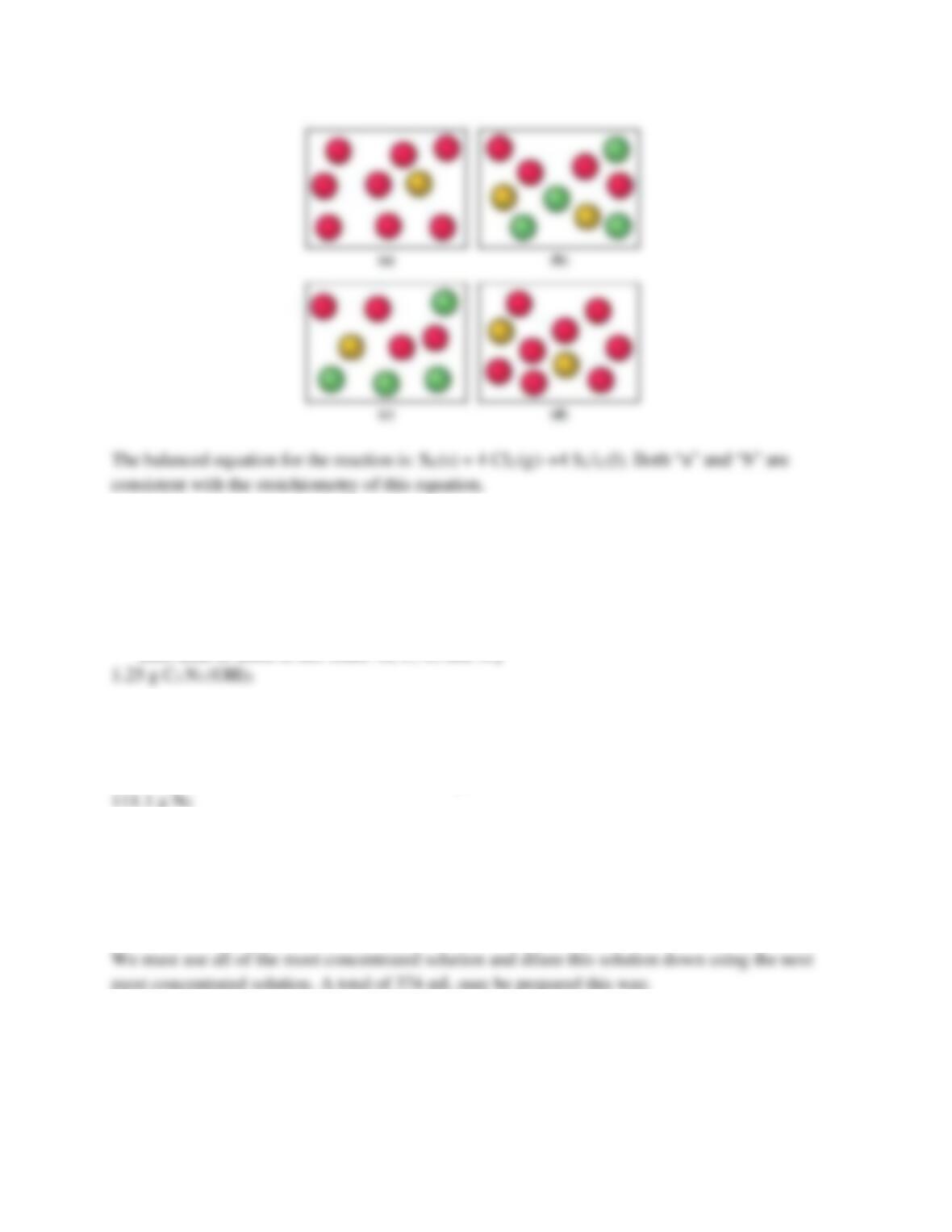
122. When sulfur
( )
8
S
and chlorine are mixed in a reaction vessel, disulfur dichloride is the
sole product. The starting mixture below is represented by yellow spheres for the
8
S
molecules and green spheres for the chlorine molecules.
Which of the following is (are) a valid representation(s) of the contents of the reaction vessel
after some disulfur dichloride (represented by red spheres) has formed?
123. A method for eliminating oxides of nitrogen (e.g., NO2) from automobile exhaust gases is
to pass the exhaust gases over solid cyanuric acid, C3N3(OH)3. When the hot exhaust gases
come in contact with cyanuric acid, solid C3N3(OH)3 decomposes into
isocyanic acid vapor, HNCO(g), which then reacts with NO2 in the exhaust gases to give N2,
CO2, and H2O. How many grams of C3N3(OH)3 are needed per gram of NO2 in this method?
[Hint: To balance the equation for reaction between HNCO and NO2, balance with respect to
each kind of atom in this order: H, C, O, and N.]
124. For a specific reaction, ammonium dichromate is the only reactant and chromium(III)
oxide and water are two of the three products. The third product contains only one type of
atom. What is the third product and how many grams of this product are produced per
kilogram of ammonium dichromate decomposed?
125. It is desired to produce as large a volume of 1.25 M urea
( ) ( )
22
CO NH aq
as possible
from these three sources: 345 mL of 1.29 M
( )
22
CO NH ,
485 mL of 0.653 M
( )
22
CO NH ,
and
835 mL of 0.775 M
( )
22
CO NH
How can this be done? What is the maximum volume of this
solution obtainable?
126. The mineral ilmenite,
3
FeTiO ,
is an important source of titanium dioxide for use as a
white pigment. In the first step in its conversion to titanium dioxide, ilmenite is treated with
sulfuric acid and water to form
4
TiOSO
and iron(II) sulfate heptahydrate. Titanium dioxide
is obtained in two subsequent steps. How many kilograms of iron(II) sulfate heptahydrate are
produced for every
3
1 00 10 kg
of ilmenite processed?
127. Refer to Exercise 126. Iron(II) sulfate heptahydrate formed in the processing of ilmenite
ore cannot be released into the environment. Its further treatment involves dehydration by
heating to produce anhydrous iron(II) sulfate. Upon further heating, the iron(II) sulfate
decomposes to iron(III) oxide, and sulfur dioxide and oxygen gases. The iron(III) oxide is
used in the production of iron and steel. How many kilograms of iron(III) oxide are obtained
for every
3
1 00 10 kg
of iron(II) sulfate heptahydrate?
128. Melamine,
( )
3 3 2 3
C N NH ,
is used in adhesives and resins. It is manufactured in a two-
step process in which urea,
( )
22
CO NH ,
is the sole starting material, isocyanic acid (HNCO)
is an intermediate, and ammonia and carbon dioxide gases are by-products.
(a) Write a balanced equation for the overall reaction.
(b)
What mass of melamine will be obtained from 100.0 kg of urea if the yield of the overall
reaction is 84%?
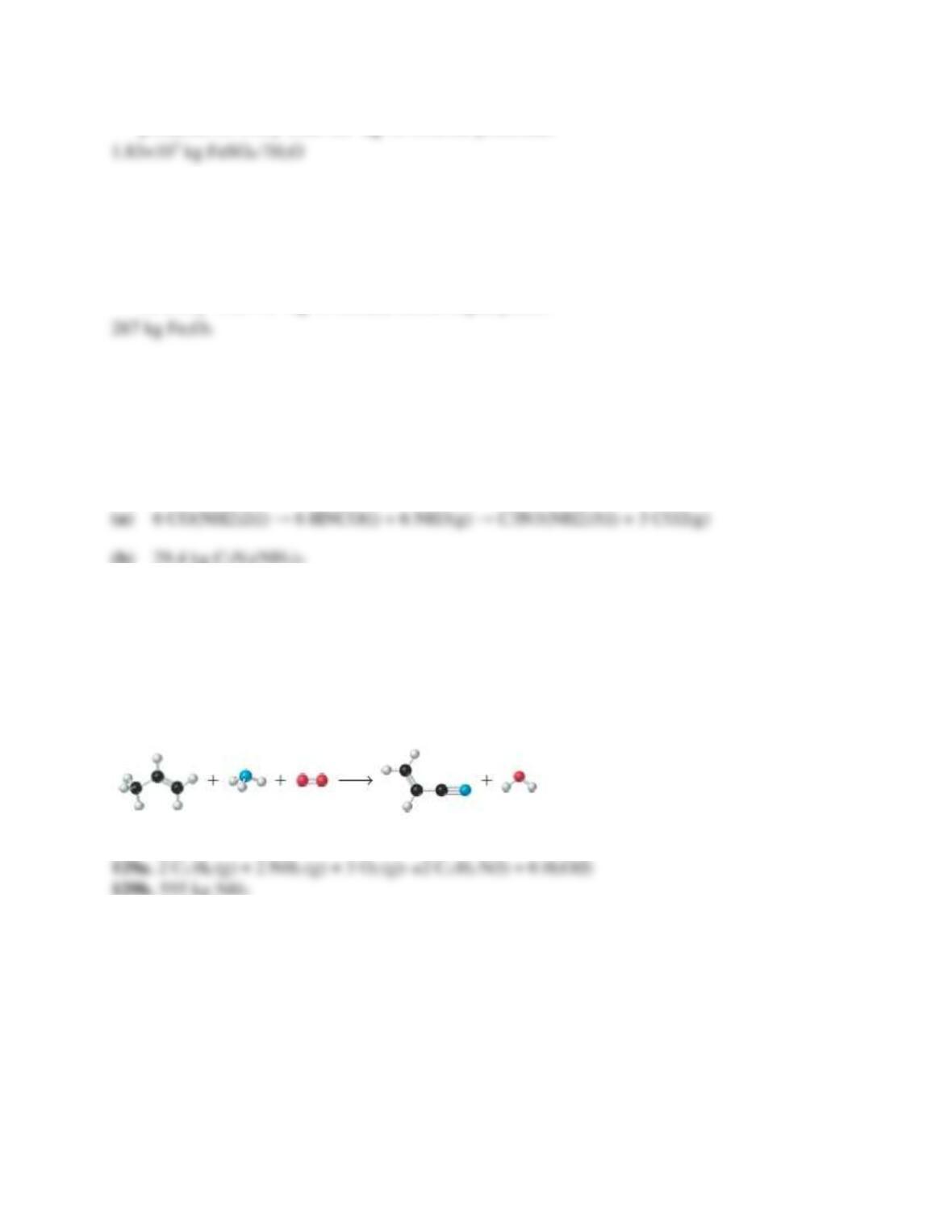
129. Acrylonitrile is used in the production of synthetic fibers, plastics, and rubber goods. It
can be prepared from propylene (propene), ammonia, and oxygen in the reaction illustrated
below.
(a) Write a balanced chemical equation for this -reaction.
(b)
The actual yield of the reaction is 0.73 kg acrylonitrile per kilogram of propylene. What is
the -minimum mass of ammonia required to produce
1.00 metric ton (1000 kg) of acrylonitrile?
130. A fundamental principle in green chemistry is atom economy (AE). AE is a measure of
how many atoms from the starting materials are incorporated into the desired product. For
example, if a reaction incorporates all the reactant atoms into the product of interest, the
reaction has a percent AE of 100%. To obtain percent AE for a reaction, we calculate the
mass of the desired product that can be formed from a stoichiometric mixture of reactants,
and compare this mass with the total mass of that reaction mixture. (In a stoichiometric mixture
of reactants, none of the reactants are present in excess; the mole amounts are in the same
ratio as the stoichiometric coefficients).
131. The industrial production of hydrazine (N2H4) by the Raschig process is the topic of the
Focus On feature for Chapter 4 on www.masteringchemistry.com. The following chemical
equation represents the overall process, which actually involves three consecutive reactions.
2 NH3(aq) + Cl2(g) + 2 NaOH(aq)
→
N2H4(aq) + 2 NaCl(aq) + 2 H2O(l)
(a) Use the definition of percent atom economy (AE) from exercise 130 to calculate, to the
nearest percent, the percent AE for the Raschig process.
(b) Propose a reaction for the synthesis of N2H4 that has percent AE of 100%.
132. It is often difficult to determine the concentration of a species in solution, particularly if it
is a biological species that takes part in complex reaction pathways. One way to do this is
through a dilution experiment with labeled molecules. Instead of molecules, however, we
will use fish.
Feature Problems
133. Lead nitrate and potassium iodide react in aqueous solution to form a yellow precipitate of
lead iodide. In one series of experiments, the masses of the two reactants were varied, but the
total mass of the two was held constant at 5.000 g. The lead iodide formed was filtered from
solution, washed, dried, and weighed. The table gives data for a series of reactions.
Experiment
Mass of
Lead
Mass of
Lead Iodide,
Nitrate, g
g
1
0.500
0.692
2
1.000
1.388
3
1.500
2.093
4
3.000
2.778
5
4.000
1.391
(a) Plot the data in a graph of mass of lead iodide versus mass of lead nitrate, and draw the
appropriate curve(s) connecting the data points. What is the maximum mass of precipitate
that can be obtained?
(b) Explain why the maximum mass of precipitate is obtained when the reactants are in their
stoichiometric proportions. What are these stoichiometric proportions expressed as a mass ratio,
and as a mole ratio?
(c) Show how the stoichiometric proportions determined in part (b) are related to the balanced
equation for the reaction.
(b) The total quantity of reactant is limited to 5.000 g. If either reactant is in excess, the
amount in excess will be “wasted,” because it cannot be used to form product. Thus,
we obtain the maximum amount of product when neither reactant is in excess (i.e.,
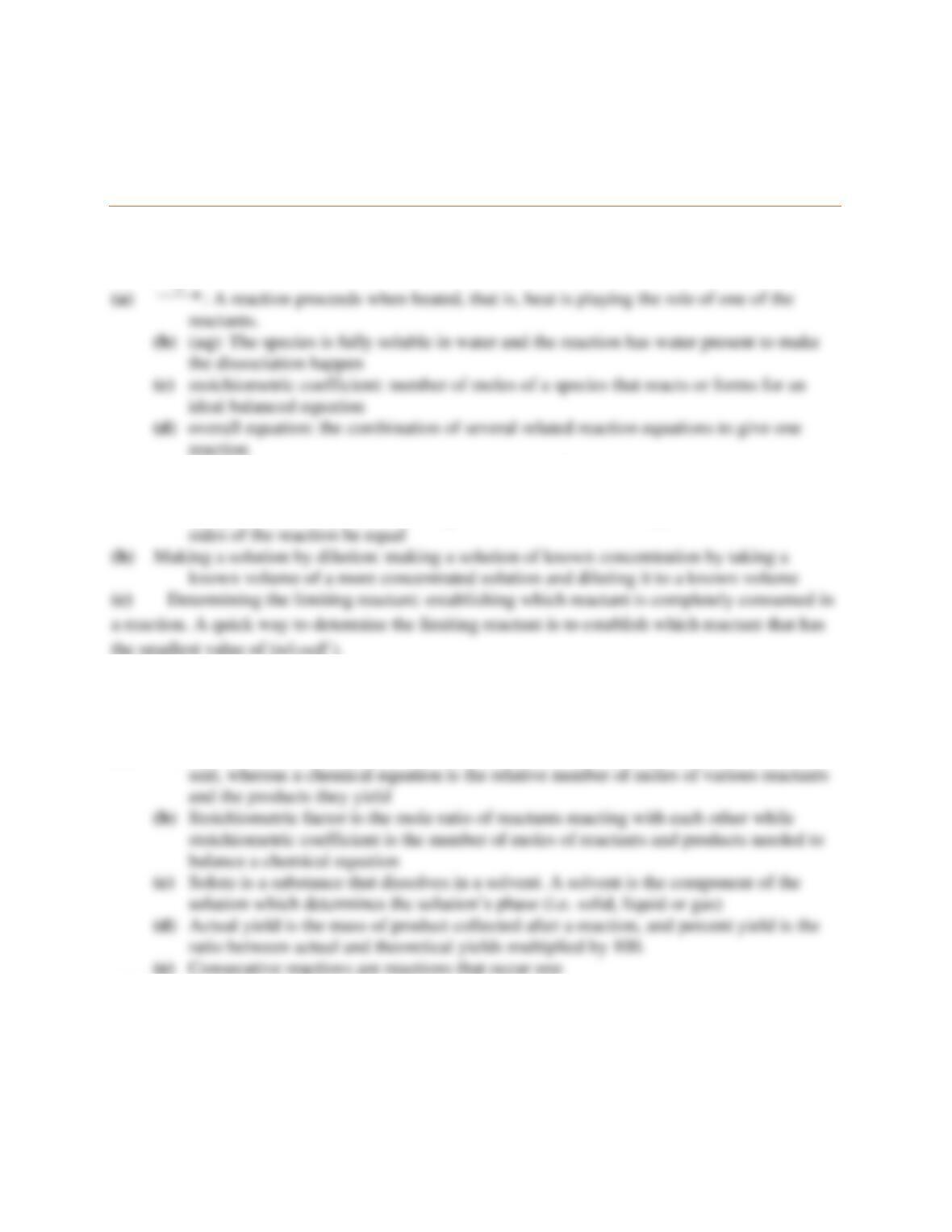
134. Baking soda,
3
NaHCO ,
is made from soda ash, a common name for sodium carbonate.
The soda ash is obtained in two ways. It can be manufactured in a process in which carbon
dioxide, ammonia, sodium chloride, and water are the starting materials. Alternatively, it is
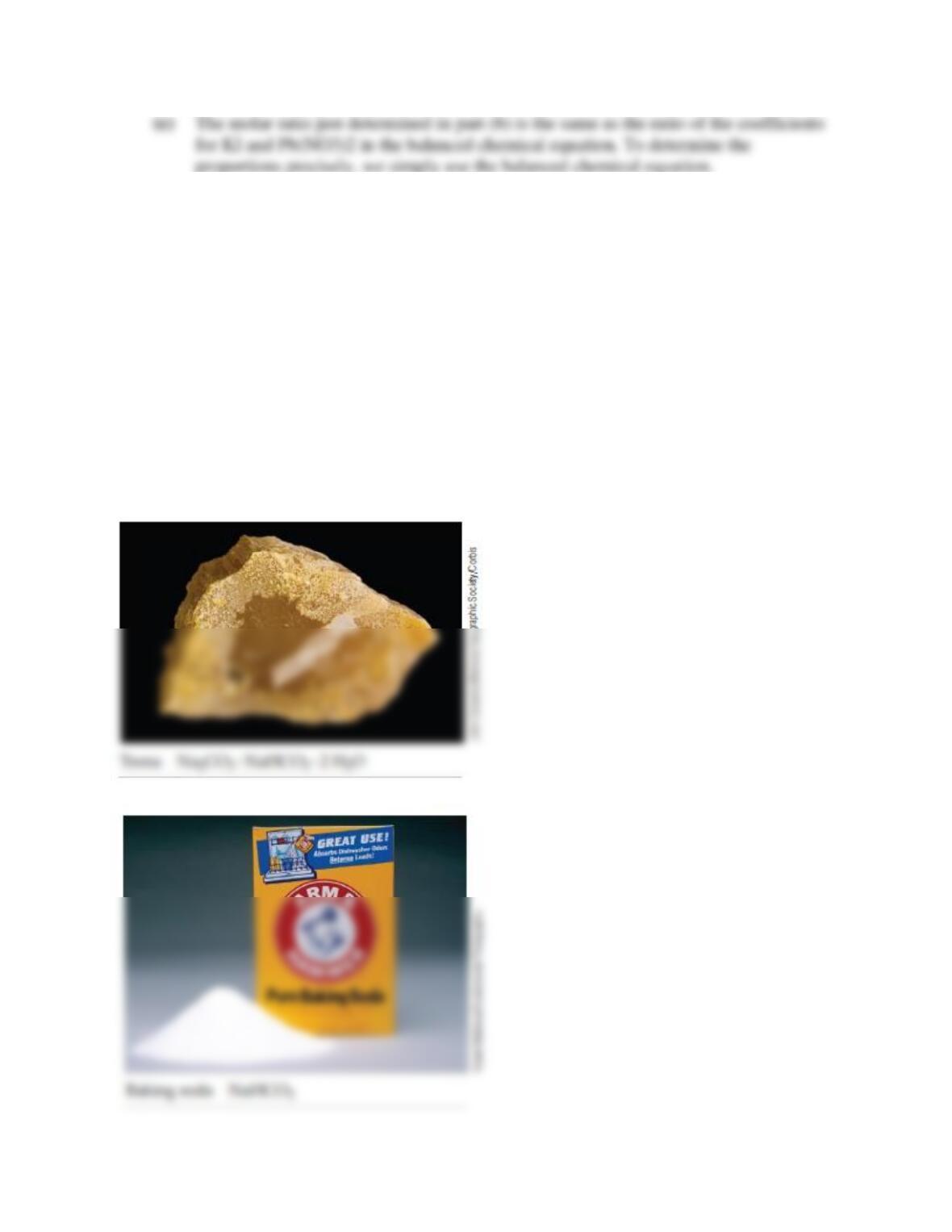
mined as a mineral called trona (top photo). Whether the soda ash is mined or manufactured,
it is dissolved in water and carbon dioxide is bubbled through the solution. Sodium
bicarbonate precipitates from the solution.
As a chemical analyst you are presented with two samples of sodium bicarbonate—one from the
manufacturing process and the other derived from trona. You are asked to determine which
is purer and are told that the impurity is sodium carbonate. You decide to treat the samples
with just sufficient hydrochloric acid to convert all the sodium carbonate and bicarbonate to
sodium chloride, carbon dioxide, and water. You then precipitate silver chloride in the
reaction of sodium chloride with silver nitrate. A 6.93 g sample of baking soda derived from
trona gave 11.89 g of silver chloride. A 6.78 g sample from manufactured sodium carbonate
gave 11.77 g of silver chloride. Which sample is purer, that is, which has the greater mass
percent
3
NaHCO ?
The trona sample is purer
Self-Assessment Exercises
135. In your own words, define or explain these terms or symbols.
(a)
⎯⎯→
(b) (aq)
(c) stoichiometric coefficient (d) overall equation
136. Briefly describe (a) balancing a chemical equation; (b) preparing a solution by dilution;
(c) determining the limiting reactant in a reaction.
(a) Balancing a chemical equations: making the total number of each type of atoms on both
137. Explain the important distinctions between (a) chemical formula and chemical equation;
(b) stoichiometric coefficient and stoichiometric factor; (c) solute and solvent; (d) actual yield
and percent yield; (e) consecutive and simultaneous reactions.
(a) Chemical formula is the number and kind of each atom constituting a molecule or formula
138. When the equation below is balanced, the correct set of stoichiometric coefficients is (a)
1 6 1 3 4, , , ;→
(b)
1 4 1 2 2, , , ;→
(c)
2 6 2 3 2, , , ;→
(d)
3 8 3 4 2, , ,→
( ) ( )
3
Cu s HNO aq??+→
( ) ( ) ( ) ( )
32
2
Cu NO aq H O l NO g? ? ?++
139. A reaction mixture contains 1.0 mol
2
CaCN
(calcium cyanamide) and 1.0 mol
2
HO
. The
maximum number of moles of
3
NH
produced is (a) 3.0; (b) 2.0;
(c) between 1.0 and 2.0; (d) less than 1.0.
( ) ( ) ( ) ( )
2 2 3 3
CaCN s 3 H O l CaCO s 2 NH g+ → +
140. Consider the chemical equation below. What is the maximum number of moles of K2SO4
that can be obtained from a reaction mixture containing 5.0 moles each of KMnO4, KI, and
H2SO4? (a) 3.0 mol; (b) 3.8 mol; (c) 5.0 mol; (d) 6.0 mol; (e) 15 mol.
2 KMnO4
+
10 KI
+
8 H2SO4
→
6 K2SO4
+
2 MnSO4 + 5 I2 + 8 H2O
141. In the decomposition of silver carbonate to form metallic silver, carbon dioxide gas, and
oxygen gas, (a) one mol of oxygen gas is formed for every 2 mol of carbon dioxide gas; (b)
2 mol of silver metal is formed for every 1 mol of oxygen gas; (c) equal numbers of moles
of carbon dioxide and oxygen gases are produced; (d) the same number of moles of silver
metal are formed as of the silver carbonate decomposed.
142. To obtain a solution that is 1.00 M
3
NaNO ,
you should prepare (a) 1.00 L of aqueous
solution containing 100 g
3
NaNO ;
(b) 1 kg of aqueous solution containing 85.0 g
3
NaNO ;
(c) 5.00 L of aqueous solution containing 425 g
3
NaNO ;
(d) an aqueous solution containing
8.5 mg
NaNO mL/
143. What is the volume (in mL) of 0.160 M KNO3 that must be added to 200.0 mL of 0.240
M K2SO4 to produce a solution having [K+] = 0.400 M?
144. To prepare a solution that is 0.50 M KCl starting with 100.0 mL of 0.40 M KCl, you
should (a) add 20.0 mL of water; (b) add 0.075 g KCl; (c) add 0.10 mol KCl; (d) evaporate
20.0 mL of water.
145. An aqueous solution that is 5.30% LiBr by mass has a density of 1.040 g/mL. What is the
molarity of this solution? (a) 0.563 M; (b) 0.635 M; (c) 0.0635 M; (d) 0.0563 M; (e) 12.0 M.
146. In the reaction of 2.00 mol
4
CCl
with an excess of HF, 1.70 mol
22
CCl F
is obtained.
4 2 2
CCl 2 HF CCl F 2 HCl+ → +
(a) The theoretical yield is 1.70 mol
22
CCl F
(b)
The theoretical yield is 1.00 mol
22
CCl F
(c) The theoretical yield depends on how large an excess of HF is used.
147. Consider the reaction 2 Fe2O3 + 3 C
→
4 Fe +
3 CO2. What is the maximum mass of Fe that can be obtained from a reaction mixture
containing 18.0 g Fe2O3 and 2.5 g C?
148. A 26.4 g sample of a mixture of NaOH and CaO contains 40.0% CaO. When the sample
is treated with aqueous HCl, the following reactions occur:
NaOH(s) + HCl(aq)
→
NaCl(aq) + H2O(l)
CaO(s) + 2 HCl(aq)
→
CaCl2(aq) + H2O(l)
All of the mixture reacts, and no HCl is left over. The resulting solution is evaporated to
dryness. What is the mass (in grams) of solid obtained?
149. The incomplete combustion of gasoline produces CO(g) as well as
( )
2
CO g
Write an
equation for (a) the complete combustion of the gasoline component octane,
( )
8 18
C H l ,
and
(b) incomplete combustion of octane with 25% of the carbon appearing as CO(g).
150. The minerals calcite,
3
CaCO ,
magnesite,
3
MgCO ,
and dolomite,
33
CaCO MgCO
,
decompose when strongly heated to form the corresponding metal oxide(s) and carbon
dioxide gas. A 1.000 g sample known to be one of the three minerals was strongly heated and
0.477 g
2
CO
was obtained. Which of the three minerals was it?
151. A 1.000 g sample of a mixture of CH4 and C2H6 is analyzed by burning it completely in
O2, yielding 2.776 g CO2. What is the percentage by mass of CH4 in the mixture? (a) 93%;
(b) 82%; (c) 67%; (d) 36%; (e) less than 36%.
152. Nitric acid, HNO3, can be manufactured from ammonia, NH3, by using the three
reactions shown below.
Step 1: 4 NH3(g)
+
5 O2(g)
→
4 NO(g)
+
6 H2O(l)
Step 2: 2 NO(g)
+
O2(g)
→
2 NO2(g)
Step 3: 3 NO2(g)
+
H2O(l)
→
2 HNO3(aq)
+
NO(g)
What is the maximum number of moles of HNO3 that can be obtained from 4.00 moles of
NH3? (Assume that the NO produced in step 3 is not
recycled back into step 2.) (a) 1.33 mol; (b) 2.00 mol;
(c) 2.67 mol; (d) 4.00 mol; (e) 6.00 mol.
153. For each of the following compounds, write a balanced chemical equation for forming
the compound from its elements. What is the percent atom economy in each case? (a)
RbBrO4; (b) H2SO4;
(c) Mg(ClO3)2; (d) NaNO2.
154. Appendix E describes a useful study aid known as concept mapping. Using the method presented