Chapter 4
Chemical Reactions
Exercises
Writing and Balancing Chemical Equations
1. Balance the following equations by inspection.
(a)
3 2 2
SO SO O→+
(b)
2 7 2 4
Cl O H O HClO+→
(c)
2 2 3
NO H O HNO NO+ → +
(d)
3 2 3 3
PCl H O H PO HCl+ → +
2. Balance the following equations by inspection.
(a)
2 4 3 4
P H PH P→+
(b)
4 2 3
P Cl PCl+→
(c)
3 2 2 3
FeCl H S Fe S HCl+ → +
(d)
( )
3 2 2 3
2
Mg N H O Mg OH NH+ → +
3. Balance the following equations by inspection.
(a)
3 2 2
PbO NH Pb N H O+ → + +
(b)
4 2 3 2 2
FeSO Fe O SO O→ + +
(c)
2 2 3 4 4 4 8
S Cl NH N S NH Cl S+ → + +
(d)
( )
3 7 2 5 2 2 2 2
C H CHOHCH C H CH OH O CO H O+ → +
4.Balance the following equations by inspection.
(a)
2 2 2 2 2
SO Cl HI H S H O HCl I+ → + + +
(b)
3 2 4 2
FeTiO H SO H O+ + →
4 2 4
FeSO 7 H O TiOSO+
(c)
3 4 2 3 2 2
Fe O HCl Cl FeCl H O O+ + → + +
(d)
6 5 2 2 6 5 2
C H CH SSCH C H O+→
2 2 2
CO SO H O++
5. Write balanced equations based on the information given.
(a)
solid magnesium oxygen gas+→
solid magnesium oxide
(b)
nitrogen monoxide gas oxygen gas+→
nitrogen dioxide gas
(c)
( )
26
gaseous ethane C H oxygen gas+→
carbon dioxide gas liquid water+
(d)
aqueous silver sulfate +
aqueous barium iodide →
solid barium sulfate + solid silver iodide
6. Write balanced equations based on the information given.
(a)
solid magnesium nitrogen gas+→
solid magnesium nitride
(b)
solid potassium chlorate →
solid potassium chloride oxygen gas+
(c)
solid sodium hydroxide +
solid ammonium chloride →
solid sodium chloride
+
gaseous ammonia
+
water vapor
(d)
solid sodium liquid water+→
aqueous sodium hydroxide hydrogen gas+
7. Write balanced equations to represent the complete combustion of each of the following in excess
–oxygen: (a) butane,
( )
4 10
C H g ;
(b) isopropyl alcohol,
( ) ( )
33
CH CH OH CH l ;
(c) lactic acid,
( ) ( )
3
CH CH OH COOH s
8. Write balanced equations to represent the complete combustion of each of the following in
excess -oxygen: (a) propylene,
( )
36
C H g ;
(b) thiobenzoic acid,
( )
65
C H COSH l ;
(c) glycerol,
( )
CH OH CH
( ) ( )
OH CH OH l
9. Write balanced equations to represent:
(a) the decomposition, by heating, of solid ammonium nitrate to produce dinitrogen monoxide
gas (laughing gas) and water vapor
(b)
the reaction of aqueous sodium carbonate with hydrochloric acid to produce water, carbon
dioxide gas, and aqueous sodium chloride
(c) the reaction of methane
( )
4
CH ,
ammonia, and oxygen gases to form gaseous hydrogen
cyanide (HCN) and water vapor
10. Write balanced equations to represent:
(a) the reaction of sulfur dioxide gas with oxygen gas to produce sulfur trioxide gas (one of
the reactions involved in the industrial preparation of sulfuric acid)
(b)
the dissolving of limestone (calcium carbonate) in water containing dissolved carbon
dioxide to produce calcium hydrogen carbonate (a reaction producing temporary hardness in
groundwater)
(c) the reaction of ammonia and nitrogen monoxide to form nitrogen gas and water vapor
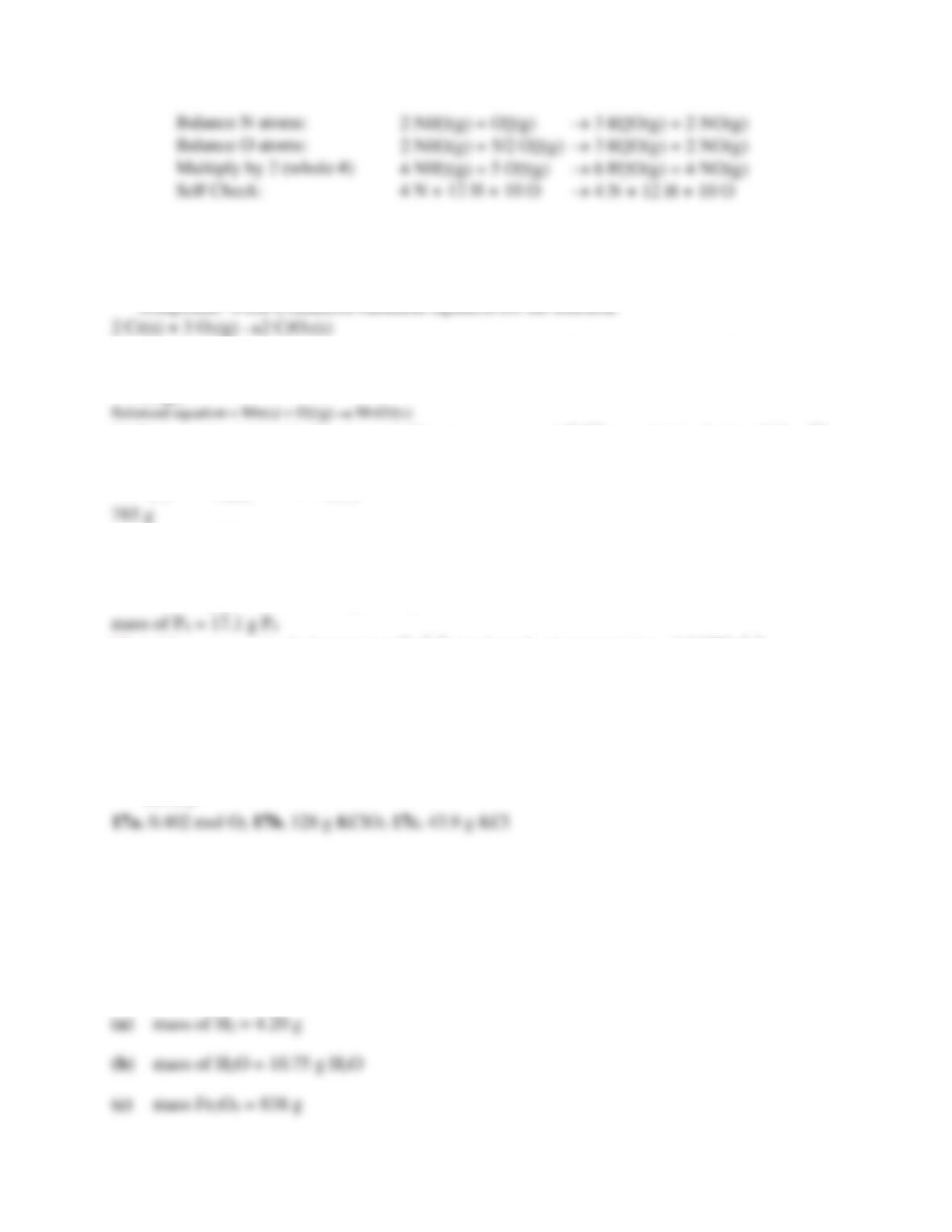
11. Write a balanced chemical equation for the reaction depicted below.
12. Write a balanced chemical equation for the reaction depicted below.
Stoichiometry of Chemical Reactions
13. In an experiment, 0.689 g Cr(s) reacts completely with 0.636 g
2
O
(g) to form a single solid
compound. Write a balanced chemical equation for the reaction.
14. A 3.104 g sample of an oxide of manganese contains 1.142 grams of oxygen. Write a
balanced chemical equation for the reaction that produces the compound from Mn(s) and
O2(g).
15. Iron metal reacts with chlorine gas. How many grams of
3
FeCl
are obtained when 515 g
2
Cl
reacts with excess Fe?
( ) ( ) ( )
23
2 Fe s 3 Cl g 2 FeCl s+→
16. If 75.8 g
3
PCl
is produced by the reaction
( ) ( ) ( )
2 4 3
6 Cl g P s 4 PCl l+→
how many grams each of
2
Cl
and
4
P
are consumed?
17. A laboratory method of preparing
( )
2
Og
involves the decomposition of
( )
3
KClO s
( ) ( ) ( )
32
2 KClO s 2 KCl s 3 O g
⎯⎯→ +
(a) How many moles of
( )
2
Og
can be produced by the decomposition of 32.8 g
3
KClO ?
(b)
How many grams of
3
KClO
must decompose to produce 50.0 g
2
O?
(c) How many grams of KCl are formed, together with 28.3 g
2
O,
in the decomposition of
KClO ?
18. A commercial method of manufacturing hydrogen involves the reaction of iron and steam.
( ) ( ) ( ) ( )
2 3 4 2
3 Fe s 4 H O g Fe O s 4 H g
+ ⎯⎯→ +
(a) How many grams of
2
H
can be produced from 87.2 g Fe and an excess of
( )
2
H O g
(steam)?
(b)
How many grams of
2
HO
are consumed in the conversion of 25.0 g Fe to
34
Fe O ?
(c) If 29.2 g
2
H
is produced, how many grams of
34
Fe O
must also be produced?
19. How many grams of
23
Ag CO
are decomposed to yield 75.1 g Ag in this reaction?
( )
23
Ag CO s
⎯⎯→
( ) ( ) ( ) ( )
22
Ag s CO g O g not balanced++
20. How many kilograms of
3
HNO
are consumed to produce 125 kg
( )
24
2
Ca H PO
in this
reaction?
( )
3 4 3
2
Ca PO HNO+→
( ) ( ) ( )
Ca H PO Ca NO not balanced+
21. The reaction of calcium hydride with water can be used to prepare small quantities of
hydrogen gas, as is done to fill weather-observation balloons.
( ) ( )
22
CaH s H O l+→
( ) ( ) ( ) ( )
2
2
Ca OH s H g not balanced+
(a) How many grams of
( )
2
Hg
result from the reaction of 127 g
2
CaH
with an excess of
water?
(b)
How many grams of water are consumed in the reaction of 56.2 g
2
CaH ?
(c) What mass of
( )
2
CaH s
must react with an excess of water to produce
24
8 12 10
molecules of
2
H?
22. The reaction of potassium superoxide,
2
KO ,
is used in life-support systems to replace
( )
2
CO g
in expired air with
( )
2
Og
The unbalanced chemical equation for the reaction is
given below.
( ) ( ) ( ) ( )
2 2 2 3 2
KO s CO g K CO s O g+ → +
(a) How many moles of
( )
2
Og
are produced by the reaction of 88.0 g
( )
2
CO g
with excess
( )
2
KO s ?
(b)
How many grams of
( )
2
KO s
are consumed per 1.000 * 103 g
( )
2
CO g
removed from
expired air?
(c) How many moles of K2CO3 are produced per milligram of
2
KO
consumed?
23. Iron ore is impure
23
Fe O
When
23
Fe O
is heated with an excess of carbon (coke), metallic
iron and carbon monoxide gas are produced. From a sample of ore weighing 938 kg, 523 kg
of pure iron is obtained. What is the mass percent
23
Fe O
in the ore sample, assuming that
none of the impurities contain Fe?
24. Solid silver oxide,
( )
2
Ag O s ,
decomposes at temperatures in excess of 300 °C, yielding
metallic silver and oxygen gas. A 3.13 g sample of impure silver oxide yields 0.187 g
( )
2
Og
What is the mass percent
2
Ag O
in the sample? Assume that
( )
2
Ag O s
is the only
source of
( )
2
Og
[Hint: Write a balanced equation for the reaction.]
25. Decaborane, B10H14, was used as a fuel for rockets in the 1950s. It reacts violently with
oxygen, O2, to produce B2O3 and water. Calculate the percentage by mass of B10H14 in a fuel
mixture designed to ensure that B10H14 and O2 run out at exactly the same time. (Such a
26. The rocket boosters of the space shuttle Discovery, launched on July 26, 2005, used a fuel
mixture containing primarily solid ammonium perchlorate, NH4ClO4(s), and aluminum
metal. The unbalanced chemical equation for the reaction is given below.
Al(s)
+
NH4ClO4(s)-
→
Al2O3(s)
+
AlCl3(s)
+
H2O(l)
+
N2(g)
What is the minimum mass of NH4ClO4 consumed, per kilogram of Al, by the reaction of
NH4ClO4 and Al? [Hint: Balance the elements in the order Cl, H, O, Al, N.]
27. A piece of aluminum foil measuring
10 25 cm
5 50 cm 0 601 mm
is dissolved in excess
HCl(aq). What mass of
( )
2
Hg
is produced? Use equation (4.2)
and
3
2 70 g/cmd=
for Al.
28. An excess of aluminum foil is allowed to react with 225 mL of an aqueous solution of HCl
( )
1 088 g/mLd=
that contains 18.0% HCl by mass. What mass of
( )
2
Hg
is produced? [Hint:
Use equation (4.2).]
29. Without performing detailed calculations, which of the following metals yields the greatest
amount of
2
H
per gram of metal reacting with HCl(aq)? (a) Na, (b) Mg, (c) Al, (d) Zn.
30. Without performing detailed calculations, which of the following yields the same mass of
( )
2
CO g
per gram of compound as does ethanol,
32
CH CH OH,
when burned in excess
oxygen? (a)
2
H CO;
Molarity
31. What are the molarities of the following solutes when dissolved in water?
(a) 2.92 mol
3
CH OH
in 7.16 L of solution
(b)
7.69 mmol
32
CH CH OH
in 50.00 mL of solution
(c) 25.2 g
( )
22
CO NH
in 275 mL of solution
32. What are the molarities of the following solutes when dissolved in water?
(a)
4
32
2 25 10 mol CH CH OH
−
in 125 mL of solution
(b)
57.5 g
( )
32
CH CO
in 525 mL of solution
(c) 18.5 mL of
( ) ( )
35 3
C H OH 1 26 g/mLd=
in 375 mL of solution
33. What are the molarities of the following solutes?
(a) sucrose
( )
12 22 11
C H O
if 150.0 g is dissolved per 250.0 mL of water solution
(b)
urea,
( )
22
CO NH ,
if 98.3 mg of the 97.9% pure solid is dissolved in 5.00 mL of aqueous
solution
(c) methanol,
3
CH OH,
( )
0 792 g/mLd=
if 125.0 mL is dissolved in enough water to make
15.0 L of solution
34. What are the molarities of the following solutes?
(a) aspartic acid
( )
2 4 5 4
H C H NO
if 0.405 g is dissolved in enough water to make 100.0 mL of
solution
(b)
acetone,
( )
32
CH CO,
( )
0 790 g/mLd=
if 35.0 mL is dissolved in enough water to make
425 mL of solution
(c) diethyl ether,
( )
25
2
C H O,
if 8.8 mg is dissolved in enough water to make 3.00 L of
solution
35. How much
(a) glucose,
6 12 6
C H O ,
in grams, must be dissolved in water to produce 75.0 mL of 0.350 M
6 12 6
C H O
?
(b)
methanol,
3
CH OH
( )
0 792 g/mLd,=
in milliliters, must be dissolved in water to
produce 2.25 L of 0.485 M
3
CH OH?
36. How much
(a) ethanol,
32
CH CH OH
( )
0 789 g/mLd,=
in liters, must be dissolved in water to produce
200.0 L of 1.65 M
32
CH CH OH
?
(b)
concentrated hydrochloric acid solution (36.0% HCl by mass;
1 18 g/mLd=
), in
milliliters, is required to produce 12.0 L of 0.234 M HCl?
37. In the United States, the concentration of glucose, C6H12O6, in the blood is reported in units
of -milligrams per deciliter (mg/dL). In Canada, the United Kingdom, and elsewhere, the
blood glucose concentration is reported in millimoles per liter (mmol/L), where 1
mmol
=
1
3
10−
mol. If a person has a blood glucose level of 85 mg/dL, then what is (a) the
blood glucose level in mmol/L; (b) the molarity of glucose in the blood?
38. In many communities, water is fluoridated to prevent tooth decay. In the United States, for
example, more than half of the population served by public water systems has access to water
that is fluoridated at approximately 1 mg F− per liter. (a) What is the molarity of F− in water
if it contains 1.2 mg F− per liter?
(b) How many grams of solid KF should be added to a 1.6
108 L water reservoir to give a
fluoride concentration of 1.2 mg F− per liter?
39. Which of the following is a 0.500 M KCl solution? (a)
0 500 g KCl/mL
solution; (b) 36.0
g
KCl/L
solution; (c) 7.46 mg
KCl/mL
solution; (d) 373 g KCl in 10.00 L solution.
40. Which two solutions have the same concentration?
41. Which has the higher concentration of sucrose: a 46% sucrose solution by mass
( )
d 1 21 g/mL ,=
or 1.50 M
12 22 11
C H O ?
Explain your reasoning.
42. Which has the greater molarity of ethanol: a white wine
( )
0 95 g/mLd=
with 11%
32
CH CH OH
43. A 10.00 mL sample of 2.05 M
3
KNO
is diluted to a volume of 250.0 mL. What is the
concentration of the diluted solution?
44. What volume of 2.00 M
3
AgNO
must be diluted with water to prepare 500.0 mL of 0.350 M
3
AgNO ?
45. Water is evaporated from 125 mL of 0.198 M
24
K SO
solution until the volume becomes 105
mL. What is the molarity of
24
K SO
in the remaining solution?
46. A 25.0 mL sample of HCl(aq) is diluted to a volume of 500.0 mL. If the concentration of the
diluted solution is found to be 0.085 M HCl, what was the concentration of the original
solution?
47. Given a 0.250 M
24
K CrO
stock solution, describe how you would prepare a solution that is
0.0125 M
24
K CrO
That is, what combination(s) of pipet and volumetric flask would you
use? Typical sizes of volumetric flasks found in a general chemistry laboratory are 100.0,
250.0, 500.0, and 1000.0 mL, and typical sizes of volumetric pipets are 1.00, 5.00, 10.00,
25.00, and 50.00 mL.
48. Given two liters of 0.496 M KCl, describe how you would use this solution to prepare 250.0
mL of 0.175 M KCl. Give sufficient details so that another student could follow your
instructions.
Chemical Reactions in Solution
49. Consider the reaction below:
( ) ( )
32
2 AgNO aq Na S s+→
( ) ( )
23
Ag S s 2 NaNO aq+
(a) How many grams of
( )
2
Na S s
are required to react completely with 27.8 mL of 0.163 M
3
AgNO ?
(b)
How many grams of
( )
2
Ag S s
are obtained from the reaction in part (a)?
50. Excess
3
NaHCO
is added to 525 mL of 0.220 M
( )
32
Cu NO
. These substances react as
follows:
( ) ( ) ( )
33
2
Cu NO aq 2 NaHCO s+→
( ) ( ) ( ) ( )
3 3 2 2
CuCO s 2 NaNO aq H O l CO g+ + +
(a) How many grams of the
( )
3
NaHCO s
will be -consumed?
(b)
How many grams of
( )
3
CuCO s
will be produced?
51. How many milliliters of 0.650 M
24
K CrO
are needed to precipitate all the silver in 415 mL
of 0.186 M
3
AgNO
as
( )
24
Ag CrO s ?
( ) ( )
3 2 4
2 AgNO aq K CrO aq+→
( ) ( )
2 4 3
Ag CrO s 2 KNO aq+
52. Consider the reaction below.
( ) ( ) ( )
2
Ca OH s 2 HCl aq+→
( ) ( )
22
CaCl aq 2 H O l+
(a) How many grams of
( )
2
Ca OH
are required to react completely with 415 mL of 0.477 M
HCl?
(b)
How many kilograms of
( )
2
Ca OH
are required to react with 324 L of a HCl solution that
is 24.28% HCl by mass, and has a density of
1 12 g/mL?
53. Exactly 1.00 mL of an aqueous solution of HNO3 is diluted to 100.0 mL. It takes 29.78
mL of 0.0142 M Ca(OH)2 to convert all of the HNO3 to Ca(NO3)2. The other product of
the reaction is water. Calculate the molarity of the undiluted HNO3 solution.
54. A 5.00 mL sample of an aqueous solution of H3PO4 requires 49.1 mL of 0.217 M NaOH to
convert all of the H3PO4 to Na2HPO4. The other product of the reaction is water. Calculate the
molarity of the H3PO4 solution.
55. Refer to Example 4-6 and equation (4.2). For the conditions stated in Example 4-6, determine
(a) the number of moles of
3
AlCl
and (b) the molarity of the
( )
3
AlCl aq
if the solution
volume is simply the 23.8 mL calculated in the example.
56. Refer to the Integrative Example on page 140. If 138 g
23
Na CO
in 1.42 L of aqueous
solution is treated with an excess of NO(g) and
( )
2
Og,
what is the molarity of the
( )
2
NaNO aq
solution that results? (Assume that the reaction goes to completion.)
57. How many grams of
24
Ag CrO
will precipitate if excess
( )
24
K CrO aq
is added to the 415 mL
of 0.186 M
3
AgNO
in Exercise 51?
58. What volume of 0.0665 M
4
KMnO
is necessary to convert 12.5 g KI to
2
I
in the reaction
below? Assume that H2SO4 is present in excess.
4 2 4
2 KMnO 10 KI 8 H SO+ + →
6 K SO 2 MnSO 5 I 8 H O+ + +
59. How many grams of sodium must react with 155 mL
2
HO
to produce a solution that is 0.175
M NaOH? (Assume a final solution volume of 155 mL.)
( ) ( ) ( ) ( )
22
2 Na s 2 H O l 2 NaOH aq H g+ → +
60. A method of lowering the concentration of HCl(aq) is to allow the solution to react with a
small quantity of Mg. How many milligrams of Mg must be added to 250.0 mL of 1.023 M
HCl to reduce the solution concentration to exactly 1.000 M HCl?
( ) ( ) ( ) ( )
22
Mg s 2 HCl aq MgCl aq H g+ → +
61. A 0.3126 g sample of oxalic acid,
2 2 4
H C O ,
requires 26.21 mL of a particular concentration
of NaOH(aq) to complete the following reaction. What is the molarity of the NaOH(aq)?
( ) ( )
2 2 4
H C O s 2 NaOH aq+→
( ) ( )
2 2 4 2
Na C O aq 2 H O l+
62. A 25.00 mL sample of HCl(aq) was added to a 0.1000 g sample of
3
CaCO
All the
3
CaCO
reacted, leaving some excess HCl(aq).
( ) ( )
3
CaCO s 2 HCl aq+→
( ) ( ) ( )
2 2 2
CaCl aq H O l CO g++
The excess HCl(aq) required 43.82 mL of 0.01185 M
( )
2
Ba OH
to complete the following
reaction. What was the molarity of the original HCl(aq)?
( ) ( ) ( )
2 HCl aq Ba OH aq+→
( ) ( )
22
BaCl aq 2 H O l+
Determining the Limiting Reactant
63. How many moles of NO(g) can be produced in the reaction of 3.00 mol
( )
3
NH g
and 4.00
mol
( )
2
Og?
64. The reaction of calcium hydride and water produces calcium hydroxide and hydrogen as
products. How many moles of
( )
2
Hg
will be formed in the reaction between 0.82 mol
( )
2
CaH s
and 1.54 mol
( )
2
H O l ?
65. A 0.696 mol sample of Cu is added to 136 mL of 6.0 M
3
HNO
Assuming the following
reaction is the only one that occurs, will the Cu react completely?
( ) ( )
3
3 Cu s 8 HNO aq+→
( ) ( ) ( ) ( )
32
2
3 Cu NO aq 4 H O l 2 NO g++
66. How many grams of
( )
2
Hg
are produced by the reaction of 1.84 g Al with 75.0 mL of 2.95
M HCl?
[Hint: Recall equation (4.2).]
67. A side reaction in the manufacture of rayon from wood pulp is
2
3 CS 6 NaOH+→
2 3 2 3 2
2 Na CS Na CO 3 H O++
How many grams of
23
Na CS
are produced in the reaction of 92.5 mL of liquid
( )
2
CS 1 26 g/mLd=
and 2.78 mol NaOH?
68. Lithopone is a brilliant white pigment used in water-based interior paints. It is a mixture of
4
BaSO
and ZnS produced by the reaction
( ) ( ) ( ) ( )
44
BaS aq ZnSO aq ZnS s BaSO s+ → +
lithopone
How many grams of lithopone are produced in the reaction of 315 mL of 0.275 M
4
ZnSO
and 285 mL of 0.315 M BaS?
69. Ammonia can be generated by heating together the solids
4
NH Cl
and
( )
2
Ca OH
2
CaCl
and
2
HO
are also formed. (a) If a mixture containing 33.0 g each of
4
NH Cl
and
( )
2
Ca OH
is
heated, how many grams of
3
NH
will form? (b) Which reactant remains in excess, and in
what mass?
70. Chlorine can be generated by heating together -calcium hypochlorite and hydrochloric acid.
Calcium chloride and water are also formed. (a) If 50.0 g
( )
2
Ca OCl
and 275 mL of 6.00 M
HCl are allowed to react, how many grams of chlorine gas will form?
(b) Which reactant,
( )
2
Ca OCl
or HCl, remains in excess, and in what mass?
71. Chromium(II) sulfate, CrSO4, is a reagent that has been used in certain applications to help
reduce -carbon–carbon double bonds
( )
C=C
in molecules to single bonds
( )
CC−
. The
reagent can be prepared via the following reaction.
4 Zn(s)
+
K2Cr2O7(aq)
+
7 H2SO4(aq)
→
4 ZnSO4(aq) + 2 CrSO4(aq) + K2SO4(aq) + 7 H2O(l)
What is the maximum number of grams of CrSO4 that can be made from a reaction mixture
containing 3.2 mol Zn, 1.7 mol K2Cr2O7, and 5.0 mol H2SO4?
72. Titanium tetrachloride, TiCl4, is prepared by the reaction below.
3 TiO2(s)
+
4 C(s)
+
6 Cl2(g)
→
3 TiCl4(g) + 2 CO2(g) + 2 CO(g)
What is the maximum mass of TiCl4 that can be obtained from 35 g TiO2, 45 g Cl2, and 11 g
C?
Theoretical, Actual, and Percent Yields
73. In the reaction of 277 g
4
CCl
with an excess of HF, 187 g
22
CCl F
is obtained. What are the
(a) theoretical, (b) actual, and (c) percent yields of this reaction?
4 2 2
CCl 2 HF CCl F 2 HCl+ → +
74. In the reaction shown, 100.0 g
6 11
C H OH
yielded 64.0 g
6 10
CH
(a) What is the theoretical
yield of the reaction? (b) What is the percent yield? (c) What mass of
6 11
C H OH
would
produce 100.0 g
6 10
CH
if the percent yield is that determined in part (b)?
C H OH C H H O→+
75. Cryolite, Na3AlF6, is an important industrial reagent. It is made by the reaction below.
Al2O3(s)
+
6 NaOH(aq)
+
12 HF(g)
→
2 Na3AlF6(s)
+
9 H2O(l)
76. Nitrogen gas, N2, can be prepared by passing gaseous ammonia over solid copper(II) oxide,
CuO, at high temperatures. The other products of the reaction are solid copper, Cu, and water
vapor. In a certain experiment, a reaction mixture containing 18.1 g NH3 and 90.4 g CuO
yields 6.63 g N2. Calculate the percent yield for this experiment.
77. The reaction of 15.0 g
49
C H OH,
22.4 g NaBr, and 32.7 g
24
H SO
yields 17.1 g
49
C H Br
in
the reaction shown. What are the (a) theoretical yield, (b) actual yield, and (c) percent yield of
this reaction?
4 9 2 4
C H OH NaBr H SO+ + →
4 9 4 2
C H Br NaHSO H O++
78. Azobenzene, an intermediate in the manufacture of dyes, can be prepared from nitrobenzene
by reaction with triethylene glycol in the presence of Zn and KOH. In one reaction, 0.10 L
of nitrobenzene
( )
1 20 g/mLd=
and 0.30 L of triethylene glycol
( )
1 12 g/mLd=
yields 55 g azobenzene. What are the (a) theoretical yield, (b) actual yield,
and (c) percent yield of this reaction?
Zn
6 5 2 6 14 4 KOH
2 C H NO 4 C H O+>
nitrobenzenetriethylene glycol
( )
6 5 6 12 4 2
2
C H N 4 C H O 4 H O++
azobenzene
79. How many grams of commercial acetic acid (97%
3
CH COOH
by mass) must be allowed to
react with an excess of
3
PCl
to produce 75 g of acetyl chloride
( )
3
CH COCl ,
if the reaction
has a 78.2% yield?
33
CH COOH PCl+→
( )
CH COCl H PO not balanced+
80. Suppose that reactions (a) and (b) each have a 92% yield. Starting with 112 g
4
CH
in
reaction (a) and an excess of
( )
2
Cl g ,
how many grams of
22
CH Cl
are formed in reaction
81. An essentially 100% yield is necessary for a chemical reaction used to analyze a compound,
but it is almost never expected for a reaction that is used to synthesize a compound. Explain
this difference.
82. Suppose we carry out the precipitation of
( )
24
Ag CrO s
described in Example 4-10. If we
obtain 2.058 g of precipitate, we might conclude that it is nearly pure
( )
24
Ag CrO s ,
but if we
Consecutive Reactions, Simultaneous Reactions
83. How many grams of HCl are consumed in the reaction of 425 g of a mixture containing
35.2%
3
MgCO
and 64.8%
( )
2
Mg OH ,
by mass?
84. How many grams of
2
CO
are produced in the complete combustion of 406 g of a bottled gas
that consists of 72.7% propane
( )
38
CH
and 27.3% butane
( )
4 10
CH ,
by mass?
85. Dichlorodifluoromethane, once widely used as a refrigerant, can be prepared by the reactions
shown. How many moles of
2
Cl
must be consumed in the first reaction to produce 2.25 kg
22
CCl F
in the second? Assume that all the
4
CCl
produced in the first reaction is consumed in
the second.
86. Carbon dioxide gas,
( )
2
CO g
, produced in the combustion of a sample of ethane is absorbed
in
( ) ( )
2
Ba OH aq ,
producing 0.506 g
( )
3
BaCO s
How many grams of ethane
( )
26
CH
must
have been burned?
( ) ( )
2 6 2
C H g O g+→
( ) ( ) ( )
22
CO g H O l not balanced+
( ) ( ) ( ) ( ) ( )
2 3 2
2
CO g Ba OH aq BaCO s H O l+ → +
87. The following process has been used to obtain iodine from oil-field brines in California. How
many kilograms of silver nitrate are required in the first step for every kilogram of iodine
produced in the third step?
sodium iodide silver nitrate+→
silver iodide sodium nitrate+
( )
silver iodide iron iron II iodide silver+ → +
( )
iron II iodide chlorine gas+→
( )
iron III chloride solid iodine+
88. Sodium bromide, used to produce silver bromide for use in photography, can be prepared as
shown. How many kilograms of iron are consumed to produce
3
2 50 10 kg
NaBr?
89. High-purity silicon is obtained using a three-step process. The first step involves heating
solid silicon dioxide, SiO2, with solid carbon to give solid silicon and carbon monoxide gas.
In the second step, solid silicon is converted into liquid silicon tetrachloride, SiCl4, by
treating it with chlorine gas. In the last step, SiCl4 is treated with hydrogen gas to give
ultrapure solid silicon and hydrogen chloride gas.