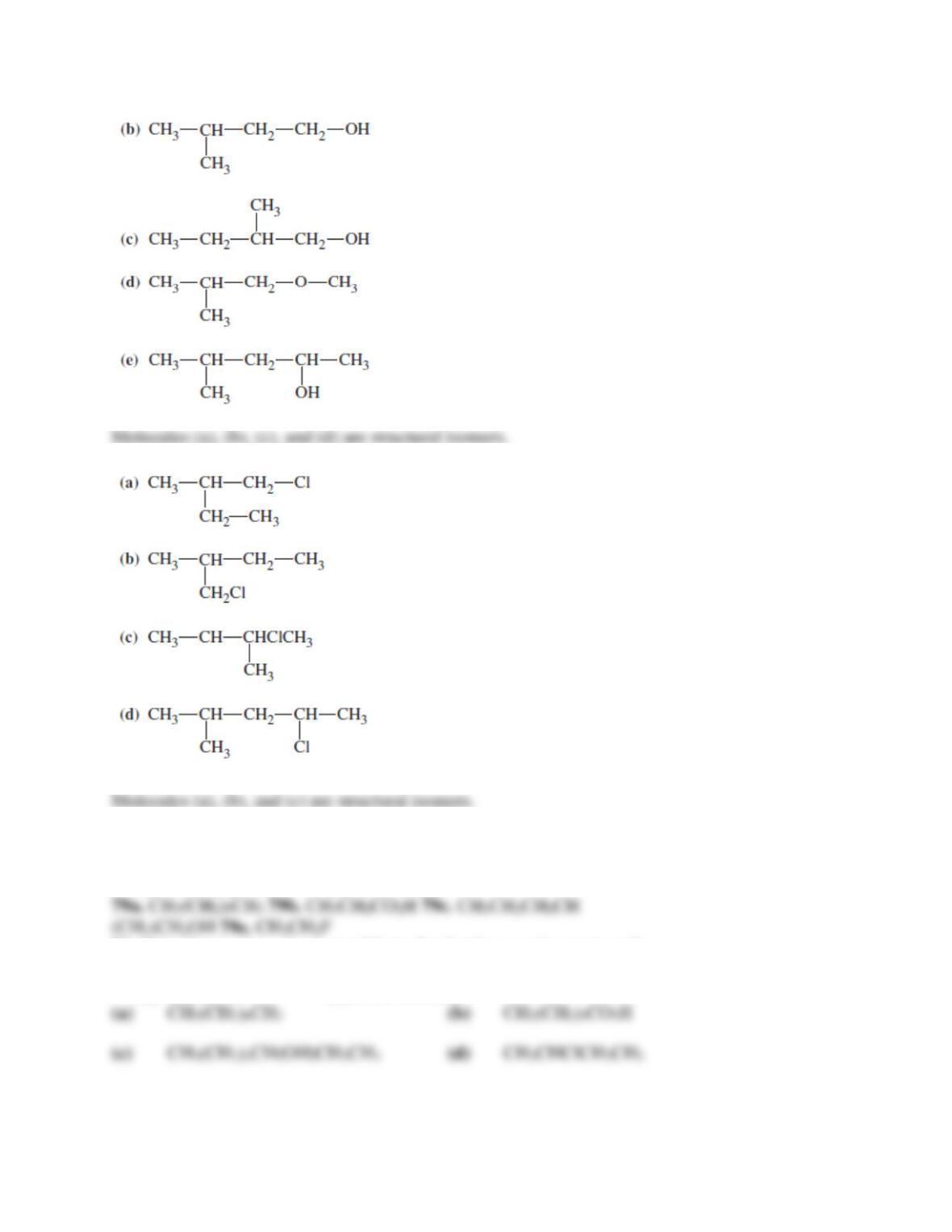
78. Which of the following structures are isomers?
79. Write the condensed structural formulas for the organic compounds:
(a) heptane (b)
propanoic acid
(c) 2 methylpentan-1-ol (d)
fluoroethane
80. Write the condensed structural formulas for the organic compounds:
(a) octane (b)
heptanoic acid
(c) hexan-3-ol (d)
2-chlorobutane
81. Give the name, condensed structural formula, and molecular mass of the molecule whose ball-
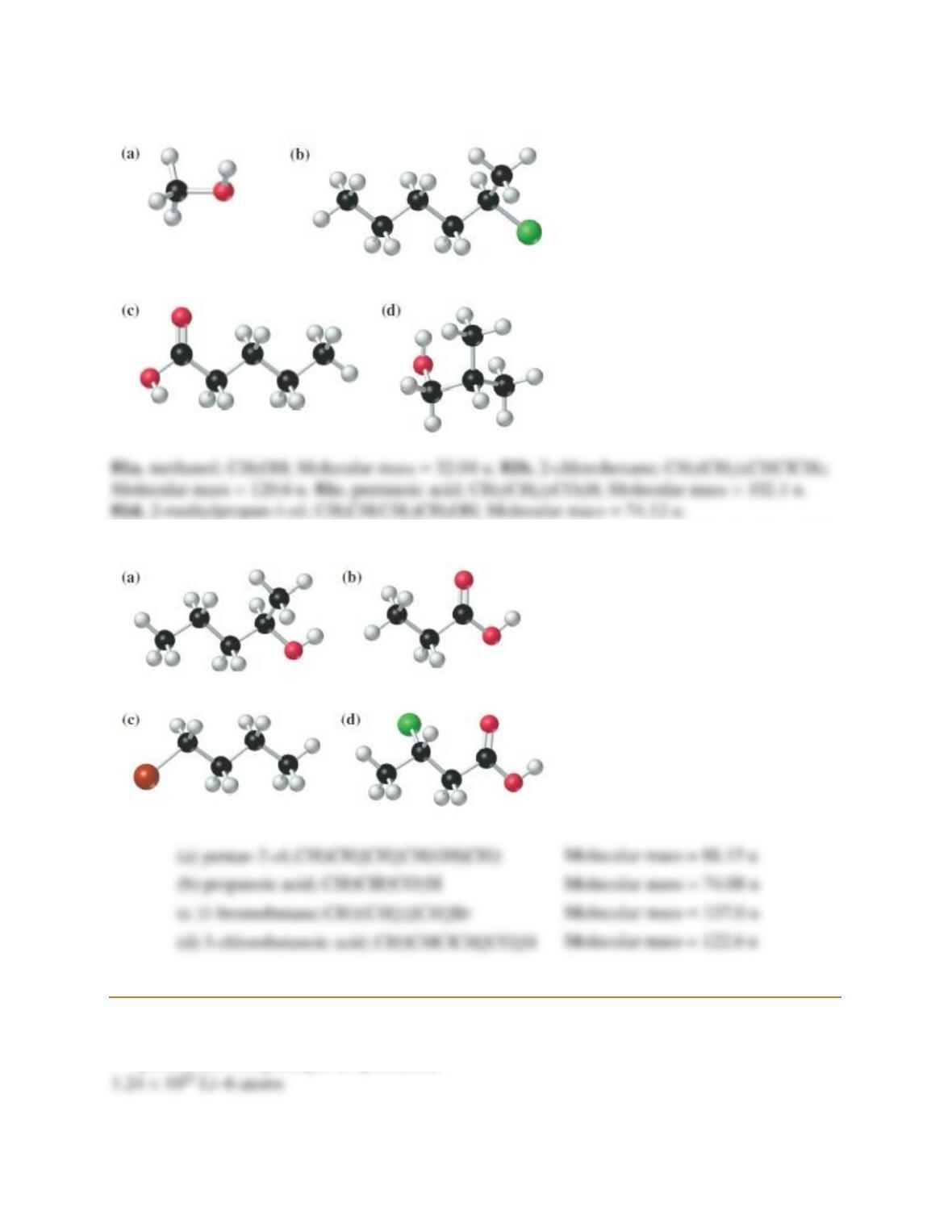
and-stick model is shown. Refer to the color scheme in Figure 3-3.
82. Give the name, condensed structural formula, and molecular mass of the molecule whose ball–
and-stick model is shown. Refer to the color scheme in Figure 3-3.
Integrative and Advanced Exercises
83. The mineral spodumene has the empirical formula
26
LiAlSi O
. Given that the percentage of
lithium-6 atoms in naturally occuring lithium is 7.40%, how many lithium-6 atoms are
present in a 518 g sample of spodumene?
84. A particular type of brass contains Cu, Sn, Pb, and Zn. A 1.1713 g sample is treated in such a
way as to convert the Sn to 0.245 g
2
SnO
, the Pb to 0.115 g
4
PbSO
, and the Zn to 0.246 g
2 2 7
Zn P O
. What is the mass percent of each element in the sample?
85. A brand of lunchmeat contains 0.12% by mass of sodium benzoate,
65
C H COONa
How many
mg of Na does a person ingest by eating 3.50 oz of this meat?
86. The important natural sources of boron compounds are the minerals kernite,
2 4 7 2
Na B O 4 H O
and borax,
2 4 7 2
Na B O 10 H O
. How much additional mass of mineral
must be processed per kilogram of boron obtained if the mineral is borax rather than kernite?
87. To deposit exactly one mole of Ag from an aqueous solution containing
Ag+
requires a
quantity of electricity known as one faraday (F). The electrodeposition requires that each
Ag+
ion gain one electron to become an Ag atom. Use appropriate physical constants listed
on the inside back cover to obtain a precise value of the Avogadro constant,
A
N
.
88. By analysis, a compound was found to contain
26 58%K and 35 45%Cr
by mass; the
remainder was oxygen. What is the oxidation state of chromium in this compound? What is
the name of the compound?
89. Is it possible to have a sample of
8
S
that weighs
23
1 00 10 g?
−
What is the smallest possible
mass that a sample of
8
S
can have? Express your answer to the second question in
appropriate SI units so that your answer has a numerical value greater than 1. (See Table 1.2
for a list of SI prefixes.)
90. What is the molecular formula of a hydrocarbon containing n carbon atoms and only one
double bond? Can such a hydrocarbon yield a greater mass of
2
HO
than
2
CO
when burned in
an excess of oxygen?
91. A hydrocarbon mixture consists of 60.0% by mass of
38
CH
and 40.0% of
CH
xy
. When 10.0
g of this mixture
is burned, 29.0 g
2
CO
and 18.8 g
2
HO
are the only products. What is the formula of the
unknown hydrocarbon?
92. A 0.732 g mixture of methane,
4
CH
, and ethane,
26
CH
, is burned, yielding 2.064 g
2
CO
.
What is the percent composition of this mixture (a) by mass; (b) on a mole basis?
93. The density of a mixture of
24
H SO
and water is
1 78 g/mL
The percent composition of the
mixture is to be determined by converting
24
H SO
to
( )
44
2
NH SO
If 32.0 mL of the mixture
gives 65.2 g
( )
44
2
NH SO
, then what is the percent composition of the mixture?
94. In 2013, the IUPAC recommended that the atomic masses of 12 elements be expressed as an
atomic mass interval rather as a single invariant value. (See Section 2-5 and Table 2.2.) For
example, the IUPAC recommends that the atomic mass of Cl be given as [35.446, 35.457].
Consequently, the results of calculations involving the atomic mass of chlorine should,
in principle, be reported as a range of values. Demonstrate this approach by calculating the
range of values possible for the mass percent of silver in an impure sample if all the silver in a
26.39 g sample is converted to 31.56 g of silver chloride. [Hint: Perform two calculations,
using first the lower bound and then the upper bound of the atomic mass interval of Cl.]
95. In the year 2000, the Guinness Book of World Records called ethyl mercaptan,
26
C H S
, the
smelliest substance known. The average person can detect its presence in air at levels as low as
43
9 10 mol/m
−
. Express the limit of detectability of ethyl mercaptan in parts per billion (ppb).
(Note: 1 ppb
26
C H S
means there is 1 g
26
C H S
per billion grams of air.) The density of air is
approximately
1 2 g/L
at room temperature.
96. Dry air is essentially a mixture of the following entities:
2
N
,
2
O
, Ar, and
2
CO
. The
composition of dry air, in mole percent, is 78.08%
2
N
, 20.95%
2
O
, 0.93% Ar, and 0.04%
CO2. (a) What is the mass, in grams, of a sample of air that contains exactly one mole of the
entities? (b) Dry air also contains other entities in much smaller amounts. For example, the
mole percent of krypton (Kr) is about
4
1 14 10
−
,
. Given that the density of dry air is about
1 2 g/L
at room temperature, what mass of krypton could be obtained from exactly one cubic
meter of dry air?
97. A public water supply was found to contain 0.8 part per billion (ppb) by mass of chloroform,
3
CHCl
.
(a) How many
3
CHCl
molecules would be present in a 350 mL glass of this water? (b) If the
3
CHCl
in part (a) could be isolated, would this quantity be detectable on an ordinary analytical
balance that measures mass with a precision of
0 0001
g?
98. A sample of the compound
4
MSO
weighing 0.1131 g reacts with barium chloride and yields
0.2193 g
4
BaSO
What must be the atomic mass of the metal M? [Hint: All
the
2
4
SO −
from the
4
MSO
appears in the
4
BaSO
.]
99. The metal M forms the sulfate
( )
24
3
M SO
. A 0.738 g sample of this sulfate is converted to
1.511 g
4
BaSO
. What is the atomic mass of M?
[Hint: Refer to Exercise 98.]
100. A 0.622 g sample of a metal oxide with the formula
23
MO
is converted to 0.685 g of the
sulfide, MS. What is the atomic mass of the metal M?
101.
2
MgCl
often occurs in table salt (NaCl) and is responsible for caking of the salt. A
0.5200 g sample of table salt is found to contain 61.10% Cl, by mass. What is the %
2
MgCl
in the sample? Why is the precision of this calculation so poor?
102. When 2.750 g of the oxide of lead
34
Pb O
is strongly heated, it decomposes and produces
0.0640 g of oxygen gas and 2.686 g of a second oxide of lead. What is the empirical formula
of this second oxide?
103. A 1.013 g sample of
42
ZnSO H Ox
is dissolved in water and the sulfate ion precipitated
as
4
BaSO
. The mass of pure, dry
4
BaSO
obtained is 0.8223 g. What is the formula of the
zinc sulfate hydrate?
104. The iodide ion in a 1.552 g sample of the ionic compound MI is removed through
precipitation. The precipitate is found to contain 1.186 g I. What is the element M?
105. An oxoacid with the formula
H E O
x y z
has a formula mass of 178 u, has 13 atoms in its
formula unit, contains 34.80% by mass, and 15.38% by number of atoms, of the element E.
What is the element E, and what is the formula of this oxoacid?
106. The insecticide dieldrin contains carbon, hydrogen, oxygen, and chlorine. When burned
in an excess of oxygen, a 1.510 g sample yields 2.094 g
2
CO
and 0.286 g
2
HO
. The
compound has a molecular mass of 381 u and has half as many chlorine atoms as -carbon
atoms. What is the molecular formula of dieldrin?
107. A thoroughly dried 1.271 g sample of
24
Na SO
is -exposed to the atmosphere and found
to gain 0.387 g in mass. What is the percent, by mass, of
2 4 2
Na SO 10 H O
in the resulting
mixture of anhydrous
24
Na SO
and the decahydrate?
108. The atomic mass of Bi is to be determined by converting the compound
( )
65
3
Bi C H
to
23
Bi O
. If 5.610 g of
( )
65
3
Bi C H
yields 2.969 g
23
Bi O
, what is the atomic mass of Bi?
109. A piece of gold (Au) foil measuring
0 25 mm
15 mm 15 mm
is treated with fluorine
gas. The treatment converts all the gold in the foil to 1.400 g of a gold fluoride. What is the
formula and name of the fluoride? The density of gold is
3
19 3 g/cm
.
110. In an experiment, 244 mL of chlorine gas
( )
2
Cl , 2 898 g/Ld=
combines with iodine to
give 1.553 g of a binary compound. In a separate experiment, the molar mass of the
compound is found to be about
467 g/mol
. What is the molecular formula of this compound?
111. Placing a 0.725 g copper strip in the presence of iodine vapor produced a yellowish-white
coating on the metal strip. The mass of the copper strip and coating was 0.733 g. The coating
was removed by rinsing the coated metal strip in a potassium thiocyanate (KSCN) solution,
yielding a clean copper strip of mass 0.721 g. What is the empirical formula of the yellowish-
white compound?
Feature Problems
112. All-purpose fertilizers contain the essential elements nitrogen, phosphorus, and
potassium. A typical fertilizer carries numbers on its label, such as “5-10-5”. These numbers
represent the % N, %
25
P O ,
and %
2
KO,
respectively. The N is contained in the form of a
nitrogen compound, such as
( )
44
2
NH SO ,
43
NH NO ,
or
( )
22
CO NH
(urea). The P is generally
present as a phosphate, and the K as KCl. The expressions %
25
PO
and %
2
KO
were devised
in the nineteenth century, before the nature of chemical compounds was fully understood. To
convert from %
25
PO
to % P and from %
2
KO
to % K, the factors 2 mol
P/mol
25
PO
and 2
mol
K/mol
2
KO
must be used, together with molar -masses.
(a) Assuming three-significant-figure precision, what is the percent composition of the “5-10–
5” fertilizer in % N, % P, and % K?
(b) What is the %
25
PO
in the following com-
pounds (both common fertilizers)? (i)
( )
24
2
Ca H PO ;
(ii)
( )
44
2
NH HPO
(c) In a similar manner to the “5-10-5” fertilizer described in this exercise, how would you
describe a fertilizer in which the mass ratio of
( )
44
2
NH HPO
to KCl is 5.00:1.00?
(d) Can a “5–10–5” fertilizer be prepared in which
( )
44
2
NH HPO
and KCl are the sole
fertilizer components, with or without inert nonfertilizer additives? If so, what should be the
proportions of the constituents of the fertilizer mixture? If this “5-10–5” fertilizer cannot be
prepared, why not?
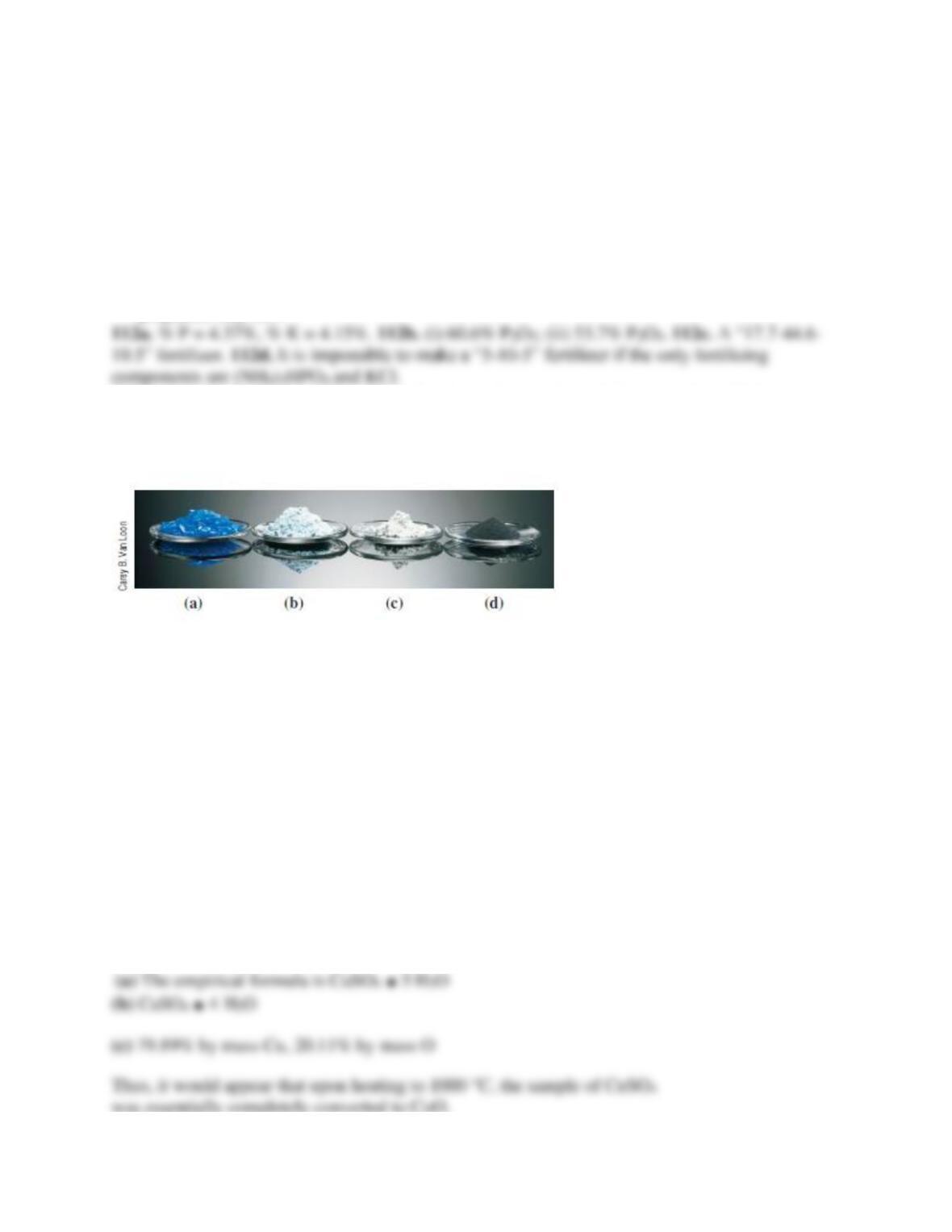
113. A hydrate of copper(II) sulfate, when heated, goes through the succession of changes
suggested by the photograph. In this photograph, (a) is the original fully hydrated copper(II)
sulfate; (b) is the product -obtained by heating the original hydrate to 140 °C; (c) is the
product obtained by further heating to 400 °C; and (d) is the product obtained at 1000 °C.
A 2.574 g sample of
42
CuSO H Ox
was heated to 140 °C, cooled, and reweighed. The
resulting solid was reheated to 400 °C, cooled, and reweighed. Finally, this solid was heated
to 1000 °C, cooled, and reweighed for the last time.
Original sample 2.574 g
After heating to 140 °C 1.833 g
After reheating to 400 °C 1.647 g
After reheating to 1000 °C 0.812 g
(a) Assuming that all the water of hydration is -driven off at 400 °C, what is the formula
of the -original hydrate?
(b) What is the formula of the hydrate obtained when the original hydrate is heated to only
140 °C?
(c) The black residue obtained at 1000 °C is an oxide of copper. What is its percent
composition and -empirical formula?
114. Some substances that are only very slightly soluble in water will spread over the surface of
water to produce a film that is called a monolayer because it is only one molecule thick. A
practical use of this phenomenon is to cover ponds to reduce the loss of water by evaporation.
Stearic acid forms a mono-layer on water. The molecules are arranged upright and in contact
with one another, rather like pencils -tightly packed and standing upright in a coffee mug. The
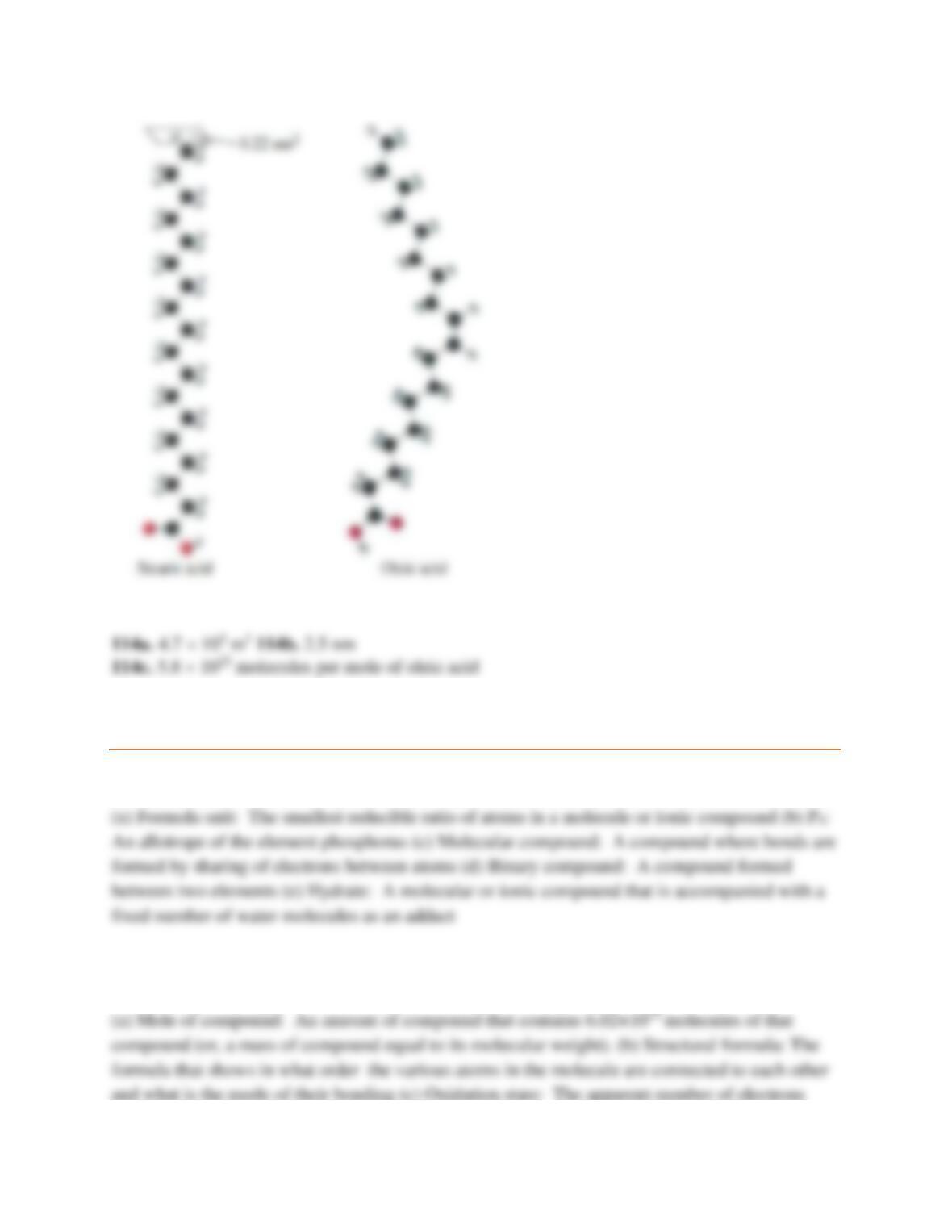
model below represents an individual stearic acid molecule in the monolayer.
(a) How many square meters of water surface would be covered by a monolayer made
from 10.0 g of stearic acid?
[Hint: What is the formula of stearic acid?]
(b) If stearic acid has a density of
3
0 85 g/cm ,
estimate the length (in nanometers) of a
stearic acid molecule.
[Hint: What is the thickness of the monolayer described in part (a)?]
(c) A very dilute solution of oleic acid in liquid pentane is prepared in the following way:
( )
1 00 mL oleic acid 9 00 mL pentane solution 1 ; + →
( ) ( )
1 00 mL solution 1 9 00 mL pentane solution 2 ; + →
( ) ( )
1 00 mL solution 2 9 00 mL pentane solution 3 ; + →
( ) ( )
1 00 mL solution 3 9 00 mL pentane solution 4 + →
Self-Assessment Exercises
115. In your own words, define or explain the following terms or symbols: (a) formula unit;
(b)
4
P;
(c) molecular compound; (d) binary compound; (e) hydrate.
116. Briefly describe each of the following ideas or methods: (a) mole of a compound; (b)
structural formula; (c) oxidation state; (d) carbon–hydrogen–oxygen determination by
combustion analysis.
117. Explain the important distinctions between each pair of terms: (a) molecular mass and
molar mass; (b) empirical and molecular formulas; (c) systematic and trivial, or common,
name; (d) hydroxyl and carboxyl functional group.
(a) Molecular mass is the mass of one molecule of a compound, while molar mass is the mass of
118. Explain each term as it applies to the element nitrogen: (a) atomic mass; (b) molecular mass;
(c) molar mass.
119. Which answer is correct? One mole of liquid bromine,
2
Br ,
(a) has a mass of 79.9 g; (b)
contains
23
6 022 10
Br atoms; (c) contains the same number of atoms as in 12.01 g
2
HO;
(d)
has twice the mass of 0.500 mole of gaseous
2
Cl
120. Three of the following formulas might be either an empirical or a molecular formula. The
formula that must be a molecular formula is (a)
2
NO;
(b)
24
NH;
(c) NaCl; (d)
3
NH
121. The compound
7 7 2
C H NO
contains (a) 17 atoms per mole; (b) equal percents by mass of C
and H; (c) about twice the percent by mass of O as of N; (d) about twice the percent by mass of
N as of H.
122. The greatest number of N atoms is found in (a) 50.0 g
2
NO;
(b) 17.0 g
3
NH ;
(c) 150
mL of liquid pyridine,
55
C H N
( )
0 983 g/mLd;=
(d)
2
1 0 mol N
123. Iron is present in red blood cells and acts to carry oxygen to the organs. Without oxygen,
these organs will die. There are about 2.6 * 1013 red blood cells in the blood of an adult
human, and the blood contains a total of 2.9 g of iron. How many atoms are there in each
blood cell?
124.
3
XF
consists of 65% F by mass. The atomic mass of the element X must be (a) 8 u; (b)
11u; (c) 31 u; (d) 35 u.
125. The oxidation state of I in the ion
46
H IO−
is (a)
1;−
(b)
1;+
(c)
7;+
(d)
8+
126. The oxidation state of Mn in MgMnO4 is (a) +2; (b) +7; (c) +6; (d) +4; (e) +3.
127. The name of which compound ends with –ate? (a) HIO4; (b) Na2SO3; (c) KClO2; (d)
HFO; (e) NO2.
128. The name of Sr(HCO3)2 is (a) strontium oxalate;
(b) strontium carbonate; (c) sodium bicarbonate;
(d) strontium bicarbonate; (e) none of these.
129. The formula for calcium chlorite is (a)
2
CaClO ;
(b)
( )
22
Ca ClO ;
(c)
3
CaClO ;
(d)
( )
42
Ca ClO
130. Which compound has a molar mass of 51.79 g mol-1? (a) NaCl; (b) KF; (c) MgS; (d)
Li3P; (e) none of these.
131. A formula unit of the compound
( )
34
4
Cu NH SO
has nearly equal masses of (a) S and
O; (b) N and O; (c) H and N; (d) Cu and O.
132. An isomer of the compound
3 2 3
CH CH CHOHCH
is
(a)
4 10
C H O;
(b)
3 2 3
CH CHOHCH CH ;
(c)
( )
32
2
CH CH OH;
(d)
3 2 2 3
CH CH OCH CH
133. A hydrate of
23
Na SO
contains almost exactly 50%
2
HO
by mass. What is the
formula of this hydrate?
134. Malachite is a common copper-containing mineral with the formula
( )
32
CuCO Cu OH
(a) What is the mass percent copper in malachite? (b) When malachite is strongly heated,
carbon dioxide and water are driven off, yielding copper(II) oxide as the sole product. What
mass of copper(II) oxide is produced per kg of malachite?
135. Acetaminophen, an analgesic and antipyretic drug, has a molecular mass of 151.2 u
and a mass percent composition of 63.56% C, 6.00% H, 9.27% N, and 21.17% O. What is
the molecular formula of acetaminophen?
136. Ibuprofen is a compound used in painkillers. When a 2.174 g sample is burned in an
excess of oxygen, it yields 6.029 g
2
CO
and 1.709 g
2
HO
as the sole products. (a) What is
the percent composition, by mass, of ibuprofen? (b) What is the empirical formula of
ibuprofen?
137. Appendix E describes a useful study aid known as concept mapping. Using the method
presented in Appendix E, construct a concept map illustrating the different concepts in Sections
3-2 and 3-3.