Chapter 3
Chemical Compounds
Exercises
Representing Molecules
1.
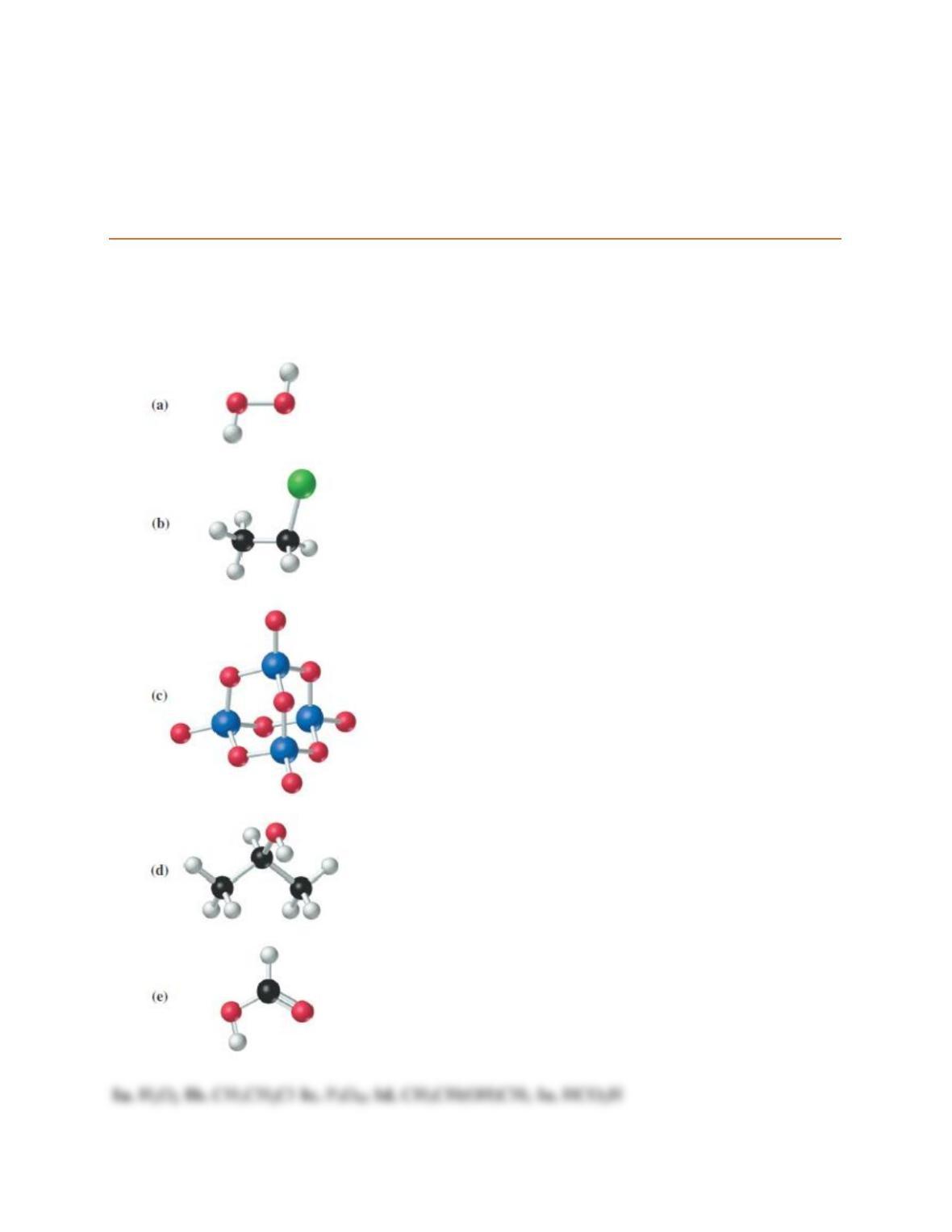
Refer to the color scheme given in Figure 3-3, and give the molecular formulas for the
molecules whose ball-and-stick models are given here.
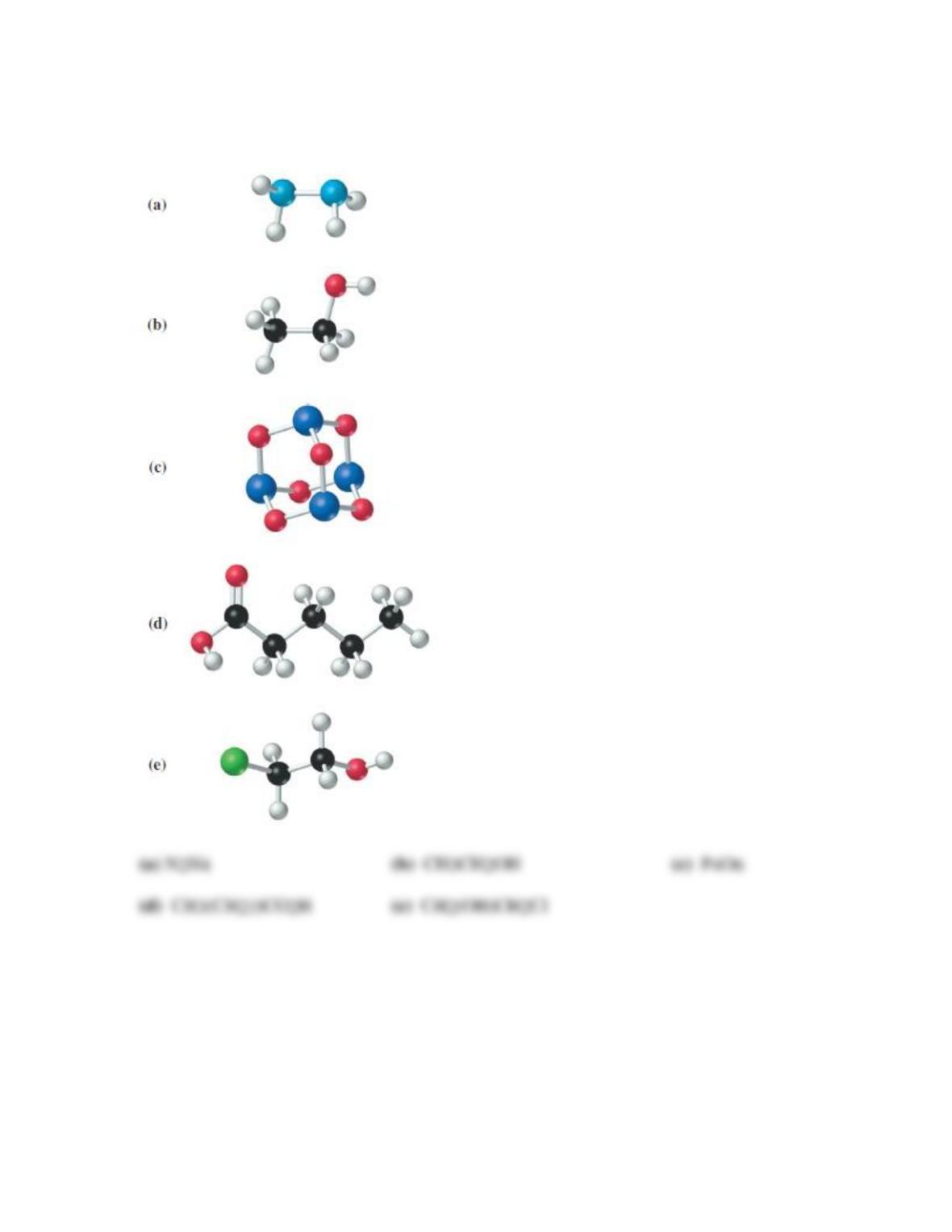
2. Give the molecular formulas for the molecules whose ball-and-stick models are given here.
Refer to the color scheme in Figure 3–3.
3. Give the structural formulas of the molecules shown in Exercise 1 (b), (d), and (e).
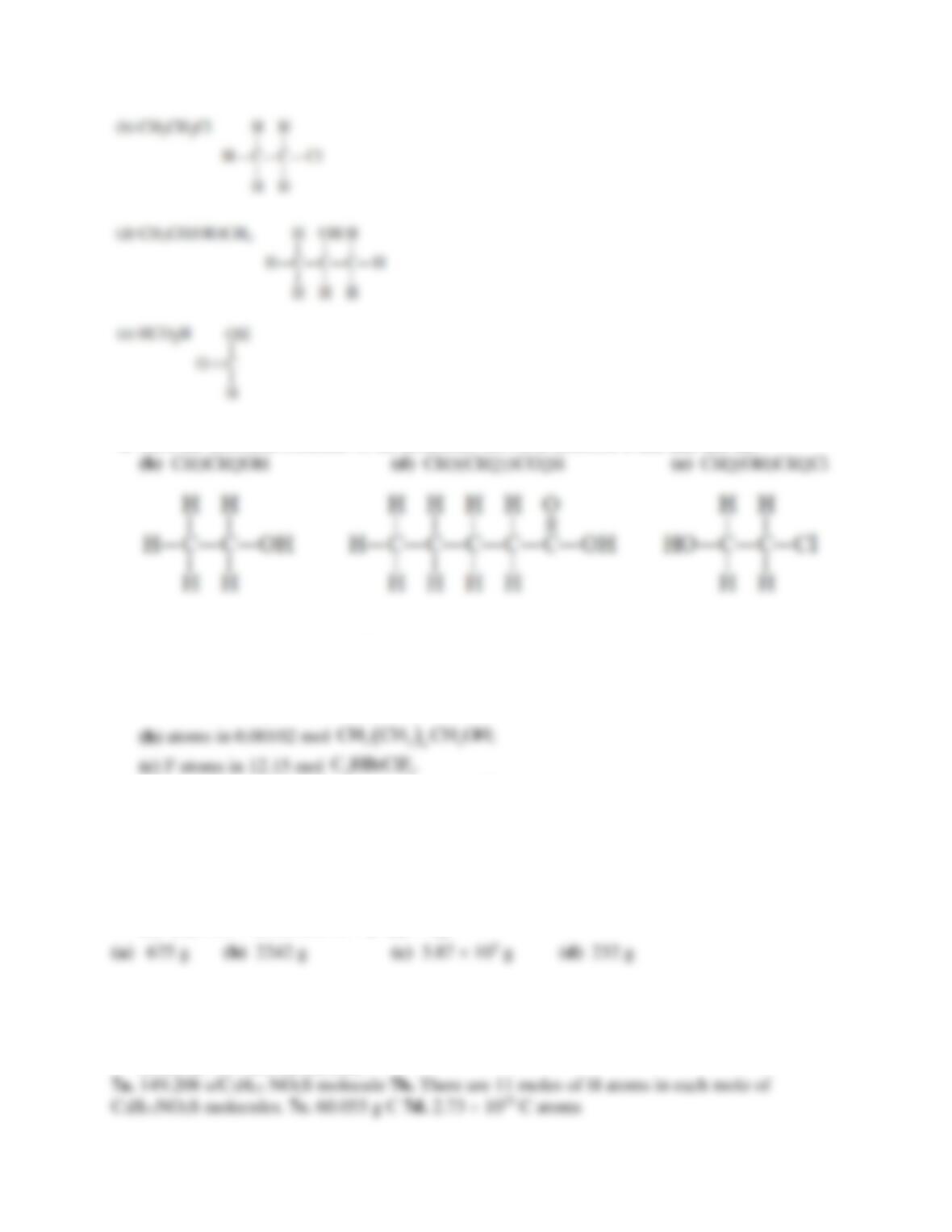
4. Give the structural formulas of the molecules shown in Exercise 2 (b), (d), and (e).
The Avogadro Constant and the Mole
5. Calculate the total number of (a) atoms in one molecule of trinitrotoluene (TNT),
( )
3 6 2 2 3
CH C H NO ;
23
5a. 21 atoms 5b. 1.29 1022 atoms 5c. 2.195 1025 F atoms
6. Determine the mass, in grams, of
(a) 7.34 mol
2
NO ;
(b)
25
2
4 220 10 O
molecules;
(c) 15.5 mol
4
CuSO
2
5 H O;
(d)
24
2 25 10
molecules of
( )
24 2
C H OH
7. The amino acid methionine, which is essential in human diets, has the molecular formula
5 11 2
C H NO S
Determine (a) its molecular mass; (b) the number of moles of H atoms per mole
of methionine; (c) the number of grams of C per mole of methionine; (d) the number of C
atoms in 9.07 mol methionine.
8. Determine the number of moles of
2
Br
in a sample
consisting of (a)
22
2
4 04 10 Br
molecules;
(b)
24
5 78 10
Br atoms (assuming that the Br atoms react completely to form Br2); (c) 7.82
kg bromine; (d) 3.56 L liquid bromine
( )
3 10 g/mLd=
9. Without doing detailed calculations, explain which of the following has the greatest number
of N atoms (a) 50.0 g
2
N O;
(b) 17.0 g
3
NH ;
(c) 150 mL of liquid pyridine,
( )
55
C H N 0 983 g/mL ;d=
(d) 1.0 mol
2
N
10. Without doing detailed calculations, determine which of the following has the greatest
number of S atoms (a) 0.12 mol of solid sulfur,
8
S;
(b) 0.50 mol of gaseous
2
S O;
(c) 65 g of
gaseous
2
SO ;
(d) 75 mL of liquid thiophene,
( )
44
C H S 1 064 g/mLd=
11. Determine the number of moles of
(a)
24
NO
in a 115 g sample
(b)
N atoms in 43.5 g of
( )
32
Mg NO
(c) N atoms in a sample of
( )
7 5 2 3
C H NO
that has the same number of O atoms as 12.4 g
6 12 6
C H O
12. Determine the mass, in grams, of
(a)
2
2 10 10
mol
8
S
(b)
22
5 02 10
molecules of palmitic acid,
16 32 2
C H O
(c) a quantity of the amino acid histidine,
6 9 3 2
C H N O ,
13. The hemoglobin content of blood is about
15 5 g/100 mL
blood. The molar mass of
hemoglobin
is about
64,500 g/mol,
and there are four iron (Fe) atoms in a hemoglobin molecule.
Approximately how many Fe atoms are present in the 6 L of blood in a typical adult?
14. In white phosphorus, P atoms are joined into
4
P
molecules (see Figure 3-5). White
phosphorus is commonly supplied in chalk-like cylindrical form. Its density
is
3
1 823 g/cm
For a cylinder of white phosphorus 6.50 cm long and 1.22 cm in diameter,
determine
(a) the number of moles of
4
P
present; (b) the total number of P atoms.
Chemical Formulas
15. Explain which of the following statement(s) is (are) correct concerning glucose (blood
sugar),
6 12 6
C H O
(a) The percentages, by mass, of C and O are the same as in CO.
(b)
The ratio of
C:H:O
atoms is the same as in dihydroxyacetone,
( )
22
CH OH CO
(c) The proportions, by mass, of C and O are equal.
(d)
The highest percentage, by mass, is that of H.
16. Explain which of the following statement(s) is (are) correct for sorbic acid,
6 8 2
C H O ,
an
inhibitor of mold and yeast.
(a) It has a
C:H:O
mass ratio of
3:4:1
(b)
It has the same mass percent composition as the aquatic herbicide, acrolein,
34
C H O
(c) It has the same empirical formula as aspidinol,
12 16 4
C H O ,
a drug used to kill parasitic
worms.
(d)
It has four times as many H atoms as O atoms, but four times as much O as H by mass.
17. For the mineral torbernite,
( ) ( )
2 4 2
22
Cu UO PO 8 H O,
determine
(a) the total number of atoms in one formula unit
(b)
the ratio, by number, of H atoms to O atoms
(c) the ratio, by mass, of Cu to P
(d)
the element present in the greatest mass percent
(e) the mass required to contain 1.00 g P
18. For the compound
( )
23
44
Ge S CH CH ,
determine
(a) the total number of atoms in one formula unit
(b)
the ratio, by number, of C atoms to H atoms
(c) the ratio, by mass, of Ge to S
(d)
the number of g S in 1 mol of the compound
(e) the number of C atoms in 33.10 g of the -compound
Percent Composition of Compounds
19. Determine the mass percent H in the hydrocarbon decane,
10 22
CH
20. Determine the mass percent O in the mineral malachite,
( )
23
2
Cu OH CO
21. Determine the mass percent H in the hydrocarbon isooctane,
( ) ( )
3 2 3
32
C CH CH CH CH
22. Determine the mass percent
2
HO
in the hydrate
( )
32
3
Cr NO 9 H O
23. Determine the mass percent of each of the elements in the antimalarial drug quinine,
20 24 2 2
C H N O
24. Determine the mass percent of each of the elements in the fungicide copper(II) oleate,
( )
18 33 2 2
Cu C H O
25. Determine the percent, by mass, of the indicated -element:
(a) Pb in tetraethyl lead,
( )
25
4
Pb C H ,
once extensively used as an additive to gasoline to
prevent engine knocking
(b)
Fe in Prussian blue,
( )
463
Fe Fe CN ,
a pigment used in paints and printing inks
(c) Mg in chlorophyll,
55 72 4 5
C H MgN O ,
the green pigment in plant cells
26. All of the following minerals are semiprecious or precious stones. Determine the mass
percent of the indicated element.
(a) Zr in zircon,
4
ZrSiO
(b)
Be in beryl (emerald),
3 2 6 18
Be Al Si O
(c) Fe in almandine (garnet),
3 2 3 12
Fe Al Si O
(d)
S in lazurite (lapis lazuli),
Na SSi Al O
27. Without doing detailed calculations, arrange the following in order of increasing % Cr, by
mass, and explain your reasoning: CrO,
23
Cr O ,
2
CrO ,
3
CrO
28. Without doing detailed calculations, explain which of the following has the greatest mass
percent of sulfur:
2
SO ,
22
S Cl ,
2
Na S,
2 2 3
Na S O ,
or
32
CH CH SH
Chemical Formulas from Percent Composition
29. Two oxides of sulfur have nearly identical molecular masses. One oxide consists of 40.05%
S. What are the simplest possible formulas for the two oxides?
30. An oxide of chromium used in chrome plating has a formula mass of 100.0 u and contains
four atoms per formula unit. Establish the formula of this compound, with a minimum of
calculation.
31. Diethylene glycol, used to de-ice aircraft, is a carbon– hydrogen–oxygen compound with
45.27% C and 9.50% H by mass. What is its empirical formula?
32. The food flavor enhancer monosodium glutamate (MSG) has the composition 13.6% Na,
35.5% C, 4.8% H, 8.3% N, 37.8% O, by mass. What is the empirical formula of MSG?
33. Determine the empirical formula of (a) the rodenticide (rat killer) warfarin, which consists of
74.01% C, 5.23% H, and 20.76% O, by mass; (b) the antibacterial agent sulfamethizole,
which consists of 39.98% C, 3.73% H, 20.73% N, 11.84% O, and 23.72% S, by mass.
34. Determine the empirical formula of (a) benzo[a]pyrene, a suspected carcinogen found in
cigarette smoke, consisting of 95.21% C and 4.79% H, by mass; (b) hexachlorophene, used in
35. A compound of carbon and hydrogen consists of 94.34% C and 5.66% H, by mass. The
molecular mass of the compound is found to be 178 u. What is its molecular formula?
36. Selenium, an element used in the manufacture of photoelectric cells and solar energy devices,
forms two oxides. One has 28.8% O, by mass, and the other, 37.8% O. What are the formulas
of these oxides? Propose acceptable names for them.
37. Indigo, the dye for blue jeans, has a percent composition, by mass, of 73.27% C, 3.84% H,
10.68% N, and the remainder is oxygen. The molecular mass of indigo is 262.3 u. What is the
molecular formula of indigo?
38. Adenine, a component of nucleic acids, has the mass percent composition: 44.45% C, 3.73%
H, 51.82% N. Its molecular mass is 135.14 u. What is its molecular formula?
39. The element X forms the chloride
4
XCl
containing 75.0% Cl, by mass. What is element X?
40. The element X forms the compound
2
XOCl
containing 59.6% Cl. What is element X?
41. Chlorophyll contains 2.72% Mg by mass. Assuming one Mg atom per chlorophyll molecule,
what is the molecular mass of chlorophyll?
42. Two compounds of Cl and X are found to have molecular masses and % Cl, by mass, as
follows: 137 u, 77.5% Cl; 208 u, 85.1% Cl. What is element X? What is the formula for each
compound?
Combustion Analysis
43. A 0.1888 g sample of a hydrocarbon produces 0.6260 g
2
CO
and 0.1602 g
2
HO
in
combustion analysis. Its molecular mass is found to be 106 u. For this hydrocarbon,
44. Para-cresol (p-cresol) is used as a disinfectant and in the manufacture of herbicides. A
0.4039 g sample of this carbon–hydrogen–oxygen compound yields 1.1518 g
2
CO
and
0.2694 g
2
HO
in combustion analysis. Its molecular mass is 108.1 u. For p-cresol, determine
its (a) mass percent composition; (b) empirical formula; (c) molecular formula.
45. Dimethylhydrazine is a carbon–hydrogen–nitrogen compound used in rocket fuels. When
burned in an excess of oxygen, a 0.312 g sample yields 0.458 g
2
CO
and 0.374 g
2
HO
The
nitrogen content of a 0.486 g sample is converted to 0.226 g
2
N
What is the empirical
formula of dimethylhydrazine?
46. The organic solvent thiophene is a carbon–hydrogen– sulfur compound that yields
2
CO ,
2
HO,
and
2
SO
when burned in an excess of oxygen. When subjected to combustion
analysis, a 1.3020 g sample of thiophene produces 2.7224 g
2
CO ,
0.5575 g
2
HO,
and 0.9915
g
SO
What is the empirical formula of thi-ophene?
47. Without doing detailed calculations, explain which of these compounds produces the greatest
mass of
2
CO
when 1.00 mol of the compound is burned in an excess of oxygen:
4 2 5 10 8 6 5
CH , C H OH C H , C H OH,
48. Without doing detailed calculations, explain which of these compounds produces the greatest
mass of
2
HO
when 1.00 g of the compound is burned in an excess of oxygen:
4 2 5 10 8 6 5
CH , C H OH C H , C H OH,
49. A 1.562 g sample of the alcohol
3 2 3
CH CHOHCH CH
is burned in an excess of oxygen. What
masses of
2
CO
and
2
HO
should be obtained?
50. Liquid ethyl mercaptan,
26
C H S,
has a density of 0.84 g/mL. Assuming that the combustion
of this compound produces only
22
CO , H O,
and
2
SO ,
what masses of each of these three
products would be -produced in the combustion of 3.15 mL of ethyl -mercaptan?
Oxidation States
51. Indicate the oxidation state of the underlined element in (a)
4
CH ;
(b)
4
SF ;
(c)
2
2
Na O ;
(d)
232
C H O ;
−
(e)
2
4
FeO −
52. Indicate the oxidation state of S in (a)
2
3
SO ;
−
(b)
2
23
S O ;
−
(c)
2
28
S O ;
−
(d)
4
HSO ;
−
(e)
2
46
SO −
53. Chromium forms three principal oxides. Write appropriate formulas for these compounds in
which the oxidation states of Cr are
3 4,,++
and
6,+
respectively.
54. Nitrogen forms five oxides in which its oxidation states are
1 2 3 4, , , ,+ + + +
and
5,+
respectively. Write appropriate formulas for these compounds.
N = +1 in N2O dinitrogen monoxide; N =+2 in NO nitric oxide; N = +3 in N2O3 dinitrogen
55. In many of its compounds, oxygen has an oxidation state of
2−
. However, there are
exceptions. What is the oxidation state of oxygen in each of the following compounds? (a)
55a. O = +2 in OF2 55b. O = +1 in O2F2 55c.
1
O−
=
in CsO2 55d. O = –1 in BaO2
56. Hydrogen and oxygen usually have oxidation states of
1+
and
2+
, respectively, in their
compounds. The following cases serve to remind us that there are exceptions. What are the
oxidation states of the atoms in each of the following compounds? (a)
2
MgH ;
(b)
3
CsO ;
(c) HOF; (d)
4
NaAlH
.
Nomenclature
57. Name these compounds: (a) SrO; (b) ZnS; (c)
24
K CrO ;
(d)
24
Cs SO ;
(e)
23
Cr O ;
(f)
( )
24
3
Fe SO ;
(g)
( )
32
Mg HCO ;
(h)
( )
44
2
NH HPO ;
(i)
( )
32
Ca HSO ;
(j)
( )
2
Cu OH ;
(k)
3
HNO ;
(l)
4
KClO ;
(m)
3
HBrO ;
(n)
33
H PO
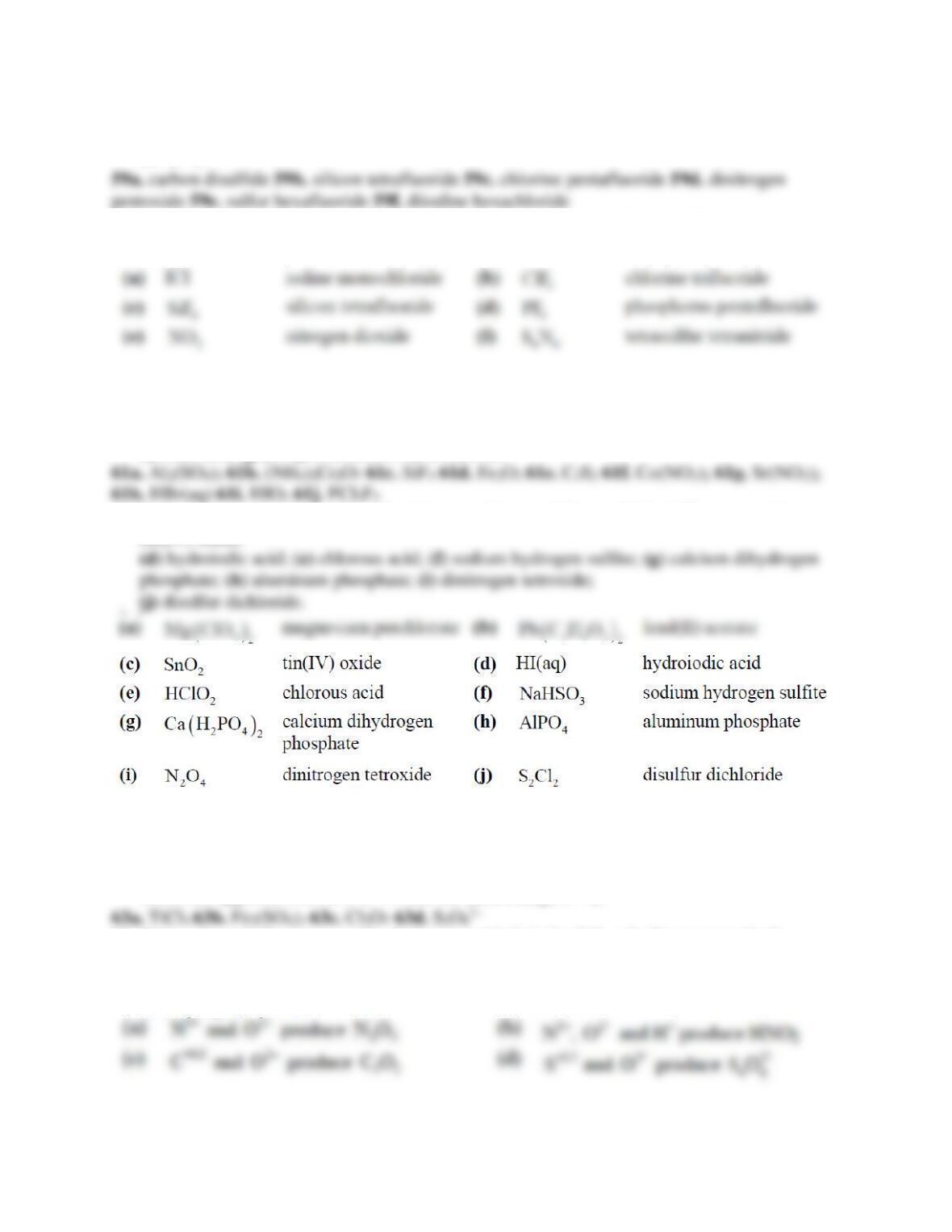
58. Name these compounds: (a)
( )
32
Ba NO ;
(b)
2
HNO ;
59. Assign suitable names to the compounds (a)
2
CS ;
(b)
4
SiF ;
(c)
5
ClF ;
(d)
25
NO;
(e)
6
SF ;
(f)
26
I Cl
60. Assign suitable names to the compounds (a) ICl; (b)
3
ClF ;
(c)
4
SiF ;
(d)
5
PF ;
(e)
2
NO ;
(f)
44
SN
61. Write formulas for the compounds: (a) aluminum sulfate; (b) ammonium dichromate; (c) silicon
tetrafluoride; (d) iron(III) oxide; (e) tricarbon disulfide; (f) cobalt(II) nitrate; (g) strontium
nitrite; (h) hydrobromic acid;
(i) iodic acid; (j) phosphorus dichloride trifluoride.
62. Write formulas for the compounds: (a) magnesium perchlorate; (b) lead(II) acetate; (c)
tin(IV) oxide;
63. Write a formula for (a) the chloride of titanium having Ti in the O.S.
4+
; (b) the sulfate of
iron having Fe
in the O.S.
3+
; (c) an oxide of chlorine with Cl in the O.S.
7+
; (d) an oxoanion of sulfur in
which the apparent O.S. of S is
7+
and the ionic charge is
2−
.
64. Write a formula for (a) an oxide of nitrogen with N in the O.S.
5+
; (b) an oxoacid of
nitrogen with N in the O.S.
3+
; (c) an oxide of carbon in which the apparent O.S. of C is
43/+
; (d) a sulfur-containing oxoanion in which the apparent O.S. of S is
25+
and the
ionic charge is
2−
.
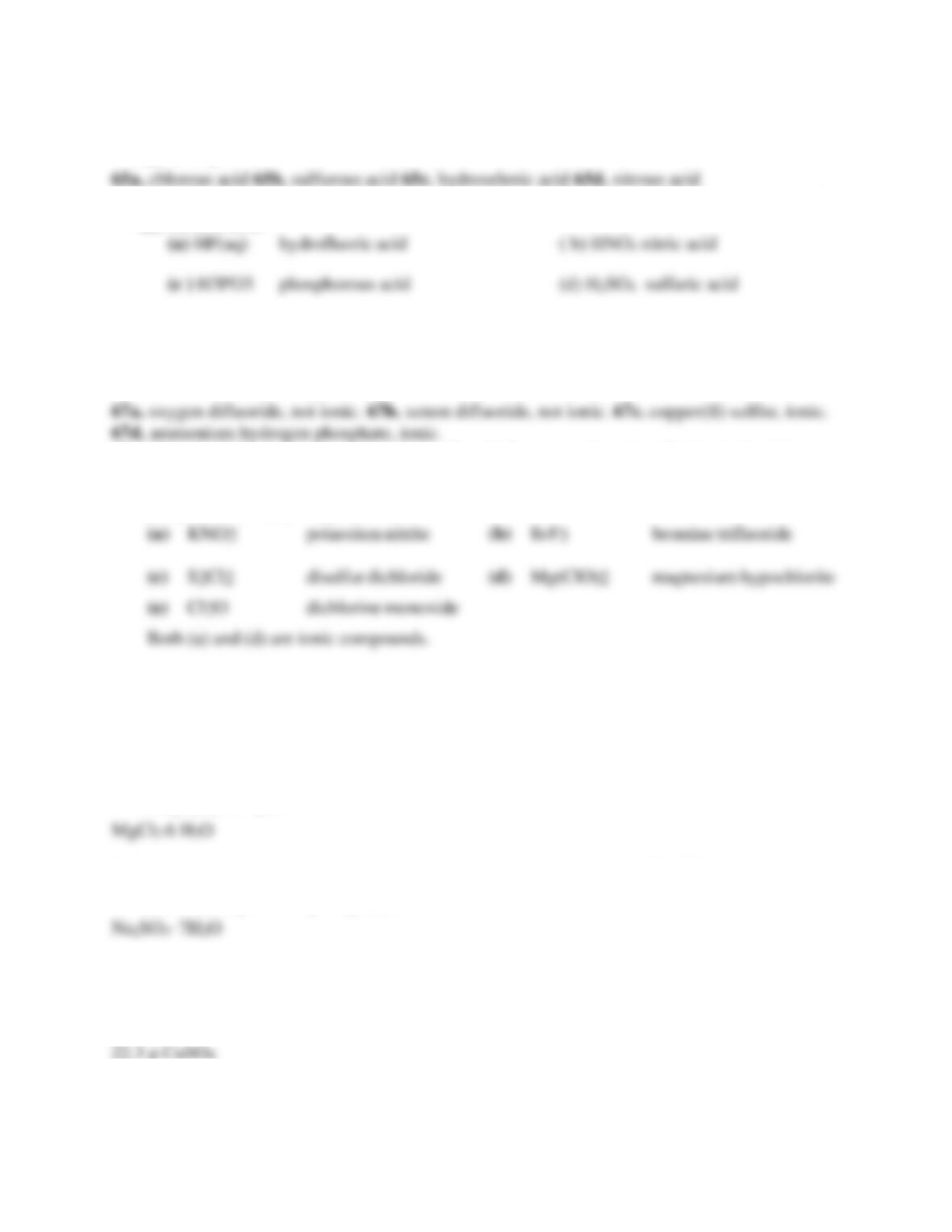
65. Name the acids: (a)
2
HClO ;
(b)
23
H SO ;
(c)
2
H Se;
(d)
2
HNO
66. Supply the formula for the acids: (a) hydrofluoric acid; (b) nitric acid; (c) phosphorous acid;
(d) sulfuric acid.
67. Name the following compounds and specify which ones are best described as ionic: (a)
2
OF ;
(b)
2
XeF ;
(c)
3
CuSO ;
(d)
( )
44
2
NH HPO
.
68. Name the following compounds and specify which ones are best described as ionic: (a)
2
KNO ;
(b)
3
BrF ;
(c)
22
S Cl ;
(d)
( )
2
Mg ClO ;
(e)
2
Cl O
.
Hydrates
69. Without performing detailed calculations, indicate which of the following hydrates has the
greatest %
2
HO
by mass:
( )
4 2 2 4 2 2 2
3
CuSO 5 H O, Cr SO 18 H O, MgCl 6 H O,
and
2 3 2 2
LiC H O 2 H O
70. Without performing detailed calculations, determine the hydrate of
23
Na SO
that contains
almost exactly 50%
2
HO,
by mass.
71. Anhydrous
4
CuSO
can be used to dry liquids in which it is insoluble. The
4
CuSO
is converted
to
42
CuSO 5 H O,
which can be filtered off from the liquid. What is the minimum mass of
anhydrous
4
CuSO
needed to remove 12.6 g
2
HO
from a tankful of gasoline?
72. Anhydrous sodium sulfate,
24
Na SO ,
absorbs water vapor and is converted to the
decahydrate,
2 4 2
Na SO 10 H O
How much would the mass of 36.15 g of anhydrous
24
Na SO
increase if converted completely to the decahydrate?
73. A certain hydrate is found to have the composition 20.3% Cu, 8.95% Si, 36.3% F, and 34.5%
2
HO
by mass. What is the empirical formula of this hydrate?
74. An 8.129 g sample of
42
MgSO H Ox
is heated until all the water of hydration is driven off.
The resulting anhydrous compound,
4
MgSO ,
weighs 3.967 g. What is the formula of the
hydrate?
Organic Compounds and Organic Nomenclature
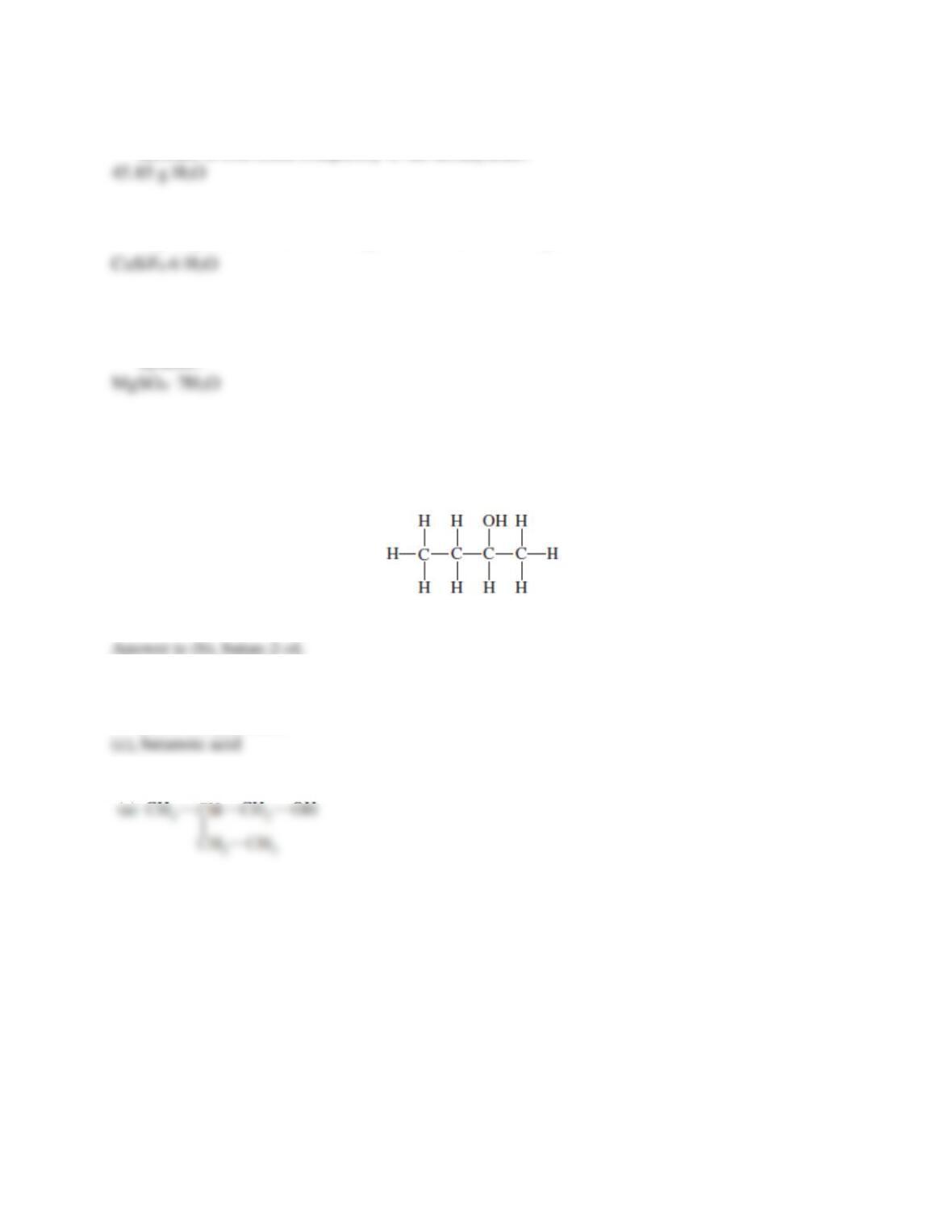
75. Which of the following names is most appropriate for the molecule with the structure shown
below? (a) butyl alcohol; (b) butan-2-ol; (c) butan-1-ol; (d) isopentyl –alcohol.
76. Which of the following names is most appropriate for the molecule
( )
32
2
CH CH COOH?
(a)
dimethylene-acetic acid; (b) propanoic acid; (c) butanoic acid;
(d) oxobutylalcohol.
77. Which of the following structures are isomers?