Chapter 2
Atoms and the Atomic Theory
Exercises
Law of Conservation of Mass
1. When an iron object rusts, its mass increases. When a match burns, its mass decreases. Do
these observations violate the law of conservation of mass? Explain.
2. When a strip of magnesium metal is burned in air (recall Figure 2-1), it produces a white
powder that weighs more than the original metal. When a strip of magnesium is burned in a
flashbulb, the bulb weighs the same before and after it is flashed. Explain the -difference in
these observations.
The magnesium that is burned in air combines with some of the oxygen in the air and this
3. A 0.406 g sample of magnesium reacts with oxygen, producing 0.674 g of magnesium oxide
as the only product. What mass of oxygen was consumed in the reaction?
4. A 1.446 g sample of potassium reacts with 8.178 g of chlorine to produce potassium chloride
as the only product. After the reaction, 6.867 g of chlorine remains unreacted. What mass of
potassium chloride was formed?
5. When a solid mixture consisting of 10.500 g calcium hydroxide and 11.125 g ammonium
chloride is strongly heated, gaseous products are evolved and 14.336 g of a solid residue
remains. The gases are passed into 62.316 g water, and the mass of the resulting solution is
69.605 g. Within the limits of experimental error, show that these data conform to the law of
conservation of mass.
6. Within the limits of experimental error, show that the law of conservation of mass was obeyed
in the following experiment: 10.00 g calcium carbonate (found in limestone) was dissolved in
100.0 mL hydrochloric acid
( )
1 148 g/mLd=
The products were 120.40 g solution (a
mixture of hydrochloric acid and calcium chloride) and 2.22 L carbon dioxide gas
Law of Constant Composition
7. In Example 2-1, we established that the mass ratio of magnesium to magnesium oxide is 0.455 g
magnesium/ 0.755 g magnesium oxide.
(a) What is the ratio of oxygen to magnesium oxide, by mass?
(b) What is the mass ratio of oxygen to magnesium in magnesium oxide?
(c) What is the percent by mass of magnesium in magnesium oxide?
8. Samples of pure carbon weighing 3.62, 5.91, and 7.07 g were burned in an excess of air. The
masses of carbon dioxide obtained (the sole product in each case) were 13.26, 21.66, and
25.91 g, respectively.
(a) Do these data establish that carbon dioxide has a fixed composition?
(b) What is the composition of carbon dioxide, expressed in % C and % O, by mass?
9. In one experiment, 2.18 g sodium was allowed to react with 16.12 g chlorine. All the sodium
was used up, and 5.54 g sodium chloride (salt) was produced. In a second experiment, 2.10 g
chlorine was allowed to react with 10.00 g sodium. All the chlorine was used up, and 3.46 g
sodium chloride was produced. Show that these results are consistent with the law of
constant composition.
10. When 3.06 g hydrogen was allowed to react with an excess of oxygen, 27.35 g water was
obtained. In a -second experiment, a sample of water was decomposed by electrolysis,
resulting in 1.45 g hydrogen and 11.51 g oxygen. Are these results consistent with the law of
constant composition? Demonstrate why or why not.
11. In one experiment, the burning of 0.312 g sulfur produced 0.623 g sulfur dioxide as the sole
product of the reaction. In a second experiment, 0.842 g sulfur dioxide was obtained. What
mass of sulfur must have been burned in the second experiment?
12. In one experiment, the reaction of 1.00 g mercury and an excess of sulfur yielded 1.16 g of a
sulfide of mercury as the sole product. In a second experiment, the same sulfide was
produced in the reaction of 1.50 g mercury and 1.00 g sulfur.
(a) What mass of the sulfide of mercury was produced in the second experiment?
(b) What mass of which element (mercury or sulfur) remained unreacted in the
second experiment?
Law of Multiple Proportions
13. Sulfur forms two compounds with oxygen. In the first compound, 1.000 g sulfur is combined
with 0.998 g oxygen, and in the second, 1.000 g sulfur is combined with 1.497 g oxygen.
Show that these results are consistent with Dalton’s law of multiple proportions.
For a given mass of sulfur, the mass of oxygen in the second compound (SO3) relative to the
14. Phosphorus forms two compounds with chlorine. In the first compound, 1.000 g of
phosphorus is combined with 3.433 g chlorine, and in the second, 2.500 g phosphorus is
combined with 14.308 g chlorine. Show that these results are consistent with Dalton’s law of
multiple proportions.
15. The following data were obtained for compounds of nitrogen and hydrogen:
Compound
Mass of
Nitrogen, g
Mass of
Hydrogen, g
A
0.500
0.108
B
1.000
0.0720
C
0.750
0.108
(a) Show that these data are consistent with the law of multiple proportions.
(b) If the formula of compound B is
22
N H ,
what are the formulas of compounds A
and C?
16. The following data were obtained for compounds of iodine and fluorine:
Compound
Mass of
Iodine, g
Δ
Mass of
Fluorine, g
A
1.000
0.1497
B
0.500
0.2246
C
0.750
0.5614
D
1.000
1.0480
(a) Show that these data are consistent with the law of multiple proportions.
(b) If the formula for compound A is IF, what are the formulas for compounds B, C,
and D?
(a)
Cmpd B: “normalized” mass of iodine = 0. 500 g I 2 = 1.000 g I
17. There are two oxides of copper. One oxide has 20% oxygen, by mass. The second oxide has
a smaller percent of oxygen than the first. What is the probable -percent of oxygen in the
second oxide?
18. The two oxides of carbon described on page 38 were CO and
2
CO
Another oxide of carbon
has 1.106 g of oxygen in a 2.350 g sample. In what ratio are carbon and oxygen atoms
combined in molecules of this third oxide? Explain.
Fundamental Charges and Mass-to-Charge Ratios
19. The following observations were made for a series of five oil drops in an experiment similar to
Millikan’s (see Figure 2–8). Drop 1 carried a charge of
18
1 28 10 C;
−
drops 2 and 3 each
carried
1
2
the charge of drop 1; drop 4 carried
1
8
the charge of drop 1; drop 5 had a charge four
times that of drop 1. Are these data consistent with the value of the electronic charge given in
the text? Could Millikan have inferred the charge on the electron from this particular series of
data? Explain.
20. In an experiment similar to that described in Exercise 19, drop 1 carried a charge of
19
6 41 10 C;
−
drop 2 had
1
2
the charge of drop 1; drop 3 had twice the charge of drop 1;
drop 4 had a charge of
18
1 44 10 C;
−
and drop 5 had
1
3
the charge of drop 4. Are these data
consistent with the value of the electronic charge given in the text? Could Millikan have
inferred the charge on the electron from this particular series of data? Explain.
21. Use data from Table 2.1 to verify that
(a) the mass of electrons is about 1/2000 that of H atoms;
(b) the mass-to-charge ratio
( )
m / e
for positive ions is considerably larger than that
for electrons.
21a. Determine the ratio of the mass of a hydrogen atom to that of an electron. Use the mass of a
22. Determine the approximate value of
m / e
in grams per coulomb for the ions
127
53 I−
and
32 2
16 S−
Why are these values only approximate?
Atomic Number, Mass Number, and Isotopes
23. The following radioactive isotopes have applications in medicine. Write their symbols in the
form
E
A
Z
(a) cobalt-60; (b) phosphorus-32; (c) iron-59; (d) radium-226.
24. For the isotope
202 Hg,
express the percentage of the fundamental particles in the nucleus that
are neutrons.
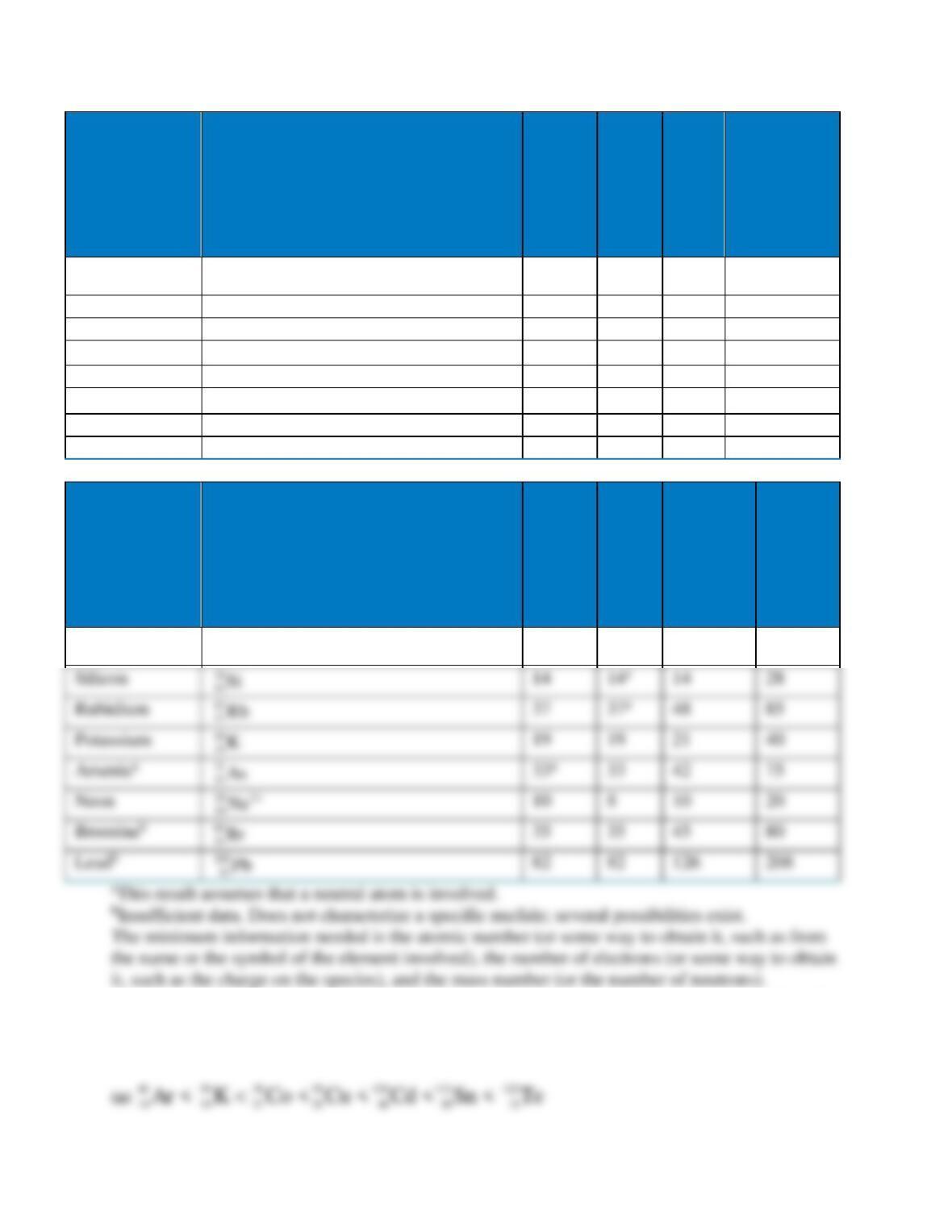
25. Complete the following table. What minimum amount of information is required to
completely characterize an atom or ion?
Name
Symbol
Numb
er
Proton
s
Num
ber
Electr
ons
Num
ber
Neut
rons
Mass
Number
Sodium
23
11 Na
11
11
12
23
Silicon
—
—
—
14
—
—
—
37
—
—
85
—
40 K
—
—
—
—
—
—
—
33
42
—
—
20 2
Ne +
—
—
—
—
—
—
—
—
—
80
—
—
—
—
126
—
Name
Symbol
Numb
er
Proton
s
Num
ber
Electr
ons
Number
Neutrons
Mass
Number
Sodium
23
11 Na
11
11
12
23
26. Arrange the following species in order of increasing (a) number of electrons; (b) number of
neutrons; (c) mass.
112 40 122 59 120 58 39
50 18 52 29 48 27 19
Sn Ar Te Cu Cd Co K
Rubidium
37
48
85
Potassium
19
19
21
40
33
42
75
Neon
10
8
10
20
82
82
126
208
27. For the atom
108 Pd
with mass 107.90389 u, determine
(a) the numbers of protons, neutrons, and electrons in the atom;
(b) the ratio of the mass of this atom to that of an atom of
12
6C
28. For the ion
228 2
Ra +
with a mass of 228.030 u, determine
(a) the numbers of protons, neutrons, and electrons in the ion;
(b) the ratio of the mass of this ion to that of an atom of
16 O
(refer to page 47).
29. An isotope of silver has a mass that is 6.68374 times that of oxygen-16. What is the mass in u
of this isotope? (Refer to page 47.)
30. The ratio of the masses of the two naturally occurring isotopes of indium is 1.0177:1. The
heavier of the two isotopes has 7.1838 times the mass of
16 O
What are the masses in u of
31. The following data on isotopic masses are from a chemical handbook. What is the ratio of
each of these masses to that of
12
6C?
(a)
35
17 Cl,
34.96885 u; (b)
26
12 Mg,
25.98259 u; (c)
222
86 Rn,
222.0175 u.
32. The following ratios of masses were obtained with a mass spectrometer:
19 12
96
F/ C 1 5832;=
35 19
17 9
Cl/ F =
1 8406;
81 35
35 17
Br/ Cl 2 3140=
Determine the mass of a
81
35 Br
atom in amu.
33. Which of the following species has
(a) equal numbers of neutrons and electrons;
(b) protons, neutrons, and electrons in the ratio 9:11:8;
(c) a number of neutrons equal to the number of protons plus one-half the number of
electrons?
34. Given the same species as listed in Exercise 33, which has
(a) equal numbers of neutrons and protons;
(b) protons contributing more than 50% of the mass;
(c) about 50% more neutrons than protons?
35. An isotope with mass number 44 has four more neutrons than protons. This is an isotope of
what element?
36. Identify the isotope X that has one more neutron than protons and a mass number equal to
nine times the charge on the ion
3
X+
37. Iodine has many radioactive isotopes. Iodine-123 is a radioactive isotope used for
obtaining images of the thyroid gland. Iodine-123 is administered to patients in the form
of sodium iodide capsules that contain
123 I−
ions. Determine the number of neutrons,
protons, and electrons in a single
123 I−
ion.
38. Iodine-131 is a radioactive isotope that has important medical uses. Small doses of iodine-
131 are used for treating hyperthyroidism (overactive thyroid) and larger doses are used for
treating thyroid cancer. Iodine-131 is administered to patients in the form of sodium iodide
capsules that contain
131 I−
ions. Determine the number of neutrons, protons, and electrons in
a single
131 I−
ion.
39. Americium-241 is a radioactive isotope that is used in high-precision gas and smoke
detectors. How many neutrons, protons, and electrons are there in an atom of americium-
241?
40. Some foods are made safer to eat by being exposed to gamma rays from radioactive
isotopes, such as cobalt-60. The energy from the gamma rays kills -bacteria in the food.
How many neutrons, protons, and electrons are there in an atom of cobalt–60?
Atomic Mass Units, Atomic Masses
41. Which statement is probably true concerning the masses of individual chlorine atoms: All
have, some have, or none has a mass of 35.45 u? Explain.
42. The mass of a carbon-12 atom is taken to be exactly 12 u. Are there likely to be any other atoms
with an exact integral (whole number) mass, expressed in u? Explain.
43. Magnesium has three naturally occurring isotopes. Their masses are 23.985042 u, 24.985837 u,
and 25.982593 u. What is the weighted-average atomic mass of magnesium in a sample for
which the percent isotopic abundances of these three isotopes are 78.99%, 10.00%, and 11.01%,
respectively?
44. There are four naturally occurring isotopes of chromium. Their masses and percent isotopic
abundances are 49.9461 u, 4.35%; 51.9405 u, 83.79%; 52.9407 u, 9.50%; and 53.9389 u, 2.36%.
Calculate the weighted-average atomic mass of chromium.
45. The two naturally occurring isotopes of silver have the following abundances:
107 Ag,
51.84%;
109 Ag,
48.16%. The mass of
107 Ag
is 106.905092 u. What is the mass of
109 Ag?
46. Gallium has two naturally occurring isotopes. One of them, gallium-69, has a mass of
68.925581 u and a percent isotopic abundance of 60.11%. What must be the mass and
percent isotopic abundance of the other isotope, gallium-71?
47. The three naturally occurring isotopes of potassium are
39 K,
38.963707 u;
40 K,
39.963999 u;
and
41 K
The percent isotopic abundances of
39 K
and
41 K
are 93.2581% and 6.7302%,
respectively. Determine the isotopic mass of
41 K
48. Use the conventional atomic mass of boron to estimate the fractional isotopic abundances of
the two naturally occurring isotopes,
10 B
and
11 B
These isotopes have masses of 10.012937
Mass Spectrometry
49. A mass spectrum of germanium displayed peaks at mass numbers 70, 72, 73, 74, and 76,
with relative heights of 20.5, 27.4, 7.8, 36.5, and 7.8, respectively.
(a) In the manner of Figure 2-14, sketch this mass spectrum.
(b) Estimate the weighted-average atomic mass of germanium, and state why this
result is only approximately correct.
50. Hydrogen and chlorine atoms react to form simple diatomic molecules in a 1:1 ratio, that is,
HCl. The percent isotopic abundances of the chlorine isotopes are
35 Cl
and
37 Cl
are
estimated to be 75.77% and 24.23%, respectively. The percent isotopic abundances of
2H
and
3H
are estimated to be 0.015% and less than 0.001%, respectively.
(a) How many different HCl molecules are possible, and what are their mass numbers
(that is, the sum of the mass numbers of the H and Cl atoms)?
(b) Which is the most abundant of the possible HCl molecules? Which is the second
most abundant?
The Periodic Table
51. Refer to the periodic table inside the front cover and identify
(a) the element that is in group 14 and the fourth period
(b) one element similar to and one unlike sulfur
(c) the alkali metal in the fifth period
(d) the halogen element in the sixth period
52. Refer to the periodic table inside the front cover and identify
(a) the element that is in group 11 and the sixth period
(b) an element with atomic number greater than 50 that has properties similar to the
element with atomic number 18
(c) the group number of an element E that forms an ion
2
E−
3
53. Assuming that the seventh period of the periodic table has 32 members, what should be the
atomic number of (a) the noble gas following radon (Rn);
(b) the alkali metal following francium (Fr)?
54. Find the several pairs of elements that are “out of order” in terms of increasing atomic mass
and explain why the reverse order is necessary.
The Avogadro Constant and the Mole
55. What is the total number of atoms in (a) 15.8 mol Fe; (b) 0.000467 mol Ag; (c)
11
8 5 10 mol Na?
−
56. Without doing detailed calculations, indicate which of the following quantities contains the
57. Determine
(a) the number of moles of Zn in a 415.0 g sample of zinc metal
(b) the number of Cr atoms in 147.4 kg chromium
(c) the mass of a one-trillion-atom
( )
12
1 0 10
sample of metallic gold
58. Determine
(a) the number of Kr atoms in a 5.25 mg sample of krypton
(b) the molar mass, M, and identity of an element if the mass of a
22
2 80 10 atom
sample of the element is 2.09 g
(c) the mass of a sample of phosphorus that contains the same number of atoms as
59. How many Cu atoms are present in a piece of –sterling-silver jewelry weighing 33.24 g?
(Sterling silver is a -silver–copper alloy containing 92.5% Ag by mass.)
60. How many atoms are present in a
3
50 0 cm
sample of plumber’s solder, a lead–tin alloy
containing 67% Pb by mass and having a density of
3
9 4 g/cm ?
61. How many
204 Pb
atoms are present in a piece of lead weighing 215 mg? The percent
isotopic abundance of
204 Pb
is 1.4%.
62. A particular lead–cadmium alloy is 8.0% cadmium by mass. What mass of this alloy, in grams,
must you weigh out to obtain a sample containing
23
7 25 10 Cd
atoms?
63. Medical experts generally believe a level of
30 g
Pb per deciliter of blood poses a
significant health risk
( )
1 dL 0 1 L=
Express this level (a) in the unit mol Pb/L blood; (b) as
the number of Pb atoms per milliliter of blood.
64. During a severe episode of air pollution, the con-centration of lead in the air was observed to