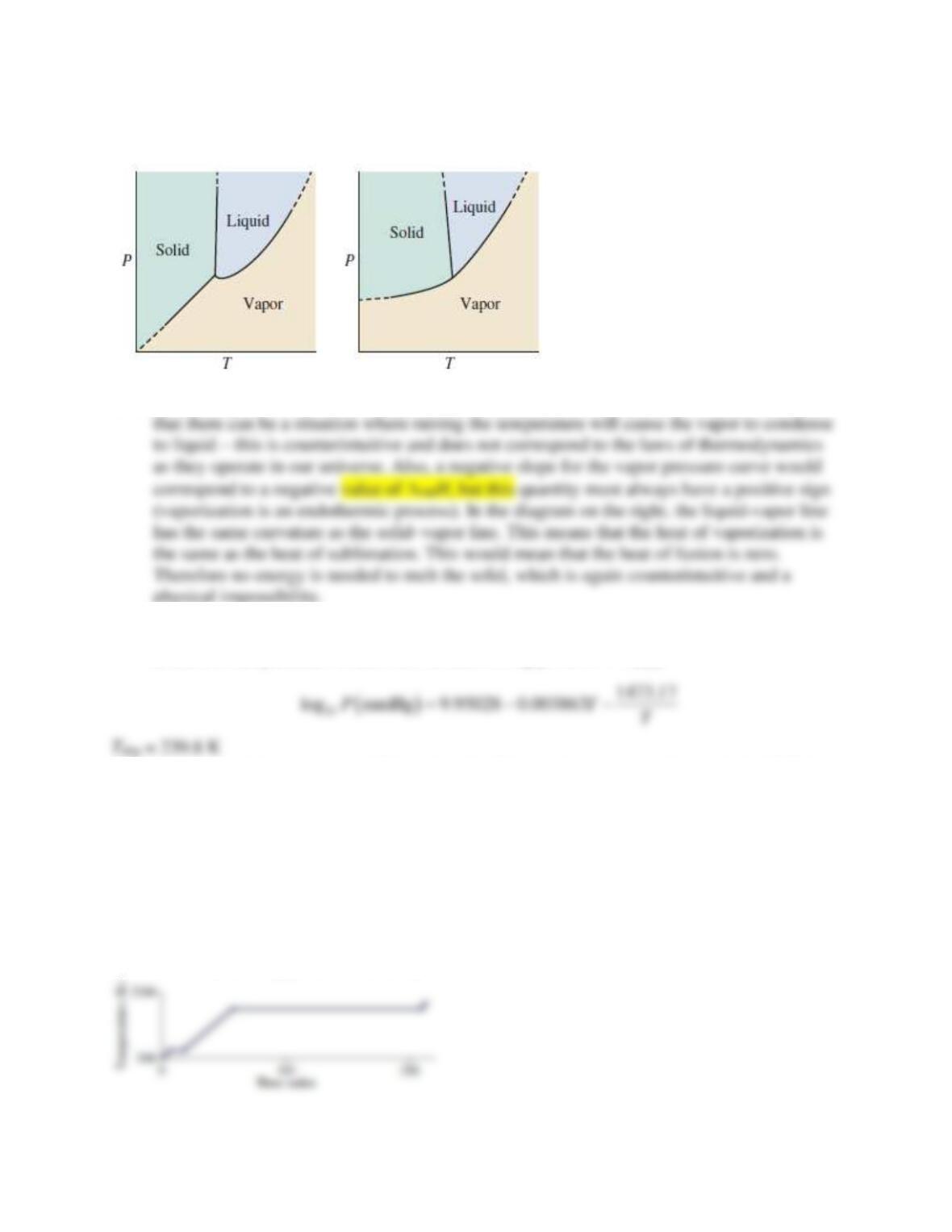
105. Sketched here are two hypothetical phase diagrams for a substance, but neither of these
diagrams is possible. Indicate what is wrong with each of them.
In the phase diagram on the left, the liquid-vapor curve dips down and then rises. This means
106. A chemistry handbook lists the following equation for the vapor pressure of
( )
3
NH l
as a
function of temperature. What is the normal boiling point of
( )
3
NH l
?
107. The triple point temperature of bismuth is 544.5 K and the normal boiling point is 1832 K.
Imagine that a 1.00 mol sample of bismuth is heated at a constant rate of
1
1 00 kJ min−
in an
apparatus in which the sample is maintained under a constant pressure of 1 atm. In the
manner shown in Figure 12-24 and as much to scale as possible, that is in terms of times and
temperatures, sketch the heating curve that would be obtained in heating the sample from
300 K to 2000 K. Use the following data.
1
fus 10 9 kJ molH−
=
for Bi(s);
1
vap 151 5kJ molH−
=
for Bi(l); average molar heat capacities, in
11
J mol K ,
−−
28 for Bi(s),
31 for Bi(l), and 21 for Bi(g). [Hint: Under the conditions described, no vapor appears until
the normal boiling point is reached.]
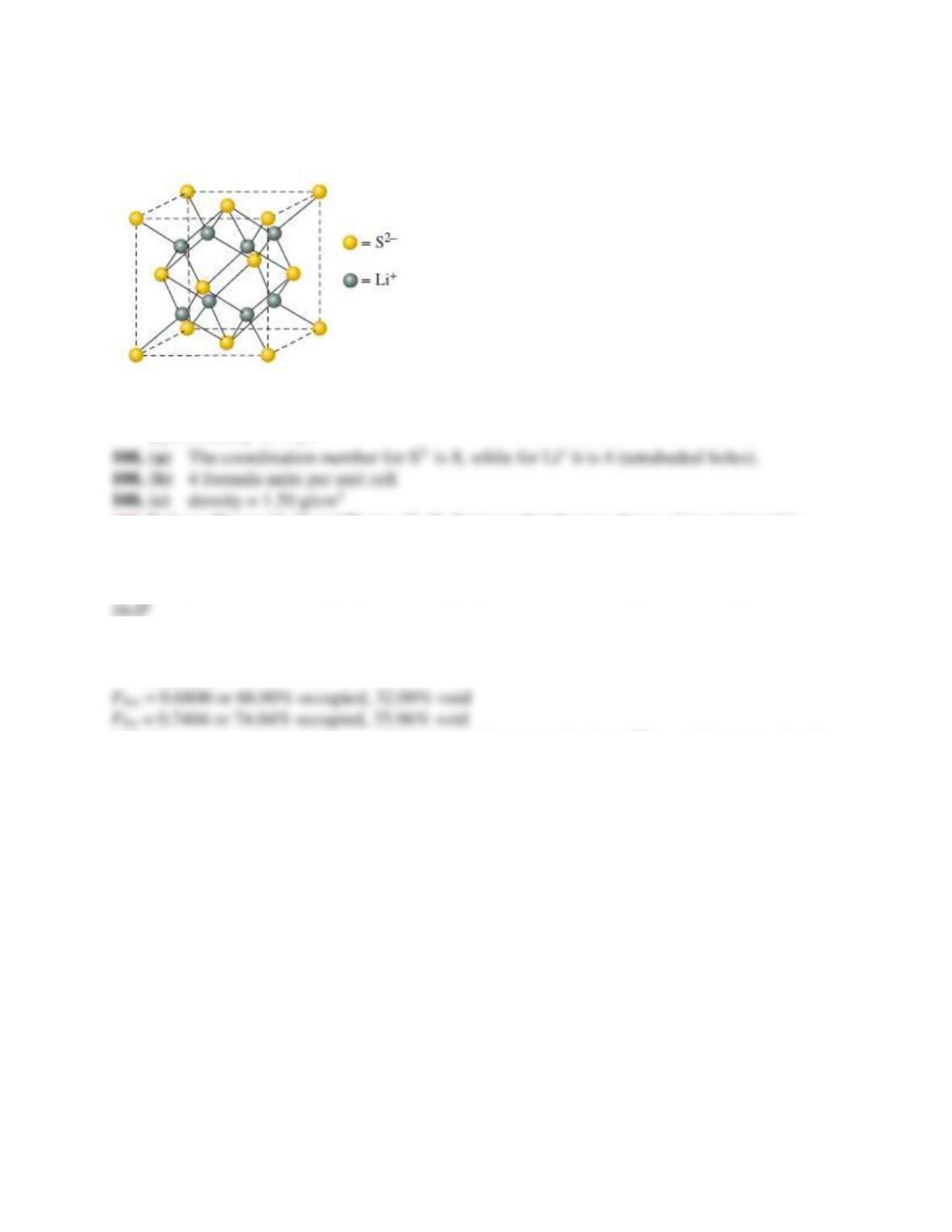
108. The crystal structure of lithium sulfide
( )
2
Li S ,
is pictured here. The length of the unit cell is
2
5 88 10 pm
For this structure, determine
(a) the coordination numbers of
Li+
and
2
S−
;
(b)
the number of formula units in the unit cell;
(c) the density of
2
Li S
109. Refer to Figure 12-44 and Figure 12-48. Suppose that the two planes of ions pictured in
Figure 12-44 correspond to the top and middle planes of ions in the NaCl unit cell in Figure
12-48. If the X-rays used have a wavelength of 154.1 pm, at what angle
would the
diffracted beam have its greatest intensity? [Hint: Use
1n=
in equation (12.5).]
110. Use the analyses of a bcc structure on page 555 and the fcc structure in Exercise 146 to
determine the percent voids in the packing-of-spheres arrangement found in the fcc crystal
structure.
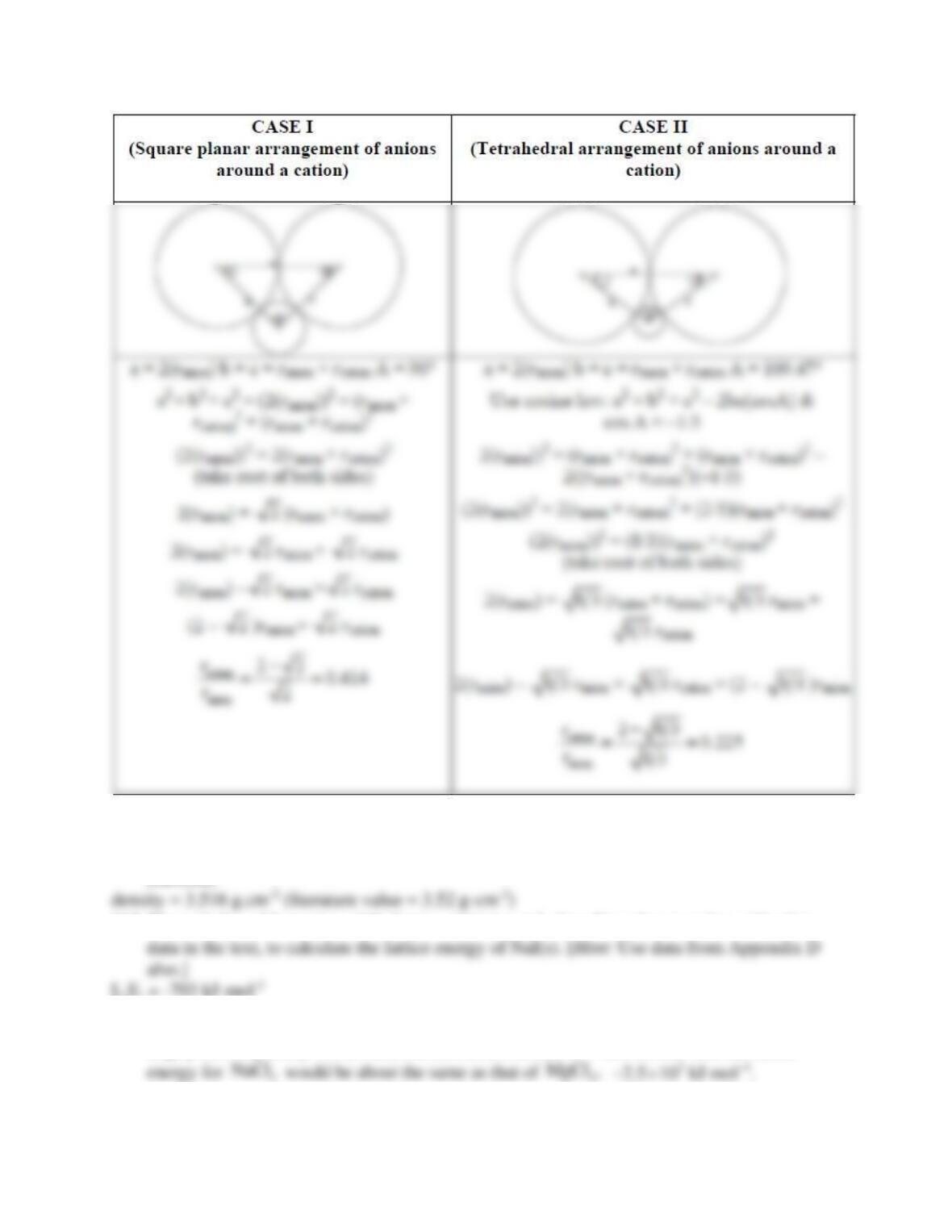
111. One way to describe ionic crystal structures is in terms of cations filling voids among closely
packed anions. Show that in order for cations to fill the tetrahedral voids in a close packed
arrangement of anions, the radius ratio of cation,
c,r
to anion,
a,r
must fall between the
following limits
ca
0 225 / 0 414rr
112. Use the unit cell of diamond in Figure 12-32(b) and a carbon-to-carbon bond length of
154.45 pm, together with other relevant data from the text, to calculate the density of
diamond.
113. The enthalpy of formation of NaI(s) is
1
288 kJ mol−
−
Use this value, together with other
114. Show that the formation of
( )
2
NaCl s
is very unfavorable; that is,
( )
f2
NaCl sH
is a
large positive quantity. To do this, use data from Section 12-7 and assume that the lattice
115. A crystalline solid contains three types of ions,
2
Na , O ,
+−
and
Cl−
The solid is made up of
cubic unit cells that have
2
O−
ions at each corner,
Na+
ions at the center of each face, and
Cl−
ions at the center of the cells. What is the chemical formula of the compound? What are
the coordination numbers for the
2
O−
and
Cl−
ions? If the length of one edge of the unit cell
is a, what is the shortest distance from the center of a
Na+
ion to the center of an
2
O−
ion?
Similarly, what is the shortest distance from the center of a
Cl−
ion to the center of an
2
O−
ion?
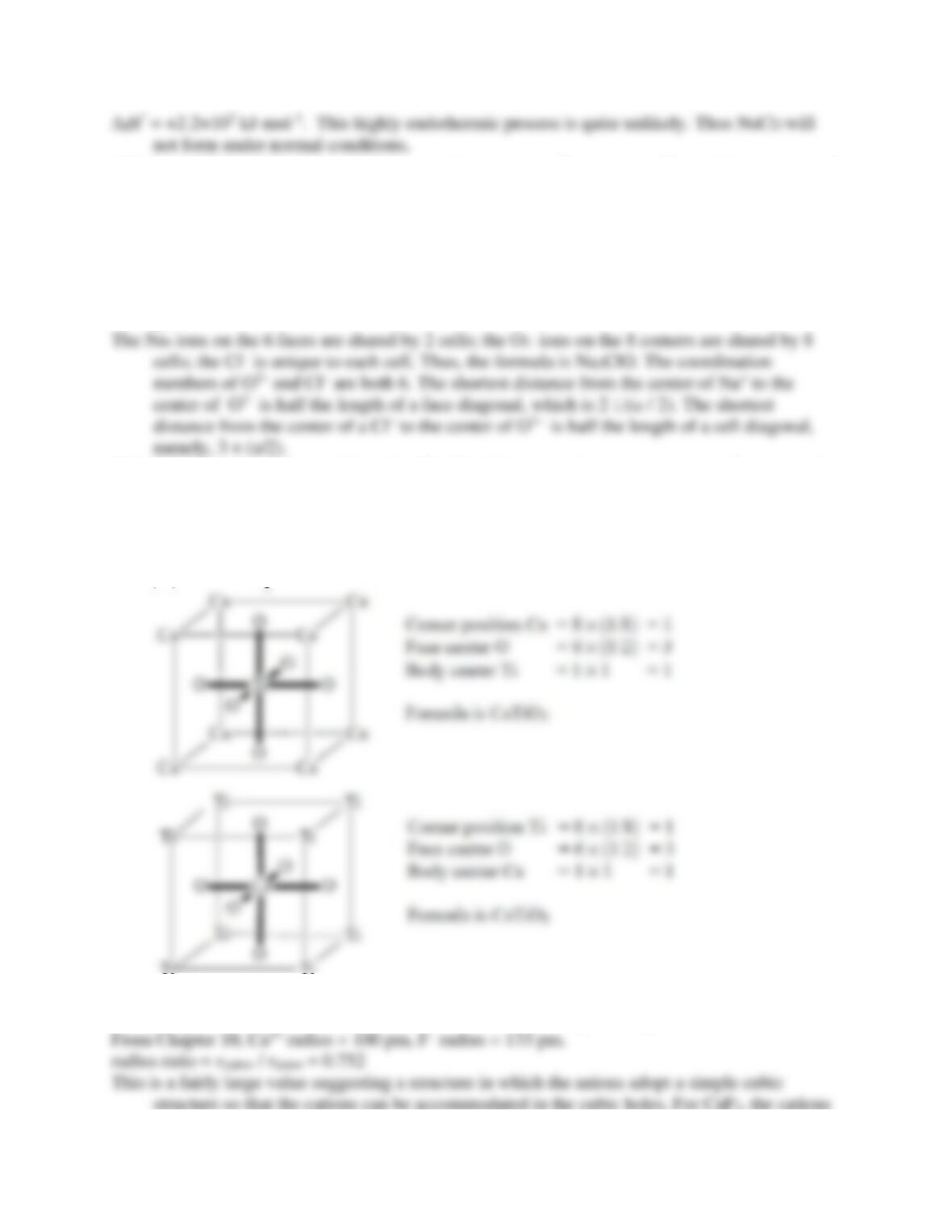
116. A certain mineral has a cubic unit cell with calcium at each corner, oxygen at the center of
each face, and titanium at its body center. What is the formula of the mineral? An alternate
way of drawing the unit cell has calcium at the center of each cubic unit cell. What are the
positions of titanium and oxygen in such a representation of the unit cell? How many
oxygen atoms surround a particular titanium atom in either representation?
117. Calculate the radius ratio
( )
r / r
+−
for
2
CaF
Suggest an alternative structure to that shown
in Figure 12-50(b) that better conforms to the radius ratio you compute.
118. In some barbecue grills the electric lighter consists of a small hammer-like device striking a
small crystal, which generates voltage and causes a spark between wires that are attached to
opposite surfaces of the crystal. The phenomenon of causing an electric potential through
mechanical stress is known as the piezoelectric effect. One type of crystal that exhibits the
piezoelectric effect is lead zirconate titanate. In this perovskite crystal structure, a
titanium(IV) ion sits in the middle of a tetragonal unit cell with dimensions of
0 403nm 0 398nm 0 398nm
At each corner is a lead(II) ion, and at the center of each
face is an oxygen anion. Some of the Ti(IV) are replaced by Zr(IV). This substitution, along
with Pb(II), results in the piezoelectic behavior.
(a)
How many oxygen ions are in the unit cell?
(b)
How many lead(II) ions are in the unit cell?
(c) How many titanium(IV) ions are in the unit cell?
(d)
What is the density of the unit cell?
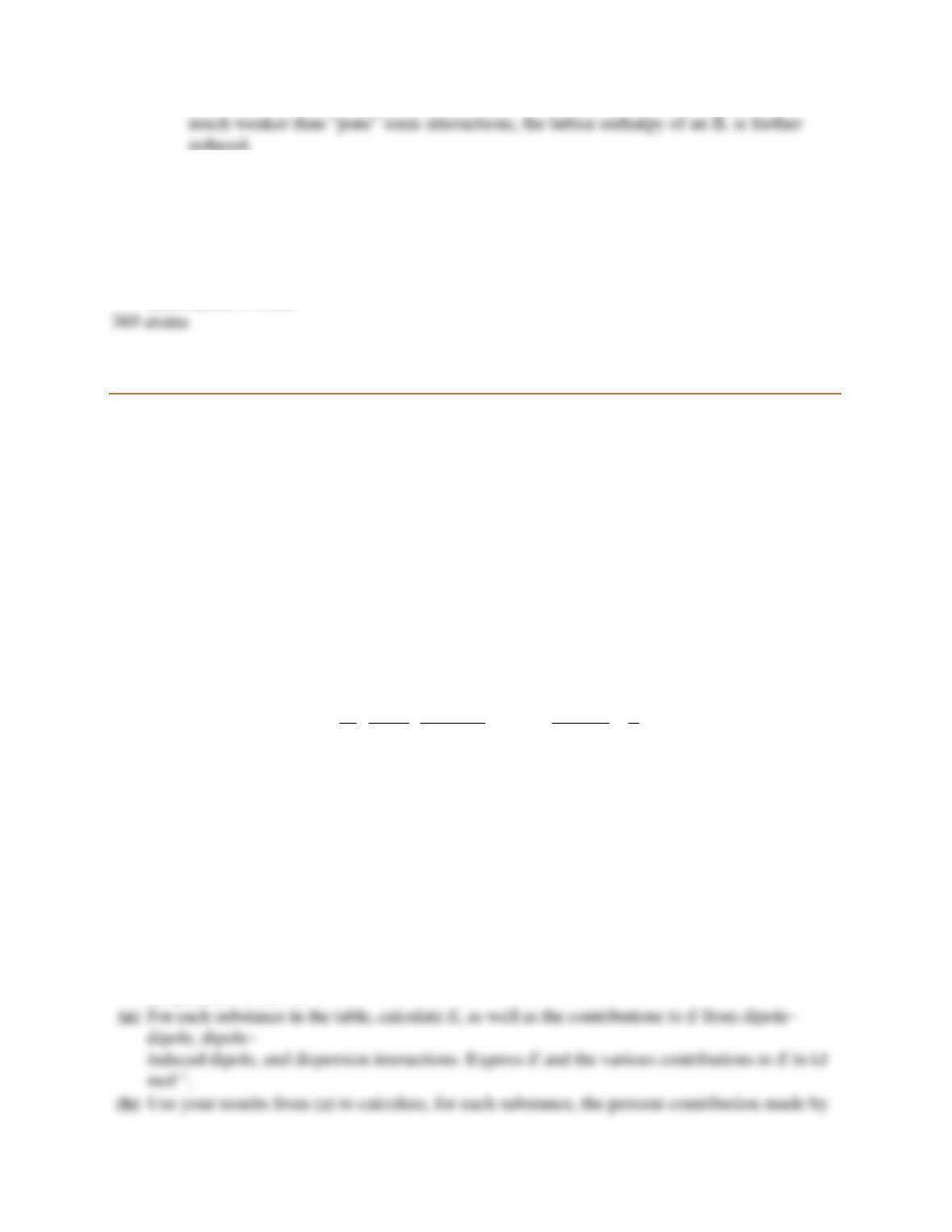
119. Ionic liquids (ILs) are salts that are in the liquid state. At a given temperature, ILs have
lower vapor pressures than molecular compounds in the liquid state because the forces of
attraction between oppositely charged ions are much stronger than intermolecular forces.
Thus, ILs tend to be much less volatile and less flammable than many other liquids. ILs are
of interest because of their potential role as “safer” and “greener” solvents. Two examples
of ionic liquids are 1-butyl-3-methylimidazolium tetrafluoroborate, [Bmim][BF4], and 1-
allyl-3-methylimidazolium chloride, [Amim]Cl, both of which consist of a relatively large
organic cation and an inorganic anion.
(a) Look up and then draw the structures of the ions making up these two ILs.
(b) Find the melting points for these two ILs and for NaCl.
(c) Explain why the melting points of these two ILs are much lower than that of NaCl.
119. (a) [Bmim][BF4] [Amim]Cl
120. In a 1999 study of cobalt nanocrystals, D. P. Dinega and M. G. Bawendi discovered that cobalt
forms an interesting cubic structure unlike any of the cubic structures described in this chapter.
They called this new form
-cobalt to distinguish it from the more commonly encountered
hcp and fcc forms of cobalt. For
–cobalt, the unit cell has an edge length of 609.7 pm and
contains 20 atoms. The density of
-cobalt is
8 635
=
g cm–3. Use these data to estimate
the number of cobalt atoms in a spherical nanocrystal of
-cobalt if the diameter of the
nanocrystal is 2 nm.
Feature Problems
121. Intermolecular forces play vital and varied roles in nature. For example, these forces enable
gecko lizards to climb walls and hang upside down from ceilings, seemingly defying gravity.
Intermolecular forces—more specifically, hydrogen bonds—are the reason that DNA
molecules, carriers of the genetic code for most living organisms, exist as a double helix. The
helical structure of proteins, the molecules that catalyze biochemical reactions occurring in
our bodies and regulate metabolic processes, is also the result of hydrogen bonding. In
Section 12-1, we learned about the physical basis of different types of intermolecular forces,
such as dipole–dipole, dipole–induced dipole, and instantaneous dipole–induced dipole
(dispersion) interactions. We also discussed the relative strengths of these different types of
interactions and the percent contributions they make to the attraction between molecules.
This problem focuses on doing calculations to verify the claims made in Section 12-1.
For two identical molecules separated from each other by a distance much greater than their
own dimensions, the average potential energy of interaction, E, is approximately
( ) ( )
422
i
2
6
B0
0
1 2 1 1 3
2
3 4 4
4
EE
r k T
= − + +
In the equation above,
is the molecular dipole moment in C m,
is the molecular
polarizability in m3, Ei is the first ionization energy of the molecule in J, and r is the center of
mass separation in m between the two molecules. In addition,
12 2 1 1
08 854 10 C J m
− − −
=
is
the permittivity of vacuum,
23 1
B1 3807 10 J Kk−−
=
is the Boltzmann constant, and T is the
temperature in K. The first term in the equation above represents the dipole–dipole
interaction, the second term represents the dipole–induced dipole interaction, and the third
term represents the dispersion interaction.
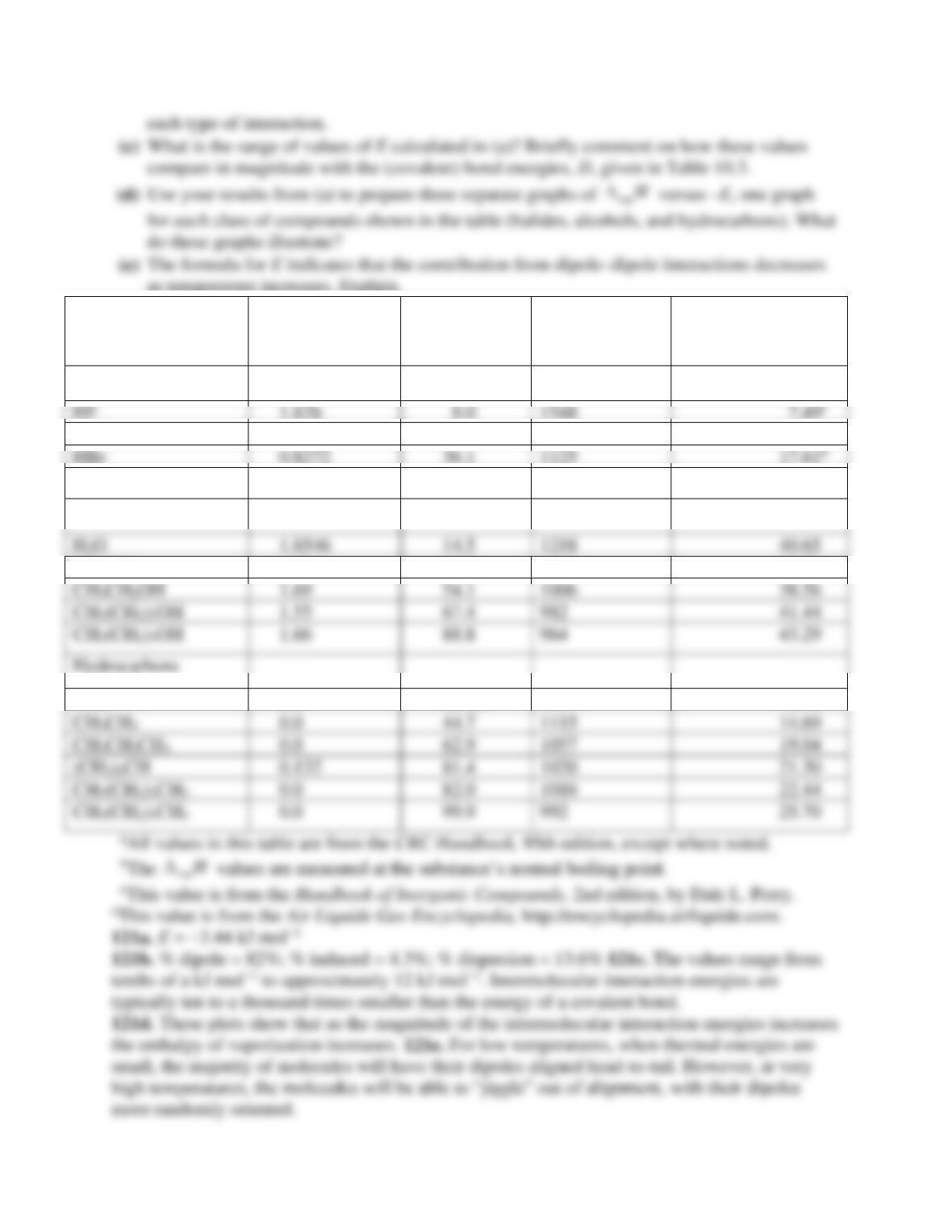
Use the equation above and data from the table that follows to answer the questions below.
Assume the center of mass separation, r, between molecules is exactly 400 pm and the
temperature is 298 K.
as temperature increases. Explain.
Substancea
, D
, 10–25 cm3
Ei, kJ mol–1
b1
vapH, kJ mol−
Halides
1.826
1548
HCl
1.1086
26.3
1230
16.15
HBr
0.8272
36.1
1125
HI
0.448
54.4
1002
19.76
Water and Alcohols
1.8546
14.5
1218
40.65
CH3OH
1.70
32.9
1047
35.21
CH3CH2OH
1.69
54.1
1006
38.56
CH3(CH2)2OH
1.55
67.4
982
41.44
Hydrocarbons
CH4
0.0
25.93
1217
8.19
CH3CH3
0.0
44.7
1115
14.69
CH3CH2CH3
0.0
62.9
1057
19.04
0.132
81.4
1020
21.30
CH3(CH2)2CH3
0.0
82.0
1016
22.44
0.0
99.9
992
25.70
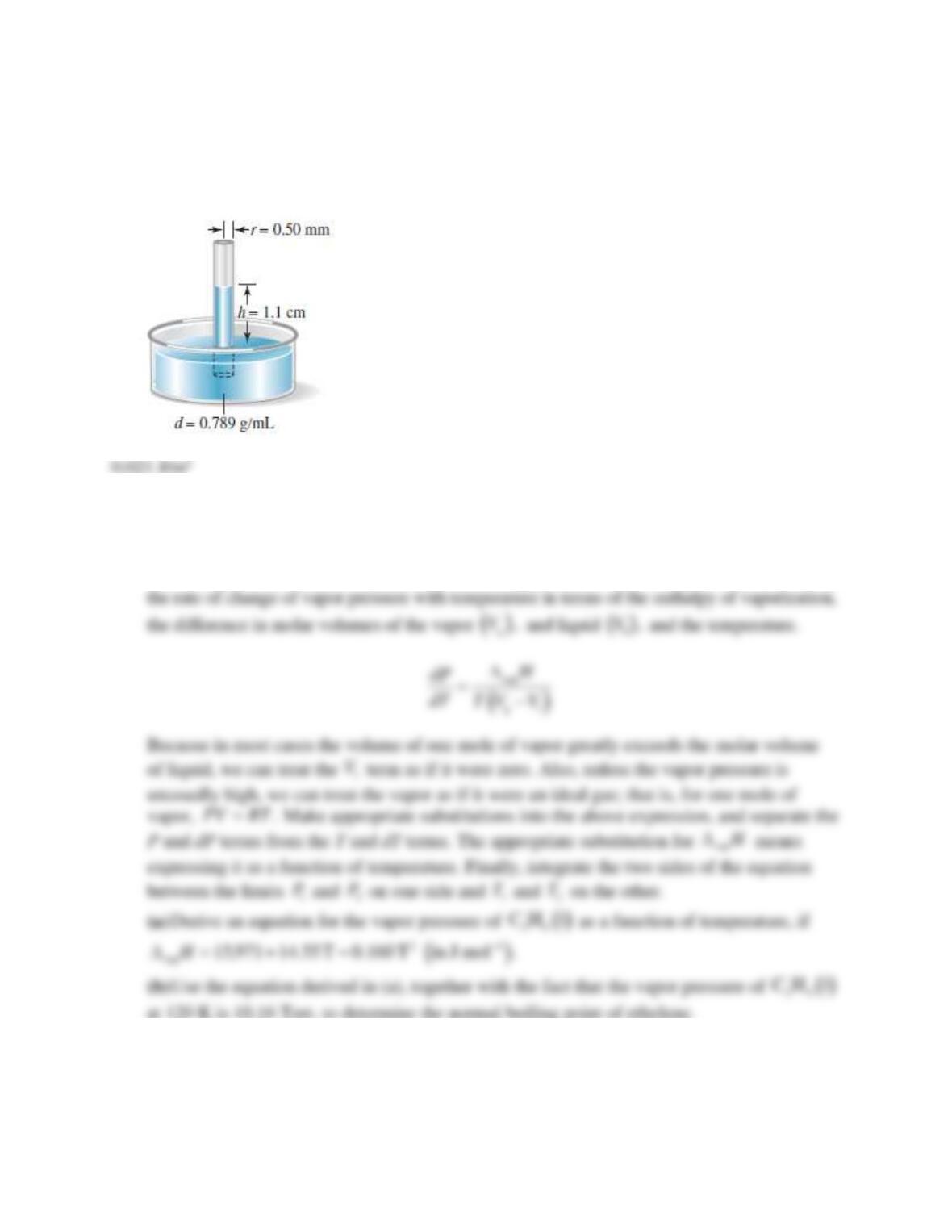
122. In a capillary rise experiment, the height (h) to which a liquid rises depends on the density
(d) and surface tension
( )
of the liquid and the radius of the capillary (r). The equation
relating these quantities and the acceleration due to gravity (g) is
2h / dgr=
The sketch
provides data obtained with ethanol. What is the surface tension of ethanol?
123. We have learned that the enthalpy of vaporization of a liquid is generally a function of
temperature. If we wish to take this temperature variation into account, we cannot use the
Clausius–Clapeyron equation in the form given in the text (that is, equation 12.2). Instead, we
must go back to the differential equation upon which the Clausius–Clapeyron equation is based
and reintegrate it into a new expression. Our starting point is the following equation describing
124. All solids contain defects or imperfections of structure or composition. Defects are
important because they influence properties, such as mechanical strength. Two common
types of defects are a missing ion in an otherwise perfect lattice, and the slipping of an ion
from its normal site to a hole in the lattice. The holes discussed in this chapter are often
called interstitial sites, since the holes are in fact interstices in the array of spheres. The two
types of defects described here are called point defects because they occur within specific
sites. In the 1930s, two solid-state physicists, W. Schottky and J. Fraenkel, studied the two
types of point defects: A Schottky defect corresponds to a missing ion in a lattice, while a
Fraenkel defect corresponds to an ion that is displaced into an interstitial site.
(a)
An example of a Schottky defect is the absence of a
Na+
ion in the NaCl structure. The
absence of a
Na+
ion means that a
Cl−
ion must also be absent to preserve electrical
neutrality. If one NaCl unit is missing per unit cell, does the overall stoichiometry change,
and what is the change in density?
(b)
An example of a Fraenkel defect is the movement of a
Ag+
ion to a tetrahedral
interstitial site from its normal octahedral site in AgCl, which has a structure like NaCl.
Does the overall stoichiometry of the compound change, and do you expect the density to
change?
(c) Titanium monoxide (TiO) has a sodium chloride-like structure. X-ray diffraction data
show that the edge length of the unit cell is 418 pm. The density of the crystal is
3
4 92 g/cm
. Do the data indicate the presence of vacancies? If so, what type of vacancies?
125. In an ionic crystal lattice each cation will be attracted by anions next to it and repulsed by
cations near it. Consequently the coulomb potential leading to the lattice energy depends on
the type of crystal. To get the total lattice energy you must sum all of the electrostatic
interactions on a given ion. The general form of the electrostatic potential is
2
12
12
Q Q e
Vd
=
where
1
Q
and
2
Q
are the charges on ions 1 and 2,
12
d
is the distance between them in the
crystal lattice. and e is the charge on the electron.
(a)
Consider the linear “crystal” shown below.
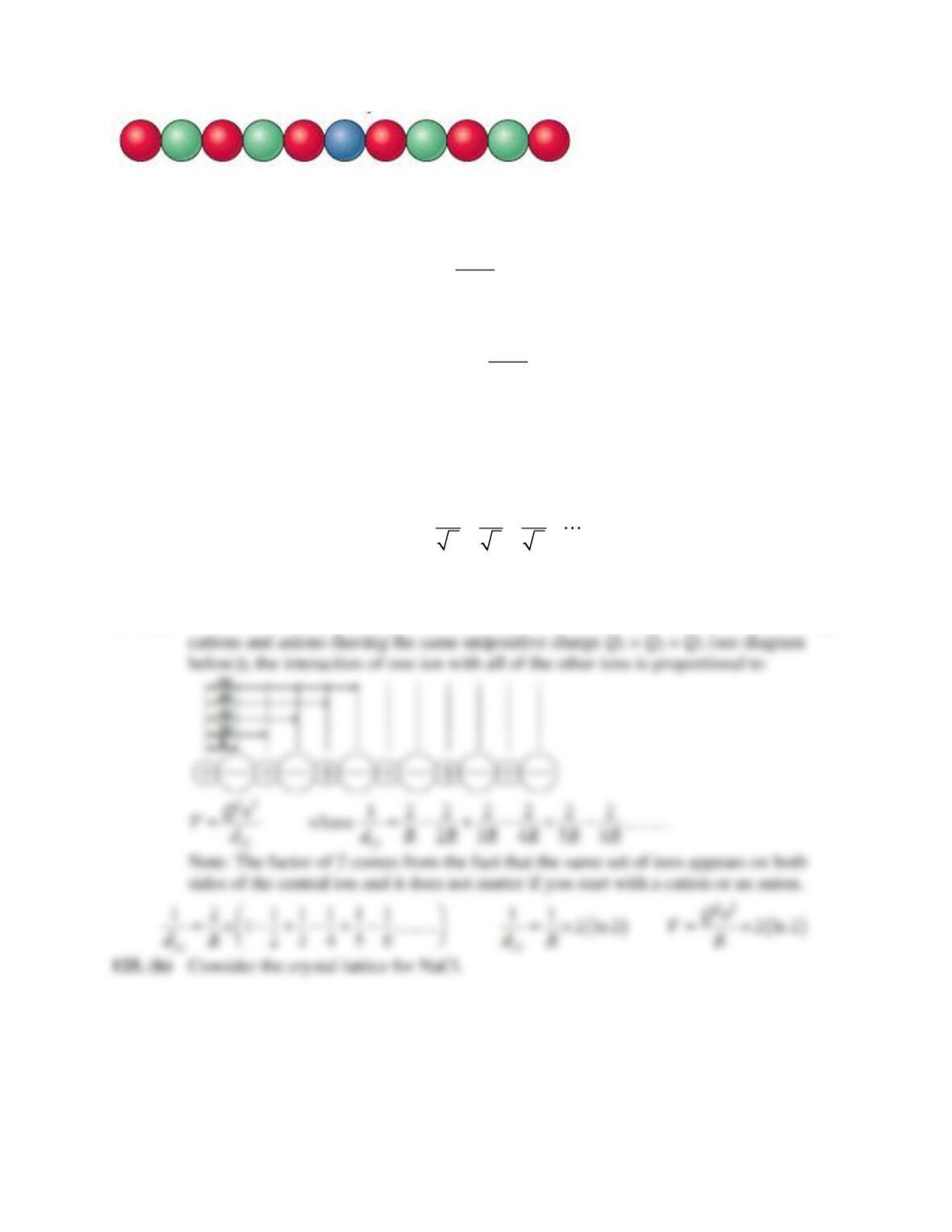
The distance between the centers of adjacent spheres is R. Assume that the blue sphere and
the green spheres are cations and that the red spheres are anions. Show that the total
electrostatic energy is
22
ln 2
Qe
Vd
= −
(b)
In general, the electrostatic potential in a crystal can be written as
22
M
Qe
Vk
R
=−
where
M
k
is a geometric constant, called the Madelung constant, for a particular crystal
system under consideration. Now consider the NaCl crystal structure and let R be the
distance between the centers of sodium and chloride ions. Show that by considering three
layers of nearest neighbors to a central chloride ion,
M
k
is given by
12 8 6
62 3 4
M
k
= − + − +
(c) Carry out the same calculation for the CsCl structure. Are the Madelung constants the
same?
125. (a) For a uniformly spaced (separation = r) one dimensional linear “crystal” of alternating
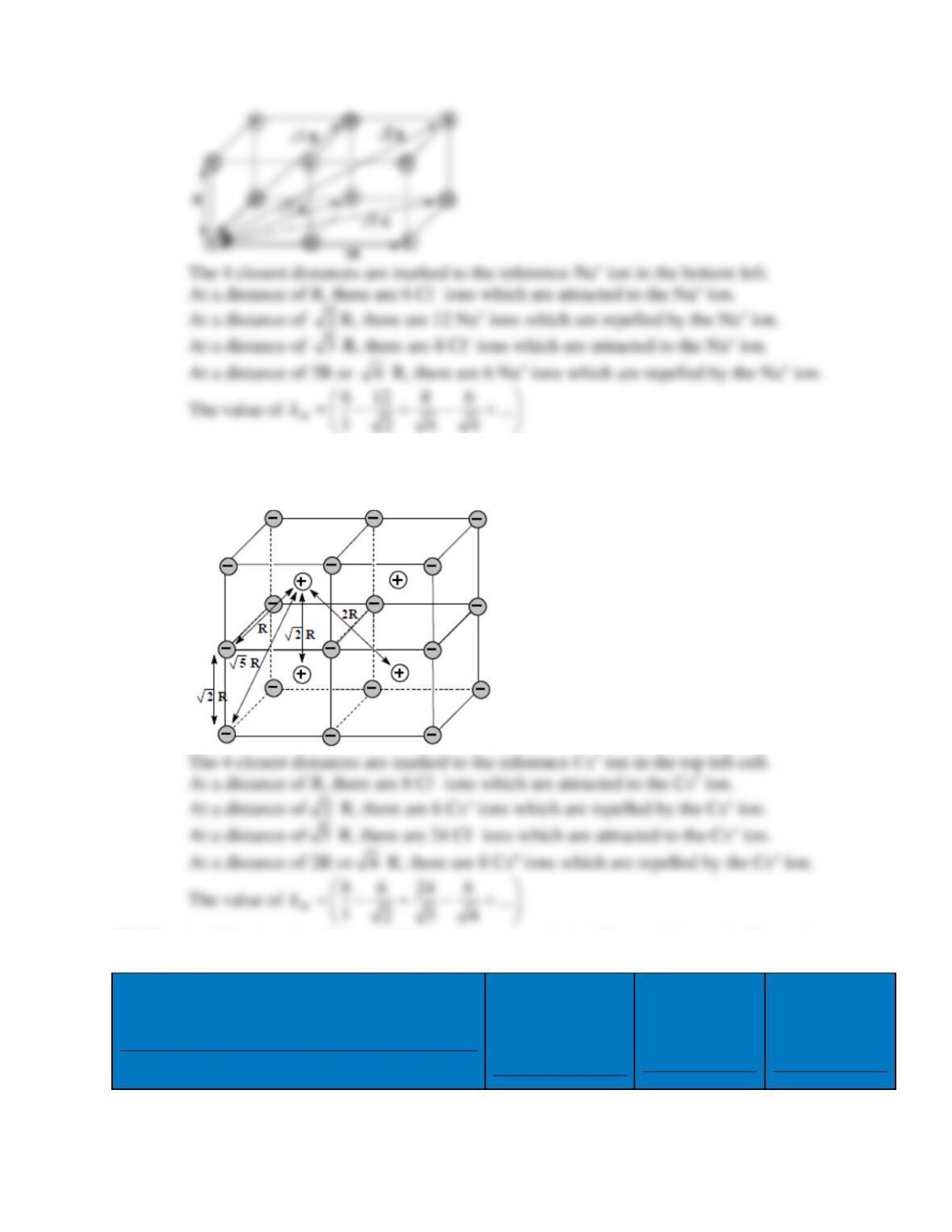
125. (c) If we carry out the same calculation for the CsCl structure, we would see that the
Madelung constant is not the same. This is because the crystal structure is not the
same. Notable is the fact that there are 8 nearest neighbors in CsCl and only 6 in NaCl.
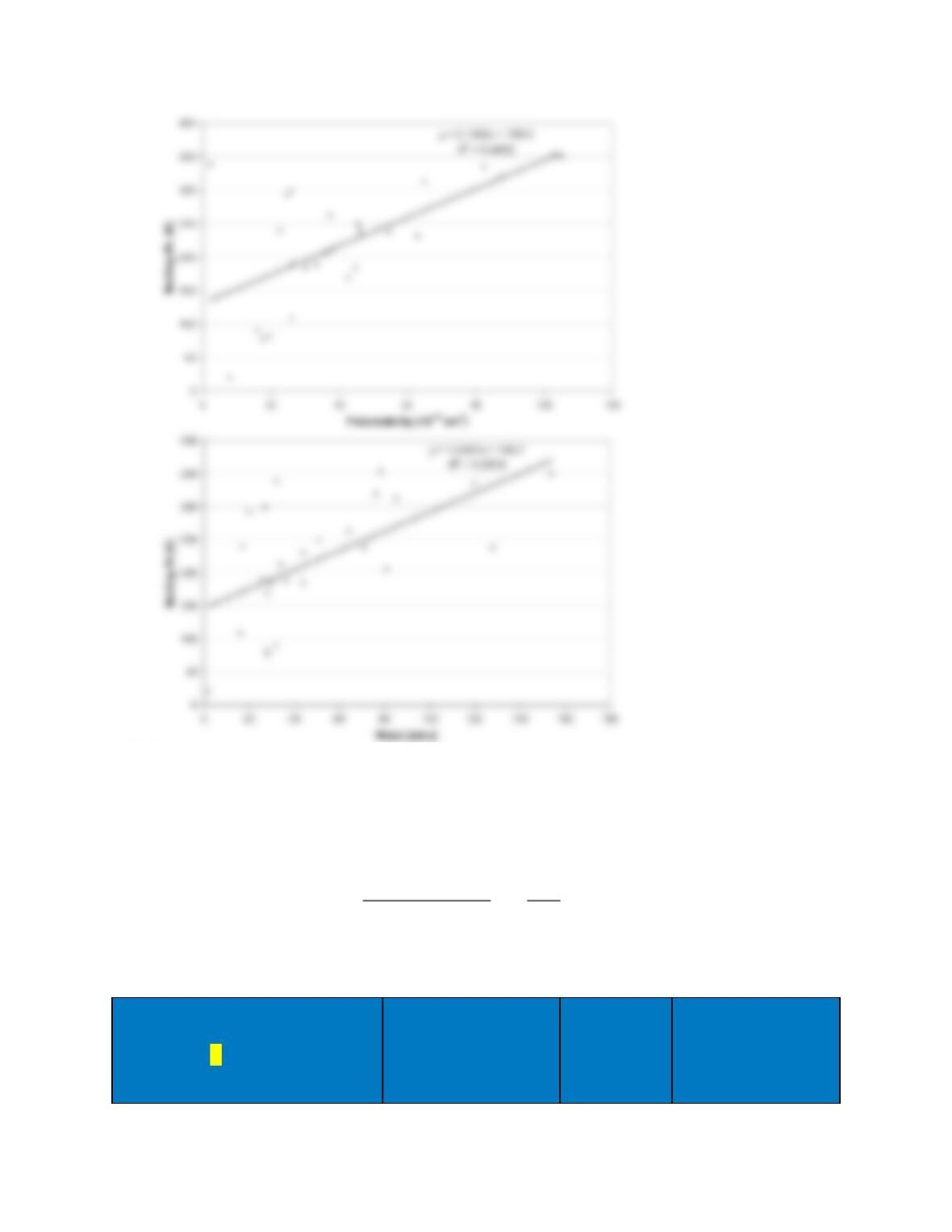
126. Plot the following data first as boiling point versus polarizability, and then as boiling point
versus mo-lecular mass. What conclusions can you draw from these plots?
Compound
Polarizability,
25 3
10 cm
−
Mass,
u
Boiling Point,
K
2
N
17.6
28.01
77.35
16.0
32.00
90.188
2
Cl
46.1
70.90
238.25
24.6
292.69
HCl
26.3
36.46
188.25
36.1
206.15
HI
54.4
127.91
237.77
30.0
44.01
184.65
CO
19.5
28.01
81.65
37.2
64.06
263.15
2
HS
37.8
34.08
212.45
87.4
76.13
319.45
3
NH
22.6
17.03
239.8
25.9
27.03
299.15
4
CH
26.0
16.04
109.15
44.7
30.07
184.55
42.6
28.05
169.45
33.3
26.04
189.15
38
CH
62.9
44.01
231.05
103
78.11
353.25
45.6
50.49
248.95
64.8
84.93
313.15
82.3
119.37
334.85
4
CCl
105
153.81
349.95
32.3
32.04
338.15
2
20.35
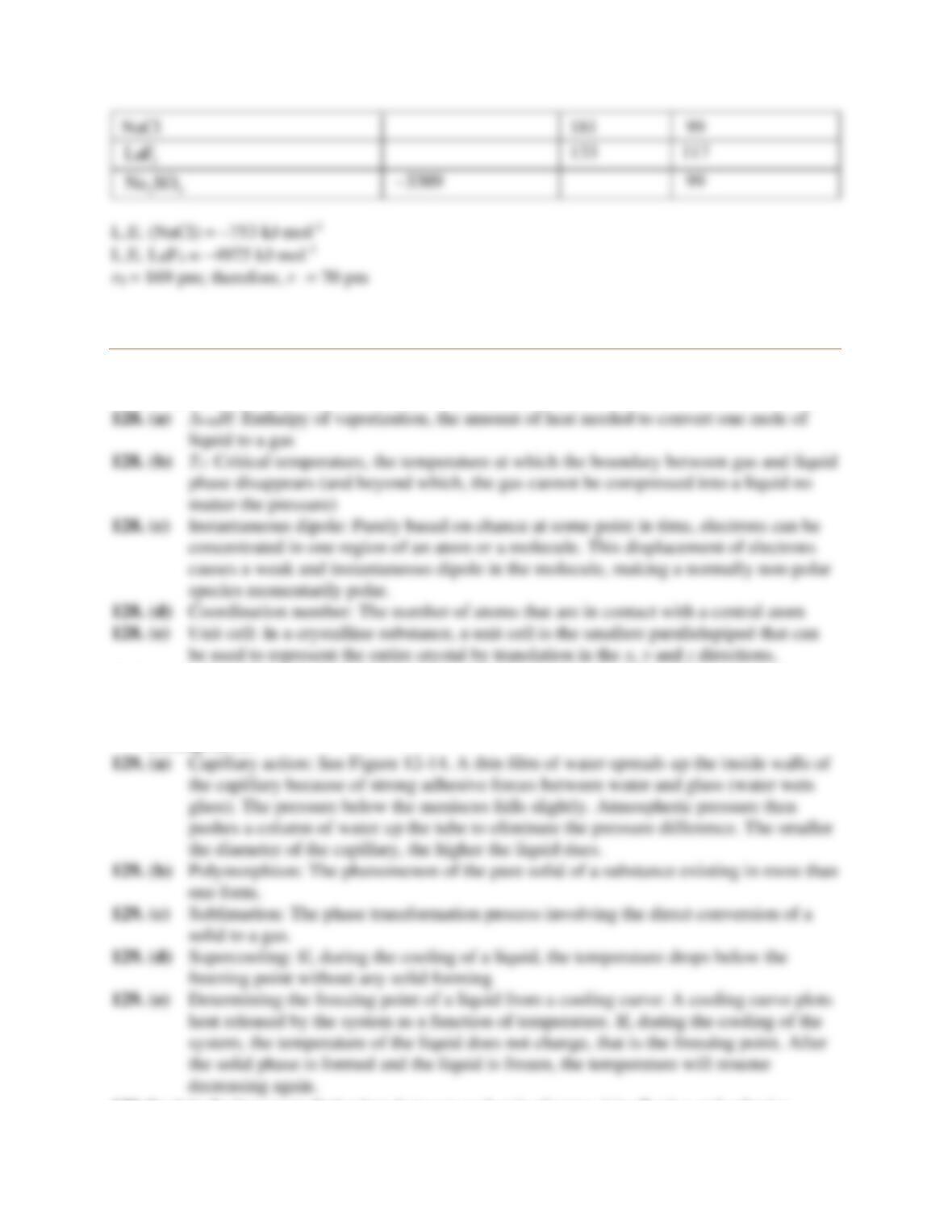
127. The Born–Fajans–Haber cycle uses thermodynamic cycles to determine lattice energy. An
alternative to the Born–Fajans–Haber method is one based on fundamental principles.
Because the dominant interactions in an ionic crystal are Coulomb interactions, we can use
the theory of electrostatics to calculate the lattice energy. Kapustinskii used these ideas and
proposed the following equation:
( )
1
00
120,250 34 5
U 1 kJ mol
ZZ
rr
+− −
= −
where the number of ions per formula unit is given by
and
0
r
is equal to the sum of the
ionic radii,
( )
pmrr
+−
+
. Use the equation to complete the following table:
Compound Ç
Lattice Energy, kJ
1
mol−
r,
−
pm
r,
+
pm
Self-Assessment Exercises
128. In your own words, define or explain the following terms or symbols: (a)
vap ;H
(b)
c;T
(c)
instantaneous dipole; (d) coordination number; (e) unit cell.
129. Briefly describe each of the following phenomena or methods: (a) capillary action; (b)
polymorphism;
(c) sublimation; (d) supercooling; (e) determining the freezing point of a liquid from a
cooling curve.
130. Explain the important distinctions between each pair of terms: (a) adhesive and cohesive
forces; (b) vaporization and condensation; (c) triple point and critical point; (d) face-centered
and body-centered cubic unit cell; (e) tetrahedral and octahedral hole.
130. (a) Adhesive and cohesive forces: Cohesive forces are forces between the molecules of a
130. (b) Vaporization and condensation: Vaporization is the process of converting a liquid into
130. (c) Triple point and critical point: Triple point is the temperature and pressure where all
130. (d) Face-centered and body-centered cubic unit cell: A face centered cubic unit cell has an
130. (e) Tetrahedral and octahedral hole: tetrahedral holes are voids between packed layers of
131. Which of the following liquid properties depends on the strength of intermolecular attractions?
(a) surface tension; (b) boiling point; (c) vapor pressure; (d) heat of vaporization; (e) all of
these.
132. A liquid is in equilibrium with its vapor in a closed container. The lid of the container is
removed briefly, allowing some of the vapor to escape, and then replaced. What is the
immediate result of the vapor escaping? (a) vaporization rate decreases; (b) condensation rate
decreases; (c) vaporization rate increases; (d) condensation rate increases; (e) none of these.
133. The magnitude of one of the following properties must always increase with temperature; that
one is (a) surface tension; (b) density; (c) vapor pressure; (d)
134. Of the compounds HF,
4
CH ,
3
CH OH,
24
N H ,
and
3
CHCl ,
hydrogen bonding is an important
intermo-lecular force in (a) none of these; (b) two of these; (c) three of these; (d) all but one of
these; (e) all of these.
135. In the responses below, the vapor pressure of trichloroethene is listed for a given temperature.
In which response does the given temperature correspond to the normal boiling point? (a) 40
Torr at 40.1 °C; (b) 100 Torr at 61.3 °C; (c) 400 Torr at 100.0 °C; (d) 760 Torr at 120.8 °C; (e)
none of these.
136. The normal boiling point of acetone is 56.2 °C, and the molar heat of vaporization is 32.0 kJ
mol–1. What is the boiling temperature of acetone under a pressure of 50.0 mmHg?
137. A metal that crystallizes in the body-centered cubic (bcc) structure has a crystal
coordination number of (a) 6; (b) 8; (c) 12; (d) any even number between 4 and 12.
138. A unit cell of an ionic crystal (a) shares some ions with other unit cells; (b) is the same as
the formula unit; (c) is any portion of the crystal that has a cubic shape; (d) must contain the
139. If the triple point pressure of a substance is greater than 1 atm, which two of the following
conclusions are valid?
(a)
The solid and liquid states of the substance cannot coexist at equilibrium.
(b)
The melting point and boiling point of the substance are identical.
(c) The liquid state of the substance cannot exist.
(d)
The liquid state cannot be maintained in a beaker open to air at 1 atm pressure.
(e) The melting point of the solid must be greater than
0C
(f) The gaseous state at 1 atm pressure cannot be condensed to the solid at the triple point
140. In each of the following pairs, which would you expect to have the higher boiling point? (a)
7 16
CH
or
10 22
C H ;
(b)
38
CH
or
( )
32
CH O;
(c)
32
CH CH SH
or
32
CH CH OH
141. One of the substances is out of order in the following list based on increasing boiling point.
Identify it, and put it in its proper place:
2
N,
3
O,
2
F,
Ar,
2
Cl
Explain your reasoning.
142. Arrange the following substances in the expected order of increasing melting point: KI, Ne,
24
K SO ,
38
C H ,
32
CH CH OH,
MgO,
22
CH OHCHOHCH OH
143. Is it possible to obtain a sample of ice from liquid water without ever putting the water in a
freezer or other enclosure at a temperature below
0C
? If so, how might this be done?
144. The phenomena in Figure 12-22 will be seen at the critical temperature only if the proper
amount of -liquid is placed in the sealed tube initially. Why should this be the case? What
would you expect to see if too little liquid was present initially? If too much liquid was
present?
145. The following data are given for
4
CCl
Normal melting point,
23 C;−
normal boiling
point,
77 C;
density of liquid
1 59 g/mL;
1
fus 3 28 kJ mol ;H−
=
vapor pressure at
25 C,
110 Torr.
(a)
What phases—solid, liquid, and/or gas—are present if
4
3 50 g CCl
is placed in a closed
8.21 L container at
25 C
?
(b)
How much heat is required to vaporize 2.00 L of
( )
CCl l
at its normal boiling point?
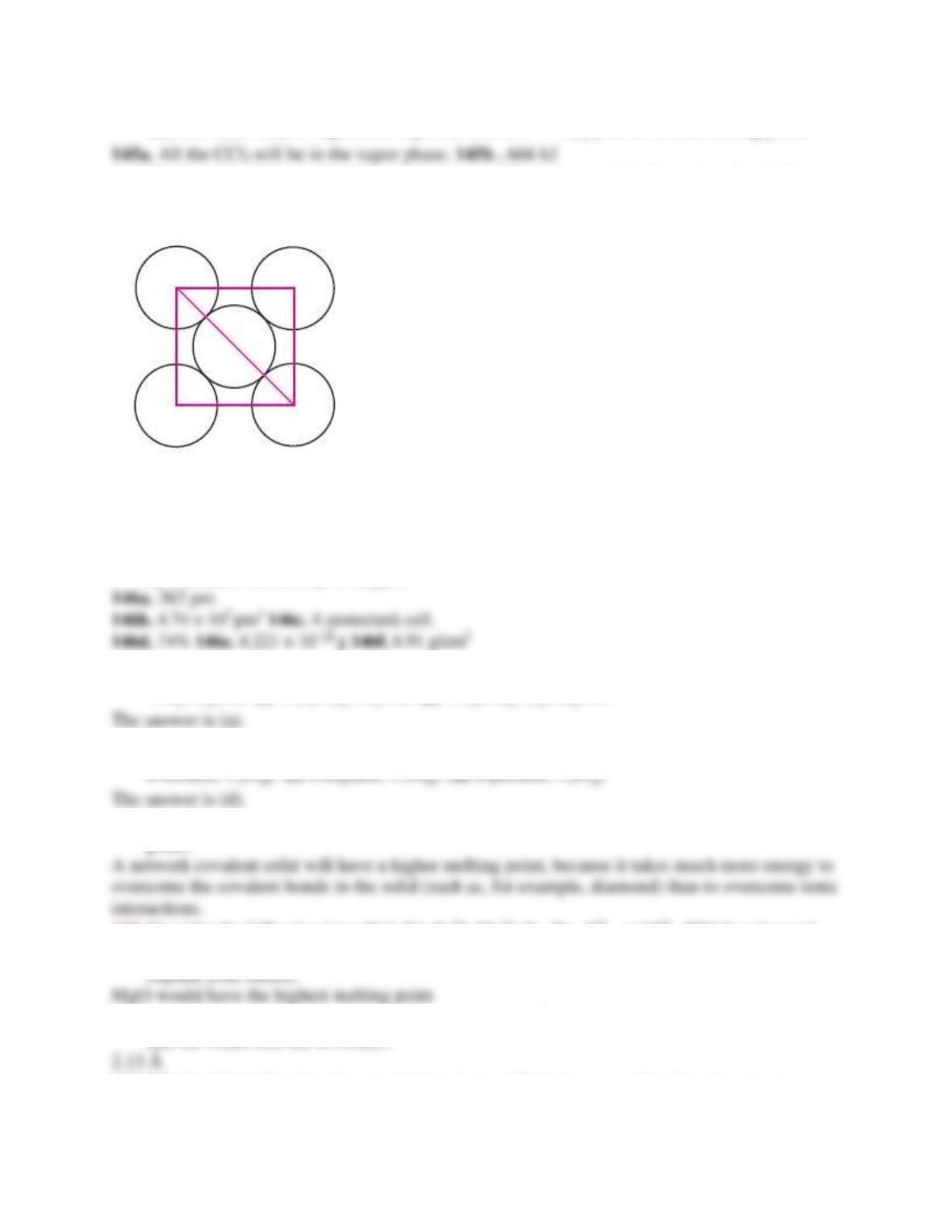
146. The fcc unit cell is a cube with atoms at each of the corners and in the center of each face, as
shown here. Copper has the fcc crystal structure. Assume an atomic radius of 128 pm for a
Cu atom.
(a)
What is the length of the unit cell of Cu?
(b)
What is the volume of the unit cell?
(c) How many atoms belong to the unit cell?
(d)
What percentage of the volume of the unit cell is occupied?
(e) What is the mass of a unit cell of copper?
(f) Calculate the density of copper.
147. Of the following liquids at
20 C,
which has the smallest surface tension? (a)
3
CH OH;
(b)
CH CH OH;
(c)
CH CH CH OH;
(d)
CH CH CH CH OH
148. Of the following liquids at
20 C,
which has the smallest viscosity? (a) dodecane,
12 26
C H ;
(b)
C H ;
C H ;
CH
149. Would you expect an ionic solid or a network covalent solid to have the higher melting
point?
150. Consider the following ions: Na+, K+, Ca2+, Mg2+, F–, Br–, O2–, and S2–. Which cation and
which anion do you expect to combine to form the highest melting compound? Carefully
151. In the lithium iodide crystal, the Li–I distance is 3.02 Å. Calculate the iodide radius, assuming
that the iodide ions are in contact.
152. Which of the following phase transitions is most likely to occur when the pressure on a
metallic solid increases? (a) bcc to sc; (b) fcc to sc; (c) bcc to fcc; (d) fcc to sc.
153. Construct a concept map representing the different types of intermolecular forces and their
origin.
The intermolecular forces can be broken down into two categories: dipole and induced dipole.
154. Construct a concept map using the ideas of packing of spheres and the structure of metal and
ionic crystals.
155. Construct a concept map showing the ideas contained in a phase diagram.
The phase diagram is the overarching concept (obviously), which needs to be broken down