Chapter 12
Intermolecular Forces: Liquids And Solids
Exercises
Intermolecular Forces
1. For each of the following substances describe the importance of dispersion (London) forces,
dipole– dipole interactions, and hydrogen bonding: (a) HCl; (b)
2
Br ;
(c) ICl; (d) HF; (e)
4
CH
2. When another atom or group of atoms is substituted for one of the hydrogen atoms in
benzene,
66
C H ,
the boiling point changes. Explain the order of the following boiling points:
66
C H ,
80 C;
65
C H Cl,
132 C;
65
C H Br,
156 C;
65
C H OH,
182 C
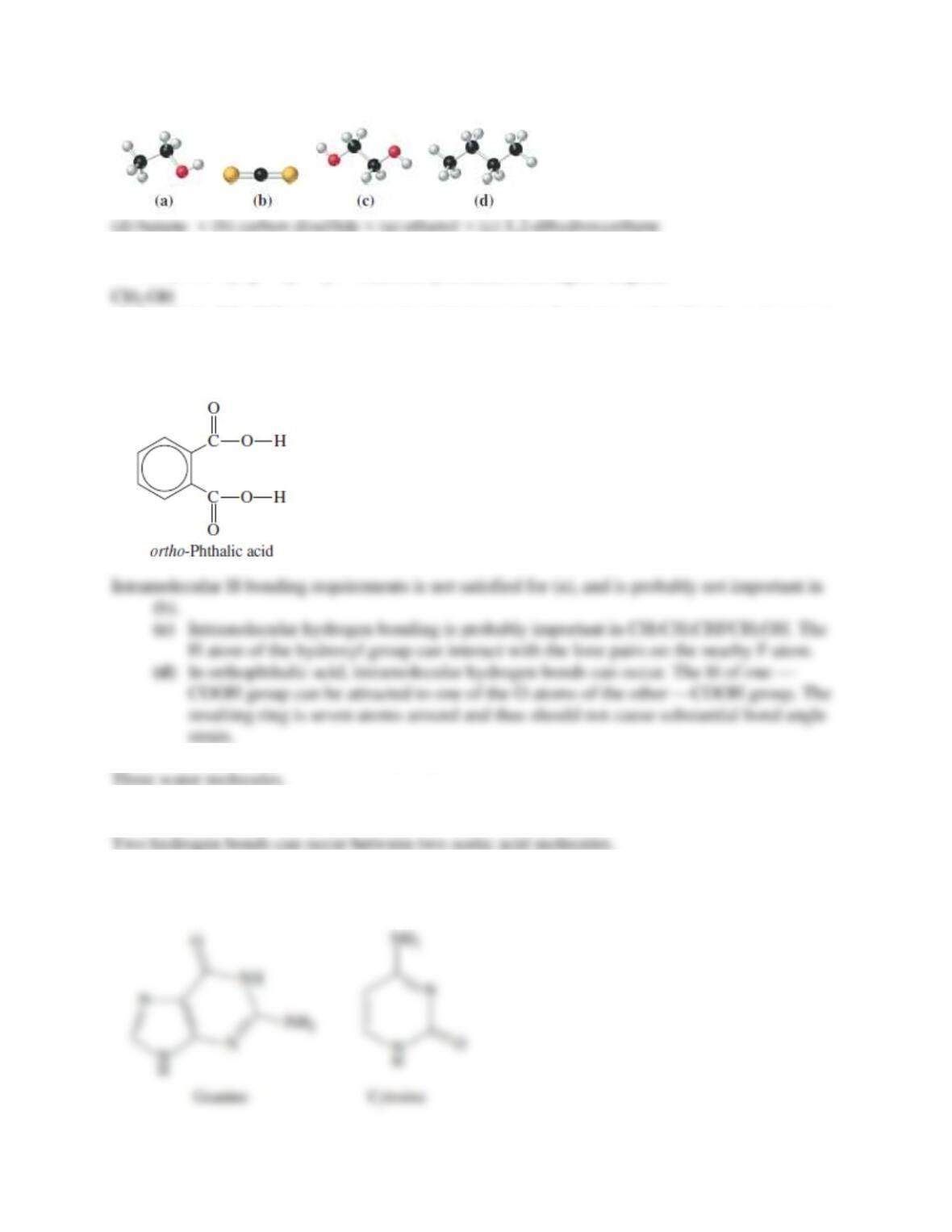
3. Arrange the liquids represented by the following -molecular models in the expected order of
increasing viscosity at
25 C
4. Arrange the liquids represented by the following
mo-lecular models in the expected order of increasing normal boiling point.
5. One of the following substances is a liquid at room temperature and the others are gaseous:
3
CH OH;
38
C H ;
2
N;
2
NO
Which do you think is the liquid? Explain.
6. In which of the following compounds might intramolecular hydrogen bonding be an important
factor? Explain. (a)
3 2 3
CH CH COCH ;
(b)
3 2 2 2
CH NH CH CH COOH;
(c)
3 2 2
CH CH CHFCH OH;
(d) ortho-phthalic acid.
7. How many water molecules can hydrogen bond to methanol?
8. What is the maximum number of hydrogen bonds that can form between two acetic acid
molecules?
9. In DNA the nucleic acid bases form hydrogen bonds between them, which are responsible
for the formation of the double-stranded helix. Arrange the bases guanine and cytosine to
give the maximum number of hydrogen bonds.
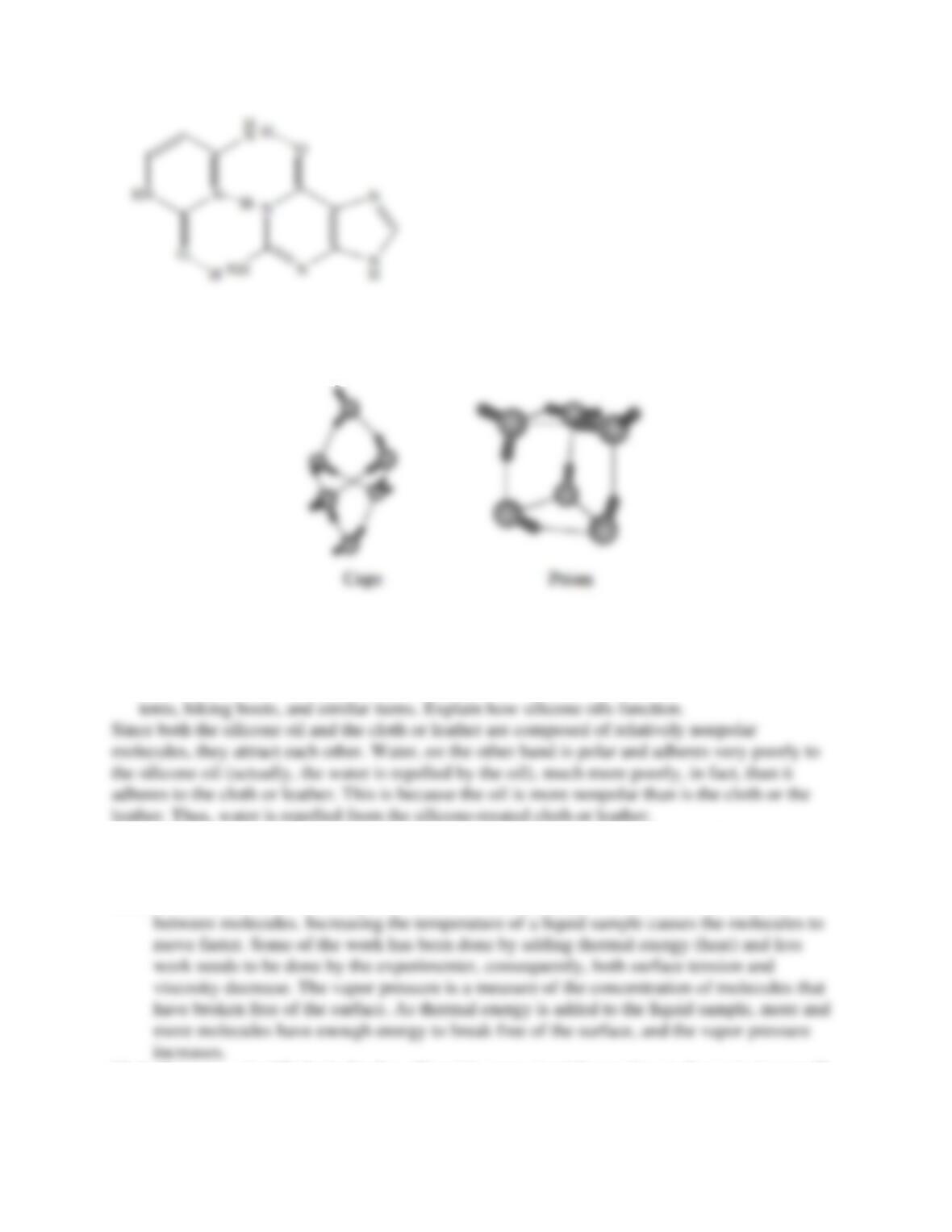
10. Water molecules will form small, stable clusters. Draw one possible water cluster by using
six water molecules and maximizing the number of hydrogen bonds for each water molecule.
See figures below:
Surface Tension and Viscosity
11. Silicone oils, such as
( ) ( )
3 3 3
2
H C SiO CH Si CH
n
, are used in water repellents for treating
12. Surface tension, viscosity, and vapor pressure are all related to intermolecular forces. Why do
surface tension and viscosity decrease with temperature, whereas vapor pressure increases
with temperature?
Both surface tension and viscosity deal with the work needed to overcome the attractions
13. Is there any scientific basis for the colloquial expression “slower than molasses in January”?
Explain.
14. A television commercial claims that a product makes water “wetter.” Can there be any basis
to this claim? Explain.
15. Rank the following in order of increasing surface tension (at room temperature):
16. Would you predict the surface tension of t-butyl alcohol,
( )
33
CH COH
, to be greater than or
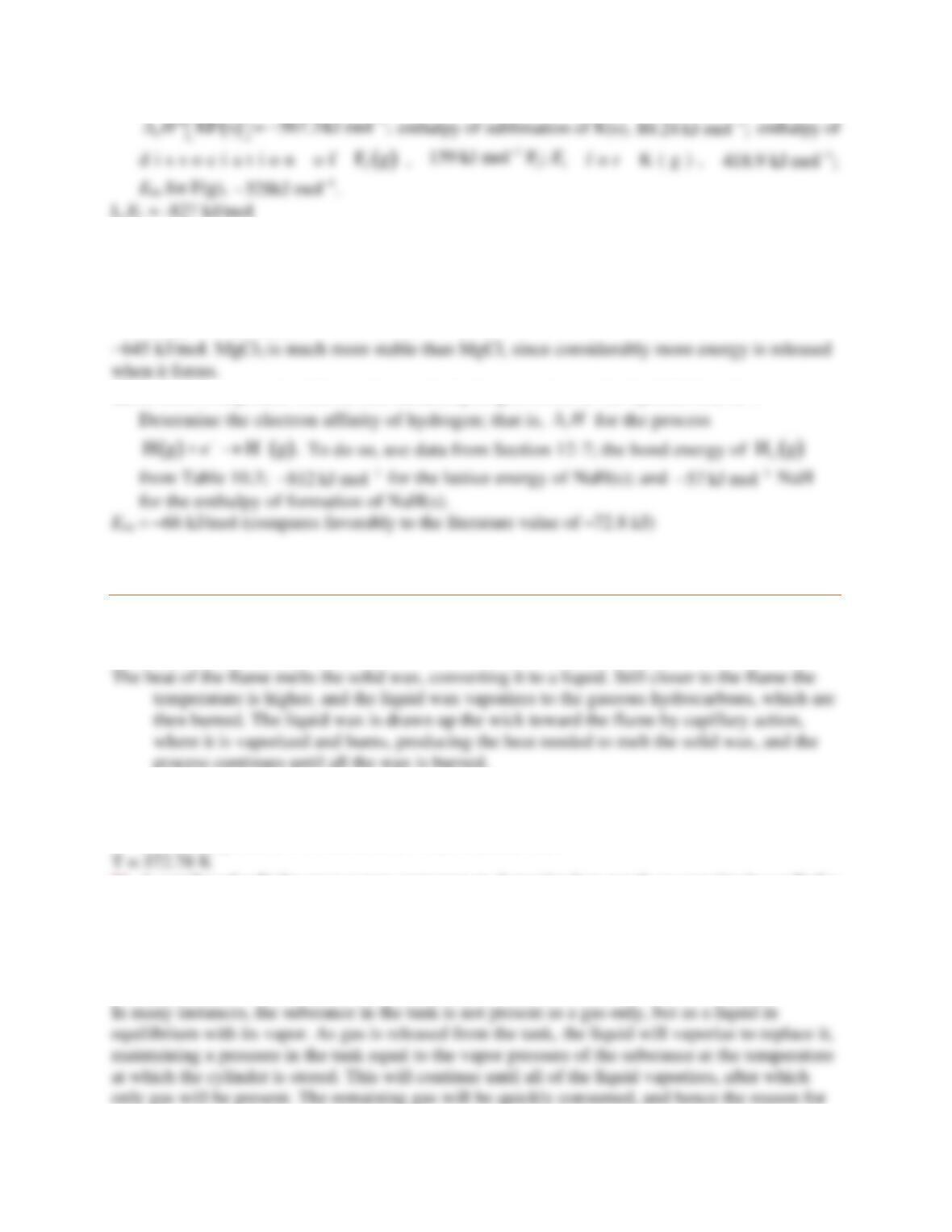
less than that of n-butyl alcohol,
3 2 2 2
CH CH CH CH OH?
Explain.
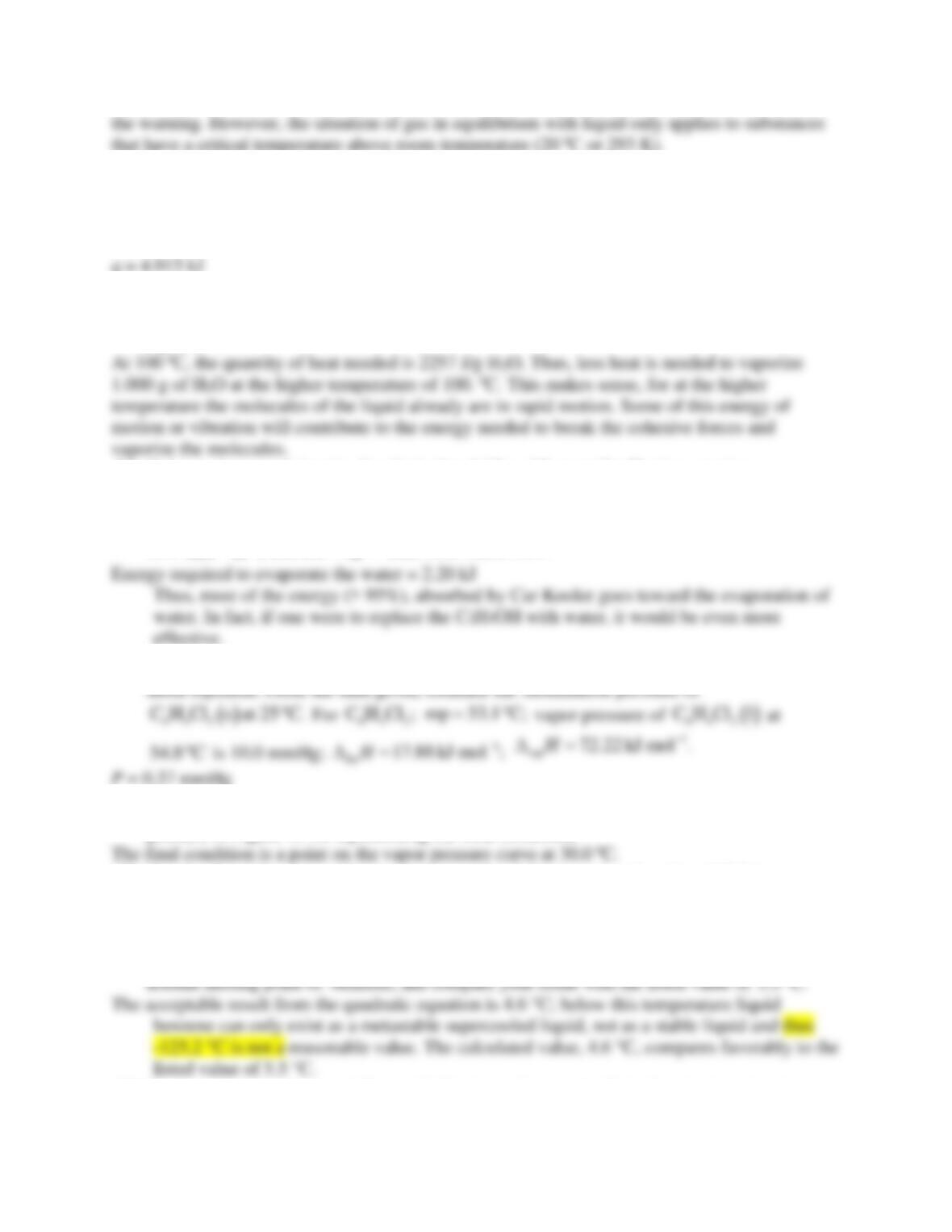
17. Butanol and pentane have approximately the same mass, however, the viscosity (at
20 C
) of
butanol is
2 948
=
cP, and the viscosity of pentane is
0 240
=
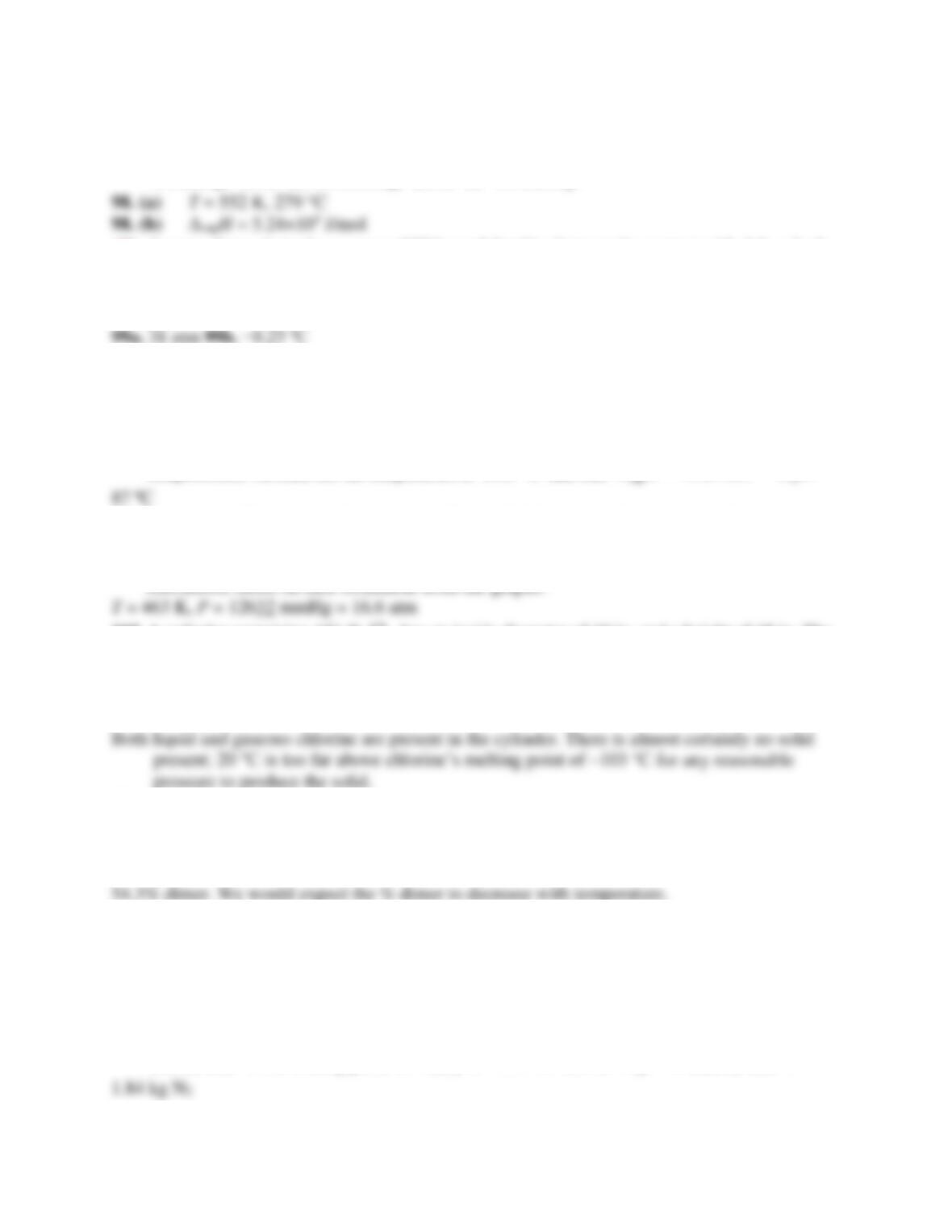
cP. Explain this
difference.
18. Carbon tetrachloride
( )
CCl
and mercury have similar viscosities at
20 C
Explain.
Vaporization
19. As a liquid evaporated from an open container, its temperature was observed to remain
roughly constant. When the same liquid evaporated from a thermally insulated container (a
vacuum bottle or Dewar flask), its temperature was observed to drop. How would you
account for this difference?
20. Explain why vaporization occurs only at the surface of a liquid until the boiling point
temperature is reached. That is, why does vapor not form throughout the liquid at all
temperatures?
21. The enthalpy of vaporization of benzene,
( )
66
C H l ,
is
1
33 9 kJ mol−
at 298 K. How many
liters of
( )
66
C H g ,
measured at 298 K and 95.1 mmHg, are formed when 1.54 kJ of heat is
absorbed by
( )
66
C H l
at a constant temperature of 298 K?
22. A vapor volume of 1.17 L forms when a sample of liquid acetonitrile,
3
CH CN,
absorbs 1.00
kJ of heat at its normal boiling point (
81 6 C
and 1 atm). What is
vap H
in kilojoules per
mole of
CH CN?
23. Use data from the Integrative Example (page 566) to determine how much heat is required to
convert 25.00 mL of liquid hydrazine at
25 0 C
to hydrazine vapor at its normal boiling
point.
24. How much heat is required to raise the temperature of 215 g
( )
3
CH OH l
from 20.0 to
30 0 C
and then vaporize it at
30 0 C
? Use data from Table 12.4 and a molar heat capacity
of
( )
3
CH OH l
of
11
81 1 J mol K
−−
25. How many liters of
( )
4
CH g ,
measured at
23 4 C
and 768 mmHg, must be burned to provide
the heat needed to vaporize 3.78 L of water at
100 C?
For CH4,
26. A 50.0 g piece of iron at
152 C
is dropped into 20.0 g
( )
2
H O l
at
89 C
in an open,
thermally insulated container. How much water would you expect to vaporize, assuming no
water splashes out? The specific heats of iron and water are 0.45 and
11
4 21 J g C ,
−−
respectively, and
1
vap 2
40 7 kJ mol H OH−
=
Vapor Pressure and Boiling Point
27. From Figure 12-18, estimate (a) the vapor pressure of
6 5 2
C H NH
at
100 C;
(b) the normal
boiling point of
6 5 3
C H CH
28. Use data in Figure 12-20 to estimate (a) the normal boiling point of aniline; (b) the vapor
pressure of diethyl ether at
25 C
29. Equilibrium is established between
( )
2
Br l
and
( )
2
Br g
at
25 0 C
A 250.0 mL sample of
the vapor weighs 0.486 g. What is the vapor pressure of bromine at
25 0 C,
in millimeters
of mercury?
30. The density of acetone vapor in equilibrium with liquid acetone,
( )
32
CH CO,
at
32 C
is
1
0 876 g L−
What is the vapor pressure of acetone at
32 C,
expressed in kilopascals?
31. A double boiler is used when a careful control of temperature is required in cooking. Water is
boiled in an outside container to produce steam, and the steam condenses on the outside walls
of an inner container in which cooking occurs. (A related laboratory device is called a steam
bath.) (a) How is heat energy conveyed to the food to be cooked in a double boiler? (b) What
31b. 100.00 ºC
32. One popular demonstration in chemistry labs is performed by boiling a small quantity of
water in a metal can (such as a used soda can), picking up the can with tongs and quickly
submerging it upside down in cold water. The can collapses with a loud and satisfying pop.
Give an explanation of this crushing of the can. (Note: If you try this demonstration, do not
heat the can over an open flame.)
pressure that is responsible for the can being crushed.
33. Pressure cookers achieve a high cooking temperature to speed the cooking process by heating
a small amount of water under a constant pressure. If the pressure is set at 2 atm, what is the
boiling point of the water? Use information from Table 12.5.
34. Use data from Table 12.5 to estimate (a) the boiling point of water in Santa Fe, New Mexico, if
the prevailing atmospheric pressure is 640 mmHg; (b) the prevailing atmospheric pressure at
Lake Arrowhead, California, if the observed boiling point of water is
94 C
.
35. A 25.0 L volume of He(g) at
30 0 C
is passed through 6.220 g of liquid aniline
( )
6 5 2
C H NH
at
30 0 C
The liquid remaining after the experiment weighs 6.108 g. Assume that the He(g)
becomes saturated with aniline vapor and that the total gas volume and temperature remain
constant. What is the vapor pressure of aniline at
30 0 C
?
36. A 7.53 L sample of
( )
2
Ng
at 742 mmHg and
45 0 C
is bubbled through
( )
4
CCl l
at
45 0 C
Assuming the gas becomes saturated with
( )
4
CCl g ,
what is the volume of the
resulting gaseous mixture if the total pressure remains at 742 mmHg and the temperature
remains at
45 C
? The vapor pressure of
4
CCl
at
45 C
is 261 mmHg.
37. Some vapor pressure data for Freon-12,
22
CCl F ,
once a common refrigerant, are
12 2 C,−
2.0
atm;
16 1 C,
5.0 atm;
42.4 C,
10.0 atm;
74 0 C,
20.0 atm. Also,
bp 29 8 C,= −
c111 5 C,T=
c39 6 atmP=
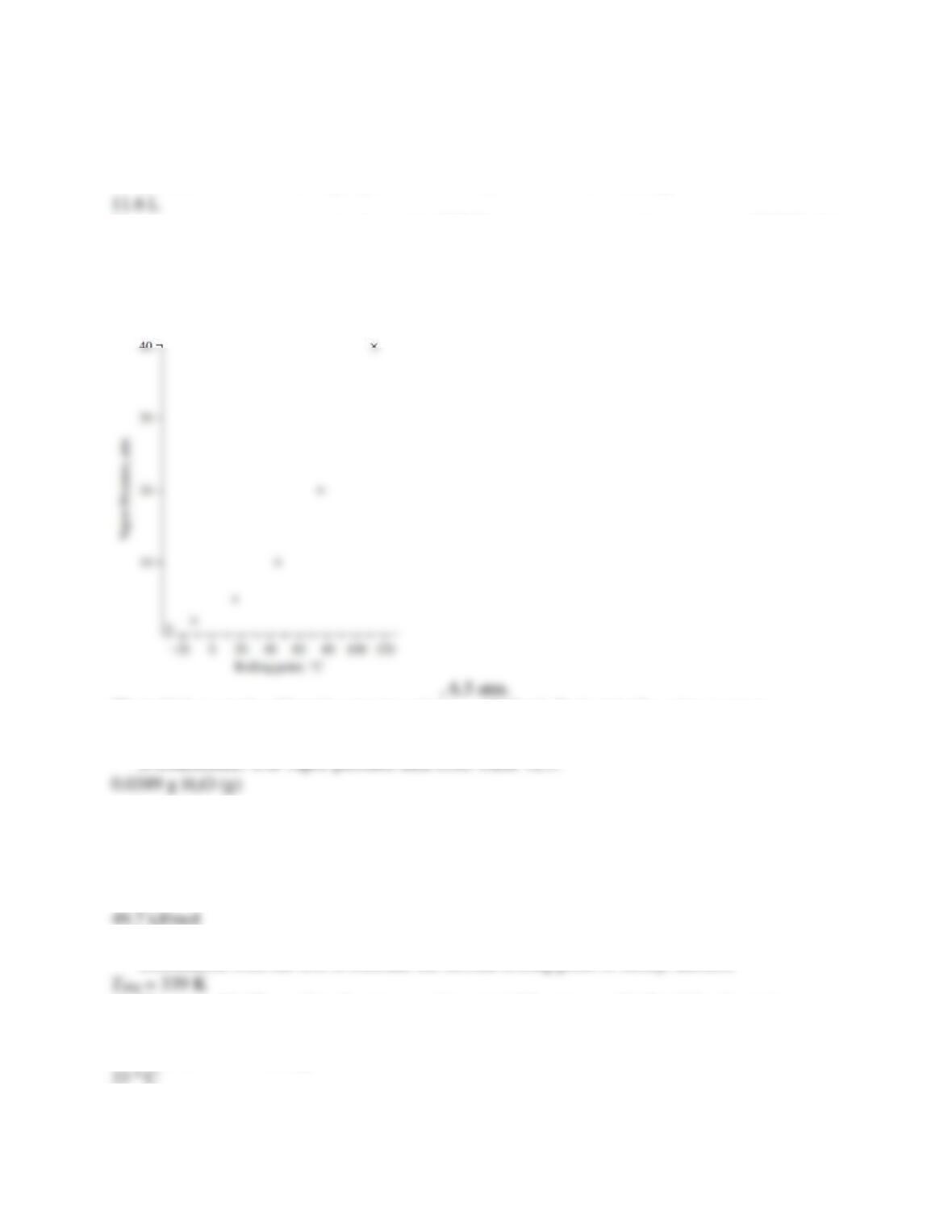
Use these data to plot the vapor pressure curve of Freon-12.
What approximate pressure would be required in the compressor of a refrigeration system to
convert Freon-12 vapor to liquid at
25 0 C
?
38. A 10.0 g sample of liquid water is sealed in a 1515 mL flask and allowed to come to
equilibrium with its vapor at
27 C
What is the mass of
( )
2
H O g
present when equilibrium
is established? Use vapor pressure data from Table 12.5.
The Clausius–Clapeyron Equation
39. Cyclohexanol has a vapor pressure of 10.0 mmHg at
56 0 C
and 100.0 mmHg at
103 7 C
Calculate its enthalpy of vaporization,
vap H
40. The vapor pressure of methyl alcohol is 40.0 mmHg at
5 0 C
Use this value and other
information from the text to estimate the normal boiling point of methyl alcohol.
41. The normal boiling point of acetone, an important laboratory and industrial solvent, is
56 2 C
and its
vap H
is
1
25 5 kJ mol−
At what temperature does acetone have a vapor
pressure of 375 mmHg?
42. The vapor pressure of trichloromethane (chloroform) is 40.0 Torr at
7 1 C−
Its enthalpy of
43. Benzaldehyde,
65
C H CHO,
has a normal boiling point of
179 0 C
and a critical point at
0.0981 atm
44. With reference to Figure 12-20, which is the more volatile liquid, benzene or toluene? At
approximately what temperature does the less volatile liquid have the same vapor pressure as
the more volatile one at
65 C
?
Critical Point
45. Which substances listed in Table 12.6 can exist as liquids at room temperature (about
20 0 C
)? Explain.
46. Can
2
SO
be maintained as a liquid under a pressure of 100 atm at
0C
? Can liquid methane
be obtained under the same conditions?
Melting and Freezing
47. The normal melting point of copper is 1357 K, and
fusH
of Cu is
1
13 05 kJ mol−
(a) How
much heat, in kilojoules, is evolved when a 3.78 kg sample of molten Cu freezes? (b) How much
heat, in kilojoules, must be absorbed at 1357 K to melt a bar of copper that is
75cm 15cm 12 cm?
(Assume
3
8 92 g/cmd=
for Cu.)
48. An ice calorimeter measures quantities of heat by the quantity of ice melted. How many
grams of ice would be melted by the heat released in the complete combustion of 1.60 L of
propane gas,
( )
38
C H g ,
measured at
20 0 C
and 735 mmHg? [Hint: What is the standard
molar enthalpy of combustion of
( )
38
C H g
?]
States of Matter and Phase Diagrams
49. An 80.0 g piece of dry ice,
( )
2
CO s ,
is placed in a 0.500 L container, and the container is
sealed. If this container is held at
25 C,
what state(s) of matter must be -present? [Hint: Refer
to Table 12.6 and Figure 12-28.]
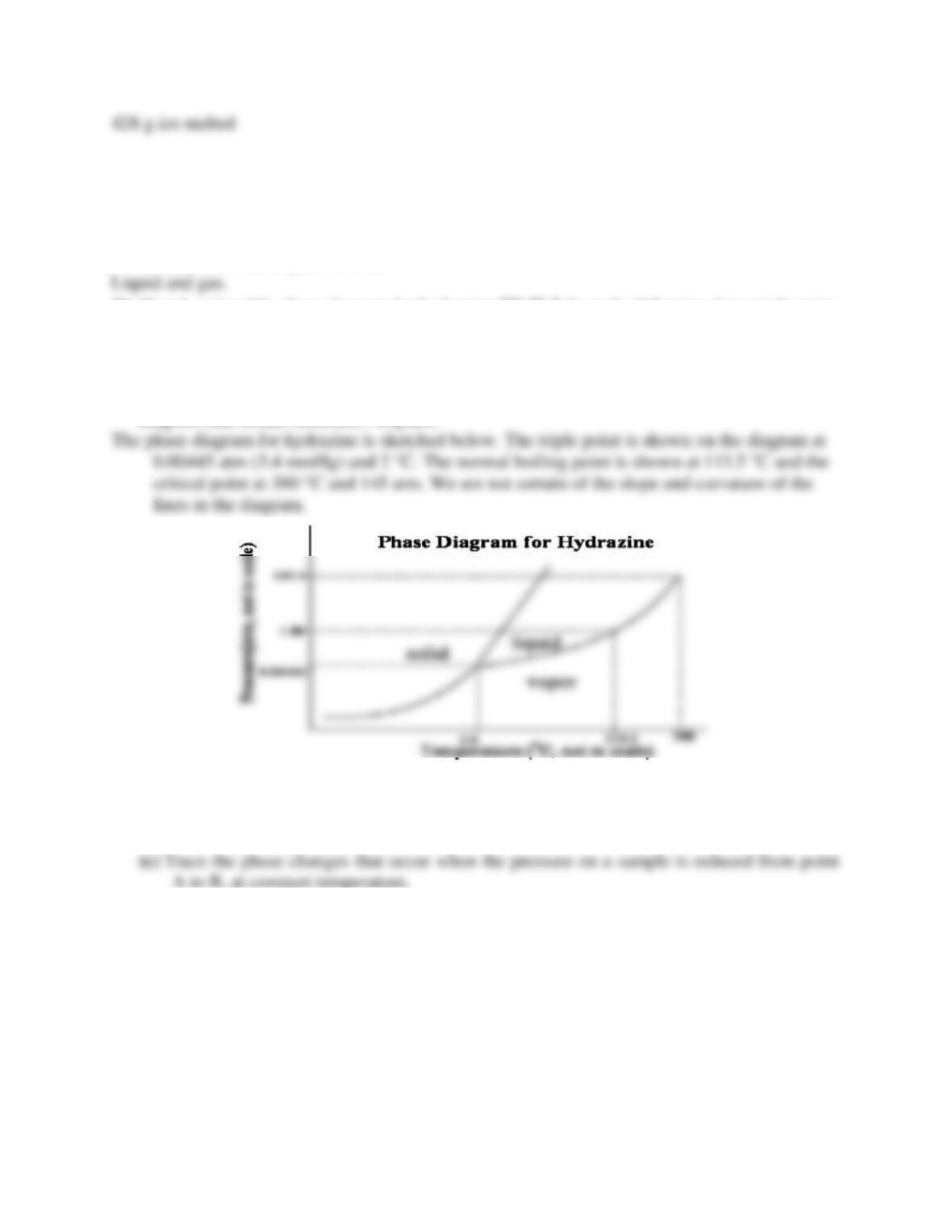
50. Sketch a plausible phase diagram for hydrazine
( )
24
NH
from the following data: triple point
and 3.4(2 0 mCHg)m
, the normal melting point
( )
2 C ,
the normal boiling point
( )
113 5 C ,
and the critical point
and 14(380 C m)5 at
. The density of the liquid is less than
that of the solid. Label significant data points on this diagram. Are there any features of the
diagram that remain uncertain? Explain.
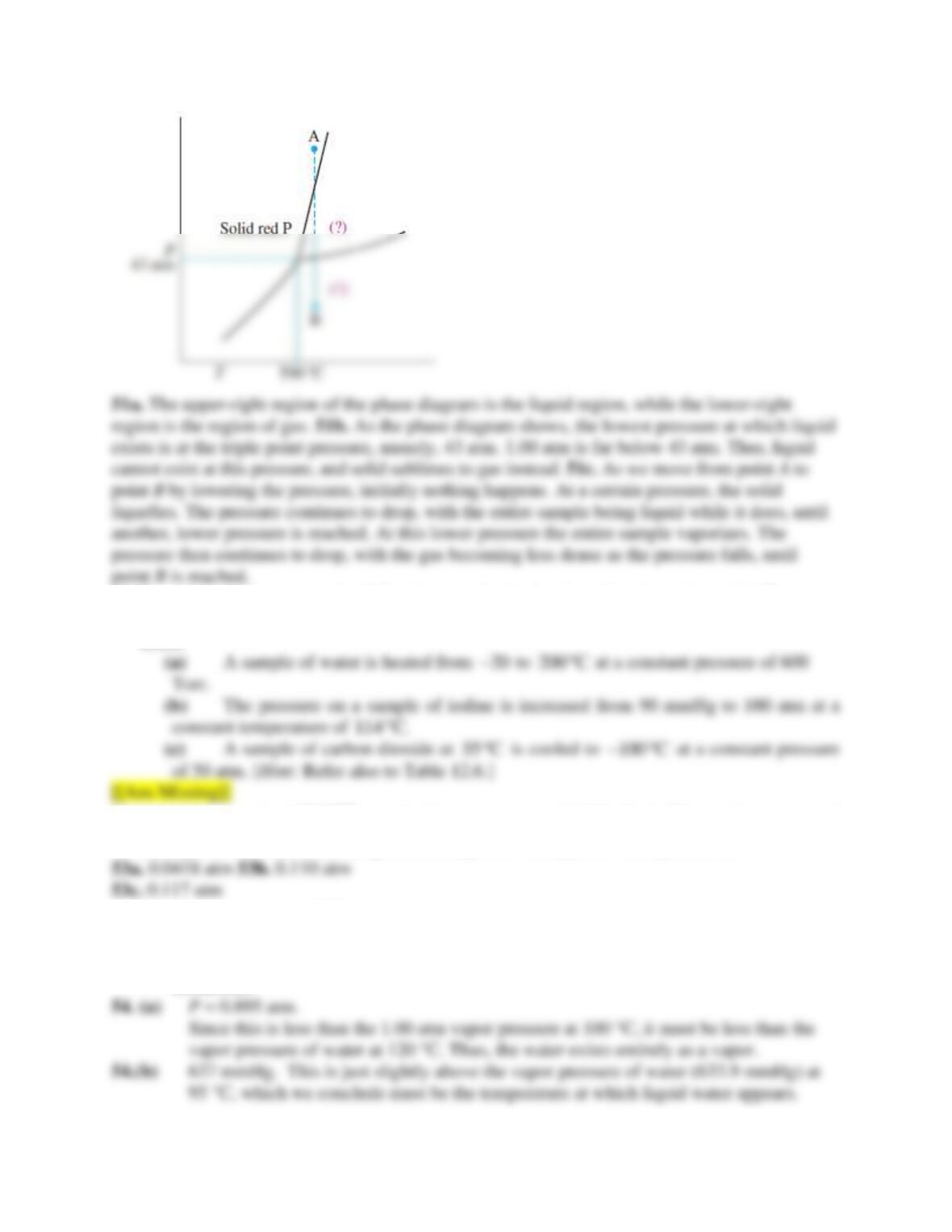
51. Shown here is a portion of the phase diagram for phosphorus.
(a) Indicate the phases present in the regions labeled with a question mark.
(b)
A sample of solid red phosphorus cannot be melted by heating in a container open to the
atmosphere. Explain why this is so.
52. Describe what happens to the following samples in situations like those pictured in Figure
12-31. Be as specific as you can about the temperatures and pressures at which changes
occur.
53. A 0.240 g sample of
( )
2
H O l
is sealed into an evacuated 3.20 L flask. What is the pressure of
the vapor in the flask if the temperature is (a)
30 0 C;
(b)
50 0 C;
(c)
70 0 C
?
54. A 2.50 g sample of
( )
2
H O l
is sealed in a 5.00 L flask at
120 0 C
(a) Show that the sample exists completely as vapor.
(b) Estimate the temperature to which the flask must be cooled before liquid water
condenses.
55. Use appropriate phase diagrams and data from Table 12.6 to determine whether any of the
following is likely to occur naturally at or near Earth’s surface anywhere on Earth. Explain.
(a)
( )
2
CO s ;
(b)
( )
4
CH l ;
(c)
( )
2
SO g ;
(d)
( )
2
Il
; (e)
( )
2
Ol
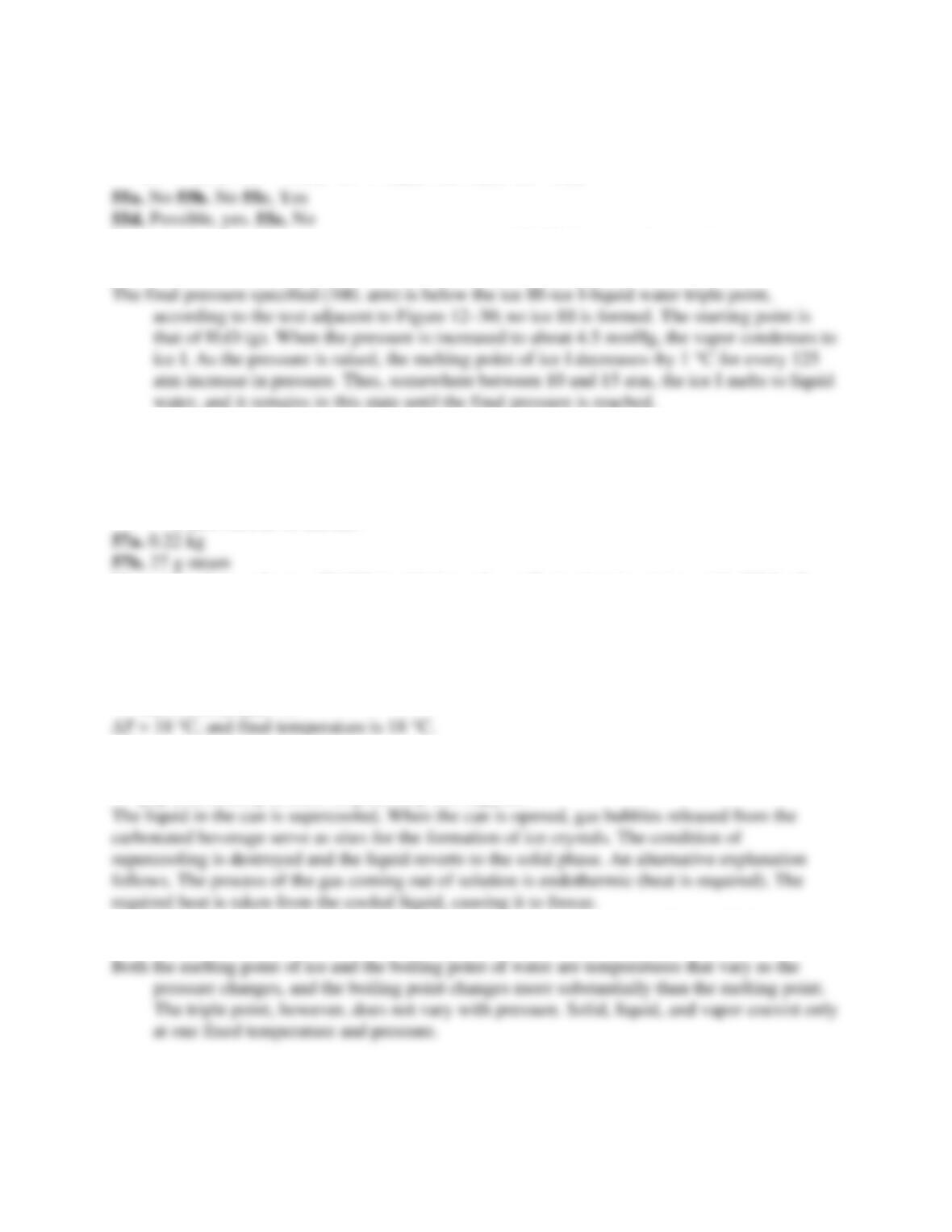
56. Trace the phase changes that occur as a sample of
( )
2
H O g ,
originally at 1.00 mmHg and
0 10 C,−
is compressed at constant temperature until the pressure reaches 100 atm.
57. To an insulated container with 100.0 g
( )
2
H O l
at
20 0 C,
175 g steam at
100 0 C
and 1.65
kg of ice at
0 0 C
are added.
(a) What mass of ice remains unmelted after equilibrium is established?
(b) What additional mass of steam should be introduced into the insulated container
to just melt all of the ice?
58. A
3
54 cm
ice cube at
25 0 C−
is added to a thermally insulated container with 400.0 mL
( )
2
H O l
at
32 0 C
What will be the final temperature in the container and what state(s) of
matter will be present? (Specific heats:
( )
2
H O s ,
11
2 01J g C ;
−−
( )
2
H O l ,
1
4 18 J g C−
Densities:
( )
2
H O s ,
3
0 917 g/cm ;
( )
2
H O l ,
3
0 998 g/cm
Also,
fusH
of
1
ice 6 01 kJ mol−
=
)
59. You decide to cool a can of soda pop quickly in the freezer compartment of a refrigerator.
When you take out the can, the soda pop is still liquid; but when you open the can, the soda
pop immediately freezes. Explain why this happens.
60. Why is the triple point of water (ice–liquid–vapor) a better fixed point for establishing a
thermometric scale than either the melting point of ice or the boiling point of water?
Network Covalent Solids
61. Based on data presented in the text, would you expect diamond or graphite to have the
greater density? Explain.
62. Diamond is often used as a cutting medium in glass cutters. What property of diamond makes
this possible? Could graphite function as well?
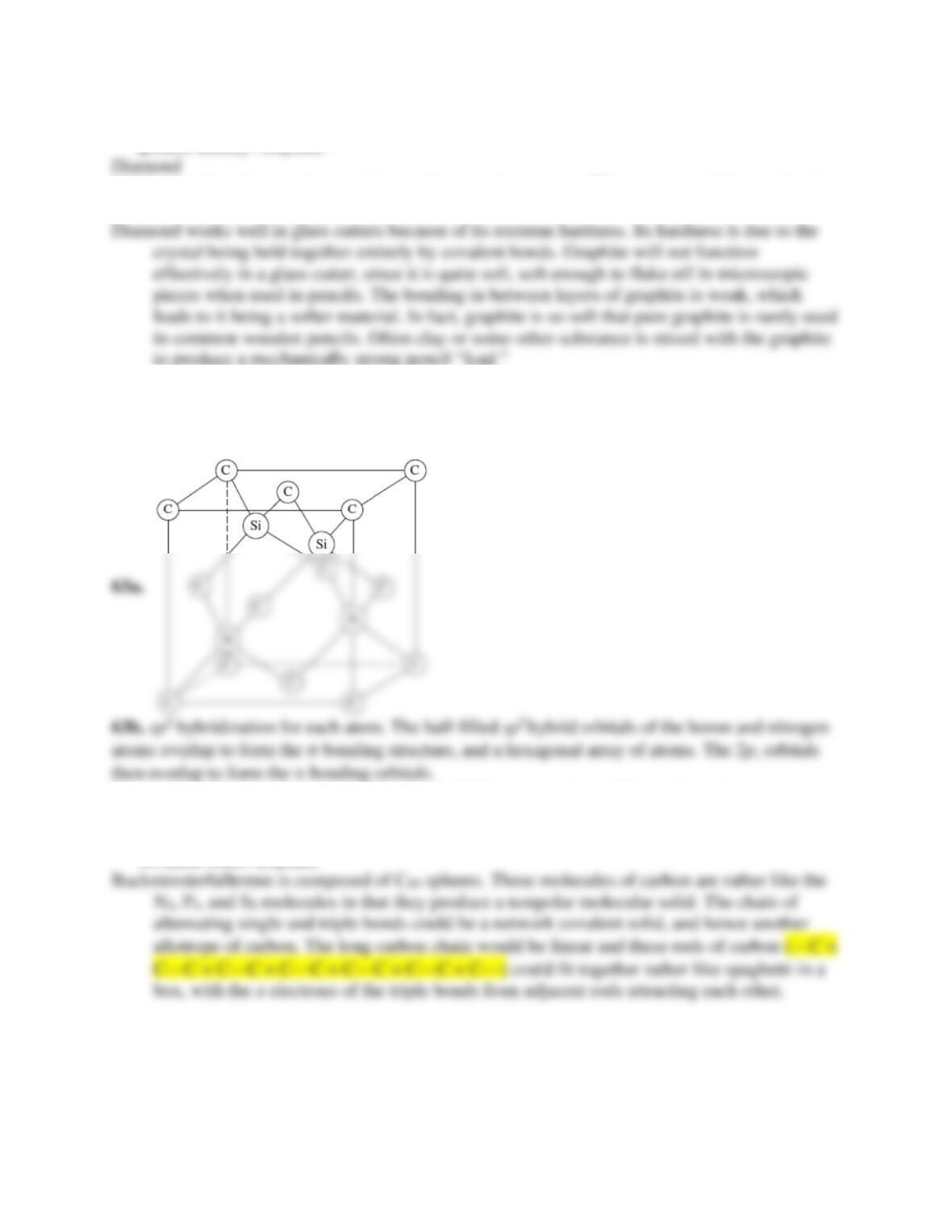
63. Silicon carbide, SiC, crystallizes in a form similar to diamond, whereas boron nitride, BN,
crystallizes in a form similar to graphite.
(a) Sketch the SiC structure as in Figure 12-32(b).
(b) Propose a bonding scheme for BN.
64. Are the fullerenes network covalent solids? What makes them different from diamond and
graphite? It has been shown that carbon can form chains in which every other carbon atom is
bonded to the next carbon atom by a triple bond. Is this allotrope of carbon a network
covalent solid? Explain.
Ionic Bonding and Properties
65. The melting points of NaF, NaCl, NaBr, and NaI are 988, 801, 755, and
651 C,
respectively. Are these data consistent with ideas developed in Section 12-5? Explain.
66. Use Coulomb’s law (see Appendix B) to verify the conclusion concerning the relative
strengths of the attractive forces in the ion pairs
Na Cl
+−
and
22
Mg O
+−
presented in Figure
12-36.
67. The hardness of crystals is rated based on Mohs hardness values. The higher the Mohs value,
the harder the material is to scratch. Which crystal will have the highest Mohs value: NaF,
NaCl, or KCl?
68. Will the mineral villaumite (NaF) or periclase (MgO) have a higher Mohs hardness value
(see Exercise 67)?
Crystal Structures
69. Explain why there are two arrangements for the closest packing of spheres rather than a
single one.
In each layer of a closest packing arrangement of spheres, there are six spheres surrounding and
70. Argon, copper, sodium chloride, and carbon dioxide all crystallize in the fcc structure. How
can this be when their physical properties are so different?
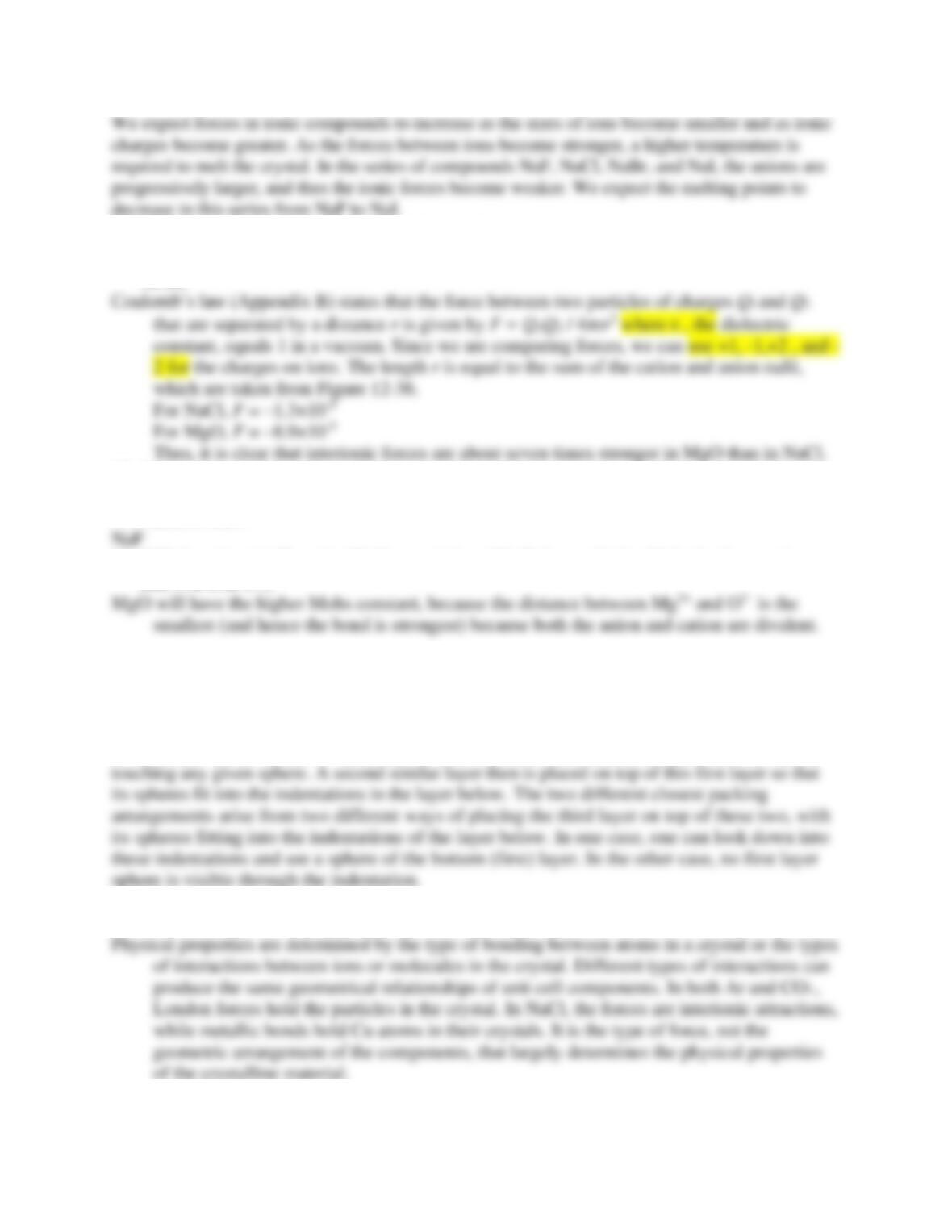
71. Consider the two-dimensional lattice shown here.
(a) Identify a unit cell.
(b) How many of each of the following elements are in the unit cell:
, +◆
, and
◯
?
(c) Indicate some simpler units than the unit cell, and explain why they cannot
function as a unit cell.
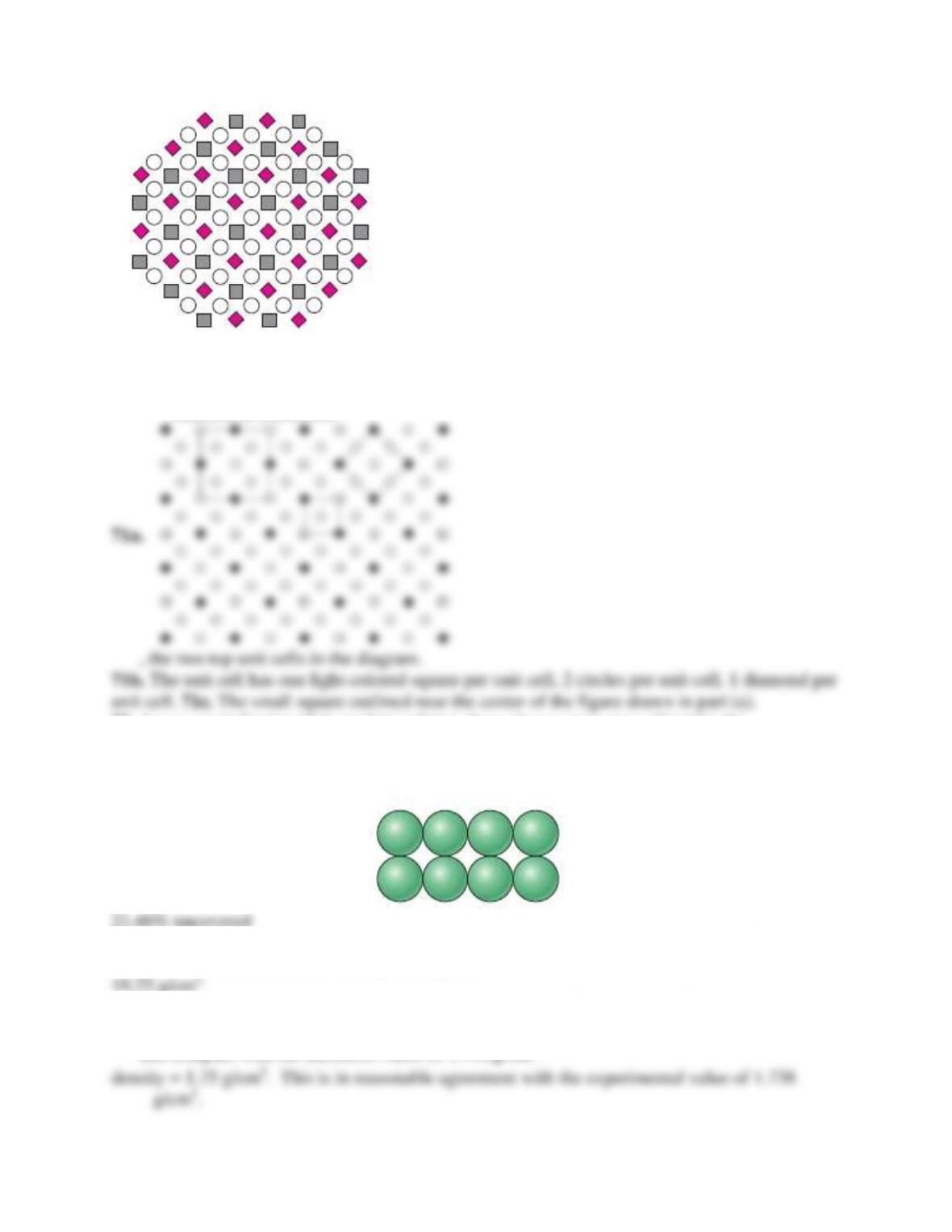
72. As we saw in Section 12-6, stacking spheres always leaves open space. Consider the
corresponding situation in two dimensions: Squares can be arranged to cover all the area, but
circles cannot. For the arrangement of circles pictured here, what percentage of the area remains
uncovered?
73. Tungsten has a body-centered cubic crystal structure. Using a metallic radius of 139 pm for
the W atom, calculate the density of tungsten.
74. Magnesium crystallizes in the hcp arrangement shown in Figure 12-41. The dimensions of
the unit cell are height, 520 pm; length on an edge, 320 pm. Calculate the density of Mg(s),
and compare with the measured value of
3
1 738 g/cm
75. Polonium (Po) is the only element known to take on the simple cubic crystal system. The
distance between nearest neighbor Po atoms in this structure is 335 pm.
(a) What is the diameter of a Po atom?
(b) What is the density of Po metal?
(c) At what angle (in degrees) to the parallel faces of the Po unit cells would first–
order diffraction be observed when using X-rays of wavelength
10
1 785 10 m?
−
76. Germanium has a cubic unit cell with a side edge of 565 pm. The density of germanium is
3
5 36 g/cm
What is the crystal system adopted by germanium?
77. Silicon tetrafluoride molecules are arranged in a body-centered cubic unit cell. How many
silicon atoms are in the unit cell?
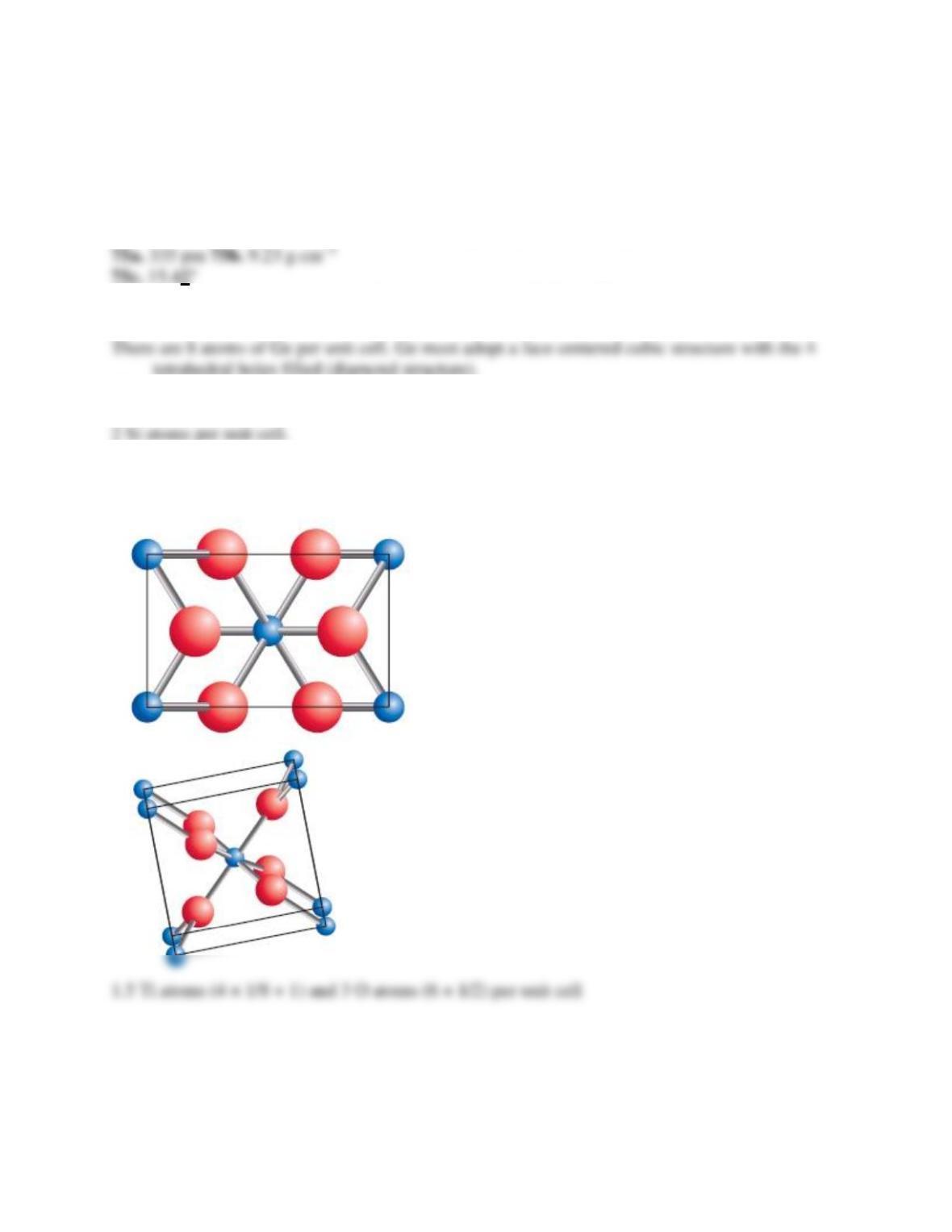
78. Two views, a top and side view, for the unit cell for rutile
( )
2
TiO
are shown here. (a) How
many titanium atoms (blue) are in this unit cell? (b) How many oxygen atoms (red) are in
this unit cell?
Ionic Crystal Structures
79. Show that the unit cells for
2
CaF
and
2
TiO
in Figure 12-50 are consistent with their
formulas.
CaF2 : There are eight Ca+ ions on the corners for a total of one corner ion per unit cell. There are
80. Using methods similar to Examples 12-10 and 12-11, calculate the density of CsCl. Use 169
pm as the radius of
Cs+
81. The crystal structure of magnesium oxide, MgO, is of the NaCl type (Fig. 12-48). Use this
fact, together with ionic radii from Figure 9-11, to establish the following.
(a) the coordination numbers of
2
Mg +
and
2
O;
−
(b) the number of formula units in the unit cell;
(c) the length and volume of a unit cell;
(d) the density of MgO.
82. Potassium chloride has the same crystal structure as NaCl. Careful measurement of the
internuclear distance between
K+
and
Cl−
ions gave a value of 314.54 pm. The density of KCl
is
3
1 9893 g/cm
Use these data to evaluate the Avogadro constant,
A
N
83. Use data from Figure 9-11 to predict the type of cubic unit cell adopted by (a) CaO; (b)
CuCl; (c)
LiO
(the radius of the
O−
ion is 128 pm).
84. Use data from Figure 9-9 to predict the type of cubic unit cell adopted by (a) BaO; (b) CuI; (c)
2
LiS
(The radii of
2
Ba +
and
2
S−
ions are 135 and 198 pm, respectively.)
Lattice Energy
85. Without doing calculations, indicate how you would expect the lattice energies of LiCl(s),
KCl(s), RbCl(s), and CsCl(s) to compare with the value of
1
787 kJ mol−
−
determined for
NaCl(s) on page 563. [Hint: Assume that the enthalpies of sublimation of the alkali metals are
comparable in value. What atomic properties from Chapter 9 should you compare?]
86. D e t e r m i n e t h e l a t t i c e e n e r g y o f K F ( s ) f r o m t h e f o l l o w i n g d a t a :
87. Refer to Example 12-12. Together with data given there, use the data here to calculate
fH
for 1 mol
( )
2
MgCl s
Explain why you would expect
2
MgCl
to be a much more stable
compound than MgCl. (The second ionization energy of Mg is
1
1451kJ mol ;
−
the lattice
energy of
( )
1
22
MgCl s is 2526 kJ mol MgCl
−
−
)
88. In ionic compounds with certain metals, hydrogen exists as the hydride ion,
H−
Integrative and Advanced Exercises
89. When a wax candle is burned, the fuel consists of gaseous hydrocarbons appearing at the end
of the candle wick. Describe the phase changes and processes by which the solid wax is
ultimately consumed.
process continues until all the wax is burned.
90. The normal boiling point of water is
100 00 C
and the enthalpy of vaporization at this
temperature is
1
vap 40 657 kJ molH−
=
What would be the boiling point of water if it were
based on a pressure of 1 bar instead of the standard atm?
91. A supplier of cylinder gases warns customers to determine how much gas remains in a cylinder
by weighing the cylinder and comparing this mass to the original mass of the full cylinder. In
particular, the customer is told not to try to estimate the mass of gas available from the
measured gas pressure. Explain the basis of this warning. Are there cases where a measurement
of the gas pressure can be used as a measure of the remaining available gas? If so, what are
they?
92. Use the following data and data from Appendix D to determine the quantity of heat needed to
convert 15.0 g of solid mercury at
50 0 C−
to mercury vapor at
25 C
Specific heats: Hg(s),
11
24 3 J mol K
−−
;
( )
Hg l
,
11
28 0 J mol K
−−
Melting point of Hg(s),
38 87 C−
Heat of
fusion,
1
2 33 kJ mol−
93. To vaporize 1.000 g water at
20 C
requires 2447 J of heat. At
100 C 10 00 kJ,
of heat will
convert 4.430 g
( )
2
H O l
to
( )
2
H O g
Do these observations conform to your expectations?
Explain.
94. Estimate how much heat is absorbed when 1.00 g of Instant Car Kooler vaporizes.
Comment on the effectiveness of this spray in cooling the interior of a car. Assume the
spray is 10%
( )
25
C H OH aq
by mass, the temperature is
55 C,
the heat capacity of air is
29 J
11
mol K ,
−−
and use
vap H
data from Table 12.4.
effective.
95. Because solid p-dichlorobenzene,
6 4 2
C H Cl ,
sublimes rather easily, it has been used as a
P = 0.37 mmHg
96. A 1.05 mol sample of
( )
2
H O g
is compressed into a 2.61 L flask at
30 0 C
Describe the
point(s) in Figure 12-30 representing the final condition.
97. One handbook lists the sublimation pressure of solid benzene as a function of Kelvin
temperature, T, as
( )
log mmHg 9 846 2309P / T = −
Another handbook lists the vapor
pressure of liquid benzene as a function of Celsius temperature, t, as
( ) ( )
log mmHg 6 90565 1211 033/ 220 790Pt = − +
Use these equations to estimate the
98. By the method used to graph Figure 12-20, plot ln P versus
1/T
for liquid white phosphorus,
and estimate (a) its normal boiling point and (b) its enthalpy of vaporization,
vap ,H
in
1
kJ mol−
Vapor pressure data:
76 6 C,
1 mmHg;
128 0 C,
10 mmHg;
166 7 C,
40 mmHg;
197 3 C,
100 mmHg;
251 0 C,
400 mmHg
99. Assume that a skater has a mass of 80 kg and that his skates make contact with
2
2 5 cm
of
ice. (a) Calculate the pressure in atm exerted by the skates on the ice. (b) If the melting
point of ice decreases by
1 0 C
for every 125 atm of pressure, what would be the melting
point of the ice under the skates?
100. Estimate the boiling point of water in Leadville, Colorado, elevation 3170 m. To do this, use
the barometric formula relating pressure and altitude:
2 303
010 Mgh / RT
PP −
=
(
where P =
pressure in atm;
01P=
atm; acceleration due to gravity,
2
g 9 81 m s−
=
; molar
mass of air,
1
0 02896 kg mol ;M−
=
11
8 3145J mol K ;R−−
=
and T is the Kelvin
temperature). Assume the air temperature is
10 0 C
and that
1
=
HO
101. Inspection of the straight-line graphs in Figure 12-20 suggests that the graphs for benzene
and water intersect at a point that falls off the page. At this point, the two liquids have the
same vapor pressure. Estimate the temperature and the vapor pressure at this point by a
102. A cylinder containing 151 lb
2
Cl
has an inside diameter of 10 in. and a height of 45 in. The
gas pressure is 100 psi
( )
1atm 14 7 psi =
at
2
20 C Cl
melts at
103 C,−
boils at
35 C,−
and has its critical point at
144 C
and 76 atm. In what state(s) of matter does the
2
Cl
exist
in the cylinder?
103. In acetic acid vapor, some molecules exist as monomers and some as dimers (see Figure 12-
9). If the density of the vapor at 350 K and 1 atm is
3 23 g/L,
what percentage of the
molecules must exist as dimers? Would you expect this percent to increase or decrease with
temperature?
104. A 685 mL sample of Hg(l) at
20 C
is added to a large quantity of liquid
2
N
kept at its
boiling point in a thermally insulated container. What mass of
( )
2
Nl
is vaporized as the Hg
is brought to the temperature of the liquid
2
N
? For the specific heat of Hg(l) from 20 to
39 C−
use
11
0 138 J g C ,
−−
and for Hg(s) from
39−
to
11
196 C, 0 126 J g C
−−
−
The
density of Hg(l) is
13 6 g/mL,
its melting point is
39 C,−
and its enthalpy of fusion is
1
2 30 kJ mol−
The boiling point of
( )
2
Nl
is
196 C,−
and its
vap H
is
1
5 58 kJ mol−