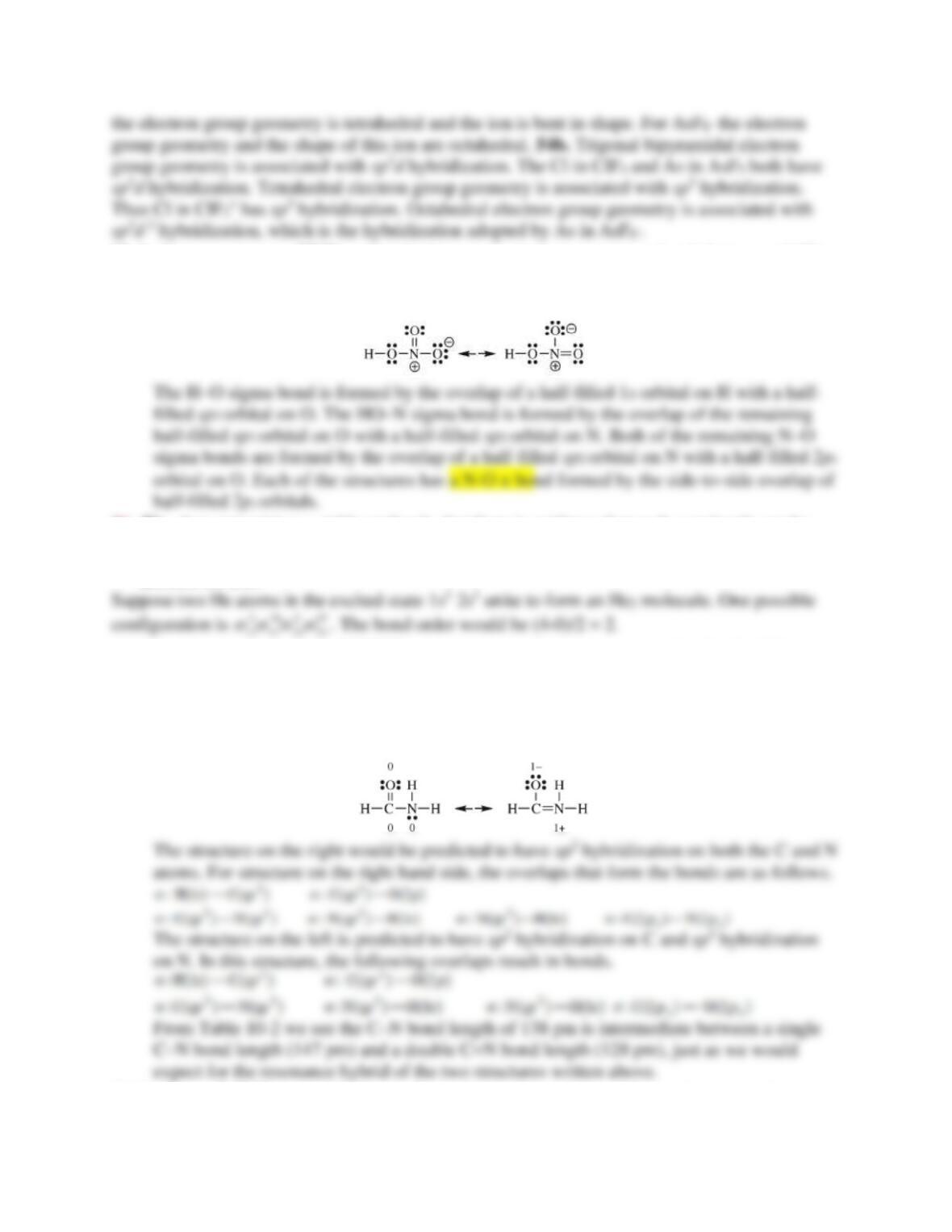
55. In the gaseous state,
3
HNO
molecules have two -nitrogen-to-oxygen bond distances of 121
pm and one of 140 pm. Draw a plausible Lewis structure(s) to represent this fact, and
propose a bonding scheme in the manner of Figure 11-19.
56.
2
He
does not exist as a stable molecule, but there is evidence that such a molecule can be
formed between electronically excited He atoms. Write an electron configuration for
2
He
to
account for this.
57. The molecule formamide,
2
HCONH ,
has the approximate bond angles
H C O,123 ;− −
H C N,−−
113 ;
N C O,−−
124 ;
C N H,−−
119 ;
H N H,−−
119
The
CN−
bond
length is 138 pm. Two Lewis structures can be written for this molecule, with the true structure
being a resonance hybrid of the two. Propose a hybridization and bonding scheme for each
structure.
58. Pyridine,
55
C H N,
is used in the synthesis of vitamins and drugs. The molecule can be
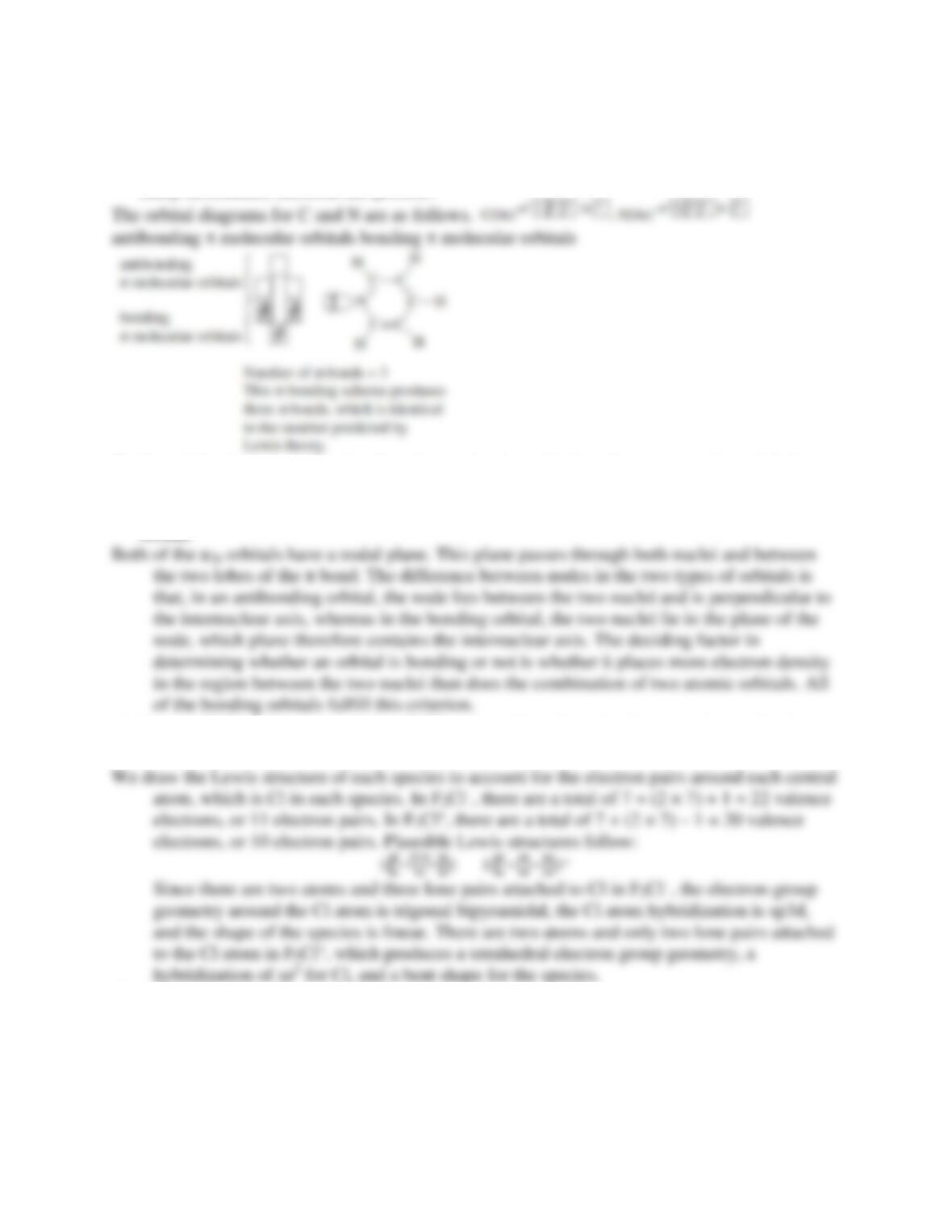
thought of in terms of replacing one CH unit in benzene with a N atom. Draw orbital
diagrams to show the orbitals of the C and N atoms involved in the
and
bonding in
pyridine. How many bonding and antibonding
-type
molecular orbitals are present? How
many delocalized electrons are present?
59. One of the characteristics of antibonding molecular orbitals is the presence of a nodal plane.
Which of the bonding molecular orbitals considered in this chapter have nodal planes?
Explain how a molecular orbital can have a nodal plane and still be a bonding molecular
orbital.
60. The ion
2
F Cl−
is linear, but the ion
2
F Cl+
is bent. Describe hybridization schemes for the
central Cl atom consistent with this difference in structure.
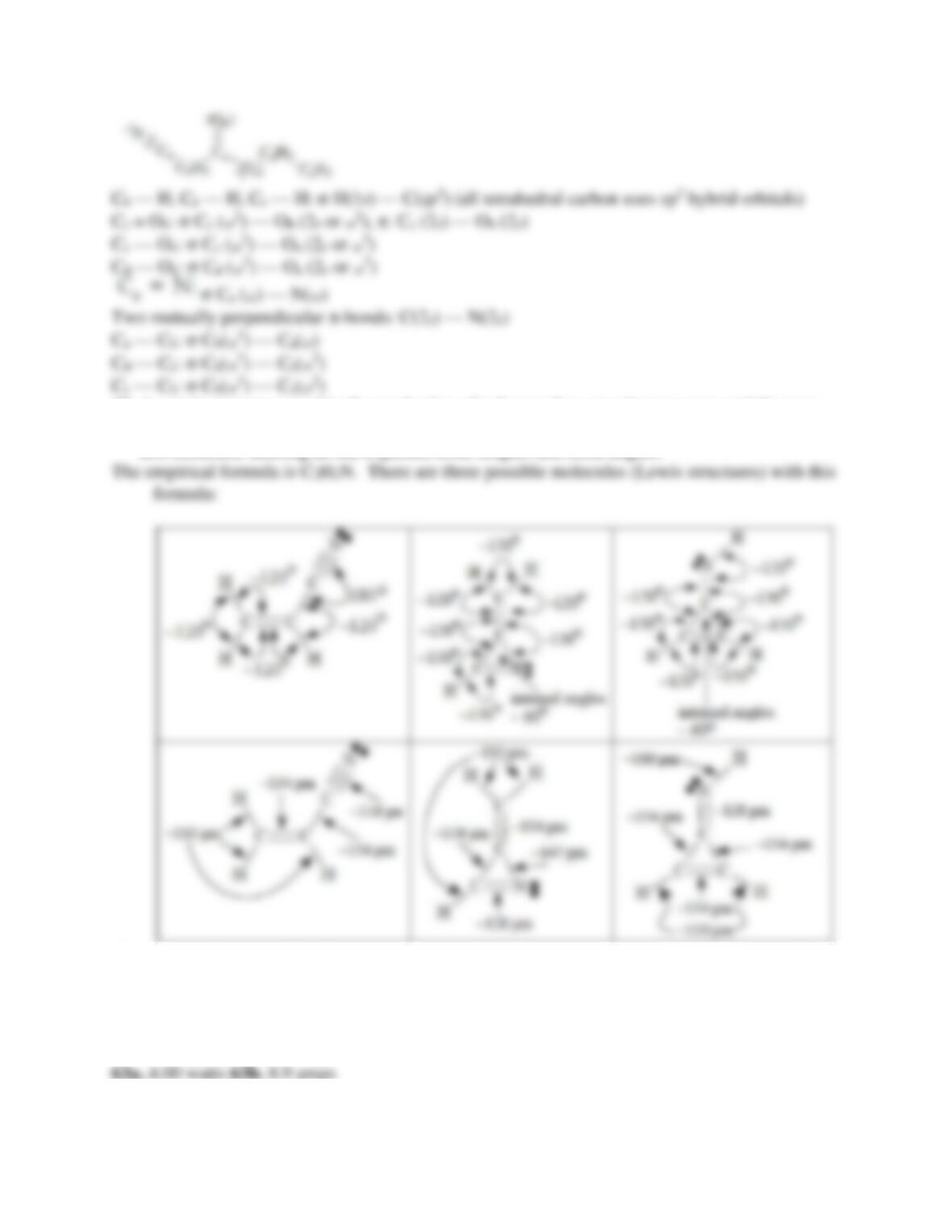
61. Ethyl cyanoacetate, a chemical used in the synthesis of dyes and pharmaceuticals, has the
mass percent composition: 53.09% C, 6.24% H, 12.39% N, and 28.29% O. In the manner of
Figure 11-19, show a bonding scheme for this substance. The scheme should designate
orbital overlaps,
and
bonds, and expected bond angles.
62. A certain monomer used in the production of polymers has one nitrogen atom and the mass
composition 67.90% C, 5.70% H, and 26.40% N. Sketch the probable geometric structure of
this molecule, labeling all the expected bond lengths and bond angles.
63. A solar cell that is 15% efficient in converting solar to electric energy produces an energy flow
of
2
1 00 kW/m
when exposed to full sunlight.
(a) If the cell has an area of
2
40 0 cm ,
what is the power output of the cell, in watts?
(b) If the power calculated in part (a) is produced at 0.45 V, how much current does the
cell deliver?
64. Toluene-2,4-diisocyanate is used in the manufacture of polyurethane foam. An incomplete
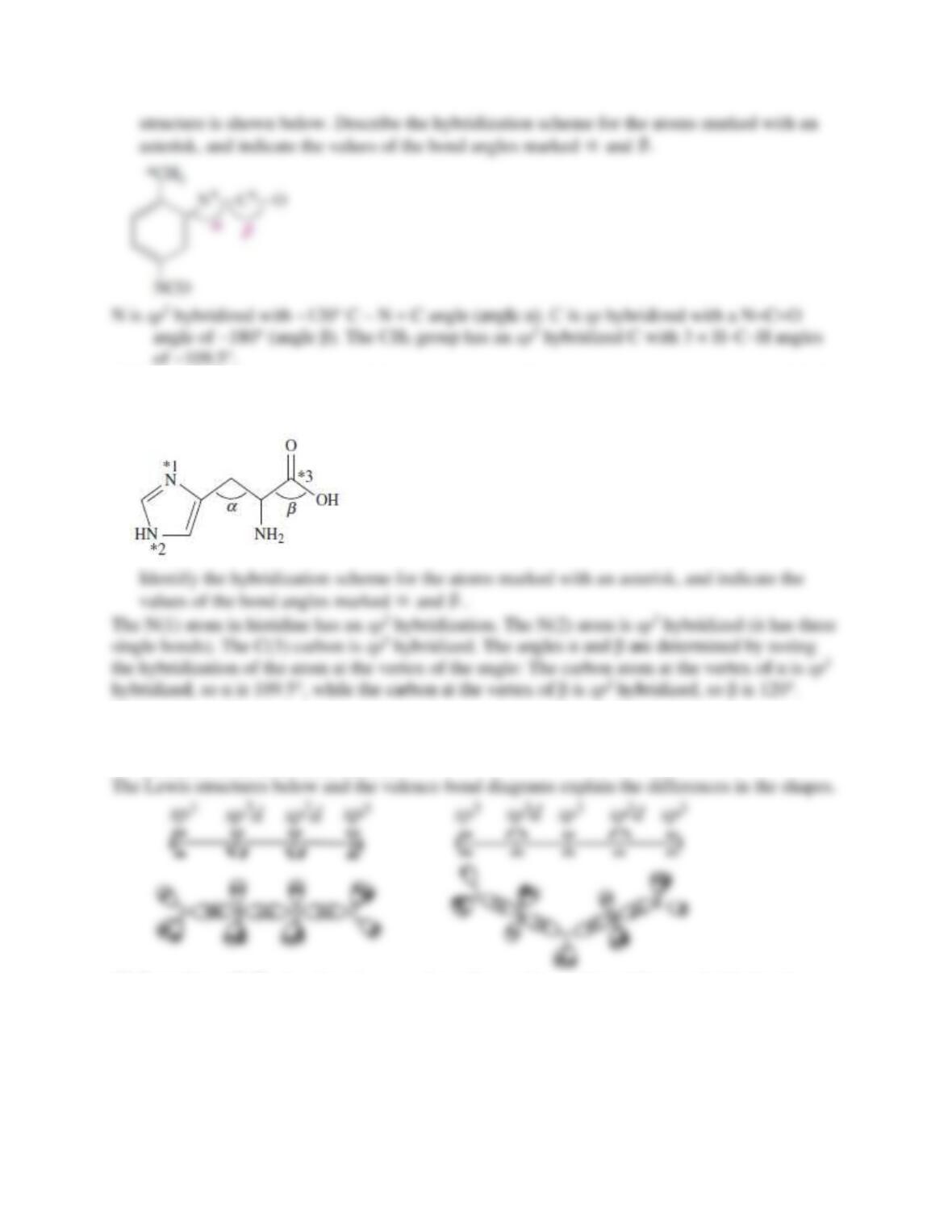
65. Histidine, an essential amino acid, serves as a part of the active center in many enzymes. It is the
precursor to histamine, a neurotransmitter and a component of the body’s immune response.
The structure of histidine is shown below.
66. The anion
2
4
I−
is linear, and the anion
5
I−
is V-shaped, with a
95
angle between the two
arms of the V. For the central atoms in these ions, propose hybridization schemes that are
consistent with these observations.
67. Pentadiene,
58
C H ,
has three isomers, depending on the position of the two double bonds.
Determine the shape of these isomers by using VSEPR theory. Describe the bonding in these
molecules by using the valence bond method. Do the shapes agree in the two theories? Use
molecular orbital theory to decide which of these molecules has a delocalized
system.
Sketch the molecular orbital and an energy-level diagram.
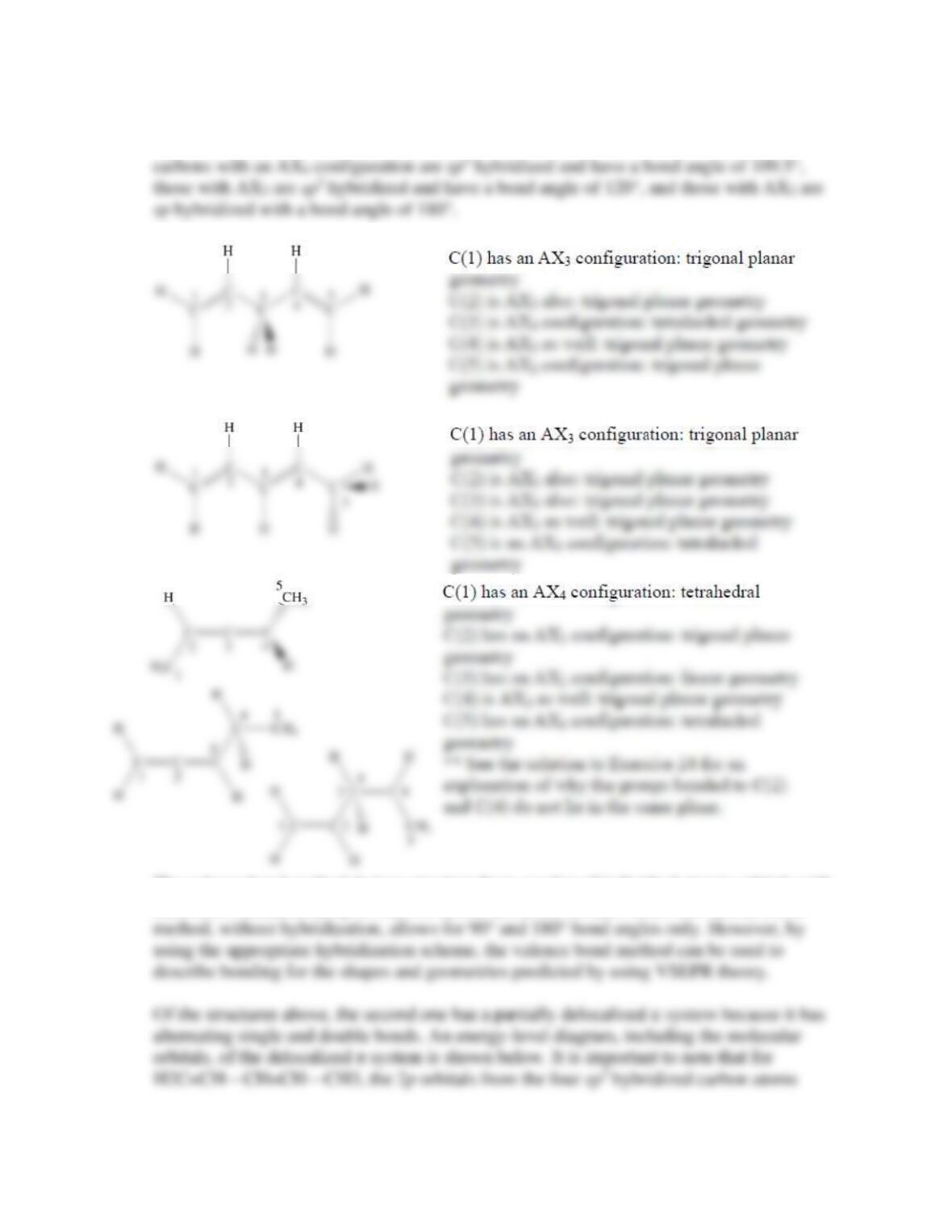
The five isomers with shapes derived from VSEPR theory are shown below, along with the
explanation for the geometry of each carbon in the structure. In the structures below,
The valence bond method derives structure from overlap of individual atomic orbitals with
each other. Because the 2p orbitals of carbon are at 90° to each other, the valence bond
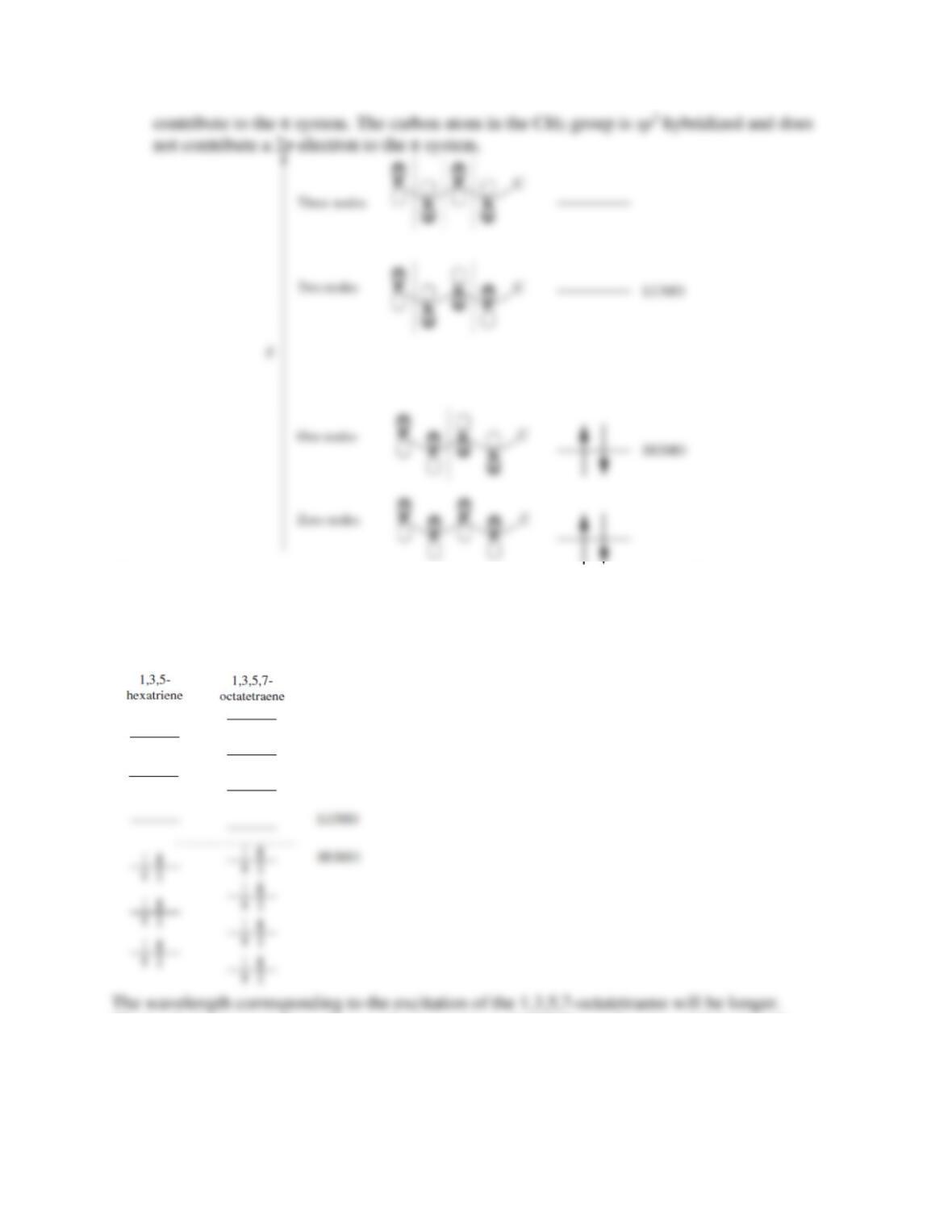
68. A conjugated hydrocarbon has an alternation of double and single bonds. Draw the molecular
orbitals of the
system of 1,3,5-hexatriene. If the energy required to excite an electron from
the HOMO to the LUMO corresponds to a wavelength of 256 nm, do you expect the
wavelength for the corresponding excitation in 1,3,5,7-octatetraene to be a longer or shorter
wavelength? [Hint: Refer to Figure 11-34.]
69. An elusive intermediate of atmospheric reactions of HONO may be nitrosyl O-hydroxide,
HOON. Electronic structure calculations seem to indicate that HOON is best represented by a
combination of three resonance structures, with major contribution from a radical-pair structure
(involving HO and NO radicals), significant contribution from a molecular structure, and a
70. Resonance energy is the difference in energy between a real molecule—a resonance hybrid—
and its most important contributing structure. To determine the resonance energy for benzene,
we can determine an energy change for benzene and the corresponding change for one of the
Kekulé structures. The resonance energy is the difference between these two quantities.
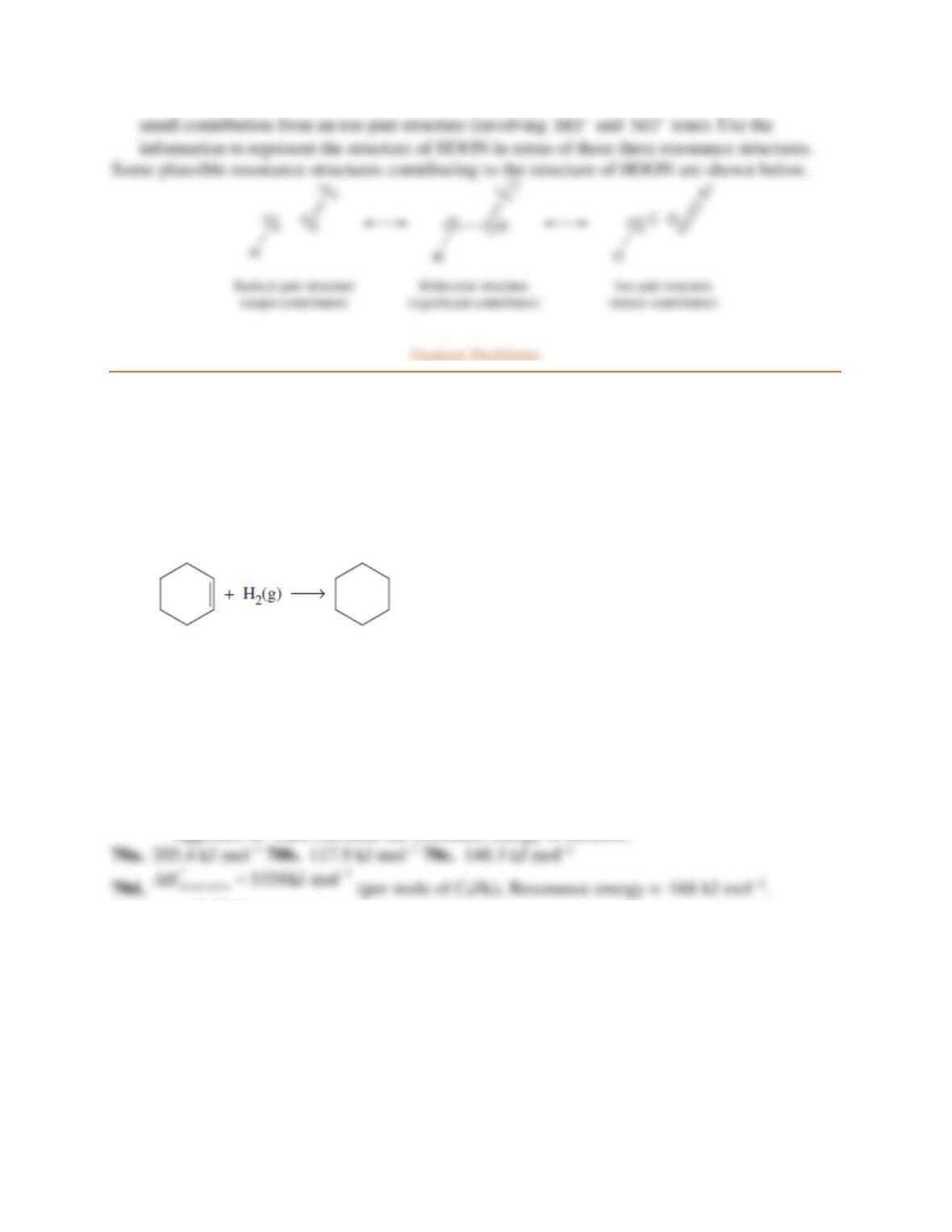
(a) Use data from Appendix D to determine the enthalpy of hydrogenation of liquid
benzene to liquid cyclohexane.
(b) Use data from Appendix D to determine the enthalpy of hydrogenation of liquid
cyclohexene to liquid cyclohexane.
For the enthalpy of formation of liquid cyclohexene, use
f 38 5 kJ/molH = −
(c) Assume that the enthalpy of hydrogenation of 1,3,5-cyclohexatriene is three times
as great as that
of cyclohexene, and calculate the resonance energy of benzene.
(d) Another way to assess resonance energy is through bond energies. Use bond
energies from Table 10.3 (page 451) to determine the total enthalpy change required to
break all the bonds in a Kekulé structure of benzene. Next, determine the enthalpy change
for the dissociation of
( )
66
C H g
into its gaseous atoms by using data from Table 10.3 and
Appendix D. Then calculate the resonance energy of benzene.
71. Furan,
44
C H O,
is a substance derivable from oat hulls, corn cobs, and other cellulosic waste.
It is a starting material for the synthesis of other chemicals used as pharmaceuticals and
herbicides. The furan molecule is planar and the C and O atoms are bonded into a five-
membered pentagonal ring. The H atoms are attached to the C atoms. The chemical behavior
of the molecule suggests that it is a resonance hybrid of several contributing structures. These
structures show that the double bond character is associated with the entire ring in the form of
a
electron cloud.
(a) Draw Lewis structures for the several contributing structures to the resonance
hybrid mentioned above.
(b) Draw orbital diagrams to show the orbitals that are involved in the
and
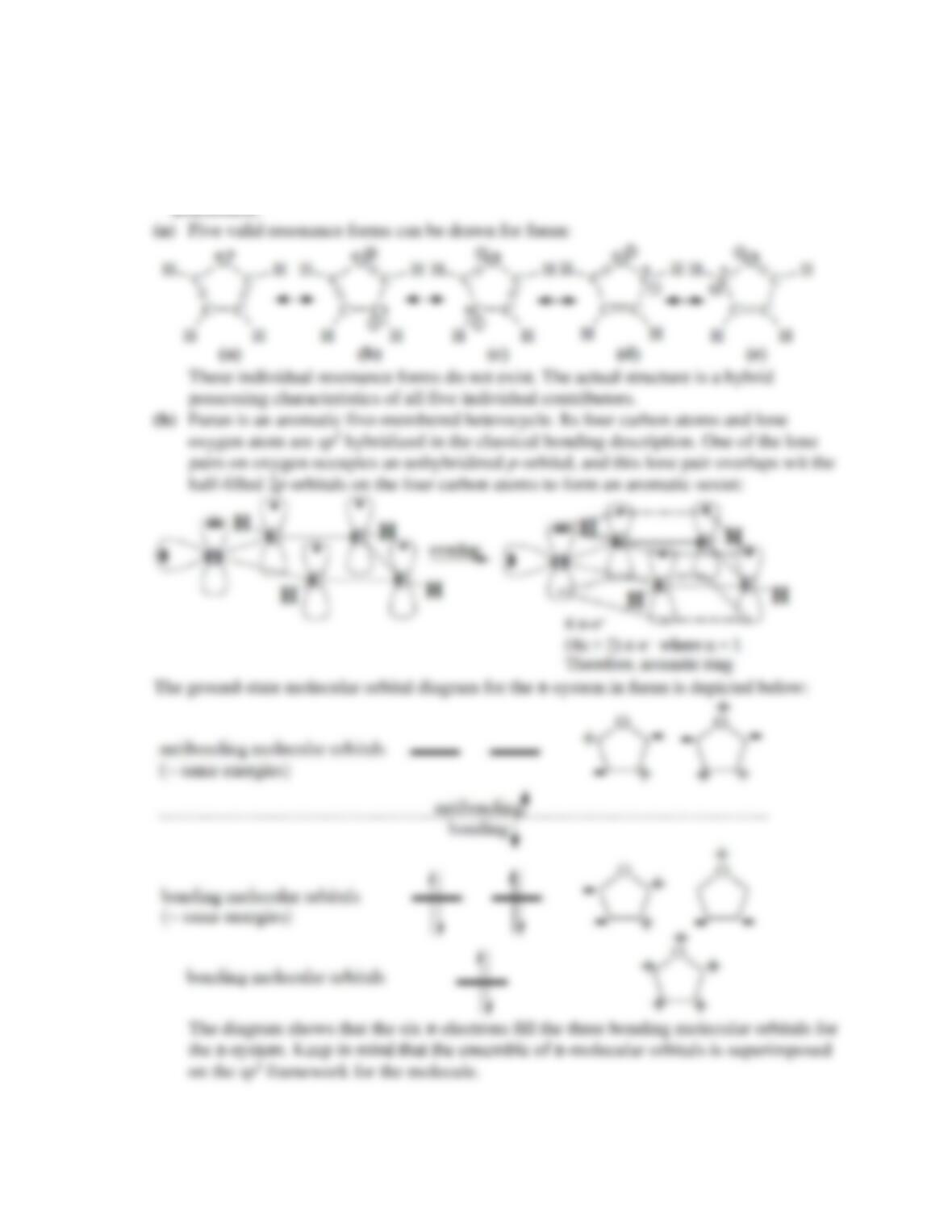
bonding in furan. [Hint: You need use only one of the contributing structures, such
as the one with no formal charges.]
(c) How many
electrons are there in the furan molecule? Show that this number of
electrons is the same, regardless of the contributing structure you use for this
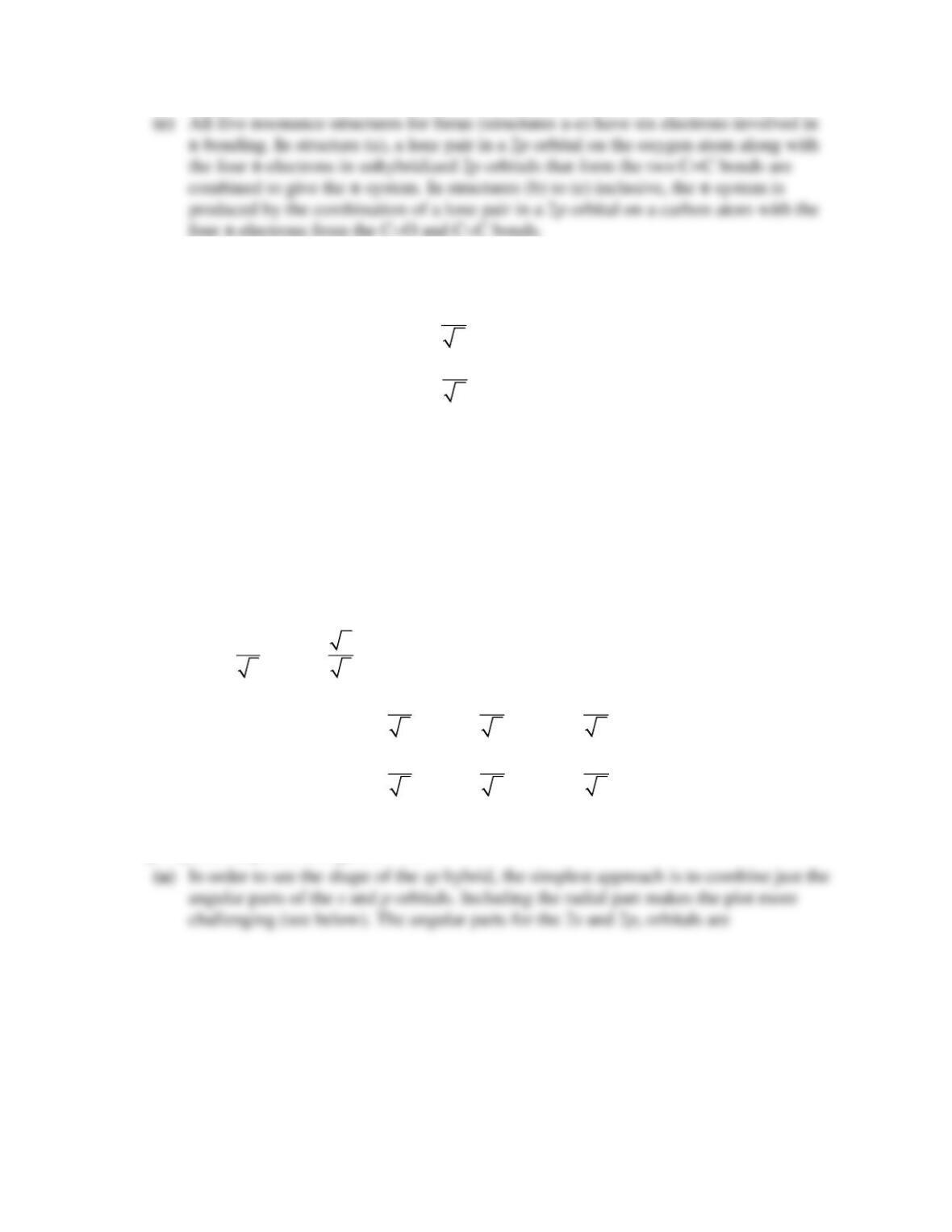
72. As discussed in Are You Wondering 11-1, the
sp
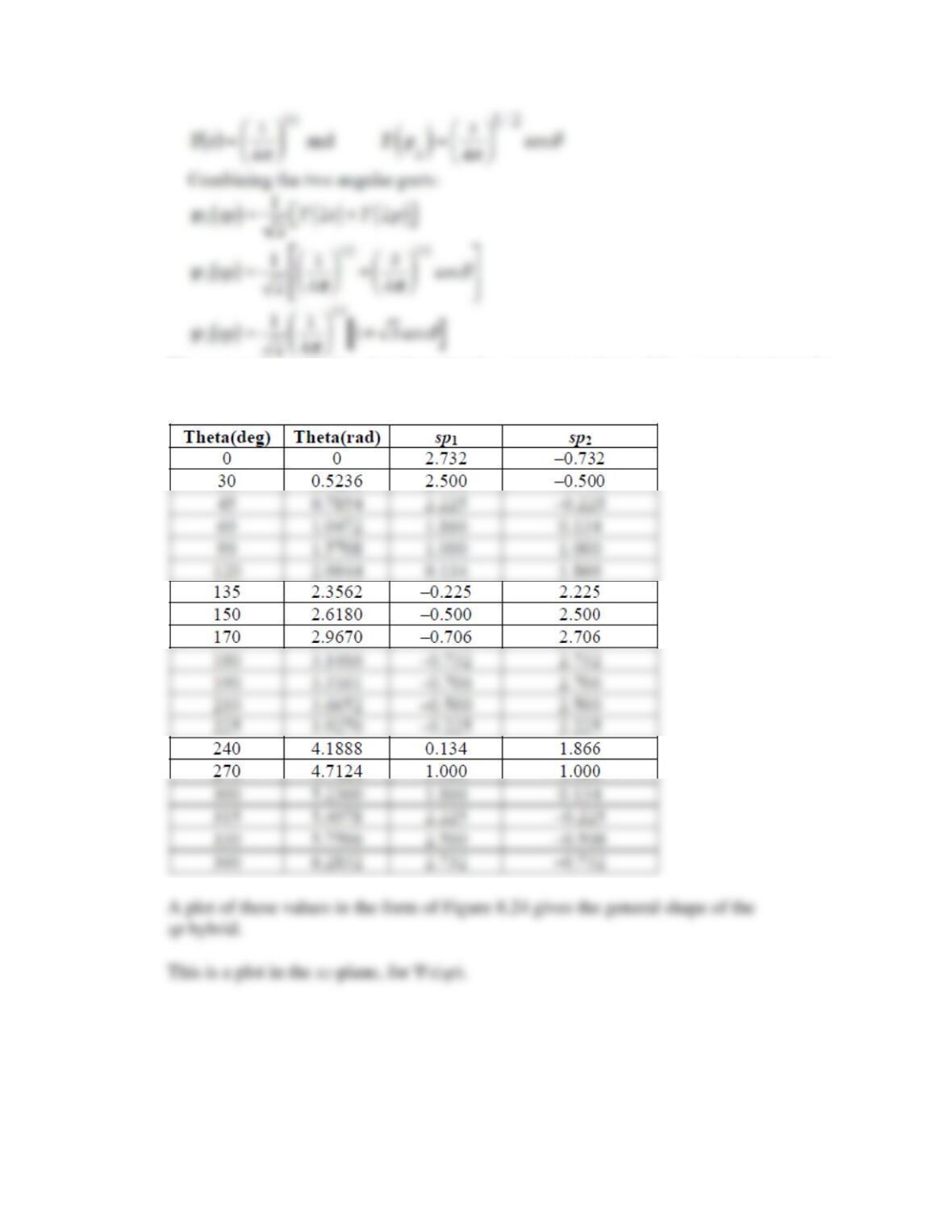
hybrid orbitals are algebraic combinations
of the s and p orbitals. The required combinations of
2s
and
2p
orbitals are
( ) ( ) ( )
1
122
2z
sp s p
=+
( ) ( ) ( )
2
122
2z
sp s p
=−
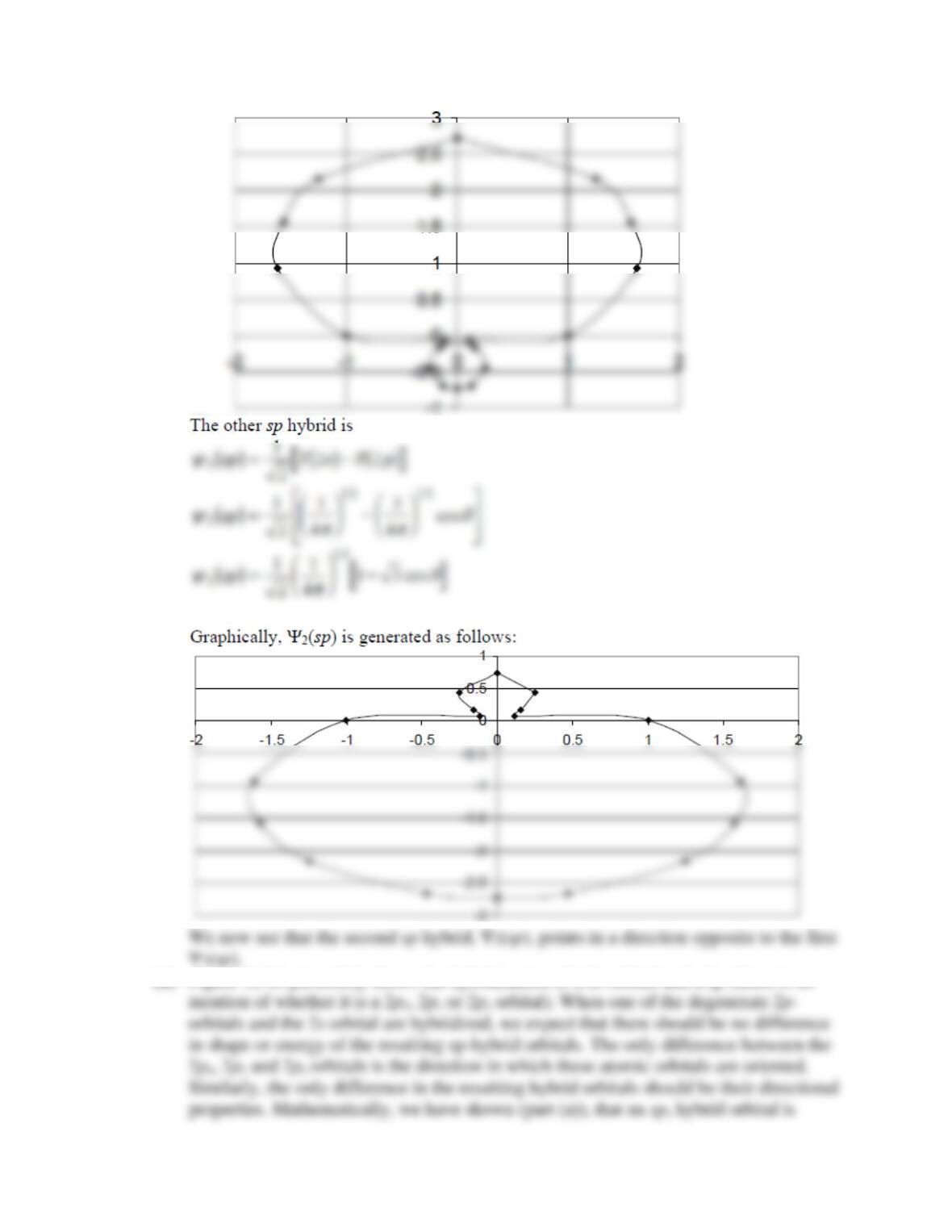
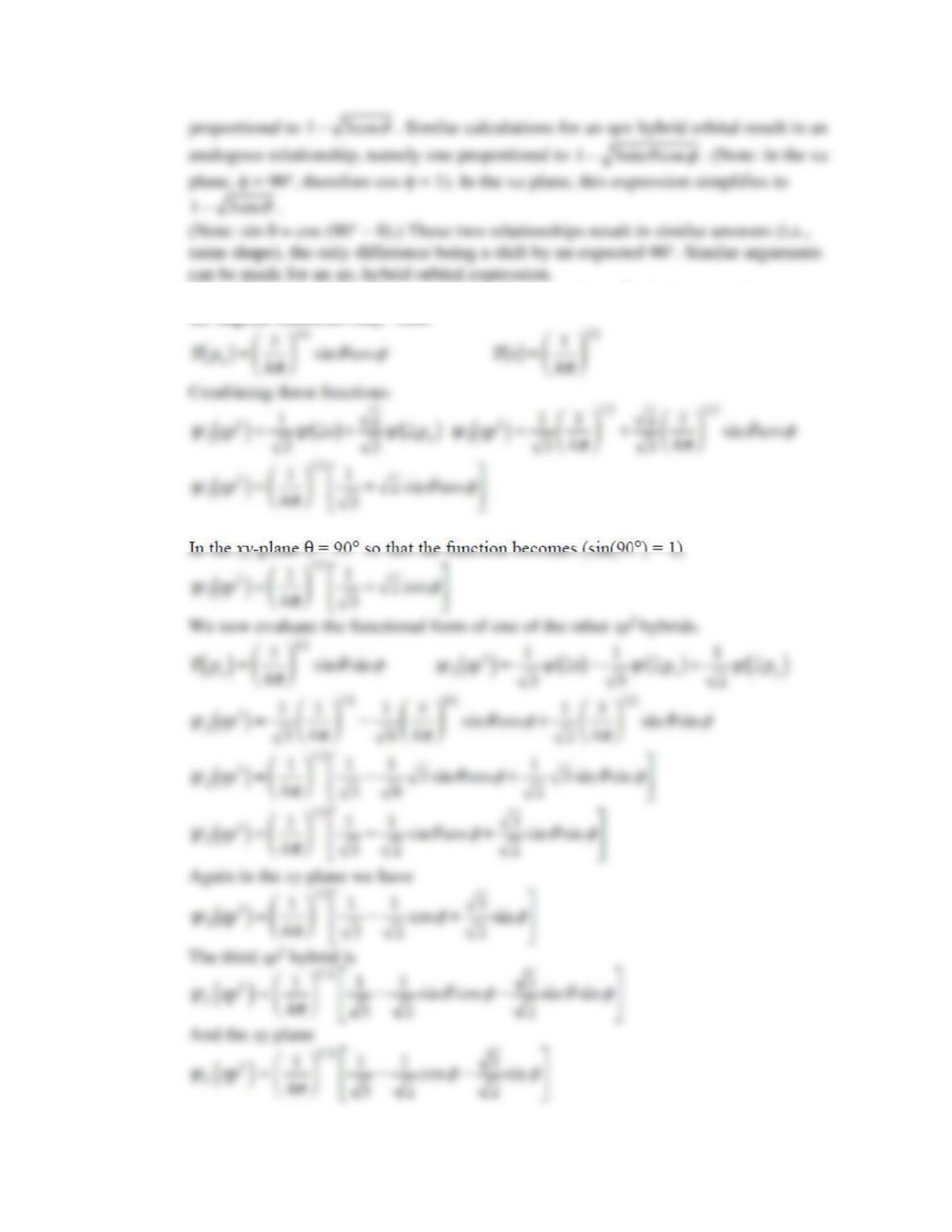
(a) By combining the appropriate functions given in Table 8.2, construct a polar
plot in the manner of Figure 8-24 for each of the above functions in the
xz
plane. In a
polar plot, the value of
0
r / a
is set at a fixed value (for example, 1). Describe the
shapes and phases of the different portions of the hybrid orbitals, and compare them
with those shown in Figure 11–12.
(b) Convince yourself that the combinations employing the
2x
p
or
2y
p
orbital also
give similar hybrid orbitals but pointing in different directions.
(c) The combinations for the
2
sp
hybrids in the xy plane are
( )
( ) ( )
2
1
12
22
33
x
sp s p
=+
( )
( ) ( )
( )
2
2
1 1 1
2 2 2
3 6 2
xy
sp s p p
= − +
( )
( ) ( )
( )
2
3
1 1 1
2 2 2
3 6 2
xy
sp s p p
= − −
By constructing polar plots (in the
xy
plane), show that these functions correspond to the
2
sp
hybrids depicted in Figure 11-10.
We now evaluate this function (ignoring the constants in front of the square brackets) for
various values of θ
(c) The sp2 hybrids. To show the spatial distribution of the sp2 hybrids, we will again use
the angular functions only. Thus
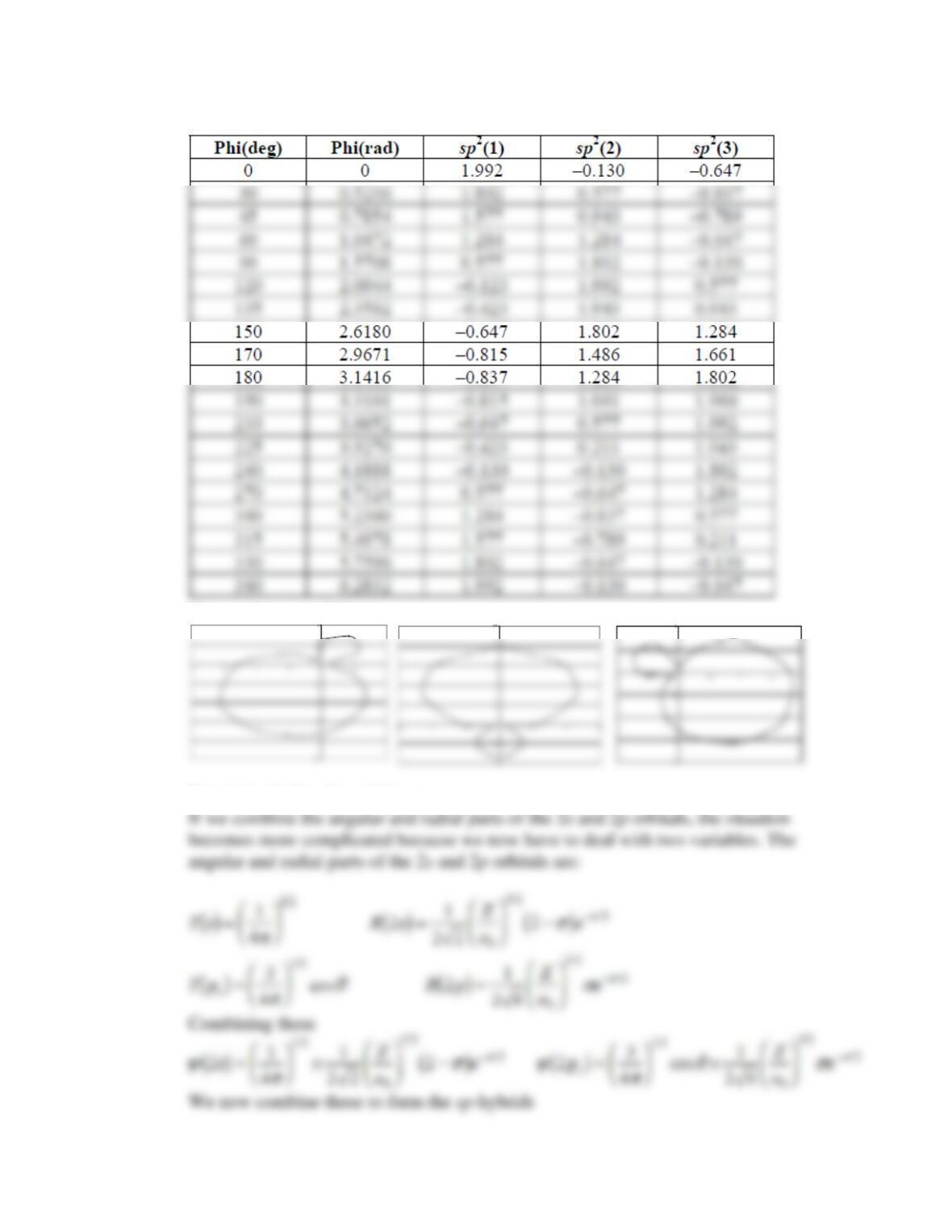
We can evaluate these functions and obtain sp2 angular values:
The graphs are as follows:
Part (a) including the radial part
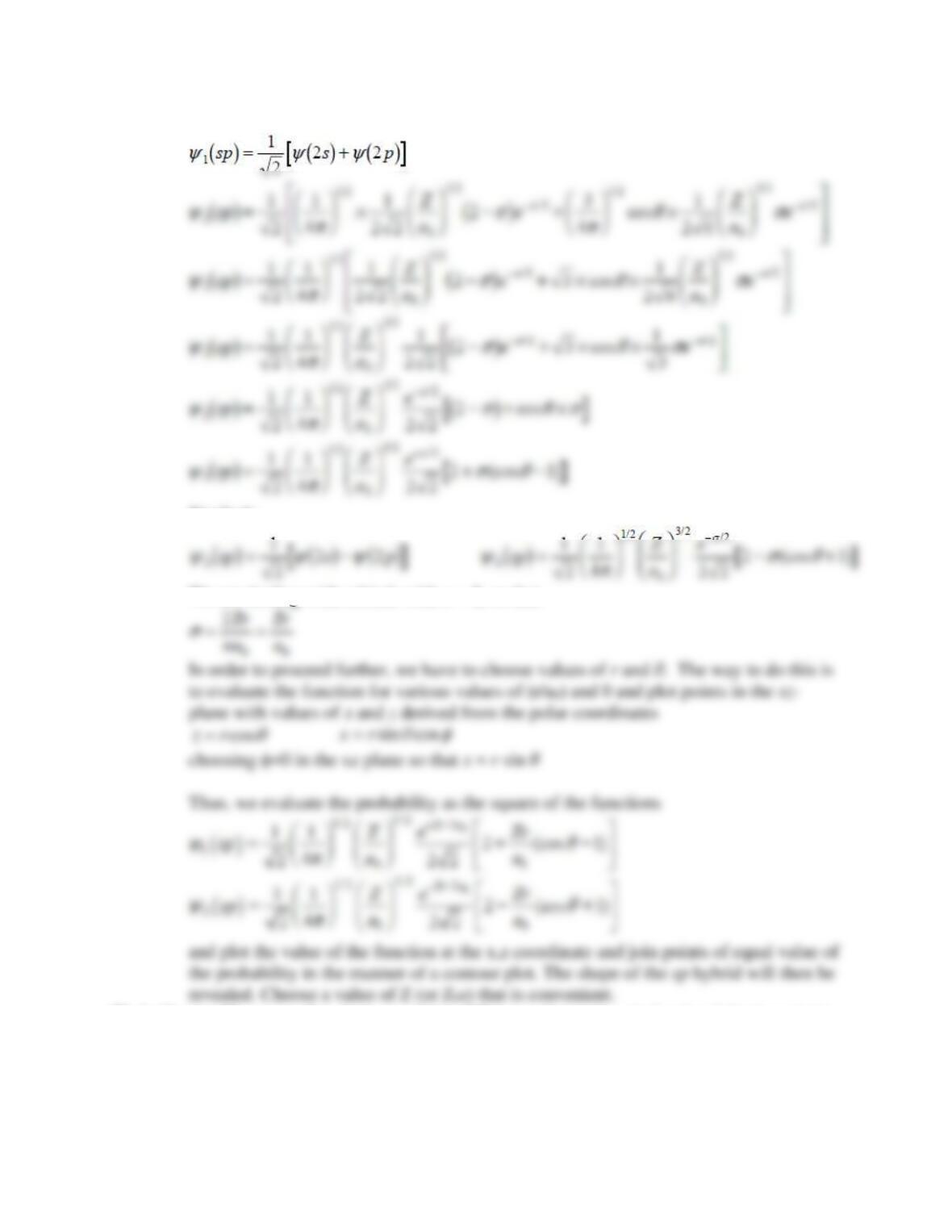
Similarly,
We are dealing with orbitals with n = 2, so that
73. In Chapter 10, we saw that electronegativity differences determine whether bond dipoles exist in
a molecule and that molecular shape determines whether bond dipoles cancel (nonpolar
molecules) or combine to produce a resultant dipole moment (polar molecules). Thus, the ozone
molecule,
3
O,
has no bond dipoles because all the atoms are alike. Yet,
3
O
does have a resultant
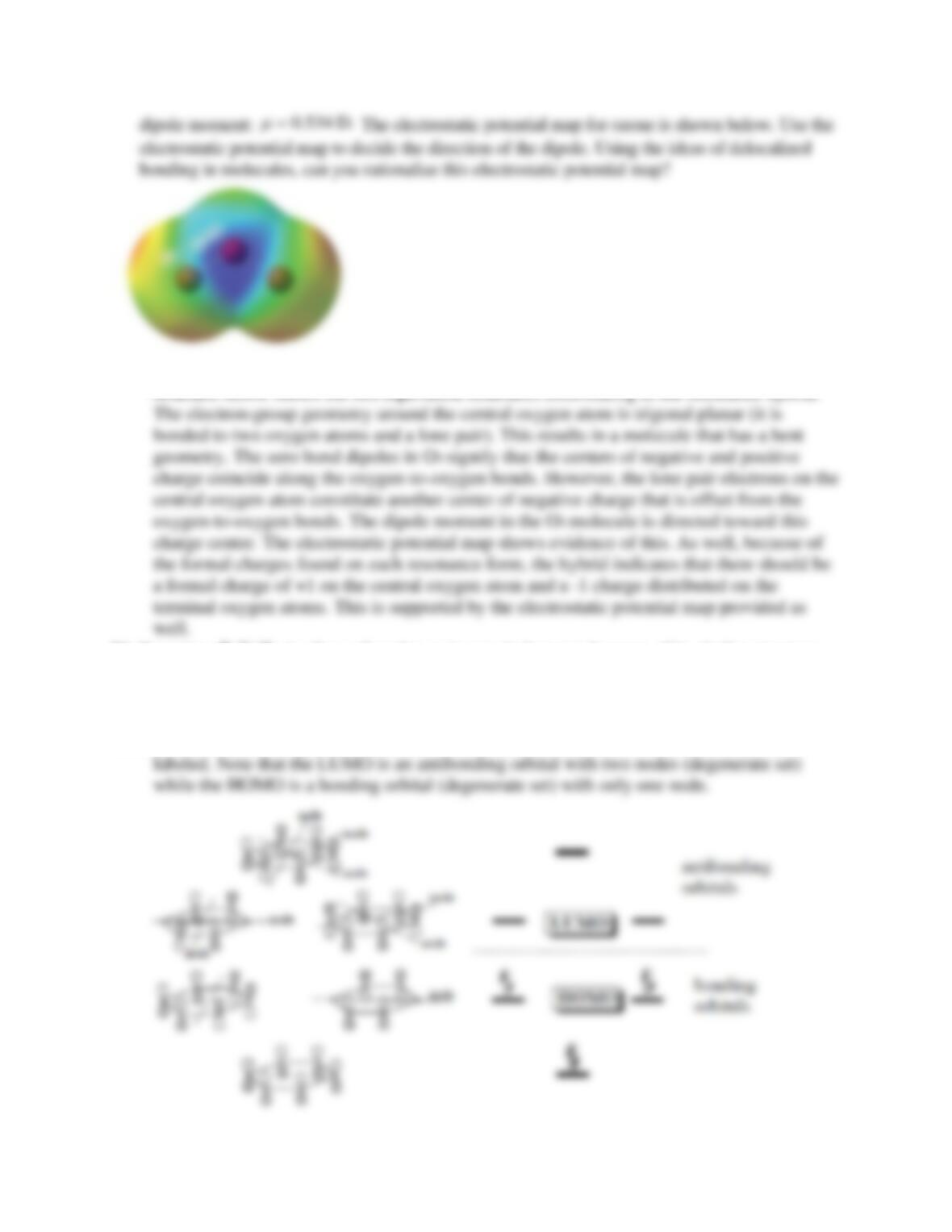
The ozone molecule, O3, has no bond dipoles because all of the atoms are alike. The Lewis
74. Borazine,
3 3 6
B N H
is often referred to as inorganic benzene because of its similar structure.
Like benzene, borazine has a delocalized
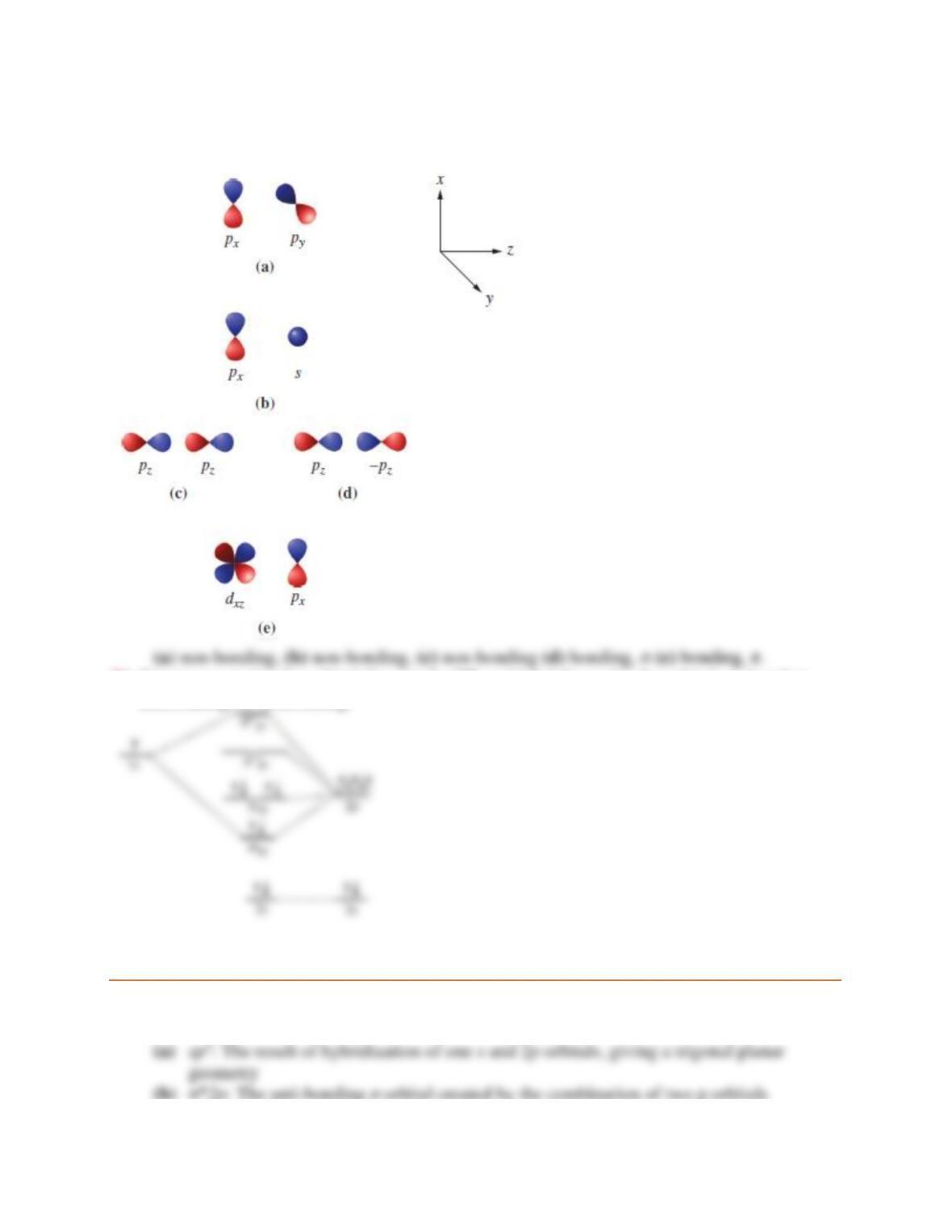
system. Describe the molecular orbitals of the
system. Identify the highest occupied molecular orbital (HOMO) and the lowest unoccupied
molecular orbital (LUMO). How many nodes does the LUMO possess?
The molecular orbital diagram for borazine is drawn below. Both the HOMO and LUMO are
75. Which of the following combinations of orbitals give rise to bonding molecular orbitals?
For those combinations that do, label the resulting bonding molecular orbital as
or
.
76. Construct a molecular orbital diagram for HF, and label the molecular orbitals as bonding,
antibonding, or nonbonding.
Self-Assessment Exercises
77. In your own words, define the following terms or symbols: (a)
2;sp
(b)
*
2p
; (c) bond order;
(d)
bond.
78. Briefly describe each of the following ideas: (a) hybridization of atomic orbitals; (b)
–bond
framework; (c) Kekulé structures of benzene,
66
CH
79. Explain the important distinctions between the terms in each of the following pairs: (a)
and
bonds; (b) localized and delocalized electrons; (c) bonding and antibonding molecular
orbitals.
80. A molecule in which
2
sp
hybrid orbitals are used by the central atom in forming covalent
bonds is (a)
5
PCl ;
(b)
2
N;
(c)
2
SO ;
(d)
2
He
81. The bond angle in
2
H Se
is best described as (a) between
109
and
120 ;
(b) less than in
H S;
HS,
90 ;
82. The hybridization scheme for the central atom includes a d orbital contribution in (a)
3
I;
−
(b)
3
PCl ;
(c)
3
NO ;
−
(d)
2
H Se
83. Of the following, the species with a bond order of 1 is (a)
2
H;
+
(b)
2
Li ;
(c)
2
He ;
(d)
2
H−
84. The hybridization scheme for Xe in
XeF
is (a)
;sp
(b)
3;sp
(c)
3;sp d
(d)
32
sp d
85. Delocalized molecular orbitals are found in (a)
2
H;
(b)
HS ;
−
(c)
4
CH ;
(d)
2
3
CO −
86. Explain why the molecular structure of
3
BF
cannot be adequately described through overlaps
involving pure s and p orbitals.
87. Why does the hybridization
3
sp d
not account for bonding in the molecule
5
BrF ?
What
88. What is the total number of (a)
bonds and (b)
bonds in the molecule
3
CH NCO?
89. Which of the following species are paramagnetic? (a)
2
B;
(b)
2
B;
−
(c)
2
B+
Which species
has the strongest bond?
90. Use the valence molecular orbital configuration to determine which of the following species
is expected to have the lowest ionization energy: (a)
C;
+
(b)
C;
(c)
C−
91. Use the valence molecular orbital configuration to determine which of the following species
2
2
92. Which of these diatomic molecules do you think has the greater bond energy,
2
Li
or
2
C?
93. For each of the following ions or molecules, decide whether the structure is best described by
a single Lewis structure or by resonance structures. (a) C2O42–; (b) H2CO; (c)
NO−
.
94. Draw Lewis structures for the
2
NO−
and
2
NO+
ions, and determine the likely geometry for
each by using VSEPR theory. How does the hybridization of N differ in these two species?
95. In which of the following is the central atom sp hybridized? (a) BeCl2; (b) BCl3; (c) CCl4;
96. Which of the following can be used to explain why all bond distances and angles in methane,
CH4, are the same? (a) resonance; (b) delocalization of electrons; (c) bond polarities; (d)
electronegativity; (e) orbital hybridization.
97. According to molecular orbital theory, the
2
2
O−
ion has which of the following? (a) two
unpaired electrons;
(b) a bond order of two; (c) its highest energy electron in a
orbital; (d) no 2s electrons; (e)
all of these.
98. What is the angle between the hybrid orbitals obtained by combining the 2s and two 2p
orbitals of an atom? (a)
90
; (b)
120
; (c)
180
; (d)
109.5
; (e) none of these.
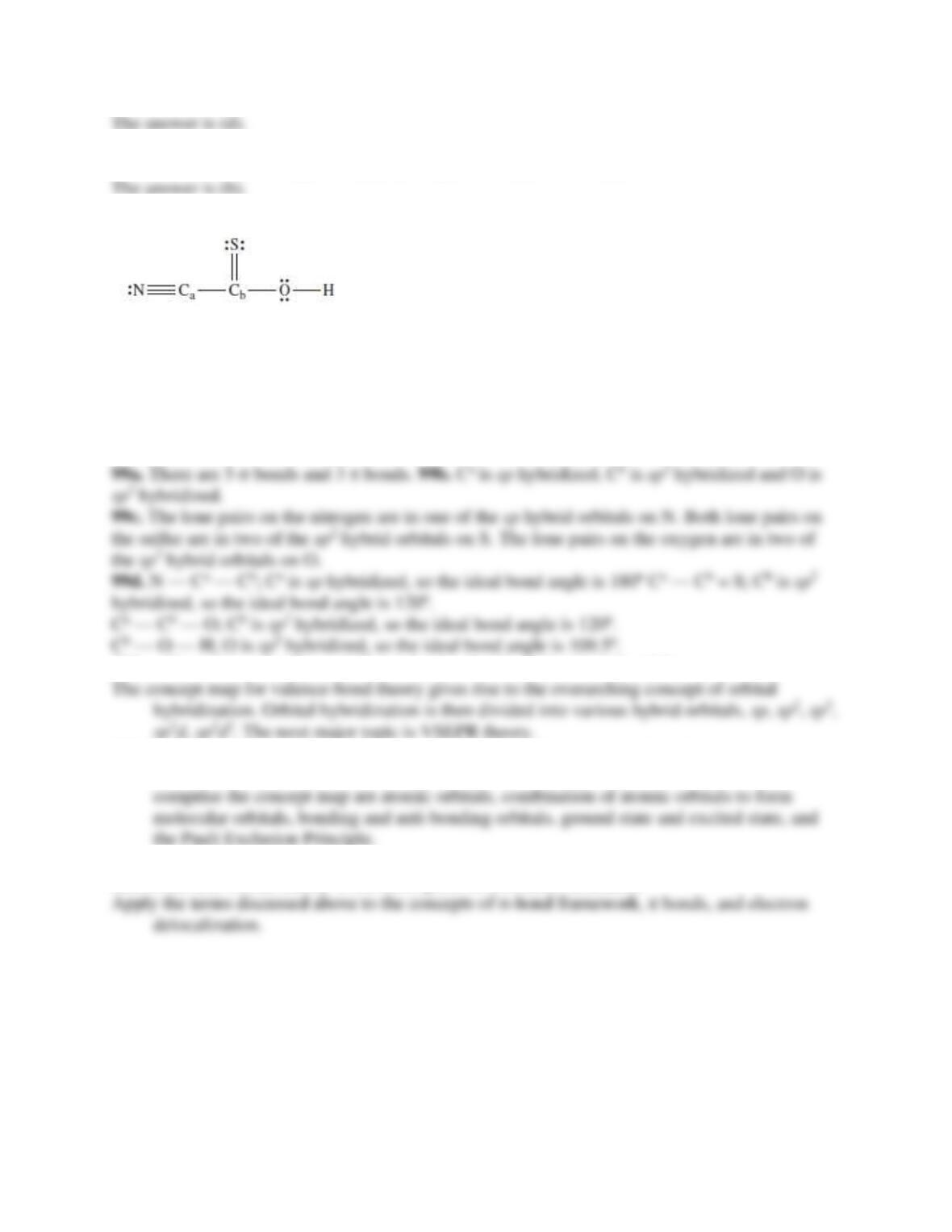
99. Consider the molecule with the Lewis structure given below.
(a) How many
and
bonds are there?
(b) What is the appropriate hybridization scheme for each of Ca, Cb, and O?
(c) In which orbitals are the lone pairs located?
(d) What are the (ideal) values of the following bond angles?
N—Ca—Cb Ca—Cb=S Ca—Cb—O Cb—O—H
100. Construct a concept map that embodies the ideas of valence bond theory.
101. Construct a concept map that connects the ideas of molecular orbital theory.
The basic ideas of molecular orbital theory are discussed on pages 486 to 488. The terms that
102. Construct a concept map that describes the inter-connection between valence bond theory
and molec-ular orbital theory in the description of resonance structures.