Chapter 11
Chemical Bonding II: Valence Bond and Molecular Orbital
Theories
Exercises
Valence Bond Method
1. Indicate several ways in which the valence bond method is superior to Lewis structures in
describing covalent bonds.
2. Explain why it is necessary to hybridize atomic orbitals when applying the valence bond
method—that is, why are there so few molecules that can be described by the overlap of pure
atomic orbitals only?
The overlap of pure atomic orbitals gives bond angles of 90° or 180°. These bond angles are
suitable only for 3- and 4-atom compounds in which the central atom is an atom of the third (or
equivalent. Overlaps with hybrid orbitals produce equivalent bonds.
3. Describe the molecular geometry of
2
HO
suggested by each of the following methods: (a)
Lewis theory; (b) valence bond method using simple atomic orbitals; (c) VSEPR theory; (d)
valence bond method using hybridized atomic orbitals.
4. Describe the molecular geometry of
3
NH
suggested by each of the following methods: (a)
Lewis theory; (b) valence bond method using simple atomic orbitals; (c) VSEPR theory; (d)
valence bond method using hybridized atomic orbitals.
5. In which of the following,
2
3
CO ,
−
2
SO ,
4
CCl ,
CO,
2
NO ,
−
would you expect to find
2
sp
hybridization of the central atom? Explain.
6. In the manner of Example 11-1, describe the probable structure and bonding in (a) HI; (b)
BrCl; (c)
2
H Se;
(d)
2
OCl
7. For each of the following species, identify the central atom(s) and propose a hybridization
scheme for those atom(s): (a)
2
CO ;
(b)
2
HONO ;
(c)
3
ClO ;
−
(d)
4
BF−
8. Propose a plausible Lewis structure, geometric structure, and hybridization scheme for the
ONF molecule.
9. Describe a hybridization scheme for the central Cl atom in the molecule
3
ClF
that is
consistent with the geometric shape pictured in Table 10.1. Which orbitals of the Cl atom are
involved in overlaps, and which are occupied by lone-pair electrons?
10. Describe a hybridization scheme for the central S atom in the molecule
4
SF
that is consistent
with the geometric shape pictured in Table 10.1. Which orbitals of the S atom are involved in
overlaps, and which are occupied by lone-pair electrons?
11. Match each of the following species with one of these hybridization schemes:
2 3 3 3 2
sp, sp , sp , sp d, sp d
(a)
6
PF ;
−
(b) COS; (c)
4
SiCl ;
(d)
3
NO ;
−
(e)
5
AsF
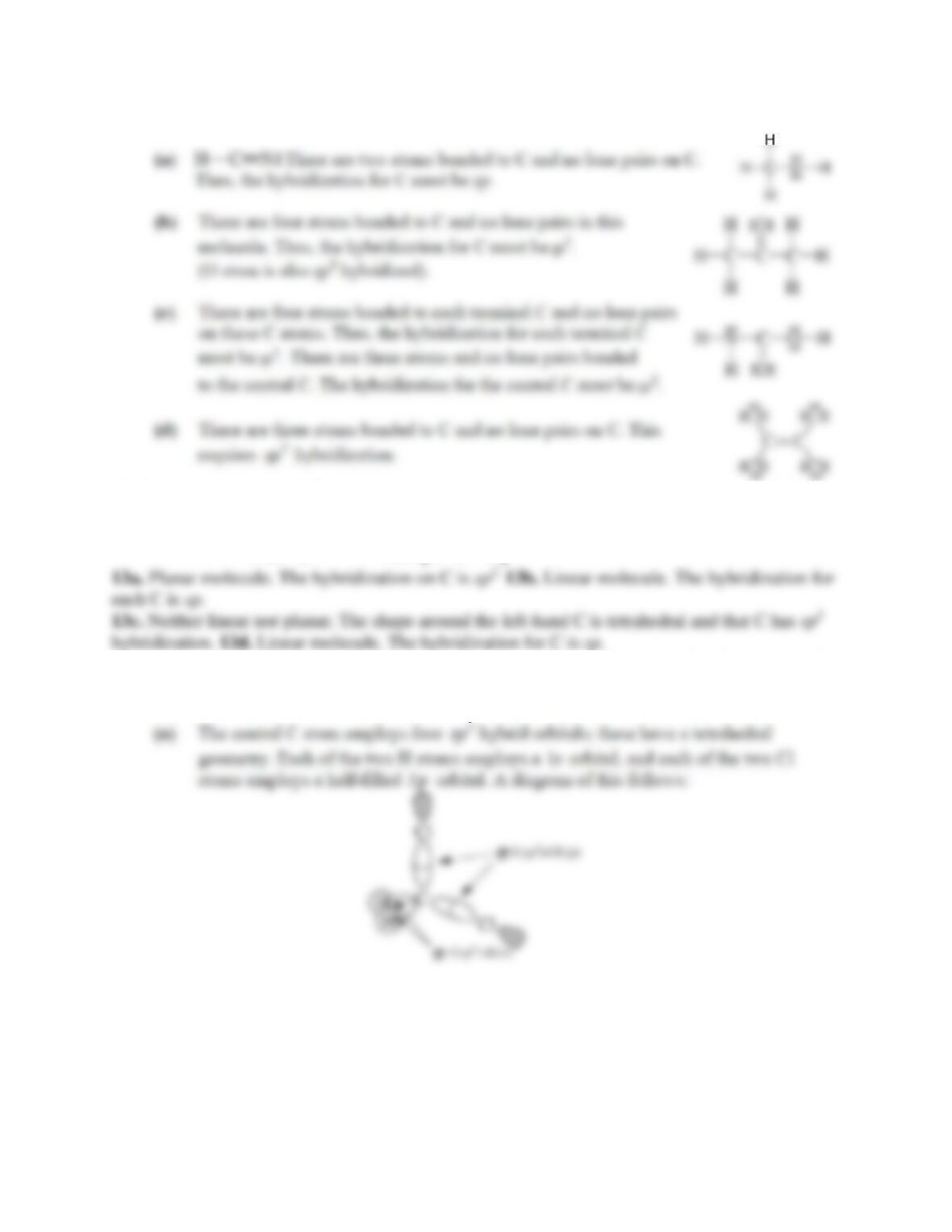
12. Propose a hybridization scheme to account for bonds formed by the central carbon atom in
each of the following molecules: (a) hydrogen cyanide, HCN; (b) methyl alcohol,
3
CH OH;
(c) acetone,
( )
32
CH CO;
(d) carbamic acid,
We base each hybridization scheme on the Lewis structure for the molecule.
13. Indicate which of the following molecules and ions are linear, which are planar, and which are
neither. Then propose hybridization schemes for the central atoms. (a)
22
Cl C = CCl ;
(b)
N C C N;−
(c)
3
F C C N;−
(d)
S C N −
−
14. In the manner of Figure 11-18, indicate the structures of the following molecules in terms of
the overlap of simple atomic orbitals and hybrid orbitals: (a)
22
CH Cl ;
(b)
OCN ;
−
(c)
3
BF
15. Write Lewis structures for the following molecules, and then label each
and
bond. (a)
HCN; (b)
22
C N ;
(c)
33
CH CHCHCCl ;
(d) HONO.
16. Represent bonding in the carbon dioxide molecule,
2
CO ,
by (a) a Lewis structure and (b) the
valence-bond method. Identify
and
bonds, the necessary hybridization scheme, and
orbital overlap.
overlap of the partially filled 2px and 2py orbitals of C and O.
17. Use the method of Figure 11-19 to represent bonding in each of the following molecules: (a)
4
CCl ;
(b) ONCl; (c) HONO; (d)
2
COCl
2 × : Cl (3px)1 — C(sp2)1 : O (2py)1 — C (sp2)1 : O (2pz)1 — C (2pz)1.
18. Use the method of Figure 11-19 to represent bonding in each of the following ions: (a)
2
NO ;
−
(b)
3
I;
−
(c)
2
24
C O ;
+
(d)
3
HCO−
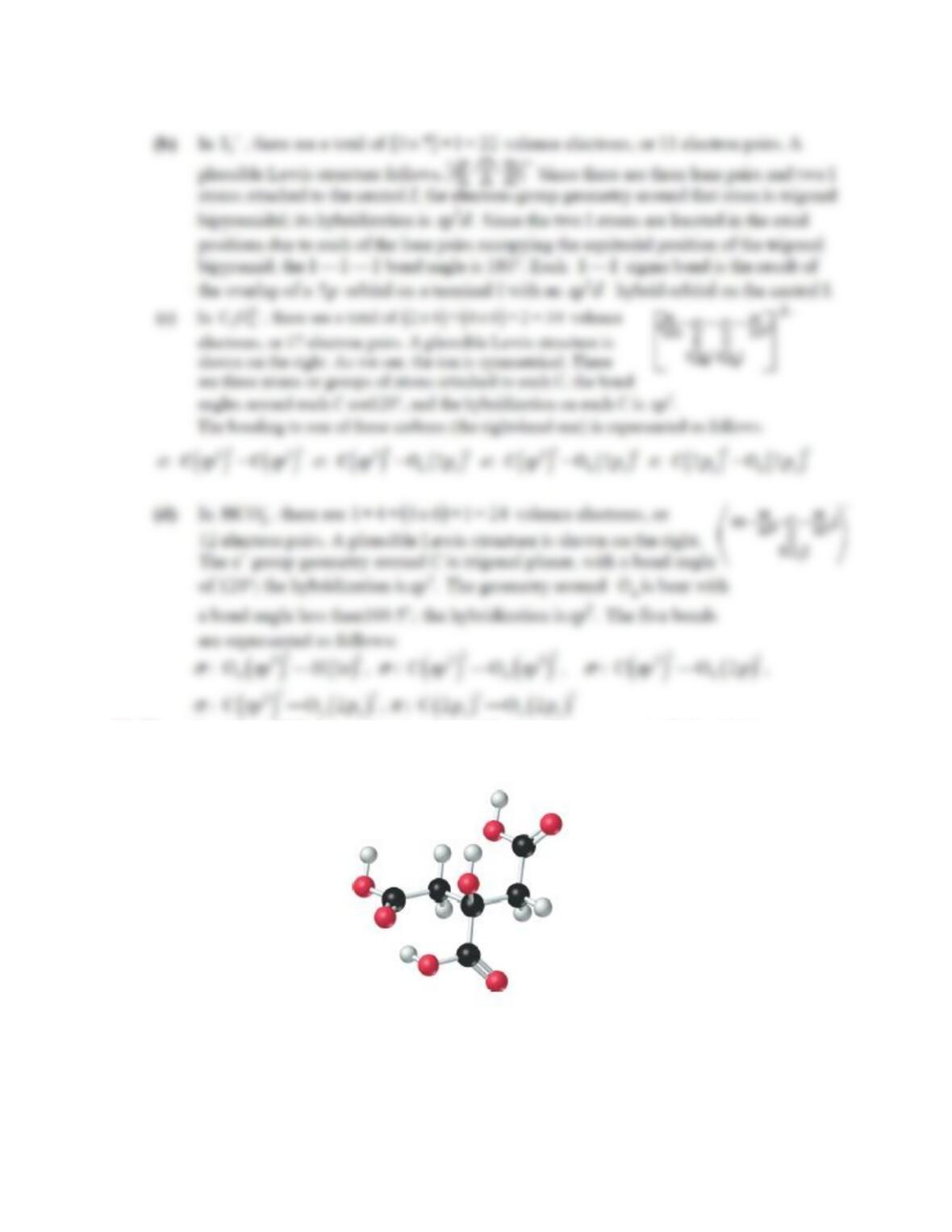
19. The molecular model below represents citric acid, an acidic component of citrus juices.
Represent bonding in the citric acid molecule using the method of Figure 11-19 to indicate
hybridization schemes and orbital overlaps.
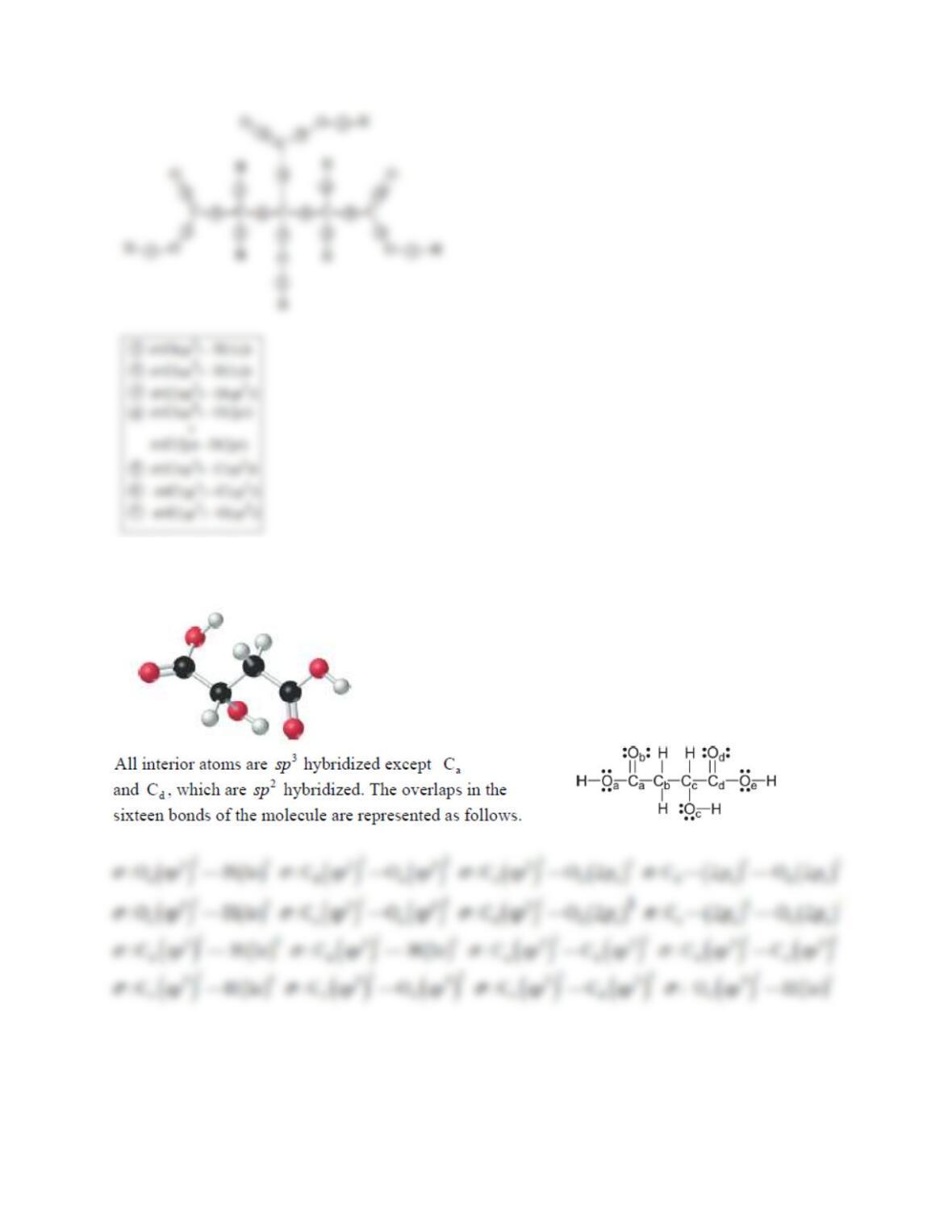
20. Malic acid is a common organic acid found in unripe apples and other fruit. With the help of
the molecular model shown below, represent bonding in the malic acid molecule, using the
method of Figure 11-19 to indicate hybridization schemes and orbital overlaps.
21. Shown below are ball-and-stick models. Describe hybridization and orbital-overlap schemes
consistent with these structures.
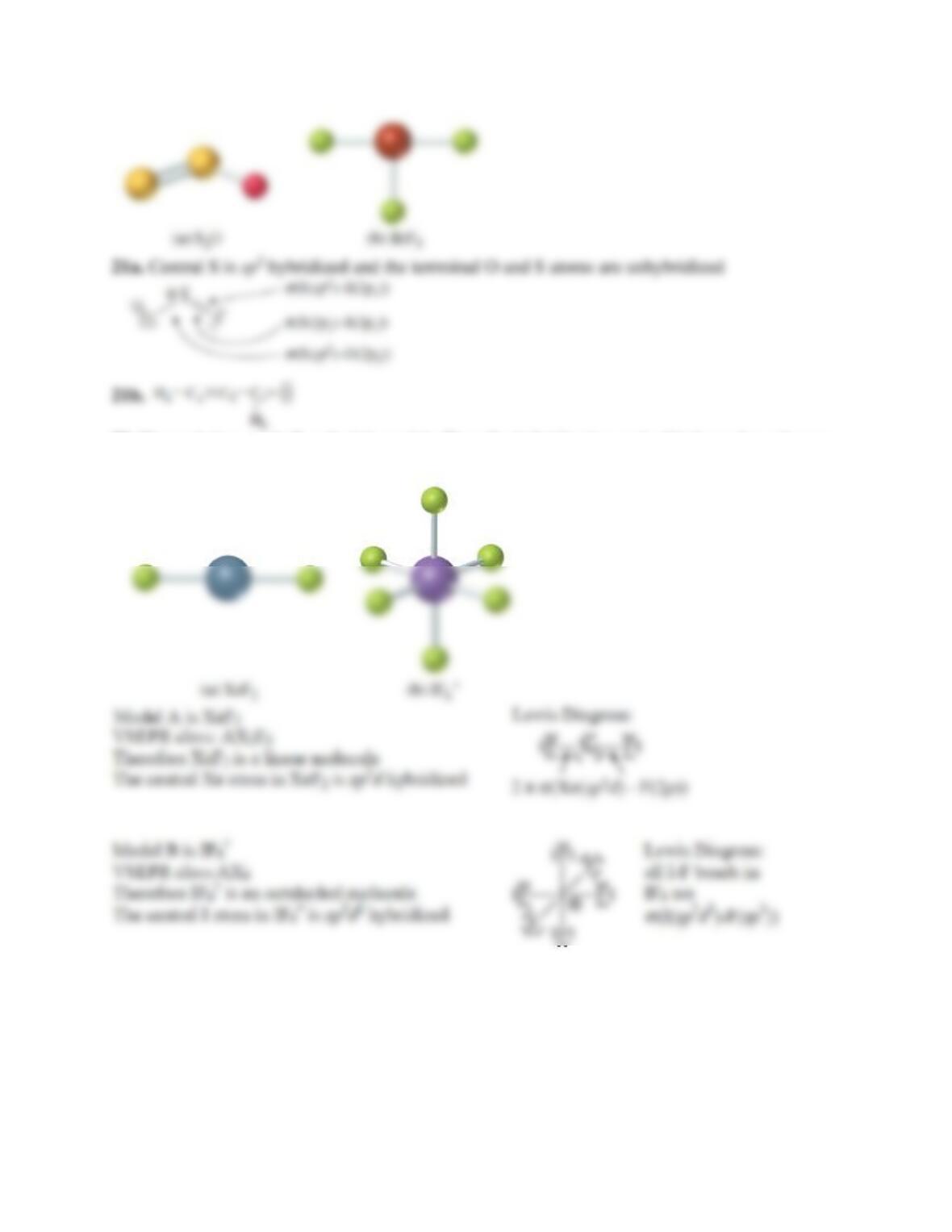
22. Shown below are ball-and-stick models. Describe hybridization and orbital-overlap schemes
consistent with these structures.
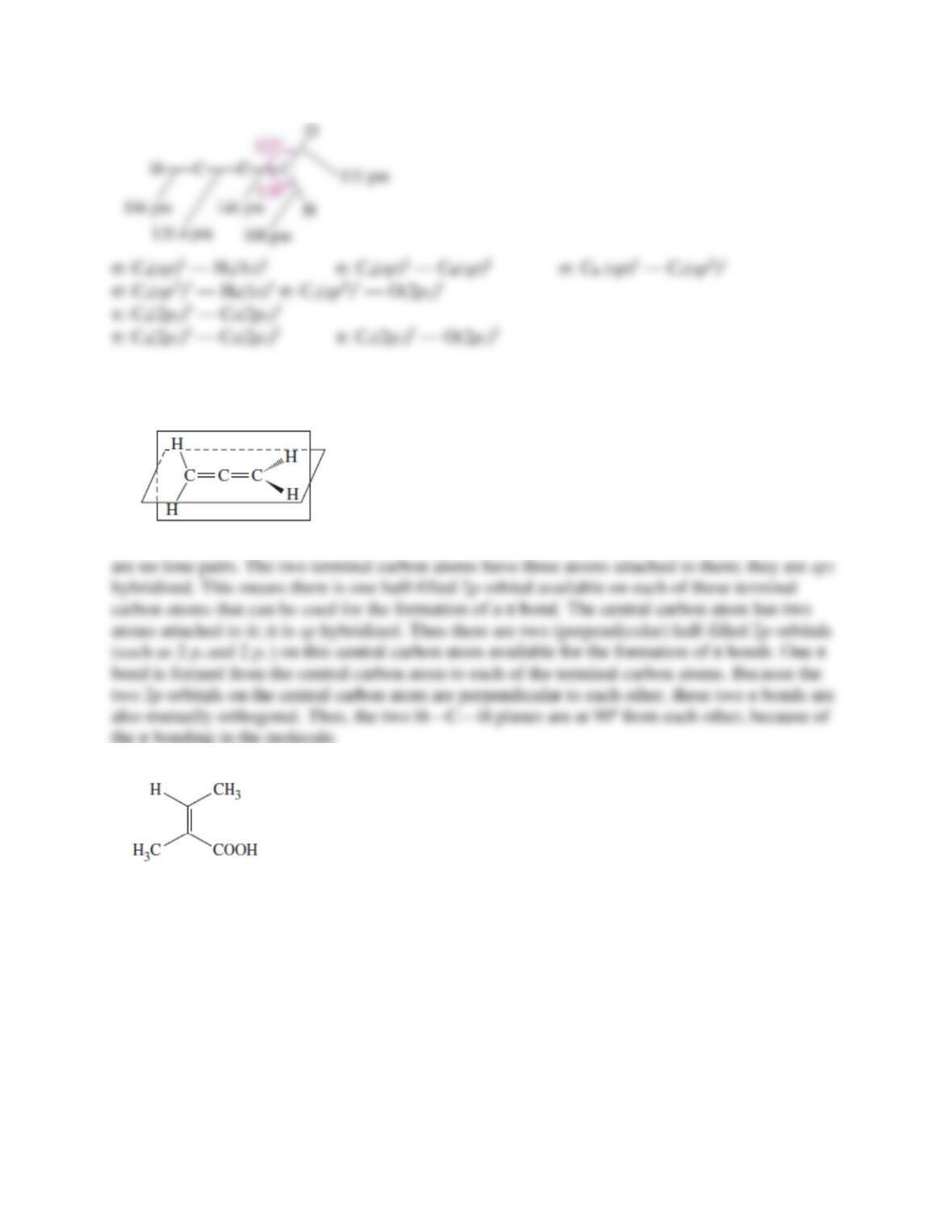
23. Propose a bonding scheme that is consistent with the structure for propynal. [Hint:
Consult Table 10.2 to assess the multiple-bond character in some of the bonds.]
24. The structure of the molecule allene,
22
CH CCH ,
is shown here. Propose hybridization
schemes for the C atoms in this molecule.
All of the valence electron pairs in the molecule are indicated in the sketch for the problem; there
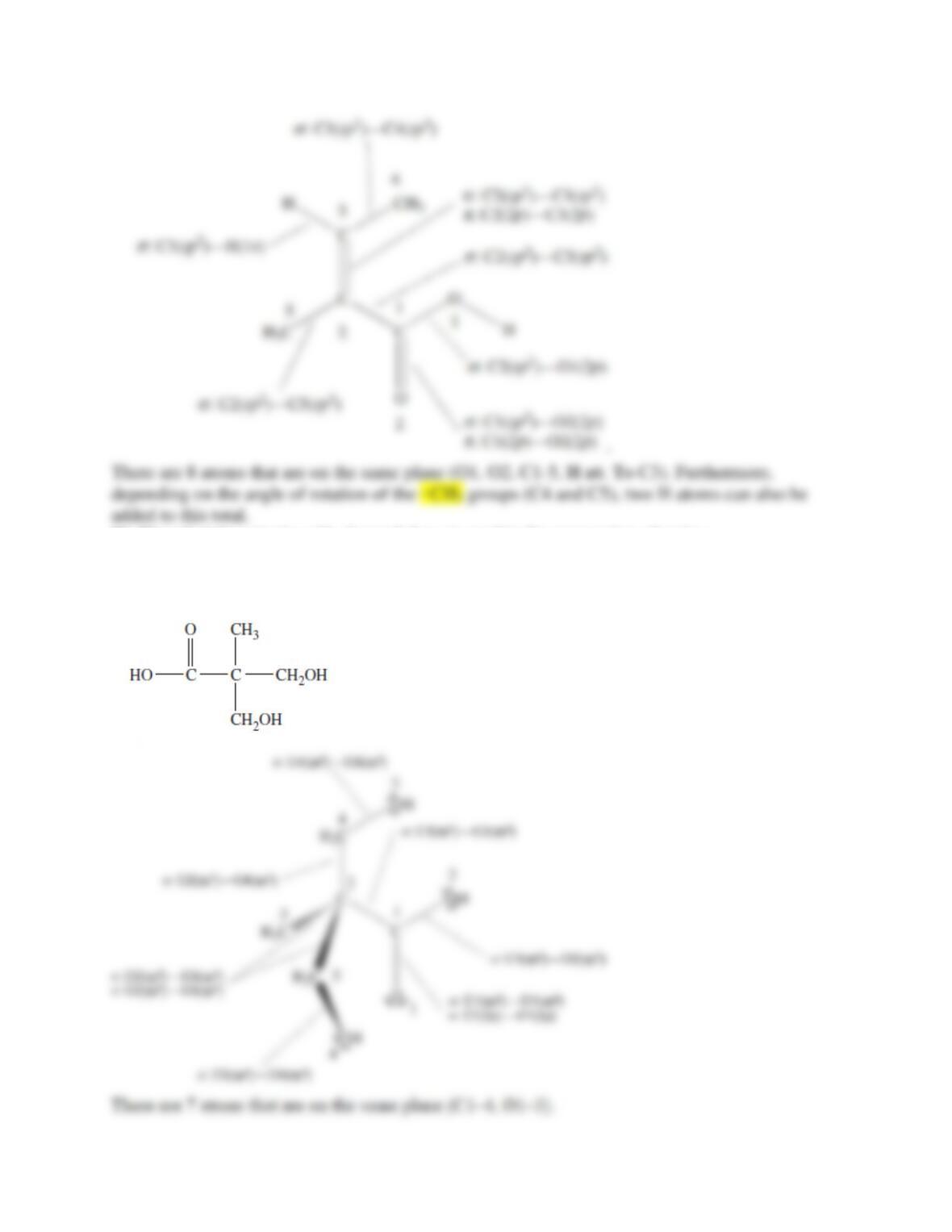
25. Angelic acid, shown below, occurs in sumbol root, a herb used as a stimulant.
Represent the bonding in the angelic acid molecule by using the method in Figure 11-19 to
indicate hybridization schemes and orbital overlaps. What is the maximum number of atoms
that can lie in the same plane?
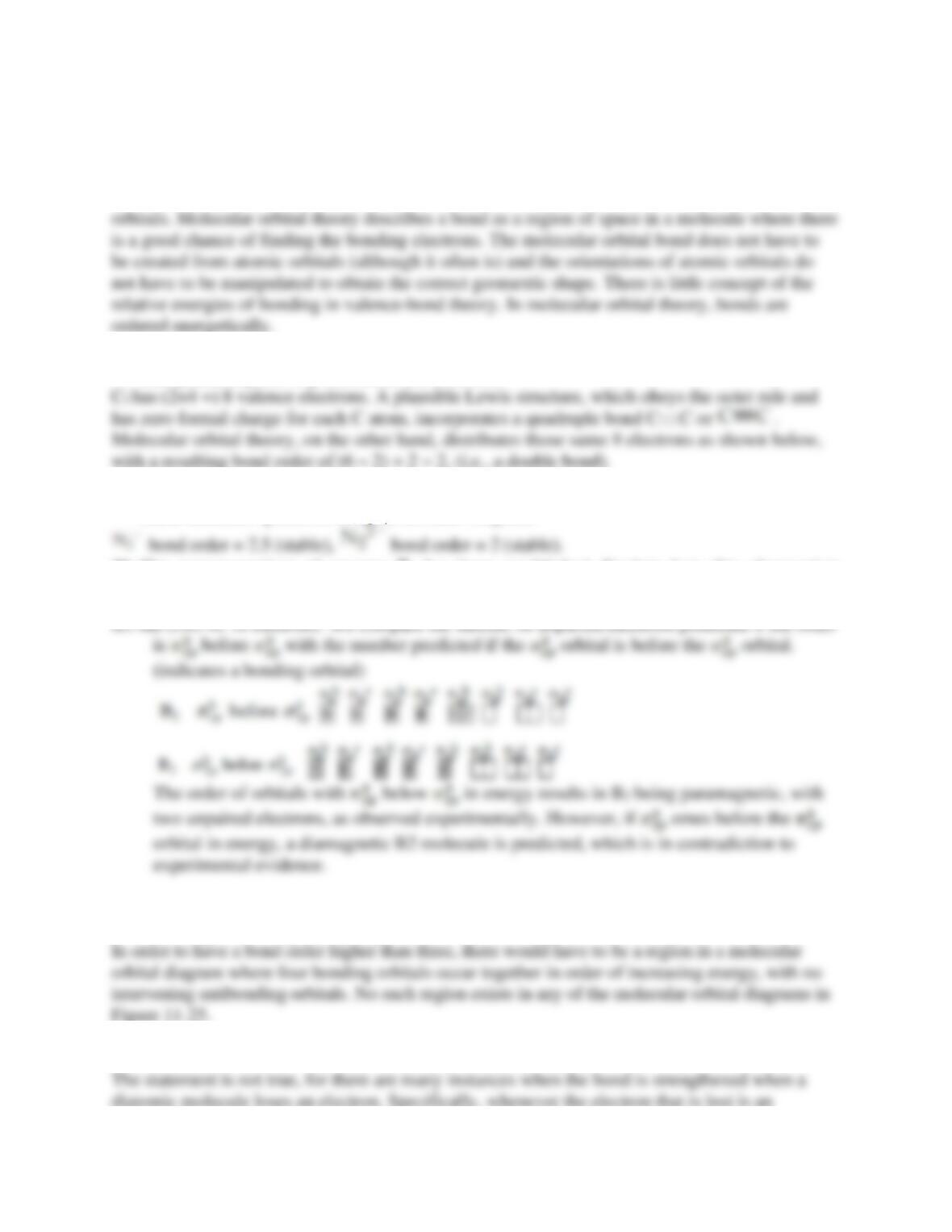
26. Dimethylolpropionic acid, shown below, is used in the preparation of resins.
Represent the bonding in the dimethylolpropionic acid molecule by using the method in
Figure 11-19 to indicate hybridization schemes and orbital overlaps. What is the maximum
number of atoms that can lie in the same plane?
Molecular Orbital Theory
27. Explain the essential difference in how the valence-bond method and molecular orbital
theory describe a covalent bond.
The valence-bond method describes a covalent bond as the result of the overlap of atomic
28. Describe the bond order of diatomic carbon,
2
C,
with Lewis theory and molecular orbital
theory, and explain why the results are different.
29.
( )
2
Ng
has an exceptionally high bond energy. Would you expect either
2
N−
or
2
2
N−
to be a
stable diatomic species in the gaseous state? Explain.
30. The paramagnetism of gaseous
2
B
has been established. Explain how this observation
confirms that the
2p
orbitals are at a lower energy than the
2p
orbital for
2
B
31. In our discussion of bonding, we have not encountered a bond order higher than triple. Use
the energy-level diagrams of Figure 11-26 to show why this is to be expected.
32. Is it correct to say that when a diatomic molecule loses an electron, the bond energy always
decreases (that is, that the bond is always weakened)? Explain.
33. For the following pairs of molecular orbitals, indicate the one you expect to have the lower
energy, and state the reason for your choice. (a)
1s
or
*
1;
s
(b)
2s
or
2;
p
(c)
*
1s
or
2;
s
(d)
2p
or
*
2p
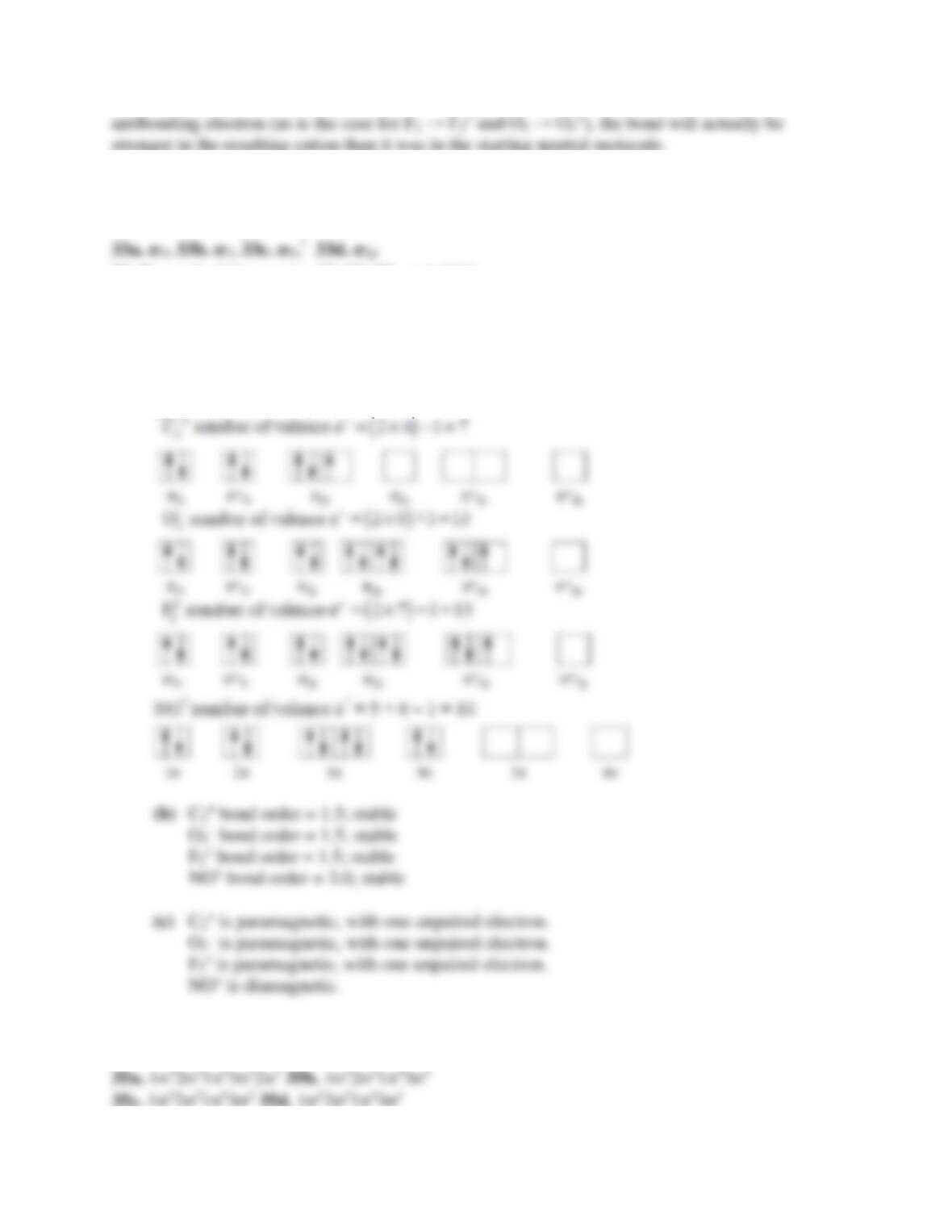
34. For each of the species
2 2 2
C , O , F ,
+ − +
and
NO ,
+
(a) Write the molecular orbital occupancy diagram (as in Example 11-6).
(b) Determine the bond order, and state whether you expect the species to be stable or
unstable.
(c) Determine if the species is diamagnetic or paramagnetic; and if paramagnetic,
indicate the number of unpaired electrons.
(a)
35. Write plausible molecular orbital occupancy diagrams for the following heteronuclear
diatomic species: (a) NO; (b)
NO ;
+
(c) CO; (d) CN; (e)
CN ;
−
(f)
CN ;
+
(g) BN.
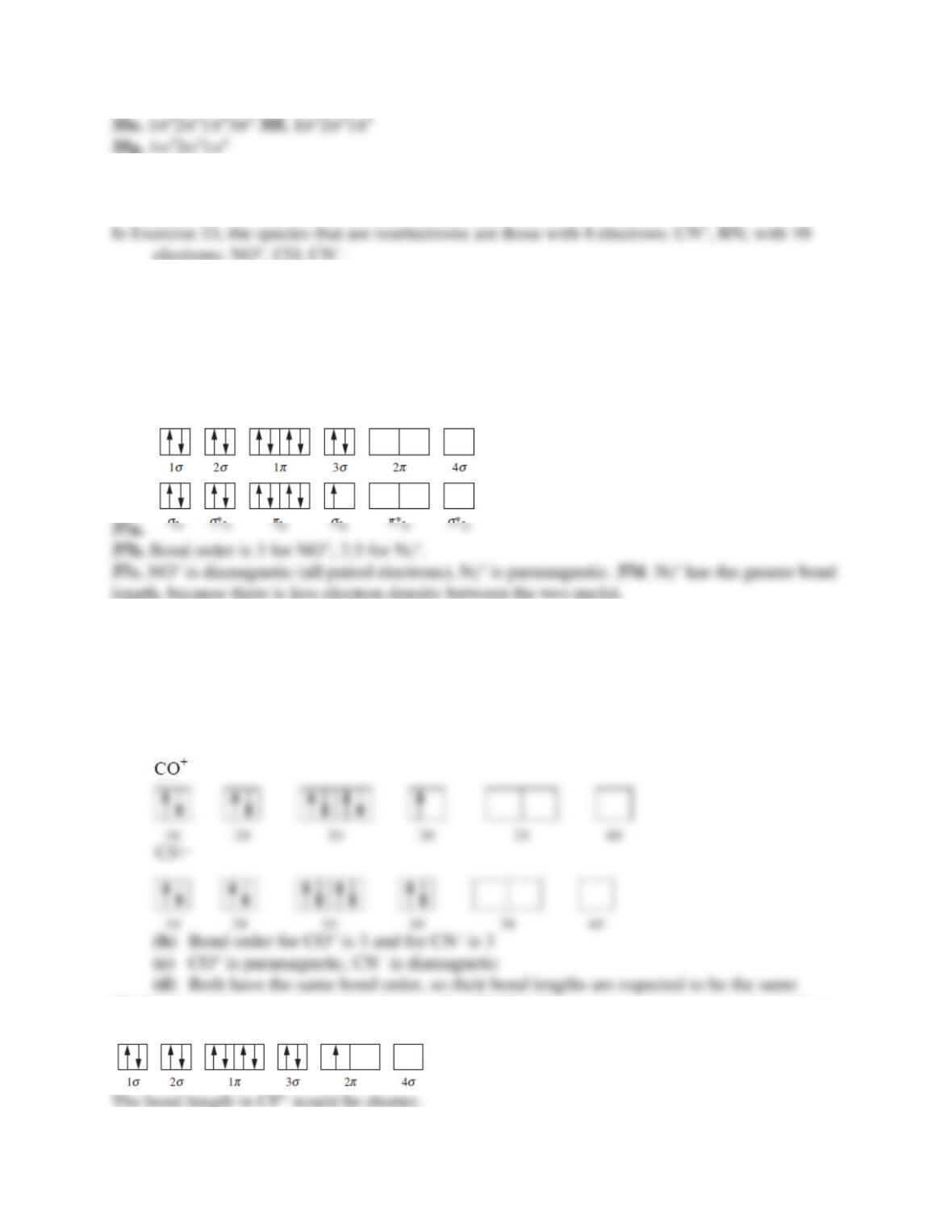
36. We have used the term “isoelectronic” to refer to atoms with identical electron
configurations. In molec-ular orbital theory, this term can be applied to molecular species as
well. Which of the species in Exercise 35 are isoelectronic?
37. Consider the molecules
NO+
and
2
N+
and use molecular orbital theory to answer the
following:
(a) Write the molecular orbital configuration of each ion (ignore the
1s
electrons).
(b) Predict the bond order of each ion.
(c) Which of these ions is paramagnetic? Which is diamagnetic?
(d) Which of these ions do you think has the greater bond length? Explain.
38. Consider the molecules
CO+
and
CN−
and use molec-ular orbital theory to answer the
following:
(a) Write the molecular orbital configuration of each ion (ignore the
1s
electrons).
(b) Predict the bond order of each ion.
(c) Which of these ions is paramagnetic? Which is diamagnetic?
(d) Which of these ions do you think has the greater bond length? Explain.
(a)
39. Construct the molecular orbital diagram for CF. Would you expect the bond length of
CF+
to
be longer or shorter than that of CF?
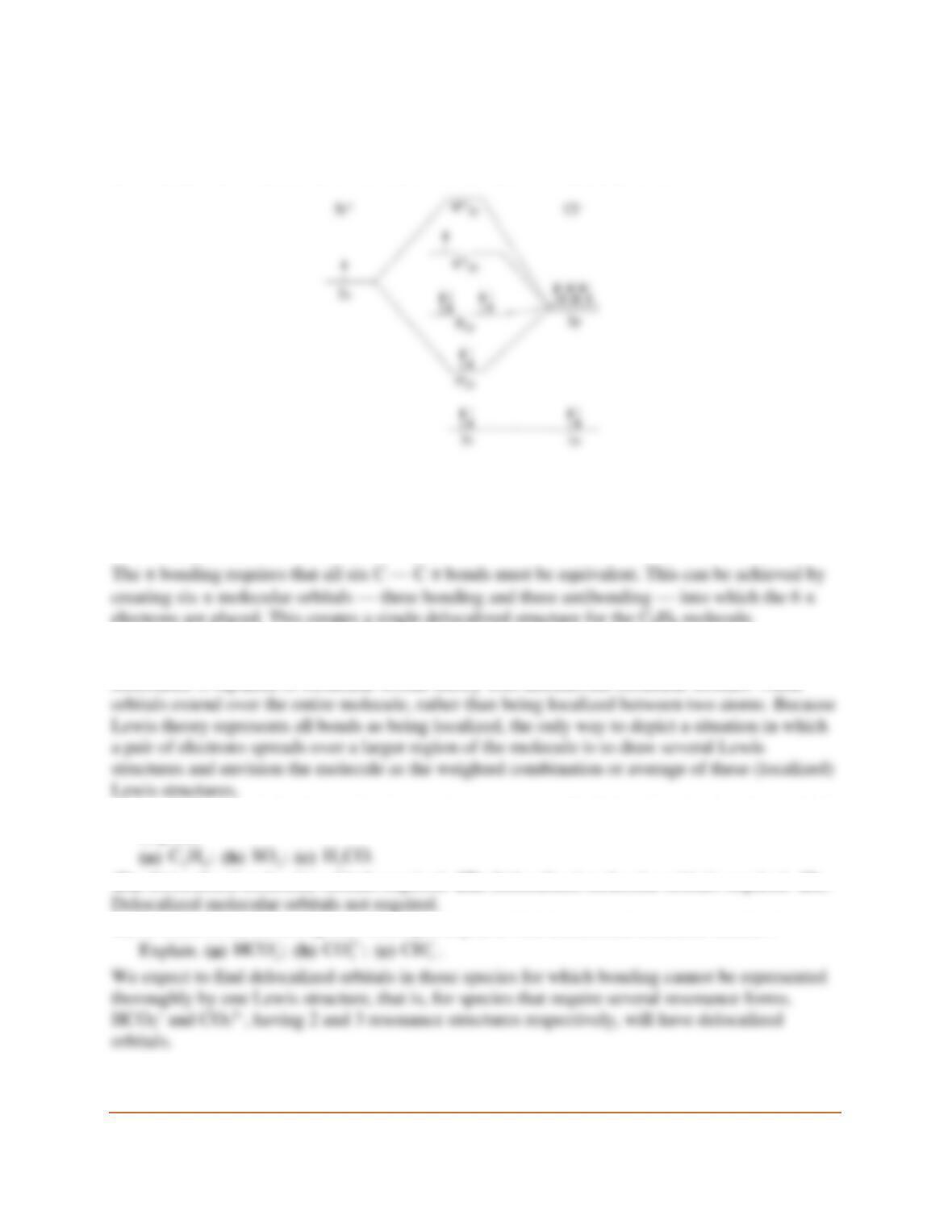
40. Construct the molecular orbital diagram for SrCl. Would you expect the bond length of
SrCl+
to be longer or shorter than that of SrCl?
SrCl+ bond will be shorter since the bond order of SrCl+ is 1 and that for SrCl is 0.5.
Delocalized Molecular Orbitals
41. Explain why the concept of delocalized molecular orbitals is essential to an understanding of
bonding in the benzene molecule,
66
CH
electrons are placed. This creates a single delocalized structure for the C6H6 molecule.
42. Explain how it is possible to avoid the concept of resonance by using molecular orbital
theory.
Resonance is replaced in molecular orbital theory with delocalized molecular orbitals. These
43. In which of the following molecules would you expect to find delocalized molecular orbitals?
Explain.
43a. Delocalized molecular orbitals required. 43b. Delocalized molecular orbitals required. 43c.
44. In which of the following ions would you expect to find delocalized molecular orbitals?
Integrative and Advanced Exercises
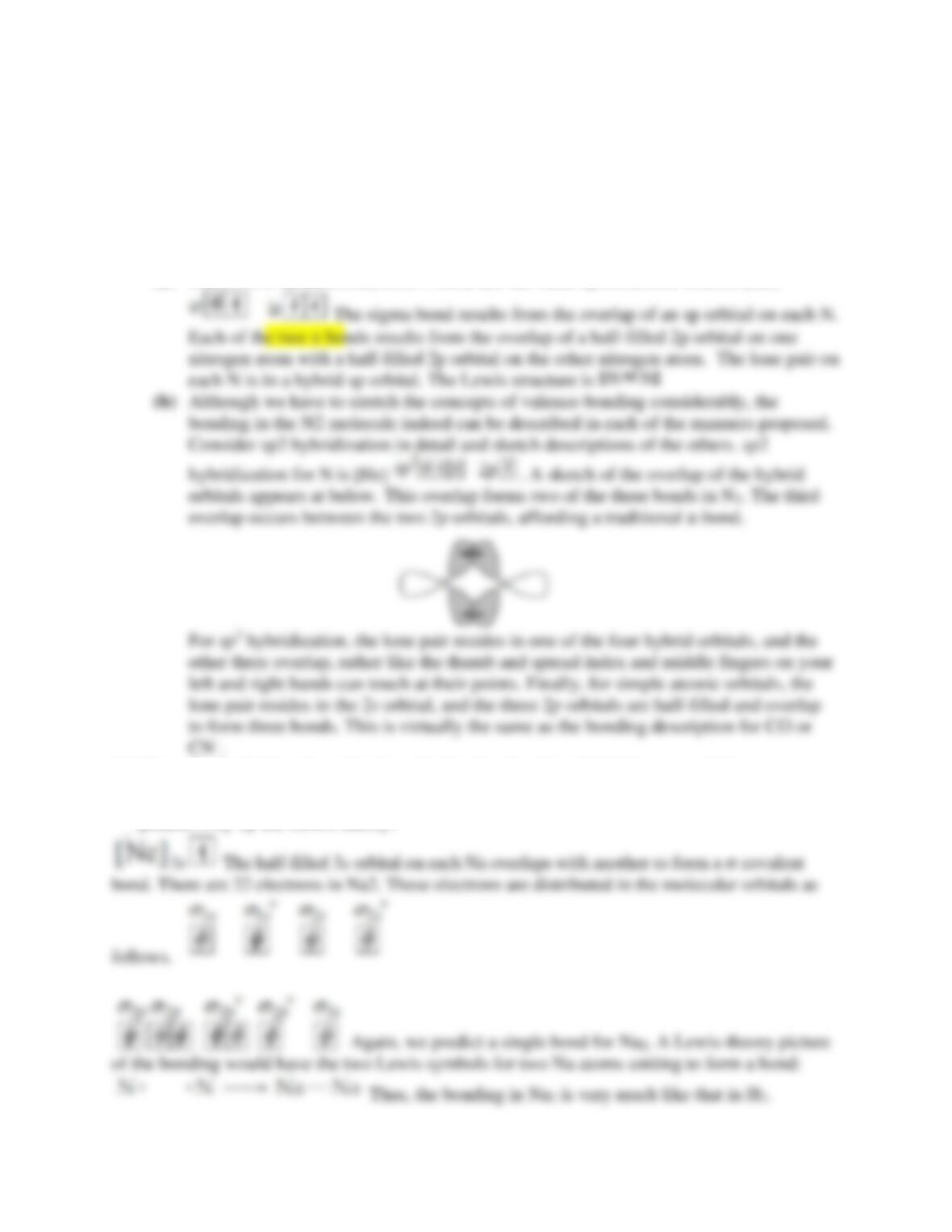
45. The Lewis structure of
2
N
indicates that the nitrogen-to-nitrogen bond is a triple covalent
bond. Other evidence suggests that the
bond in this molecule involves the overlap of
sp
hybrid orbitals.
(a) Draw orbital diagrams for the N atoms to describe bonding in
2
N
(b) Can this bonding be described by either
2
sp
or
3
sp
hybridization of the N
atoms? Can bonding in
2
N
be described in terms of unhybridized orbitals? Explain.
(a) Since N2 is symmetrical, each N atom has the same hybridization scheme [He]
46. Show that both the valence bond method and molecular orbital theory provide an
explanation for the existence of the covalent molecule
2
Na
in the gaseous state. Would you
predict
Na
by the Lewis theory?
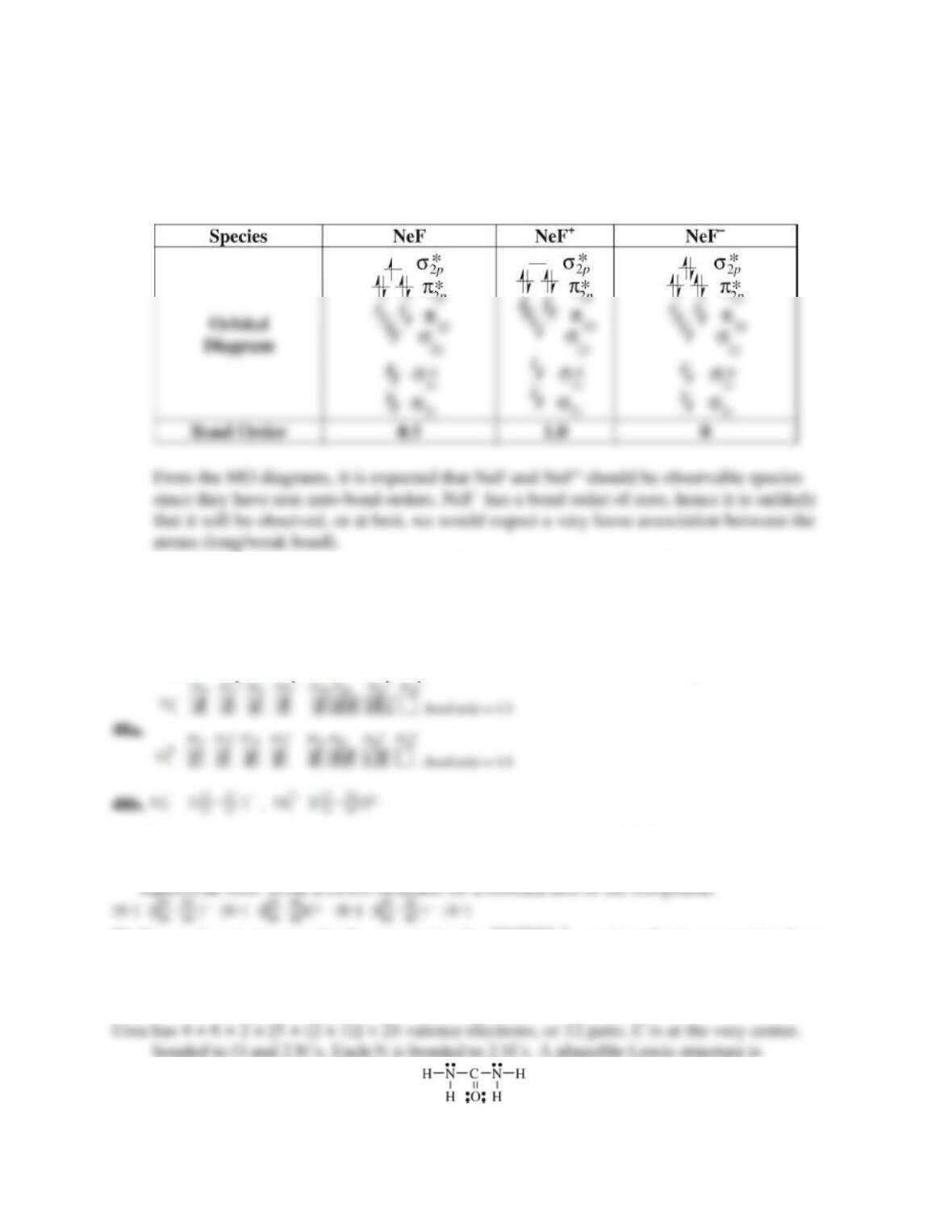
47. A group of spectroscopists believe that they have detected one of the following species:
NeF, NeF ,
+
or
NeF−
Assume that the energy-level diagrams of Figure 11-25 apply, and
describe bonding in these species. Which of these species would you expect the
spectroscopists to have observed?
48. Lewis theory is satisfactory to explain bonding in the ionic compound
2
K O,
but it does not
readily explain formation of the ionic compounds potassium superoxide,
2
KO ,
and
potassium peroxide,
22
KO
(a) Show that molecular orbital theory can provide this explanation.
(b) Write Lewis structures consistent with the molecular orbital explanation.
49. The compound potassium sesquoxide has the empirical formula
23
KO
Show that this
compound can be described by an appropriate combination of potassium, peroxide, and
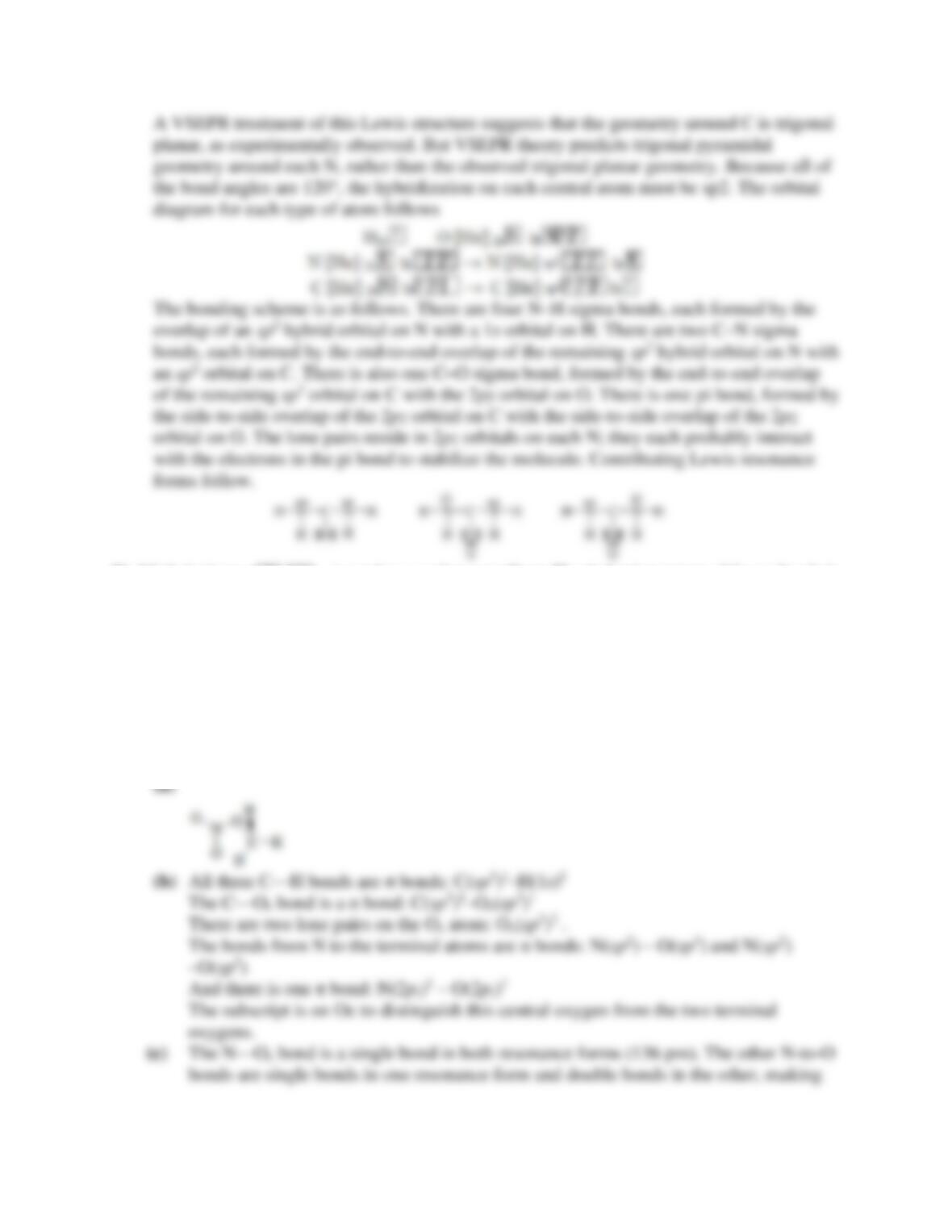
50. Draw a Lewis structure for the urea molecule,
( )
22
CO NH ,
and predict its geometric shape
with the VSEPR theory. Then revise your assessment of this molecule, given the fact that all
the atoms lie in the same plane, and all the bond angles are
120
Propose a hybridization
and bonding scheme consistent with these experimental observations.
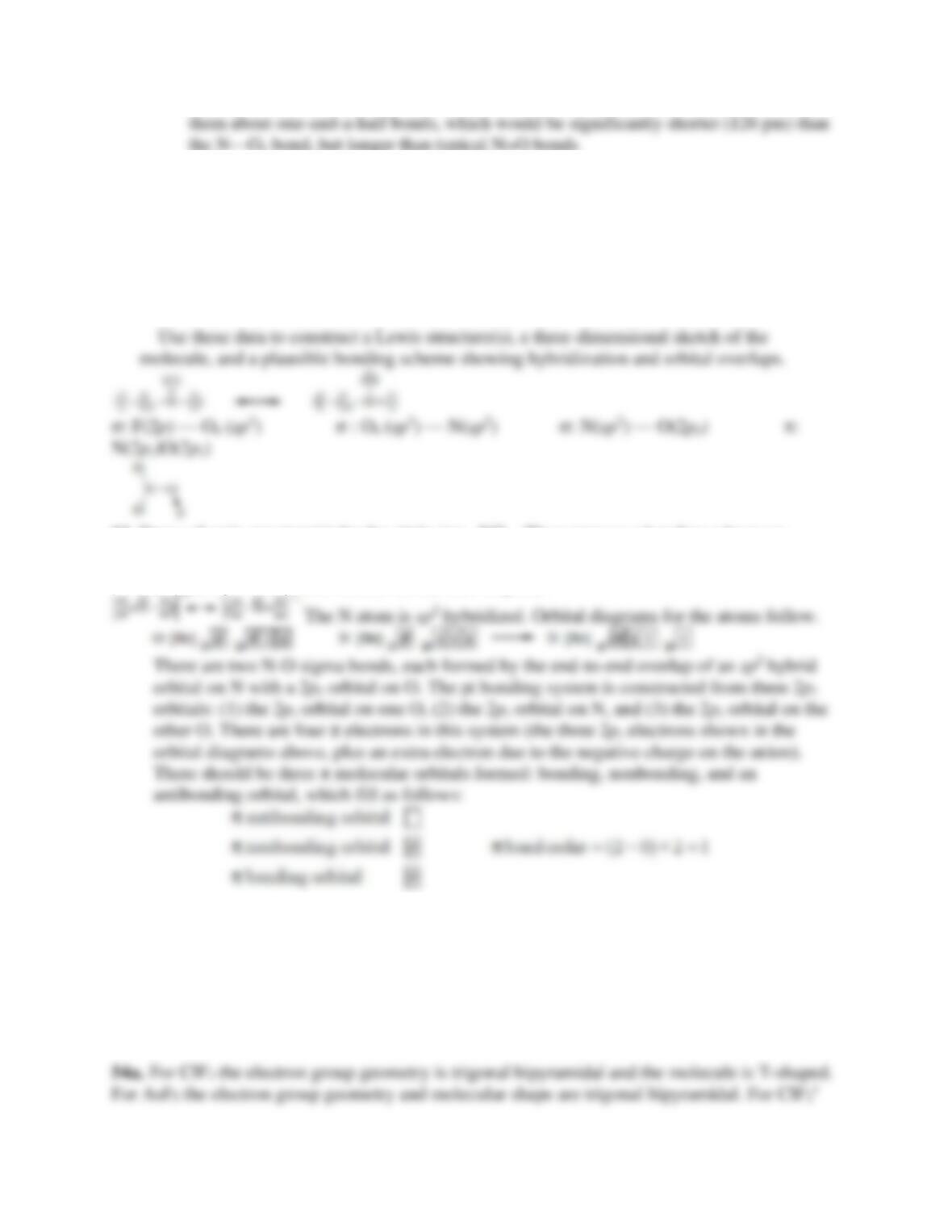
51. Methyl nitrate,
33
CH NO ,
is used as a rocket propellant. The skeletal structure of the molecule is
32
CH ONO
The N and three O atoms all lie in the same plane, but the
3
CH
group is not in the
same plane as the
3
NO
group. The bond angle
C O N−−
is
105 ,
and the bond angle
O N O−−
is
125
One nitrogen–to–oxygen bond length is 136 pm, and the other two are 126
pm.
(a) Draw a sketch of the molecule showing its geometric shape.
(b) Label all the bonds in the molecule as
or
,
and indicate the probable orbital
overlaps involved.
(c) Explain why all three nitrogen-to-oxygen bond lengths are not the same.
52. Fluorine nitrate,
2
FONO ,
is an oxidizing agent used as a rocket propellant. A reference
source lists the following data for
a2
FO NO
(The subscript “a” shows that this O atom is
different from the other two.)
Bond lengths:
N O 129 pm;− =
a
N O 139 pm;− =
a
O F 142 pm− =
Bond angles:
O N O 125 ;− − =
a
F O N 105− − =
a
NO F
plane is perpendicular to the
2a
O NO
plane
53. Draw a Lewis structure(s) for the nitrite ion,
2
NO−
Then propose a bonding scheme to
describe the
and
bonding in this ion. What conclusion can you reach about the number
and types of
molecular orbitals in this ion? Explain.
54. Think of the reaction shown here as involving the transfer of a fluoride ion from
3
ClF
to
5
AsF
to form the ions
2
ClF+
and
6
AsF−
As a result, the hybridization scheme of each central
atom must change. For each reactant molecule and product ion, indicate (a) its geometric
structure and (b) the hybridization scheme for its central atom.
( )( )
3 5 2 6
ClF AsF ClF AsF
+−
+→