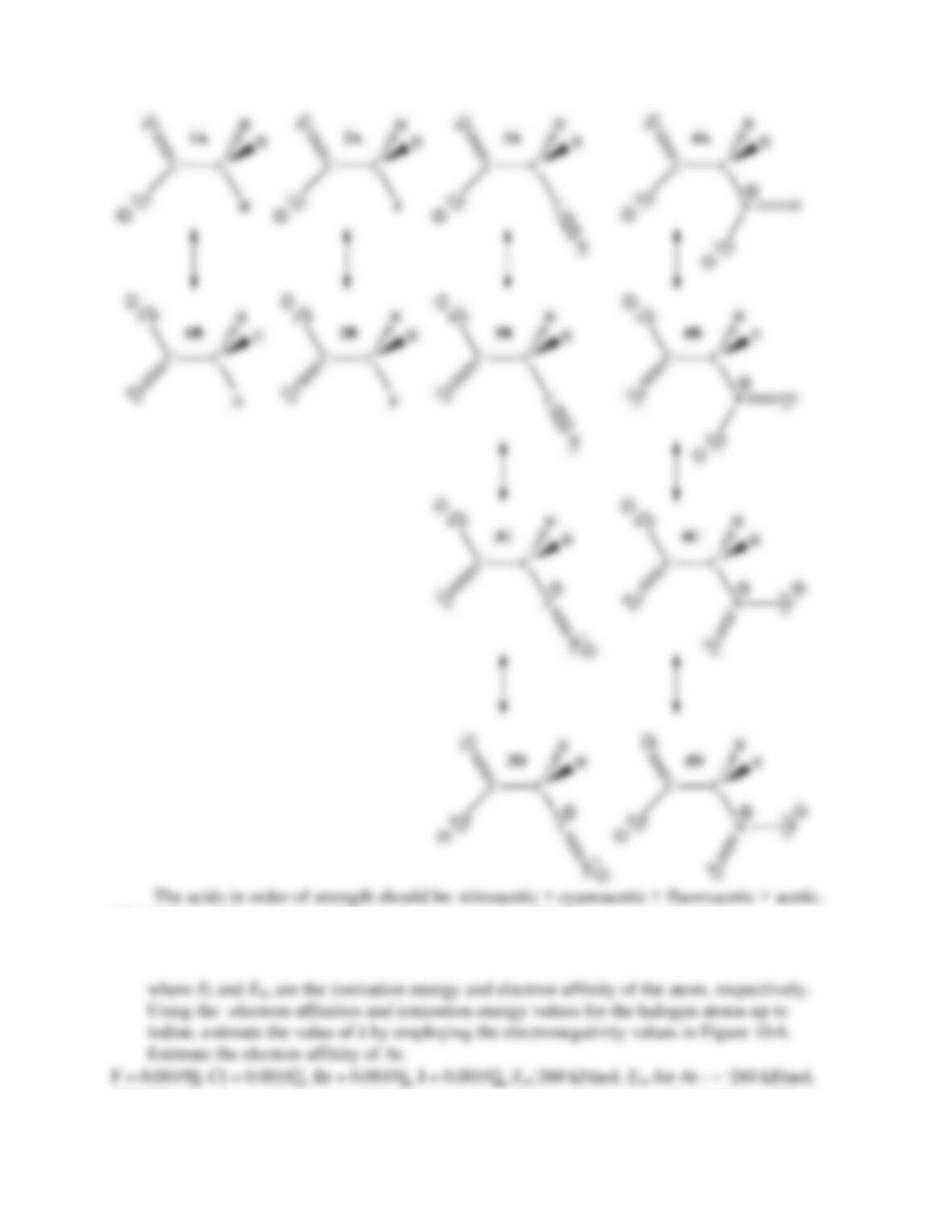
120. R. S. Mulliken proposed that the electronegativity (EN) of an atom is given by
( )
i ea
EN k E E= −
121. When molten sulfur reacts with chlorine gas, a vile-smelling orange liquid forms. When
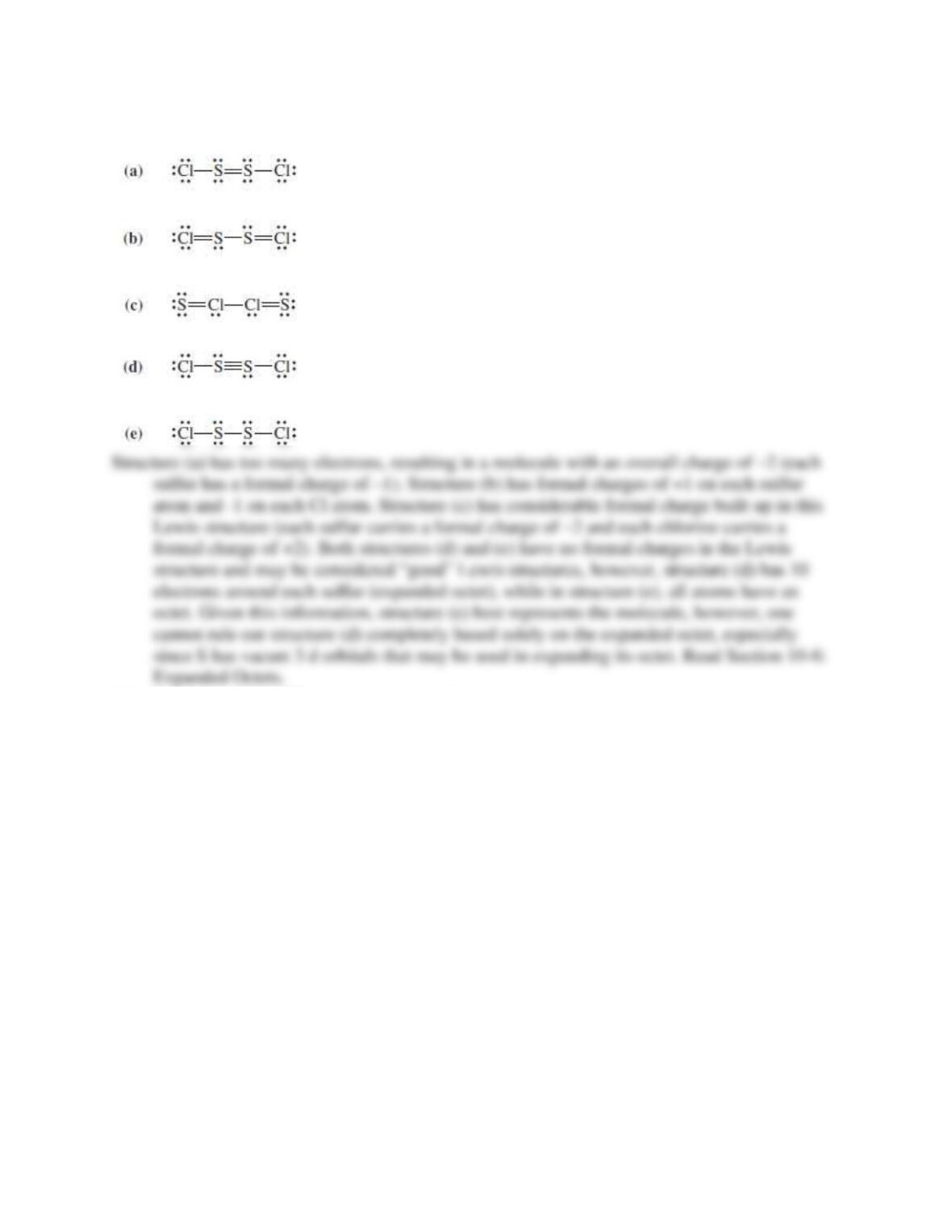
analyzed, the liquid compound has the empirical formula SCl. Several possible Lewis
structures are shown below. Criticize these structures and choose the best one.
122. Hydrogen azide,
3
HN ,
can exist in two forms. One form has the three nitrogen atoms
connected in a line; and the nitrogen atoms form a triangle in the other. Construct Lewis
structures for these isomers and describe their shapes. Other interesting derivatives are
nitrosyl azide
( )
4
NO
and trifluoromethyl azide
( )
33
CF N
Describe the shapes of these
molecules based on a line of nitrogen atoms.
The molecules hydrogen azide, nitrosyl azide and trifluoromethyl azide share some common
structural elements. They can be viewed as N3– attached to H, NO, and CF3 respectively.
There are numerous resonance structures that can be written for these molecules. Some of
the resonance forms are better than others for several reasons, including such factors as the
lack of a full octet and unacceptably large charge separations. Drawn below are the various
resonance forms for the molecules. The Lewis diagrams have been modified to include
geometric considerations that are imposed on the molecule by hybridization and the effects
of lone pairs.
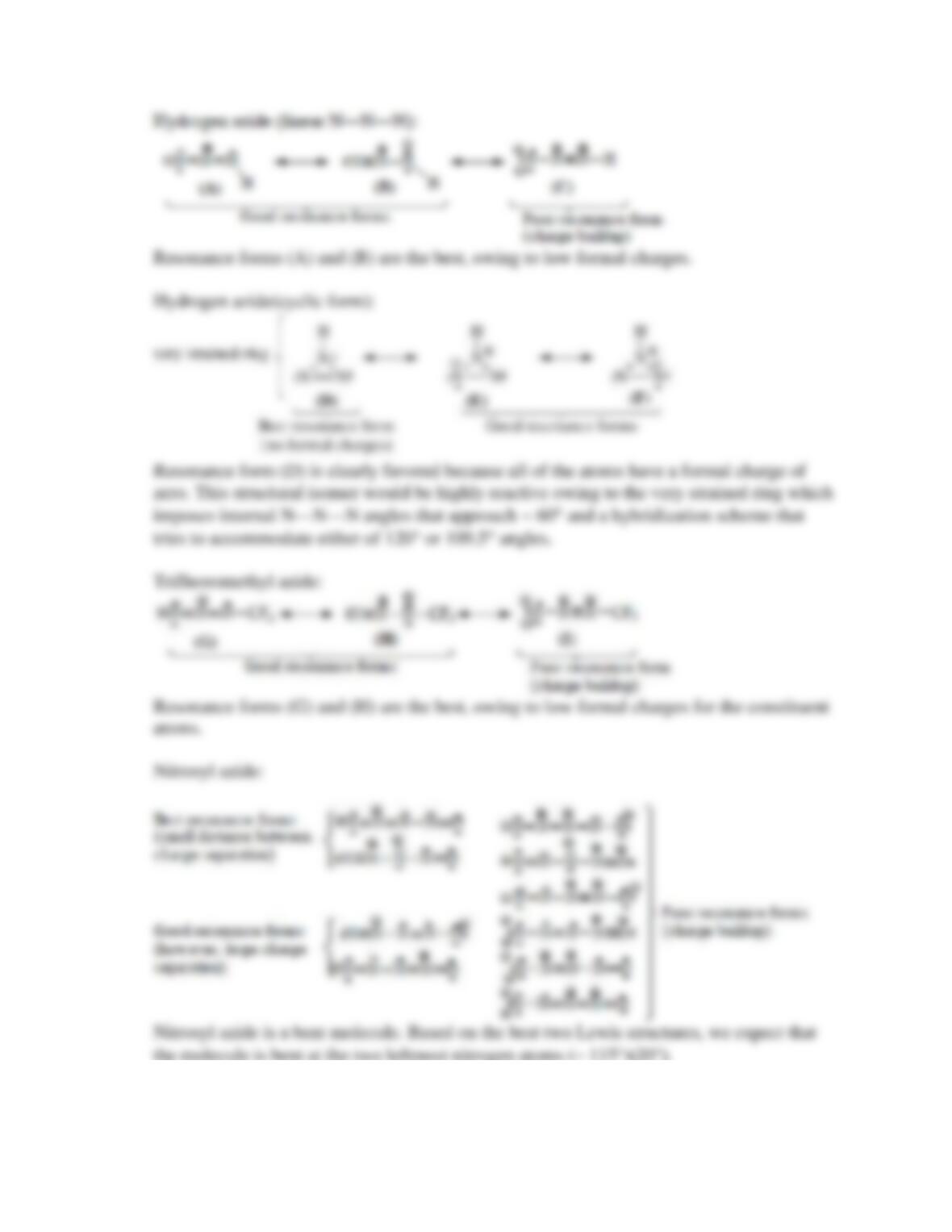
the molecule is bent at the two leftmost nitrogen atoms (~ 115±20).
123. A pair of isoelectronic species for C and N exist with the formula
24
XO
in which there is an
XX−
bond. A corresponding fluoride of boron also exists. Draw Lewis structures for these
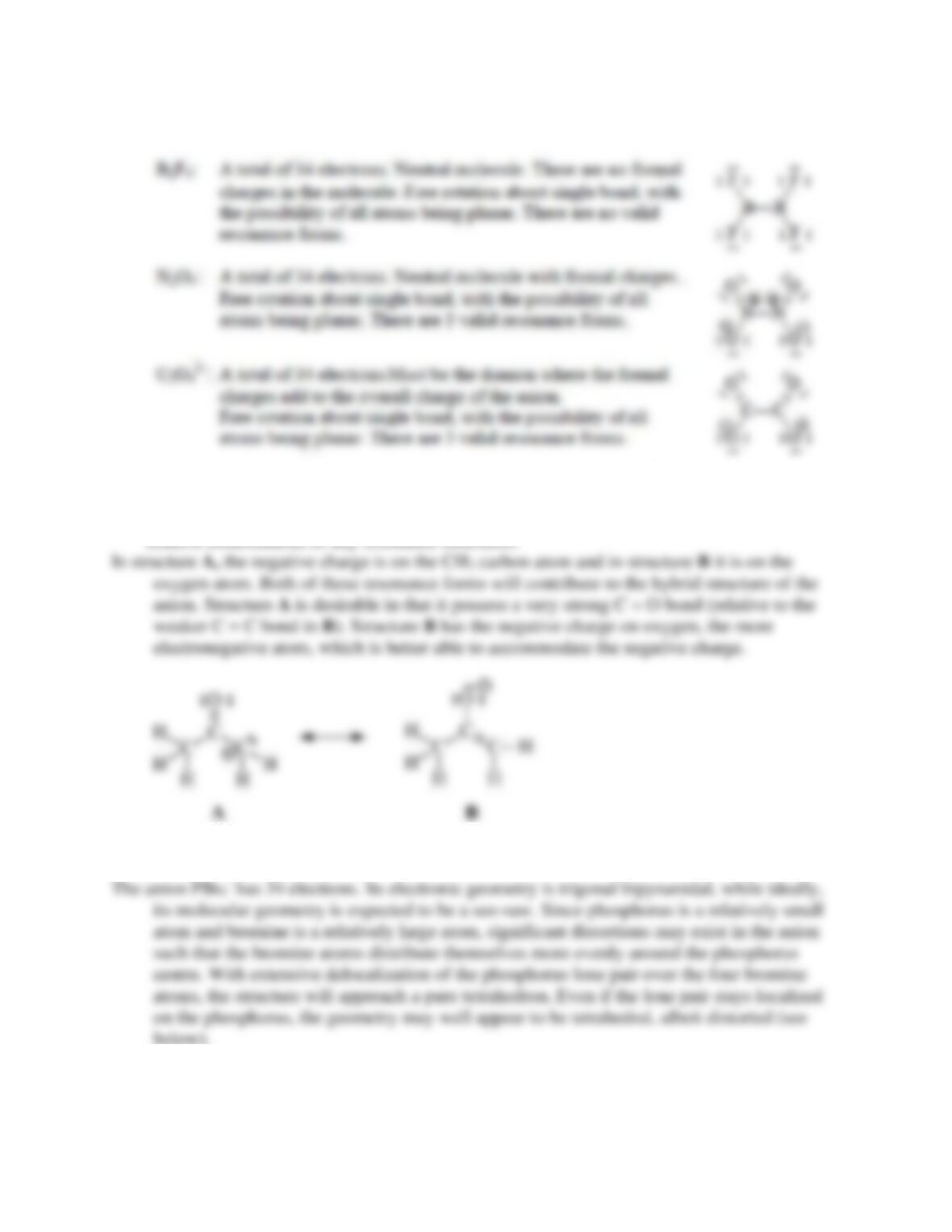
species and describe their shapes.
124. Acetone
( )
32
CH C = O,
a ketone, will react with a strong base
( )
A−
to produce the enolate
anion,
( )
32
CH C = O CH
−
Draw the Lewis structure of the enolate anion, and describe the
125. The species
4
PBr−
has been synthesized and has been described as a tetrahedral anion.
Comment on this description.
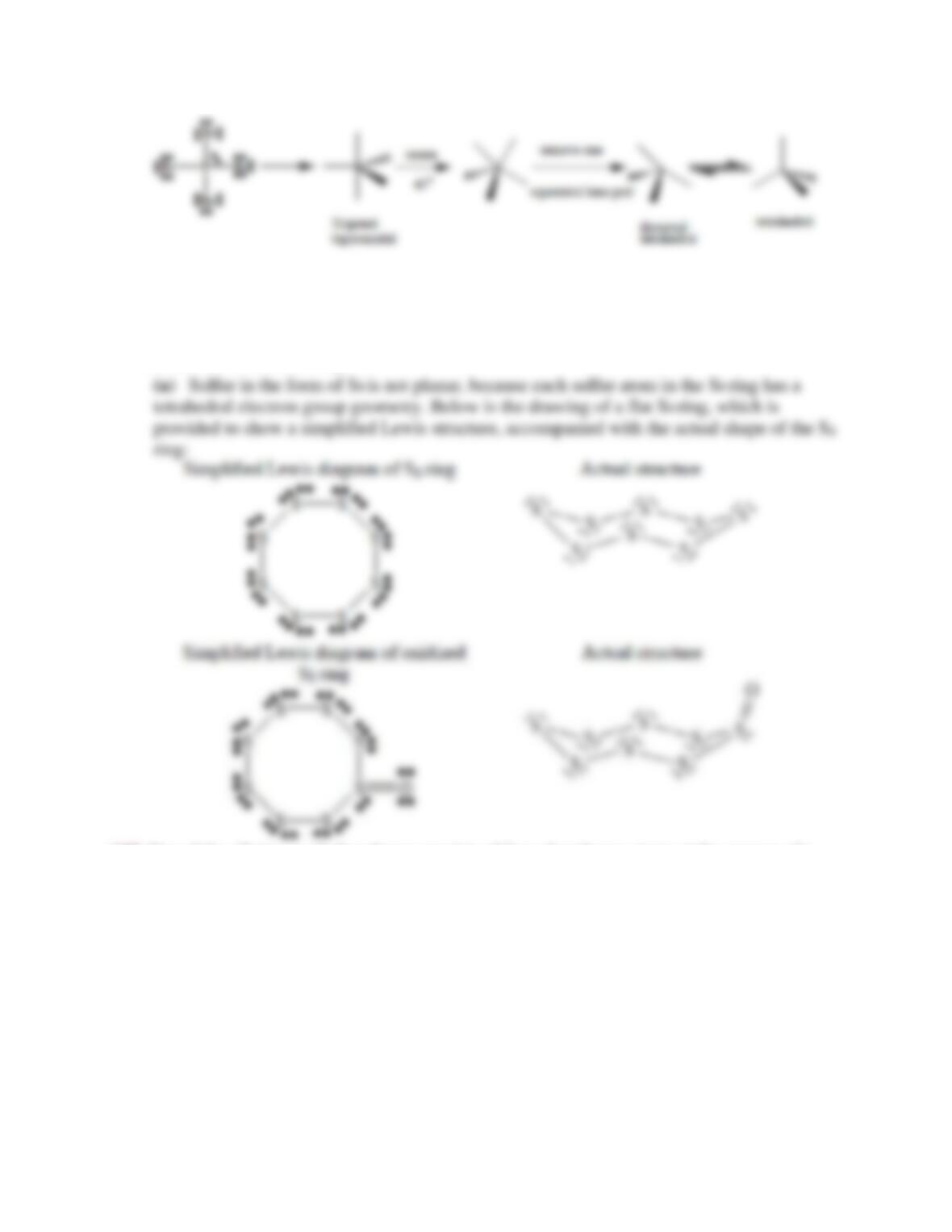
126. One of the allotropes of sulfur is a ring of eight sulfur atoms. Draw the Lewis structure for
the
8
S
ring. Is the ring likely to be planar? The
8
S
ring can be oxidized to produce
8
SO
In
8
S O,
the oxygen atom is bonded to one of the S atoms and the
8
S
ring is still intact. Draw
the Lewis structure for
8
SO
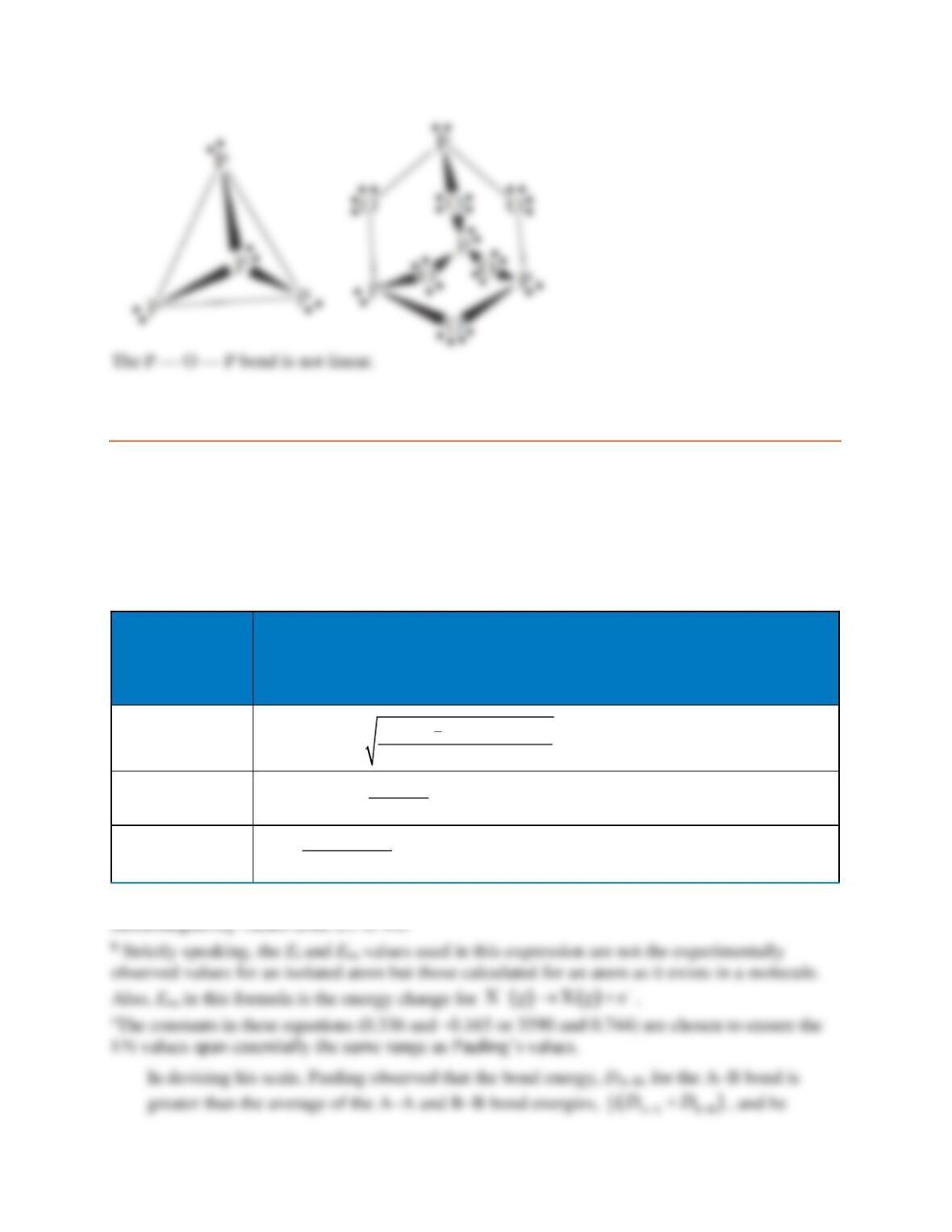
127. One of the allotropes of phosphorus consists of four phosphorus atoms at the corners of a
tetrahedron. Draw a Lewis structure for this allotrope that satisfies the octet rule. The
4
P
molecule can be oxidized to
46
PO ,
where the oxygen atoms insert between the phosphorus
atoms. Draw the Lewis structure of this oxide. Are the
P O P−−
bonds linear?
Feature Problems
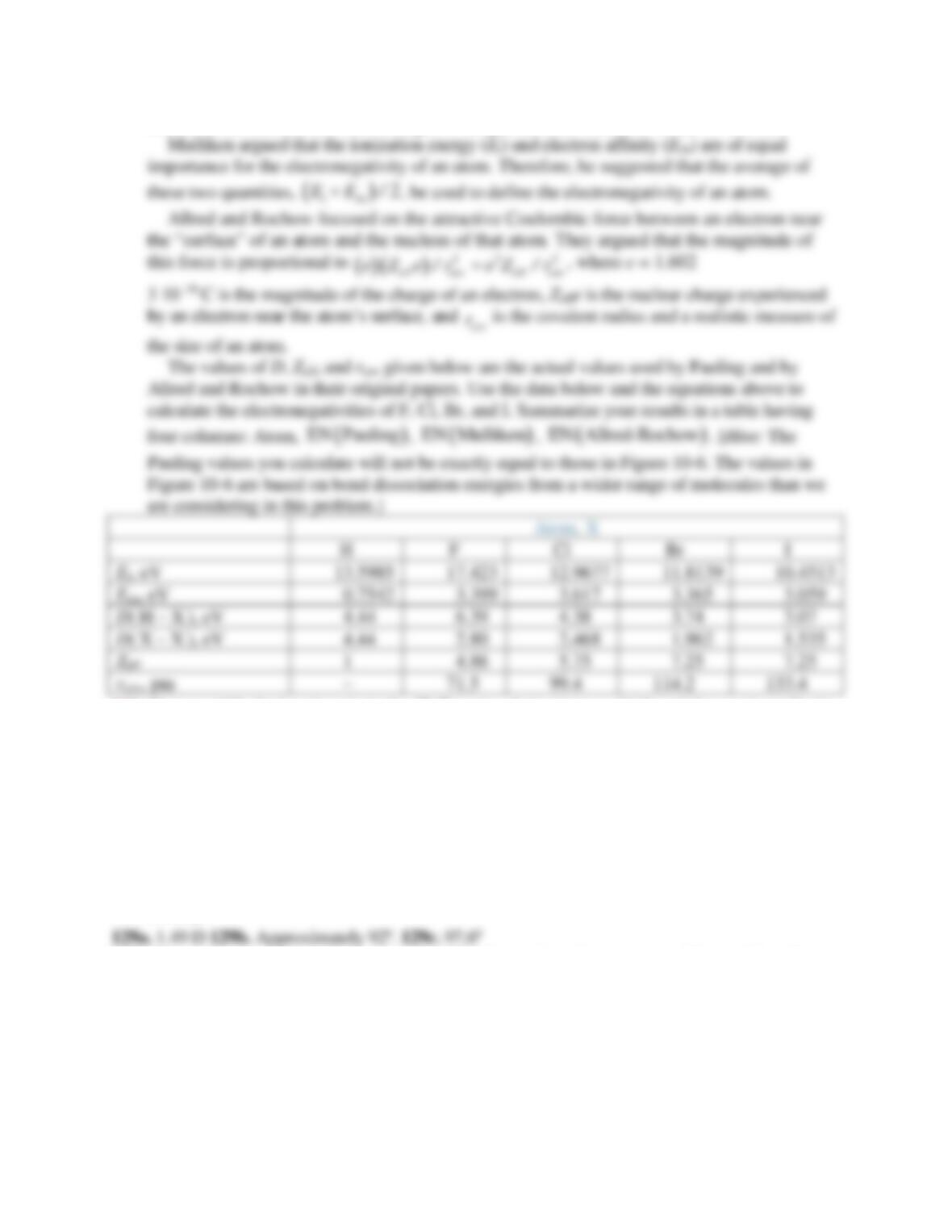
128. In this problem, we examine the basis of three different electronegativity scales and work
through the same types of calculations as those performed by the people who initially
suggested these scales. The scale developed by Robert Mulliken employs ionization energies
(Ei) and electron affinities (Eea) whereas the scale developed by Linus Pauling is based on
bond dissociation energies (D). The scale developed by A. Louis Allred and Eugene G.
Rochow employs effective nuclear charges (Zeff) and covalent radii (rcov). The key equations
for each scale are given below.
Electronegativity
Scale
Defining
Equation
Paulinga
( )
1
2
A B A A B B
AB
EN EN 1 eV
D D D
− − −
−+
−=
Mullikenb, c
i ea
EN 0 336 0 165
2 eV
EE+
= −
Allred-Rochowc
( )
eff
2
cov
3590
EN 0 744
/1 pm
Z
r
= +
aOriginally, Pauling defined
H
EN
to be 2.1, the value chosen to give the elements C to F
attributed the increase in bond strength to the partial ionic character of the A–B bond.
129. On page 447, the bond angle in the
2
HO
molecule is given as
104
and the resultant dipole
moment as
1 84 D =
(a) By an appropriate geometric calculation, determine the value of the
HO−
bond dipole
in
2
HO
(b)
Use the same method as in part (a) to estimate the bond angle in
2
HS,
given that the
HS−
bond dipole is 0.67 D and that the resultant dipole moment is
0 93 D =
(c) Refer to Figure 10-16. Given the bond dipoles 1.87 D for the
C Cl−
bond and 0.30 D
for the
CH−
bond, together with
1 04 D, =
estimate the
H C Cl−−
bond angle in
3
CHCl
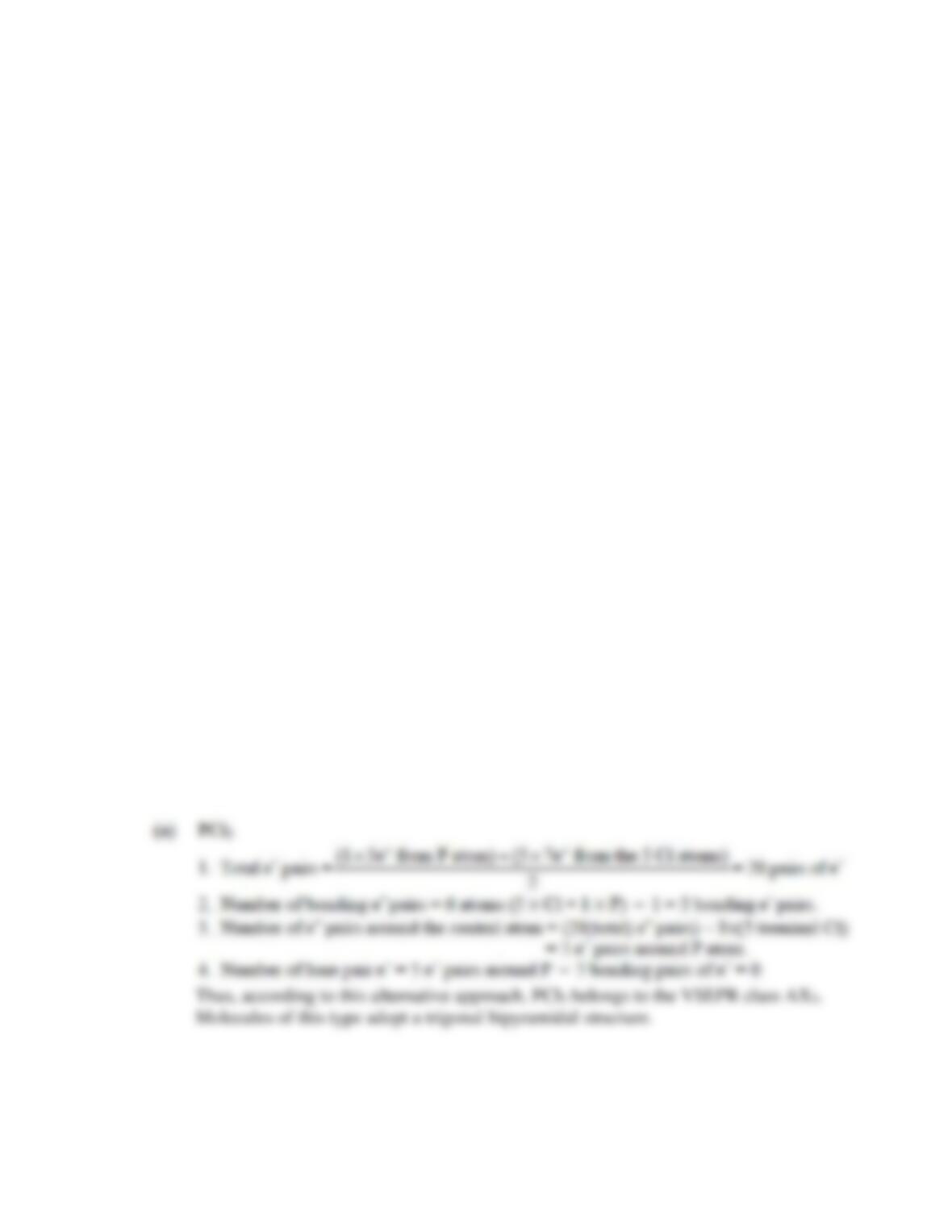
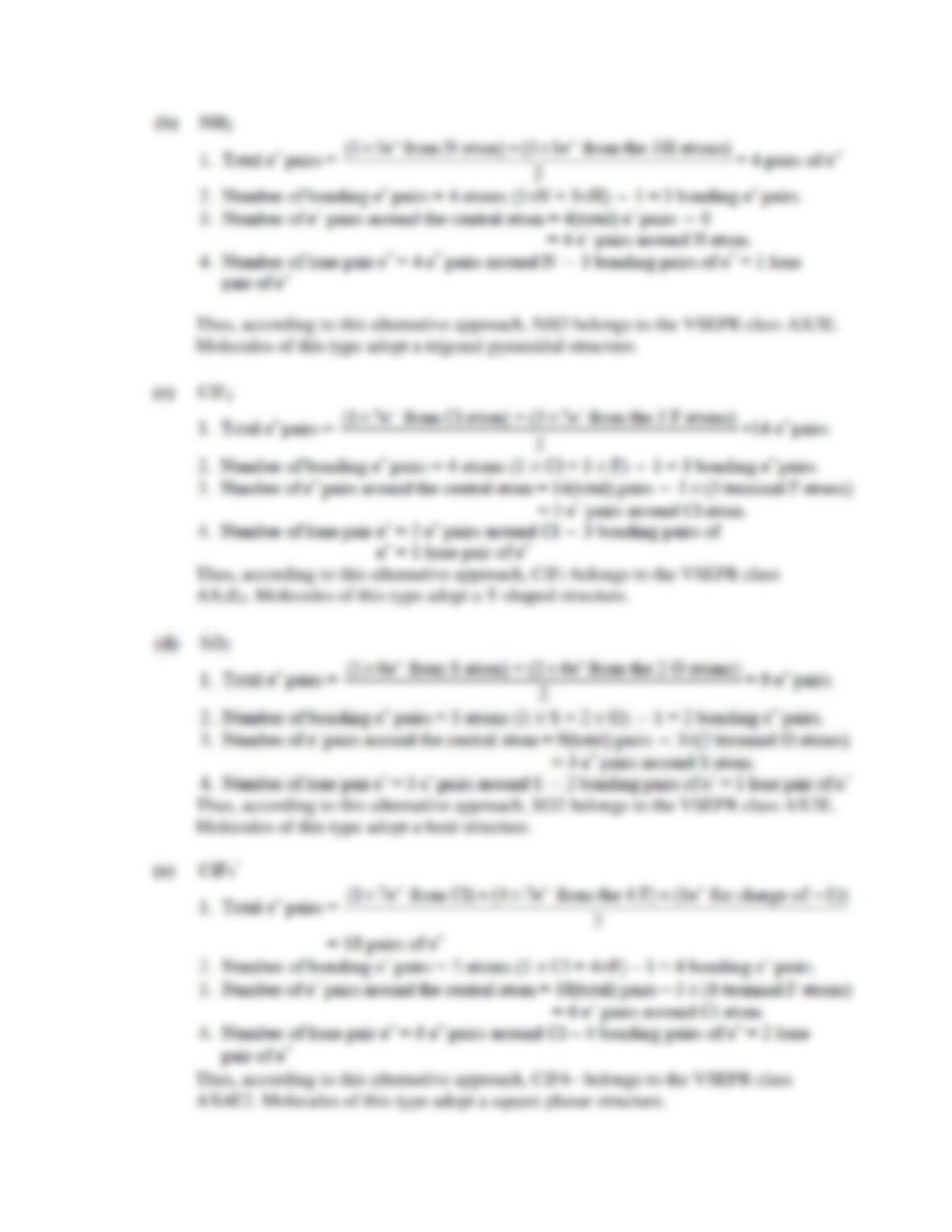
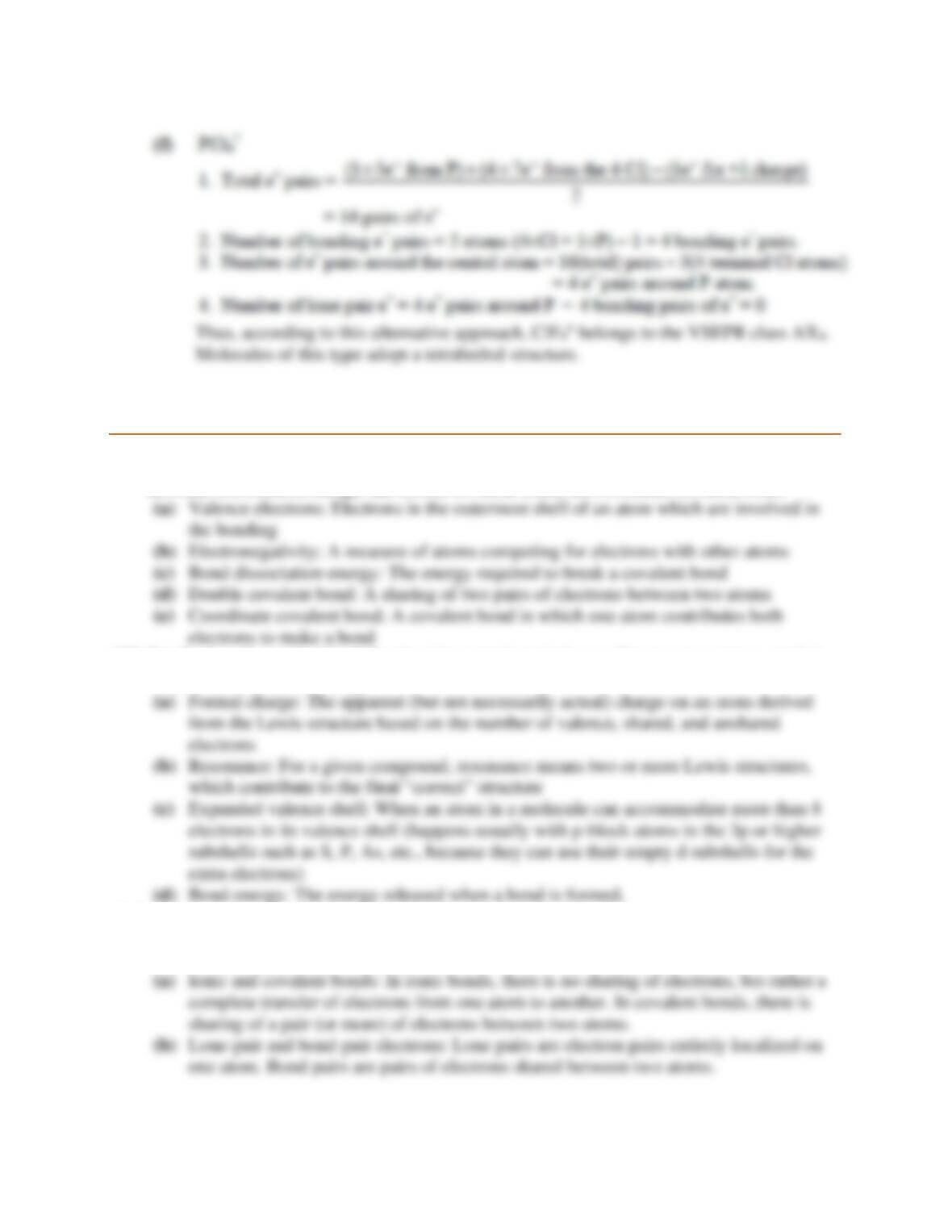
130. Alternative strategies to the one used in this chapter have been proposed for applying the
VSEPR theory to molecules or ions with a single central atom. In general, these strategies
do not require writing Lewis structures. In one strategy, we write
(1) the total number of electron pairs
=
[(number of valence electrons)
(electrons
required for ionic charge)]
/
2
(2) the number of bonding electron pairs
=
(number of atoms)
1−
(3) the number of electron pairs around central atom
=
total number of electron pairs
3−
[number of terminal atoms (excluding H)]
(4) the number of lone-pair
electrons number=
of central atom pairs
−
number of bonding
pairs
After evaluating items 2, 3, and 4, establish the VSEPR notation and determine the molecular
shape. Use this method to predict the geometrical shapes of the following: (a)
5
PCl ;
(b)
3
NH ;
(c)
3
ClF ;
(d)
2
SO ;
(e)
4
ClF ;
−
(f)
4
PCl+
Justify each of the steps in the strategy, and
explain why it yields the same results as the VSEPR method based on Lewis structures. How
does the strategy deal with multiple bonds?
Step 1 in the alternative approach is similar to the first step in the method used for drawing
Lewis structures. The only significant difference is that “electron pairs” rather than the total
number of valence electrons are counted in this alternative approach. The second step in the
alternative strategy is also similar to the second step for writing Lewis structures. By
counting the number of bonding electron pairs in the alternative method, one is effectively
working out the number of bonds present in the skeletal structure of the Lewis diagram. In
step 3, the number of electron pairs surrounding the central atom is calculated. This is
basically the same procedure as completing the octets for the terminal atoms and assigning
the remaining electrons to the central atom in the Lewis structure. Finally, in step 4 of the
alternative method, the number of lone pair electrons on the central atom is calculated. This
number, together with the result from step 3, allows one to establish the VSEPR class.
Consequently, both the alternative strategy and the Lewis diagram provide the number of
bonding electron pairs and lone pairs on the central atom for the species whose shape is
being predicted. Since the shape of the molecule or ion in the VSEPR approach is
determined solely by the number and types of electron pairs on the central atom (i.e., the
VSEPR class) both methods end up giving the same result.
Included in the “alternative strategy” is the assumption that the central atom does not form
double bonds with any of the terminal atoms. This means that in many instances, the
central atom does not possess a complete octet. The presence or absence of an octet is,
however, of no consequence to the VSEPR method because, according to the tenets of this
theory, the shape adopted by the molecule is determined solely by the number and types of
electron pairs on the central atom. Examples follow on the next two pages.
Self-Assessment Exercises
131. In your own words, define the following terms: (a) valence electrons; (b) electronegativity;
(c) bond-dissociation energy; (d) double covalent bond; (e) coordinate covalent bond.
132. Briefly describe each of the following ideas: (a) formal charge; (b) resonance; (c) expanded
valence shell; (d) bond energy.
133. Explain the important distinctions between (a) ionic and covalent bonds; (b) lone-pair and
bond-pair electrons; (c) molecular geometry and electron-group geometry; (d) bond dipole
and resultant dipole moment; (e) polar molecule and nonpolar molecule.
134. Of the following species, the one with a triple covalent bond is (a)
3
NO ;
−
(b)
CN ;
−
(c)
2
CO ;
(d)
3
AlCl
135. The formal charges on the O atoms in the ion
ONO +
is (a)
2;−
(b)
1;−
(c) 0; (d)
1+
136. Which molecule is nonlinear? (a)
2
SO ;
(b)
2
CO ;
(c) HCN; (d) NO.
137. Which molecule is nonpolar? (a)
3
SO ;
(b)
22
CH Cl ;
(c)
3
NH ;
(d) FNO.
138. The highest bond-dissociation energy is found in
(a)
2
O;
(b)
2
N;
(c)
2
Cl ;
(d)
2
I
139. The greatest bond length is found in (a)
2
2
O;
(b)
N;
(c)
Br ;
(d) BrCl.
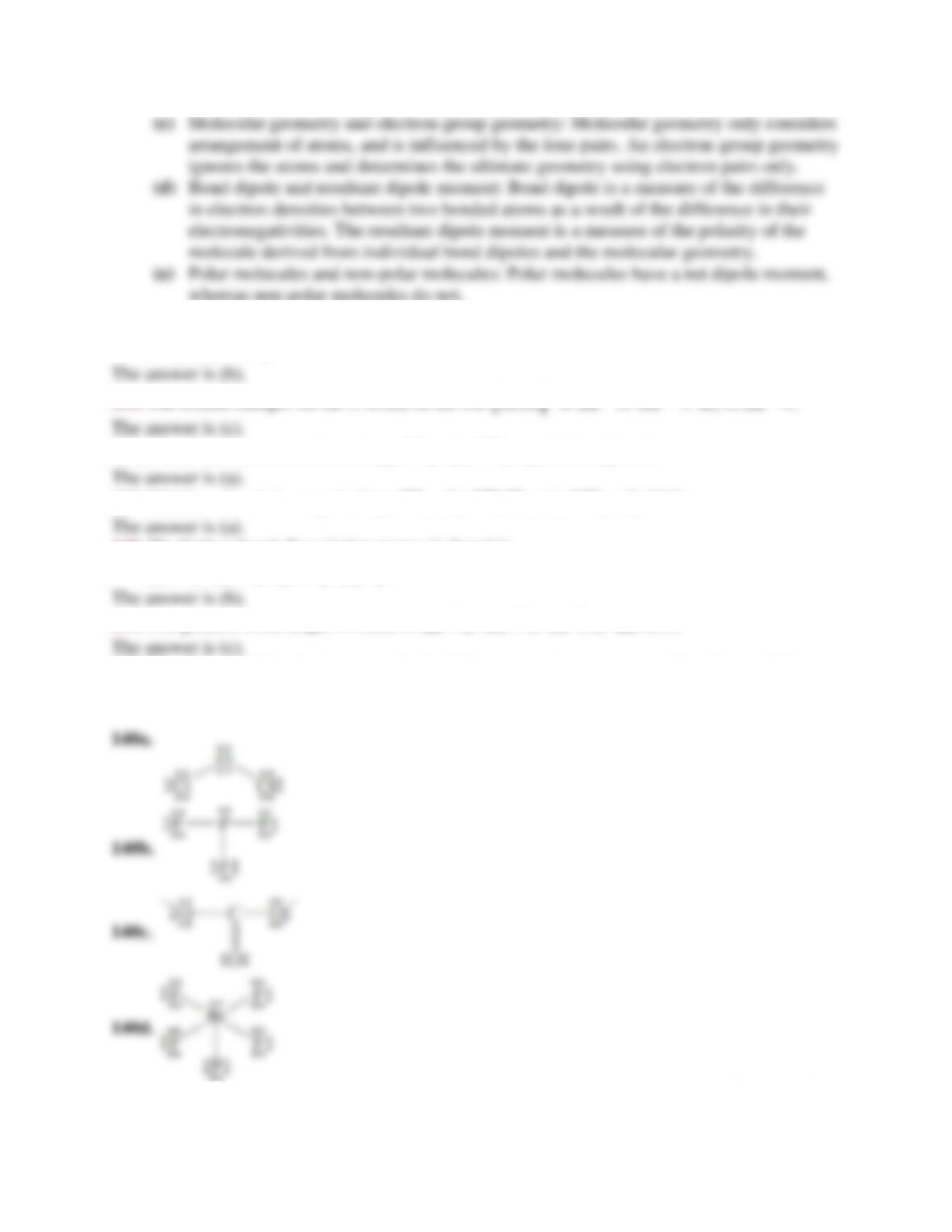
140. Draw plausible Lewis structures for the following species; use expanded valence shells
where necessary. (a)
2
Cl O;
(b)
3
PF ;
(c)
2
3
CO ;
−
(d)
5
BrF
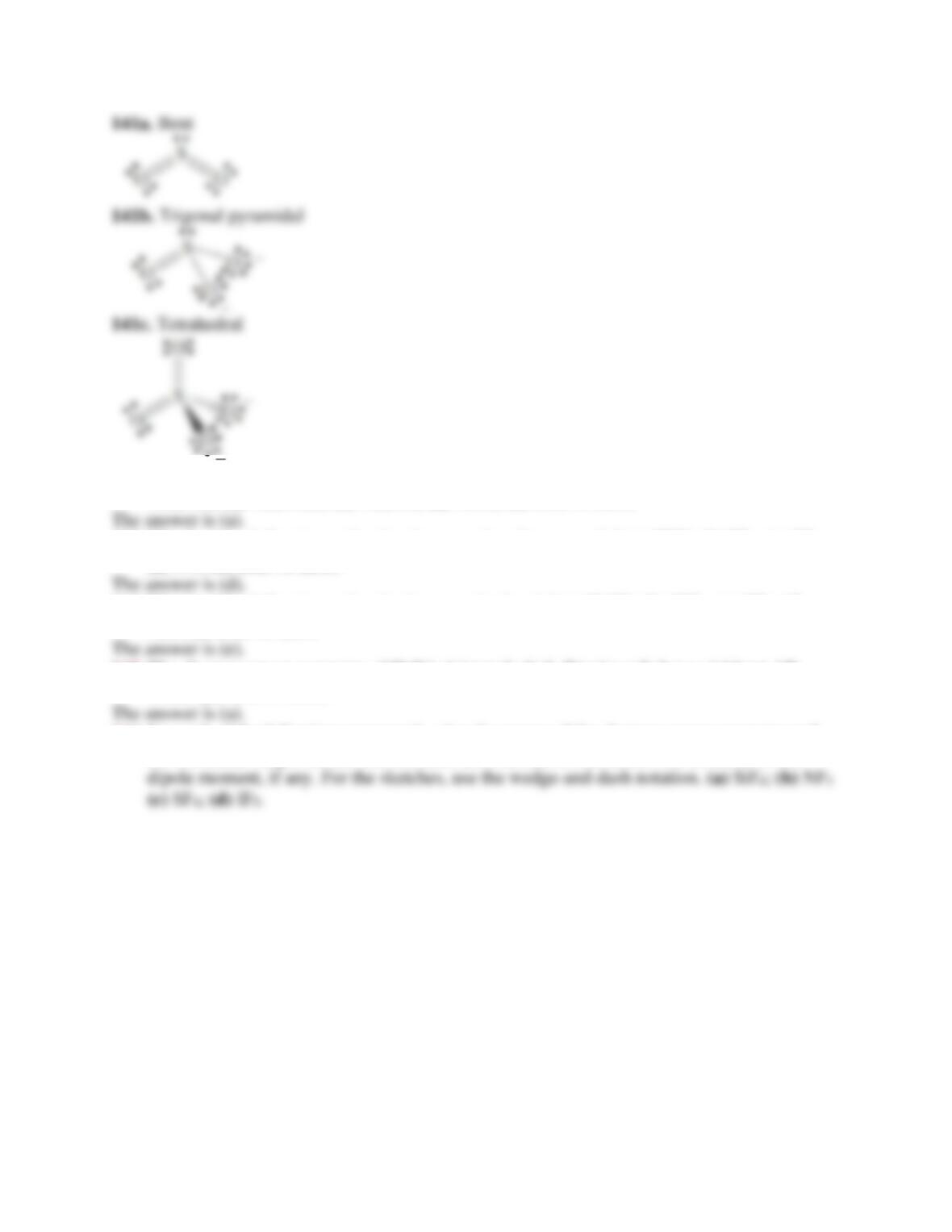
141. Predict the shapes of the following sulfur-containing species. (a)
2
SO ;
(b)
2
3
SO ;
−
(c)
2
4
SO −
142. Which of the following ionic compounds is composed of only nonmetal atoms? (a)
NH4NO3; (b) Al2(SO4)3; (c) Na2SO3; (d) AlCl3; (e) none of these.
143. Which of the following molecules does not obey the octet rule? (a) HCN; (b) PF3; (c) CS2;
(d) NO; (e) none of these.
144. Which of the following molecules has no polar bonds? (a) H2CO; (b) CCl4; (c) OF2; (d)
N2O; (e) none of these.
145. The electron-group geometry of H2O is (a) tetrahedral; (b) trigonal planar; (c) bent; (d)
linear; (e) none of these.
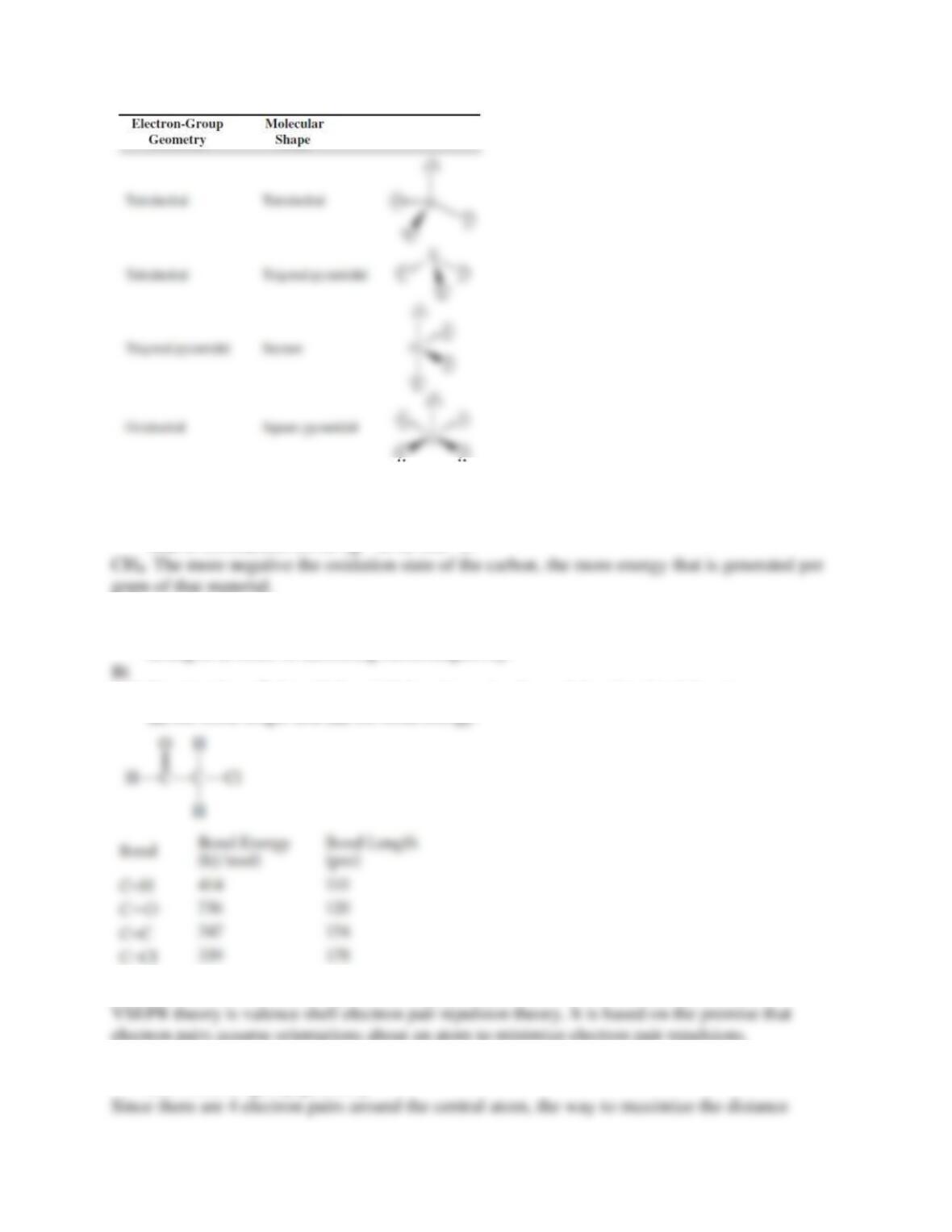
146. For each of the following compounds, give the names of the electron-group geometry and
the molecular shape. Sketch the molecule and indicate on the sketch the direction of the
147. Use bond enthalpies from Table 10.3 to determine whether CH4(g), CH3OH(g), H2CO(g), or
HCOOH(g) produces the most energy per gram when burned completely in O2(g) to give
CO2(g) and H2O(g). Is there any relationship between the oxidation state of carbon and the
heat of combustion (in kJ kg–1 or kJ mol–1)?
148. Without referring to tables or figures in the text other than the periodic table, indicate which
of the following atoms, Bi, S, Ba, As, or Mg, has the intermediate value when they are
arranged in order of increasing electronegativity.
149. Use data from Tables 10.2 and 10.3 to determine for each bond in this following structure
(a) the bond length and (b) the bond energy.
150. What is the VSEPR theory? On what physical basis is the VSEPR theory founded?
151. Use the
3
NH
molecule as an example to explain the difference between molecular geometry
and -electron-group geometry.
152. If you have four electron pairs around a central atom, under what circumstances can you
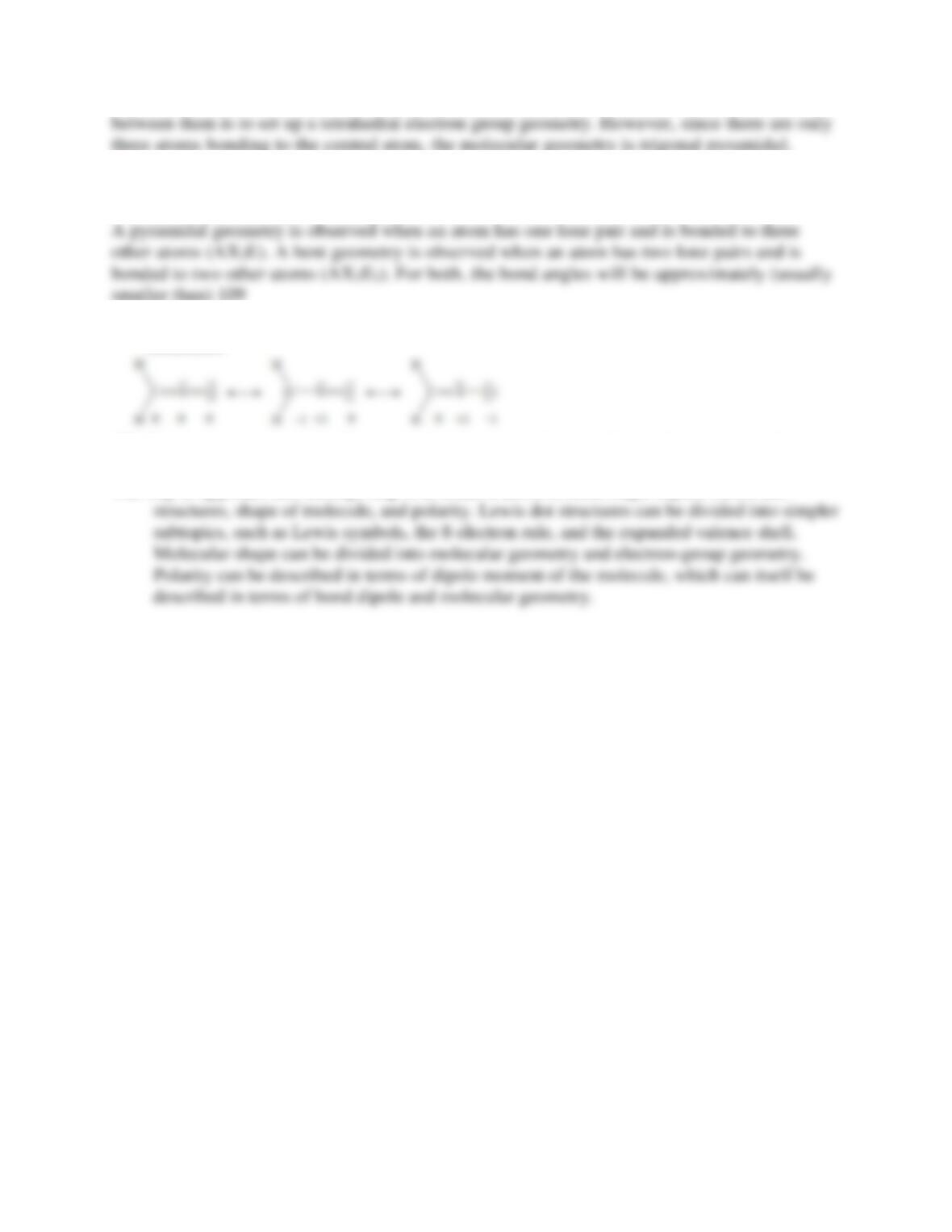
have a pyramidal molecule? Similarly, how can you have a bent molecule? What are the
expected bond angles in each case?
153. Draw three resonance structures for the sulfine molecule,
2
H CSO
Do not consider ring
structures.
154. Construct a concept map illustrating the connections between Lewis dot structures, the
shapes of molecules, and polarity.
The way to approach this concept map is to break it down to three major topics: Lewis dot