Chapter 10
Chemical Bonding I: Basic Concepts
Exercises
Lewis Theory
1. Write Lewis symbols for the following atoms. (a) Kr; (b) Ge; (c) N; (d) Ga; (e) As; (f) Rb.
2. Write Lewis symbols for the following ions. (a)
H;
−
3. Write plausible Lewis structures for the following molecules that contain only single
covalent bonds.
4. Each of the following molecules contains at least one multiple (double or triple) covalent
bond. Give a plausible Lewis structure for (a) HCN; (b)
( )
22
SC NH ;
(c)
2
F CO;
(d)
2
Cl SO;
(e)
22
CH
; (f) SO2.
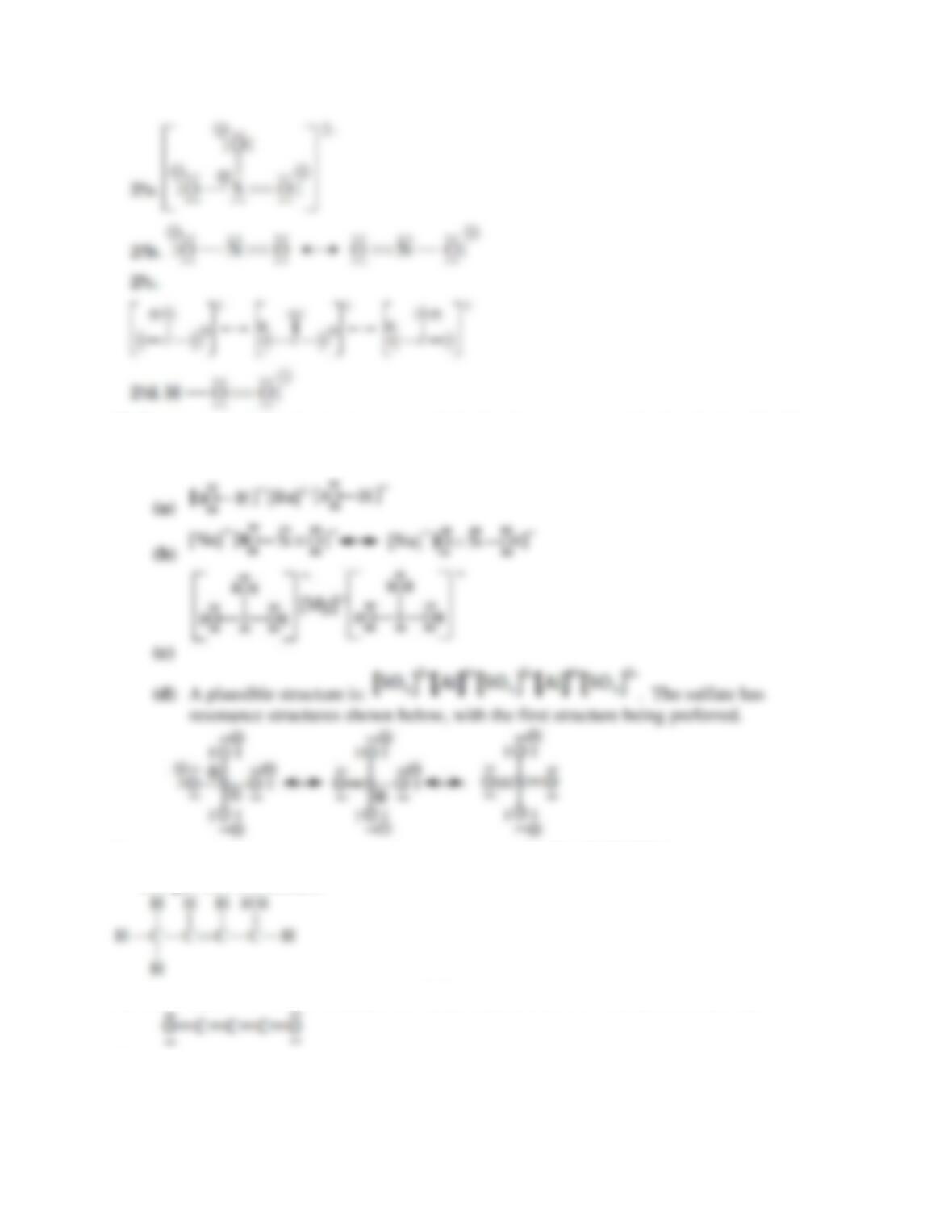
5. By means of Lewis structures, represent bonding between the following pairs of elements:
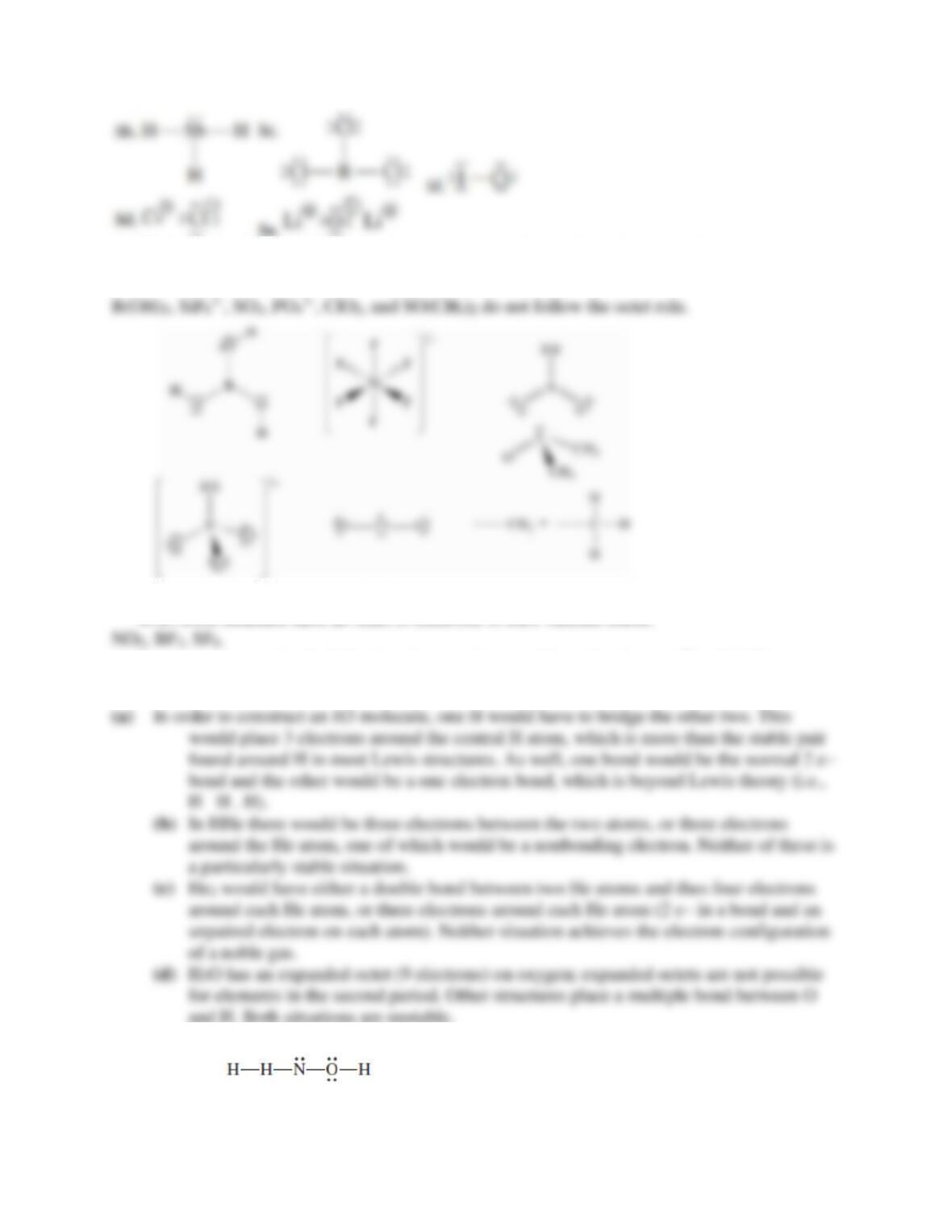
6. Which of the following have Lewis structures that do not obey the octet rule:
( )
2
3 6 3
3
NF , B OH , SiF , SO ,
−
4
PH ,
+
( )
3
4 2 2 4 3
PO , ClO , C H , SO CH
−
.
7. Give several examples for which the following statement proves to be incorrect. “All atoms
in a Lewis structure have an octet of electrons in their valence shells.”
8. Suggest reasons why the following do not exist as stable molecules: (a)
3
H;
(b) HHe; (c)
2
He ;
(d)
3
HO
9. Describe what is wrong with each of the following Lewis structures.
(a)
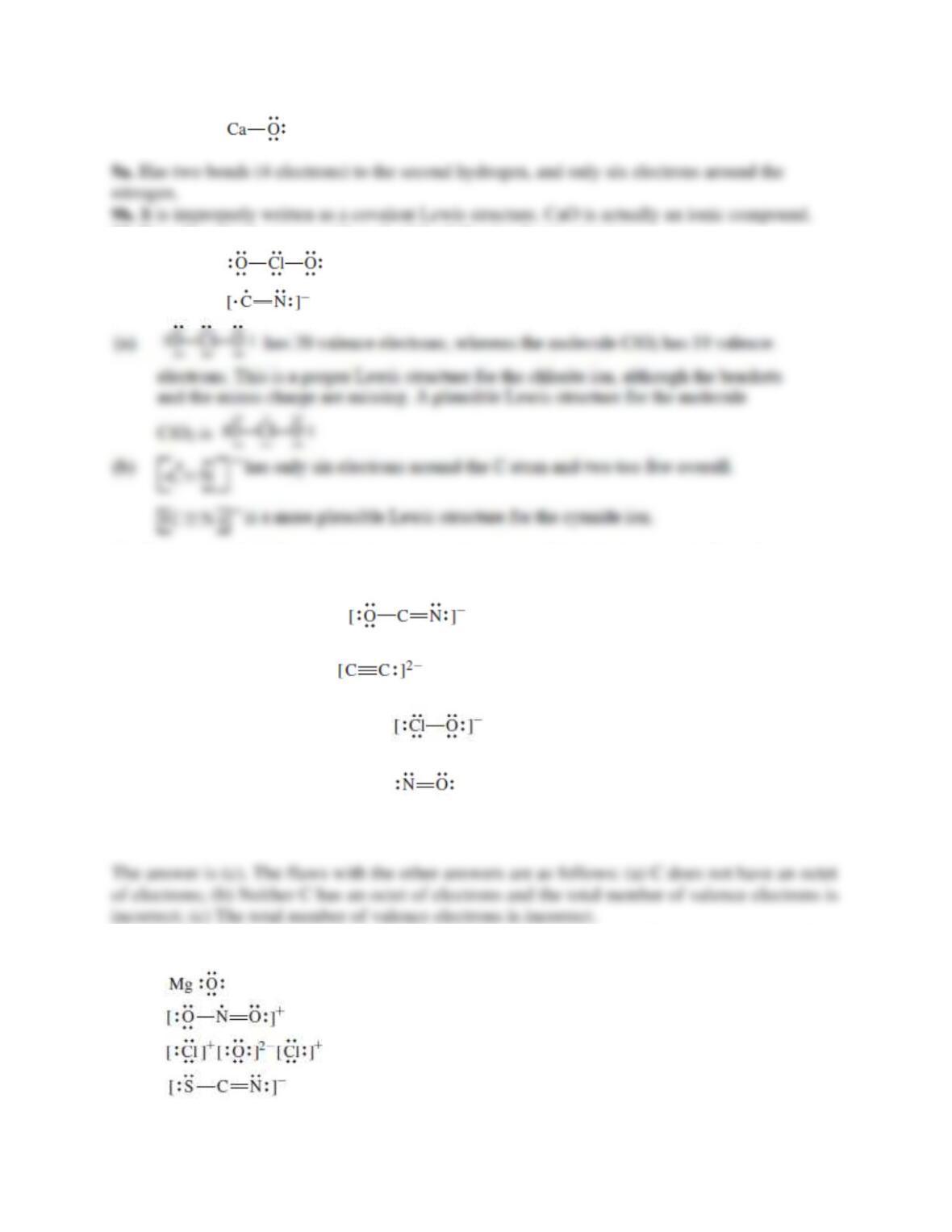
(b)
10. Describe what is wrong with each of the following Lewis structures.
(a)
(b)
11. Only one of the following Lewis structures is correct. Select that one and indicate the errors
in the others.
(a) cyanate ion
(b) carbide ion
(c) hypochlorite ion
(d) nitrogen(II) oxide
12. Indicate what is wrong with each of the following Lewis structures. Replace each one with a
more acceptable structure.
(a)
(b)
(c)
(d)
Ionic Bonding
13. Write Lewis structures for the following ionic compounds: (a) calcium chloride; (b) barium
sulfide; (c) lithium oxide; (d) sodium fluoride.
14. Under appropriate conditions, both hydrogen and nitrogen can form monatomic anions. What
are the Lewis symbols for these ions? What are the Lewis structures of the compounds (a)
lithium hydride;
(b) calcium hydride; (c) magnesium nitride?
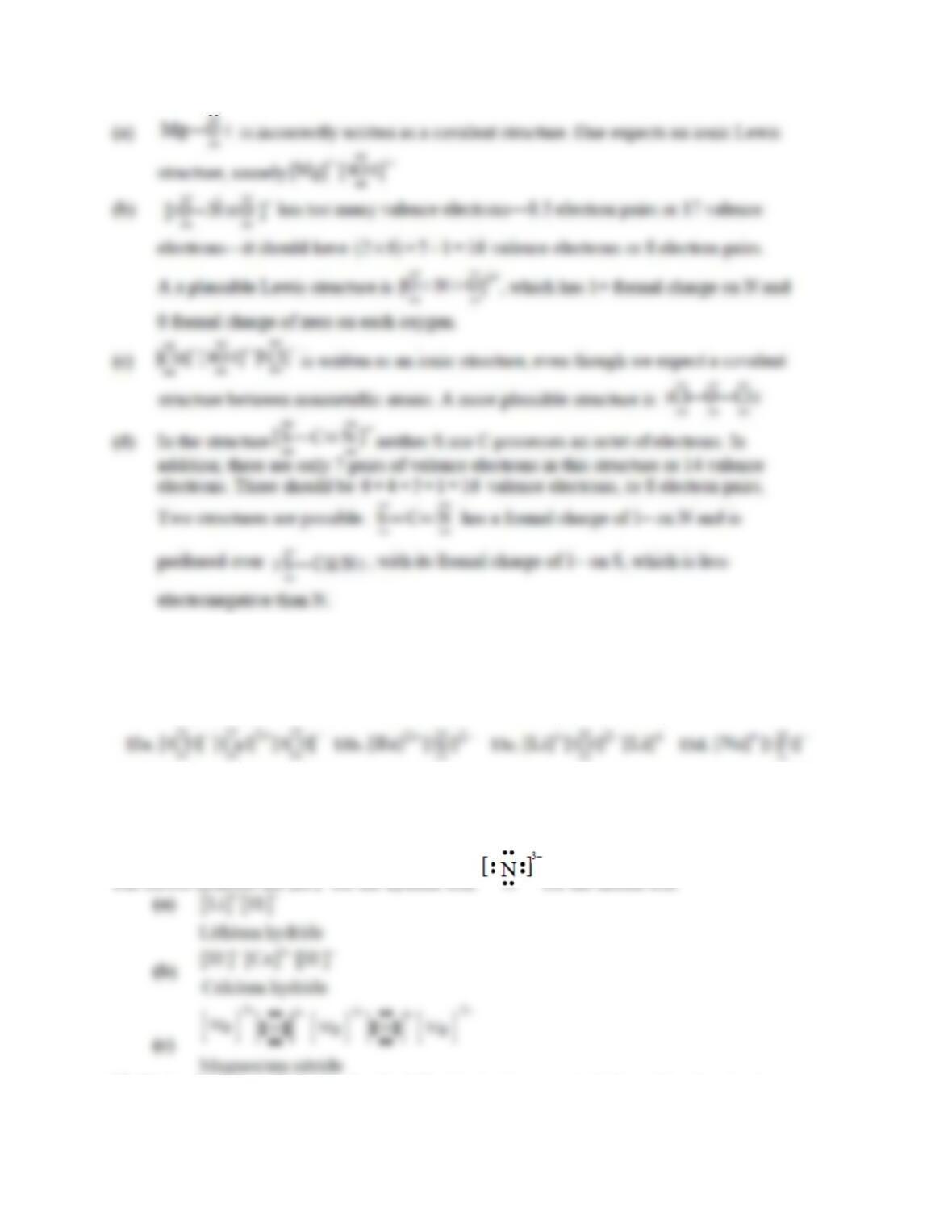
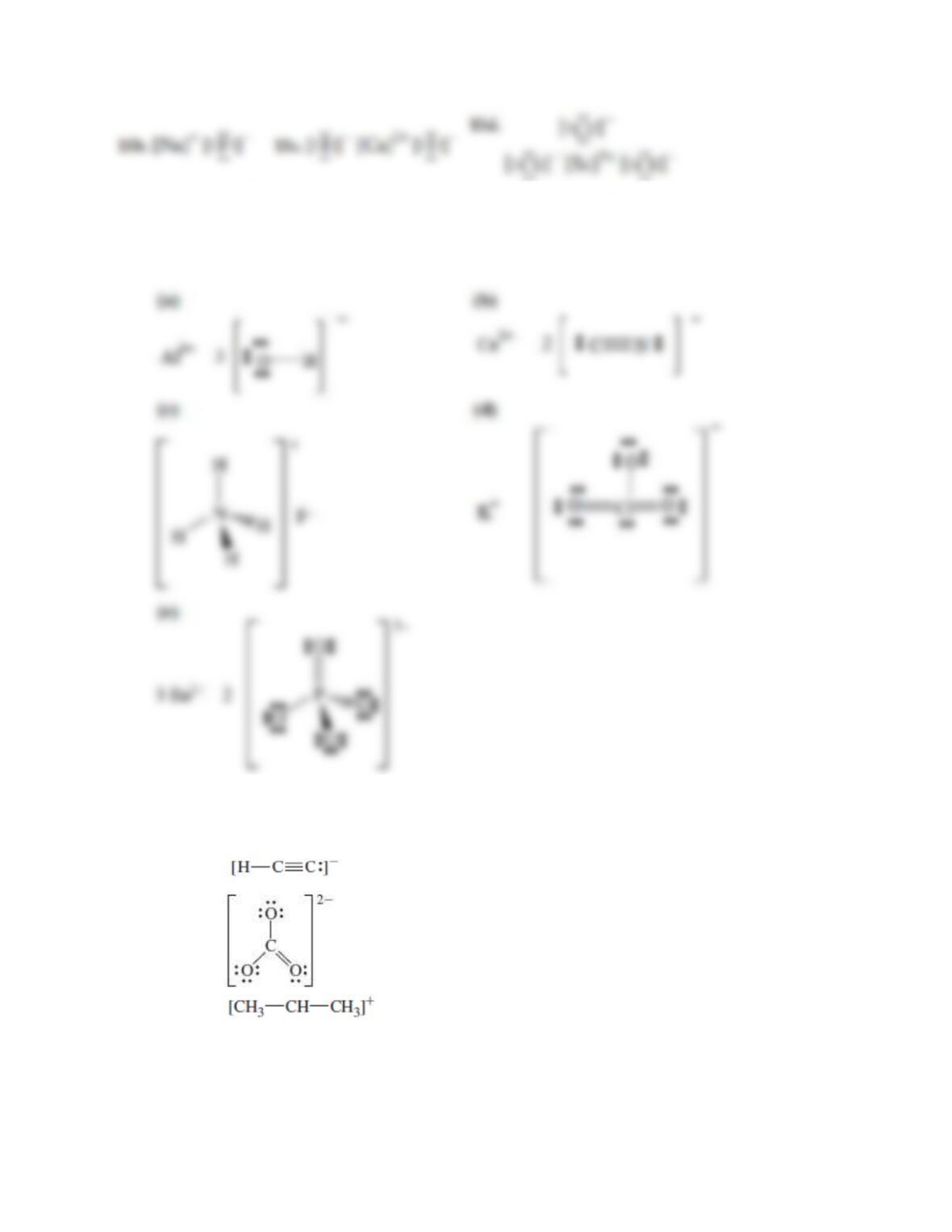
The Lewis symbols are [H:]– for the hydride ion, for the nitride ion.
15. Derive the correct formulas for the following ionic compounds by writing Lewis structures.
(a) lithium sulfide; (b) sodium fluoride; (c) calcium iodide; (d) scandium chloride.
16. Each of the following ionic compounds consists of a combination of monatomic and
polyatomic ions. Represent these compounds with Lewis structures. (a)
( )
3
Al OH ;
(b)
( )
2
Ca CN ;
(c)
4
NH F;
(d)
3
KClO ;
(e)
( )
34
2
Ba PO
Formal Charge
17. Assign formal charges to each of the atoms in the following structures.
(a)
(b)
(c)
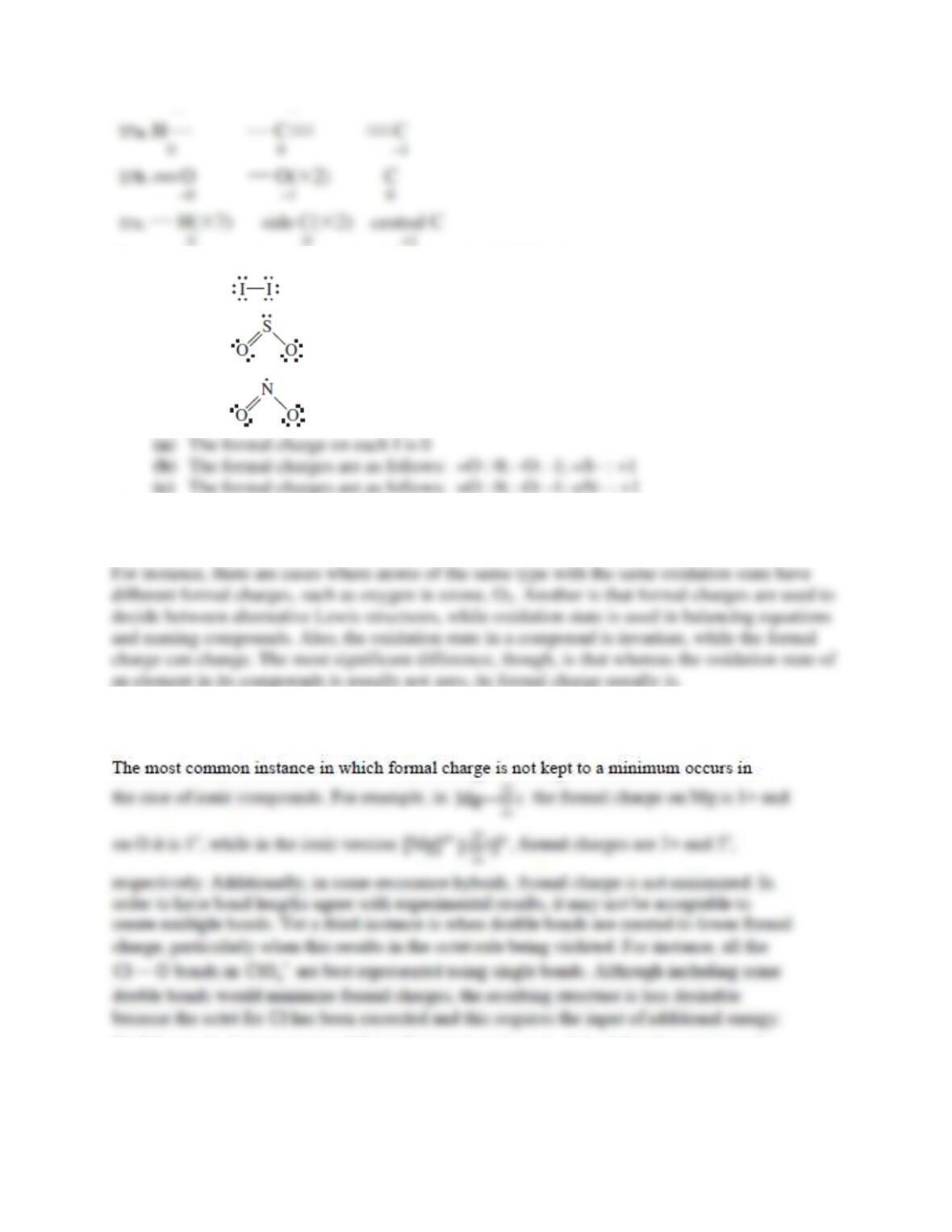
18. Assign formal charges to each of the atoms in the following structures.
(a)
(b)
(c)
19. Both oxidation state and formal charge involve conventions for assigning valence electrons to
bonded atoms in compounds, but clearly they are not the same. Describe several ways in which
these concepts differ.
20. Although the notion that a Lewis structure in which formal charges are zero or held to a
minimum seems to apply in most instances, describe several significant situations in which
this appears not to be the case.
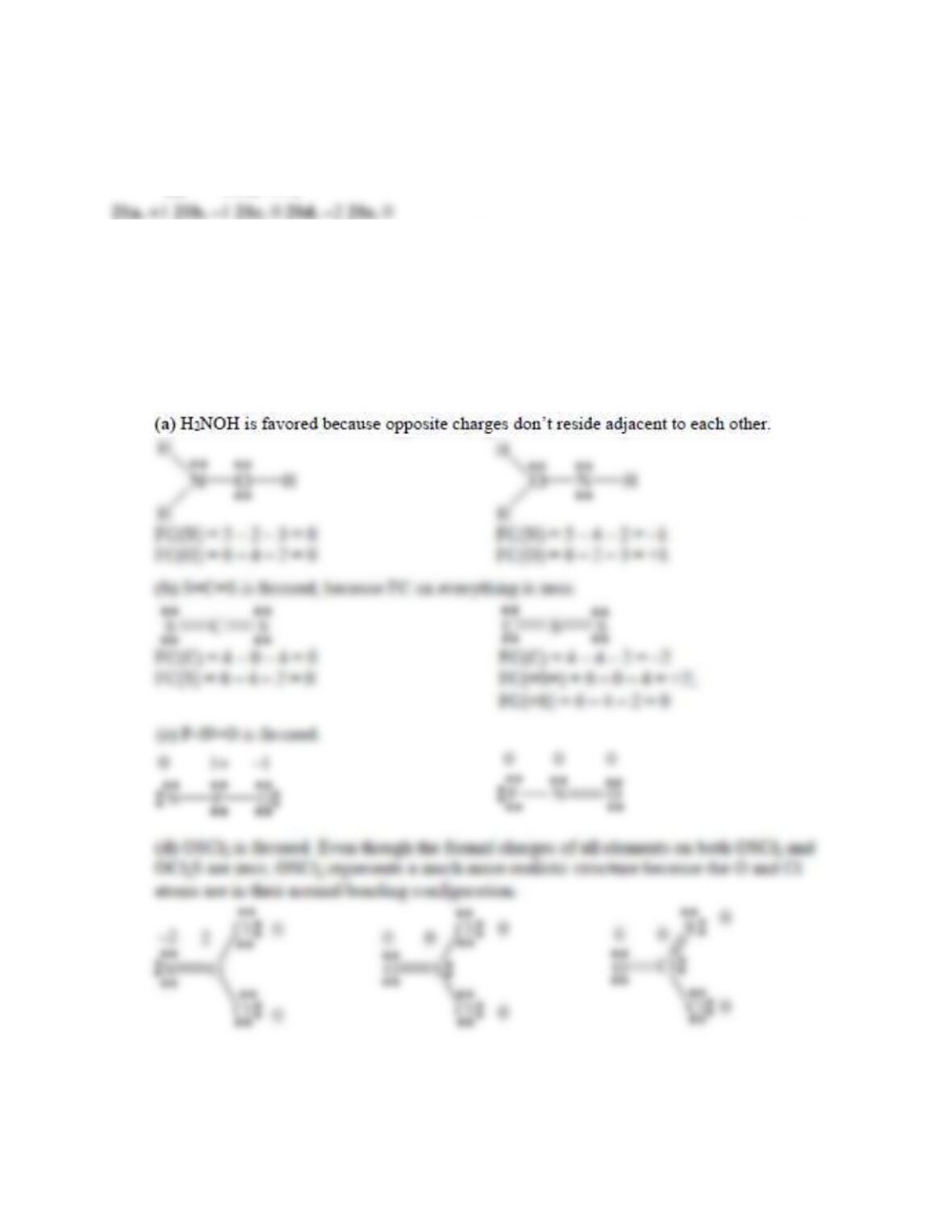
21. What is the formal charge of the indicated atom in each of the following structures?
(a) the central O atom in
3
O
(b) Al in
4
AlH−
(c) Cl in
3
ClO−
(d) Si in
2
6
SiF −
(e) Cl in
ClF
22. Assign formal charges to the atoms in the following species, and then select the more likely
skeletal structure.
(a)
2
H NOH
or
2
H ONH
(b) SCS or CSS
(c) NFO or FNO
(d)
2
SOCl
or
2
OSCl
or
2
OCl S
(e)
3
F SN
and
3
F NS
23. The concept of formal charge helped us to choose the more plausible of the Lewis structures
for
2
NO+
given in expressions (10.14) and (10.15). Can it similarly help us to choose a single
Lewis structure as most plausible for
2
CO H ?
+
Explain.
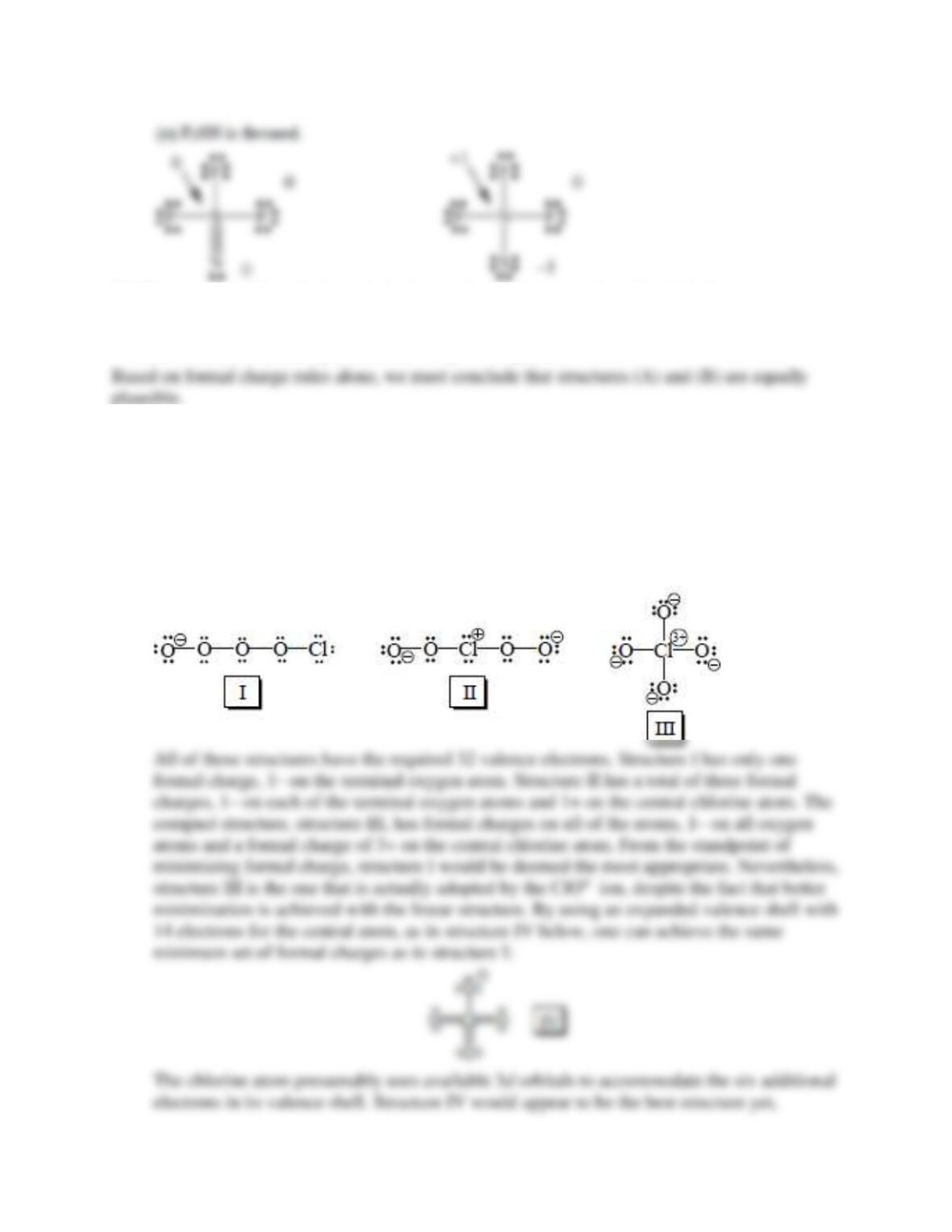
24. Show that the idea of minimizing the formal charges in a structure is at times in conflict with
the observation that compact, symmetrical structures are more commonly observed than
elongated ones with many central atoms. Use
4
ClO−
as an illustrative example.
The intention of this question is to make the student aware of the fact that on occasion, one can
obtain a better Lewis structure “from the standpoint of formal charge minimization” by
using chain-like structures rather than the expected compact, symmetrical structures. The
two linear Lewis structures for the ClO4– (I) and (II) and a compact structure(III) are shown
below:
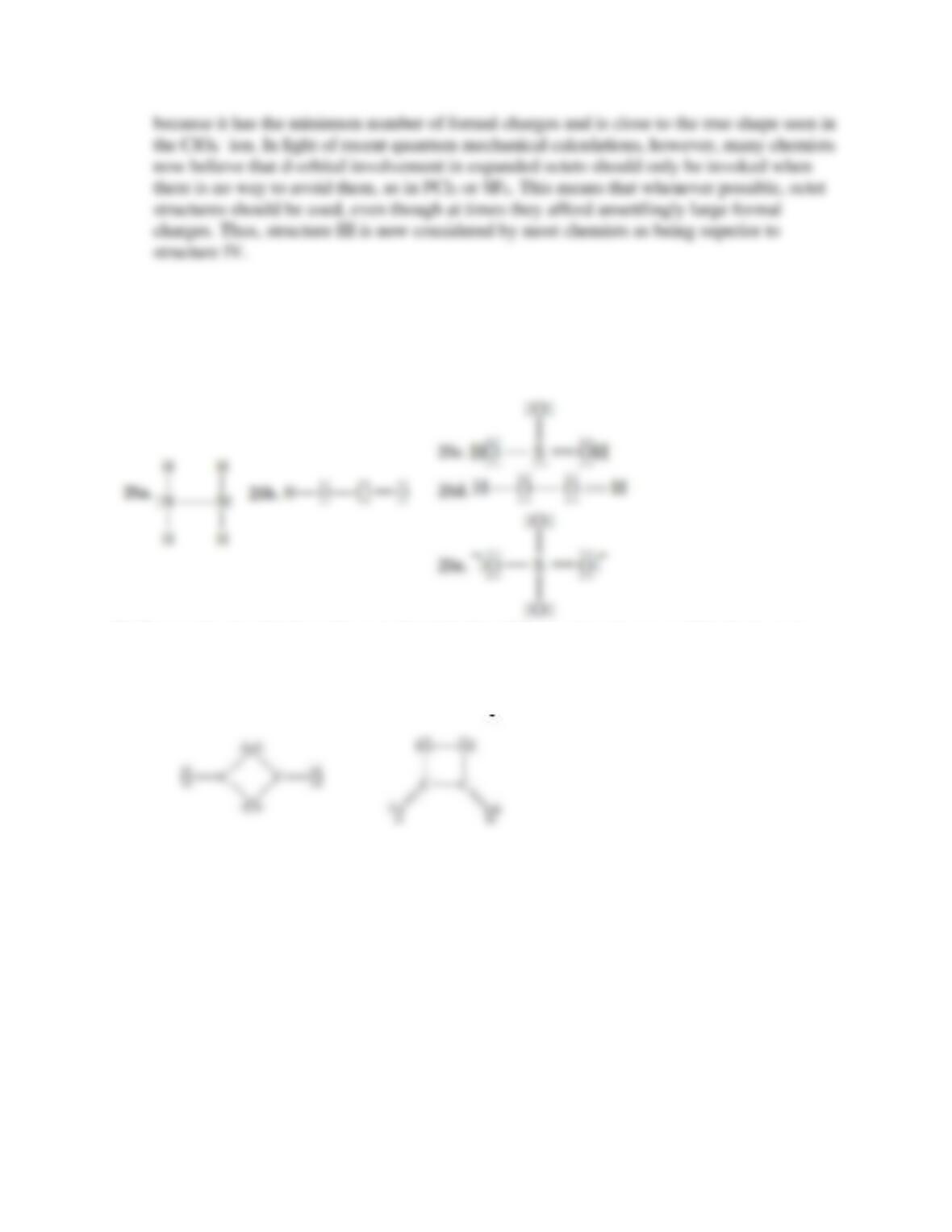
Lewis Structures
25. Write acceptable Lewis structures for the following molecules: (a)
22
H NNH ;
(b) HOClO;
(c)
( )
2
HO SO;
(d) HOOH; (e)
2
4
SO −
26. Two molecules that have the same formulas but different structures are said to be isomers.
(In isomers, the same atoms are present but linked together in different ways.) Draw
acceptable Lewis structures for two isomers of
24
CO
[Hint: The C atoms and two O atoms
form a square.]
27. The following polyatomic anions involve covalent bonds between O atoms and the central
nonmetal atom. Propose an acceptable Lewis structure for each. (a)
2
3
SO ;
−
(b)
2
NO ;
−
(c)
2
3
CO ;
−
(d)
2
HO−
28. Represent the following ionic compounds by Lewis structures: (a) barium hydroxide; (b)
sodium nitrite; (c) magnesium iodate; (d) aluminum sulfate.
29. Write a plausible Lewis structure for crotonaldehyde,
3
CH CHCHCHO,
a substance used in
tear gas and insecticides.
30. Write a plausible Lewis structure for
32
C O ,
a substance known as carbon suboxide.
31. Write Lewis structures for the molecules represented by the following molecular models.
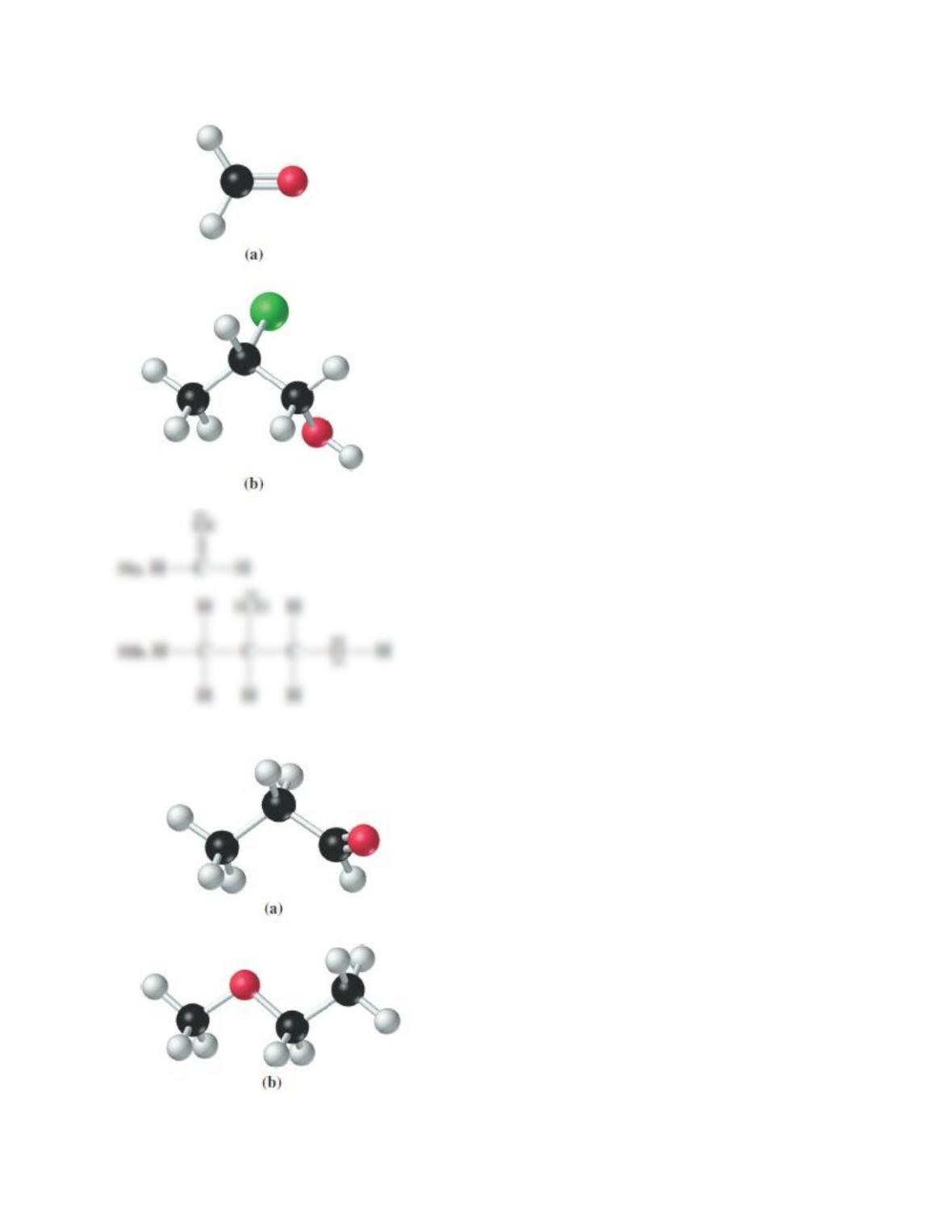
32. Write Lewis structures for the molecules represented by the following molecular models.
33. Write Lewis structures for the molecules represented by the following line-angle formulas.
[Hint: Recall page 70 and Figure 3-2.]
(a)
(b)
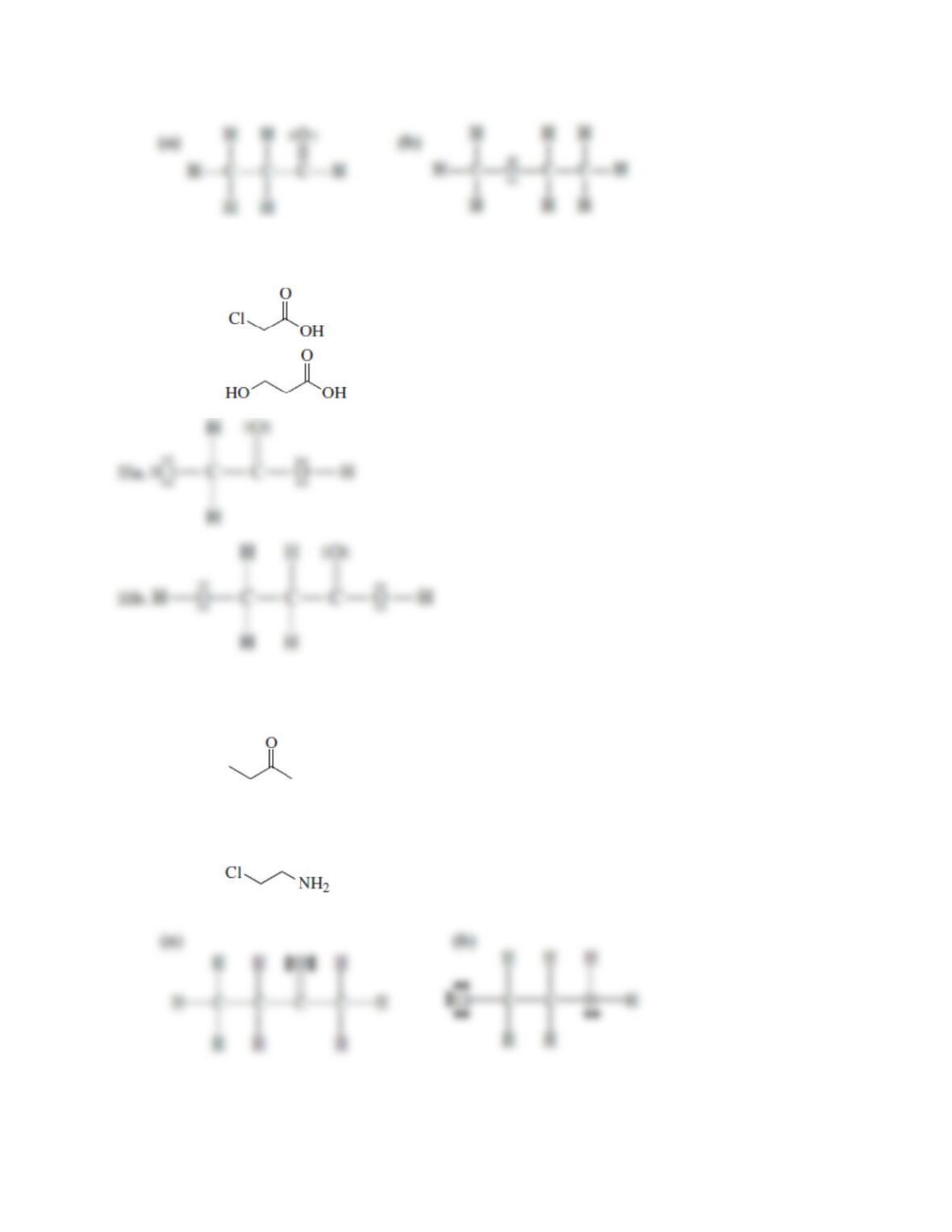
34. Write Lewis structures for the molecules represented by the following line-angle formulas.
[Hint: Recall page 70 and Figure 3-2.]
(a)
(b)
35. Identify the main group that the element X belongs to in each of the following Lewis
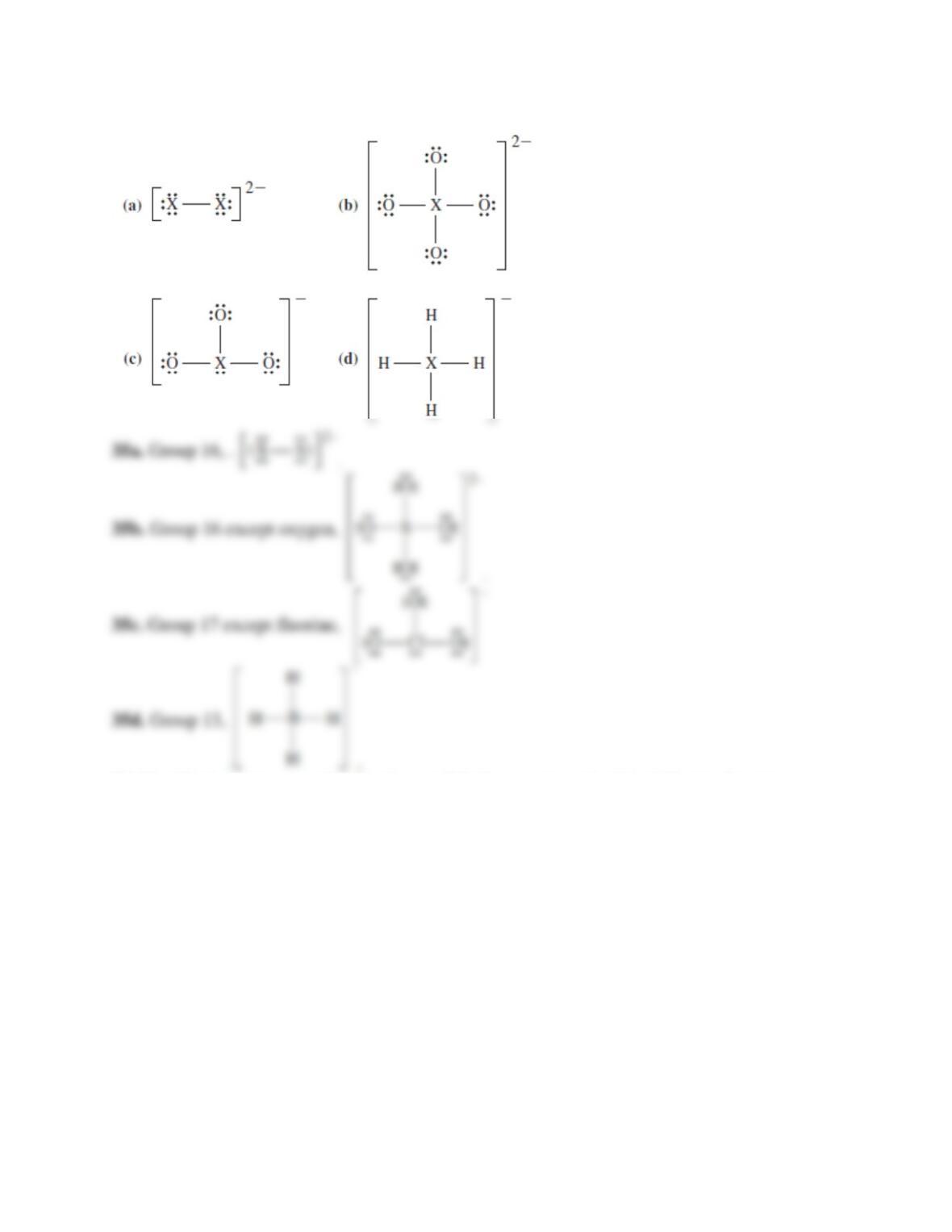
structures. For the types of molecule shown, give an example that exists.
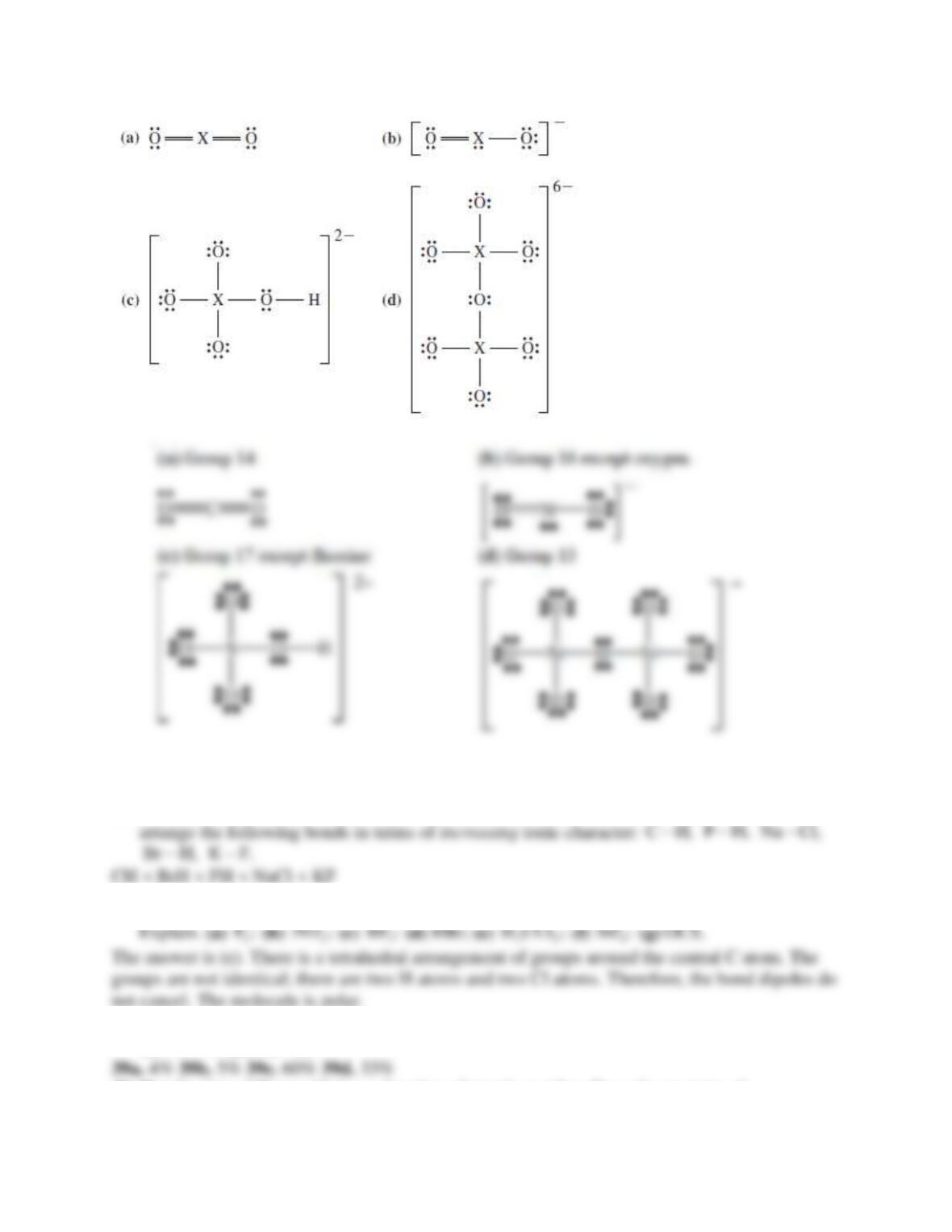
36. Identify the main group that the element X belongs to in each of the following Lewis
structures. For the types of molecule shown, give an example that exists.
Polar Covalent Bonds and Electrostatic Potential Maps
37. Use your knowledge of electronegativities, but do not refer to tables or figures in the text, to
38. Which of the following molecules would you expect to have a resultant dipole moment
( )
?
39. What is the percent ionic character of each of the -following bonds? (a)
S H;−
(b)
O Cl;−
(c)
Al O;−
(d)
As O−
.
40. Plot the data of Figure 10-6 as a function of atomic number. Does the property of
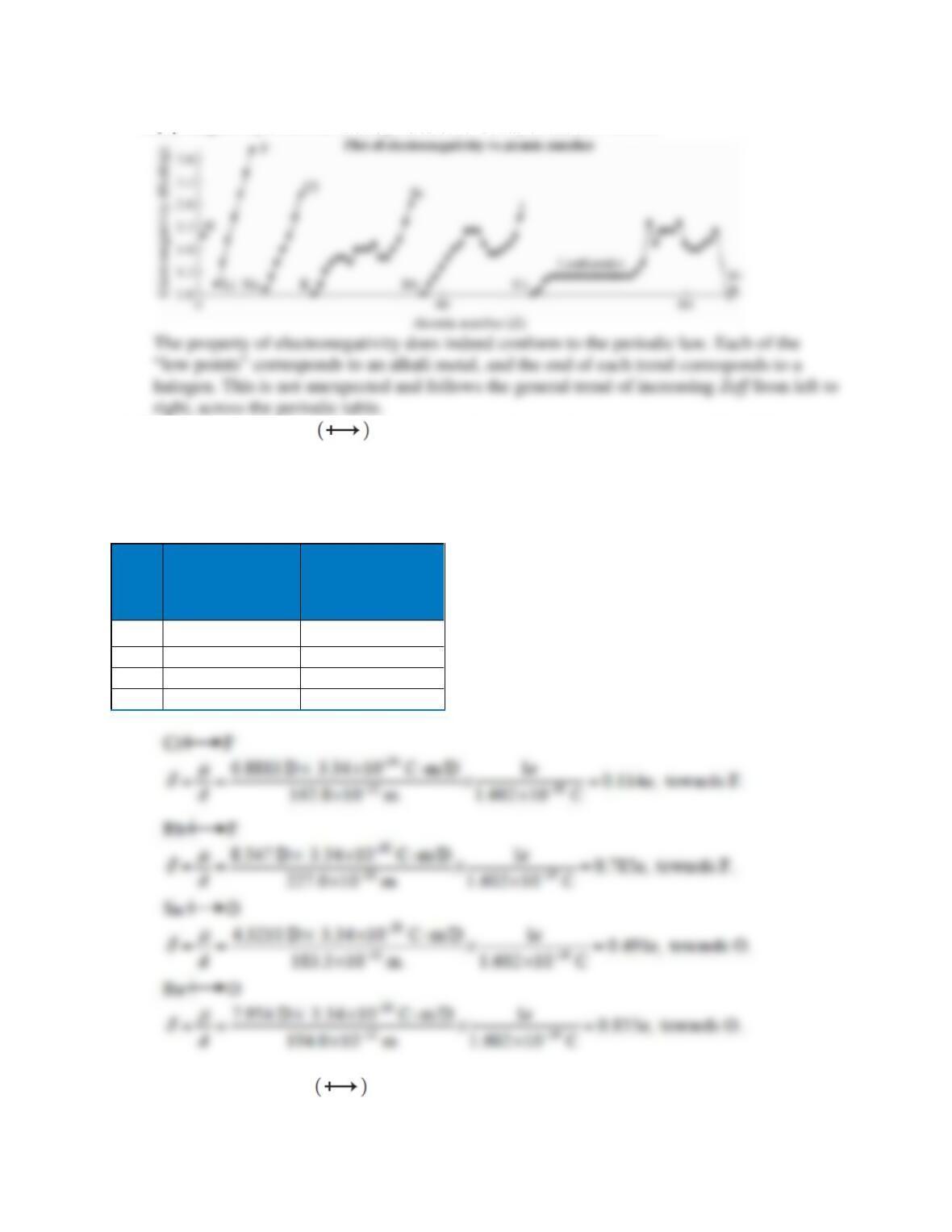
electronegativity conform to the periodic law? Do you think it should?
41. Use a cross-base arrow to represent the polarity of the bond in each of the following
diatomic molecules. Then use the data below to calculate, in the –manner described on page
447, the partial charges
( )
on the atoms in each molecule. Express the partial charges as a
decimal fraction of the elementary charge,
19
e 1 602 10 C,
−
=
for example
0 17e = +
or
0 17e = −
Bond Length, pm
Dipole Moment, D
ClF
162.8
0.8881
RbF
227.0
8.547
SnO
183.3
4.3210
BaO
194.0
7.954
42. Use a cross-base arrow to represent the polarity of the bond in each of the following
diatomic molecules. Then use the data below to calculate the partial charges
( )
on the atoms
in each molecule. Express the partial charges in the manner described in Exercise 41.
Bond Length, pm
Dipole Moment, D
OH
98.0
1.66
CH
131.1
1.46
CN
117.5
1.45
CS
194.4
1.96
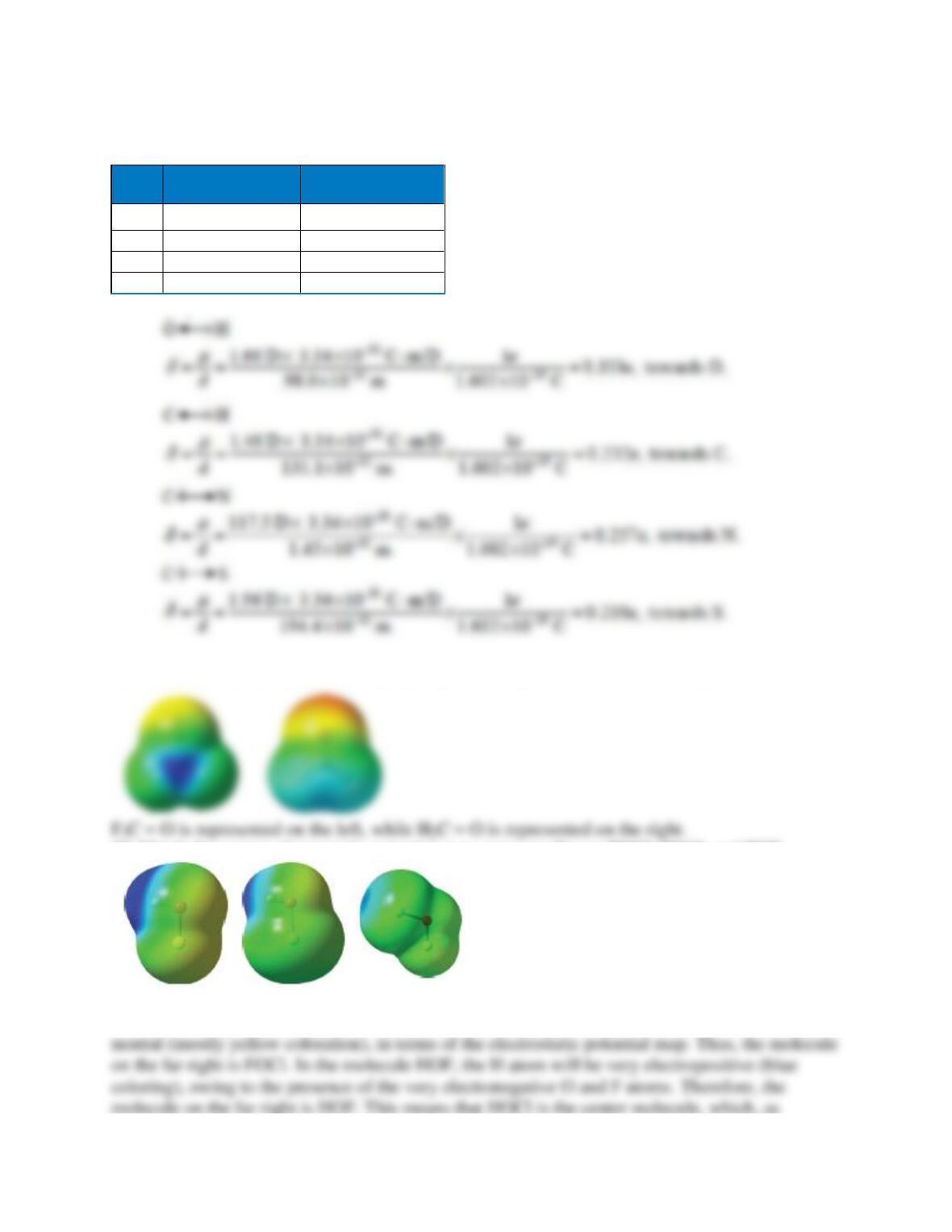
43. Which electrostatic potential map corresponds to
2
F C = O,
and which to
2
H C = O?
44. Match the correct electrostatic potential map corresponding to HOCl, FOCl, and HOF.
HOCl, HOF, and FOCl have similar structural features, however, they differ in terms of their
electron density maps. O, Cl, and F have similar electronegativities, thus FOCl should be fairly
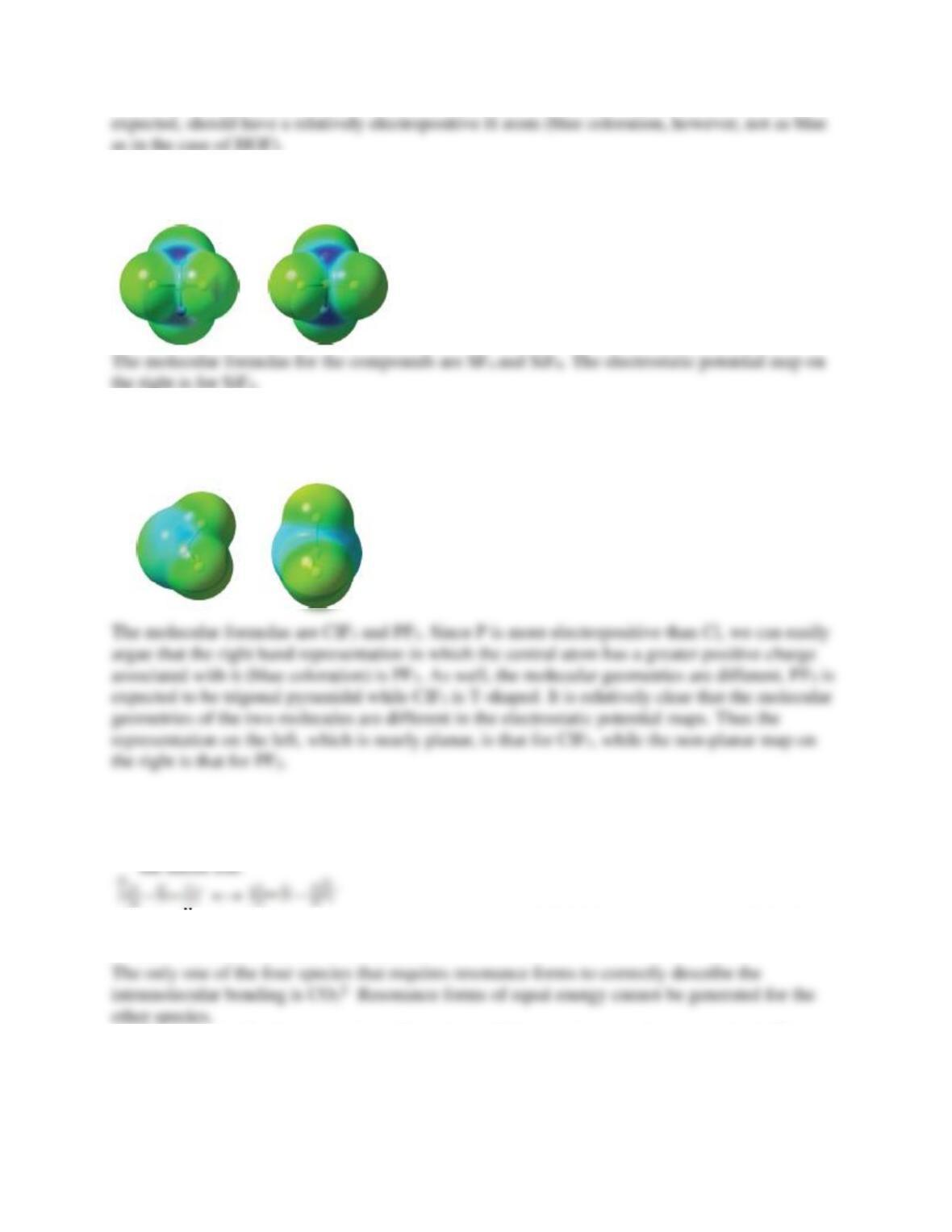
45. Two electrostatic potential maps are shown, one corresponding to a molecule containing only
S and F, the other Si and F. Match them. What are the molecular formulas of the compounds?
46. Two electrostatic potential maps are shown, one corresponding to a molecule containing only
Cl and F, the other P and F. Match them. What are the molecular formulas of the
compounds?
Resonance
47. Through appropriate Lewis structures, show that the phenomenon of resonance is involved in
48. Which of the following species requires a resonance hybrid for its Lewis structure? Explain.
(a)
2
CO ;
(b)
OCl ;
−
(c)
2
3
CO ;
−
(d)
OH−
49. Dinitrogen oxide (nitrous oxide, or “laughing gas”) is sometimes used as an anesthetic. Here are
some data about the
2
NO
molecule:
NN−
bond
length 113 pm;=
NO−
bond
length 119 pm=
Use these data and other information from the chapter to comment on the
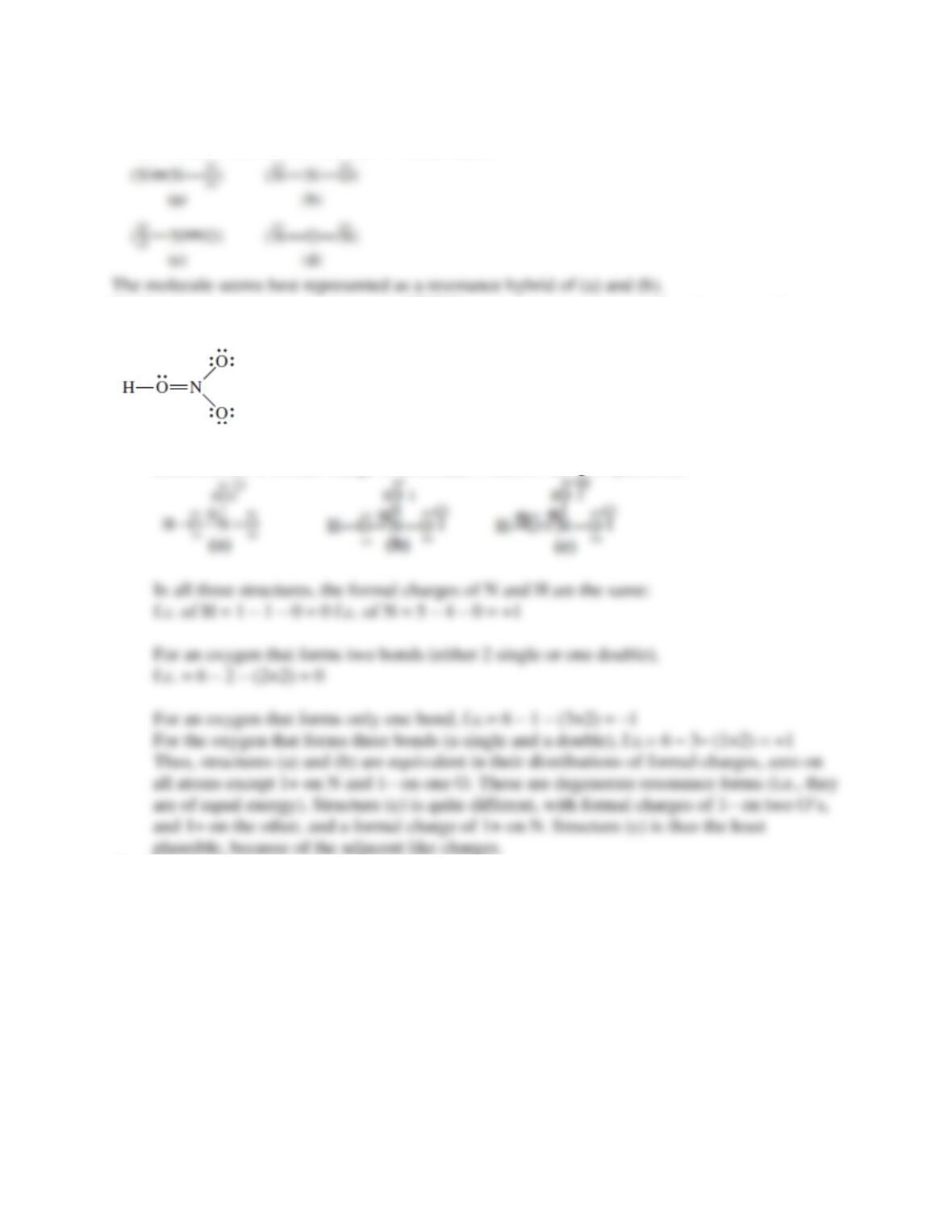
plausibility of each of the following Lewis structures shown. Are they all valid? Which ones do
you think contribute most to the resonance hybrid?
50. The Lewis structure of nitric acid,
2
HONO ,
is a resonance hybrid. How important do you
think the –contribution of the following structure is to the resonance hybrid? Explain.
We begin by drawing all three valid resonance forms of HNO3 and then analyzing their
distributions of formal charge to determine which is the most plausible.
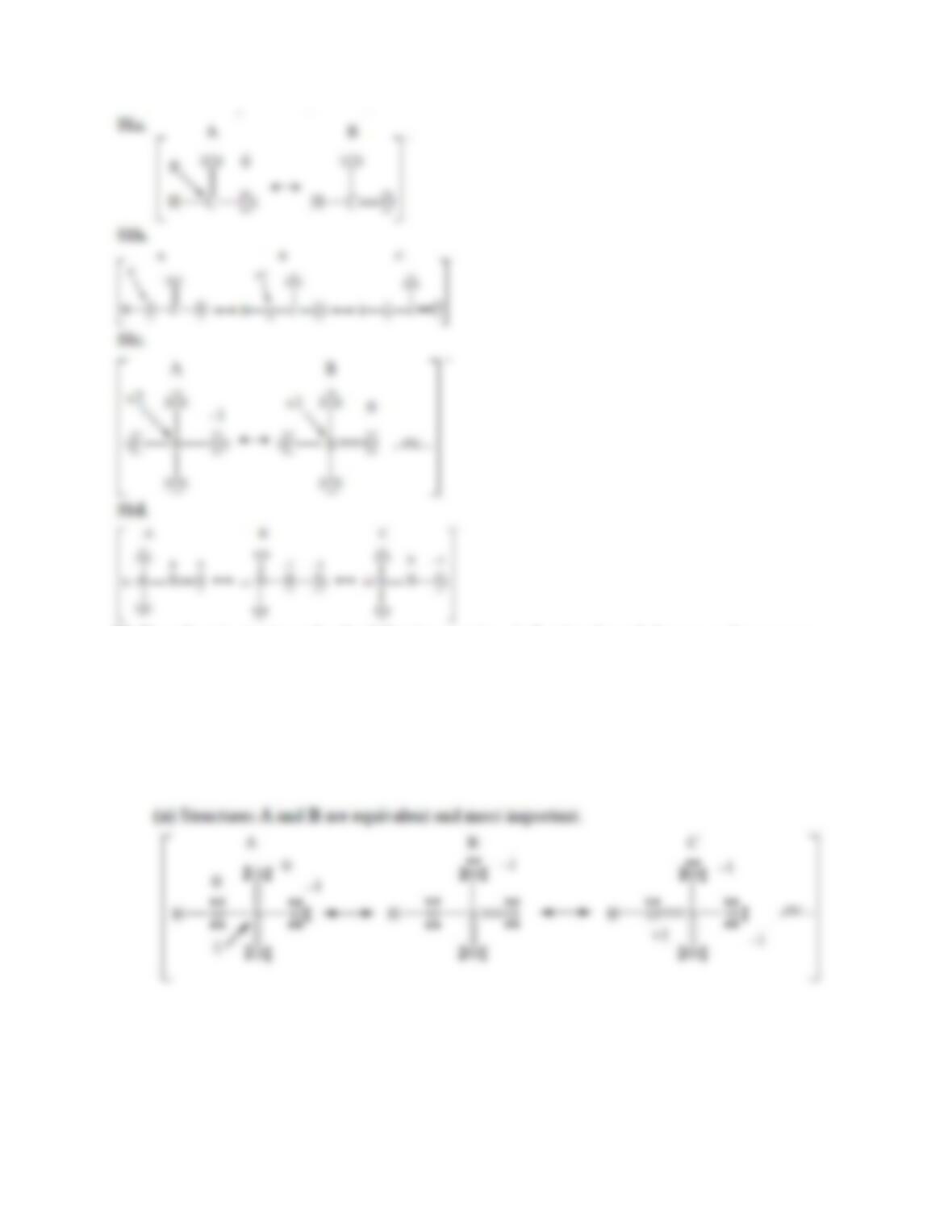
51. Draw Lewis structures for the following species, indicating formal charges and resonance
where applicable:
(a)
2
HCO−
(b)
3
HCO−
(c)
3
FSO−
(d)
2
23
NO−
(the nitrogen atoms are joined centrally with one oxygen atom on one N
and two on the other)
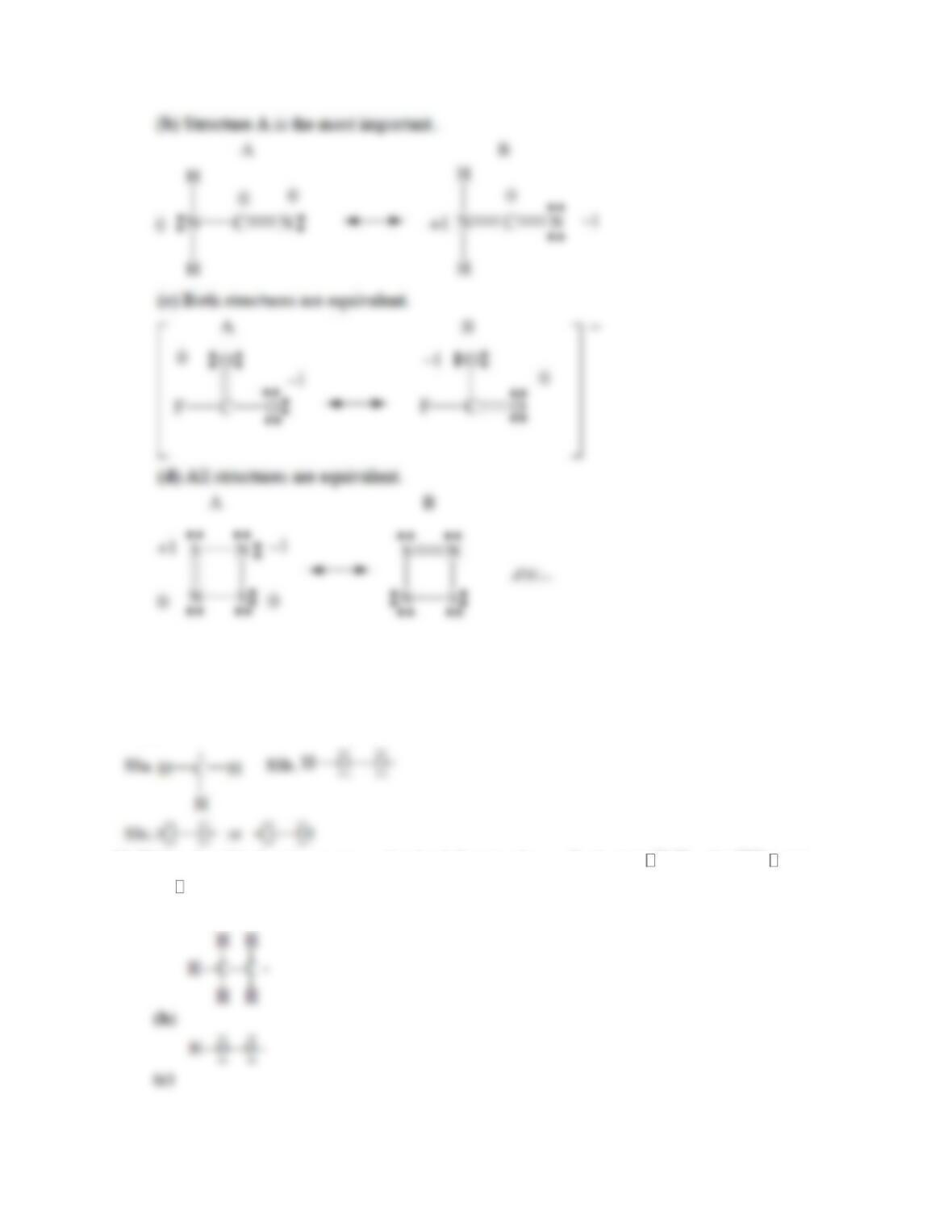
52. Draw Lewis structures for the following species, -indicating formal charges and resonance
where applicable:
(a)
3
HOSO−
(b)
2
H NCN
(c)
2
FCO−
(d)
22
SN
(a cyclic structure with S and N alternating)
Odd-Electron Species
53. Write plausible Lewis structures for the following odd-electron species: (a)
3
CH ;
(b)
2
ClO ;
(c)
3
NO
54. Write plausible Lewis structures for the following free radicals: (a)
25
C H ;
(b)
2
HO ;
(c)
ClO
(a)