55. Which of the following species would you expect to be diamagnetic and which
paramagnetic? (a)
OH ;
−
(b) OH; (c)
3
NO ;
(d)
3
SO ;
(e)
2
3
SO ;
−
(f)
2
HO
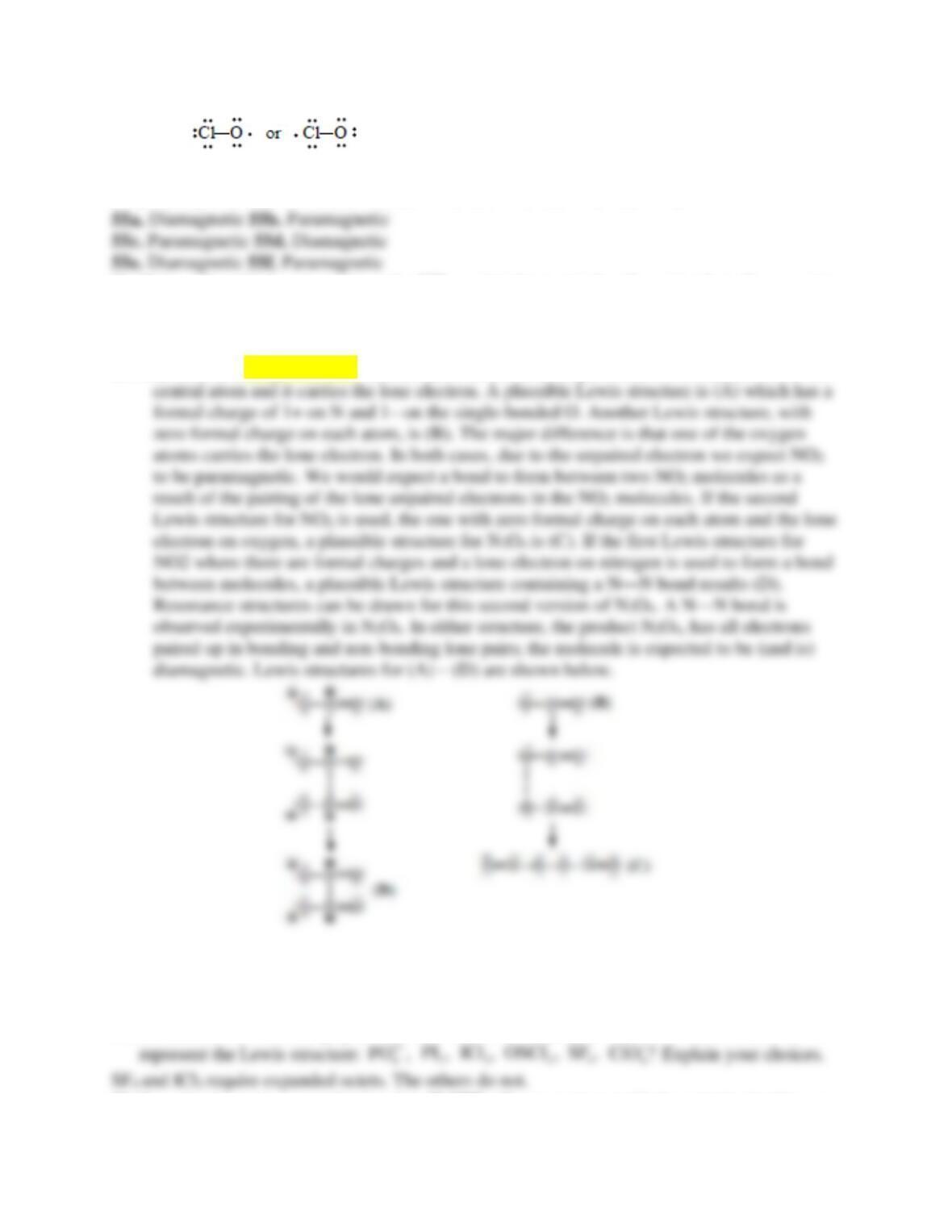
56. Write a plausible Lewis structure for
2
NO ,
and indicate whether the molecule is diamagnetic
or paramagnetic. Two
2
NO
molecules can join together (dimerize) to form
24
NO
Write a
plausible Lewis structure for
24
N O ,
and comment on the magnetic properties of the molecule.
In NO2, there are 5+ (2 6) = 17 valence electrons, 8 electron pairs and a lone electron. N is the
Expanded Valence Shells
57. In which of the following species is it necessary to employ an expanded valence shell to
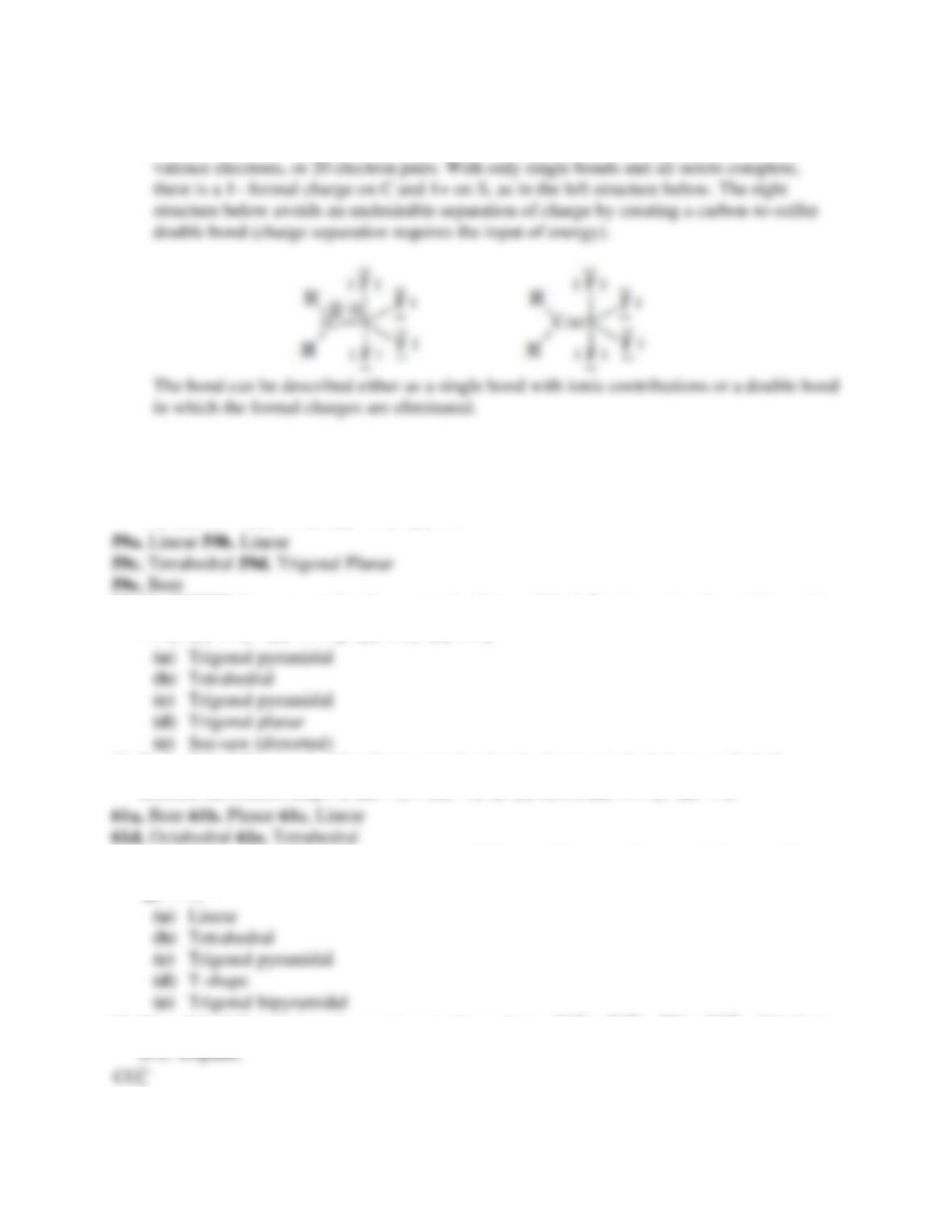
58. Describe the carbon-to-sulfur bond in
24
H CSF
That is, is it most likely a single, double, or
triple bond?
Let us draw the Lewis structure of H CSF 2 4. The molecule has (2 1) + 4 + 6 + (4 7) = 40
Molecular Shapes
59. Use VSEPR theory to predict the geometric shapes of the following molecules and ions: (a)
2
N;
(b) HCN; (c)
4
NH ;
+
(d)
3
NO ;
−
(e) NSF.
60. Use VSEPR theory to predict the geometric shapes of the following molecules and ions: (a)
3
PCl ;
(b)
2
4
SO ;
−
(c)
2
SOCl ;
(d)
3
SO ;
(e)
4
BrF+
61. Each of the following is either linear, angular (bent), planar, tetrahedral, or octahedral.
Indicate the correct shape of (a)
H S;
(b)
N O ;
(c) HCN; (d)
SbCl ;
−
(e)
BF−
62. Predict the geometric shapes of (a) CO; (b)
4
SiCl ;
(c)
3
PH ;
(d)
3
ICl ;
(e)
5
SbCl ;
(f)
2
SO ;
(g)
3
6
AlF −
63. One of the following ions has a trigonal-planar shape:
2
3
SO ;
−
3
4
PO ;
−
6
PF ;
−
2
3
CO −
Which ion
3
64. Two of the following have the same shape. Which two, and what is their shape? What are the
shapes of the other two?
3
NI ,
HCN,
2
3
SO ,
−
3
NO−
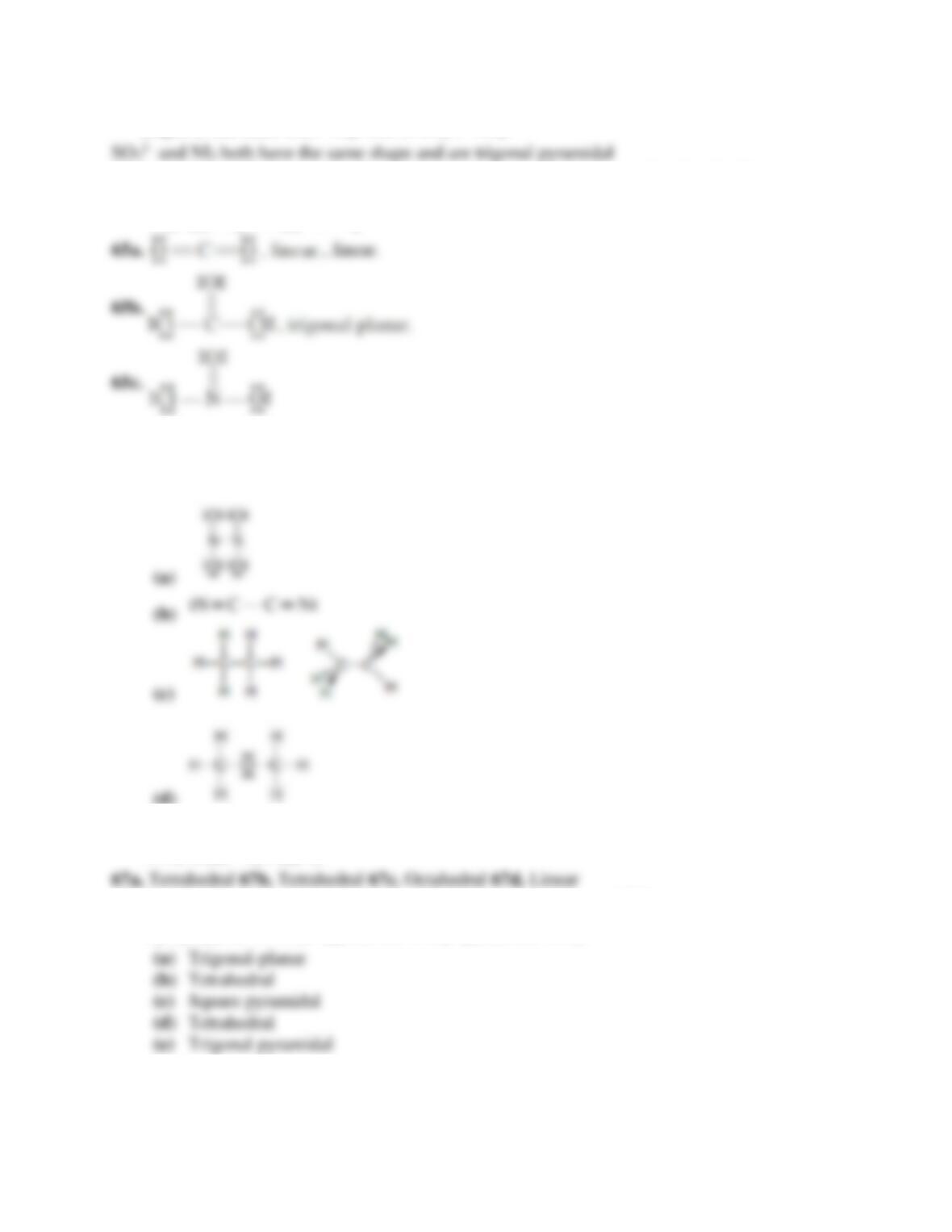
65. Each of the following molecules contains one or more multiple covalent bonds. Draw
plausible Lewis structures to represent this fact, and predict the shape of each molecule. (a)
2
CO ;
(b)
2
Cl CO;
(c)
2
ClNO
66. Sketch the probable geometric shape of a molecule of (a)
24
NO
( )
22
O NNO ;
(b)
22
CN
( )
NCCN ;
(c)
26
CH
( )
33
H CCH ;
(d)
26
C H O
( )
33
H COCH
(d)
67. Use the VSEPR theory to predict the shapes of the anions (a)
4
ClO ;
−
(b)
2
23
SO−
(that is,
2
3
SSO −
); (c)
6
PF ;
−
(d)
3
I−
68. Use the VSEPR theory to predict the shape of (a) the molecule
2
OSF ;
(b) the molecule
22
O SF ;
(c) the ion
5
SF ;
−
(d) the ion
4
ClO ;
−
(e) the ion
3
ClO−
69. The molecular shape of
3
BF
is planar (see Table 10.1). If a fluoride ion is attached to the B
atom of
3
BF
through a coordinate covalent bond, the ion
4
BF−
results. What is the shape of
this ion?
70. Explain why it is not necessary to find the Lewis structure with the smallest formal charges
to make a successful prediction of molecular geometry in the VSEPR theory. For example,
write Lewis structures for
2
SO
having different formal charges, and predict the molecular
geometry based on these structures.
71. Comment on the similarities and differences in the molecular structure of the following
triatomic species:
2
CO , NO , O ,
−
and
ClO−
72. Comment on the similarities and differences in the molecular structure of the following four-
atom species:
22
3 3 3
NO , CO , SO ,
− − −
and
3
ClO−
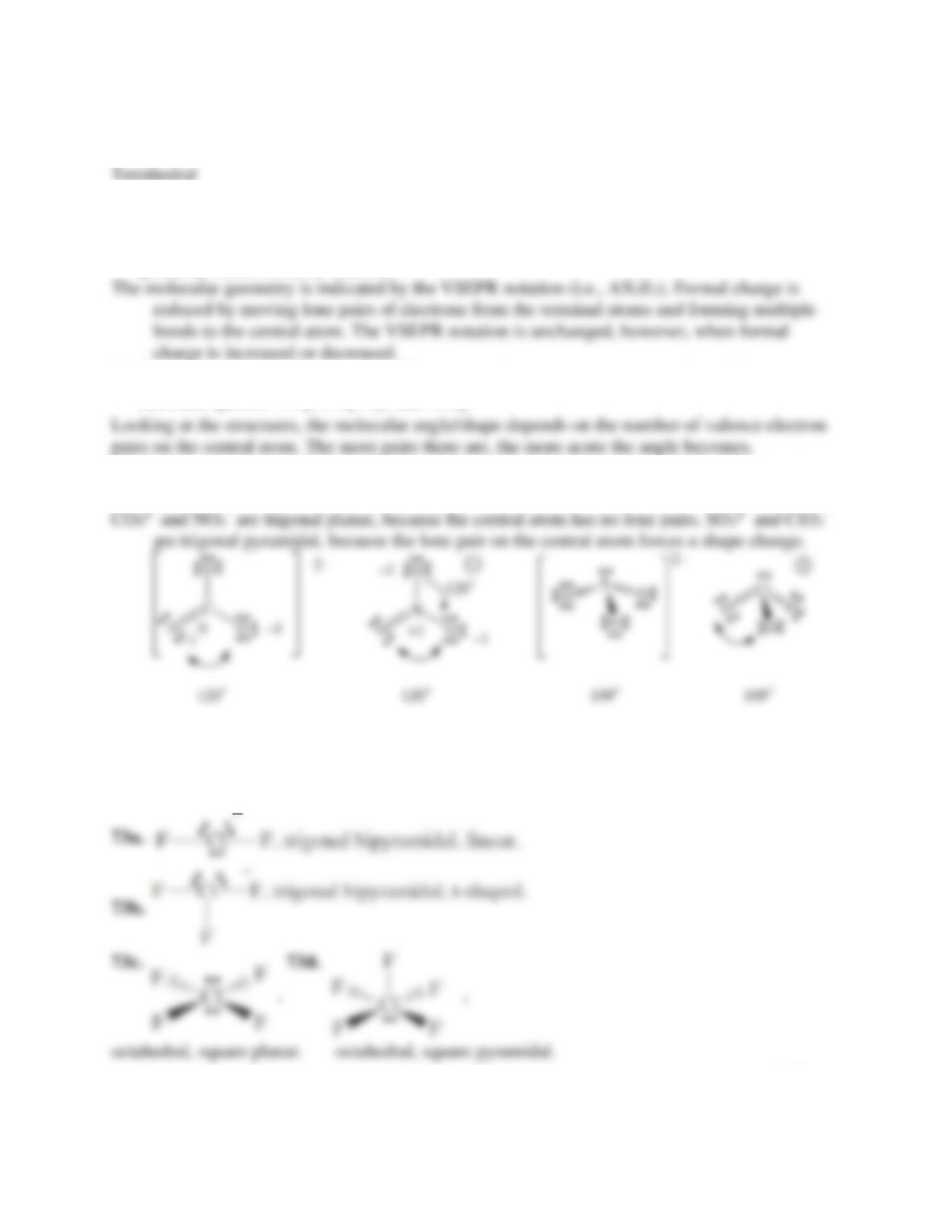
73. Draw a plausible Lewis structure for the following series of molecules and ions: (a)
2
ClF ;
−
(b)
3
ClF ;
(c)
4
ClF ;
−
(d)
5
ClF
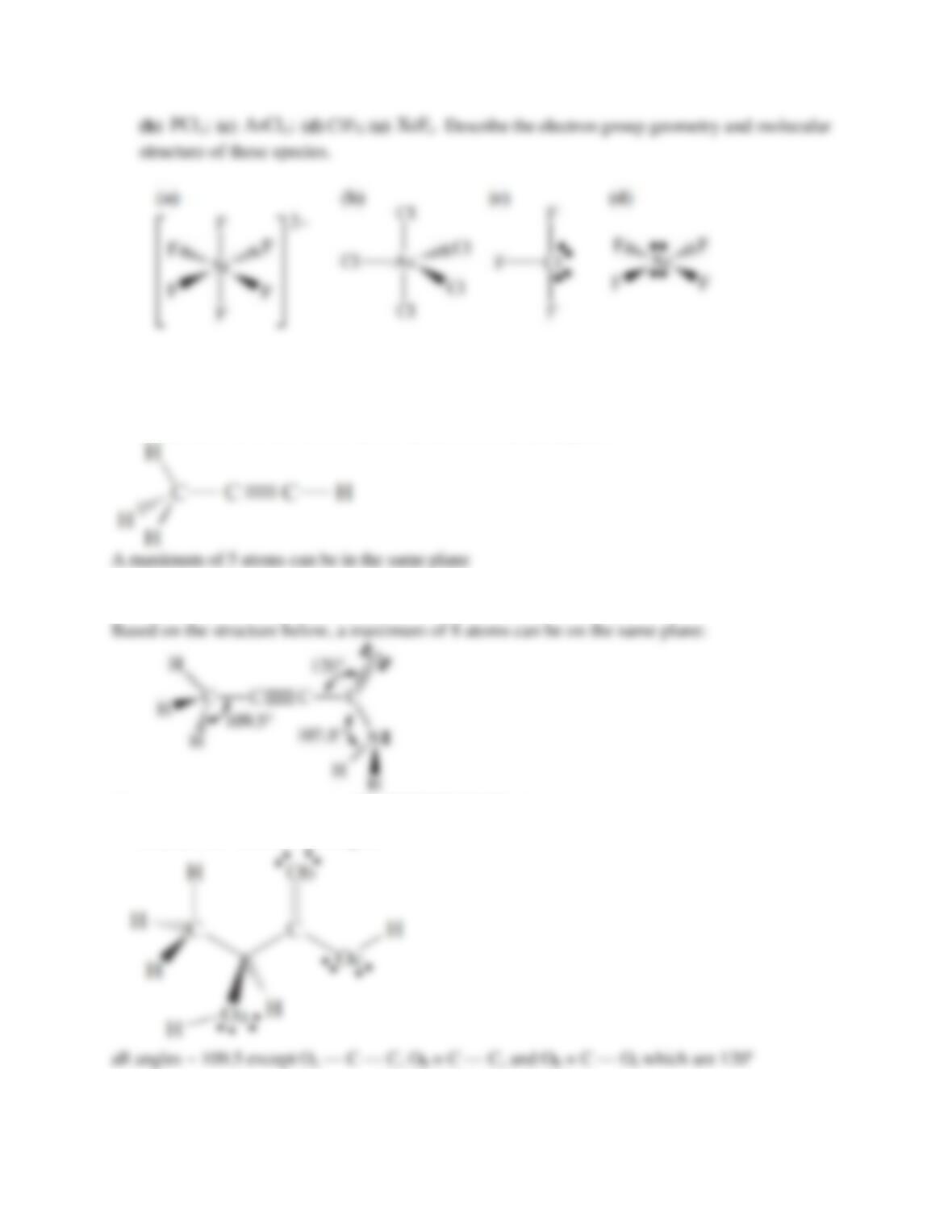
Describe the electron group geometry and molecular structure
of these species.
74. Draw a plausible Lewis structure for the following series of molecules and ions: (a)
2
6
SiF −
;
Shapes of Molecules with More Than One Central Atom
75. Sketch the propyne molecule,
3
CH C CH
Indicate the bond angles in this molecule. What
is the maximum number of atoms that can be in the same plane?
76. Sketch the propene molecule,
32
CH CH = CH
Indi-cate the bond angles in this molecule.
What is the maximum number of atoms that can be in the same plane?
77. Lactic acid has the formula
( )
3
CH CH OH COOH
. Sketch the lactic acid molecule, and
indicate the various bond angles.
78. Levulinic acid has the formula
( )
3 2 2
CH CO CH CH COOH
Sketch the levulinic acid
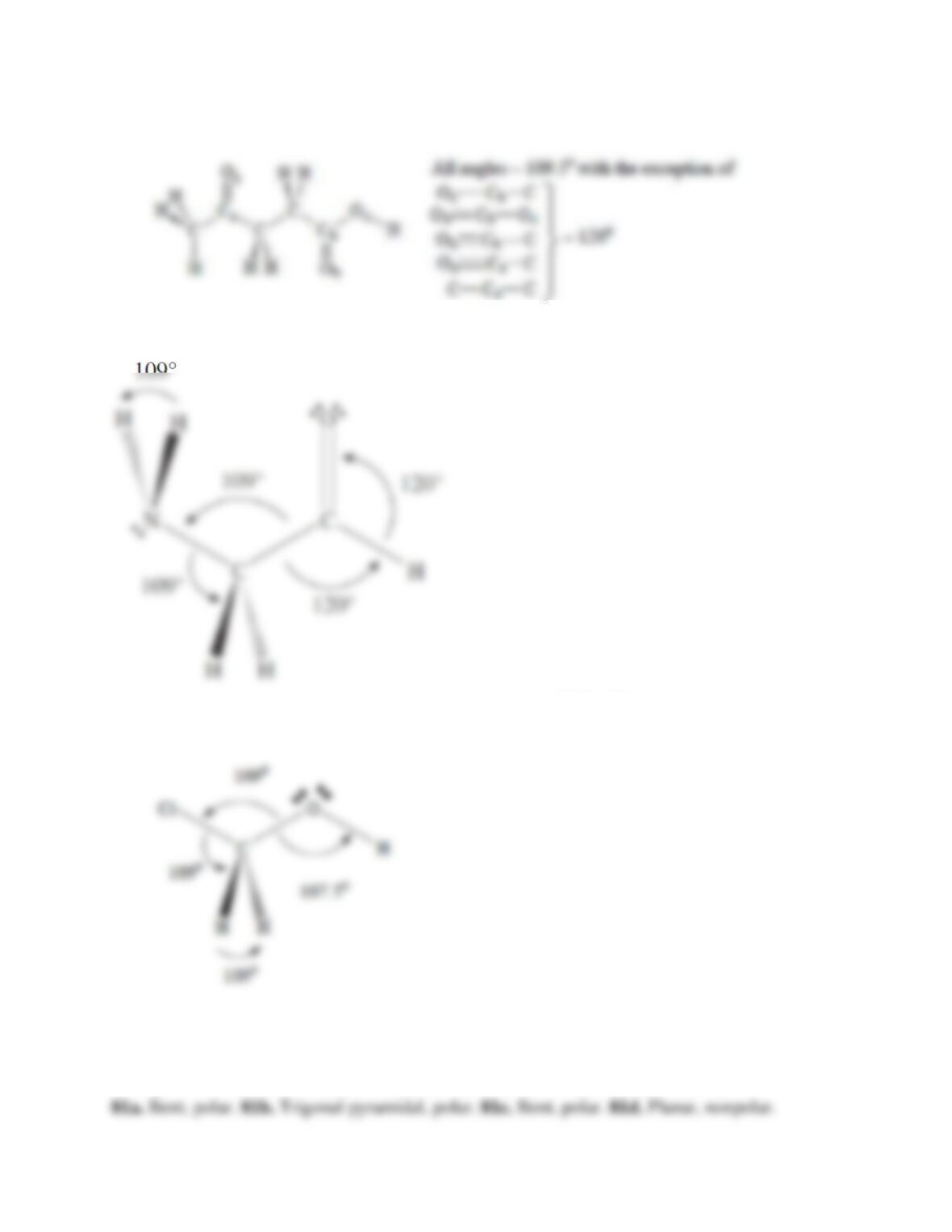
molecule, and indicate the various bond angles.
79. Sketch, by using the dash and wedge symbolism, the
22
H NCH CHO
molecule, and indicate
the various bond angles.
80. One of the isomers of chloromethanol has the formula
2
ClCH OH
Sketch, by using the dash
and wedge symbolism, this isomer of chloromethanol, and indicate the various bond angles.
Polar Molecules
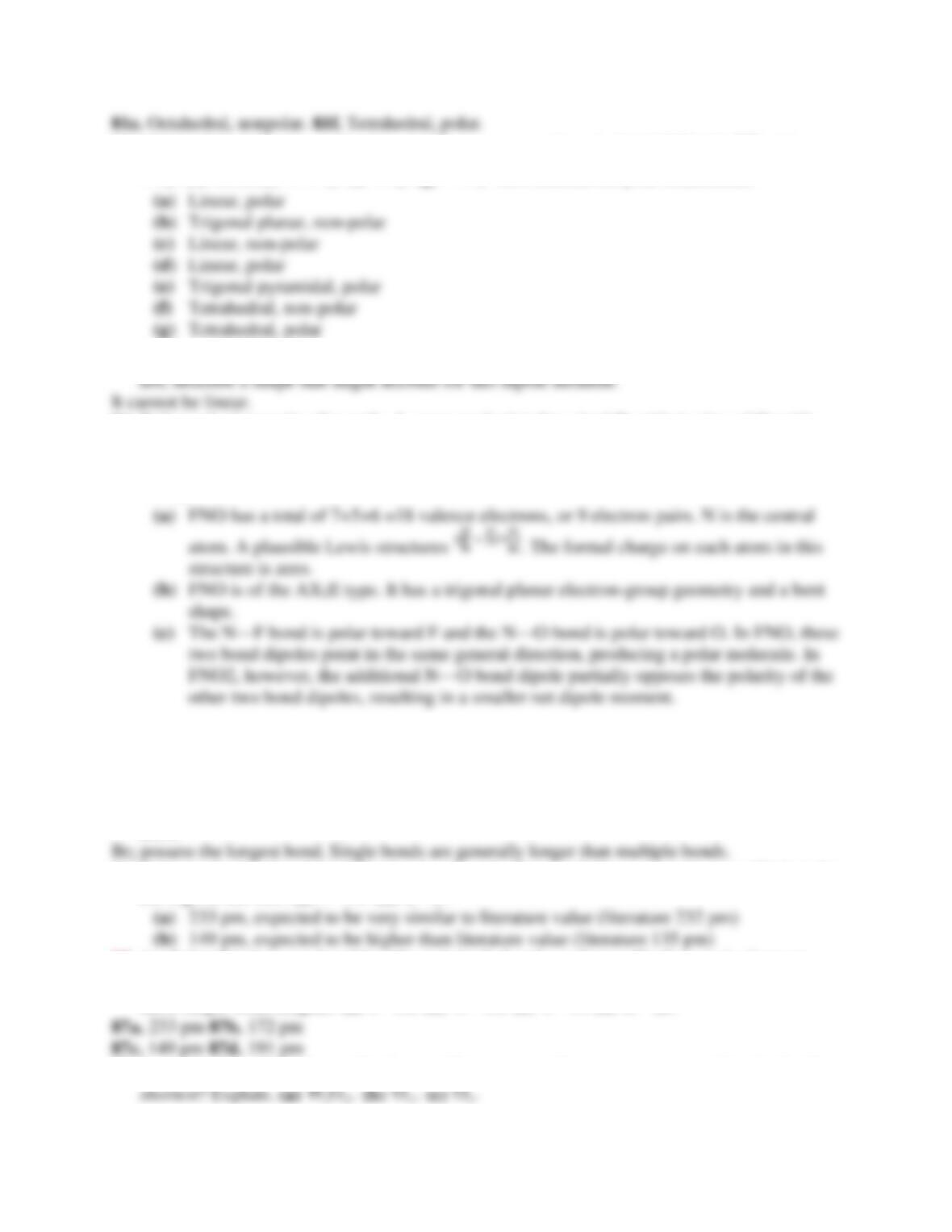
81. Predict the shapes of the following molecules, and then predict which would have resultant
dipole moments: (a)
2
SO ;
(b)
3
NH ;
(c)
2
H S;
(d)
24
C H ;
(e)
6
SF ;
(f)
22
CH Cl
82. Which of the following molecules would you expect to be polar? (a) HCN; (b)
3
SO ;
(c)
2
CS ;
(d) OCS; (e)
2
SOCl ;
(f)
4
SiF ;
(g)
3
POF
Give reasons for your conclusions.
83. The molecule
22
HO
has a resultant dipole moment of 2.2 D. Can this molecule be linear? If
84. Refer to the Integrative Example. A compound related to nitryl fluoride is nitrosyl fluoride,
FNO. For this molecule, indicate (a) a plausible Lewis structure and (b) the geometric shape.
(c) Explain why the measured resultant dipole moment for FNO is larger than the value for
2
FNO
Bond Lengths
85. Without referring to tables in the text, indicate which of the following bonds you would
expect to have the greatest bond length, and give your reasons. (a)
2
O;
(b)
2
N;
(c)
2
Br ;
(d)
BrCl.
86. Estimate the lengths of the following bonds and indicate whether your estimate is likely to be
too high or too low: (a)
I Cl;−
(b)
CF−
87. A relationship between bond lengths and single–bond covalent radii of atoms is given on
page 449. Use this relationship together with appropriate data from Table 10.2 to estimate
these single-bond lengths. (a)
I Cl;−
(b)
O Cl;−
(c)
C F;−
(d)
C Br−
88. In which of the following molecules would you expect the oxygen-to-oxygen bond to be the
89. Refer to the Integrative Example. Use data from the chapter to estimate the length of the
NF−
FNO
90. Write a Lewis structure of the hydroxylamine molecule,
2
H NOH
Then, with data from
Table 10.2, determine all the bond lengths.
Bond Energies
91. A reaction involved in the formation of ozone in the upper atmosphere is
2
O 2 O→
Without
referring to Table 10.3, indicate whether this reaction is endothermic or exothermic. Explain.
92. Use data from Table 10.3, but without performing detailed calculations, determine whether
each of the following reactions is exothermic or endothermic.
(a)
( ) ( ) ( ) ( )
43
CH g I g CH g HI g+ →• +
(b)
( ) ( ) ( )
22
H g I g 2 HI g+→
93. Use data from Table 10.3 to estimate the enthalpy change
( )
rH
for the following reaction.
( ) ( ) ( ) ( )
2 6 2 2 5
C H g Cl g C H Cl g HCl g+ → +
94. One of the chemical reactions that occurs in the formation of photochemical smog is
3 2 2
O +NO NO +O→
Estimate
rH
for this reaction by using appropriate Lewis structures
95. Estimate the standard enthalpies of formation at
25 C
and 1 bar of (a) OH(g); (b)
( )
24
N H g
Write Lewis structures and use data from Table 10.3, as necessary.
96. Use
rH
for the reaction in Example 10-15 and other data from Appendix D to estimate
97. Use bond energies from Table 10.3 to estimate
rH
for the following reaction.
( ) ( ) ( )
2 2 2 2 4 r
C H g H g C H g ?H+ → =
98. Equations (1) and (2) can be combined to yield the equation for the formation of
( )
4
CH g
from its -elements.
(1)
( ) ( )
1
r
C s C g 717 kJ molH−
→ =
(2)
( ) ( )
2 4 r
C g 2H (g) CH g ?H+ → =
Overall:
( ) ( ) ( )
1
24
C s 2 H g CH g 75 kJ mol
fH−
+ → = −
99. One reaction involved in the sequence of reactions leading to the destruction of ozone is
( ) ( ) ( ) ( )
22
NO g O g NO g O g+ → +
100. A reaction involved in the sequence of reactions leading to the destruction of ozone is
( ) ( ) ( )
32
O g O g 2 O g+ →
1
r394 kJ molH−
= −
Estimate the oxygen-oxygen bond energy in ozone by using the oxygen–oxygen bond
energy in dioxygen from Table 10.3. Compare this value with the
OO−
and
O = O
bond
energies in Table 10.3. How could you explain any differences?
Integrative and Advanced Exercises
101. Given the bond–dissociation energies: nitrogen–to-oxygen bond in NO,
1
631kJ mol ;
−
HH−
in
2
H,
1
436 kJ mol ;
−
NH−
in
3
NH ,
1
389 kJ mol ;
−
OH−
in
2
H O,
1
463 kJ mol ;
−
calculate
rH
for the reaction below.
102. The following statements are not made as carefully as they might be. Criticize each one.
(a) Lewis structures with formal charges are -incorrect.
(b)
Triatomic molecules have a planar shape.
(c) Molecules in which there is an electronegativity difference between the bonded atoms
are polar.
103. A compound consists of 42.44% N and 57.56% F, by mass. Write a plausible Lewis
structure based on the empirical formula of this compound.
104. A 0.325 g sample of a gaseous hydrocarbon occupies a volume of 193 mL at 749 mmHg
and
26 1 C
Determine the molecular mass, and write a plausible condensed structural
formula for this hydrocarbon.
105. A 1.24 g sample of a hydrocarbon, when completely burned in an excess of
( )
2
O g ,
yields
4.04 g
2
CO
and 1.24 g
2
HO
Draw a plausible structural formula for the hydrocarbon
106. Draw Lewis structures for two different molecules with the formula
34
CH
Is either of these
molecules linear? Explain.
107. Sodium azide,
3
NaN ,
is the nitrogen gas-forming substance used in automobile air-bag
systems. It is an ionic compound containing the azide ion,
3
N−
In this ion, the two nitrogen-
to-nitrogen bond lengths are 116 pm. Describe the resonance hybrid Lewis structure of this
108. Use the bond-dissociation energies of
( )
2
Ng
and
( )
2
Og
in Table 10.3, together
109. Hydrogen azide,
3
HN ,
is a liquid that explodes violently when subjected to physical shock.
In the
3
HN
molecule, one nitrogen-to-nitrogen bond length is 113 pm, and the other is 124
pm. The
HNN−−
bond angle is
112
Draw Lewis structures and a sketch of the
110. A few years ago the synthesis of a salt containing the
5
N+
ion was reported. What is the
likely shape of this ion—linear, bent, zigzag, tetrahedral, seesaw, or square-planar? Explain
your choice.
111. Carbon suboxide has the formula
32
CO
The -carbon–to-carbon bond lengths are 130 pm
and carbon-to-oxygen, 120 pm. Propose a plausible Lewis structure to account for these
bond lengths, and predict the shape of the molecule.
112. In certain polar solvents,
5
PCl
undergoes an ionization reaction in which a
Cl−
ion leaves
one
5
PCl
molecule and attaches itself to another. The products of the ionization are
4
PCl+
and
6
PCl−
Draw a sketch showing the changes in geometric shapes that occur in this
ionization (that is, give the shapes of
5
PCl ,
4
PCl ,
+
and
6
PCl−
).
113. Estimate the enthalpy of formation of HCN using bond energies from Table 10.3, data from
elsewhere in the text, and the reaction scheme outlined as follows.
(1)
( ) ( )
r
C s C g ?H→ =
(2)
( ) ( ) ( ) ( )
11
2 2 r
22
C g N g H g HCN g ?H+ + → =
114. The standard enthalpy of formation of
( )
22
H O g
is
1
136 kJ mol−
−
Use this value, with
other appropriate data from the text, to estimate the oxygen-to-oxygen single-bond energy.
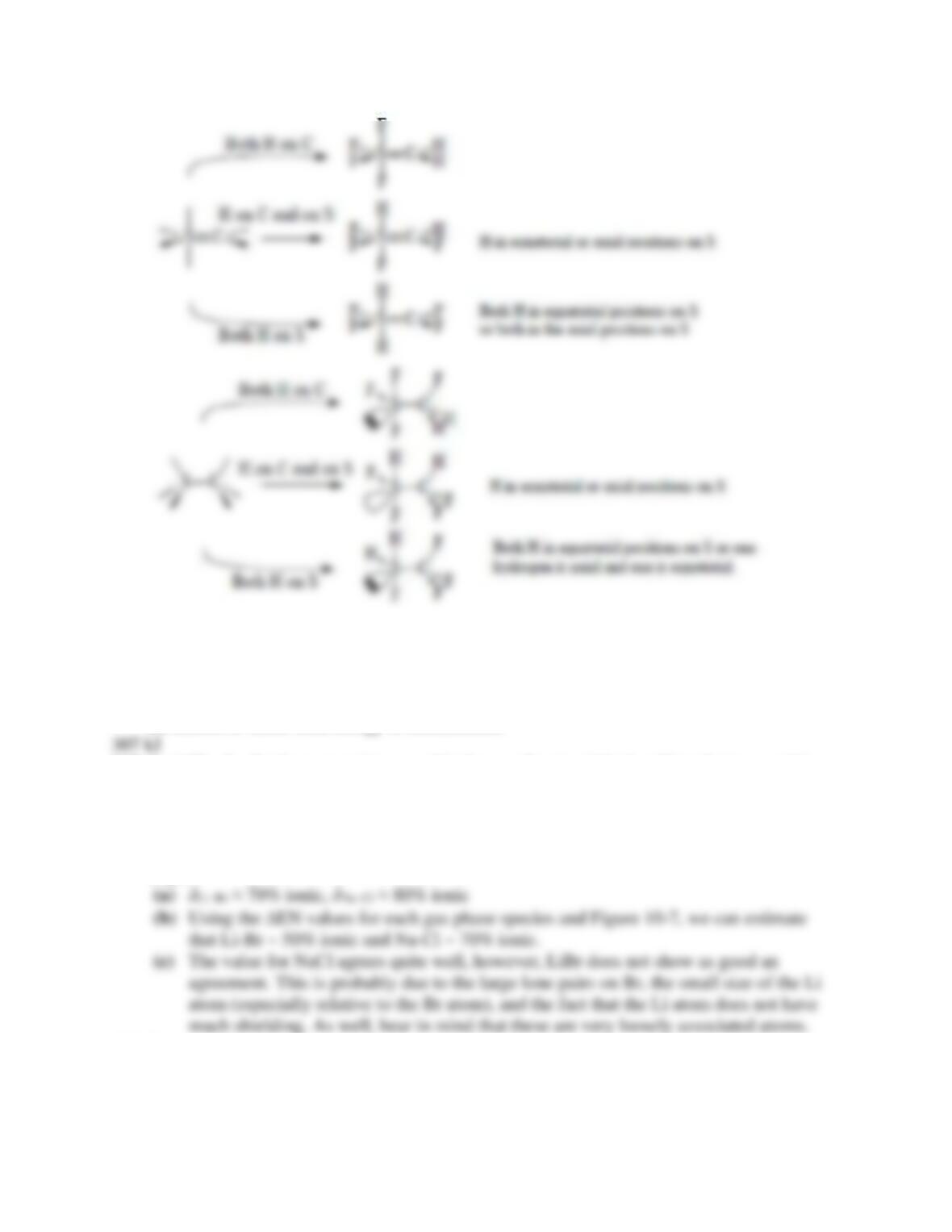
115. Use the VSEPR theory to predict a probable shape of the molecule
42
F SCH ,
and explain the
source of any ambiguities in your prediction.
Ambiguity arises because of uncertainty over (i) bond order between C and S and (ii) the
position of the H atoms.
116. The standard enthalpy of formation of methanethiol,
( )
3
CH SH g ,
is
1
22 9 kJ mol−
−
Methanethiol can be synthesized by the reaction of gaseous methanol and
( )
2
H S g
Water
vapor is another product. Use this information and data from elsewhere in the text to estimate
the carbon–to-sulfur bond energy in methanethiol.
117. For LiBr, the dipole moment (measured in the gas phase) and the bond length (measured in
the solid state) are 7.268 D and 217 pm, respectively. For NaCl, the corresponding values are
9.001 D and 236.1 pm. (a) Calculate the percent ionic character for each bond. (b) Compare
these values with the expected ionic character based on differences in electronegativity (see
Figure 10-7). (c) Account for any differences in the values obtained in these two different
ways.
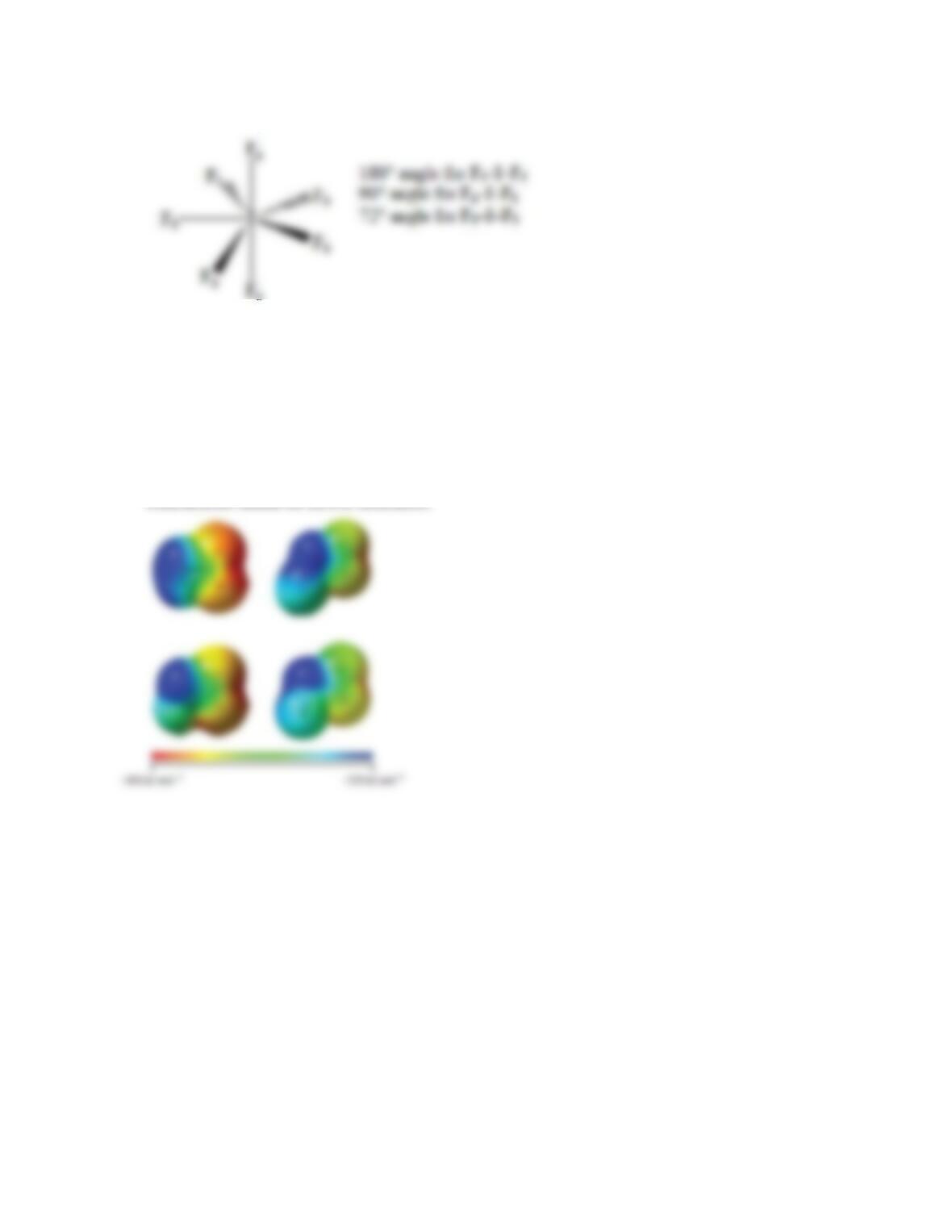
118. One possibility for the electron-group geometry for seven electron groups is pentagonal-
bipyramidal, as found in the
7
IF
molecule. Write the VSEPR notation for this molecule.
Sketch the structure of the molecule, labeling all the bond angles.
119. The extent to which an acid (HA) ionizes in water depends upon the stability of the anion
( )
A;
−
the more stable the anion, the more extensive is the dissociation of the acid. The
anion is most stable when the negative charge is distributed over the whole anion rather than
localized at one particular atom. Consider the following acids: acetic acid, -fluoroacetic
acid, cyanoacetic acid, and nitroacetic acid. Draw Lewis structures for their anions,
including contributing resonance structures. Rank the acids in order of increasing extent of
ionization. Electrostatic potential maps for the four anions are provided on the next page.
Identify which map corresponds to which anion, and discuss whether the maps confirm