cross section with sides equal to 2.50 in. The density of the steel is
3
7 70 g/cm
How many
inches long must the section of bar be?
71. The volume of seawater on Earth is about
3
330,000,000 mi
If seawater is 3.5% sodium
chloride by mass and has a density of
1 03 g/mL,
what is the approximate mass of sodium
chloride, in tons, dissolved in the seawater on Earth
(1 ton =2000 lb)?
72. The diameter of metal wire is often referred to by its American wire-gauge number. A 16-
gauge wire has a diameter of 0.05082 in. What length of wire, in meters, is found in a 1.00 lb
spool of 16-gauge copper wire? The density of copper is
3
8 92 g/cm
73. Magnesium occurs in seawater to the extent of 1.4 g magnesium per kilogram of seawater.
What volume of seawater, in cubic meters, would have to be processed to produce
74. A typical rate of deposit of dust (“dustfall”) from unpolluted air was reported as 10 tons
per square mile per month. (a) Express this dustfall in -milligrams per square meter per
hour. (b) If the dust has an -average density of
3
2 g/cm ,
how long would it take to
accumulate a layer of dust 1 mm thick?
75. In the United States, the volume of irrigation water is usually expressed in acre-feet. One
acre-foot is a volume of water sufficient to cover 1 acre of land to a depth of 1 ft
( )
2
640 acres 1 mi 1 mi 5280 ft;= =
The principal lake in the California Water Project is
Lake Oroville, whose water storage capacity is listed as
6
3 54 10
acre-feet. Express the
volume of Lake Oroville in (a) cubic feet; (b) cubic meters; (c) U.S. gallons.
76. A Fahrenheit and a Celsius thermometer are immersed in the same medium. At what
Celsius temperature will the numerical reading on the Fahrenheit thermometer be
(a) 49° less than that on the Celsius thermometer;
(b) twice that on the Celsius thermometer;
(c) one-eighth that on the Celsius thermometer;
(d) 300° more than that on the Celsius thermometer?
77. The accompanying illustration shows a 100.0 mL graduated cylinder half-filled with 8.0 g of
diatomaceous earth, a material consisting mostly of silica and used as a filtering medium in
swimming pools. How many milliliters of water are required to fill the cylinder to the 100.0
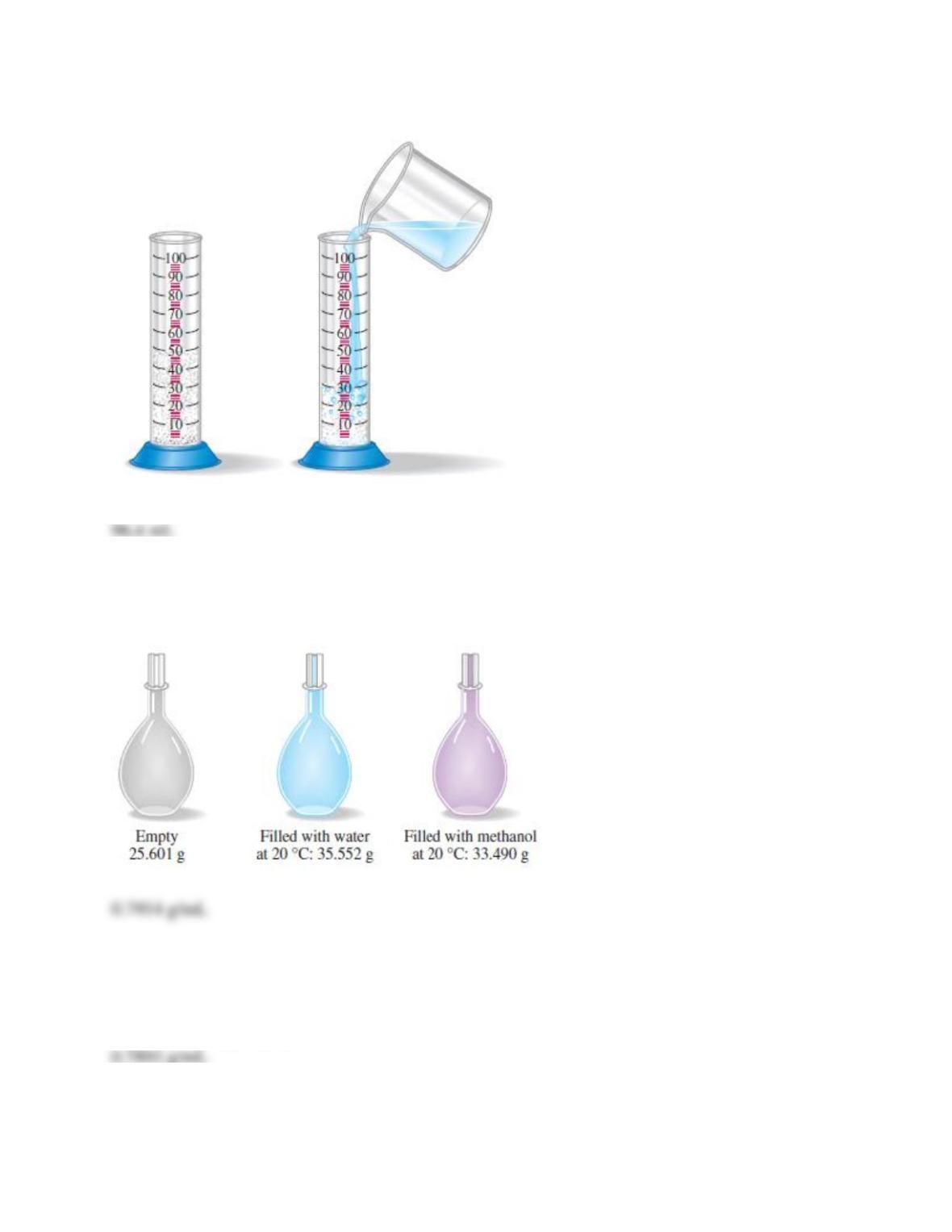
mL mark? The diatomaceous earth is insoluble in water and has a density of
3
2 2 g/cm
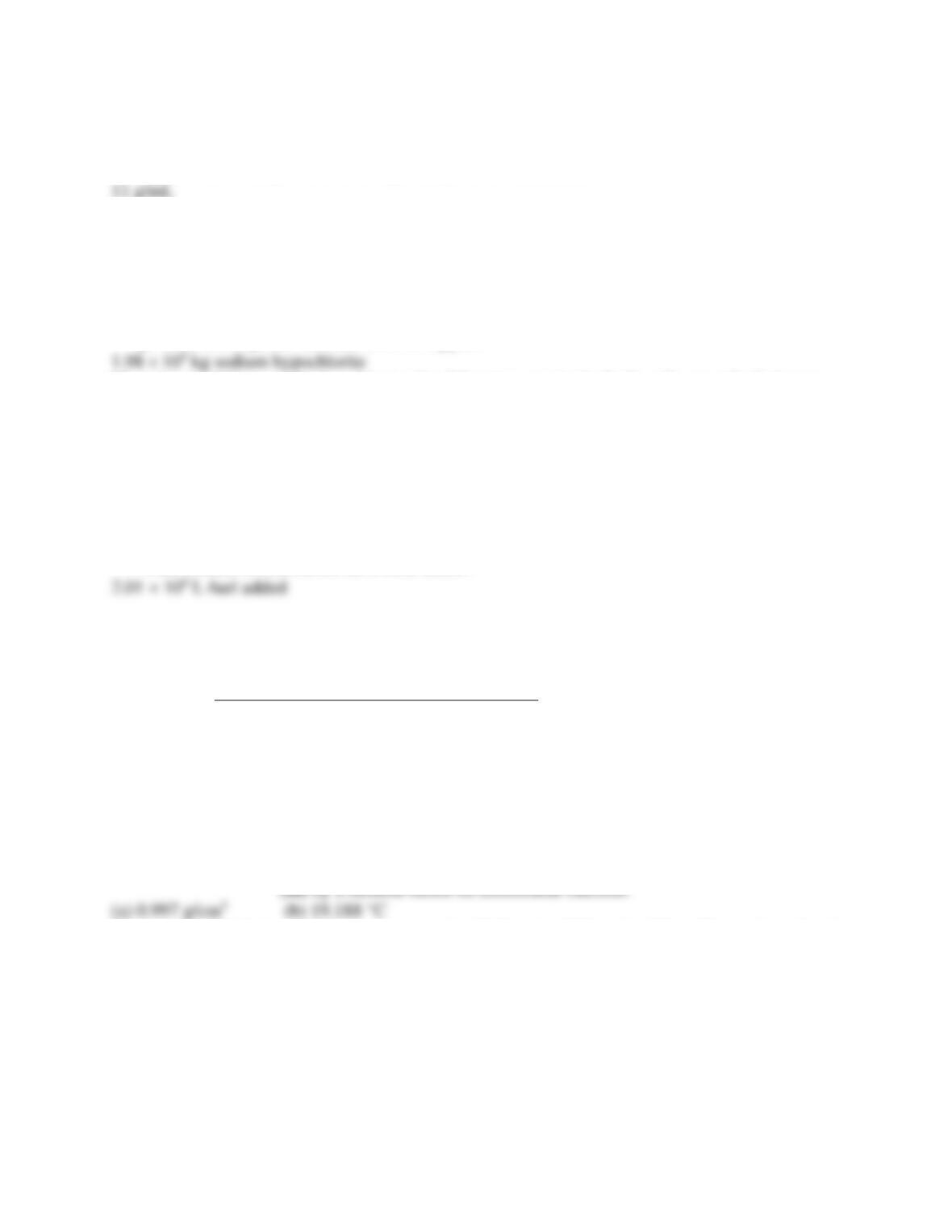
78. The simple device pictured here, a pycnometer, is used for precise density determinations.
From the data presented, together with the fact that the density of water at 20 °C is
0 99821 g/mL,
determine the density of methanol, in grams per milliliter.
79. If the pycnometer of Exercise 78 is filled with ethanol at 20 °C instead of methanol, the
observed mass is 33.470 g. What is the density of ethanol? How precisely could you
determine the composition of an ethanol–methanol solution by measuring its density with a
pycnometer? Assume that the density of the solution is a linear function of the volume
percent composition.
80. A pycnometer (see Exercise 78) weighs 25.60 g empty and 35.55 g when filled with water at
20 °C. The density of water at 20 °C is
0 9982 g/mL
When 10.20 g of lead is placed in the
pycnometer and the pycnometer is again filled with water at 20 °C, the total mass is 44.83 g.
What is the density of the lead in grams per cubic centimeter?
81. The Greater Vancouver Regional District (GVRD) chlorinates the water supply of the region
at the rate of 1 ppm, that is, 1 kilogram of chlorine per million kilograms of water. The
chlorine is introduced in the form of sodium hypochlorite, which is 47.62% chlorine. The
population of the GVRD is 1.8 million persons. If each person uses 750 L of water per day,
how many kilograms of sodium hypochlorite must be added to the water supply each week to
produce the required chlorine level of 1 ppm?
82. A Boeing 767 due to fly from Montreal to Edmonton required refueling. Because the fuel gauge
on the aircraft was not working, a mechanic used a dipstick to determine that 7682 L of fuel were
left on the plane. The plane required 22,300 kg of fuel to make the trip. In order to determine the
volume of fuel required, the pilot asked for the conversion factor needed to convert a volume of
fuel to a mass of fuel. The mechanic gave the factor as 1.77. Assuming that this factor was in
metric units
( )
kg/L ,
the pilot calculated the volume to be added as 4916 L. This volume of fuel
was added and the 767 subsequently ran out the fuel, but landed safely by gliding into Gimli
Airport near Winnipeg. The error arose because the factor 1.77 was in units of pounds per liter.
What volume of fuel should have been added?
83. The following equation can be used to relate the density of liquid water to Celsius
temperature in the range from 0 °C to about 20 °C:
( ) ( ) ( )
( )
2 6 2
3
2
0.99984 1.6945 10 7.987 10
/1 1.6880 10
tt
d g cm t
−−
−
+ −
=+
(a) To four significant figures, determine the density of water at 10 °C.
(b) At what temperature does water have a density of
3
0 99860 g/cm ?
(c) In the following ways, show that the density passes through a maximum
somewhere in the temperature range to which the equation applies.
(i) by estimation
(ii) by a graphical method
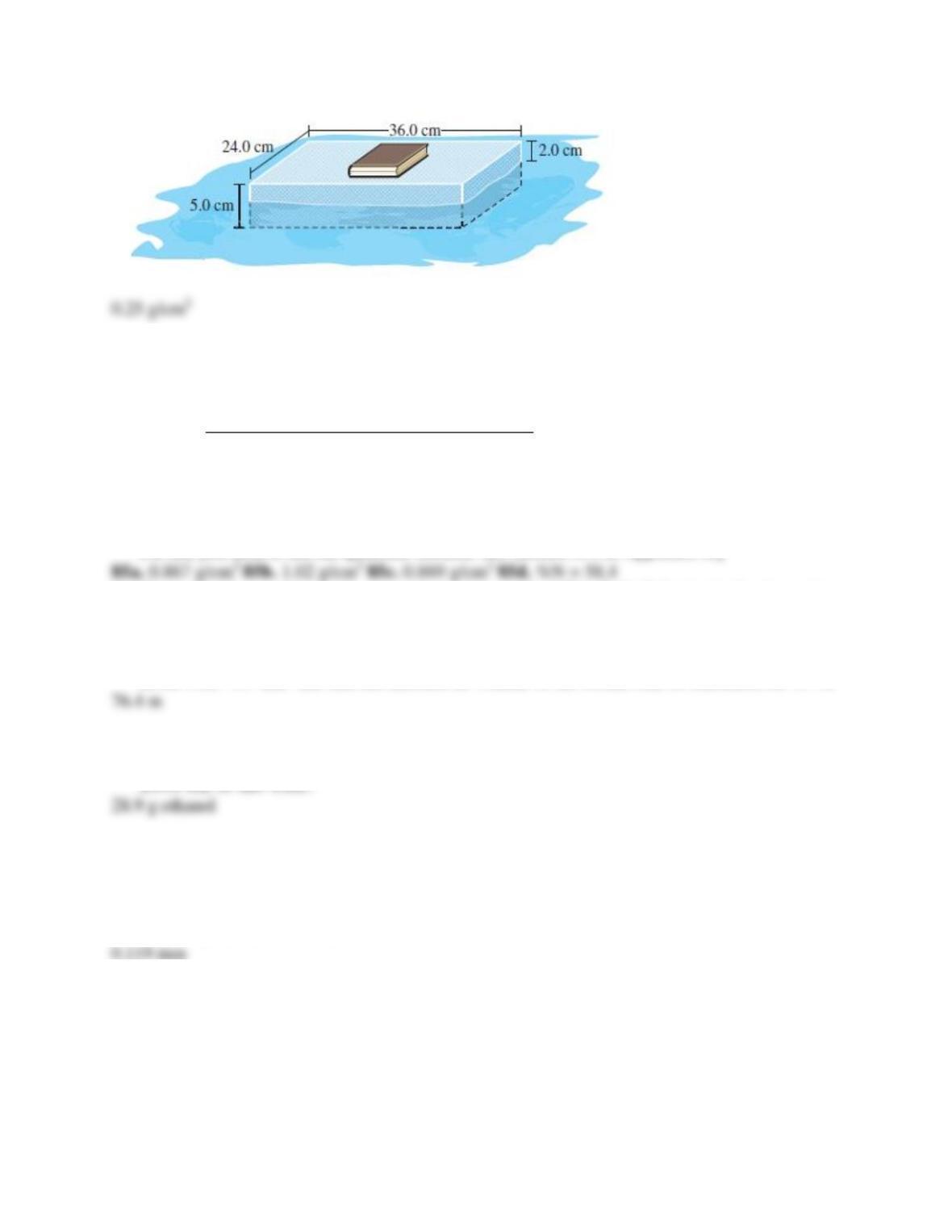
84. A piece of high-density Styrofoam measuring 24.0 cm by 36.0 cm by 5.0 cm floats when placed
in a tub of water. When a 1.5 kg book is placed on top of the Styrofoam, the Styrofoam partially
sinks, as illustrated in the diagram below. Assuming that the density of water is 1.00 g/mL, what
is the density of Styrofoam?
85. A tabulation of data lists the following equation for calculating the densities (d) of
solutions of naphthalene in benzene at 30 °C as a function of the mass percent of
naphthalene.
( )
( ) ( )
3
2
36
1
g/cm
1 153 1 82 10 % 1 08 10 %
d
NN
−−
=
− +
Use the equation above to calculate (a) the density of pure benzene at 30 °C; (b) the density of
pure naphthalene at 30 °C; (c) the density of a solution at 30 °C that is 1.15% naphthalene; (d)
the mass percent of naphthalene in a solution that has a density of 0.952 g/cm3 at 30 °C. [Hint:
For (d), you need to use the quadratic formula. See Section A-3 of Appendix A.]
86. The total volume of ice in the Antarctic is about 3.01
107 km3. If all the ice in the Antarctic
were to melt completely, estimate the rise, h, in sea level that would result from the
additional liquid water entering the oceans. The densities of ice and fresh water are 0.92
g/cm3 and 1.0 g/cm3, respectively. Assume that the oceans of the world cover an area, A, of
about 3.62
108 km2 and that the increase in volume of the oceans can be calculated as
Ah
87. An empty 3.00 L bottle weighs 1.70 kg. Filled with a certain wine, it weighs 4.72 kg. The
wine contains 11.5% ethyl alcohol by mass. How many grams of ethyl alcohol are there in
250.0 mL of this wine?
88. The filament in an incandescent light bulb is made from tungsten metal (d
=
19.3 g/cm3) that
has been drawn into a very thin wire. The diameter of the wire is difficult to measure
directly, so it is sometimes estimated by measuring the mass of a fixed length of wire. If a
0.200 m length of tungsten wire weighs 42.9 mg, then what is the diameter of the wire?
Express your answer in millimeters.
89. Blood alcohol content (BAC) is sometimes reported in weight-volume percent and, when it is, a
BAC of 0.10% corresponds to 0.10 g of ethyl alcohol per 100 mL of blood. In many
jurisdictions, a person is considered legally intoxicated if his or her BAC is 0.10%. Suppose
that a 68 kg person has a total blood volume of 5.4 L and breaks down ethyl alcohol at a rate
of 10.0 grams per hour.* How many 145 mL glasses of wine, consumed over three hours,
will produce a BAC of 0.10% in this 68 kg person? Assume the wine has a density of 1.01
g/mL and is 11.5% ethyl alcohol by mass. (*The rate at which ethyl alcohol is broken down
varies dramatically from person to person. The value given here for the rate is a realistic, but
not necessarily accurate, value.)
Feature Problems
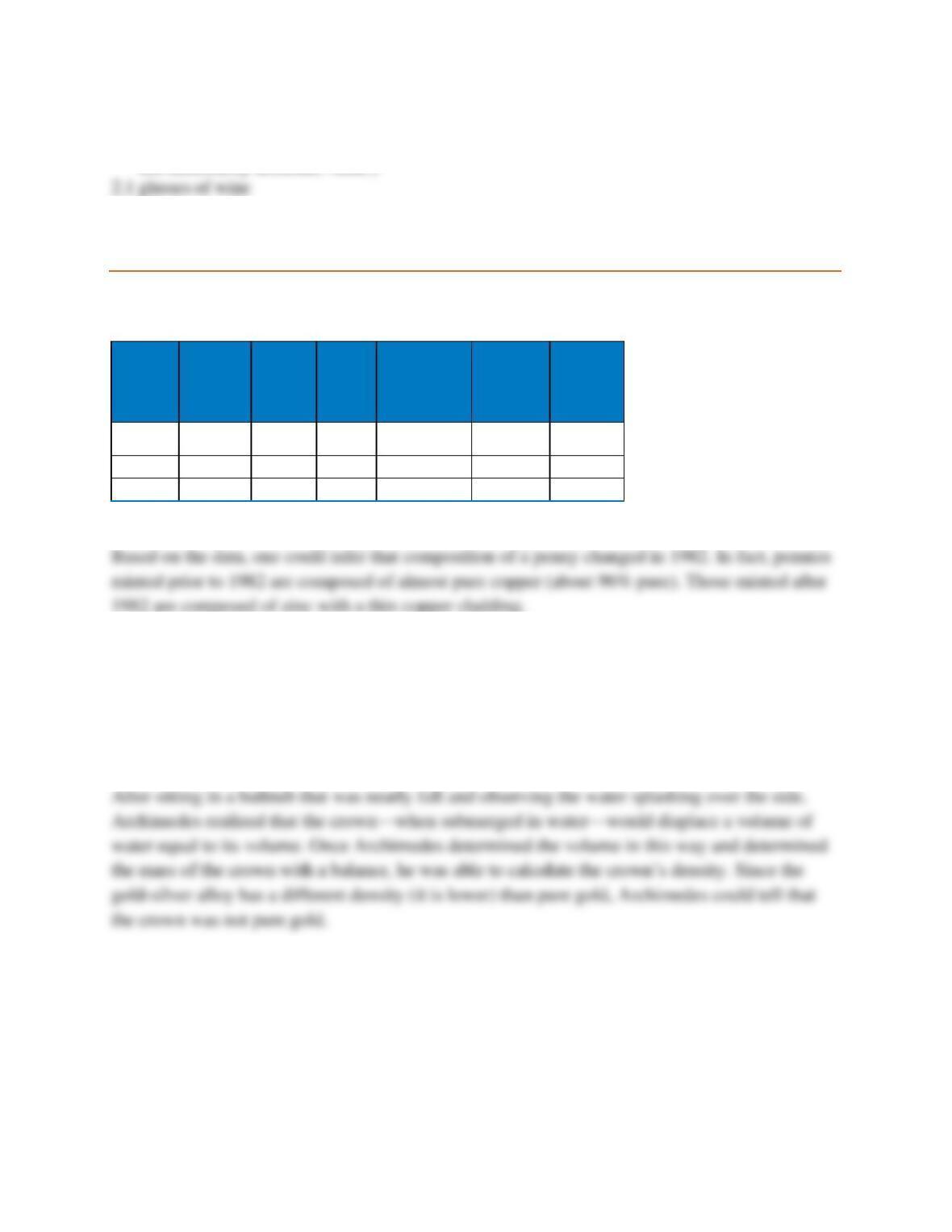
90. In an attempt to determine any possible relationship between the year in which a U.S. penny was
minted and its current mass (in grams), students weighed an assortment of pennies and obtained
the following data.
1968
1973
1977
1980
1982
1983
1985
3.11
3.14
3.13
3.12
3.12
2.51
2.54
3.08
3.06
3.10
3.11
2.53
2.49
2.53
3.09
3.07
3.06
3.08
2.54
2.47
2.53
What valid conclusion(s) might they have drawn about the relationship between the masses
of the pennies within a given year and from year to year?
91. In the third century B.C., the Greek mathematician Archimedes is said to have discovered an
important principle that is useful in density determinations. The story told is that King Hiero
of Syracuse (in Sicily) asked Archimedes to verify that an ornate crown made for him by a
goldsmith consisted of pure gold and not a gold–silver alloy. Archimedes had to do this, of
course, without damaging the crown in any way. Describe how Archimedes did this, or if you
don’t know the rest of the story, rediscover Archimedes’s principle and explain how it can be
used to settle the question.
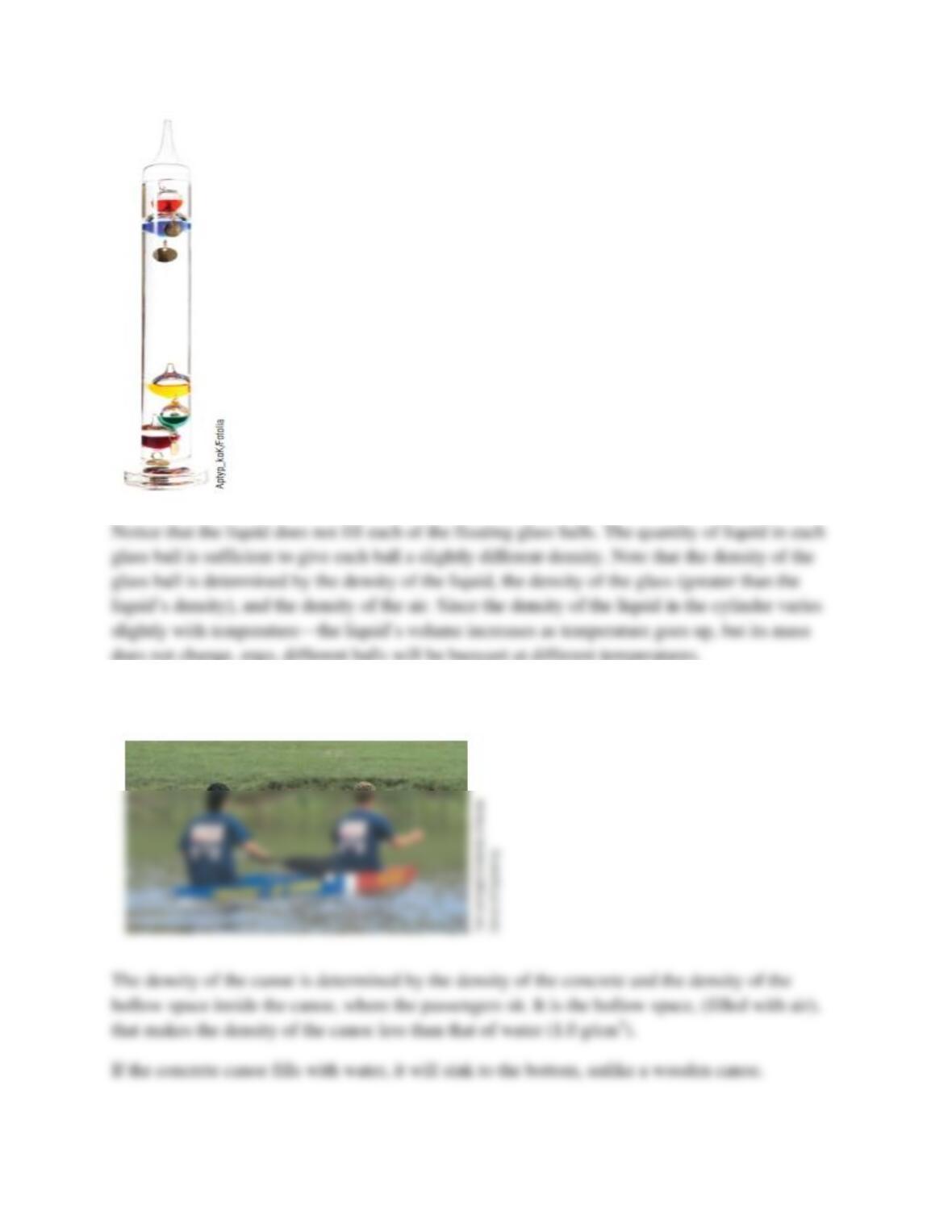
92. The Galileo thermometer shown in the photograph is based on the dependence of density on
temperature. The liquid in the outer cylinder and the liquid in the partially filled floating
glass balls are the same except that a colored dye has been added to the liquid in the balls.
Explain how the Galileo thermometer works.
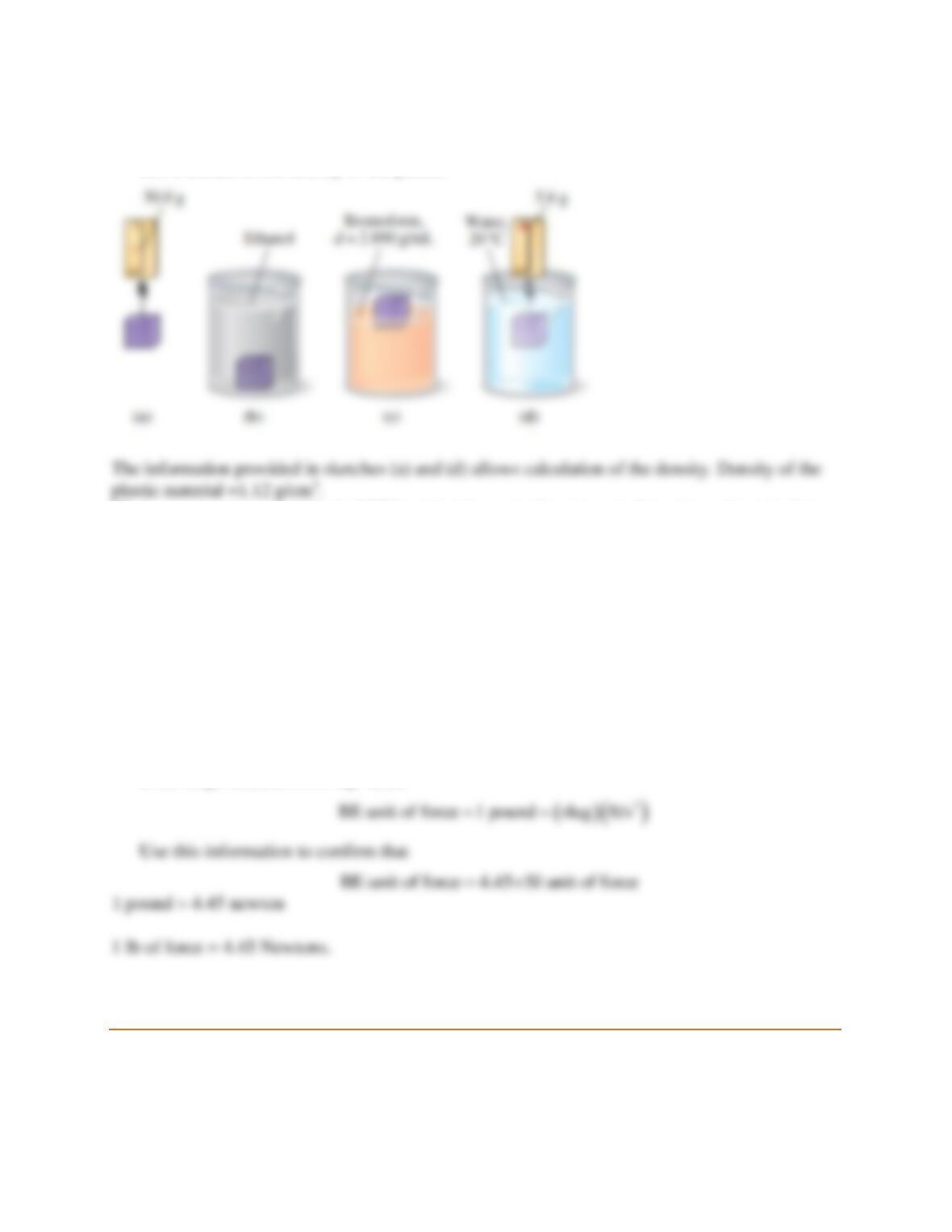
93. The canoe gliding gracefully along the water in the photograph is made of concrete, which
has a density of about
3
2 4 g/cm
Explain why the canoe does not sink.
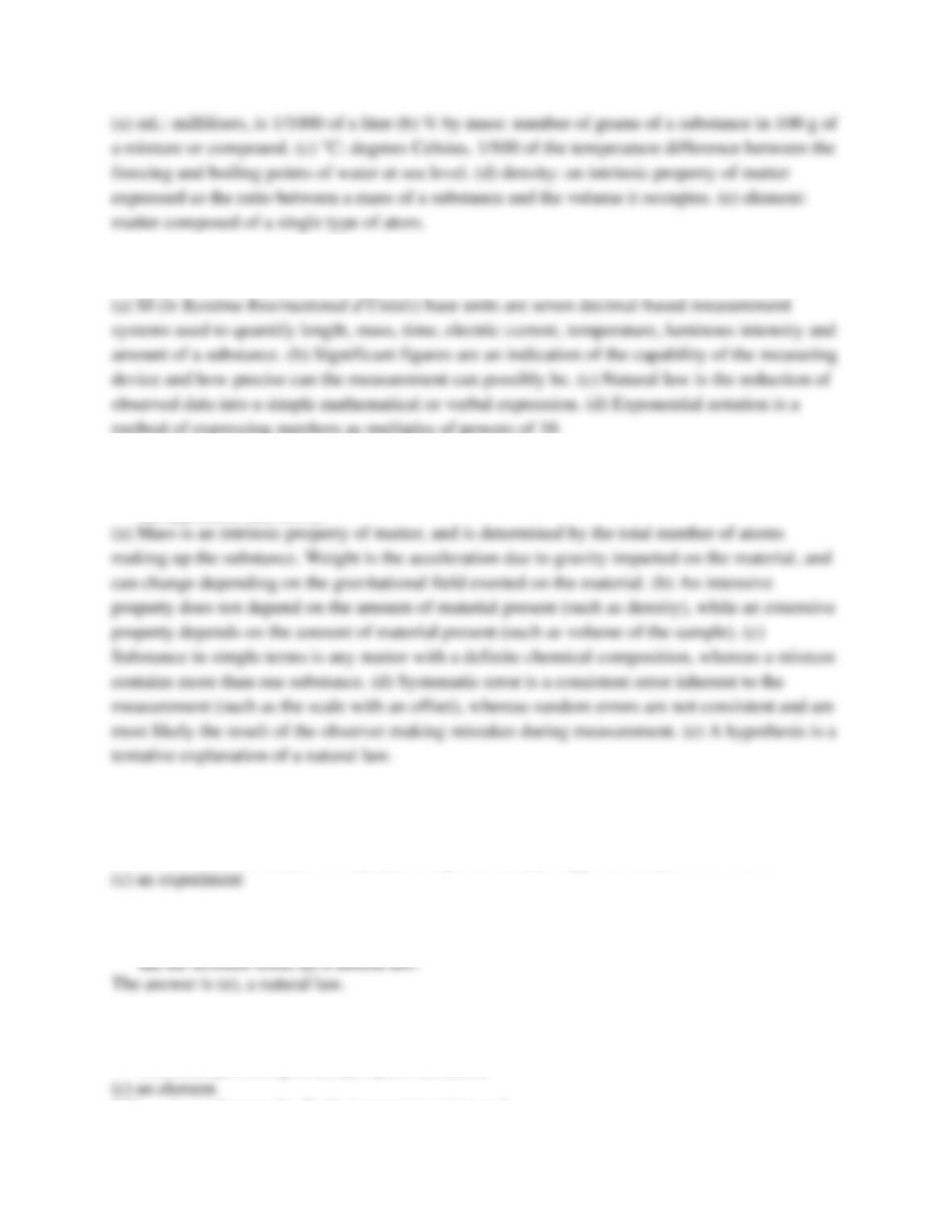
94. The accompanying sketches suggest four observations made on a small block of plastic
material. Tell what conclusions can be drawn from each sketch, and conclude by giving your
best estimate of the density of the plastic.
95. As mentioned on page 13, the MCO was lost because of a mix-up in the units used to calculate
the force needed to correct its trajectory. Ground-based computers generated the force correction
file. On September 29, 1999, it was discovered that the forces reported by the ground-based
computer for use in MCO navigation software were low by a factor of 4.45. The erroneous
trajectory brought the MCO 56 km above the surface of Mars; the correct trajectory would
have brought the MCO approximately 250 km above the surface. At 250 km, the MCO would
have suc-cessfully entered the desired elliptic orbit. The data contained in the force correction
file were delivered in lb-sec instead of the required SI units of newton-sec for the MCO
navigation software. The newton is the SI unit of force and is described in Appendix B. The
British Engineering (gravitational) system uses a pound (lb) as a unit of force and
2
ft/s
as a
unit of acceleration. In turn, the pound is defined as the pull of Earth on a unit of mass at a
location where the acceleration caused by gravity is
2
32 174 ft/s
The unit of mass in this case
is the slug, which is 14.59 kg. Thus,
Self-Assessment Exercises
96. In your own words, define or explain the follow–ing terms or symbols: (a) mL; (b) % by
mass; (c) °C; (d) density; (e) element.
97. Briefly describe each of the following ideas: (a) SI base units; (b) significant figures; (c)
natural law; (d) exponential notation.
98. Explain the important distinctions between each pair of terms: (a) mass and weight; (b)
intensive and extensive properties; (c) substance and mixture; (d) systematic and random errors;
(e) hypothesis and theory.
A theory is a hypothesis that has been supported by experimentation and data.
99. A procedure designed to test the truth or the validity of an explanation for many observations
is called (a) a law; (b) a theory; (c) an experiment; (d) a hypothesis; (e) none of these.
100. The fact that the volume of a fixed amount of gas at a fixed temperature is inversely
proportional to the gas pressure is an example of (a) a hypothesis; (b) a theory; (c) a paradigm;
101. If a sample of matter cannot be separated by physical means or decomposed by chemical
means, the sample is (a) a homogeneous mixture; (b) a heterogeneous mixture; (c) an
element; (d) a compound; (e) a pure substance.
102. A good example of a homogeneous mixture is
(a) a cola drink in a tightly capped bottle
(b) distilled water leaving a distillation apparatus
(c) oxygen gas in a cylinder used in welding
(d) the material produced in a kitchen blender
103. Compared with its mass on Earth, the mass of the same object on the moon should be
(a) less; (b) more; (c) the same; (d) nearly the same, but somewhat less.
104. Which answer has the correct number of significant figures?
(a) (14.7 + 24.312) * 87.27 = 3405
(b) (58 + 18 + 51)/3.000 = 42
(c) [97.2/(114 − 37)] = 1.26
(d) (1.172 − 0.4963)(4.193) = 2.83
(e) none of these
105. Which two of the following masses are expressed to the nearest milligram? (a) 32.7 g; (b)
0.03271 kg; (c) 32.7068 g; (d) 32.707 g; (e) 30.7 mg; (f)
3
3 10 g
.
106. The highest temperature of the following group is (a) 217 K; (b) 273 K; (c) 217 °F; (d)
105 °C; (e) 373 K.
107. Which of the following quantities has the greatest mass?
(a) 752 mL of water at 20 °C
(b) 1.05 L of ethanol at 20 °C
( )
0 789 g/mLd=
(c) 750 g of chloroform at 20 °C
( )
1 483 g/mLd=
(d) a cube of balsa wood
( )
3
0 11 g/cmd=
that is 19.20 cm on edge
108. The density of silver is 10.5 g/mL. What is the volume of 475 g of silver?
109. The density of water is 0.9982 g/cm3 at 20 °C. Express the density of water at 20 °C in
the following units: (a) g/L; (b) kg/m3; (c) kg/km3.
110. Two students each made four measurements of the mass of an object. Their results are
shown in the table below.
Student A
Student B
Four
measurements:
51.6, 50.8,
52.2, 50.2 g
50.1, 49.6,
51.0, 49.4 g
Their average:
51.3 g
50.0 g
The exact mass of the object is 51.0 g. Whose results are more precise, Student A’s or
Student B’s? Whose results are more accurate?
111. The reported value for the volume of a rectangular piece of cardboard with the
d i m e n s i o n s
36 cm
20 2 cm 9 mm
s h o u l d b e ( a )
33
6 5 10 cm ;
(b)
23
7 10 cm ;
(c)
3
655 cm ;
(d)
23
6 5 10 cm
112. List the following in the order of increasing precision, indicating any quantities about
which the precision is uncertain: (a) 1400 km; (b) 1516 kg; (c) 0.00304 g; (d) 125.34 cm; (e)
2000 mg.
113. Without doing detailed calculations, explain which of the following objects contains the
greatest mass of the element iron.
(a) A 1.00 kg pile of pure iron filings.
(b) A cube of wrought iron, 5.0 cm on edge. Wrought iron contains 98.5% iron by
mass and has a density of
3
7 7 g/cm
(c) A square sheet of stainless steel 0.30 m on edge and 1.0 mm thick. The stainless
steel is an alloy (mixture) containing iron, together with 18% chromium, 8% nickel, and
0.18% carbon by mass. Its density is
3
7 7 g/cm
(d) 10.0 L of a solution characterized as follows:
1 295 g/mLd=
This solution is
70.0% water and 30.0% of a compound of iron, by mass. The iron compound consists of
34.4% iron by mass.
114. A lump of pure copper weighs 25.305 g in air and 22.486 g when submerged in water
( )
0 9982 g/mLd=
at 20.0 °C. Suppose the copper is then rolled into a
2
248 cm
foil of
uniform thickness. What will this thickness be, in millimeters?
115. Water, a compound, is a substance. Is there any circumstance under which a sample of
pure water can exist as a heterogeneous mixture? Explain.
116. In the production of ammonia, the following processes occur.
(a) Air is liquefied at low temperature and high pressure.
(b) The temperature of the liquid air is raised gradually until the oxygen boils off.
Essentially pure liquid nitrogen remains.
(c) Natural gas is treated with steam to produce carbon dioxide and hydrogen. The
proportions of the products vary with the composition of the natural gas.
(d) Hydrogen and nitrogen (both gases) are combined at high temperature and
pressures. They react to form ammonia gas. Some unreacted hydrogen and nitrogen
remain.
(e) The gases are cooled until the ammonia liquefies, and then the gaseous hydrogen
and nitrogen are recirculated to react again.
For each of (a) to (e), indicate whether a physical or chemical change occurs, and briefly
explain your choice. For each italicized word or phrase, state whether it refers to an
element, a compound, a mixture, or none of these, and briefly explain your choice.
117. Appendix E describes a useful study aid known as concept mapping. Using the
method presented in Appendix E, construct a concept map illustrating the different concepts