Electrons in Atoms and 9
the Periodic Table
Chapter Overview
This chapter gives us the background of atomic theory. All atomic theories attempt to
explain experimental observations. The current quantum mechanical model is much more
complicated than the Bohr model. The periodic trends based on electronic structure are also
discussed.
Lecture Outline
9.1 Blimps, Balloons, and Models for the Atom
9.2 Light: Electromagnetic Radiation
Learning Objective: Understand and explain the nature of electromagnetic radiation.
A. Light is not matter, it is pure energy
B. A photon is a particle of light
9.3 The Electromagnetic Spectrum
Learning Objective: Predict the relative wavelength, energy, and frequency of different
types of light.
A. Gamma rays
2. Low frequency
B. X-rays
C. Ultraviolet
D. Visible
1. Very narrow band
2. Does not damage biological molecules
9.4 The Bohr Model: Atoms with Orbits
Learning Objective: Understand and explain the key characteristics of the Bohr model of
the atom.
9.5 The Quantum-Mechanical Model: Atoms with Orbitals
Learning Objective: Understand and explain the key characteristics of the quantum-
mechanical model of the atom.
9.6 Quantum-Mechanical Orbits and Electronic Configuration
Learning Objective: Write electron configurations and orbital diagrams for atoms.
A. Quantum numbers
2. Subshell
B. Electronic configuration
2. Li: 1s22s1
C. How the electrons fill in the atom’s orbitals
2. Pauli exclusion principle
9.7 Electron Configurations and the Periodic Table
Learning Objective: Identify valence electrons and core electrons.
Learning Objective: Write electron configurations for elements based on their positions
in the periodic table.
A. Valence electrons
B. Core electrons
C. Writing electronic configurations
1. Noble gas core
3. Highest n value is equal to row value
9.8 The Explanatory Power of the Quantum-Mechanical Model
Learning Objective: Recognize that the chemical properties of elements are largely
determined by the number of valence electrons they contain.
9.9 Periodic Trends: Ionization Energy, Atomic Size, and Metallic Character
Learning Objective: Identify and understand periodic trends such as atomic size,
ionization energy, and metallic character.
A. Atomic size
1. Decreases as you move to the right along a row
B. Ionization energy
1. Increases as you move to the right along a row
C. Metallic character
1. Decreases as you move to the right
2. Increases as you go down
Chemical Principle Teaching Ideas
Light
Emphasize for the students that all light behaves like the light we see with our eyes.
Radio waves, infrared radiation, and gamma rays are just different “colors” of light. Our eyes are
radiation detectors of a very narrow frequency range. Our bodies can be thought of as infrared
detectors. The molecules in our skin absorb the infrared radiation and get excited, making us feel
warm. However, radio waves pass through us with no reaction.
Bohr Model
As a first model of the nuclear atom, the Bohr model explained many observed properties
The Quantum-Mechanical Model
The idea of not knowing the exact locations of the electrons is sometimes difficult for
students. Try blowing up a latex balloon with helium. Have them think about one particular
helium atom in the balloon. We know it is inside the balloon, but not exactly where inside.
However, the balloon will slowly deflate, so sometimes the helium atom is outside the balloon.
You are more than 90% sure the atom is inside the balloon, but there is a small chance it is out.
This is the same idea as the probability map of an electron orbital.
The Periodic Table
Not only do species in the same column or group have similar properties, but elements in
Skill Builder Solutions
9.1. a. Blue (~390 nm), green, red (~680 nm)
9.2. a. Al has13 electrons. Putting them in order gives 1s22s22p63s23p1 or [Ne] 3s23p1
b. Br has 35 electrons. Putting them in order gives 1s22s22p63s23p64s23d104p5
Plus. a. A neutral Al atom has 13 electrons, so a +3 ion has 13 – 3 = 10 electrons, and the
electron configuration is the same as Ne: 1s22s22p6.
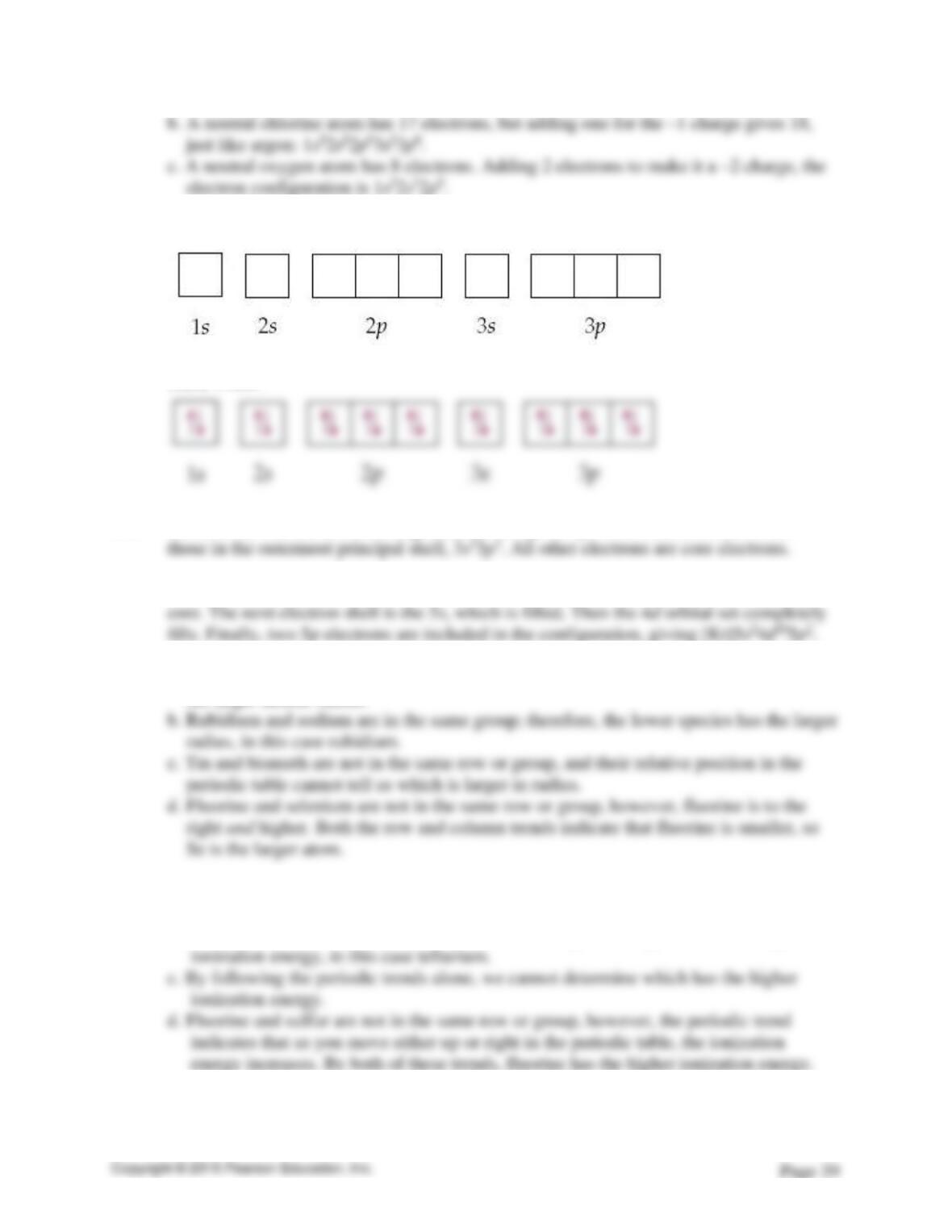
9.3. Argon has 18 electrons. Let us first draw the orbitals up to the 3p
We then distribute the 18 electrons in the orbitals, going from left to right remembering
Hund’s rule:
9.4. Chlorine has the electronic configuration 1s22s22p63s23p5. The valence electrons are
9.5. Tin has 50 electrons. We go back to the last noble gas, which is Kr, and start with that
9.6. a. Lead and polonium are in the same row, and by following the periodic trend, lead has
the larger atomic radius.
9.7. a. Magnesium is higher on the periodic table and in the same group. By the periodic
trend, it has a higher ionization energy.
b. Tellurium and indium are in the same row, so the right-most species has the higher
9.8. a. Indium is closer to the lower left corner of the periodic table, and the periodic trend
indicates that it has the larger metallic character.
b. Gallium and tin are equally distant from the lower left corner of the periodic table;
Guided Inquiry Ideas
Below are a few example questions that students answer in the guided inquiry activities provided
in the Guided Activity Workbook.
What is the value of n for the outermost principle shell of silicon?
Recall that the alkali metals (first column of the periodic table) all demonstrate similar chemical
properties. How do their electron configurations compare?
Why is the electron configuration for sodium (Na, 11 electrons) 1s2 2s2 2p6 3s1 instead of
1s2 2s2 2p7?