Chapter 8
8.1 The term 0.18FCI has nothing to do with the interest on capital investment. From Table
8.2 we see that the following costs are based on the FCI:
Maintenance and repairs
8.2 The number of operators per shift is multiplied by approximately 4.5 to get the total
number of operators required by the plant because it is assumed that a single operator
works 5 shifts a week and 49 weeks per year.
8.3 Stream Factor (SF) = # Days plant operated per yea
r
365 (Equation 8.5)
8.5 The simple answer is that the cooling water cost does not vary very much with return
temperature because the main costs are associated with pumping (electricity), fans (power),
cost of water make up and chemical addition.
8-2
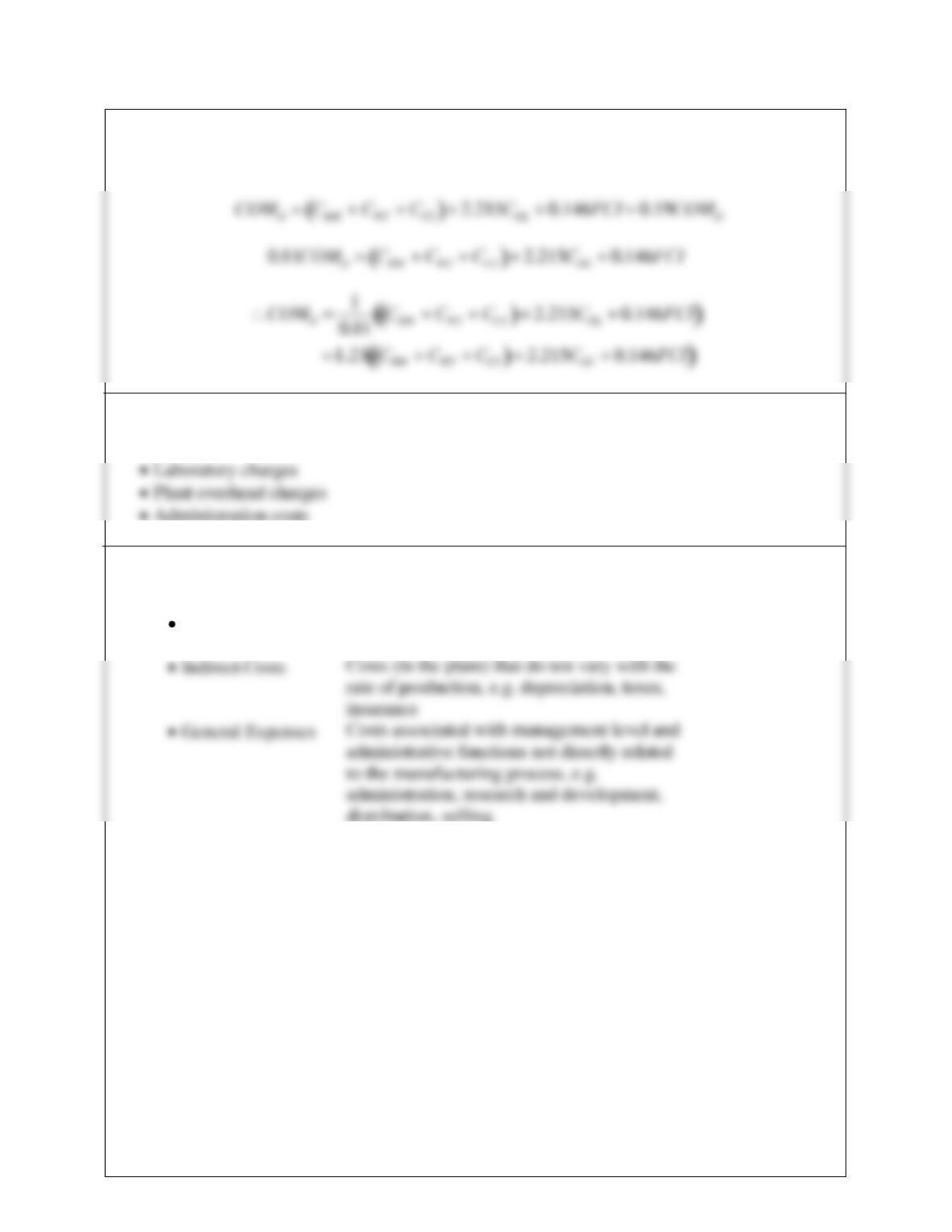
8.6 No this is not the reason for the factor of 1.23 multiplying CRM. The reason is that in the
derivation of Equation (8.2) from the data in Table 8.2 some of the costs are based on the
COMD. Thus when all terms are added, the factor multiplying COMD is 0.19COMD.
8.7 Yes, the 2.73 multiplier does include costs for supervisory and clerical labor but also
includes:
8.8 From Table 8.1 we have
Direct Costs Costs that vary with the rate of production
e.g. raw materials, utility costs.
8-3
8.9
(a) Options (i) and (ii) are not reliable, and option (iii) is the best. If you do not have
time to dig up information on the new plant then (i) is probably better than (ii) unless
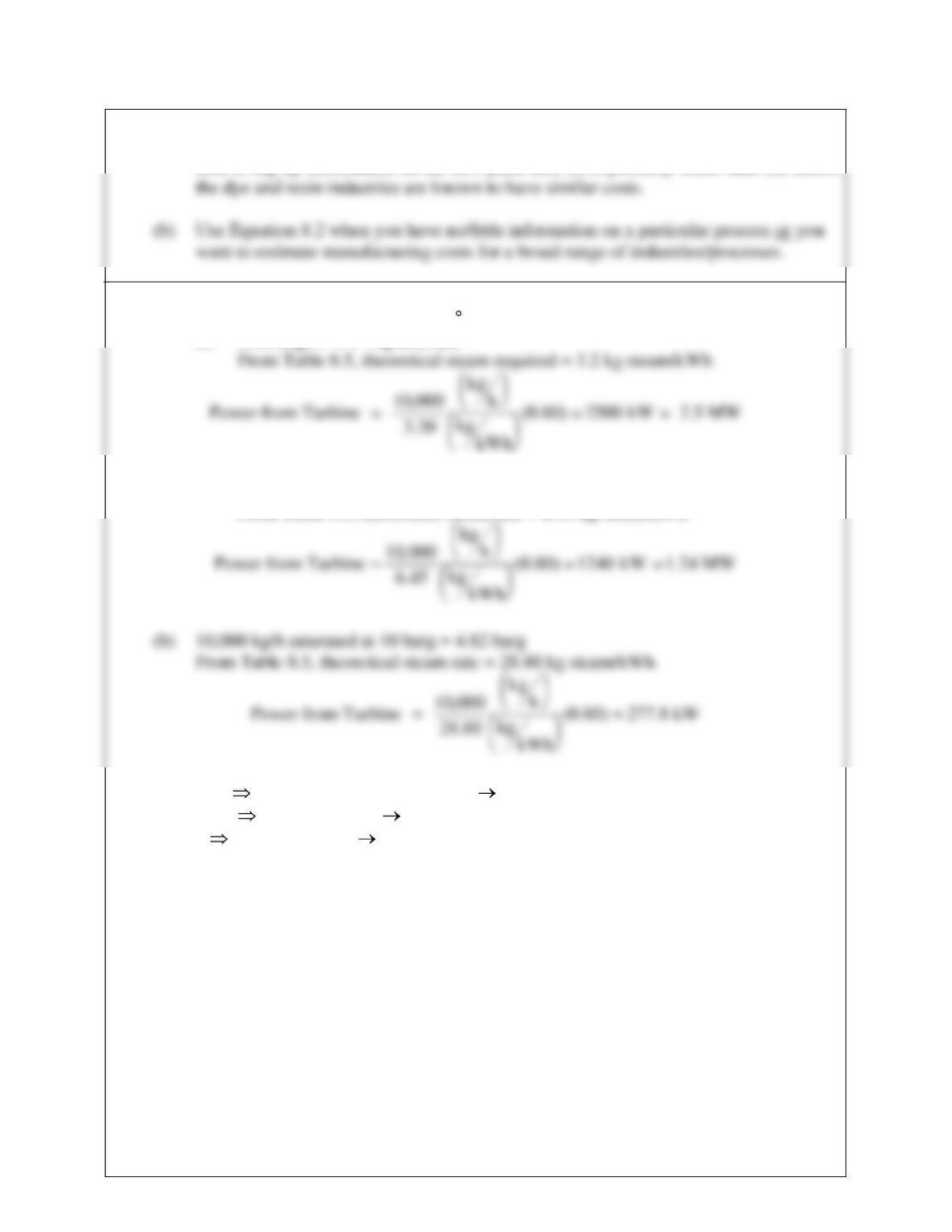
8.10 (a) 10,000 kg/h, 58.6 barg SH = 165 C
(i) Discharge P = 4 Hg absolute
(ii) Discharge P = 4.82 barg
From Table 8.5, theoretical steam rate = 6.45 kg steam/kWh
(c) a-(i) Turbine #1 in Figure 8.6 (HP surface condenser)
a-(ii) Turbine #2 (HP LP)
b Turbine #4 (MP LP)
8-4
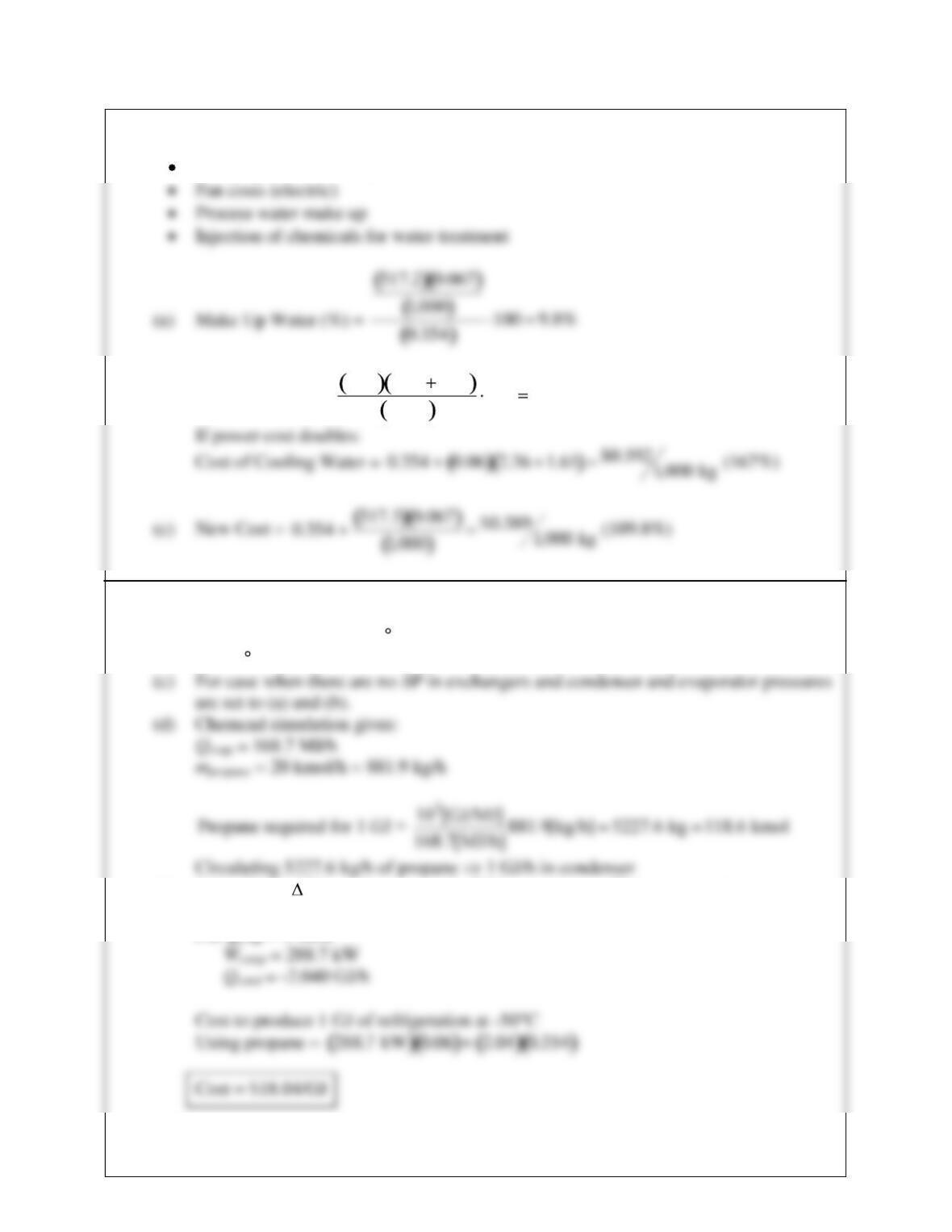
8.11 Costs for cooling water are:
Pumping costs (electric)
(b) Power Cost (%) = 0.06 2.36 1.61
0.354 100 67.3%
8.12 (a) Using Chemcad and SRK package for k-values and enthalpy calculations, the
following data are found: at 45 C vapor pressure of propane = 1556 kPa
(b) At -50 C vapor pressure of propane = 69.47 kPa
(e) Using 5 kPa P in exchangers and a 75% compressor efficiency we get:
For Qevap = 1 GJ/h
8-5
8.13 (a) Repeat problem 8.12 using propylene as refrigerant
Vapor pressure (45 C) = 1,876 kPa
(b) Repeat problem 8.12 using ethane as refrigerant
Vapor pressure (45 C) = No result Tcritical 32 C
(c) Repeat problem 8.12 using ammonia as refrigerant
Vapor pressure (45 C) = 1,797 kPa
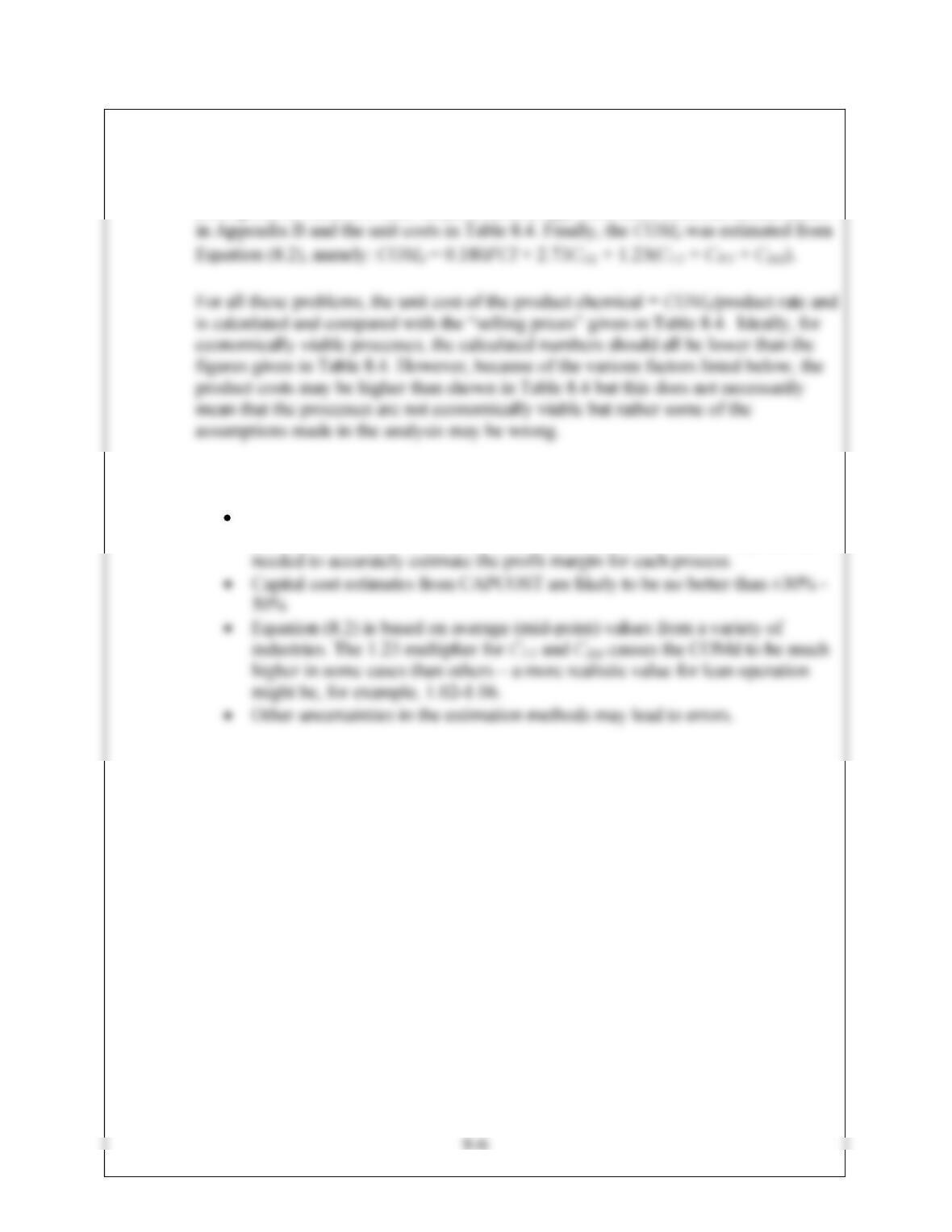
Note: For problems 12 and 13 only single stage compressors have been used.
Because the pressure ratios are all much greater than the recommended maximum of
Cost 232.6 kW 0.06 1.837 GJ/h 0.354 $14.61GJ
For the solutions to Problems (8.14-8.19), fixed capital investment figures (FCI) were
taken from the results of Problems (7.22-7.27), using the CAPCOST program. The
utility costs (CUT) were also estimated using the results of CAPCOST and the utility
costs given in Table 8.3. Raw material costs (CRM) were taken from the stream tables
Factors/assumptions in analysis that may require modification:
Raw material costs given in Table 8.4 are a single snapshot of prices at a
given point in time – historical trends of product and raw material prices are
8-7
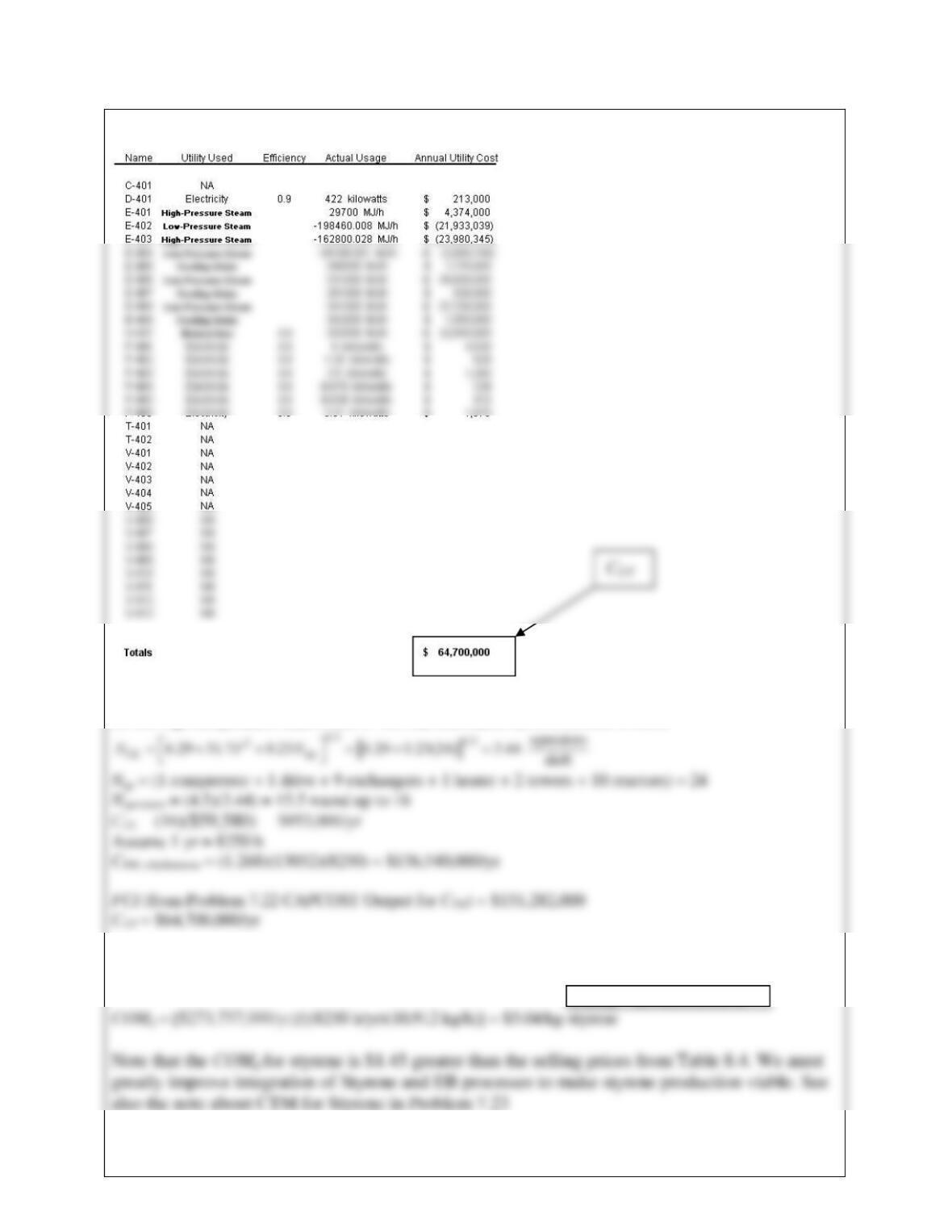
8.14 Operating Costs for the Ethyl Benzene Project B.2
Note that full credit is given for the steam generated in E-301 304 (In CAPCOST, this credit is
activated by using a negative duty for the exchanger)
FCI (from Problem 7.21 CAPCOST Output for CTM) = $12,455,000
CUT = $390,000/yr
COMd =0.180FCI + 2.73COL + 1.23(CUT + CWT + CRM) = 0.180(12.46) + 2.73(0.894) +
1.23(0.390 + 0 + 59.82+35.18) = $122,013,000/yr
CUT
8-8
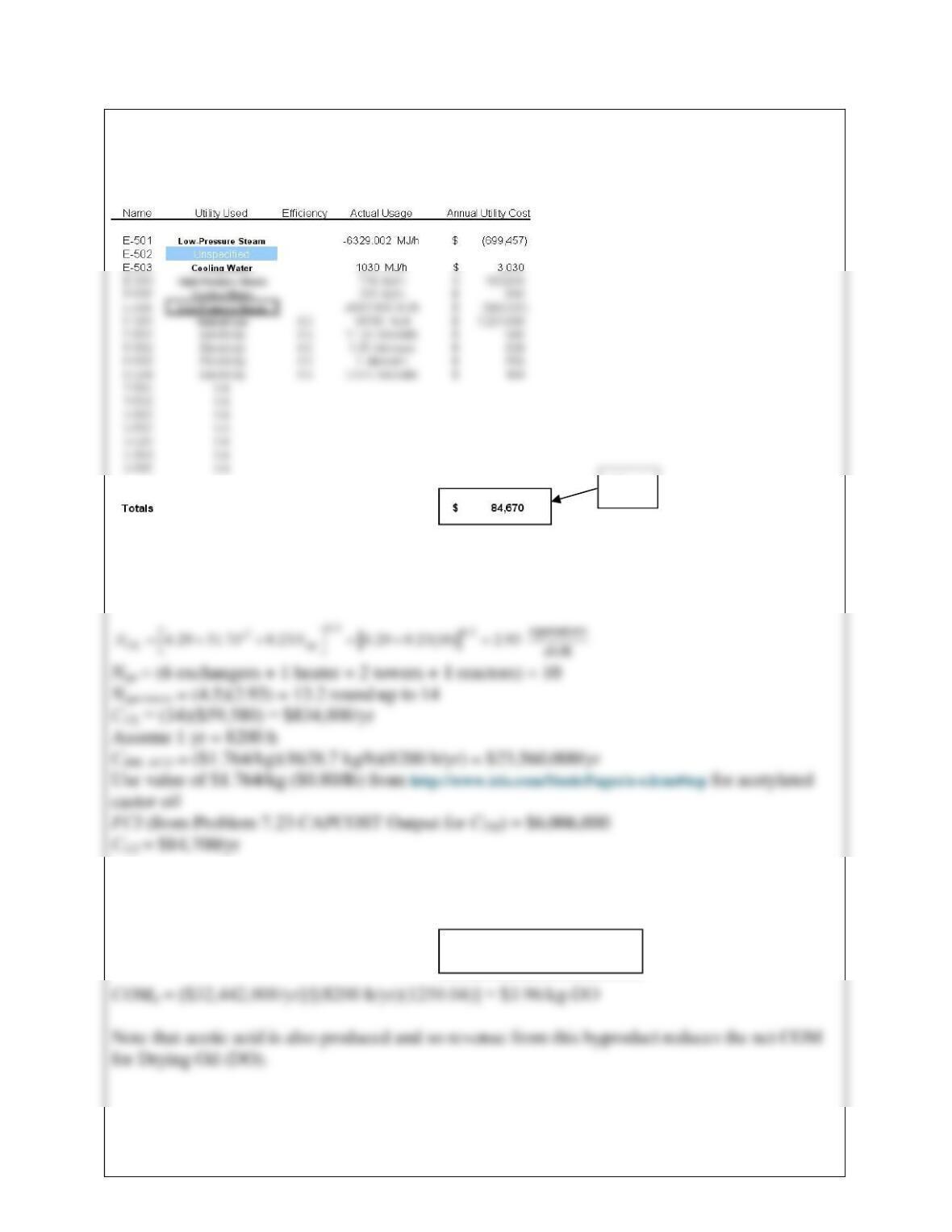
8.15 Operating Costs for the Styrene Process Project B.3
Note that full credit for the HPS and LPS in Exchangers E-403 and E-404 has been taken and that credit
for the high temperature steam from E-402 has been taken as LPS (which is low).
COMd =0.180FCI + 2.73COL + 1.23(CUT + CWT + CRM) = 0.180(131.28) + 2.73(0.953) + 1.23(64.7 + 0 +
136.54) = $273,757,000/yr
COMd = $298,300,000/yr
8-9
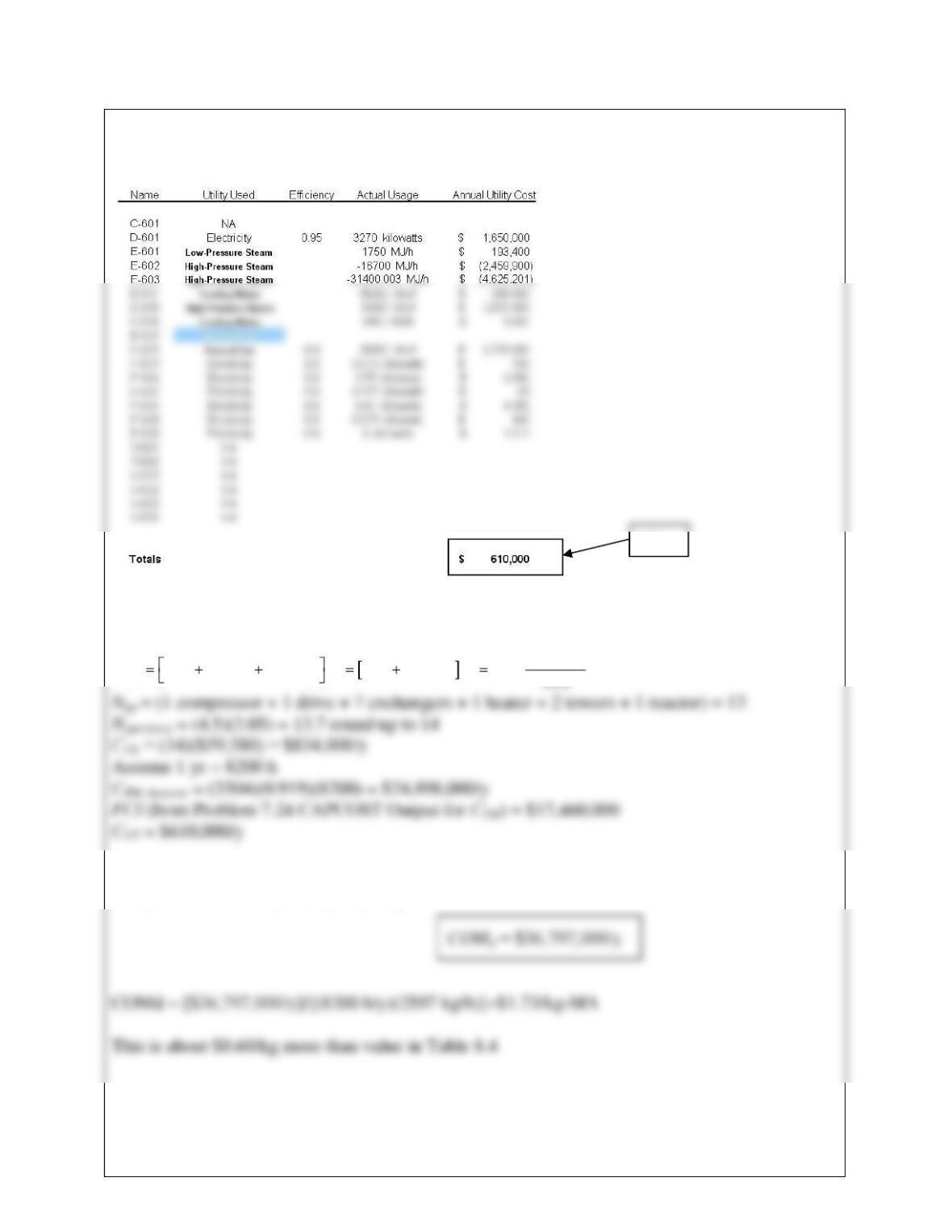
8.16 Operating Costs for the Drying Oil Process Project B.4
Note that the utility cost for the Dowtherm exchanger (E-402) is accounted for in the natural gas
for the fired heater and lps credit is given for E-501 and E-506.
COMd =0.180FCI + 2.73COL + 1.23(CUT + CWT + CRM) = 0.180(6.01) + 2.73(0.834) + 1.23(.085
+ 0 +23.56) = $32,442,000/yr
COMd = $32,442,000/yr
CUT
8-10
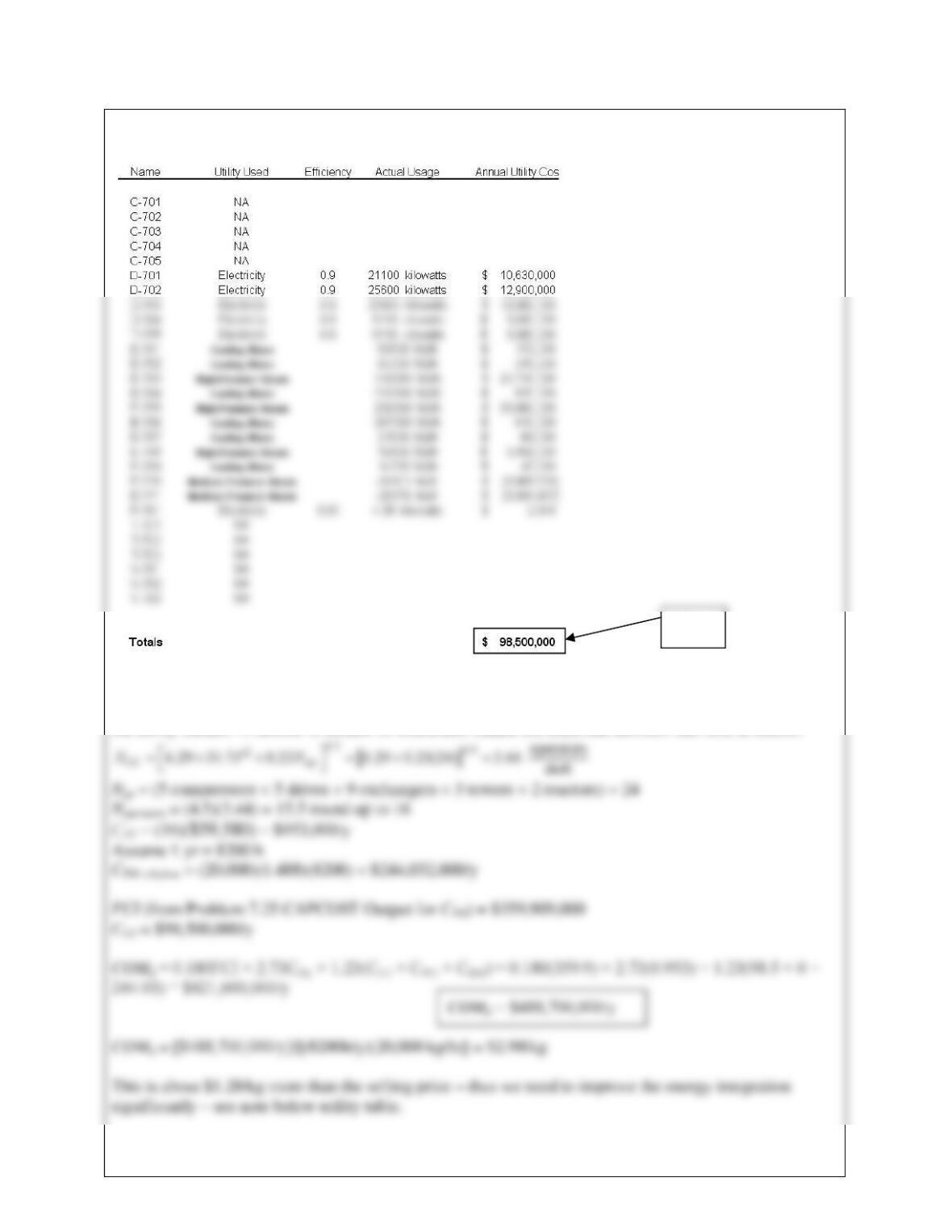
8.17 Operating Costs for the Maleic Anhydride Process Project B.5
Note that credit is taken for hps in E-602 and E-603
0.5 0.5
2operators
6.29 31.7 0.23 6.29 0.23(13) 3.05 shift
OL np
N P N
COMd =0.180FCI + 2.73COL + 1.23(CUT + CWT + CRM) = 0.180(17.46) + 2.73(0.834) +
1.23(0.61 + 0 + 24.90) = $36,797,000/y
C
UT
8-11
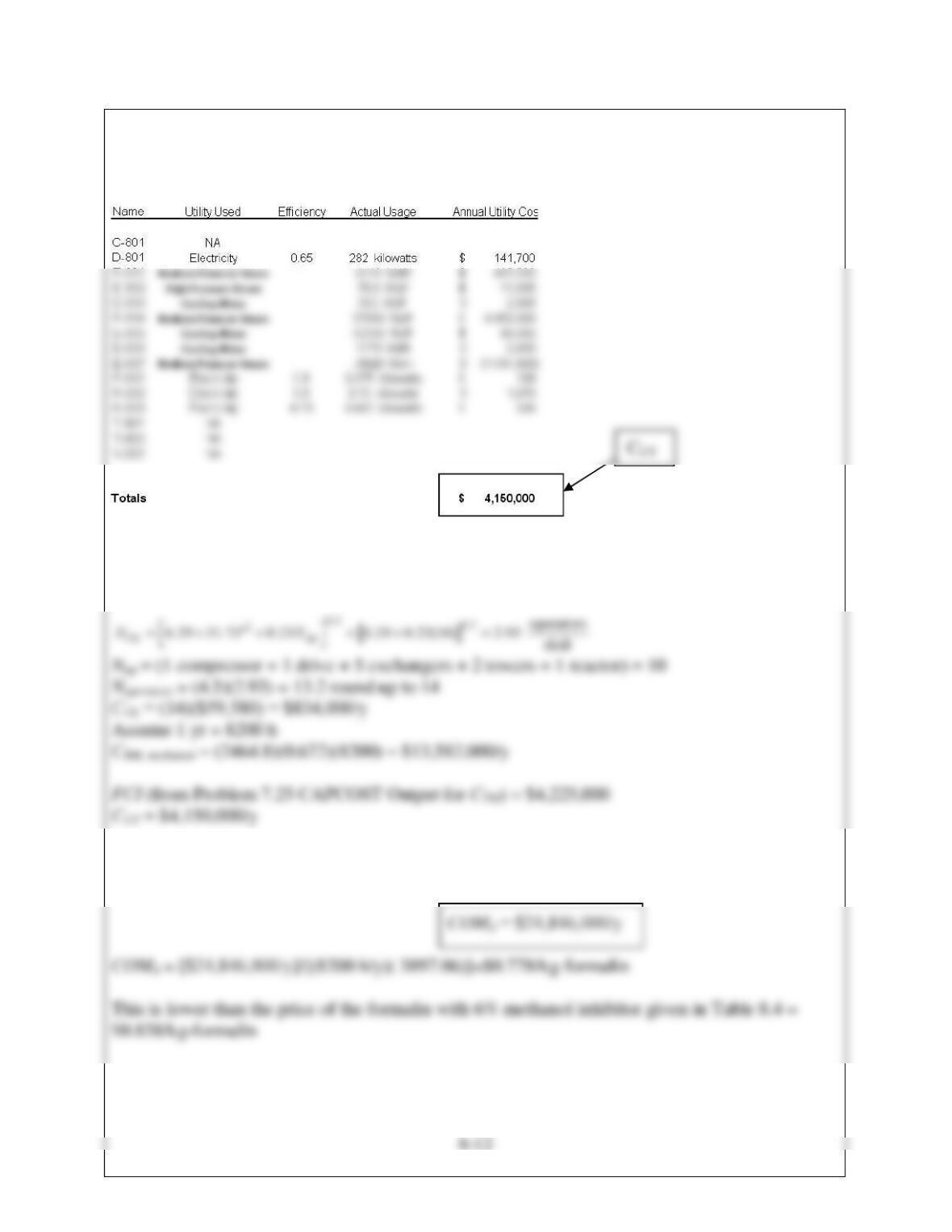
8.18 Operating Costs for the Ethylene Oxide Process Project B.6
Note that credit is taken for hps in R-701 and R-702 that correspond to E-710 and E711. This process
looses enormous amounts of useful energy in E-704 and E-706. Heat integration can significantly reduce
the utility burden. A turbine in Stream 29 could also reduce the electrical utilities. See note at bottom
CUT
8.19 Operating Costs for the Formalin Process Project B.7
Note that credit for the mps generated in the reactor is taken account of in E-807, which
represents the reactor exchanger.
COMd =0.180FCI + 2.73COL + 1.23(CUT + CWT + CRM) = 0.180(4.23) + 2.73(0.834) + 1.23(4.15
+ 0 + 13.58) = $24,846,000/y