Quantities in Chemical 8
Reactions
Chapter Overview
Chapter 8 incorporates more in-depth calculations involved in the study of chemistry.
Conversions between amounts of different species using a chemical equation will be discussed.
A simple example involving pancakes is used to introduce a traditionally difficult concept. As
this is a concept that students will use again later in the text, the content here is very important.
Lecture Outline
8.1 Climate Change: Too Much Carbon Dioxide
8.2 Making Pancakes: Relationships between Ingredients
Learning Objective: Recognize the numerical relationship between chemical quantities in
8.3 Making Molecules: Mole-to-Mole Conversions
Learning Objective: Carry out mole-to-mole conversions between reactants and products
8.4 Making Molecules: Mass-to-Mass Conversions
Learning Objective: Carry out mass-to-mass conversions between reactants and products
8.5 More Pancakes: Limiting Reactant, Theoretical Yield, and Percent Yield
Learning Objective: Calculate limiting reactant, theoretical yield, and percent yield for a
8.6 Limiting Reactant, Theoretical Yield, and Percent Yield from Initial Masses of Reactants
Learning Objective: Calculate limiting reactant, theoretical yield, and percent yield for a
8.7 Enthalpy: A Measure of Heat Evolved or Absorbed in a Reaction
Learning Objective: Calculate the amount of thermal energy emitted or absorbed by a
chemical reaction.
Chemical Principle Teaching Ideas
Stoichiometry
The use of a real world example here allows for further solidification of the concept in
the students’ minds. Any number of examples can be used, including a bicycle shop, cooking, or
the building of a house.
Limiting Reactant, Theoretical Yield, and Percent Yield
Use a real-world example as a sample calculation of limiting reactant, theoretical yield,
and percent yield. For example, given 5 slices of ham and 4 slices of bread, how many ham
sandwiches can be made? Then, do a very simple chemical example, e.g., given 1.0 g of H2 and
1.0 g of O2, what are the limiting reactant and theoretical yield?
Skill Builder Solutions
2 mol H O
32
1000g SO
2
1 mol SO
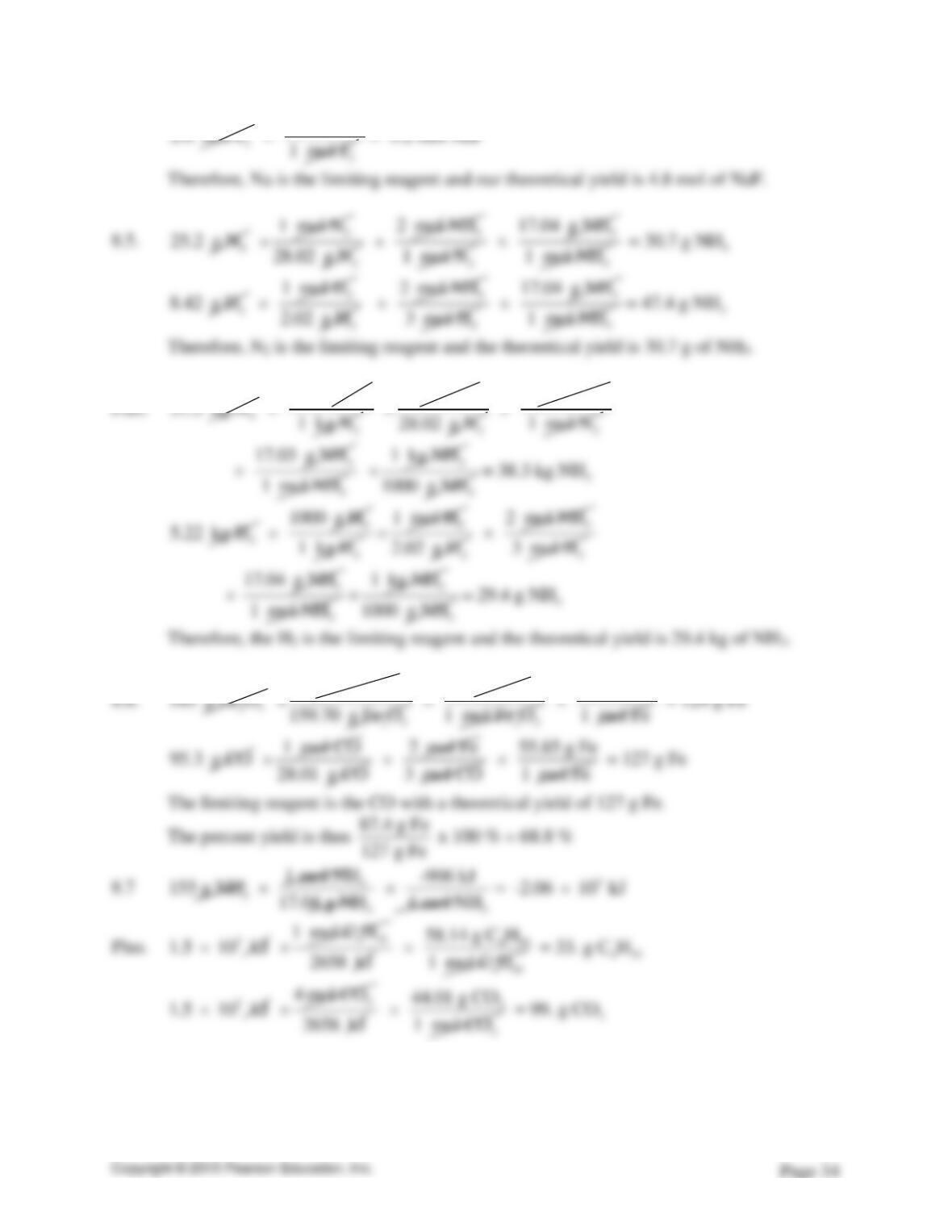
2 mol NaF
1000 g N
2
1 mol N
3
2 mol NH
1 mol Fe O
2 mol Fe
55.85 g Fe
Suggested Demonstrations
Come in to class with all the ingredients for making ham sandwiches. Put the balanced equation
on the board and do some sample calculations involving limiting reactants, theoretical yield, and
percent yield.
Ignite a balloon containing only H2 gas and then ignite a balloon containing H2 and O2 in their
Guided Inquiry Ideas
Below are a few example questions that students answer in the guided inquiry activities provided
in the Guided Activity Workbook.
Frequently, chemists will want to predict how much product can be formed from a particular
amount of reactant. Can the coefficients in the balanced chemical reaction be used directly to
convert from mass product to mass reactant? Explain.
If not mass, what can the coefficients in a balanced chemical equation convert between?
Consider the following reaction: Ti(s) + 2 Cl2(g) → TiCl4(s)
We begin with 1.8 mol Ti and 3.2 mol Cl2.
What is the theoretical yield of TiCl4 in moles? Explain your answer.
What is the limiting reactant?