Chemical Reactions 7
Chapter Overview
This chapter covers many of the aspects of chemical reactions, including how to
recognize and classify them. Several examples of the main categories of reaction are presented
and discussed. The concept of the balanced chemical equation is introduced and manipulated.
Lecture Outline
7.1 Grade School Volcanoes, Automobiles, and Laundry Detergents
7.2 Evidence of a Chemical Reaction
Learning Objective: Identify a chemical reaction.
A. Color change
7.3 The Chemical Equation
Learning Objective: Identify balanced chemical equations.
7.4 How to Write Balanced Chemical Equations
Learning Objective: Write balanced chemical equations.
A. Write reactant and product species, including physical states
7.5 Aqueous Solutions and Solubility: Compounds Dissolved in Water
Learning Objective: Determine whether a compound is soluble.
A. Aqueous: homogeneous mixture of substance in water
7.6 Precipitation Reactions: Reactions in Aqueous Solution that Form a Solid
Learning Objective: Predict and write equations for precipitation reactions.
A. Aqueous ions combine to form insoluble products
B. Predicting precipitation reactions
1. Predict potential solid products
3. If all potential solid products are soluble, there is no reaction
7.7 Writing Chemical Equations for Reactions in Solutions: Molecular, Complete Ionic, and Net
Ionic Equations
Learning Objective: Write molecular, complete ionic, and net ionic equations.
7.8 Acid-Base and Gas Evolution Reactions
Learning Objective: Identify and write equations for acid–base reactions.
7.9 Oxidation-Reduction Reactions
Learning Objective: Identify redox reactions.
Learning Objective: Identify and write equations for combustion reactions.
A. Also known as redox reactions
B. Reaction in which
2. A metal reacts with a nonmetal
3. One substance transfers electrons to another substance
C. Combustion reactions
1. An important type of oxidation-reduction reaction
7.10 Classifying Chemical Reactions
Learning Objective: Classify chemical reactions.
Chemical Principle Teaching Ideas
Chemical Equations
Start with a very simple example, such as 2 wheels + 1 bike → 1 bicycle. Emphasize that
each species should have a coefficient in front of it letting the reader know that the equations
Types of Reactions and How to Classify Them
There are many examples of each kind of reaction either that the students are familiar
Skill Builder Solutions
7.1. a. During combustion, butane turns into carbon dioxide and water, giving off
heat and light. Since the identity of the substances is changing, it is a chemical
reaction.
b. During evaporation, butane exhibits a phase change, from liquid to gas, so it is not a
7.2. Cr2O3(s) + C(s) → Cr(s) + CO2(g)
Balance the chromium atoms first, so we need a 1 in front of the Cr2O3(s) and a 2
in front of the Cr(s):
7.3. C4H10(g) + O2(g) → CO2(g) + H2O(g)
Balance the carbon atoms first by putting a 1 in front of C4H10 and a 4 in front of CO2:
C4H10(g) + O2(g) → 4 CO2(g) + H2O(g)
7.4. Skeletal equation found by switching partners and making neutral products:
Pb(C2H3O2)2(aq) + KI(aq) → PbI2(s) + KC2H3O2(aq)
Pb is balanced as it now appears.
7.5. HCl(g) + O2(g) → H2O(l) + Cl2(g)
Cl only appears in one species on each side, so we will balance that first. There are two
7.6. a. Insoluble; most sulfides are insoluble, and Cu salts is not an exception (Table 7.2).
7.7. The two potential products are Ni(OH)2 and KBr. KBr is soluble, but Ni(OH)2 is not,
7.9. Potassium sulfate: K2SO4 ; Strontium nitrate: Sr(NO3)2. Potential products are KNO3 and
SrSO4. The SrSO4 is an insoluble product (exception to sulfate rule), so the
reaction is
7.10. We must first break up all the aqueous species, giving the overall ionic equation
2 H+(aq) + 2 Br–(aq) + Ca2+(aq) + 2 OH–(aq) → 2 H2O(l) + Ca2+ (aq) + 2 Br–(aq).
7.11. This is a reaction between an acid and a base so the products are a salt and water. The
initial reaction is thus
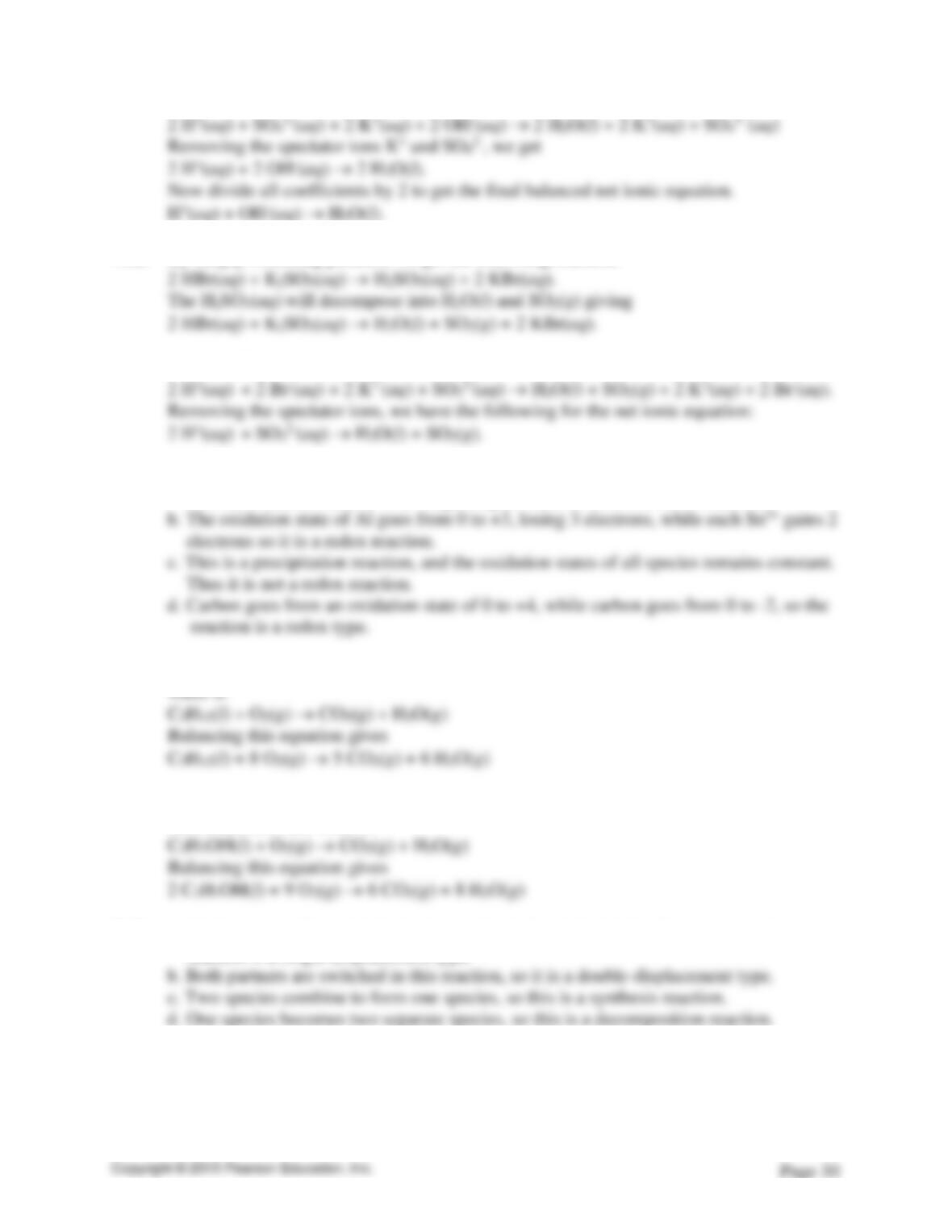
7.12. By simply switching partners, we get the following reaction:
Plus. We must first write the complete ionic equation:
7.13. a. Lithium goes from an oxidation state of 0 to +1, losing 1 electron, while chlorine goes
from an oxidation state of 0 to -1, gaining an electron so it is a redox reaction.
7.14. The skeletal equation of pentane combining with oxygen to form carbon dioxide and
Plus. The skeletal equation of liquid propanol burning in the presence of oxygen to form
carbon dioxide and water is
7.15. a. Al changes position with the hydrogen that is bonded with the phosphate, so the
reaction is a single-displacement type.
Suggested Demonstrations
In a clear plastic soda bottle, place a small amount of vinegar. Put some baking soda into a
balloon, attach the balloon over the neck of the bottle, and then invert the balloon to combine the
reactants. Explain all of the reactions going on and classify them accordingly.
Guided Inquiry Ideas
Below are a few example questions that students answer in the guided inquiry activities provided
in the Guided Activity Workbook.
Some antacids are used by dropping a tablet into a glass of water, which results in significant
fizzing, and then drinking the water. Is there any evidence to suggest there might be a chemical
reaction involved? What is the evidence?
The reaction of zinc with iron (II) chloride is an example of an oxidation-reduction reaction:
Zn(s) + FeCl2(aq) → ZnCl2(aq) + Fe(s)
What is the spectator ion in the above reaction?