Chemical Composition 6
Chapter Overview
In Chapter 6, we begin to talk about measurable quantities and what they represent in the
atomic reference frame. A discussion of how mass can be converted into numbers of species,
Lecture Outline
6.1 How Much Sodium?
6.2 Counting Nails by the Pound
Learning Objective: Recognize that we use the mass of atoms to count them because they
6.3 Counting Atoms by the Gram
Learning Objective: Convert between moles and number of atoms.
Learning Objective: Convert between grams and moles.
6.4 Counting Molecules by the Gram
Learning Objective: Convert between grams and moles of a compound.
6.5 Chemical Formulas as Conversion Factors
Learning Objective: Convert between moles of a compound and moles of a constituent
6.6 Mass Percent Composition of Compounds
6.7 Mass Percent Composition from a Chemical Formula
Learning Objective: Determine mass percent composition from a chemical formula.
6.8 Calculating Empirical Formulas for Compounds
Learning Objective: Determine an empirical formula from experimental data.
6.9 Calculating Molecular Formulas for Compounds
Learning Objective: Calculate a molecular formula from an empirical formula and molar
Chemical Principle Teaching Ideas
The Mole Concept
To reinforce the concept of a mole, it helps to use several real world examples involving
moles. Calculating the mass of a pair, a dozen, and a mole of M&Ms can help a student
understand how a mole is just a number, nothing else.
Chemical Formulas and Chemical Composition
Explain that when we are talking about making large things, such as cars, bicycles, and
Empirical and Molecular Formulas from Laboratory Data
Any time you can reinforce a concept with a simple demonstration, it will help the
students with the material. Here is a valuable opportunity to show them exactly how it can be
done in the laboratory.
Skill Builder Solutions
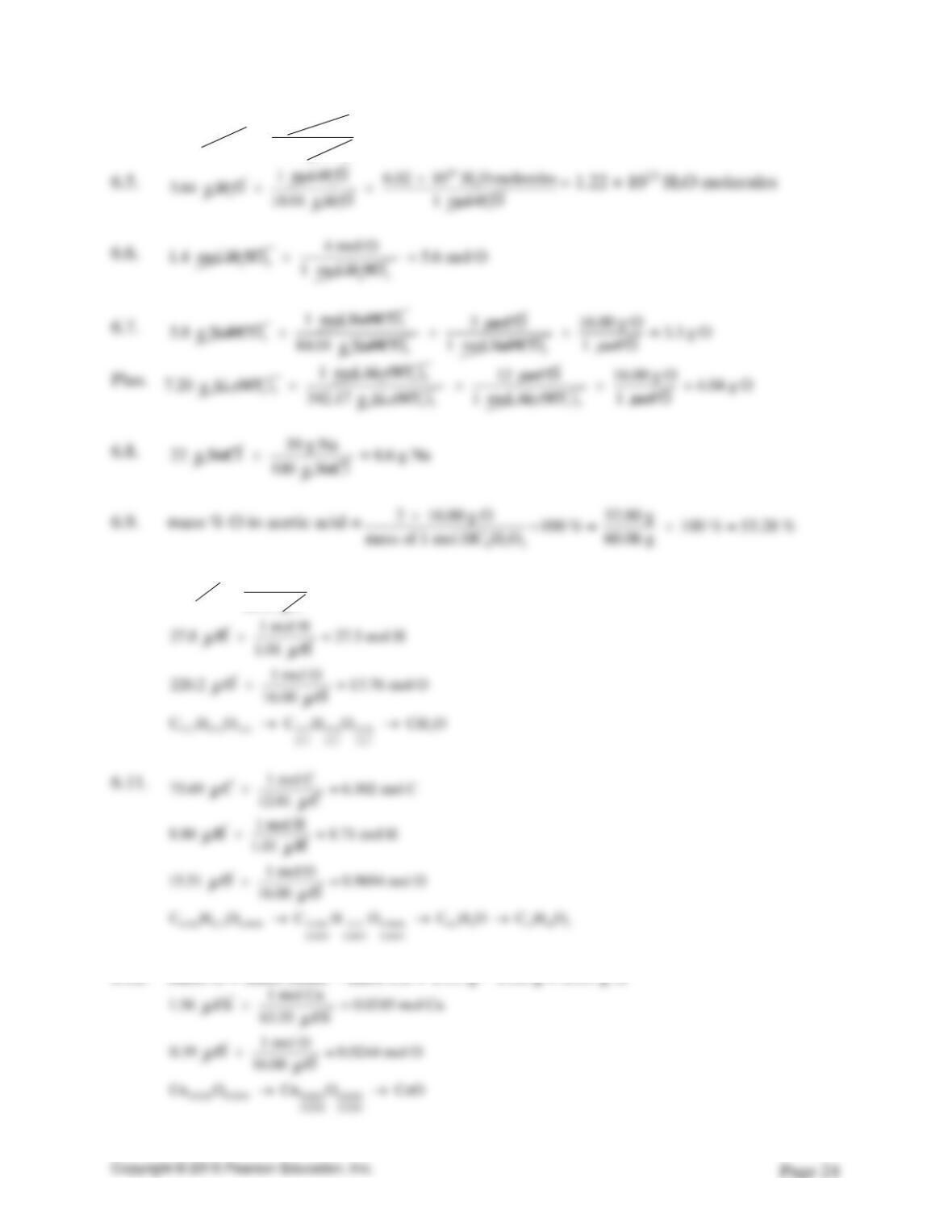
6.4
2
1.18 g NO 2
1 mol NO
2
46.01g NO 2
0.0256 mol NO=
6.10.
165 g C 1 mol C
12.01 g C
= 13.7 mol C
6.12. Mass O = mass oxide – mass Cu = 1.95 g – 1.56 g = 0.39 g O
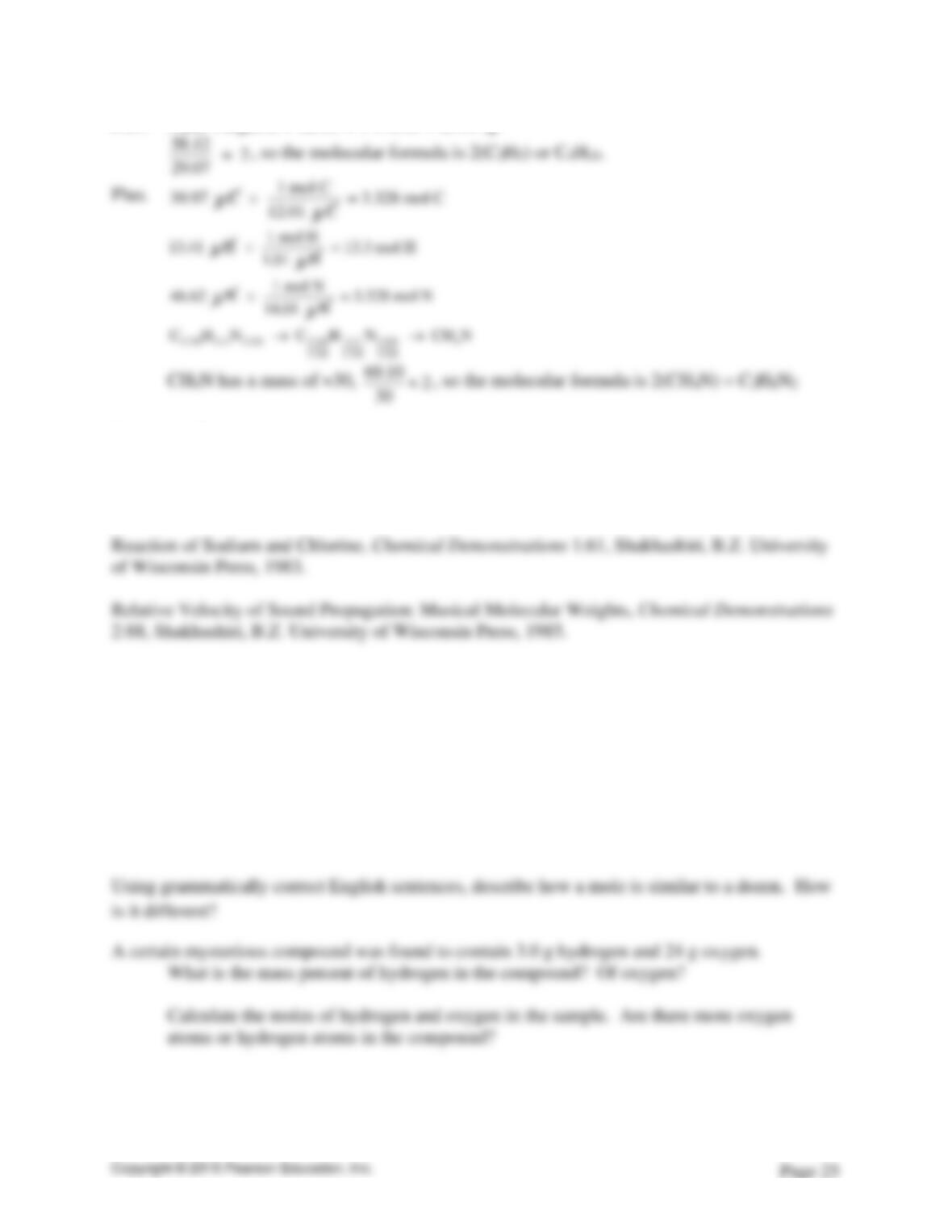
6.13. C2H5 weighs 2 × 12.01 + 5 × 1.01 = 29.07 g.
Suggested Demonstrations
Burning of Magnesium, Chemical Demonstrations 1:38, Shakhashiri, B.Z. University of
Wisconsin Press, 1983.
Guided Inquiry Ideas
Below are a few example questions that students answer in the guided inquiry activities provided
in the Guided Activity Workbook.
How many nails are in 3.5 doz nails? Show all your work using conversion factors correctly.
How many He atoms are in 3.5 mol He atoms? Show all your work using conversion factors
correctly.