Biochemistry 19
Chapter Overview
Chapter 19 introduces us to the complex world of the chemistry of biological organisms.
The complete study is well beyond the scope of this text, but the introduction will give an
Lecture Outline
19.1 The Human Genome Project
19.2 The Cell and Its Main Chemical Components
Learning Objective: Identify the key chemical components of the cell.
A. Nucleus
19.3 Carbohydrates: Sugar, Starch, and Fiber
Learning Objective: Identify carbohydrates and compare and contrast monosaccharides,
disaccharides, and polysaccharides.
A. Monosaccharides
B. Disaccharides
C. Polysaccharides
2. Cellulose
19.4 Lipids
Learning Objective: Identify lipids.
Learning Objective: Compare and contrast saturated and unsaturated triglycerides.
A. Fatty acids
B. Fats and oils
C. Other lipids
19.5 Proteins
Learning Objective: Identify proteins.
Learning Objective: Describe how amino acids link together to form proteins.

19.6 Protein Structure
Learning Objective: Describe primary structure, secondary structure, tertiary structure,
and quaternary structure in proteins.
A. Primary structure
B. Secondary structure
2. Helix
3. Random coil
C. Tertiary structure
1. Hydrogen bonds
3. Hydrophilic interactions
4. Salt bridges
D. Quaternary structure
19.7 Nucleic Acids: Molecular Blueprints
Learning Objective: Describe the role that nucleic acids play in determining the order of
amino acids in a protein.
A. DNA
B. RNA
C. Nucleotides
1. Codon
3. Chromosome
19.8 DNA Structure, DNA Replication, and Protein Synthesis
Learning Objective: Summarize the process of DNA replication and protein synthesis.
A. DNA structure
B. DNA replication
C. Protein synthesis
Chemical Principle Teaching Ideas
The Cell
Many students are familiar with the most basic ideas of cells from biology, but they fail
to see that there is something going on in cells that is much smaller than what they learned in
biology class, the chemistry happening on the molecular level.
Carbohydrates
Lipids
Different lipids do very different things, but all lipids have chemical similarities. Some of
them are very important for life (fatty acids) and some are illegally taken by athletes (steroids).
Proteins
Most students think of protein simply as a necessary component of their everyday diet.
Make sure to emphasize that this is a very narrow view of a most complex group of molecules.
Nucleic Acids and DNA Replication
Understanding life means understanding DNA replication. DNA replication makes life
Skill Builder Solutions
19.1. a. Carboxylic acids are not carbohydrates.
b. This species has an oxygen atom in the ring with several OH groups also attached to
19.2. a. There is no three-carbon glycerol backbone to this species, so it is not a triglyceride.
b. There is a three-carbon glycerol backbone with a long fatty acid tail, so it is a
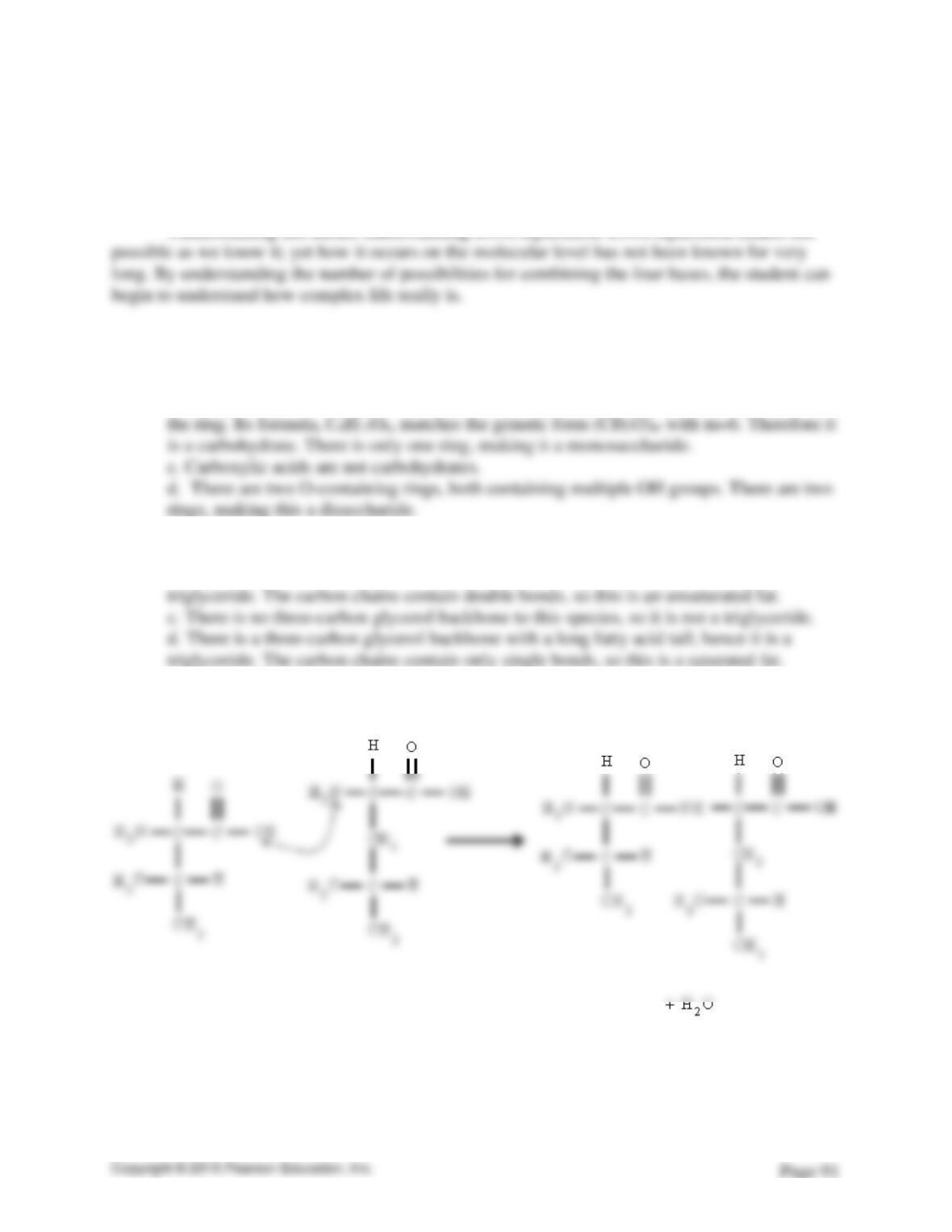
19.3. Peptide bonds are formed when the carboxylic end of one amino acid reacts with the
amine end of a second amino acid to form a dipeptide and water as shown below.

19.4. A pairs with T and C pairs with G giving
Guided Inquiry Ideas
Below are a few example questions that students answer in the guided inquiry activities provided
in the Guided Activity Workbook.
What holds monosaccharides together in a polysaccharide?
Is starch a carbohydrate? Why or why not?
Are most carbohydrates polar or non-polar compounds?
Will most carbohydrates tend to be soluble in water? Why or why not?