Organic Chemistry 18
Chapter Overview
Organic chemistry is a very broad domain of chemistry, and it is very important to our
Lecture Outline
18.1 What Do I Smell?
18.2 Vitalism: The Difference Between Organic and Inorganic
Learning Objective: Explain how the experiments of Wöhler lead to the development of
18.3 Carbon: A Versatile Atom
Learning Objective: Identify the unique properties that allow carbon to form such a large
18.4 Hydrocarbons: Compounds Containing Only Carbon and Hydrogen
Learning Objective: Differentiate between alkanes, alkenes, and alkynes based on
molecular formulas.
18.5 Alkanes: Saturated Hydrocarbons
Learning Objective: Write formulas for n-alkanes.
18.6 Isomers: Same Formula, Different Structure
Learning Objective: Write structural formulas for hydrocarbon isomers.
18.7 Naming Alkanes
Learning Objective: Name alkanes.
18.8 Alkenes and Alkynes
Learning Objective: Name alkenes and alkynes.
18.9 Hydrocarbon Reactions
Learning Objective: Compare and contrast combustion, substitution, and addition
18.10 Aromatic Hydrocarbons
Learning Objective: Name aromatic hydrocarbons.
18.11 Functional Groups
Learning Objective: Identify common functional groups and families of organic
compounds.
A. Alcohols – ROH
B. Ethers – ROR
18.12 Alcohols
Learning Objective: Identify alcohols and their properties.
A. Naming alcohols
B. Properties of alcohols
18.13 Ethers
18.14 Aldehydes and Ketones
Learning Objective: Identify aldehydes and ketones and their properties.
A. Naming
18.15 Carboxylic Acids and Esters
Learning Objective: Identify carboxylic acids and esters and their properties.
A. Naming
1. Carboxylic acid names end with –oic acid
18.16 Amines
Learning Objective: Identify amines and their properties.
18.17 Polymers
Learning Objective: Identify the unique properties of polymers.
A. Monomers
Chemical Principle Teaching Ideas
Organic Chemistry
Organic chemistry is the study of carbon-containing compounds. Almost all biological
processes involve organic chemistry. Students can appreciate that their bodies are stockpiles of
Isomers
The easiest way to talk about isomers is to bring in a chemical model kit with some large
simple hydrocarbons in a straight-chain formation. Hold it up and have students name the
Functional Groups
Polymers
All plastics are polymers, and most plastics will tell you what kind they are if you find
Skill Builder Solutions
18.1. a. The number of hydrogen atoms is 2 times the number of carbons, so C6H12 must be an
alkene.
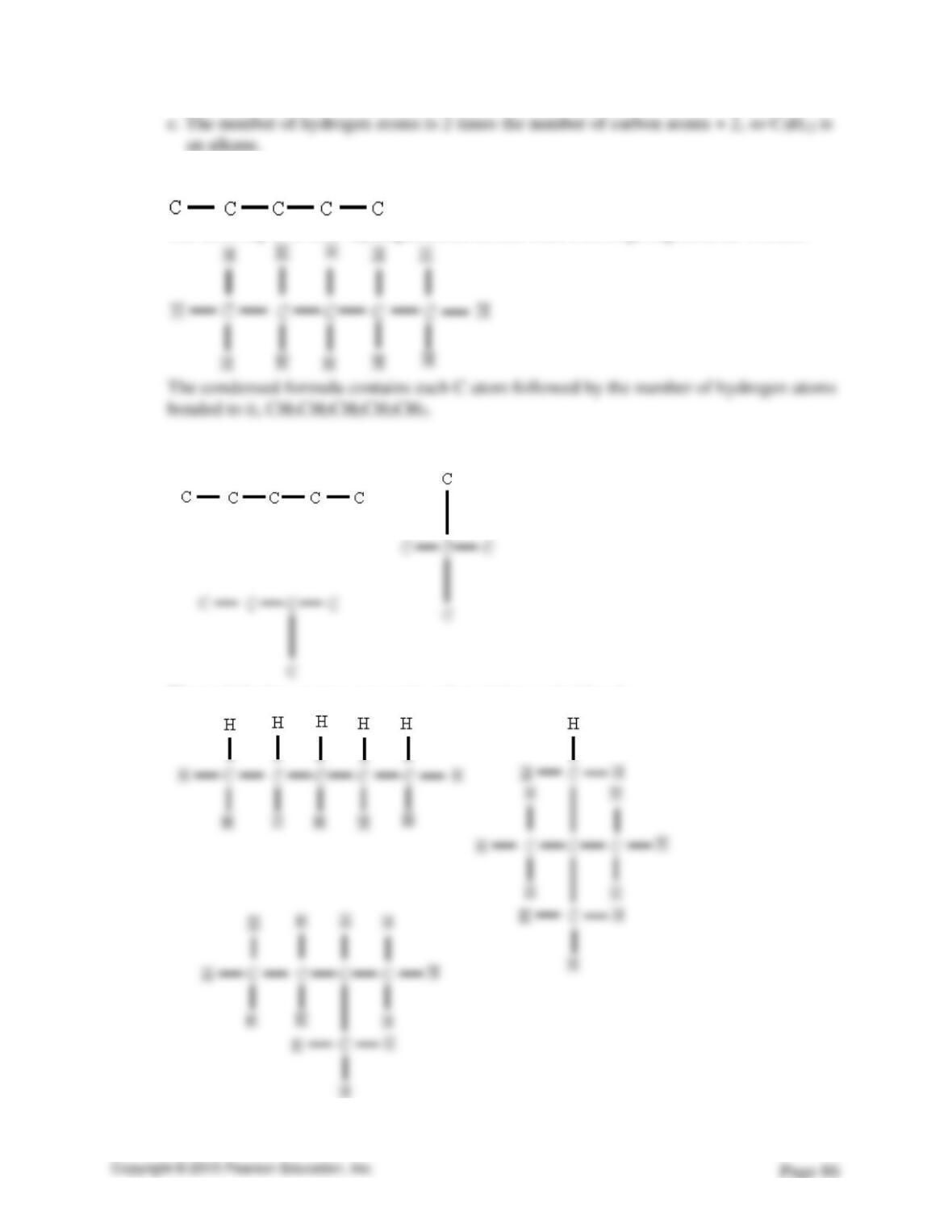
18.2. First, we draw 5 carbons connected by single bonds:
The next step is to draw hydrogen atoms around each carbon giving them all 4 bonds.
18.3. First, draw the three possible carbon backbones:
Then add hydrogen atoms to each carbon giving each 4 bonds.
18.4. The longest chain is 3 carbons long, so the base name is propane. There is one substituent
18.5. The longest chain is 5 carbons long and will be numbered from the left. The base name
18.6. The longest chain is 6 atoms long, so the base name is hexane. There are two possible
numbering methods, one from each side. From one side, the numbers of the substituents
18.7. a. The longest carbon chain is 5 atoms long so the base name is pentane. There is a
triple bond between carbon atoms 2 and 3, so the base name changes to 2-pentyne. There
18.8. There are two of the same species bonded to the benzene, so it does not matter which
Suggested Demonstrations
Mix a small amount (~ 1 tsp) of sodium polyacrylate (used in some baby diapers) with ~ 50 mL
Guided Inquiry Ideas
Below are a few example questions that students answer in the guided inquiry activities provided
in the Guided Activity Workbook.
What do the structures of all ethers have in common?

What do the names of all ethers have in common?
What do the structures of all alcohols have in common?
What do the names of all alcohols have in common?