Radioactivity and 17
Nuclear Chemistry
Chapter Overview
Chapter 17 gives us an introduction to the history of radiation, from its discovery to how
it has changed the history of mankind in the last 100 years. The main kinds of radiation are
Lecture Outline
17.2 The Discovery of Radioactivity
Learning Objective: Explain how the experiments of Becquerel and Curie lead to the
discovery of radioactivity.
A. Becquerel
B. Curie
17.3 Types of Radioactivity: Alpha, Beta, and Gamma Decay
Learning Objective: Write nuclear equations for alpha decay.
Learning Objective: Write nuclear equations for beta decay.
Learning Objective: Write nuclear equations for positron emission.
A. Alpha: 2 protons + 2 neutrons
17.4 Detecting Radioactivity
Learning Objective: Describe and explain the methods used to detect radioactivity.
17.5 Natural Radioactivity and Half-Life
Learning Objective: Use half-life to relate radioactive sample amounts to elapsed time.
17.6 Radiocarbon Dating: Using Radioactivity to Measure the Age of Fossils and Other Artifacts
17.7 The Discovery of Fission and the Atomic Bomb
Learning Objective: Explain how the experiments of Fermi, Meitner, Strassmann, and
Hahn lead to the discovery of nuclear fission.
A. Fermi, Meitner, Strassman, and Hahn
17.8 Nuclear Power: Using Fission to Generate Electricity
Learning Objective: Explain how nuclear power plants generate electricity using fission.
A. Reactor
17.9 Nuclear Fusion: The Power of the Sun
Learning Objective: Compare and contrast nuclear fission and nuclear fusion.
17.10 The Effects of Radiation on Life
Learning Objective: Describe how radiation exposure affects biological molecules and
how exposure is measured.
A. Acute radiation damage
17.11 Radioactivity in Medicine
Learning Objective: Describe how radioactivity is used in the diagnosis and treatment of
disease.
Chemical Principle Teaching Ideas
Forms of Radiation
Students rarely realize that they are bombarded with radiation every day as they go about
their normal routines. Giving them real-world examples of radiation will help them internalize
the concept.
Detecting Radioactivity
Half-Life and Radiocarbon Dating
Only species that were once alive can be radiocarbon dated. Non-living things such as
rocks are not in equilibrium with the carbon dioxide in the atmosphere, so they never get carbon-
Fission, the Atomic Bomb, and Nuclear Power
This is a delicate subject as many students will already have formed a previous opinion
Nuclear Fusion
Fusion is much more powerful than fission and, at this point, is so energetic that we
The Effects of Radiation on Life and Nuclear Medicine
Most students consider radiation a “dirty” word with nothing but a negative connotation.
Skill Builder Solutions
17.1. Let us first write what we know from the following question:
216 4
84 2
Po He + ?→
The sum of the atomic numbers on both sides of a nuclear equation must be equal, and
84 2 82
17.2. What is given in the following question:
228 0
89 1
Ac e + ?
−
→
The sum of the atomic numbers on both sides of a nuclear equation must be equal, and
Plus. Step 1:
235 4
92 2
U He + ?→
The other product must have an atomic number of 92 – 2 = 90
and a mass number of 235 – 4 = 231, giving
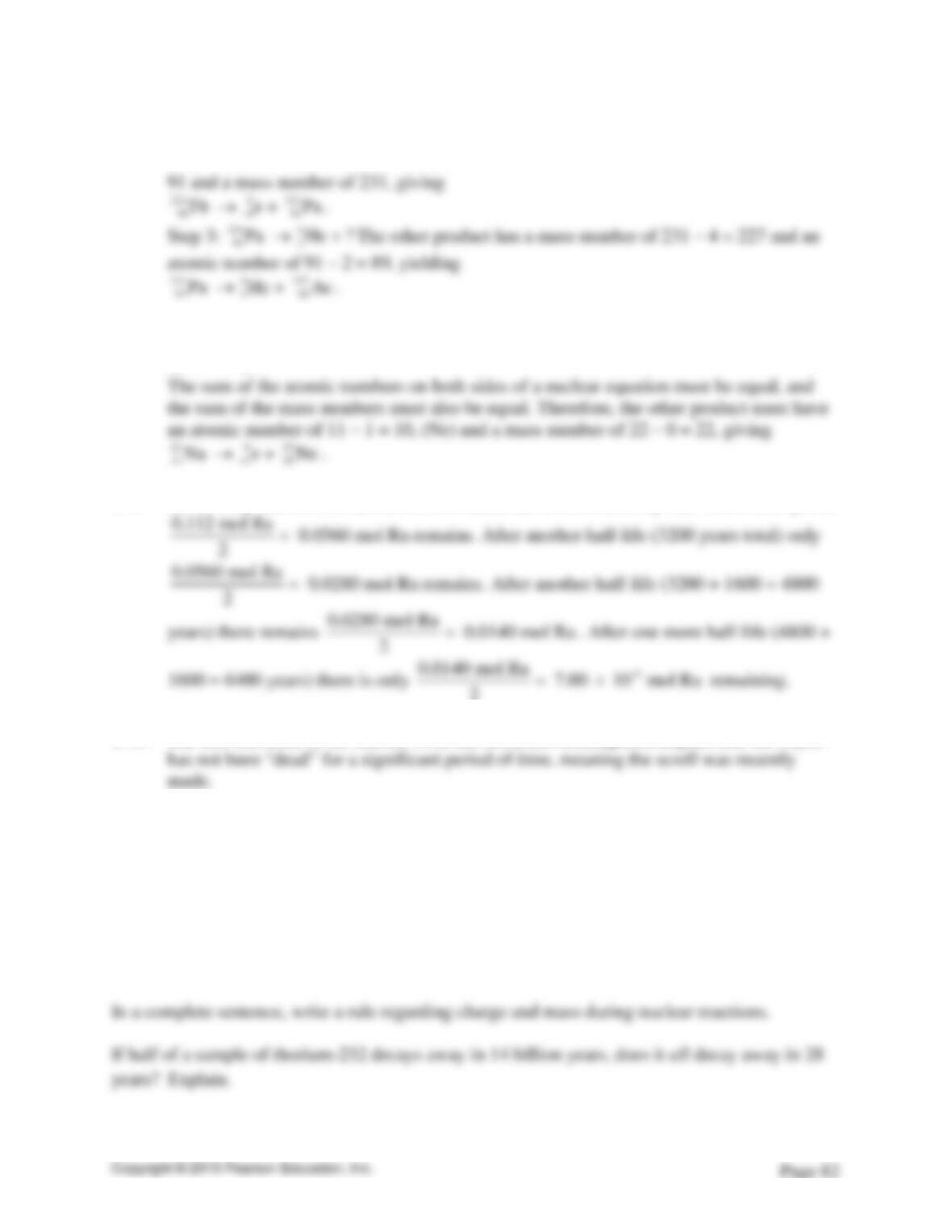
235 4 231
92 2 90
U He + Th→
.
Step 2:
231 0
90 1
Th e + ?
−
→
The other product must have an atomic number of 90 – (–1) =
17.3. From the given information we have
22 0
11 1
Na e + ?
+
→
17.4. After every half life, the amount of substance has been reduced by half. After 1600 years,
2=
17.5. The fact that none of the carbon-14 in the scroll has disintegrated implies that the object
Guided Inquiry Ideas
Below are a few example questions that students answer in the guided inquiry activities provided
in the Guided Activity Workbook.
What is the total charge before
238
92
U undergoes α decay?
What is the total charge after
238
92
U undergoes α decay?