Oxidation and Reduction 16
Chapter Overview
The definition of oxidation-reduction reactions is given using several examples. The
many ways to detect such a reaction are also explained. Everyday oxidation-reduction reactions
are shown.
Lecture Outline
16.1 The End of the Internal Combustion Engine?
16.2 Oxidation and Reduction: Some Definitions
Learning Objective: Define and identify oxidation and reduction.
16.3 Oxidation States: Electron Bookkeeping
Learning Objective: Assign oxidation states.
Learning Objective: Use oxidation states to identify oxidation and reduction.
A. Atom in free element = 0
16.4 Balancing Redox Equations
Learning Objective: Balance redox reactions.
16.5 The Activity Series: Predicting Spontaneous Redox Reactions
Learning Objective: Predict spontaneous redox reactions.
16.6 Batteries: Using Chemistry to Generate Electricity
Learning Objective: Describe how a voltaic cell functions.
Learning Objective: Compare and contrast the various type of batteries.
A. Electrochemical cell
B. Two half-cells, wire, and a salt bridge
16.7 Electrolysis: Using Electricity to Do Chemistry
Learning Objective: Describe the process of electrolysis and how an electrolytic cell
functions.
16.8 Corrosion: Undesirable Redox Reactions
Learning Objective: Describe the process of corrosion and the various methods used to
prevent rust.
Chemical Principle Teaching Ideas
Oxidation and Reduction
Many reactions that the students have already seen are redox equations, but the students
do not necessarily see the change in oxidation state. The combustion of hydrogen and oxygen is
Oxidation States
Make sure the students do not confuse oxidation state with ion charge, as they are not the
same. Also mention that, in a redox reaction, you need at least one species to be reduced and at
The Activity Series
The activity series ranks substances from most easily oxidized to least easily oxidized.
Batteries
Electrolysis
What many students do not understand is the prevalence of electrolysis around them in
Corrosion
An example of corrosion with which the students would be familiar is the oxidation of Al
Skill Builder Solutions
16.1. a. The charge of K on the reactant side is 0, and the Cl2 has a charge of 0 as well. On the
right-hand side, K is in a +1 state and Cl is in a –1 state. K lost one electron, so it was
16.2. a. K was oxidized, so it was the reducing agent. Conversely, Cl was reduced so it was the
oxidizing agent.
b. Al was oxidized, so it was the reducing agent. Conversely, Sn+2 was being reduced
16.3. a. 0; Lone neutral atoms are always 0 by rule 1.
b. +2 ; Lone atomic ion is the charge of the ion by rule 2.
c. Cl has an oxidation state of –1 by rule 5. Ca is +2 by rule 4.
d. F has an oxidation state of –1 by rule 5. Since there are four fluorine atoms for every
16.4.
0 +1 +5 -2 +4 -2 +4 -2 +1 2
2
3 2 2
Sn( ) 4 H NO ( ) SnO ( ) + 4 NO ( ) + 2 H O( )s aq s g g
−
+→
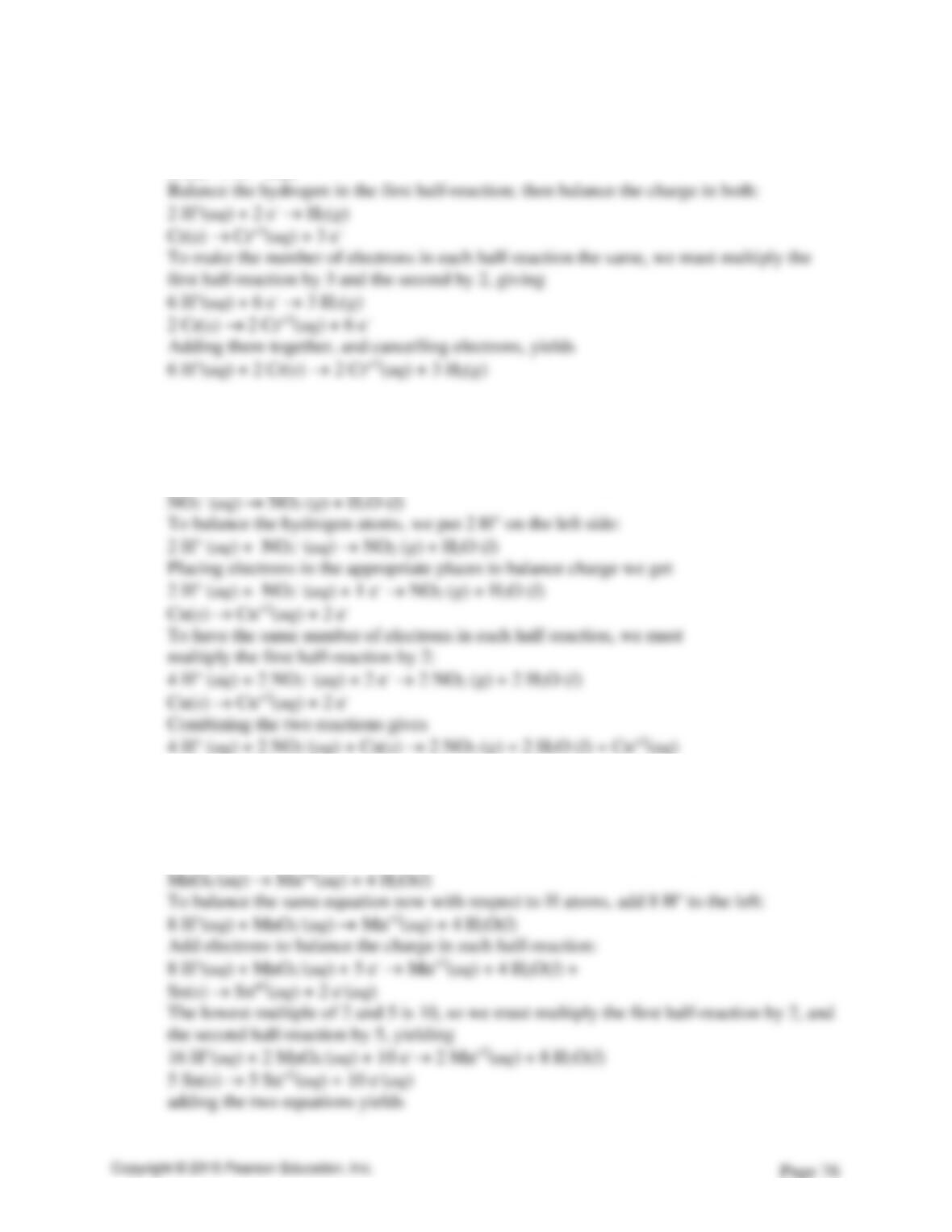
16.5. Write the two skeletal half-reactions:
H+(aq) → H2(g)
Cr(s) → Cr+3(aq)
16.6. Two skeletal half-reactions:
Cu(s) → Cu+2(aq)
NO3– (aq) → NO2 (g)
The oxygens are balanced in the second equation by adding 1 H2O to the right:
16.7. Two skeletal half-reactions:
Sn(s) → Sn+2(aq)
MnO4–(aq) → Mn+2(aq)
To balance the second equation with respect to O, add 4 H2O on the right:
16.8. Two skeletal half-reactions:
ClO2(aq) → ClO2–(aq)
H2O2(aq) → O2(g)
The first reaction is already balanced with respect to O and H.
The second equation is already balanced with respect to O. To balance the H atoms, add 2
H+ on the right:
16.9. a. The oxidation of Zn is above the reaction of Ni (Ni → Ni+2) in the activity
Suggested Demonstrations
Fill a test tube with a very dilute solution of Cu+2 ion, place a small amount of solid Zn inside,
Guided Inquiry Ideas
Below are a few example questions that students answer in the guided inquiry activities provided
in the Guided Activity Workbook.