
14-54
I. Variation of Da number
Conversion
Damköhler number/ Da
Closed-vessel
Open-vessel
Parameter
0.69
0.432
0.378
8*U0
1.38
0.713
0.641
4*U0
2.76
0.959
0.911
2*U0
5.52
1
1
U0
11.04
/
/
U0/2
22.08
/
/
U0/4
44.16
/
/
U0/8
II. Variation of Pe number
Conversion
Peclet number/Pe
Closed-vessel
Open-vessel
Parameter
1.04e3
1
1
100* DAB
1.04e4
1
1
10* DAB
1.04e5
1
1
DAB
1.04e6
/
0.9995
0.1*DAB
1.04e7
/
0.9994
0.01*DAB
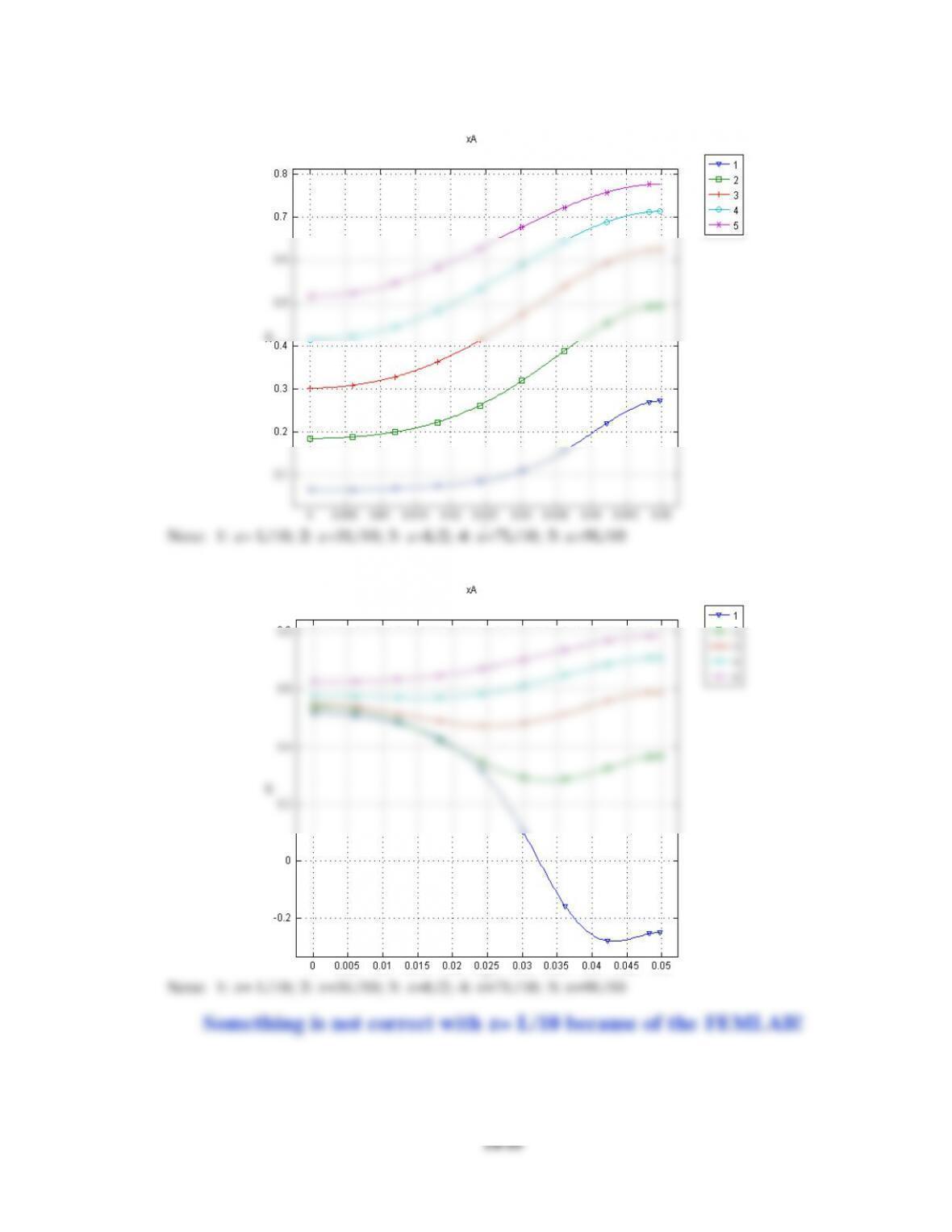
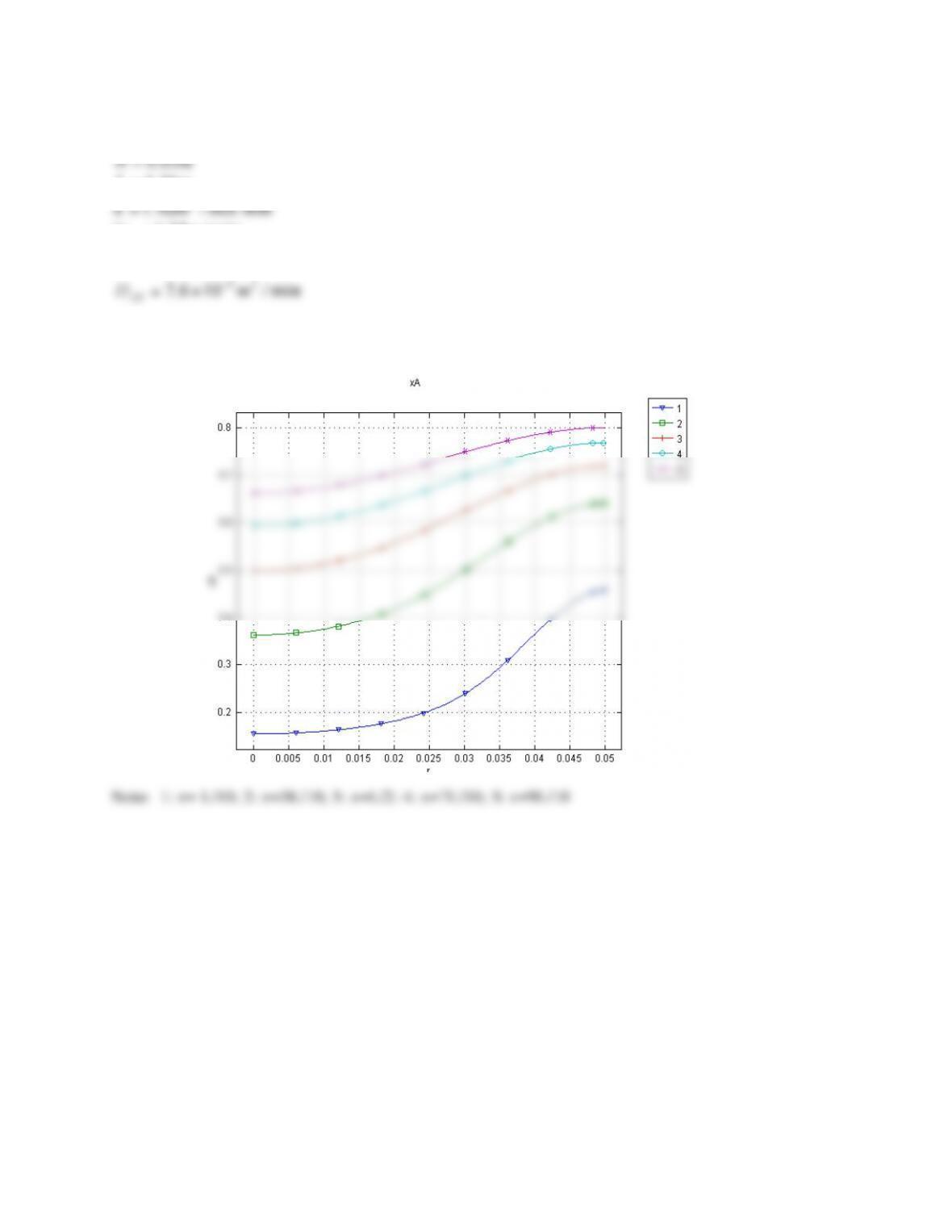
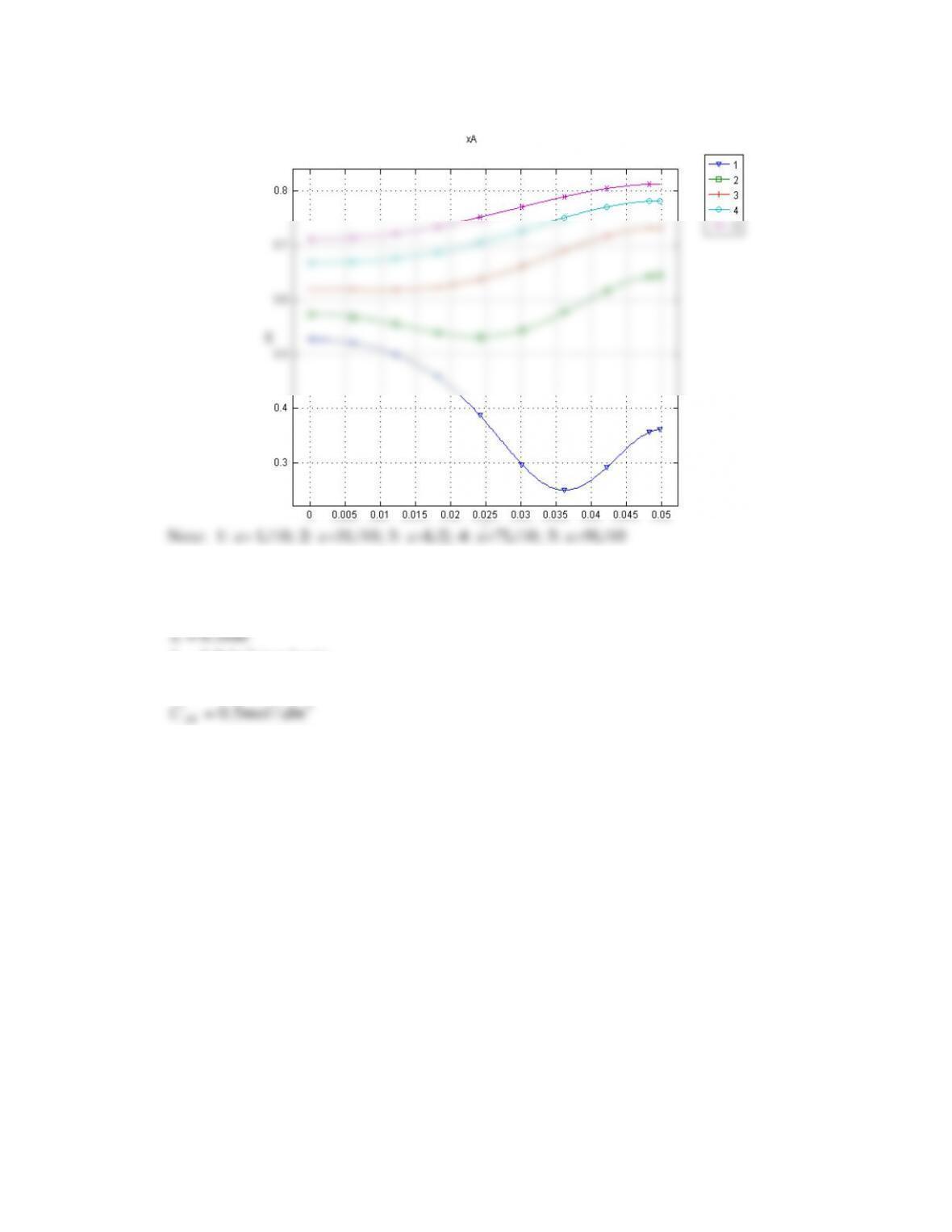
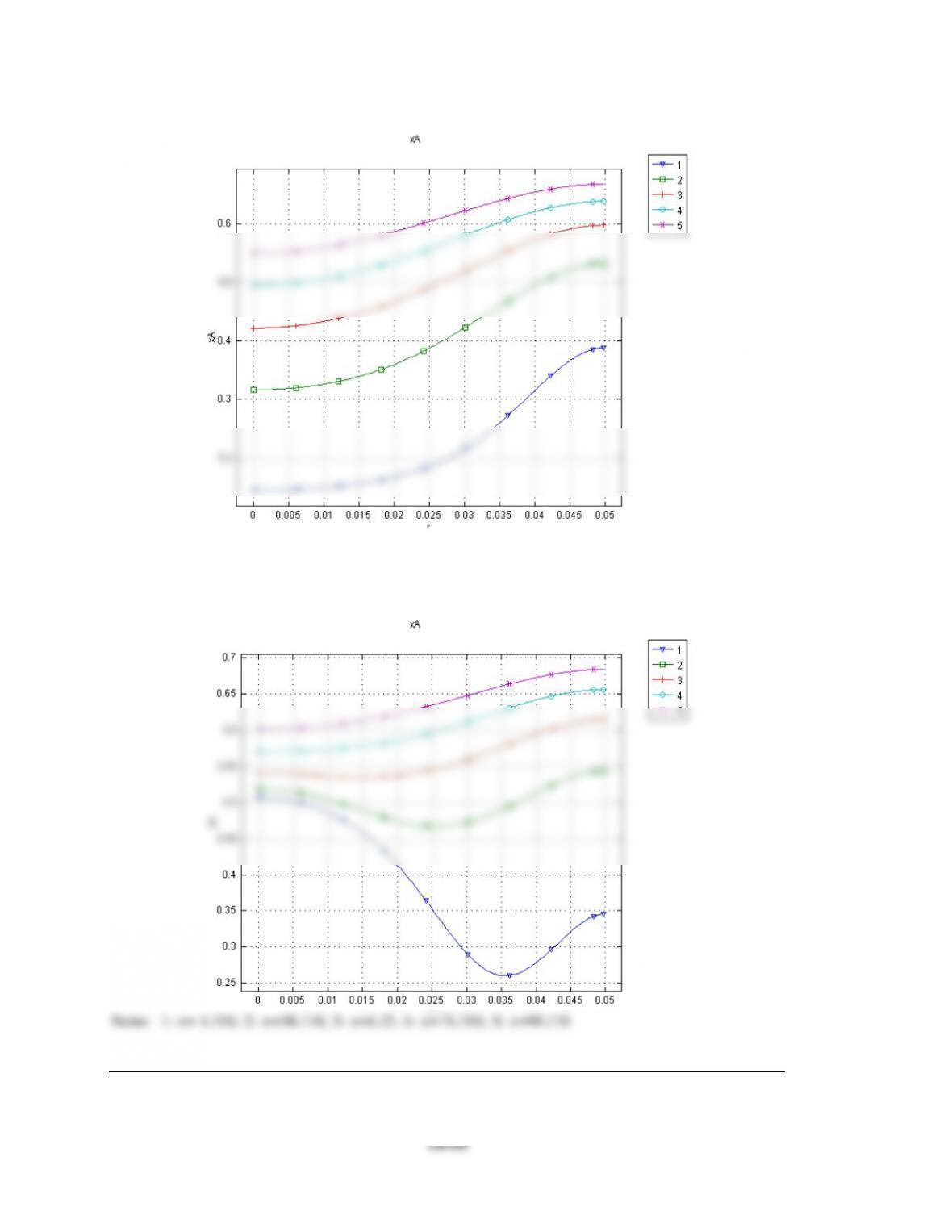
(d) The radial conversion profiles for various order of reaction
(1) First order
1=n
mL 36.6=
mR 05.0=
min./25.0 3moldmk =
min/24.1
0mU =
3
0/5.0 dmmolC A=
min/106.7 25 mDAB
!
“=
14-55
I. Open–vessel:
Note: 1: z= L/10; 2: z=3L/10; 3: z=L/2; 4: z=7L/10; 5: z=9L/10
II. Closed-vessel:
Note: 1: z= L/10; 2: z=3L/10; 3: z=L/2; 4: z=7L/10; 5: z=9L/10
Something is not correct with z= L/10 because of the FEMLAB!
14-56
(2) Second order
2=n
mR 05.0=
mL 36.6=
min./4.1 3moldmk =
min/24.1
0mU =
3
0/5.0 dmmolC A=
min/106.7 25 mDAB
!
“=
I. Open–vessel:
Note: 1: z= L/10; 2: z=3L/10; 3: z=L/2; 4: z=7L/10; 5: z=9L/10
14-57
II. Closed-vessel:
Note: 1: z= L/10; 2: z=3L/10; 3: z=L/2; 4: z=7L/10; 5: z=9L/10
(3) Third order
mR 05.0=
mL 36.6=
min./8.2 3moldmk =
min/24.1
0mU =
3
0/5.0 dmmolC A=
min/106.7 25 mDAB
!
“=
14-58
I. Open vessel:
Note: 1: z= L/10; 2: z=3L/10; 3: z=L/2; 4: z=7L/10; 5: z=9L/10
II. Closed– vessel
Note: 1: z= L/10; 2: z=3L/10; 3: z=L/2; 4: z=7L/10; 5: z=9L/10
14-59
P14-20 (a)
Higher Peclet number
Curve 1 (“closer” to the one of an ideal PFR) has a higher Peclet number, because the cumulative
distribution is more concentrated around the mean residence time.
P14-20 (b)
Higher dispersion coefficient
Curve 2 has a higher dispersion coefficient: a higher Peclet number corresponds to a lower
dispersion coefficient.
Curve 1: Increasing the number of T-I-S corresponds to increase the Peclet Number (i.e. Bo=2(n–
1)).
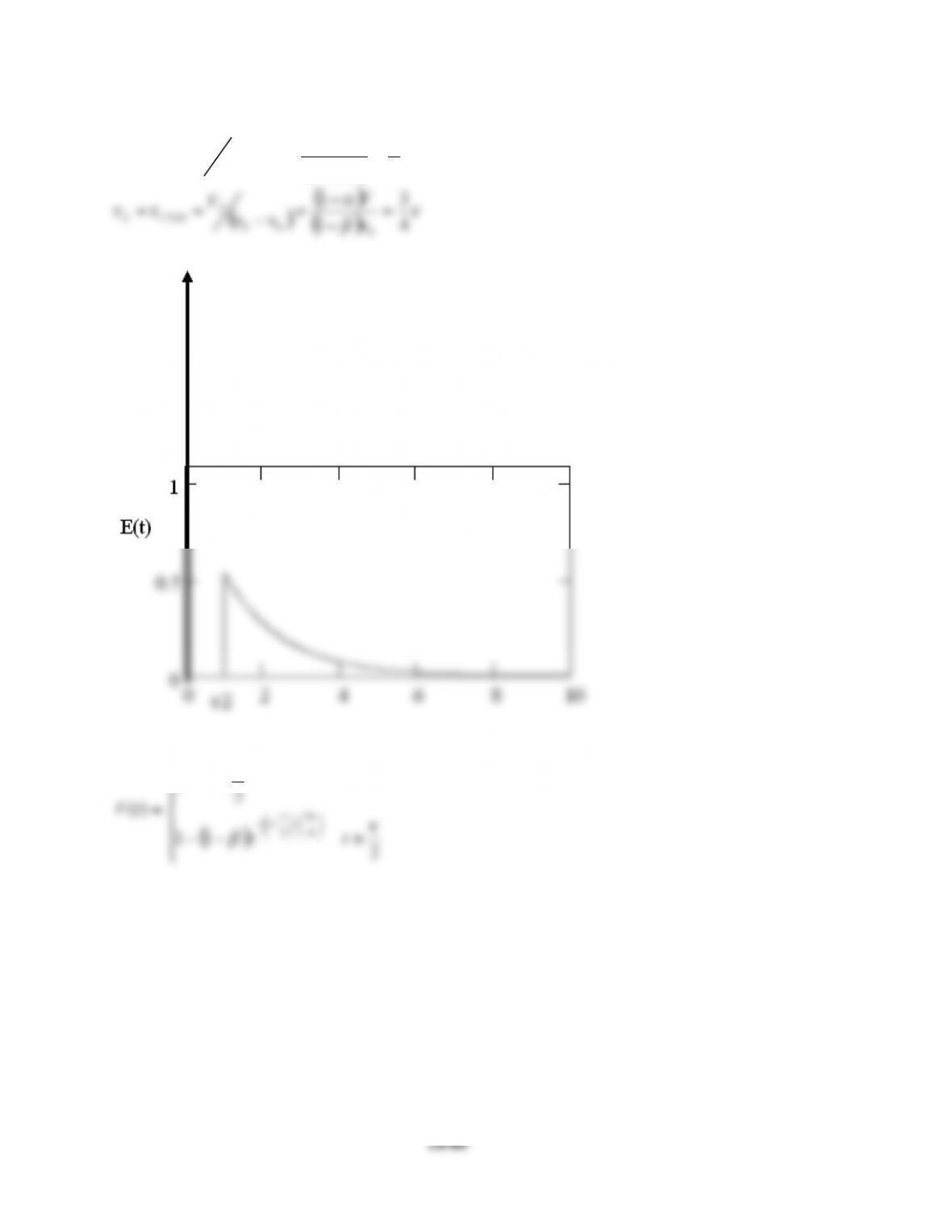
F(t) and E(t) curves for
2.04.0
0
1==== v
v
and
V
Vb
!“
The analytical expression for E (t) is given by:
( ) ( )
!
“
!
#
$
%&
<
=&&
1
2
/
1
21
1
)(
)(
‘
‘
(
‘()
‘‘
t
e
tt
tE t
V2
V1
vb
vb=βvo
V1=αV
node1
14-60
Where:
( ) ( )
( ) ( )
( )
!
“
#
!!
!
“
#
!!
4
3
1
1
2
1
1
0
0
2
2
0
0
1
1
=
$
$
=
$
==
=
$
=
$
==
v
V
vv
V
v
V
vv
V
b
CSTR
b
PFR
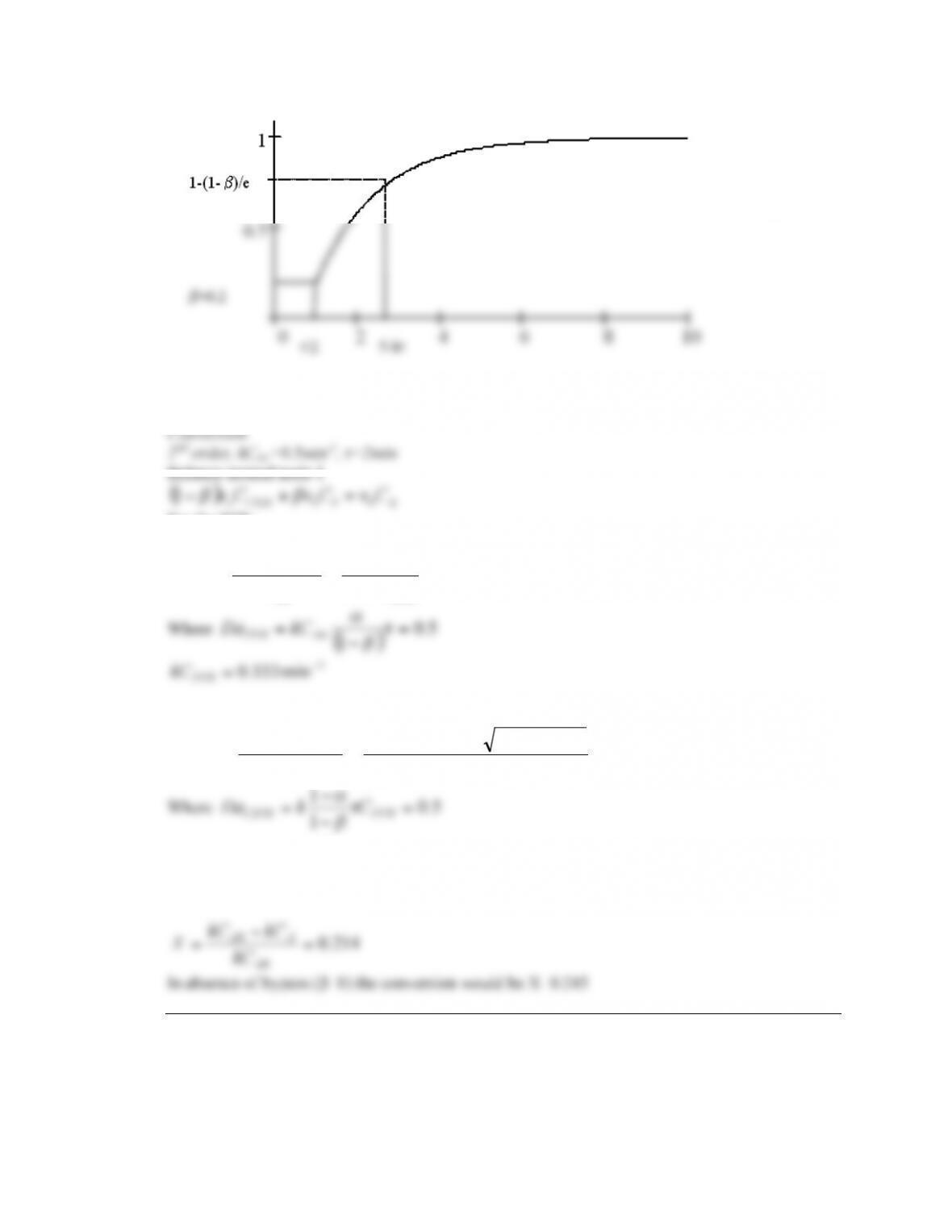
Integrating we can obtain the analytical expression for F (t):
( )
!
!
“
!
!
#
%&&
<
=
‘
(
)
*
+
,
‘
(
)
*
+
,&&
2
11
2
)(
4
3
/
2
–
.
.
––
te
t
tF
t
14-61
P14-21 (b)
Conversion
2nd order, kCAo=0.5min-1, τ=2min
Balance around node 1
333.0
1
0
0=
+
=
!
=
PFR
PFR
A
PFRA
PFR Da
Da
C
CC
X
Where
( ) 5.0
1=
!
=
“
#
$
AoPFR kCDa
1
min333.0 !
=
PFR
kC
( ) 268.0
2
4121
=
+!+
=
!
=
CSTR
CSTRCSTR
PFR
CSTRPFR
CSTR Da
DaDa
C
CC
X
Where
5.0
1
1=
!
!
=PFRCSTR CkDa
“
#
$
1
min366.0 !
=
CSTR
kC
( ) ( ) 1
min393.011 !
=+!=+!=AoCSTRbCSTRA kCkCkCkCkC
““““
214.0
0
0=
!
=
A
AA
kC
kCkC
X
In absence of bypass (β=0) the conversion would be X=0.245
14-62
P14-22
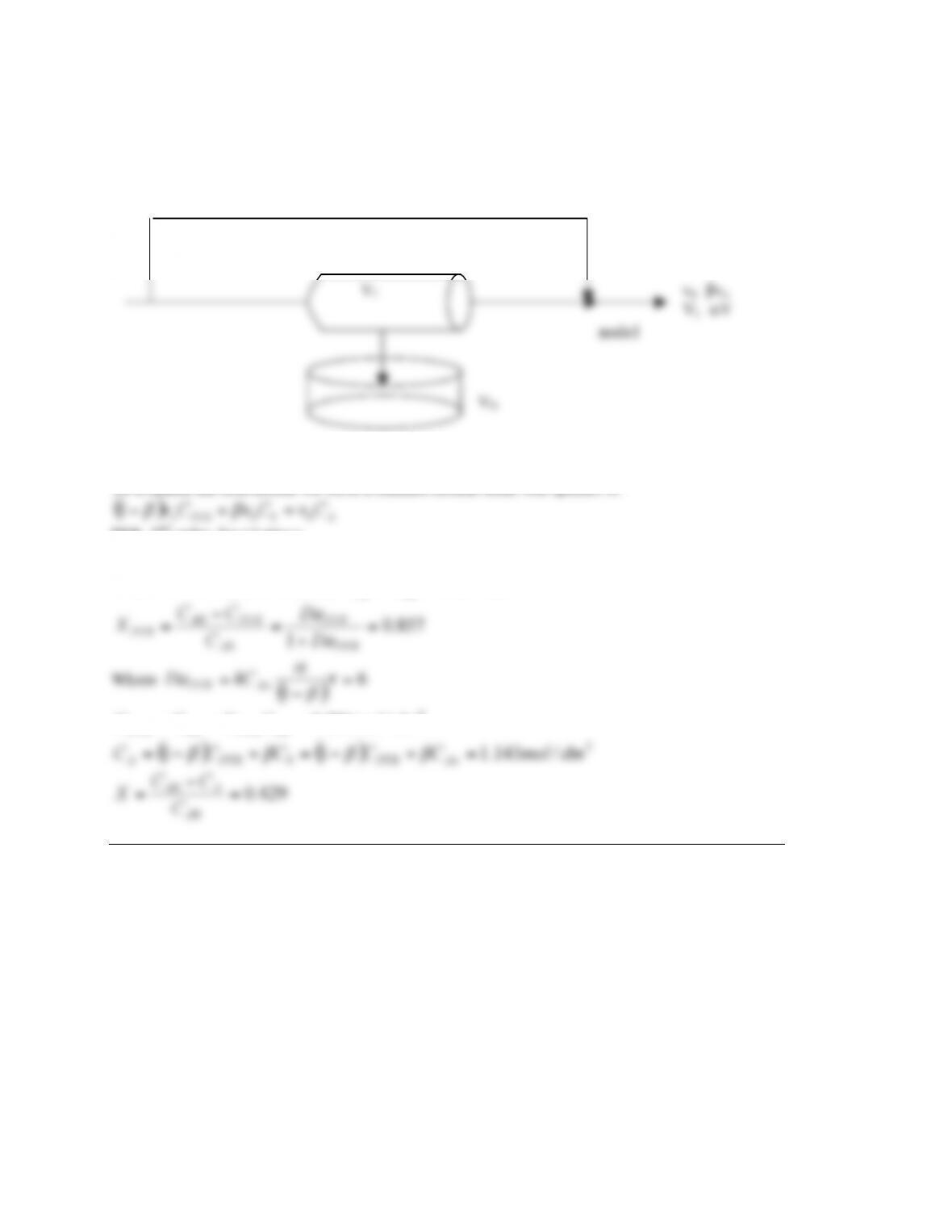
Two parameters model
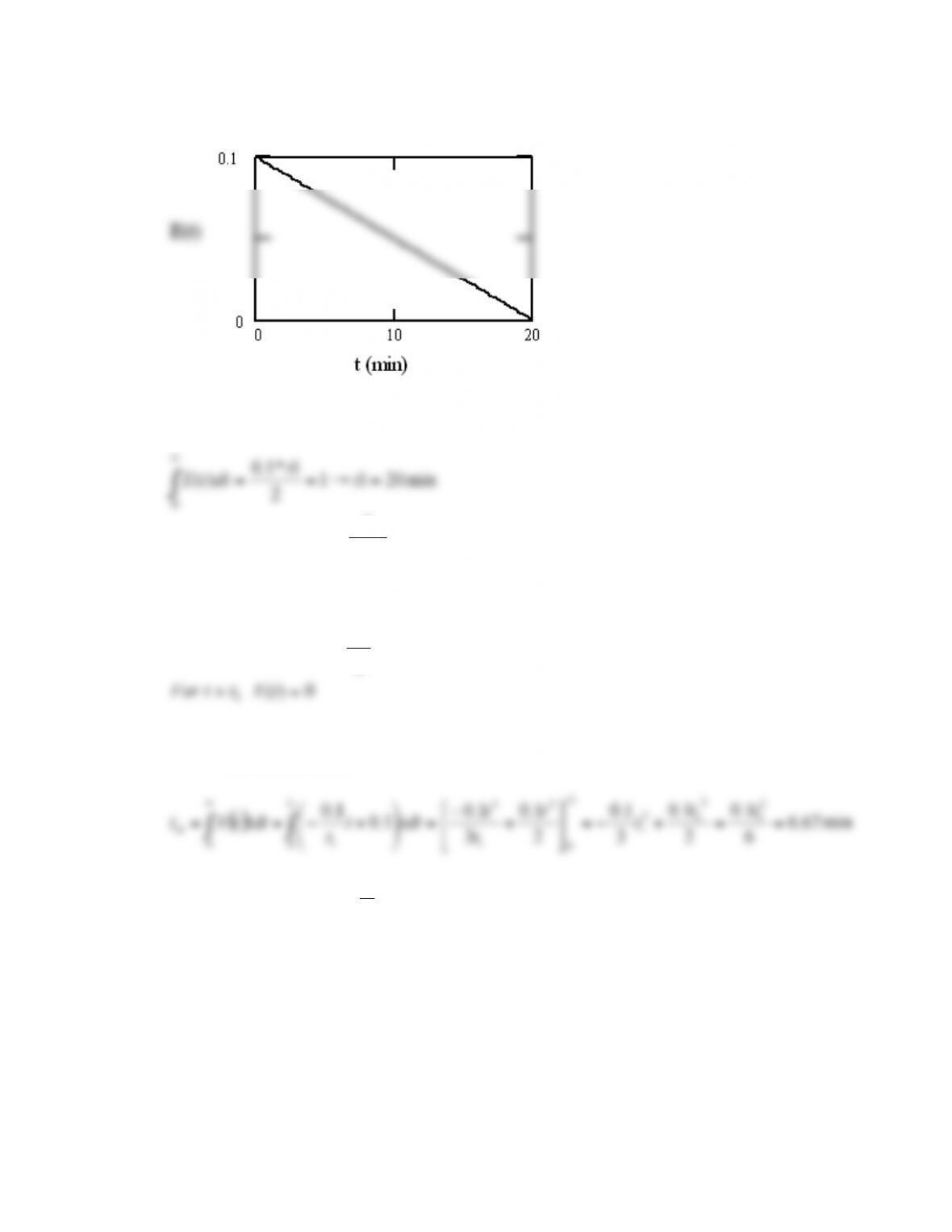
A possible two-parameter model is the PFR with Bypass (vb) and Dead Volume (VD)
Where vo=1m3min-1, V=2m3, α=V1/V=0.5, β=vb/vo=0.5 and τ=V/vo=2min
To evaluate the conversion we write a balance around node 1on species A:
( ) AbPFRo CvCvCv 00
1=+!
““
PFR, 2nd order, liquid phase
BAA CkCr !=
Where k=1.5 m3/(kmol⋅min) and
3
/2 dmmolCC BoAo ==
857.0
1
0
0=
+
=
!
=
PFR
PFR
A
PFRA
PFR Da
Da
C
CC
X
Where
( ) 6
1=
!
=
“
#
$
AoPFR kCDa
3
/286.0 dmmolCXCC AoPFRAoPFR =!=
( ) ( ) 3
/143.111 dmmolCCCCC AoPFRbPFRA =+!=+!=
““““
429.0
0
0=
!
=
A
AA
C
CC
X
VD
vb
V1
vb=βvo
V1=αV
node1
V2
P14-23
By definition:
1)(
0
=
!
“
dttE
min2011
2
1*1.0
)(
0
=!==
“
#
t
t
dttE
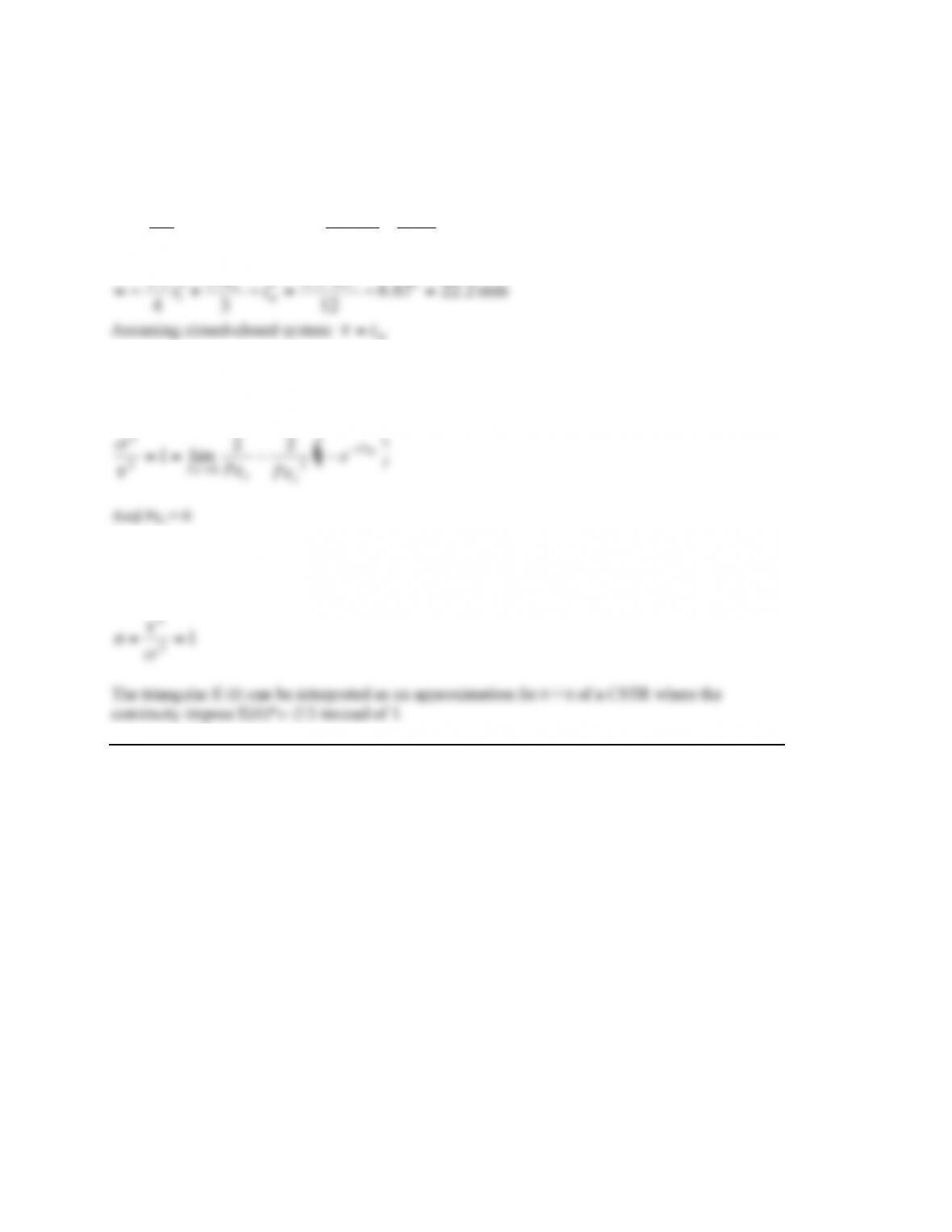
For a triangular E(t):
)0(
2
1E
t=
The analytical expression for E(t) is given by:
0)(
1.0
1.0
)(0
1
1
1
=>
+!=““
tEttFor
t
t
tEttFor
P14-23 (a)
Mean residence time
( ) min67.6
6
1.0
2
1.0
3
1.0
2
1.0
3
1.0
1.0
1.0 2
1
2
1
2
1
1
2
3
1
==+!=
“
$
%
‘+
!
=
(
(
*
+
+
–+!== ..
/tt
t
t
t
t
dttt
t
dtttEt
t
t
m
14-64
Variance
( )( )
min2.2267.6
12
201.0
3
1.0
4
1.0
3
1.0
4
1.0
1.0
1.0
2
3
2
3
1
3
1
2
min201
0
3
1
4
0
22
1
0
2
2
1
=!
“
=!+!=
!
#
$
%
&
‘
(+
!
=!
)
)
*
+
,
,
–
.+!
=!=
=
/
0
0
m
m
t
t
m
m
t
t
t
t
t
t
t
tdttt
t
dttttE
1
Assuming closed-closed system:
m
t=
!
P14-23 (b)
Peclet number
( )
r
Pe
r
r
Pe
e
Pe
Pe
!
“
!!== 1
22
lim1 2
0
2
2
#
$
And Per = 0
P14-23 (c)
Tanks in series
1
2
2
==
!
“
n
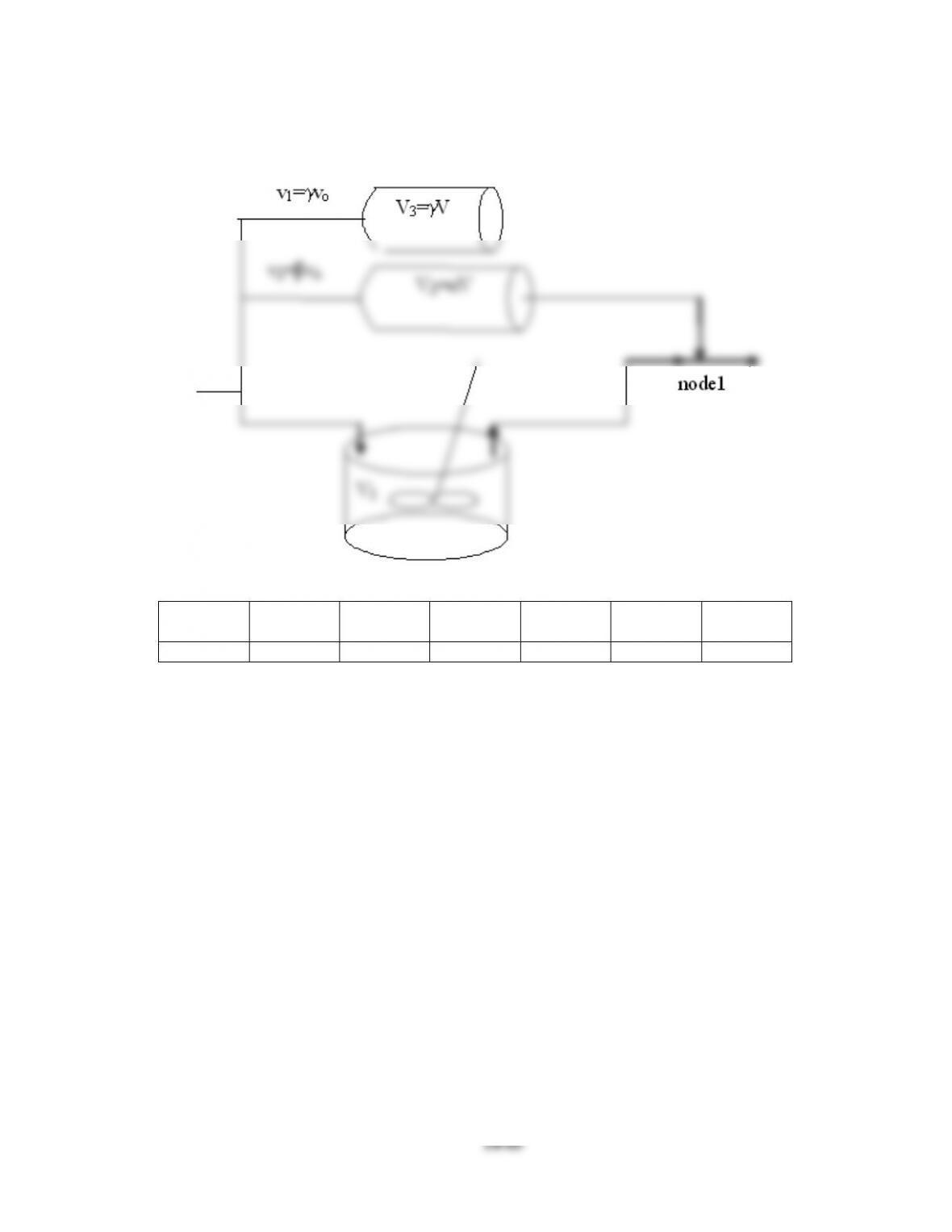
The triangular E (t) can be interpreted as an approximation for t<<τ of a CSTR where the
continuity impose E(0)*τ=2/3 instead of 1.
14-65
P14-24
The F(t) con be representative of a CSTR in parallel with two PFRs:
First order reaction
Ideal PFR
Ideal CSTR
Ideal laminar
flow reactor
Segregation
Maximum
Mixedness
Dispersion
Tanks in series