Gases 11
Chapter Overview
This chapter introduces the relationships between the four measurable quantities of a
sample of gas: pressure, volume, temperature, and the number of molecules. Their relationships
are shown, applications to stoichiometry are illustrated, and calculations involving them are
explained.
Lecture Outline
11.1 Extra-Long Straws
11.2 Kinetic Molecular Theory: A Model for Gases
Learning Objective: Describe how the main properties of a gas are predicted by kinetic
molecular theory.
11.3 Pressure: The Result of Constant Molecular Collisions
Learning Objective: Identify and understand the relationship between pressure, force, and
area.
Learning Objective: Convert among pressure units.
A. Pressure = force/area
B. Units of pressure
1. Atmosphere (atm)
3. Millimeters of mercury (mm Hg)
5. Pounds per square inch (psi)
11.4 Boyle’s Law: Pressure and Volume
Learning Objective: Restate and apply Boyle’s law.
11.5 Charles’s Law: Volume and Temperature
Learning Objective: Restate and apply Charles’s law.
B. Pressure and number of moles of gas must be constant
11.6 The Combined Gas Law: Pressure, Volume, and Temperature
Learning Objective: Restate and apply the combined gas law.
11.7 Avogadro’s Law: Volume and Moles
11.8 The Ideal Gas Law: Pressure, Volume, Temperature, and Moles
Learning Objective: Restate and apply the Ideal gas law.
11.9 Mixtures of Gases: Why Deep Sea Divers Breathe a Mixture of Helium and Oxygen
Learning Objective: Restate and apply Dalton’s law of partial pressures.
11.10 Gases in Chemical Reactions
Learning Objective: Apply the principles of stoichiometry to chemical reactions
involving gases.
Chemical Principle Teaching Ideas
Kinetic Molecular Theory
Although this is just a theory and is not 100% correct, it is a good estimation when
talking about gases under low-pressure and high-temperature conditions. Explain to students that
these conditions make molecules move very fast and have a lot of space in between species,
which means that there are very few interactions.
Pressure
Talking about why balloons and tires stay inflated gives the students a real-world
The Combined Gas Law
Getting the students familiar with the gas laws is most easily done by simply giving them
plenty of simple calculations to do.
The Ideal Gas Law
Once you understand the ideal gas law, the individual gas laws need not be memorized,
Mixtures of Gases
Talking about the partial pressure of the individual air molecules in the classroom is an
easy way for the students to see Dalton’s law. If only 21% of the gas molecules are oxygen
Skill Builder Solutions
14.7 psi
1.0 atm 16 mL
12
VV
V
88.2 mL =
88.2 mL 428 K
11.4.
1 1 2 2
PV P V
=
;
2
4.7 atm x V
1.1 atm x 3.7 L =
; V2=
1.1 atm 3.7 L x 288 K
= 0.82 L
12
VV
2
2.1 L V
2.1 L 0.69 mol
L atm
11.7. We must convert temperature to K and pressure to atm before we use the ideal gas law.
Plus. We need to calculate the number of moles of He, the temperature in K, and volume in L.
11.8. To calculate the molar mass of a gas, we need to know the number of moles and the
grams of the sample.
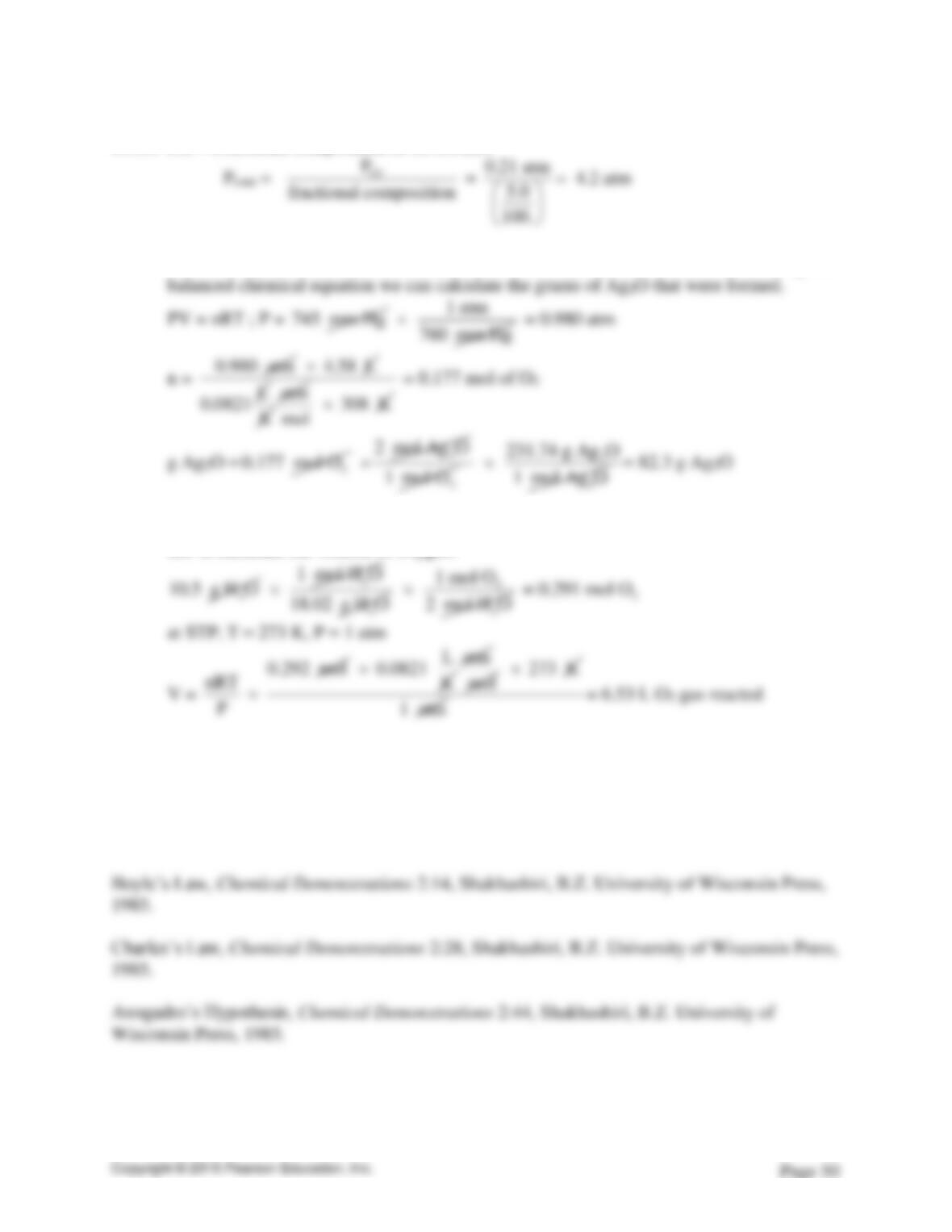
11.10. PO2 = Fractional composition of O2 x Ptotal ;
11.11. The first step is to calculate the number of moles of O2 that were formed. Then, using the
11.12. We must first calculate the number of moles of oxygen required, then use the ideal gas
law to calculate the volume of oxygen.
Suggested Demonstrations
Collapsing Can, Chemical Demonstrations 2:6, Shakhashiri, B.Z. University of Wisconsin Press,
1985.
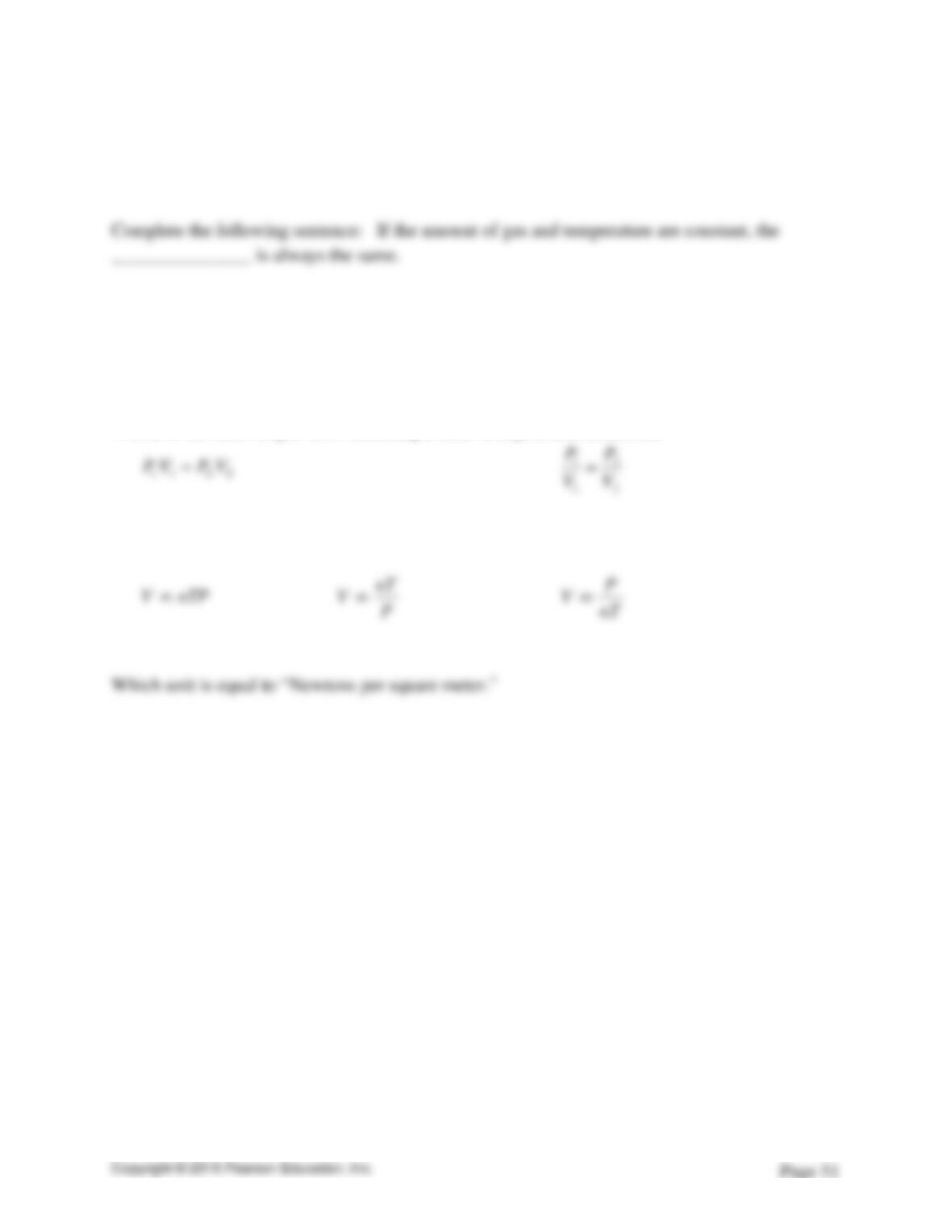
Guided Inquiry Ideas
Below are a few example questions that students answer in the guided inquiry activities provided
in the Guided Activity Workbook.
The proportionality constant, R, is called the ideal gas constant and is known to have a value
0.0821 L·atm/K·mol. Of the variables pressure, volume, number of moles, and temperature,
how many would you have to know to calculate them all?
Which of the following is true? (Subscripts refer to experiment numbers.)
Which of the following incorporates all the gas behavior observed so far?