PROBLEM 9.28
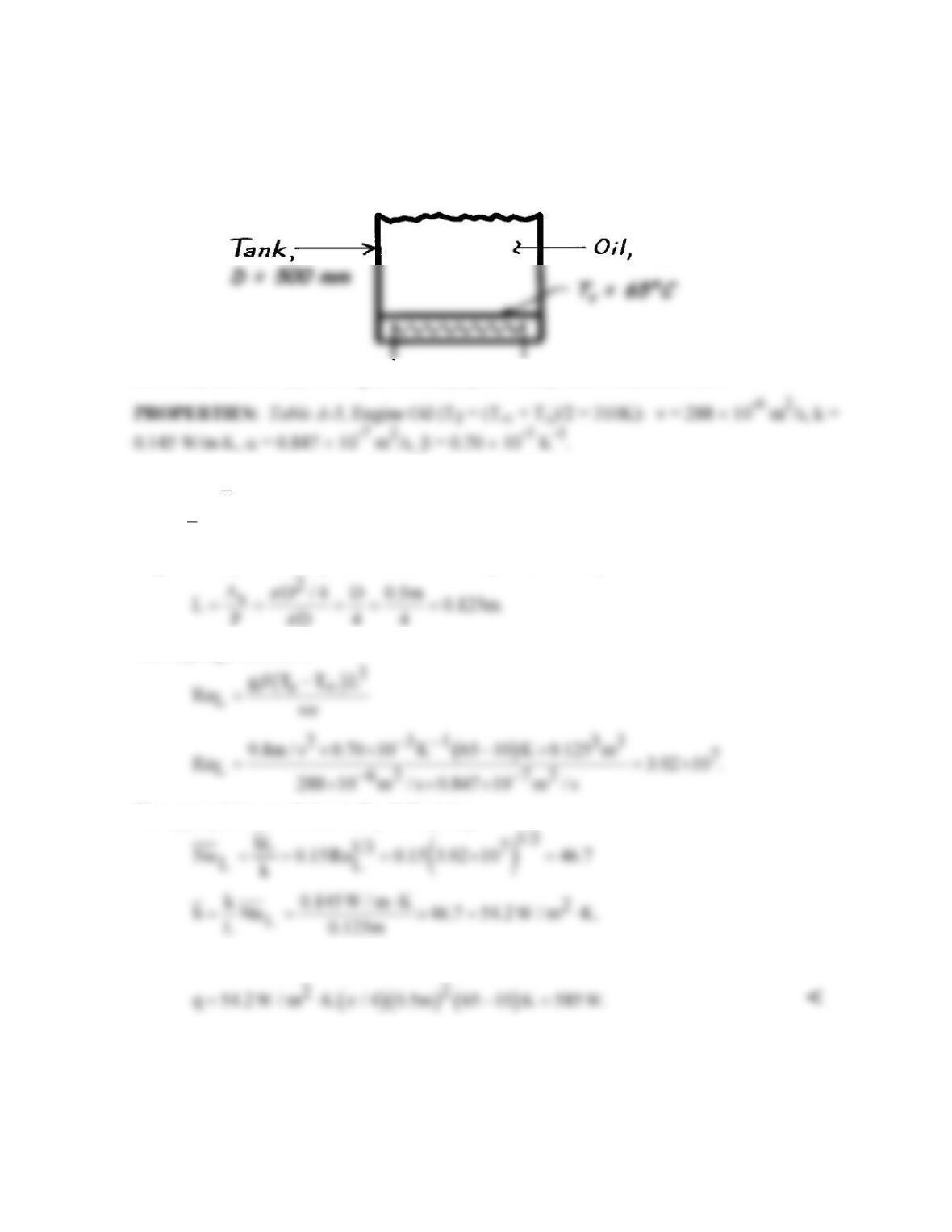
KNOWN: Electric heater at bottom of tank of 500 mm diameter maintains surface at 65°C
with engine oil at 10°C.
FIND: Power required to maintain 65°C surface temperature.
SCHEMATIC:
T
∞
= 10° C
ASSUMPTIONS: (1) Oil is quiescent, (2) Quasi-steady state conditions exist.
ANALYSIS: The heat rate from the bottom heater surface to the oil is
( )
ss
q hA T T∞
= −
where
h
is estimated from the appropriate correlation depending upon the Rayleigh number
RaL, from Eq. 9.25, using the characteristic length, L, from Eq. 9.29,
The Rayleigh number is
The appropriate correlation is Eq. 9.31 giving
The heat rate is then
COMMENTS: Note that the characteristic length is D/4 and not D; however, As is based
upon D. Recognize that if the oil is being continuously heated by the plate, T∞ could change.
Hence, here we have analyzed a quasi-steady state condition.
PROBLEM 9.29
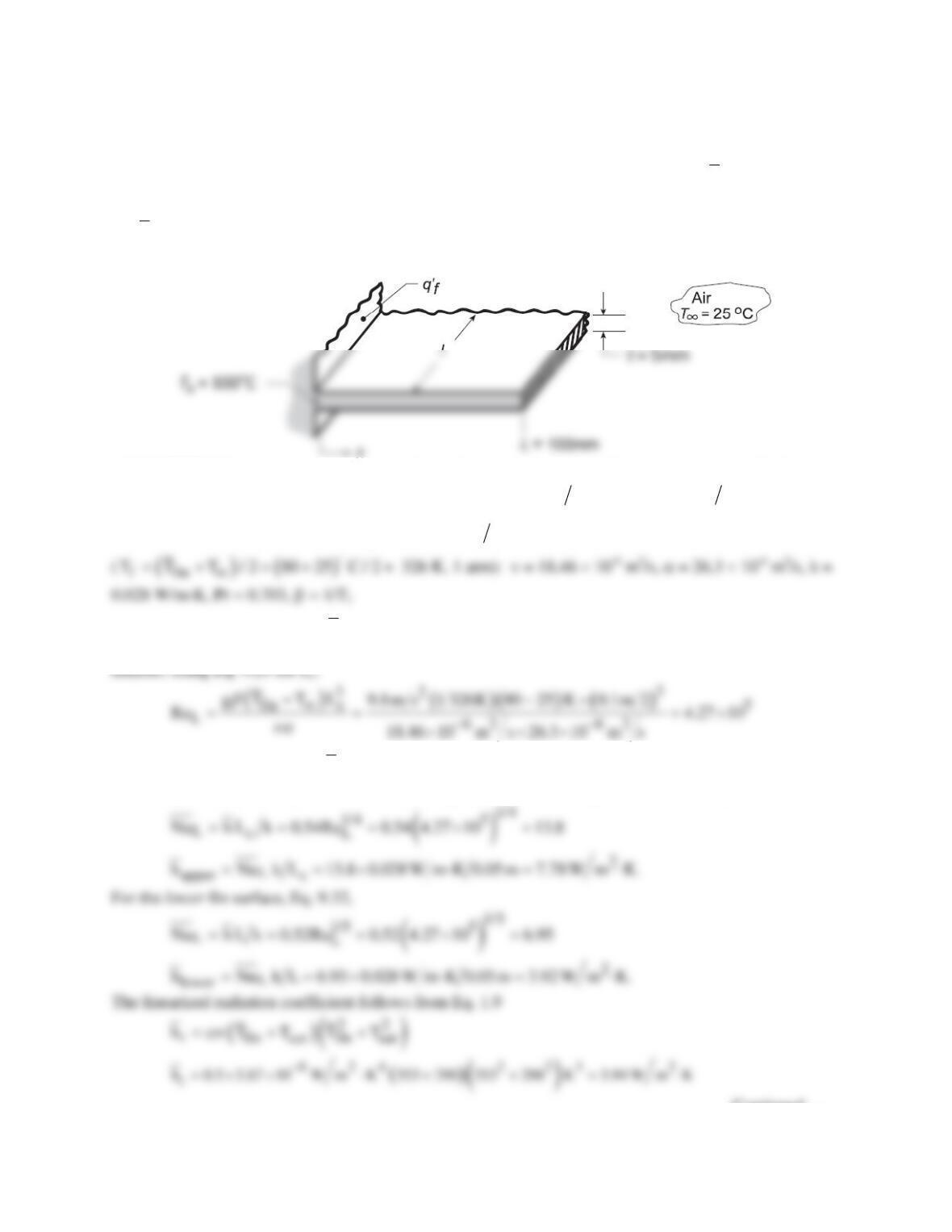
KNOWN: Horizontal, straight fin fabricated from plain carbon steel with thickness 5 mm and length
100 mm; base temperature is 100°C and air temperature is 25°C.
FIND: Fin heat rate per unit width,
f
q′
, assuming an average fin surface temperature
s
T 80 C=
for
estimating free convection and linearized radiation coefficient; how sensitive is
f
q′
to the assumed value
for
s
T
?
SCHEMATIC:
ASSUMPTIONS: (1) Air is quiescent medium, (2) Surface radiation effects are negligible, (3) One
dimensional conduction in fin, (4) Characteristic length,
( )
cs
L A P L 2 2L L 2= = +≈
.
PROPERTIES: Plain carbon steel, given:
k 57 W m K, 0.5
ε
= ⋅=
; Table A-4, Air
ANALYSIS: (a) We estimate
h
as the average of the values for a heated plate facing upward and a
heated plate facing downward. See Table 9.3, Case 3(a) and (b). Begin by evaluating the Rayleigh
An average fin temperature of
fin
T 80 C≈
has been assumed in evaluating properties and RaL.
According to Table 9.3, Eqs. 9.30 and 9.32 are appropriate. For the upper fin surface, Eq. 9.30,
Continued …
PROBLEM 9.29 (Cont.)
Hence, the average heat transfer coefficient for the fin is
ff
To determine how sensitive the estimate of
f
q′
is to the choice of the average fin surface temperature, the
foregoing calculations were repeated and the results are tabulated below; coefficients have units of
W m K
2
⋅
.
( )
fin
TC
70 80 90
lower
h
3.77 3.92 4.05
The estimate of
f
q′
varies by around ±4% as the fin temperature varies by ±10°C. <
COMMENTS: It has been assumed that the base to which the fin is attached does not affect the free
convection processes. The veracity of this assumption is questionable.
PROBLEM 9.30
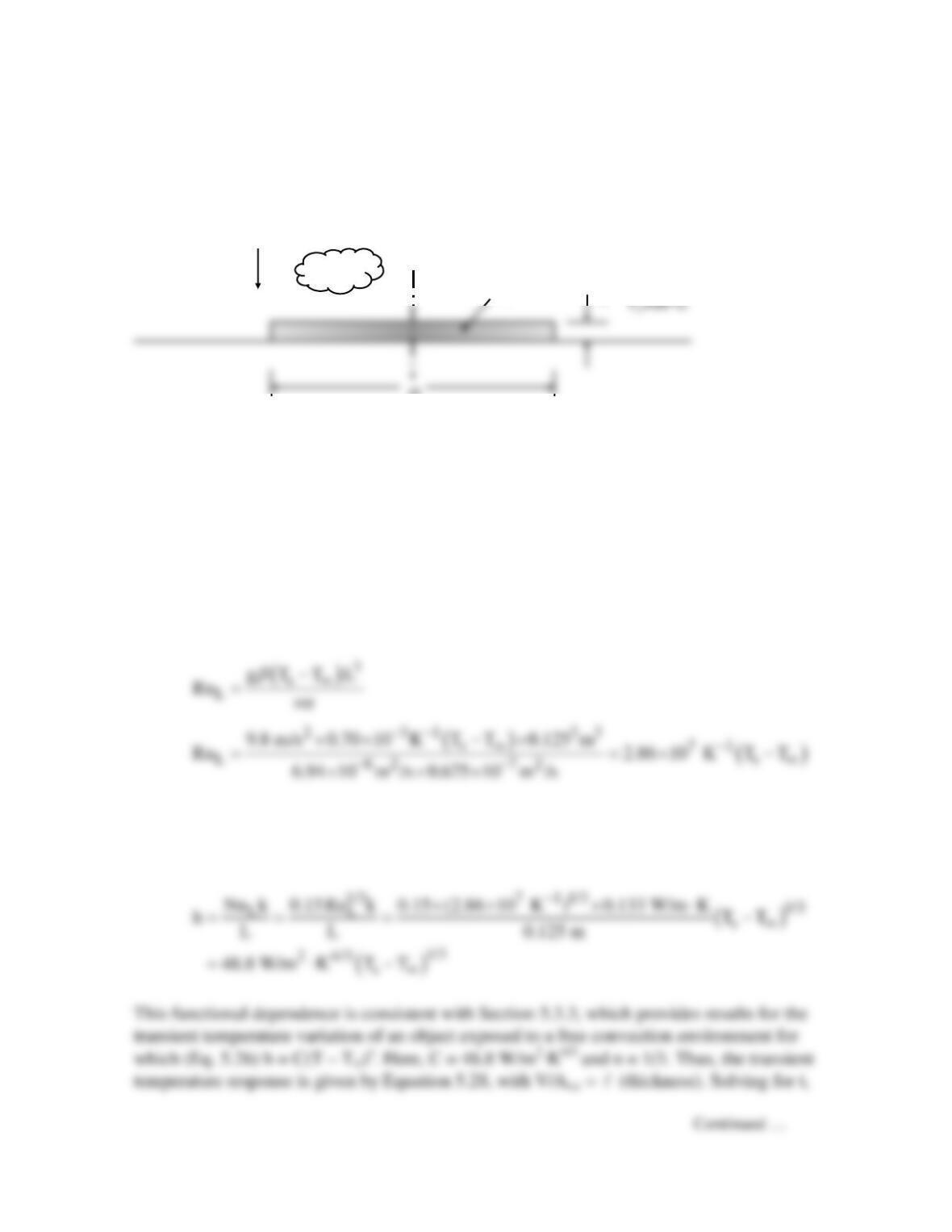
KNOWN: Diameter, thickness, and initial temperature of aluminum alloy disk. Temperature
of oil bath. Metal properties.
FIND: Time needed to reduce disk temperature to 100°C, using results of Section 5.3.3.
SCHEMATIC:
D = 0.5 m
ℓ= 35 mm
Ti= 400°C
D
ℓ
Ti
Oil, T∞
ρ
Al = 1000 kg/m3
kAl = 185 W/m∙K
cAl = 775 J/kg∙K
g
ASSUMPTIONS: (1) Oil is quiescent, (2) Oil temperature doesn’t change with time, (3) Oil
properties are the same as engine oil, (4) Constant properties, (5) Lumped capacitance model
is valid, (6) No heat transfer from bottom of disk.
PROPERTIES: Table A-5, Engine Oil (Tf = 420 K, average film temperature between initial
and final times): ν = 6.94 × 10⁻⁶ m2/s, k = 0.133 W/m⋅K, a = 0.675 × 10⁻⁷ m2/s, Pr = 103, β
= 0.70 × 10⁻³ K–1.
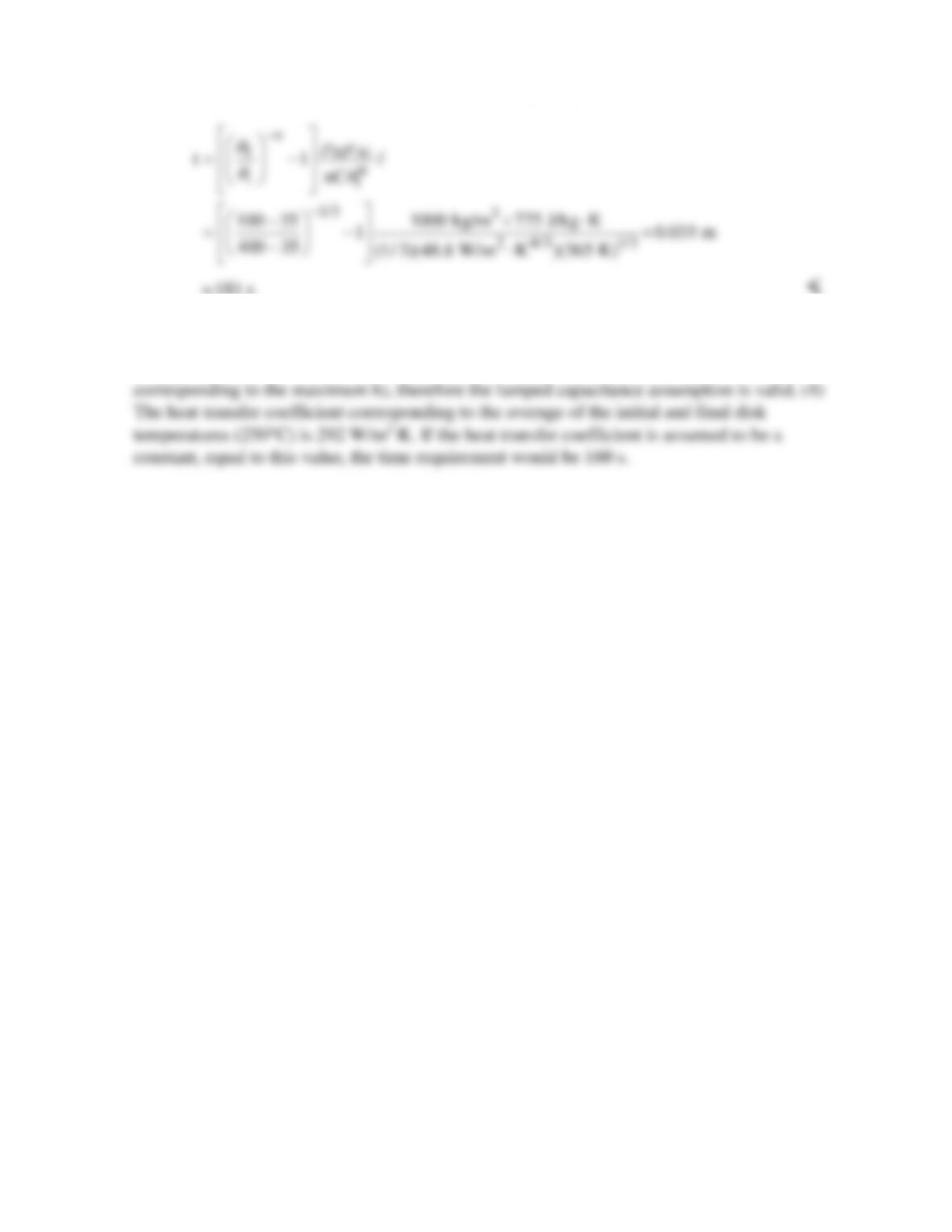
ANALYSIS: The characteristic length for use in Eqs. 9.30-9.32 is L = As/P = D/4 = 0.125 m.
The Rayleigh number is:
Evaluating the Rayleigh number at the initial and final times, we find RaL is in the range from
1.04 × 10¹⁰ down to 1.86 × 10⁹. Therefore, Equation 9.31 is appropriate for the hot disk in
cooler oil. The heat transfer coefficient is given by:
PROBLEM 9.30 (Cont.)
181 s=
<
COMMENTS: (1) Note that the characteristic length is D/4 and not D; however, As is based
upon D. (2) Recognize that if the oil is being continuously heated by the disk, T∞ could
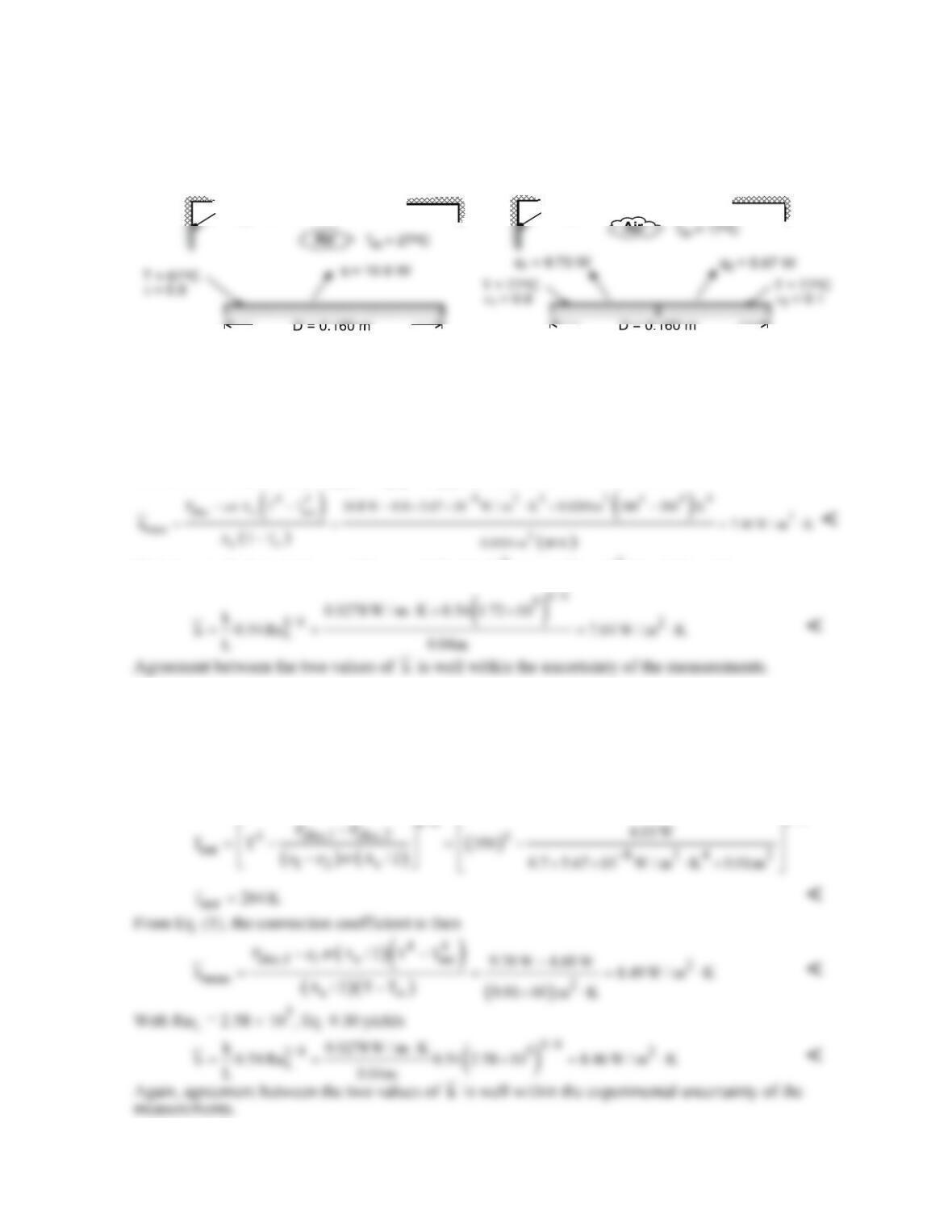
change. (3) The Biot number for the disk is Bi = h
/kAl = 0.066 (at the initial time,
PROBLEM 9.31
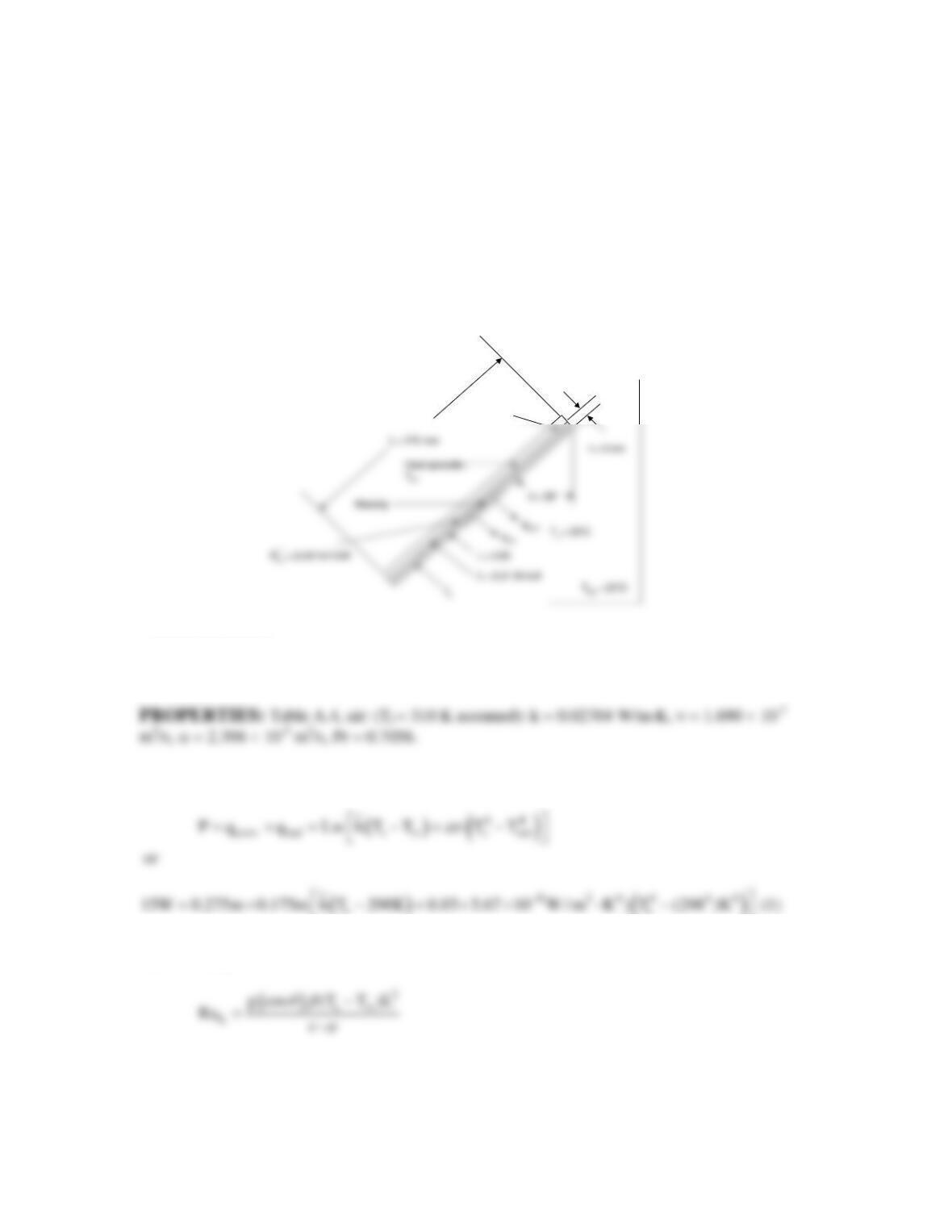
KNOWN: Diameter, power dissipation, emissivity and temperature of gage(s). Air temperature
(Cases A and B) and temperature of surroundings (Case A).
FIND: (a) Convection heat transfer coefficient (Case A), (b) Convection coefficient and temperature
of surroundings (Case B).
SCHEMATIC:
ASSUMPTIONS: (1) Steady-state, (2) Quiescent air, (3) Net radiation exchange from surface of
gage approximates that of a small surface in large surroundings, (4) All of the electrical power is
dissipated by convection and radiation heat transfer from the surface(s) of the gage, (5) Negligible
thickness of strip separating semi-circular disks of Part B, (6) Constant properties.
PROPERTIES: Table A-4, air (Tf = 320K):
ν
= 17.9 × 10⁻⁶ m2/s,
a
= 25.5 × 10⁻⁶ m2/s, k = 0.0278
W/m⋅K, Pr = 0.704,
β
= 0.00313 K-1.
ANALYSIS: (a) With q = qconv + qrad = Pelec and As = πD2/4 = 0.0201 m2,
With L = As/P=D/4=0.04 m and RaL = g
β
(T – T∞)L3/
νa
= 1.72 × 10⁵, Eq. 9.30 yields
(b) Since the semi–circular disks have the same temperature, each is characterized by the same
convection coefficient and qconv,1 = qconv,2. Hence, with
( )
()
44
elec,1 conv,1 1 s sur
P q A /2 T T
εs
=+−
(1)
( )
()
44
elec,2 conv,2 2 s sur
P q A /2 T T
εs
=+−
(2)
1/ 4
COMMENTS: Because the semi–circular disks are at the same temperature, the characteristic length
corresponds to that of the circular disk, L = D/4.
Tsur o
= 25 C
Tsur
7
PROBLEM 9.32
KNOWN: Power dissipation by a laptop computer CPU. Dimensions and emissivity of the
laptop screen assembly. Thickness and thermal conductivity of plastic casing as well as thermal
contact resistance between heat spreader and plastic casing. Temperature of the surroundings and
of the ambient.
FIND: Temperature of the heat spreader and magnitudes of convection, radiation, conduction
and contact resistances.
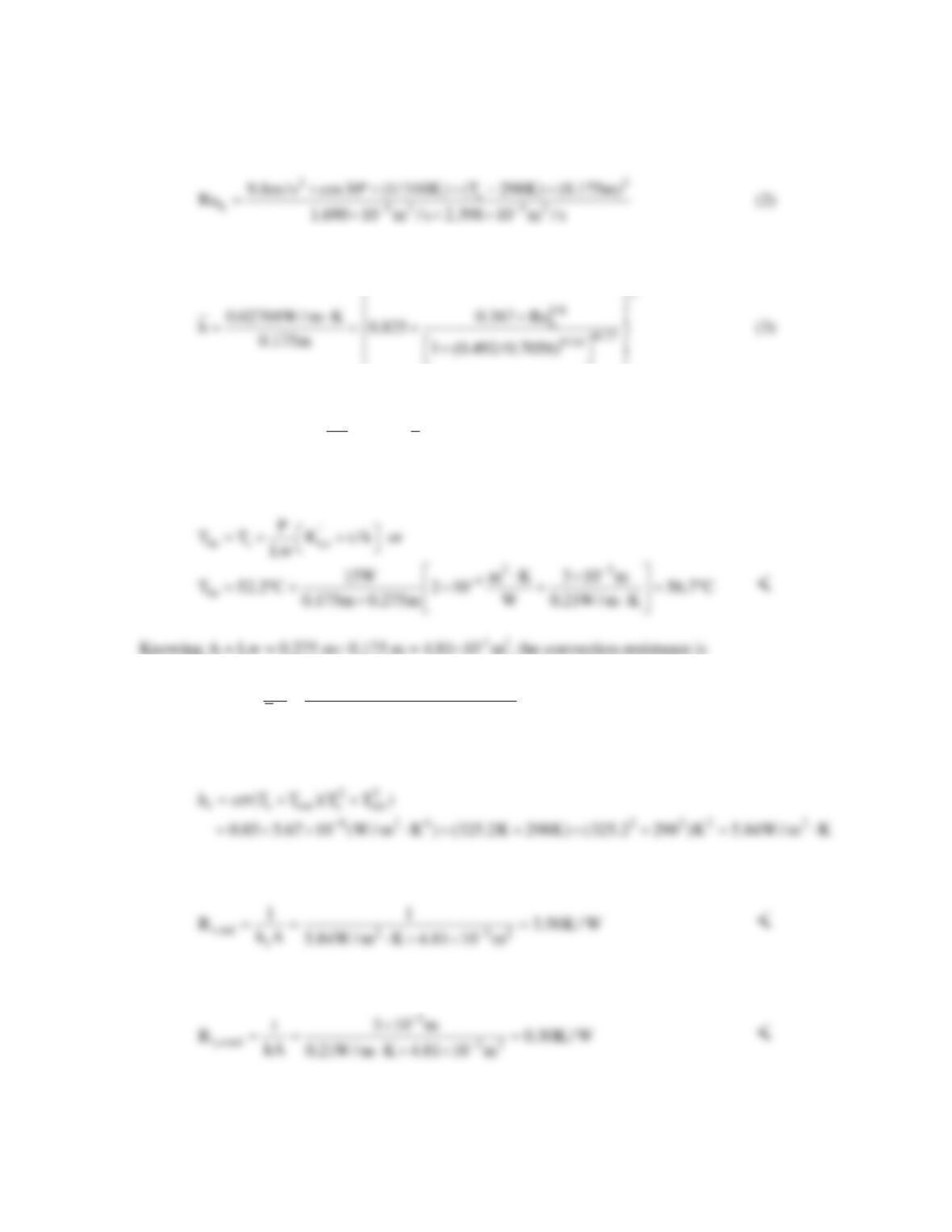
SCHEMATIC:
ASSUMPTIONS: (1) Constant properties and steady-state conditions, (2) Large surroundings,
(3) Isothermal heat spreader, (4) Laptop screen can be treated as a suspended plate.
ANALYSIS: An energy balance on the control surface shown in the schematic yields
ss
The convection coefficient can be found by using the Churchill and Chu correlation with g
replaced by gcos
θ
. Hence,
Continued…
P = 15 W
P = 15 W
PROBLEM 9.32 (Cont.)
and
Simultaneous solution of Equations 1 through 3 yields
72
L
Ls
Ra 1.048 10 , Nu 31.6,h 4.89W / m K,T 325.2K 52.2 C=× = = ⋅= =°
The temperature of the heat spreader is
t,conv 232
11
R4.30K/W
hA 4.89W / m K 4.81 10 m
−
== =
⋅× × <
The radiation resistance, using
is
The conduction resistance is
Continued…
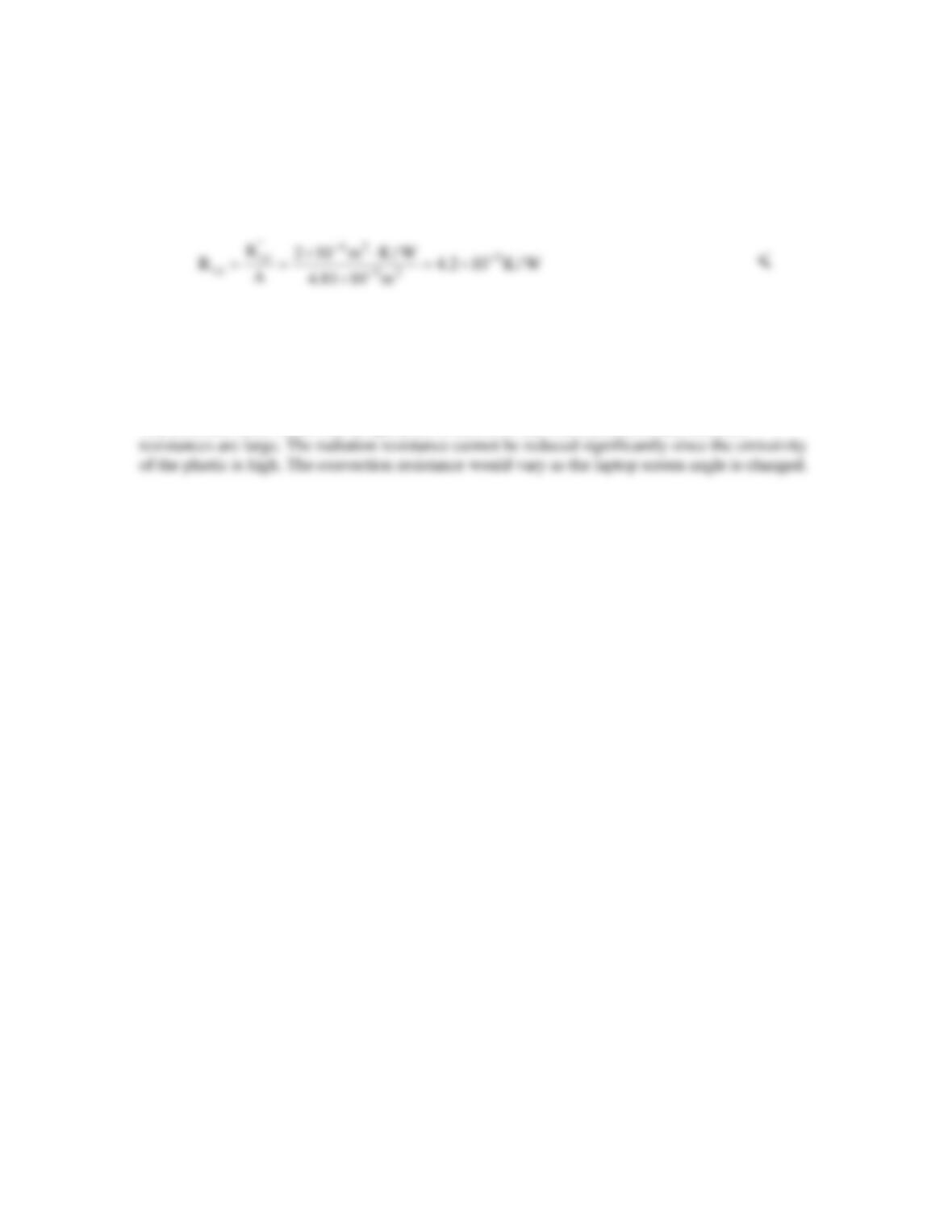
PROBLEM 9.32 (Cont.)
The contact resistance is
COMMENTS: (1) The actual film temperature is Tf = (23°C + 52.2°C)/2 = 37.6°C = 310.6 K.
The assumed value of the film temperature is excellent. (2) The convection and radiation
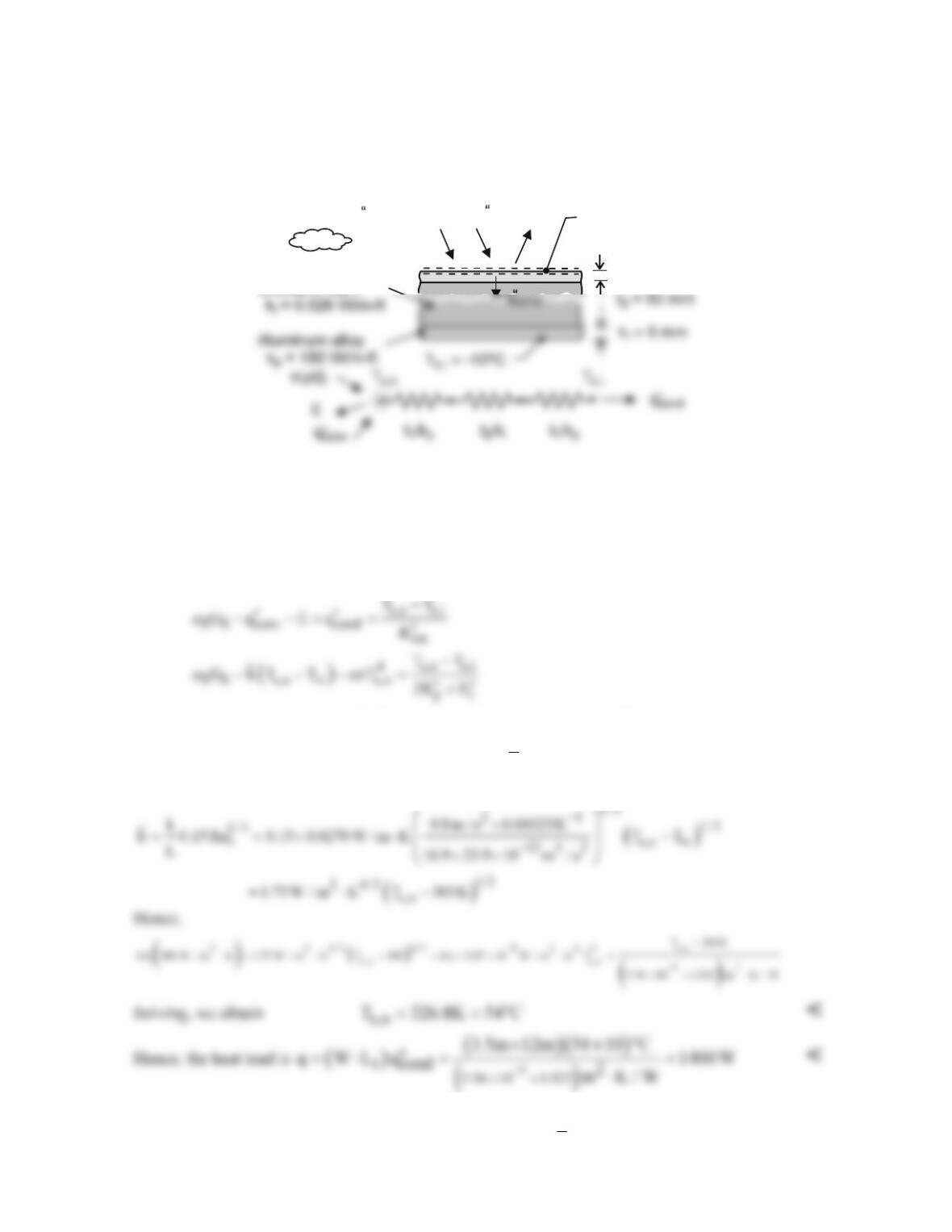
PROBLEM 9.33
KNOWN: Material properties, inner surface temperature and dimensions of roof of refrigerated
truck compartment. Solar irradiation and ambient temperature.
FIND: Outer surface temperature of roof and rate of heat transfer to compartment.
SCHEMATIC:
Urethane foam
E Ts,o S
, = 0.5
W = 3.5m
ε = a
t1 = 5 mm
q = 75
S0 W/m2q
conv
Air
T = 32 C
o
o
o
= 900 W/m2= 0.6
T∞= 30°C
ASSUMPTIONS: (1) Negligible irradiation from the sky, (2) Ts,o > T∞ (hot surface facing upward)
and RaL > 107, (3) Constant properties.
PROPERTIES: Table A-4, air (p = 1 atm, Tf ≈ 310K):
ν
= 16.9 × 10⁻⁶ m2/s, k = 0.0270 W/m⋅K, Pr
= 0.706,
a
=
ν
/Pr = 23.9 × 10⁻⁶ m2/s,
β
= 0.00323 K-1.
ANALYSIS: From an energy balance for the outer surface,
where
( )
( )
52 2
p 1p i 2i
R t / k 2.78 10 m K / W and R t / k 1.923 m K / W.
−
′′ ′′
= =×⋅ = = ⋅
For a hot surface
facing upward and
( )
37
L s,o
Ra g T T L / 10 , h
β aν
∞
=−>
is obtained from Eq. 9.31. Hence, with
cancellation of L,
COMMENTS: (1) The thermal resistance of the aluminum panels is negligible compared to that of
the insulation. (2) The value of the convection coefficient is
( )
1/3 2
s,o
h 1.73 T T 5.0 W / m K.
∞
= −= ⋅
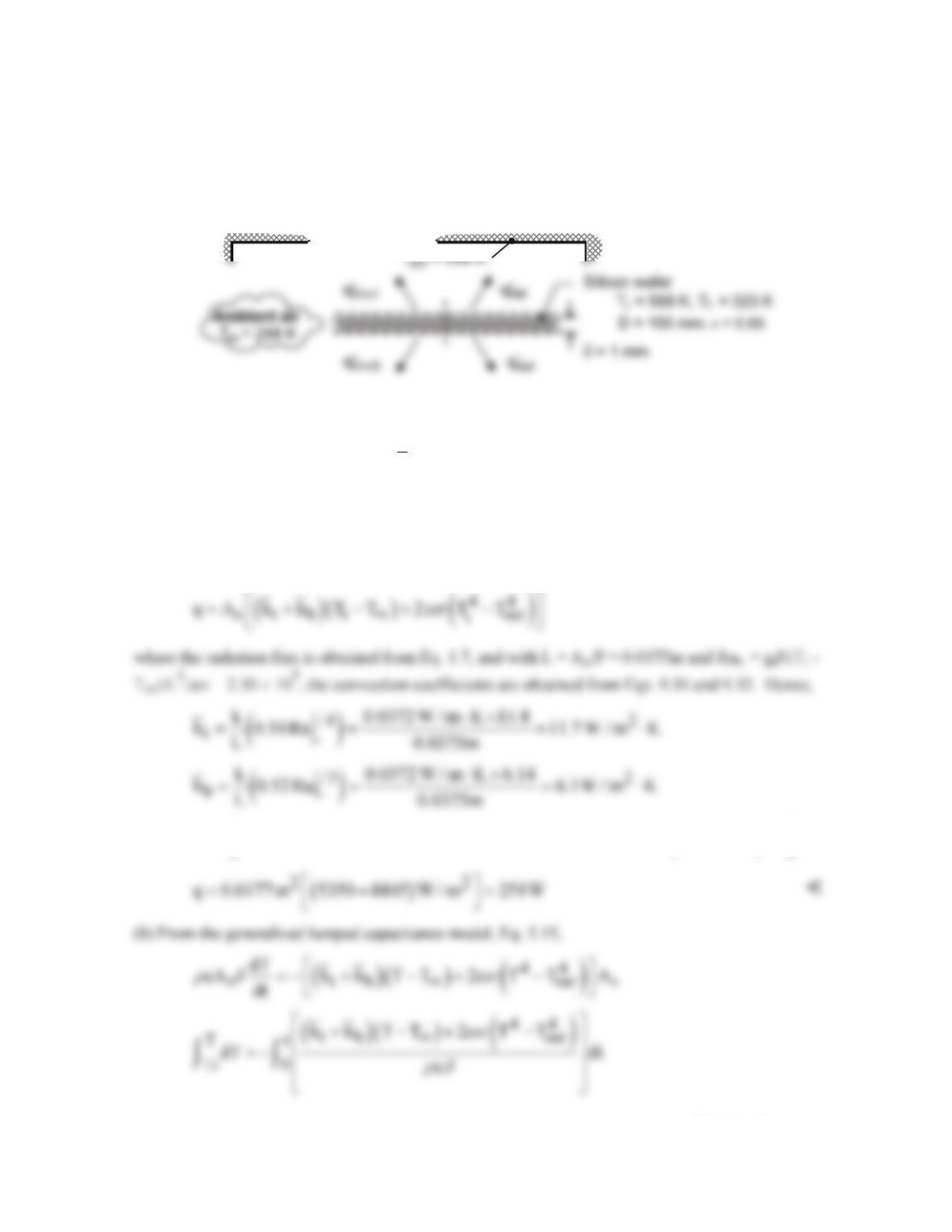
PROBLEM 9.34
KNOWN: Diameter, thickness, emissivity and initial temperature of silicon wafer. Temperature of
air and surrounding.
FIND: (a) Initial cooling rate, (b) Time required to achieve prescribed final temperature.
SCHEMATIC:
ASSUMPTIONS: (1) Negligible heat transfer from side of wafer, (2) Large surroundings, (3) Wafer
may be treated as a lumped capacitance, (4) Constant properties, (5) Quiescent air.
PROPERTIES: Table A-1, Silicon (
T
= 187°C = 460K):
ρ
= 2330 kg/m3, cp = 813 J/kg⋅K, k =
87.8 W/m⋅K. Table A-4, Air (Tf,i = 175°C = 448K):
ν
= 32.15 × 10⁻⁶ m2/s, k = 0.0372 W/m⋅K,
a
=
46.8 × 10⁻⁶ m2/s, Pr = 0.686,
β
= 0.00223 K-1.
SOLUTION: (a) Heat transfer is by natural convection and net radiation exchange from top and
bottom surfaces. Hence, with As = πD2/4 = 0.0177 m2,
( ) ( )
( )
2 2 8 24 4 44
q 0.0177 m 11.7 6.1 W / m K 300K 2 0.65 5.67 10 W / m K 598 298 K
−
= + ⋅ +× × × ⋅ −
Continued …..
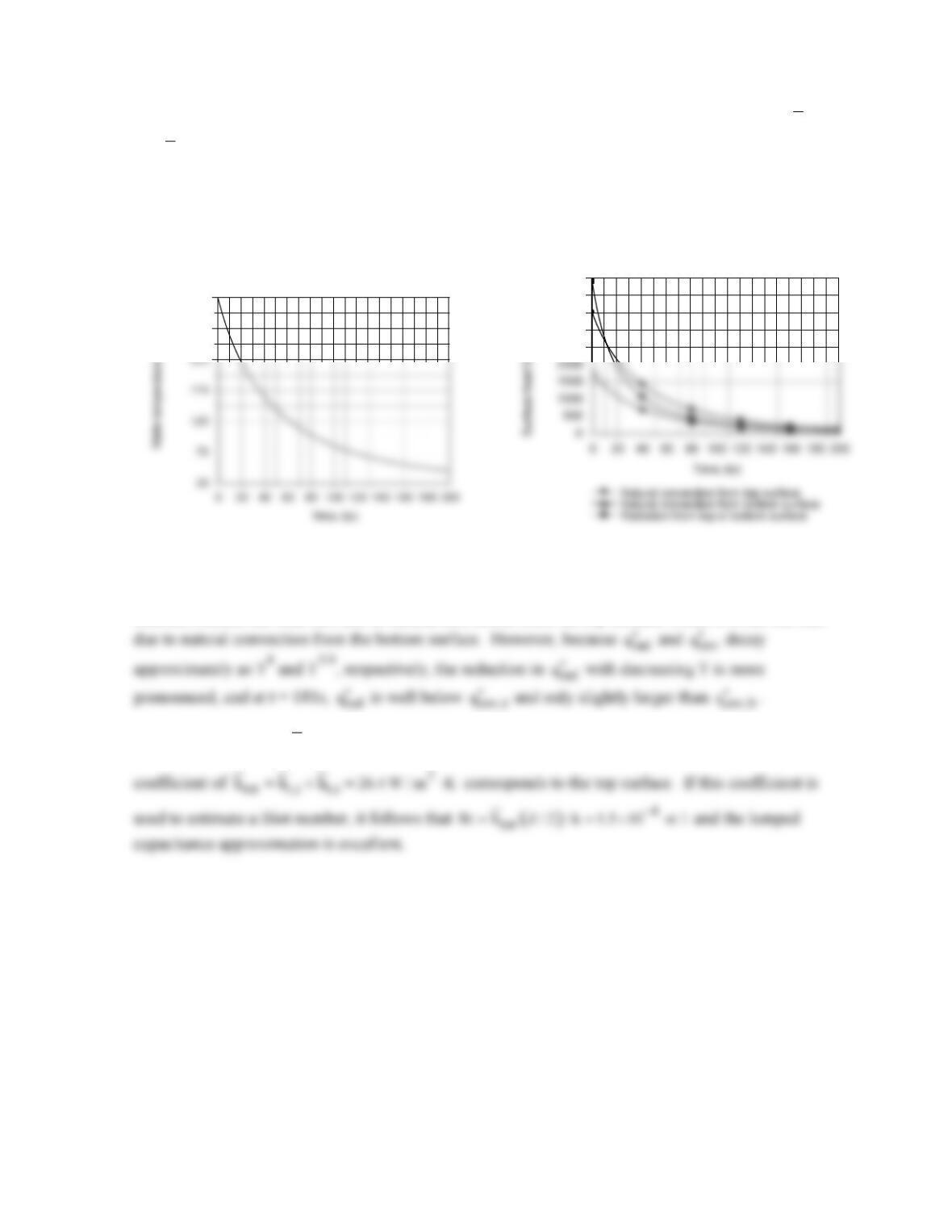
PROBLEM 9.34 (Cont.)
Using the DER function of IHT to perform the integration, thereby accounting for variations in
t
h
and
b
h
with T, the time tf to reach a wafer temperature of 50°C is found to be
( )
f
t T 323 K 179 s= =
<
As shown above, the rate at which the wafer temperature decays with increasing time decreases due to
reductions in the convection and radiation heat fluxes. Initially, the surface radiative flux (top or
bottom) exceeds the heat flux due to natural convection from the top surface, which is twice the flux
COMMENTS: With
( )
( )
22 2
r,i i sur i sur
h T T T T 14.7 W / m K,
εs
= + += ⋅
the largest cumulative
275
325
2500
3000
3500
4000
4500
PROBLEM 9.35
KNOWN: Pyrex tile, initially at a uniform temperature Ti = 140°C, experiences cooling by convection
with ambient air and radiation exchange with surroundings.
FIND: (a) Time required for tile to reach the safe–to–touch temperature of Tf = 40°C with free
convection and radiation exchange; use
( )
if
T TT 2= +
to estimate the average free convection and
linearized radiation coefficients; comment on how sensitive result is to this estimate, and (b) Time–to–
cool if ambient air is blown in parallel flow over the tile with a velocity of 10 m/s.
SCHEMATIC:
ASSUMPTIONS: (1) Tile behaves as spacewise isothermal object, (2) Backside of tile is perfectly
insulated, (3) Surroundings are large compared to the tile, (4) For forced convection situation, part (b),
assume flow is fully turbulent.
PROPERTIES: Table A.3, Pyrex (300 K): ρ = 2225 kg/m3, cp = 835 J/kg⋅K, k = 1.4 W/m⋅K, ε = 0.80
(given); Table A.4, Air
( )
( )
fs
T T T 2 330.5 K, 1 atm
∞
=+=
: ν = 18.96 × 10⁻⁶ m2/s, k = 0.0286 W/m⋅K, a =
27.01 × 10⁻⁶ m2/s, Pr = 0.7027, β = 1/Tf.
ANALYSIS: (a) For the lumped capacitance system with a constant coefficient, from Eq. 5.6,
The linearized radiation coefficient based upon the average temperature,
s
T
, is
The free convection coefficient can be estimated from the correlation for the flat plate, Eq. 9.30, with
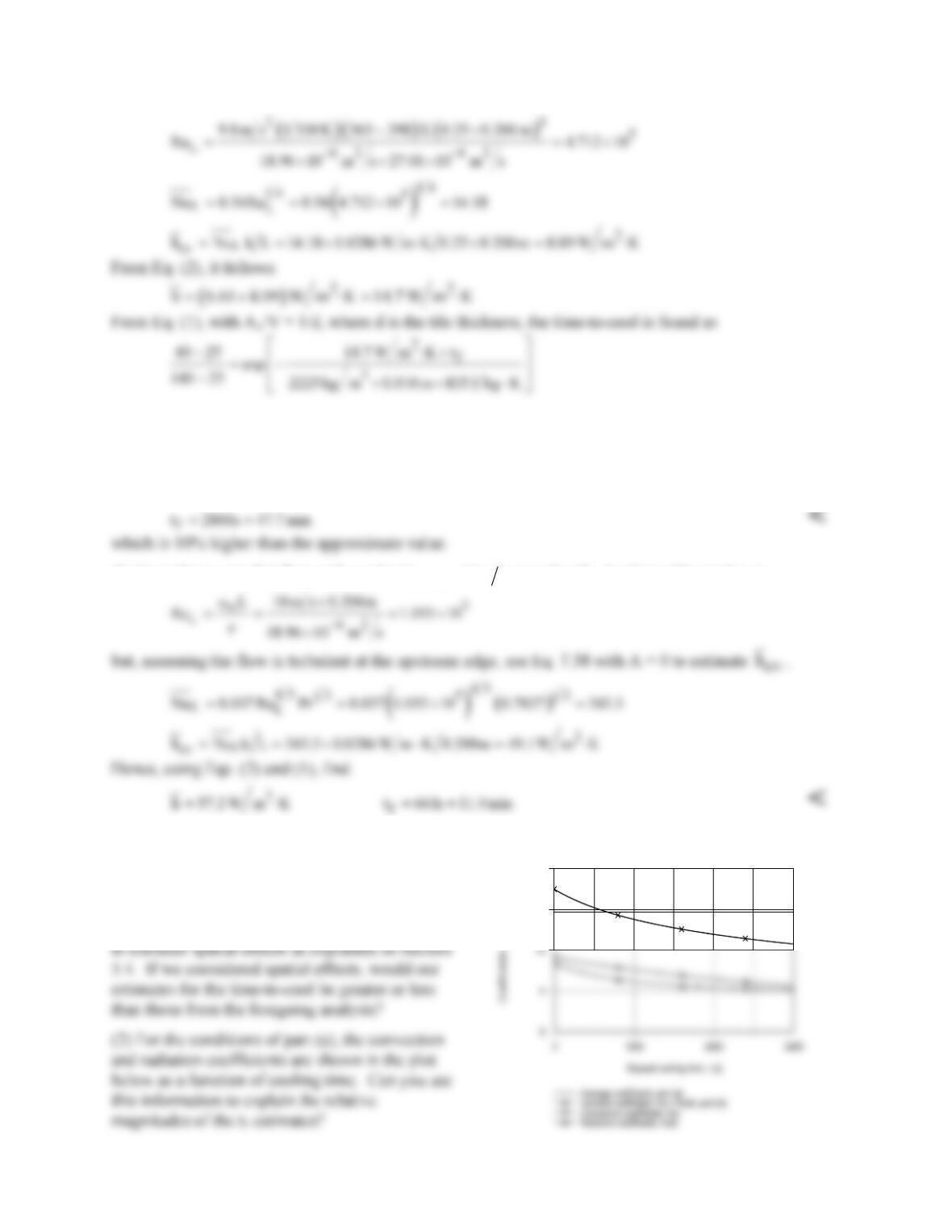
PROBLEM 9.35 (Cont.)
f
t 2574s 42.9 min= =
<
Using the IHT Lumped Capacitance Model with the Correlations Tool, Free Convection, Flat Plate, we
can perform the analysis where both hcv and hrad are evaluated as a function of the tile temperature. The
time–to-cool is
(b) Considering parallel flow with a velocity,
u 10 m s
∞=
over the tile, the Reynolds number is
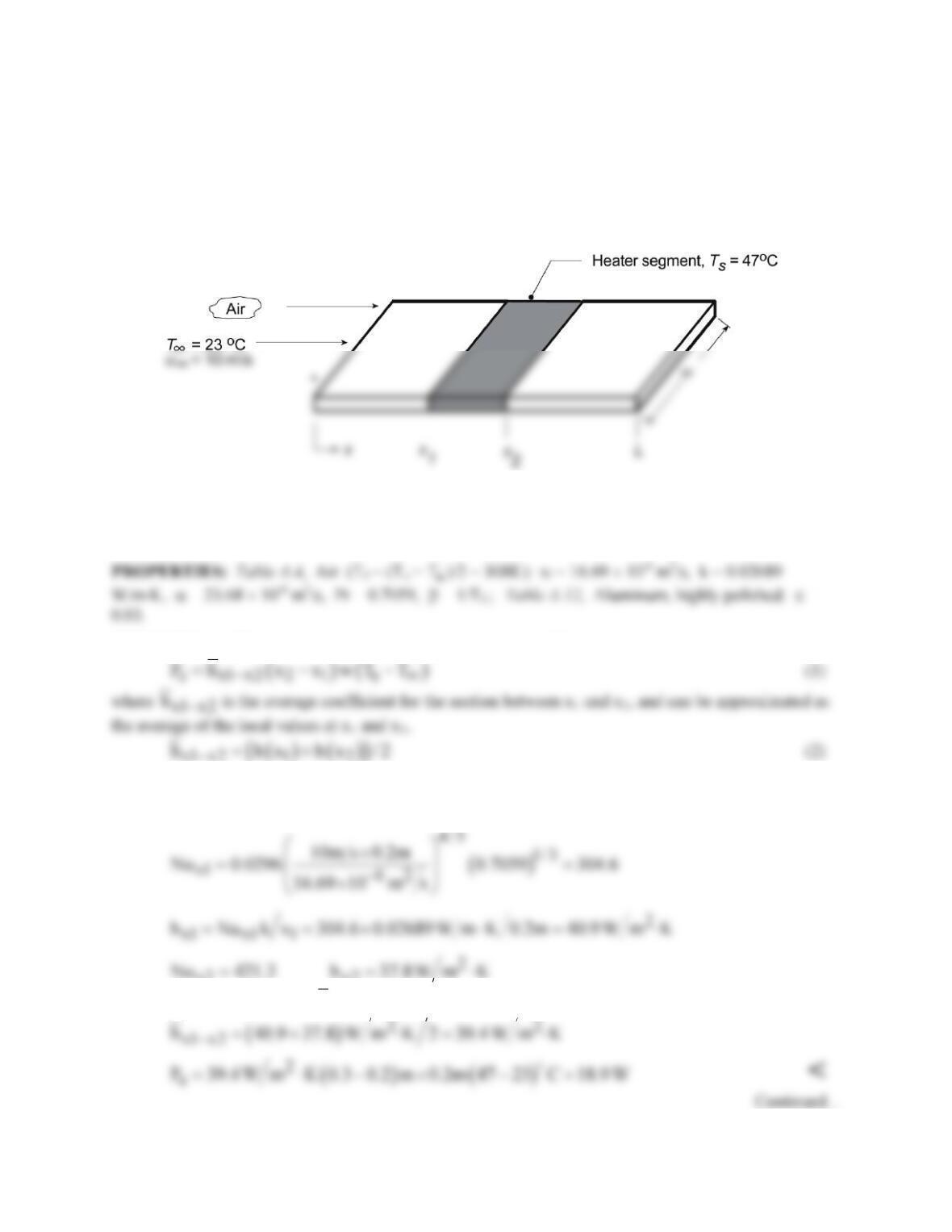
COMMENTS: (1) For the conditions of part (a),
Bi = hd/k= 14.7 W/m2 ⋅K × 0.01m / 1.4 W/m⋅K =
0.105. We conclude that the lumped capacitance
analysis is marginally applicable. For the
condition of part (b), Bi = 0.4 and, hence, we need
15
20
PROBLEM 9.36
KNOWN: Parallel flow of air over a highly polished aluminum plate flat plate maintained at a uniform
temperature Ts = 47°C by a series of segmented heaters.
FIND: (a) Electrical power required to maintain the heater segment covering the section between x1 =
0.2 m and x2 = 0.3m and (b) Temperature that the surface would reach if the air blower malfunctions and
heat transfer occurs by free, rather than forced, convection.
SCHEMATIC:
ASSUMPTIONS : (l) Steady–state conditions, (2) Backside of plate is perfectly insulated, (3) Flow is
turbulent over the entire length of plate, part (a), (4) Ambient air is extensive, quiescent at 23°C for part
(b).
ANALYSIS: (a) The power required to maintain the segmented heater (x1 – x2) is
x1 x2 1 2
−
Using Eq. 7.36 appropriate for fully turbulent flow, with Rex =
u
¥
x /k,
4/5 1/3
x1 x
Nu 0.0296 Re Pr=
x2 x2
Hence, from Eq (2) to obtain
x1 x2
h
−
and Eq. (1) to obtain Pe,
PROBLEM 9.36 (Cont.)
(b) Without the airstream flow, the heater segment experiences free convection and radiation exchange
with the surroundings,
We will assume that the free convection coefficient,
cv
h
, for the segment is the same as that for the
entire plate. Using the correlation for a flat plate, Eq. 9.30, with
and evaluating properties at Tf = 308 K,
Substituting numerical values into Eq. (3),
s
COMMENTS: Recognize that in part (b), the assumed value for Tf = 308 K is a poor approximation.
Using the above relations in the IHT work space with the Properties Tool, find that Ts = 406 K = 133 °C
using the properly evaluated film temperature (Tf) and temperature difference (∆T) in the correlation.
From this analysis,
2
cv
h 8.29 W m K= ⋅
and hrad = 0.3 W/m2⋅K. Because of the low emissivity of the
plate, the radiation exchange process is not significant.
PROBLEM 9.37
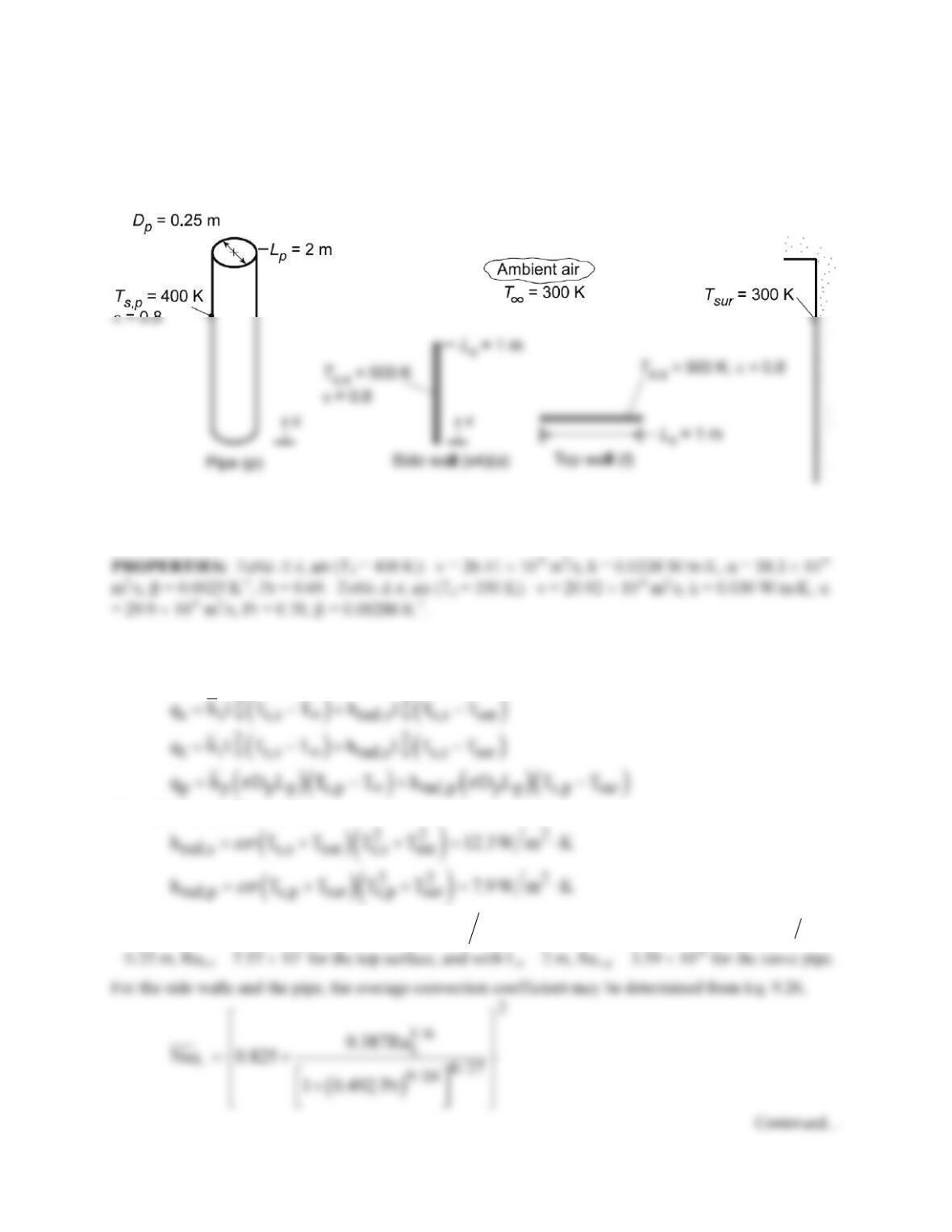
KNOWN: Dimensions, emissivity and operating temperatures of a wood burning stove. Temperature of
ambient air and surroundings.
FIND: Rate of heat transfer.
SCHEMATIC:
ASSUMPTIONS: (1) Steady-state, (2) Quiescent air, (3) Negligible heat transfer from pipe elbow, (4)
Free convection from pipe corresponds to that from a vertical plate.
ANALYSIS: Three distinct contributions to the heat rate are made by the 4 side walls, the top surface,
and the pipe surface. Hence qt = 4qs + qt + qp, where each contribution includes transport due to
convection and radiation.
The radiation coefficients are
For the stove side walls, RaL,s =
( )
3
s,s s
gT TL
β aν
∞
−
= 4.84 × 10⁹. Similarly, with (As/P) =
L L
s s
24
PROBLEM 9.37 (Cont.)
which yields
L,s
Nu
= 199.9 and
L,p
Nu
= 377.6. For the top surface, the average coefficient may be
obtained from Eq. 9.31,
2
s
h 6.8 W m K= ⋅
,
2
t
h 8.6 W m K= ⋅
,
2
p
h 5.7 W m K= ⋅
Hence,
and the total heat rate is
COMMENTS: The amount of heat transfer is significant, and the stove would be capable of
maintaining comfortable conditions in a large, living space under harsh (cold) environmental conditions.
L,t
Nu
PROBLEM 9.38
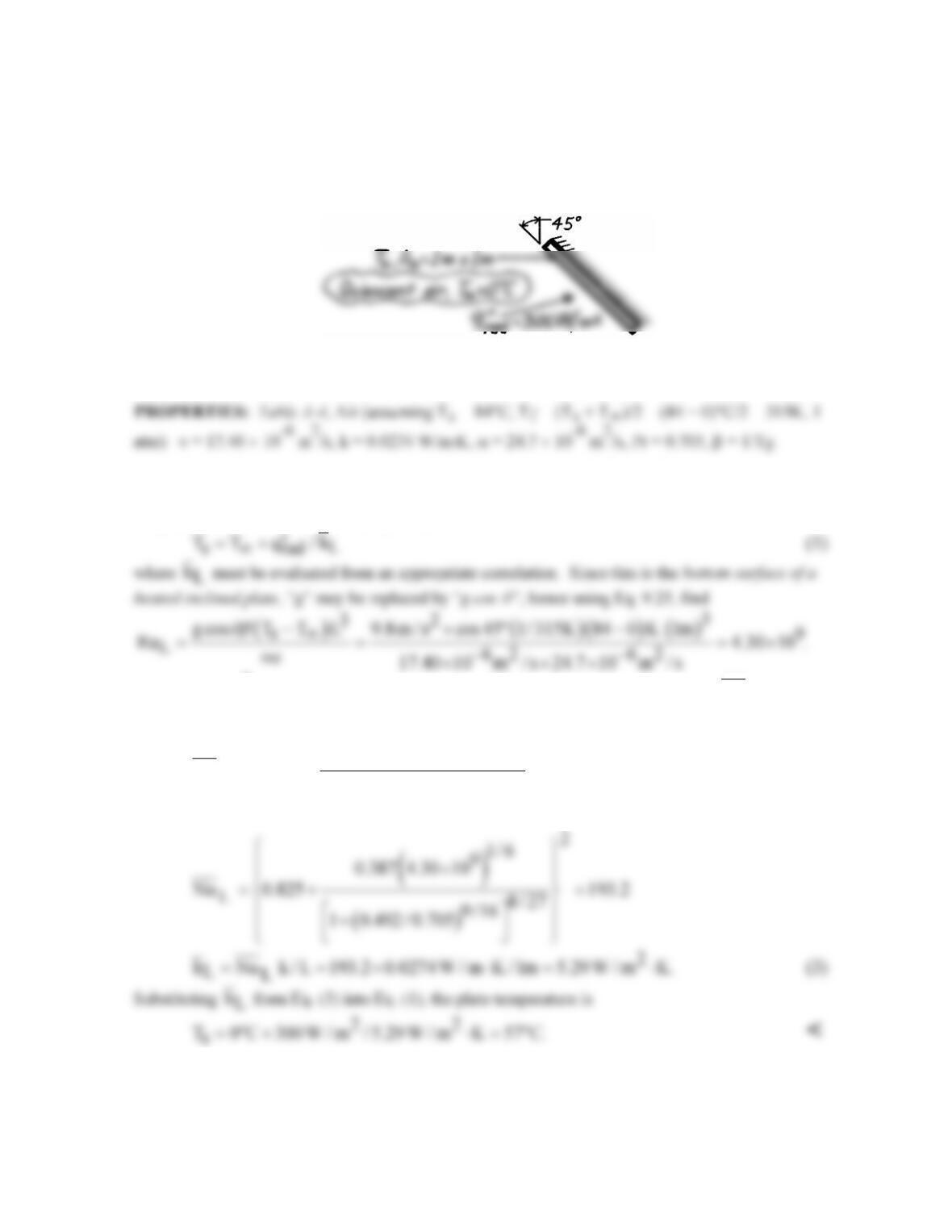
KNOWN: Plate, 1m × 1m, inclined at 45° from the vertical is exposed to a net radiation heat flux of
300 W/m2; backside of plate is insulated and ambient air is at 0°C.
FIND: Temperature plate reaches for the prescribed conditions.
SCHEMATIC:
ASSUMPTIONS: (1) Net radiation heat flux (300 W/m2) includes exchange with surroundings, (2)
Ambient air is quiescent, (3) No heat losses from backside of plate, (4) Steady-state conditions.
ANALYSIS: From an energy balance on the plate, it follows that
q q.
rad conv
′′ ′′
=
That is, the net
radiation heat flux into the plate is equal to the free convection heat flux to the ambient air. The
temperature of the surface can be expressed as
Since RaL > 109, conditions are turbulent and Eq. 9.26 is appropriate for estimating
Nu L
( )
2
1/6
0.387 RaL
Nu 0.825
L8 / 27
9 /16
1 0.492 / Pr
= +
+
(2)
COMMENTS: Note that the resulting value of Ts ≈ 57°C is substantially lower than the assumed
value of 84°C. The calculation should be repeated with a new estimate of Ts, say, 60°C. An alternate
approach is to write Eq. (2) in terms of Ts, the unknown surface temperature and then combine with
Eq. (1) to obtain an expression which can be solved, by trial-and-error, for Ts.
PROBLEM 9.39
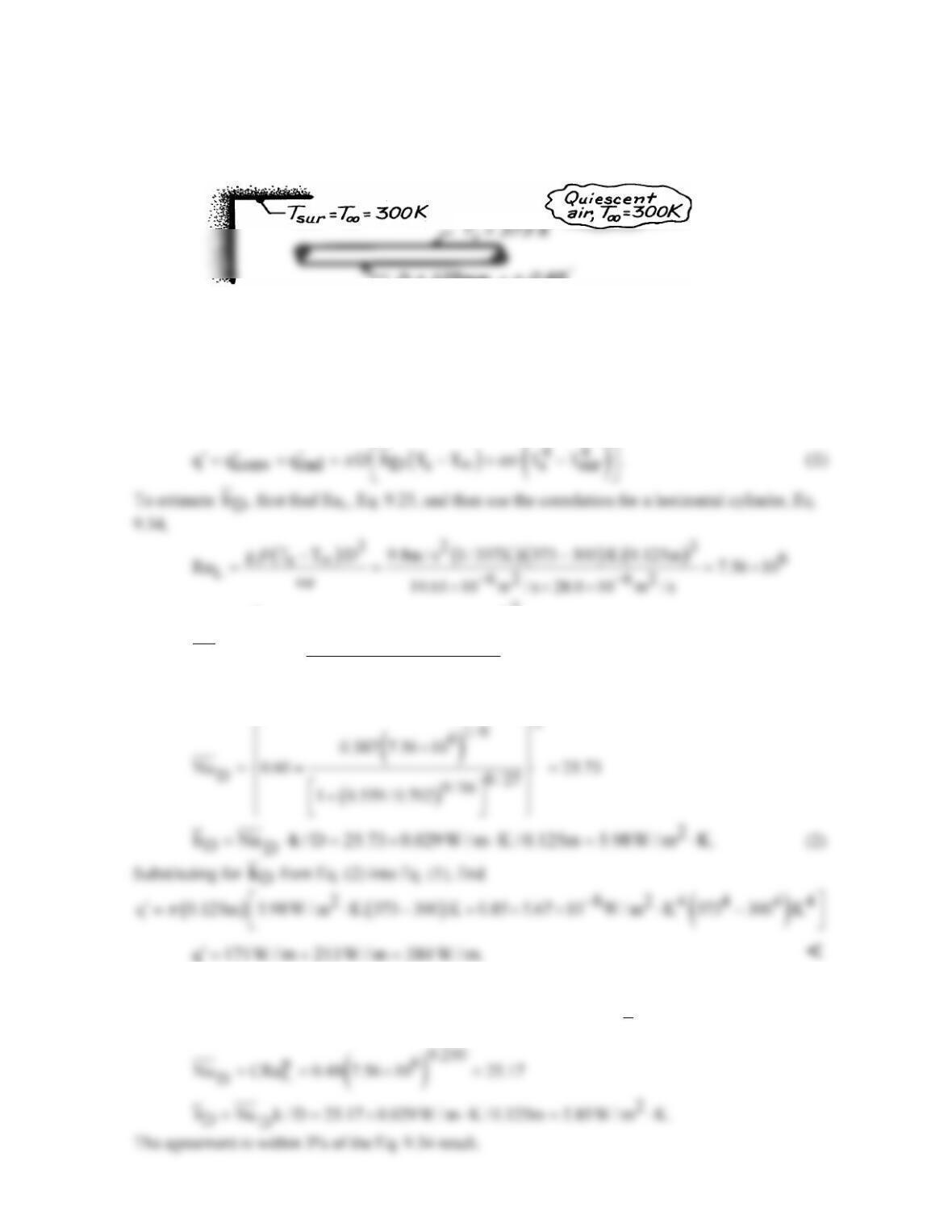
KNOWN: Horizontal, uninsulated steam pipe passing through a room.
FIND: Rate of heat loss per unit length from the pipe.
SCHEMATIC:
ASSUMPTIONS: (1) Pipe surface is at uniform temperature, (2) Air is quiescent medium, (3)
Surroundings are large compared to pipe.
PROPERTIES: Table A-4, Air (Tf = (Ts + T∞)/2 = 337K, 1 atm): ν = 19.61 × 10⁻⁶ m2/s, k =
0.029 W/m⋅K, a = 28.0 × 10⁻⁶ m2/s, Pr = 0.702, β = 1/Tf = 2.967 × 10⁻³ K–1.
ANALYSIS: Recognizing that the heat loss from the pipe will be by free convection to the air and by
radiation exchange with the surroundings, we can write
( )
2
1/6
0.387 RaL
Nu 0.60
D8 / 27
9 /16
1 0.559 / Pr
= +
+
hD
COMMENTS: (1) Note that for this situation, heat transfer by radiation and free convection are of
equal importance.
(2) Using Eq. 9.33 with constants C,n from Table 9.2, the estimate for
hD
is
D = 125mm, ε= 0.85