Chapter 9
Nucleic Acids: How Structure Conveys Information
1
SUMMARY
Section 9.1
The two principal kinds of nucleic acids are DNA and RNA.
The primary structure of nucleic acids is the order of bases. The secondary
Section 9.2
Two kinds of nitrogen-containing nucleobases, pyrimidines and purines, are
joined to sugars to form nucleosides.
The sugar is deoxyribose in DNA and ribose in RNA.
Section 9.3
The double helix is the predominant secondary structure of DNA. The sugar–
phosphate backbones, which run in antiparallel directions on the two strands, lie
Section 9.4
The two strands of the double helix can be separated by heating DNA samples.
This process is called denaturation.
2 Chapter 9
Section 9.5
Four kinds of RNA—transfer RNA, ribosomal RNA, messenger RNA, and small
nuclear RNA—are involved in protein synthesis.
LECTURE NOTES
Much of the material in this chapter will be familiar to students in the sense that
LECTURE OUTLINE
I. Hierarchical structure of nucleic acids
II. Structures of nucleotides
A. Purines and pyrimidines
III. DNA structure
A. The double helix
1. Strand complementarity
D. DNA denaturation
IV. RNA structures and functions
A. Sequence dependence on DNA
B. Transfer RNA
Nucleic Acids: How Structure Conveys Information 3
ANSWERS TO PROBLEMS
9.1 Levels of Structure in Nucleic Acids
1.
(a) Double-stranded DNA is usually thought of as having secondary structure, unless
9.2 The Covalent Structure of Polynucleotides
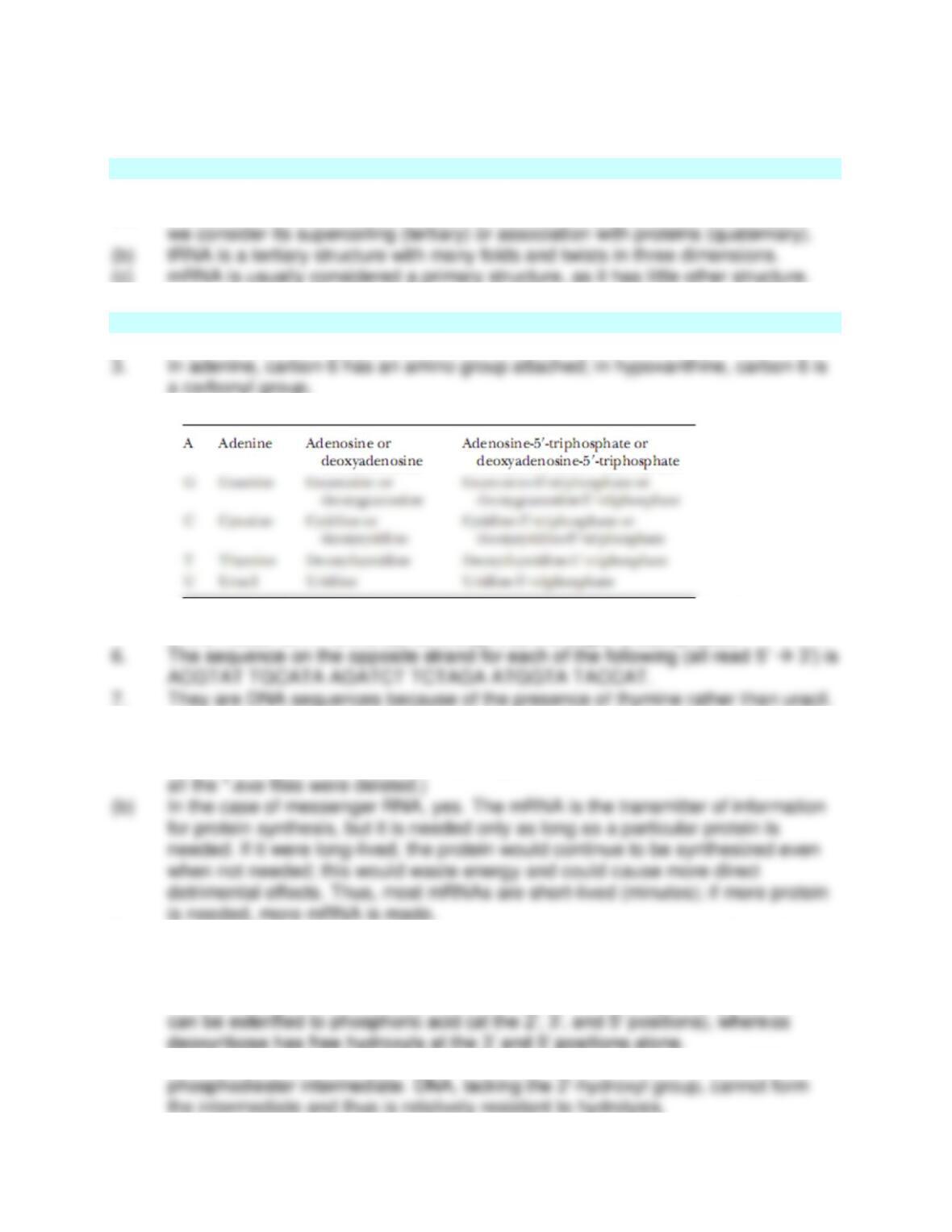
2. Thymine has a methyl group attached to carbon 5; uracil does not.
4.
5. ATP is made from adenine, ribose, and three phosphates linked the 5′–hydroxyl
of the ribose. dATP is the same, except that the sugar is deoxyribose.
8.
(a) Definitely yes! If there is anything that you don’t want falling apart, it’s your
storehouse of genetic instructions. (Compare the effectiveness of a computer if
9. Four different kinds of bases—adenine, cytosine, guanine, and uracil—make up
the preponderant majority of the bases found in RNA, but they are not the only
ones. Modified bases occur to some extent, principally in tRNA.
10. This speculation arose from the fact that ribose has three hydroxyl groups that
11. The hydrolysis of RNA is greatly enhanced by the formation of a cyclic 2′,3′–
4 Chapter 9
9.3 The Structure of DNA
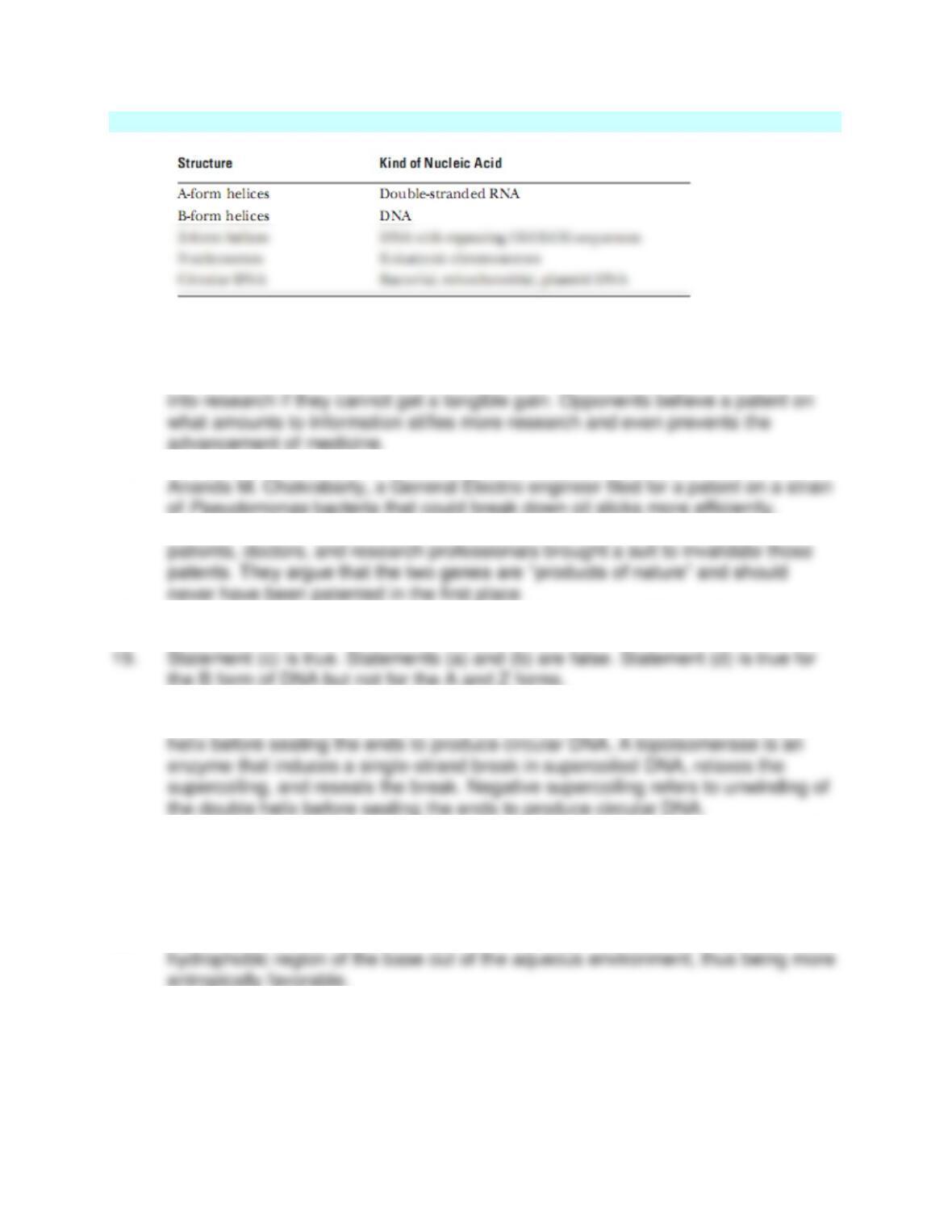
12.
13. See Figure 9.8.
14. Statements (c) and (d) are true; statements (a) and (b) are not.
15. Proponents for the patent system say it takes money to drive research.
Companies will not want to invest hundreds of thousands to millions of dollars
16. The idea of patenting information began with a landmark case in 1972 when
17. Two genes related to breast cancer, BRCA 1 and BRCA 2. In 2009 a group of
18. The major groove and minor groove in B-DNA have very different dimensions
(width); those in A-DNA are much closer in width.
20. Supercoiling refers to twists in DNA over and above those of the double helix.
Positive supercoiling refers to an extra twist in DNA caused by overwinding of the
21. Propeller-twist is a movement of the two bases in a base pair away from being in
the same plane.
22. An AG/CT step is a small section of double–stranded DNA where one strand is 5′–
AG–3′, and the other is 5′–CT–3′. The exact nature of such steps greatly
influences the overall shape of a double helix.
23. Propeller-twist reduces the strength of the hydrogen bond but moves the
Nucleic Acids: How Structure Conveys Information 5
24. B-DNA is a right-handed helix with specified dimensions (10 base pairs per turn,
25. Positive supercoils in circular DNA will be left-handed.
26. Chromatin is the complex consisting of DNA and basic proteins found in
eukaryotic nuclei (see Figure 9.15).
27. Genome 10K Project proposes to sequence 10,000 genomes in the next 5 years.
28. Negative supercoiling, nucleosome winding, Z-form DNA.
30. Histones are very basic proteins with many arginine and lysine residues. These
residues have positively charged side chains under physiological pH. This is a
31. Adenine–guanine base pairs occupy more space than is available in the interior
32. The phosphate groups in DNA are negatively charged at physiological pH. If they
33. The percentage of cytosine equals that of guanine, 22%. This DNA thus has a
44% G–C content, implying a 56% A–T content. The percentage of adenine
equals that of thymine, so adenine and thymine are 28% each.
34. If the DNA were not double stranded, the requirement G=C and A=T would no
longer exist.
36. The purpose of the Human Genome Project was the complete sequencing of the
human genome. There are many reasons for doing this. Some are tied to basic
research (i.e., the desire to know all that is knowable, especially about our own
6 Chapter 9
37. Human gene therapy has many legal and ethical considerations. Some are moral
and philosophical: Do we have the right to manipulate human DNA? Are we
playing God? Should ―tailor–made‖ humans be allowed? Some are more
scientific: Do we have the knowledge to do it right? What happens if we make a
mistake? Will a patient die that would not have died with other treatments?
38. Advantages would be that people could make informed lifestyle choices. A
person with a genotype known to lead to atherosclerosis could change his or her
39. Because any system involving replication of DNA by DNA polymerases must
9.4 Denaturation of DNA
40. A–T base pairs have two hydrogen bonds, whereas G–C base pairs have three.
It takes more energy and higher temperature to disrupt the structure of DNA rich
in G–C base pairs.
9.5 The Principal Kinds of RNA and Their Structures
41. See Figures 9.19 and 9.24.
42. Small nuclear RNA (snRNA) is found in the eukaryotic nucleus and is involved in
splicing reactions of other RNA types. An snRNP is a small nuclear
45. The bases in a double-stranded chain are partially hidden from the light beam of
a spectrophotometer by the other bases in close proximity, as though they were
in the shadow of the other bases. When the strands unwind, these bases
become exposed to the light and absorb it; therefore, the absorbance increases.
46. RNA interference is the process by which small RNAs prevent the expression of
genes.
47. More extensive hydrogen bonding occurs in tRNA than in mRNA. The folded
Nucleic Acids: How Structure Conveys Information 7
49. Turnover of mRNA should be rapid to ensure that the cell can respond quickly
50. The mistake in the DNA would be more harmful because every cell division
51. Eukaryotic mRNA is initially formed in the nucleus by transcription of DNA. The
mRNA transcript is then spliced to remove introns, a poly–A tail is added at the 3′
end, and a 5′-cap is put on. This is the final mRNA, which is then transported, in
most cases, out of the nucleus for translation by the ribosomes.