ACCOUNTING, ANALYSIS, AND PRINCIPLES
Accounting
(a)
Residential pumps:
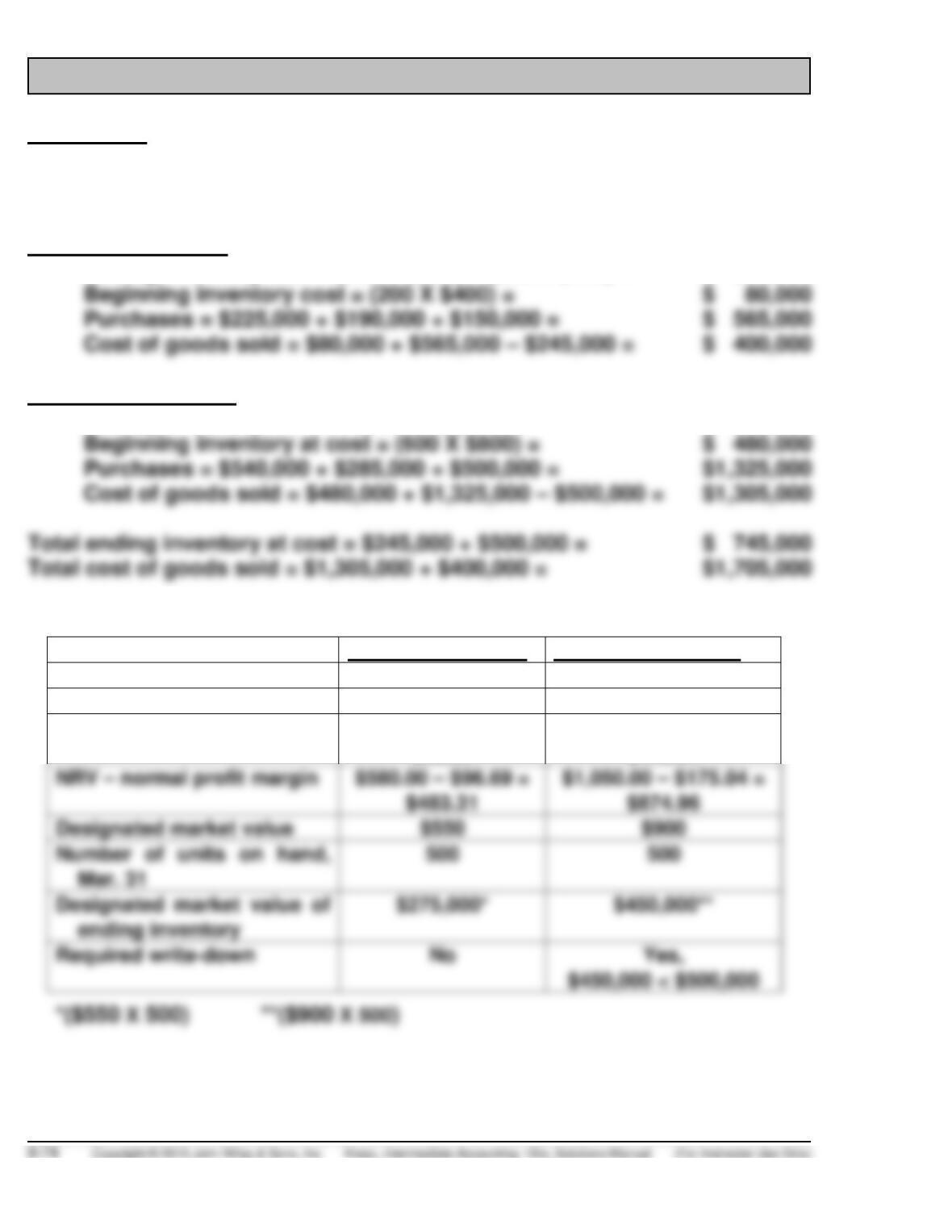
Ending inventory cost = (300 X $500) + (200 X $475) = $ 245,000
Commercial pumps:
Ending inventory at cost = (500 X $1,000) = $ 500,000
Lower-of-cost-or-market:
Residential pumps
Commercial pumps
NRV
$580
$1,050
Replacement cost
$550
$ 900
Normal profit margin
0.1667 X $580.00 =
$96.69
0.1667 X $1,050.00 =
$175.04
NRV – normal profit margin
$874.96
Designated market value
$550
Total amount of inventory reported on March 31 balance sheet = $695,000
($245,000 + $450,000).
ACCOUNTING, ANALYSIS, AND PRINCIPLES (Continued)
(b) Inventory at cost = $245,000 + $500,000 = $745,000
Designated market value = $275,000 + $450,000 = $725,000
$725,000 < $745,000, therefore write inventory down to $725,000
Analysis
In this problem, one product’s market value is above cost and the
other one is below. From a conservative perspective, the individual
product approach results in a write-down for any product whose
designated market value is below cost. So, potentially the individual
Principles
(a) If the designated market value is $1,050, the designated market value
of commercial pumps would be above cost. The written-down amount
PROFESSIONAL RESEARCH
(a) The codification provides guidance at: FASB ASC 330–10-05
(Codification String: Assets > 330 Inventory > 10 Overall > 05
(b) According to the FASB ASC 330-10-20, the Glossary indicates the
following.
Inventory is the aggregate of those items of tangible personal
property that have any of the following characteristics:
a. Held for sale in the ordinary course of business
The term inventory embraces goods awaiting sale (the merchandise
of a trading concern and the finished goods of a manufacturer),
goods in the course of production (work in process), and goods to be
consumed directly or indirectly in production (raw materials and
supplies). This definition of inventories excludes long-term assets
PROFESSIONAL RESEARCH (Continued)
(c) According to the FASB ASC 330–10-20, the Glossary indicates the
following for the term Market:
As used in the phrase lower-of-cost-or–market, the term market means
current replacement cost (by purchase or by reproduction, as the
(d) According to FASB ASC 330-10–35:
35–15 Only in exceptional cases may inventories properly be stated
above cost. For example, precious metals having a fixed
characteristic of unit interchangeability.
For: Goods Stated Above Cost
50-3 Where goods are stated above cost this fact shall be fully
disclosed.
35–16 It is generally recognized that income accrues only at the time
of sale, and that gains may not be anticipated by reflecting
assets at their current sales prices. However, exceptions for
reflecting assets at selling prices are permissible for both of
the following:
a. Inventories of gold and silver, when there is an effective
Where such inventories are stated at sales prices, they shall be
reduced by expenditures to be incurred in disposal.
PROFESSIONAL SIMULATION
Resources
Journal Entry
Cost of Goods Sold……………………………………………….
4,000
Allowance to Reduce Inventory to Market ………
4,000
Note: This entry assumes use of the cost–of–goods-sold method.
Explanation
Expected selling prices are important in the application of the lower-of–
cost-or-market rule because they are used in measuring losses of utility in
inventory that otherwise would not be recognized until the period during
IFRS CONCEPTS AND APPLICATION
IFRS9-1
Key similarities are (1) the guidelines on who owns the goods—goods in
transit, consigned goods, special sales agreements, and the costs to
include in inventory are essentially accounted for the same under IFRS and
Key differences are related to (1) the LIFO cost flow assumption—GAAP
permits the use of LIFO for inventory valuation. IFRS prohibits its use. FIFO
and average-cost are the only two acceptable cost flow assumptions
permitted under IFRS; (2) lower-of-cost-or–market test for inventory
valuation—IFRS defines market as net realizable value. GAAP on the other
hand defines market as replacement cost subject to the constraints of net
realizable value (the ceiling) and net realizable value less a normal markup
IFRS9-2
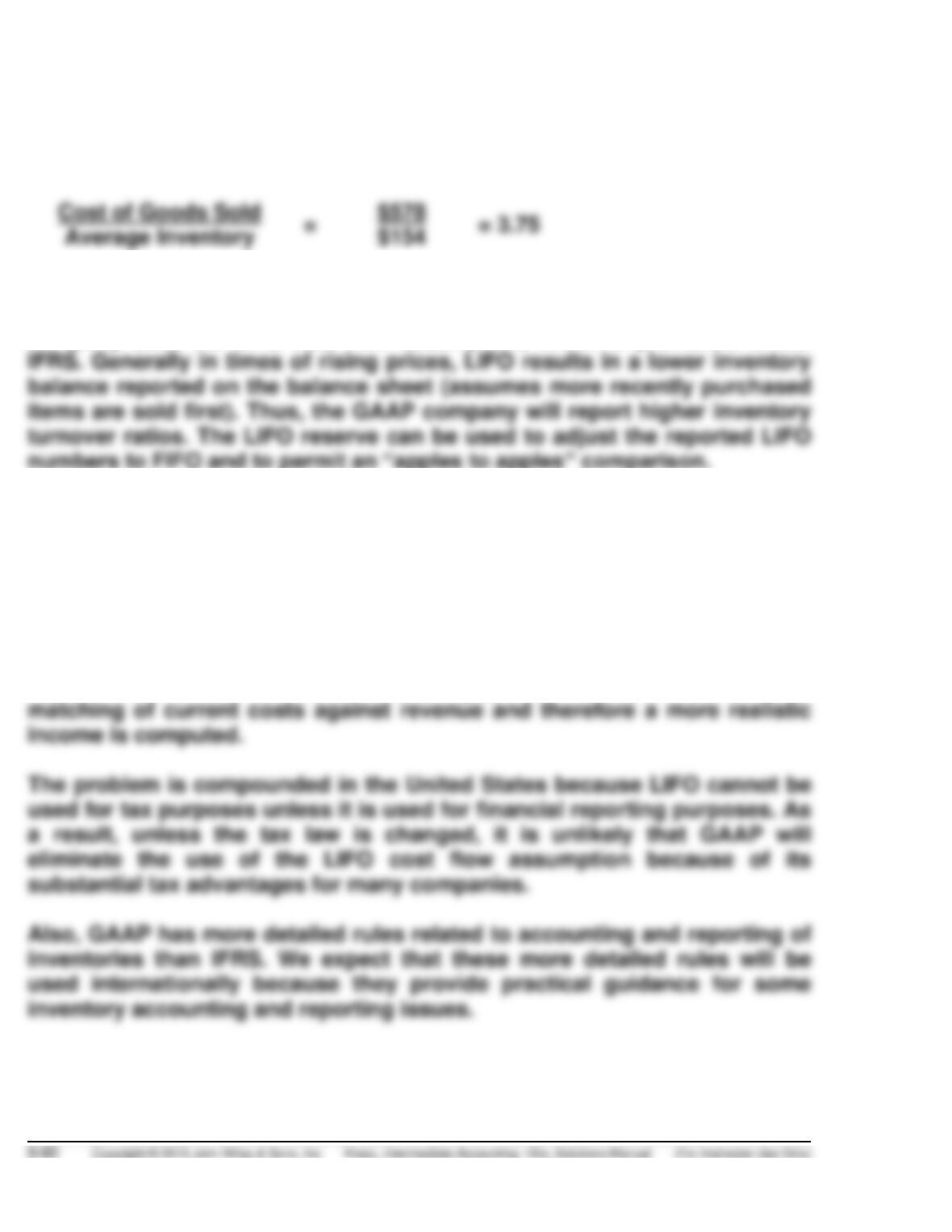
As shown in the analysis below, under IFRS, LaTour’s inventory turnover
ratio is computed as follows:
Difficulties in comparison to a company using GAAP could arise if the U.S.
company uses the LIFO cost flow assumption, which is prohibited under
numbers to FIFO and to permit an “apples to apples” comparison.
IFRS9-3
Reed must not be aware of the important convergence issue arising from
the use of the LIFO cost flow assumption; IFRS specifically prohibits its
use. Conversely, the LIFO cost flow assumption is widely used in the
United States because of its favorable tax advantages. In addition, many
argue that LIFO from a financial reporting point of view provides a better
IFRS9-4
(a) Biological assets are measured on initial recognition and at the end of
each reporting period at fair value less costs to sell (net realizable
IFRS9-5
(1) $12.80 ($14.80 – $1.50 – $.50).
IFRS9-6
Item
Net
Realizable
Value
Cost
LCNRV
D
$80*
$75
$75
E
62
80
62
F
60
80
60
G
35
80
35
H
70
50
50
40
36
36
IFRS9-7
(a)
12/31/14
Cost of Goods Sold …………………………..
24,000
Allowance to Reduce Inventory
to Net Realizable Value …………………………..
24,000
Allowance to Reduce Inventory to
Cost of Goods Sold …………………………..
(b)
12/31/14
Loss Due to Decline of
Inventory to Net Realizable Value ………………………….
24,000
Allowance to Reduce Inventory
24,000
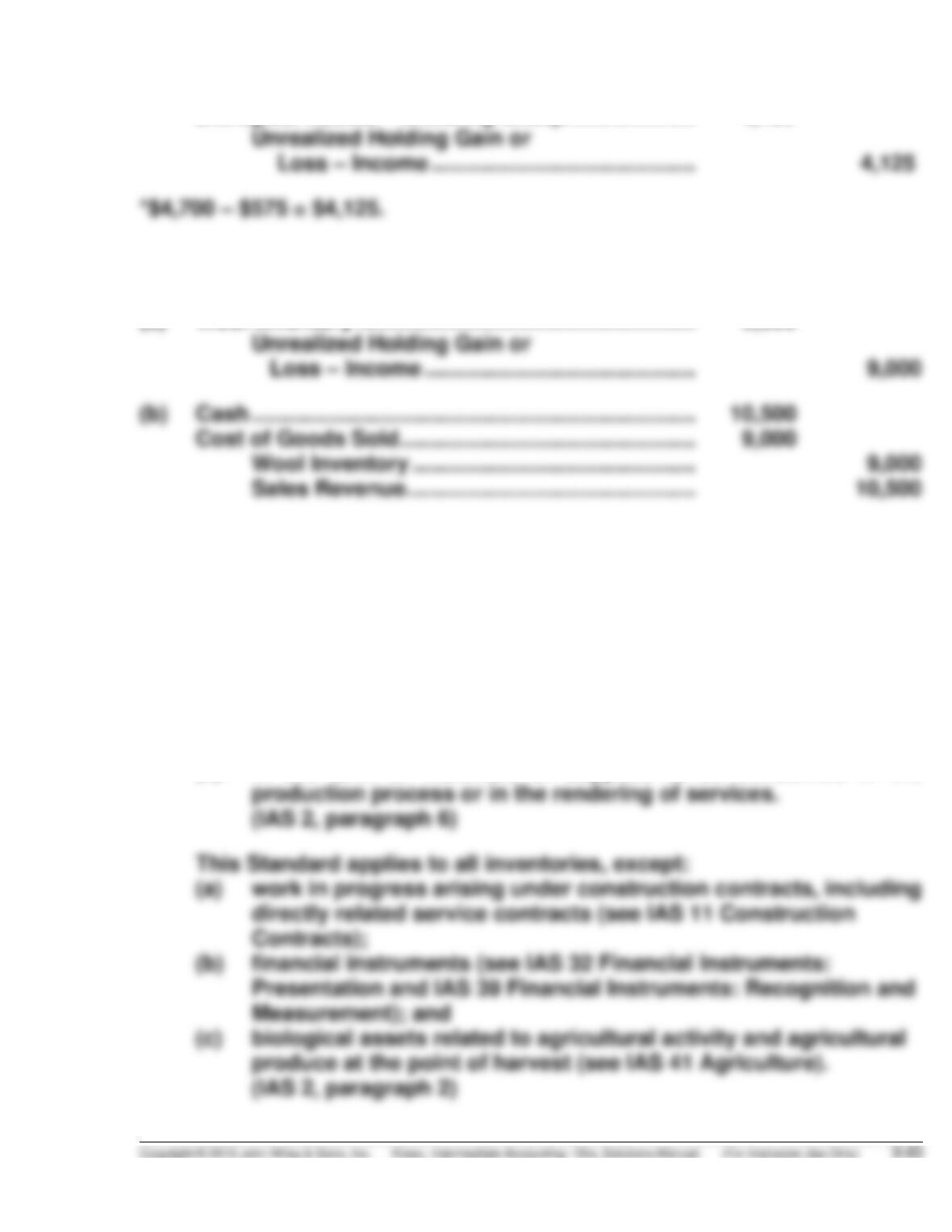
Allowance to Reduce Inventory
Recovery of Loss Inventory …………………………..
*Cost of inventory at 12/31/14 …………………………..
Lower-of-cost-or-NRV at 12/31/14 ……………………….
(322,000)
Inventory to NRV (a) ………………………………………..
$ 24,000
Cost of inventory at 12/31/15 …………………………..
$410,000
Lower-of-cost-or-NRV at 12/31/15 ……………………….
(390,000)
Allowance amount needed to reduce
Inventory to NRV (b) ………………………………………..
$ 20,000
Recovery of previously recognized loss
= (a) – (b)
= $24,000 – $20,000
= $4,000.
(c)
Both methods of recording lower-of-cost-or-NRV adjustments have
IFRS9-8
Biological Assets – Shearing Sheep …………………
4,125*
IFRS9-9
(a)
Wool Inventory ……………………………………………….
9,000
(b)
Cash ………………………………………………………………
Wool Inventory ……………………………………….
Sales Revenue ………………………………………..
IFRS9-10
(a) The IFRS requirements related to accounting and reporting for
inventories is found in IAS 2 (Inventories), IAS 18 (Revenue) and IAS
41 (Agriculture).
Inventories are assets:
(a) held for sale in the ordinary course of business;
(b) in the process of production for such sale; or
(c) in the form of materials or supplies to be consumed in the
IFRS9-10 (Continued)
(c) Net realisable value refers to the net amount that an entity expects to
realise from the sale of inventory in the ordinary course of business.
(d) This Standard does not apply to the measurement of inventories held by:
(a) producers of agricultural and forest products, agricultural produce
after harvest, and minerals and mineral products, to the extent
that they are measured at net realisable value in accordance
(IAS 2, paragraph 3).
IFRS9-11
(a) Inventories are valued at the lower-of-cost-or-net realisable value
using the retail method, which is computed on the basis of selling
IFRS9-11 (Continued)
(d)
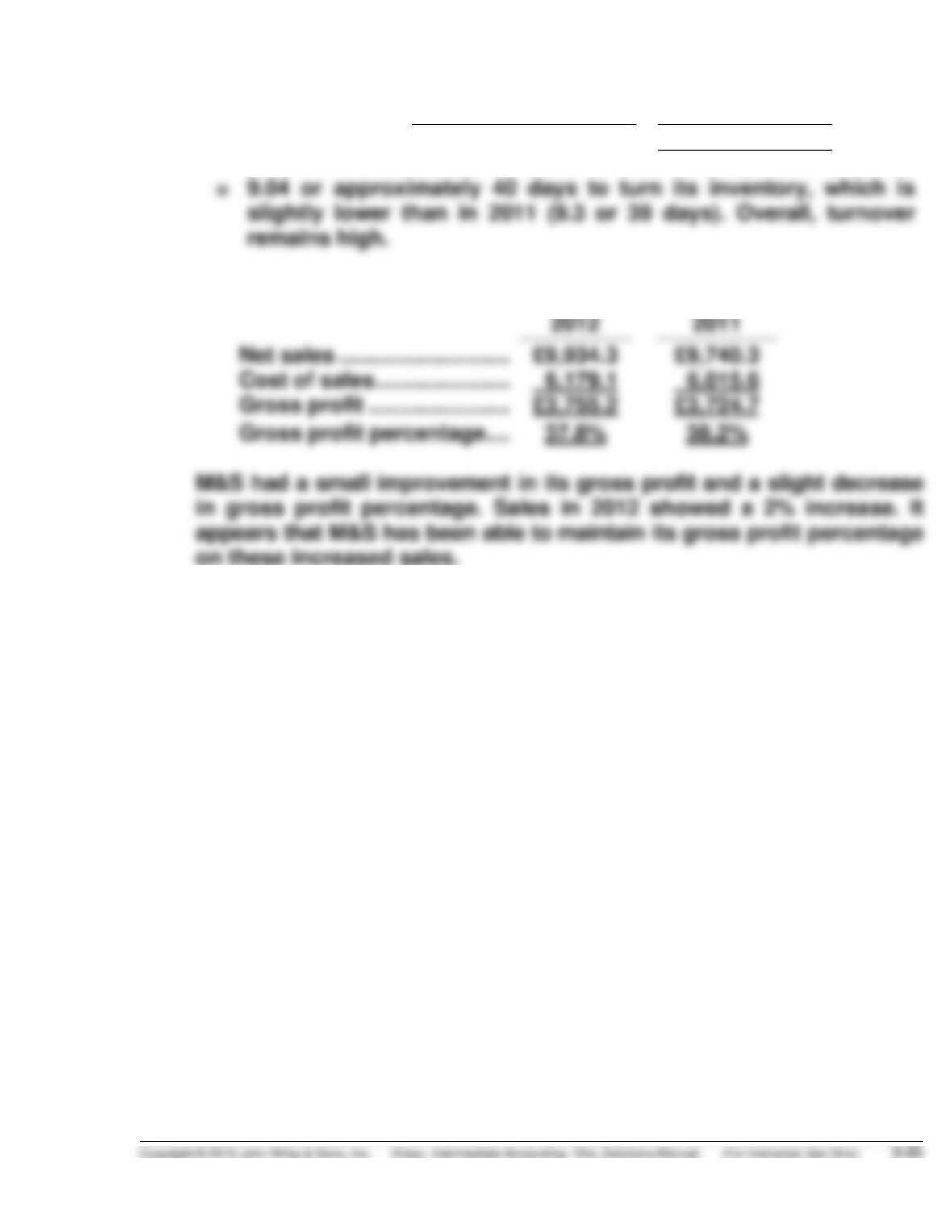
Inventory turnover =
Cost of Sales
=
£6,179.1
Average Inventory
£681.9 + £685.3
2
Its gross profit percentages for 2012 and 2011 are as follows: