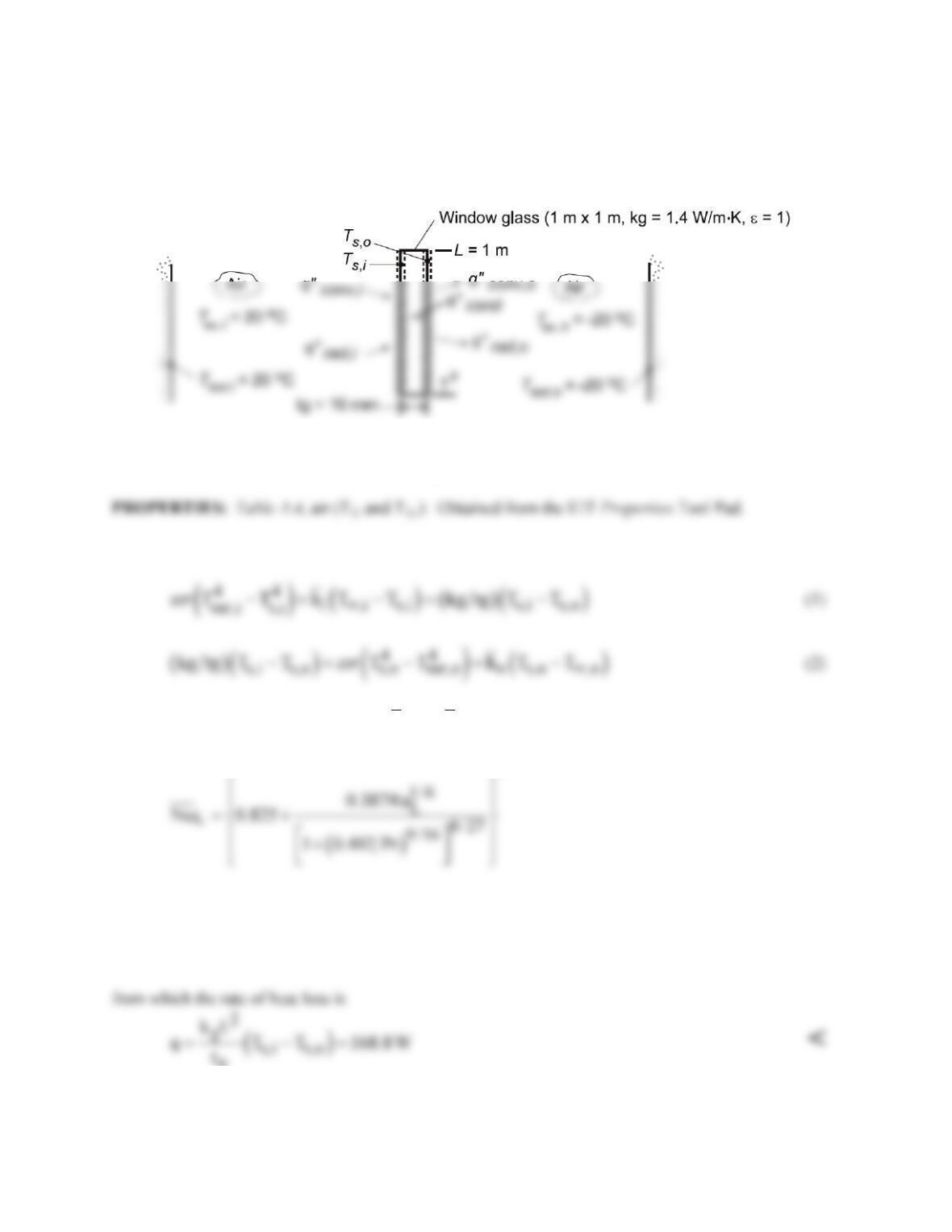
PROBLEM 9.17
KNOWN: Room and ambient air conditions for window glass. Thickness and thermal conductivity of
glass.
FIND: Inner and outer surface temperatures and rate of heat loss.
SCHEMATIC:
ASSUMPTIONS: (1) Steady-state conditions, (2) One-dimensional conduction in the glass, (3) Inner
and outer surfaces exposed to large surroundings.
ANALYSIS: Performing energy balances at the inner and outer surfaces, we obtain, respectively,
where Eq. 9.26 may be used to evaluate
i
h
and
o
h
2
Using the First Law Model for One-dimensional Conduction in a Plane Wall and the Correlations and
Properties Tool Pads of IHT, the energy balance equations were formulated and solved to obtain
Ts,i = 274.4 K Ts,o = 273.2 K <
g
COMMENTS: By accounting for the thermal resistance of the glass, the rate of heat loss is smaller
(168.8 W) than that determined in the preceding problem (174.8 W) by assuming an isothermal pane.
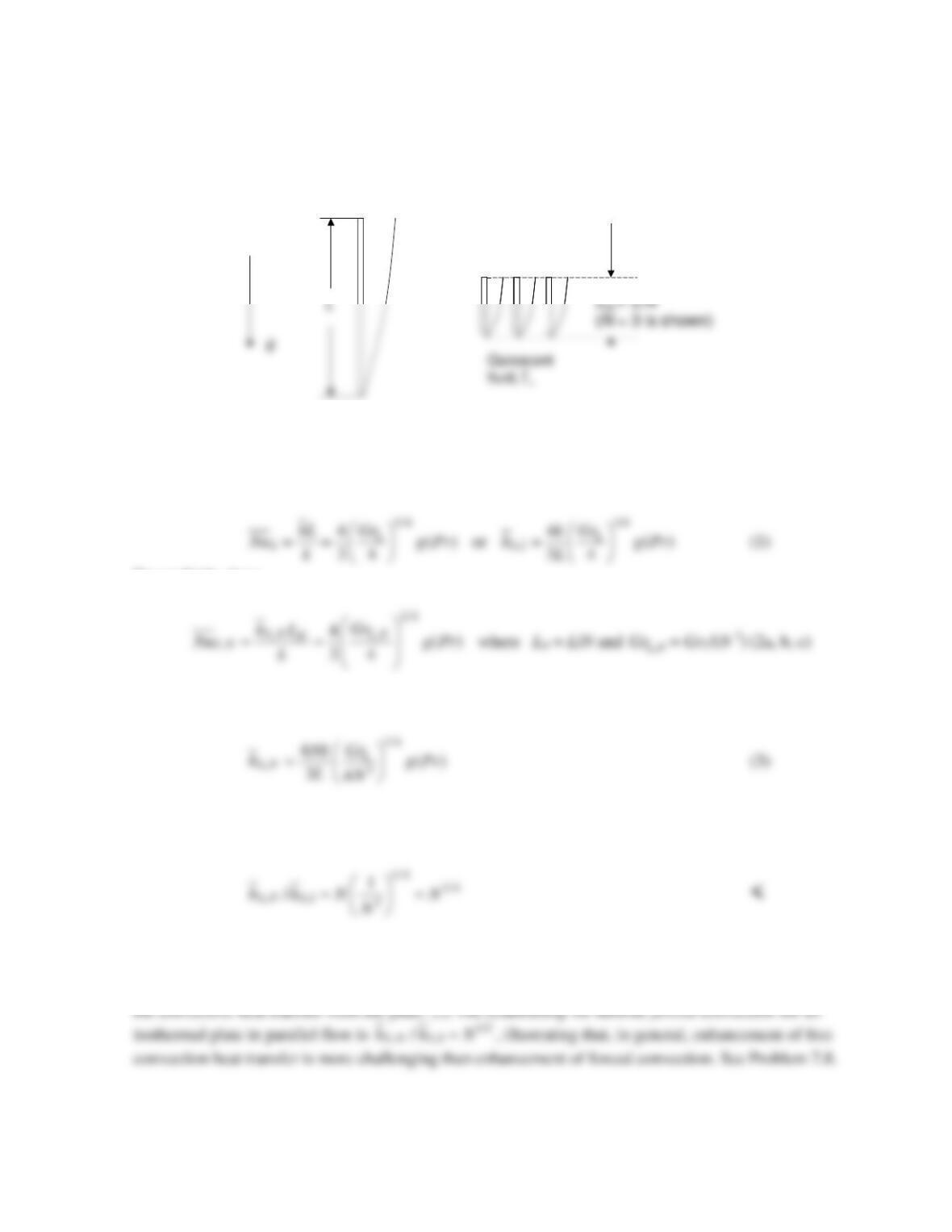
PROBLEM 9.18
KNOWN: Length of isothermal vertical plate, L.
FIND: Expression for the ratio of the average heat transfer coefficients for N plates each of length LN
= L/N to the average coefficient for the single plate.
SCHEMATIC:
ASSUMPTIONS: (1) Constant properties.
ANALYSIS: Equation 9.21 yields, for the single plate,
For multiple plates,
Combining Equations 2a, 2b and 2c yields
Dividing Equation 3 by Equation 1 yields
COMMENTS: (1) By breaking the single plate into shorter segments, the average boundary layer
thickness is reduced, resulting in a modest increase in the average heat transfer coefficient and, in turn,
Quiescent
fluid,T
∞
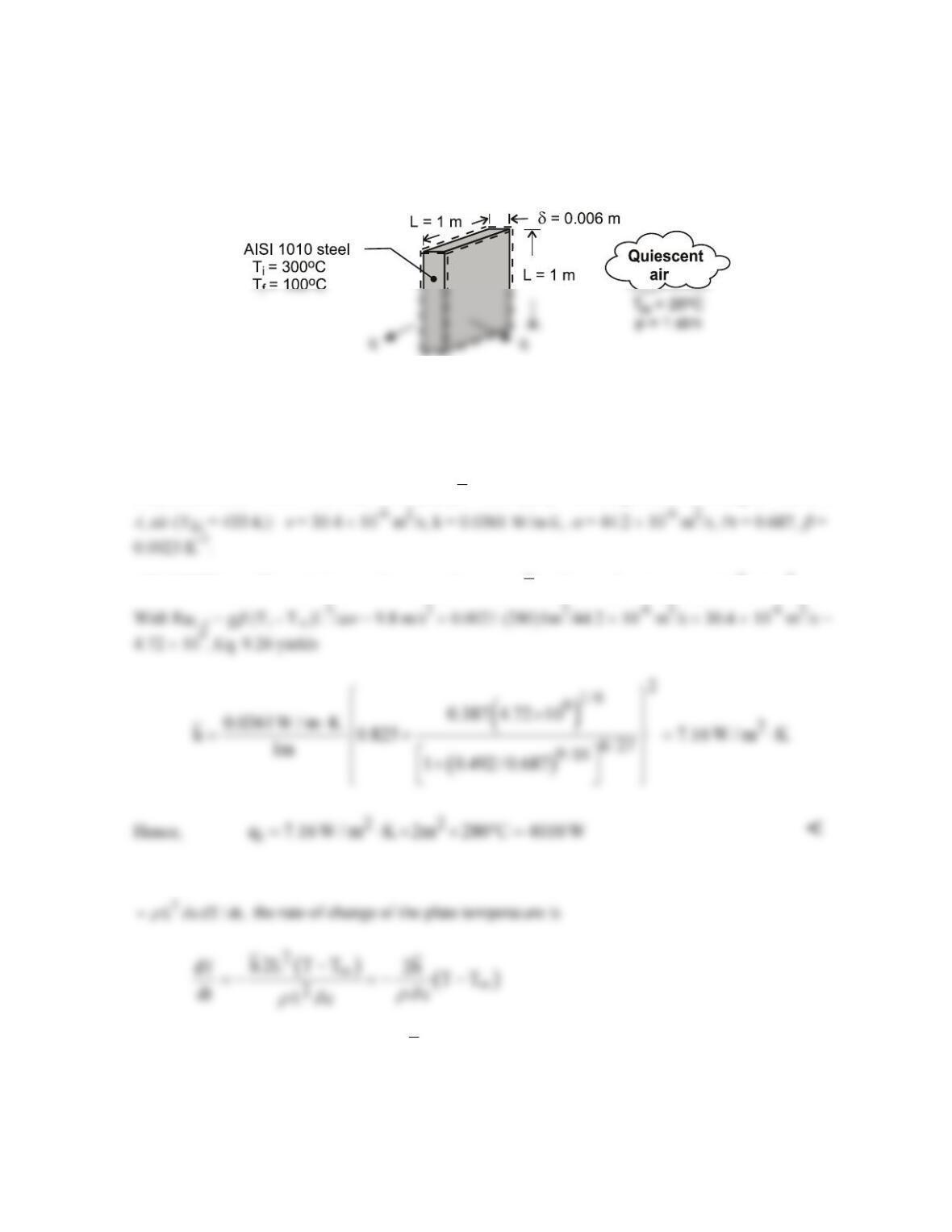
PROBLEM 9.19
KNOWN: Plate dimensions, initial temperature, and final temperature. Air temperature.
FIND: (a) Initial cooling rate, (b) Time to reach prescribed final temperature.
SCHEMATIC:
ASSUMPTIONS: (1) Plate is spacewise isothermal as it cools (lumped capacitance approximation),
(2) Negligible heat transfer from minor sides of plate, (3) Thermal boundary layer development
corresponds to that for an isolated plate (negligible interference between adjoining boundary layers).
(4) Negligible radiation. (5) Constant properties.
PROPERTIES: Table A-1, AISI 1010 steel
( )
T 473 K :=
ρ
= 7832 kg/m3, c = 513 J/kg⋅K. Table A-
ANALYSIS: (a) The initial rate of heat transfer is
( )
i si
q hA T T ,
∞
= −
where
22
s
A 2L 2m .≈=
(b) From an energy balance at an instant of time for a control surface about the plate,
st
qE−=
where the Rayleigh number, and hence
h,
changes with time due to the change in the temperature of
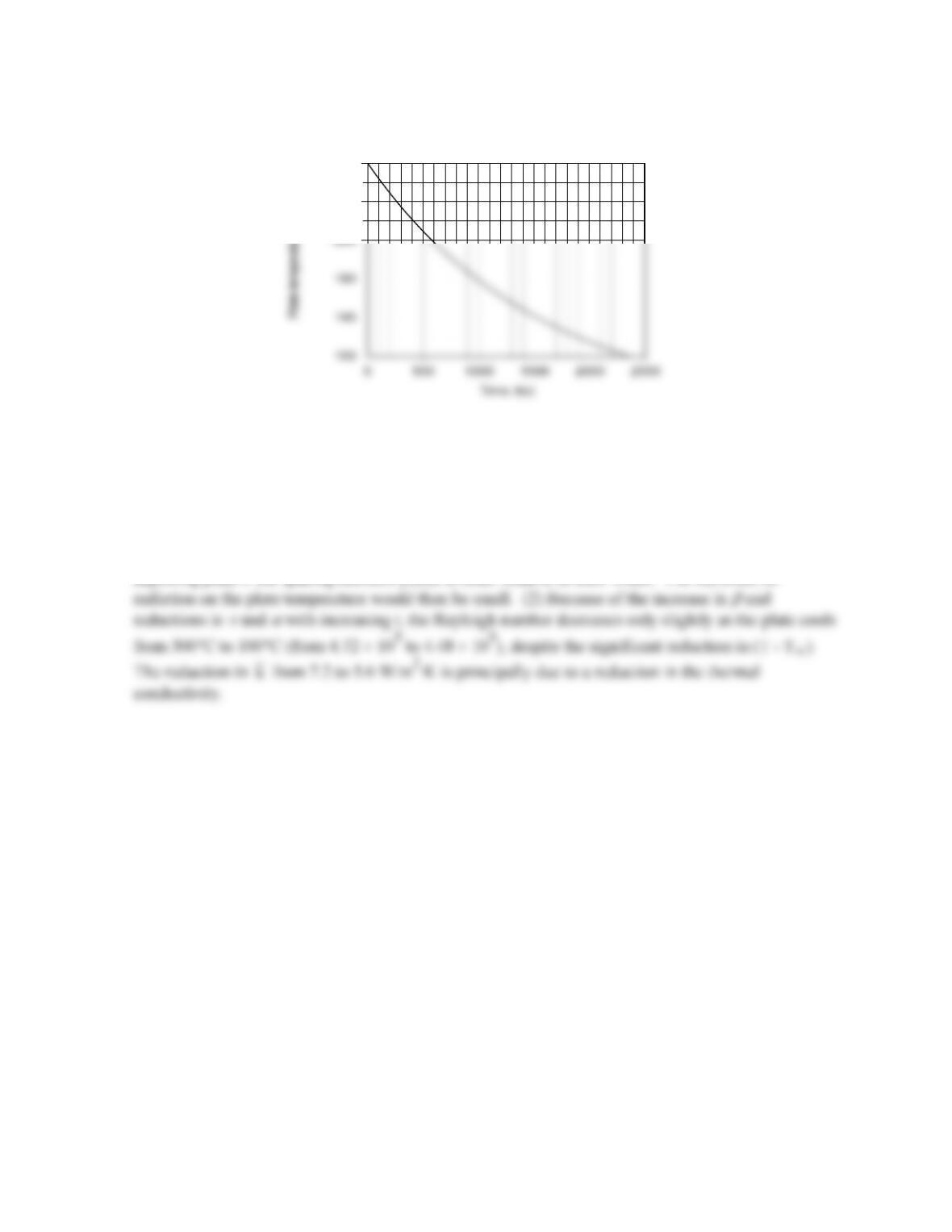
the plate. Integrating the foregoing equation with the DER function of IHT, the following results are
obtained for the temperature history of the plate.
Continued …
PROBLEM 9.19 (Cont.)
The time for the plate to cool to 100°C is
t 2365s≈
<
COMMENTS: (1) Although the plate temperature is comparatively large and radiation emission is
significant relative to convection, much of the radiation leaving one plate is intercepted by the
adjoining plate if the spacing between plates is small relative to their width. The net effect of
260
300
PROBLEM 9.20
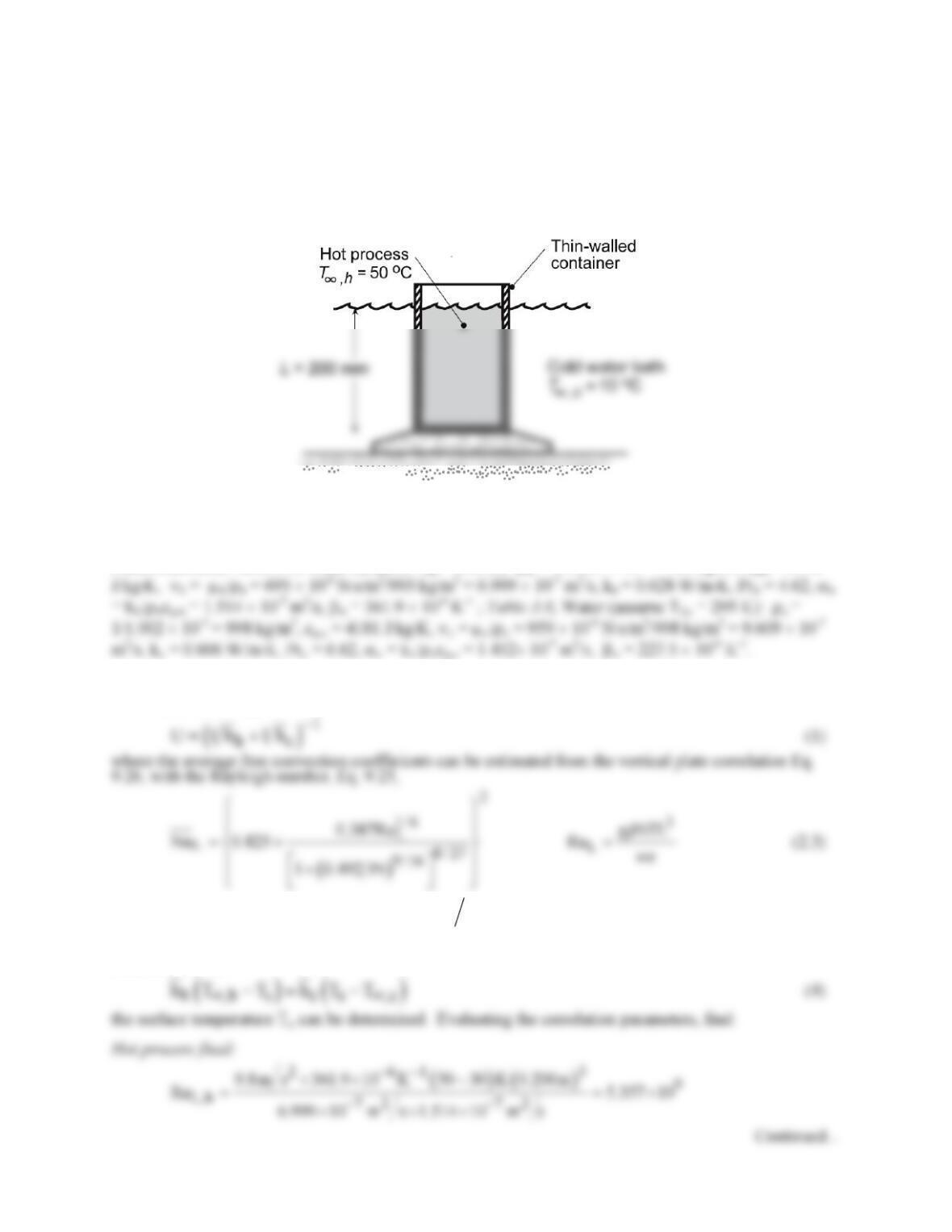
KNOWN: Thin-walled container with hot process fluid at 50°C placed in a quiescent, cold water bath at
10°C.
FIND: (a) Overall heat transfer coefficient, U, between the hot and cold fluids, and (b) Compute and
plot U as a function of the hot process fluid temperature for the range 20 ≤
Th∞,
≤ 50°C.
SCHEMATIC:
ASSUMPTIONS: (1) Steady-state conditions, (2) Heat transfer at the surfaces approximated by free
convection from a vertical plate, (3) Fluids are extensive and quiescent, (4) Hot process fluid
thermophysical properties approximated as those of water, and (5) Negligible container wall thermal
resistance.
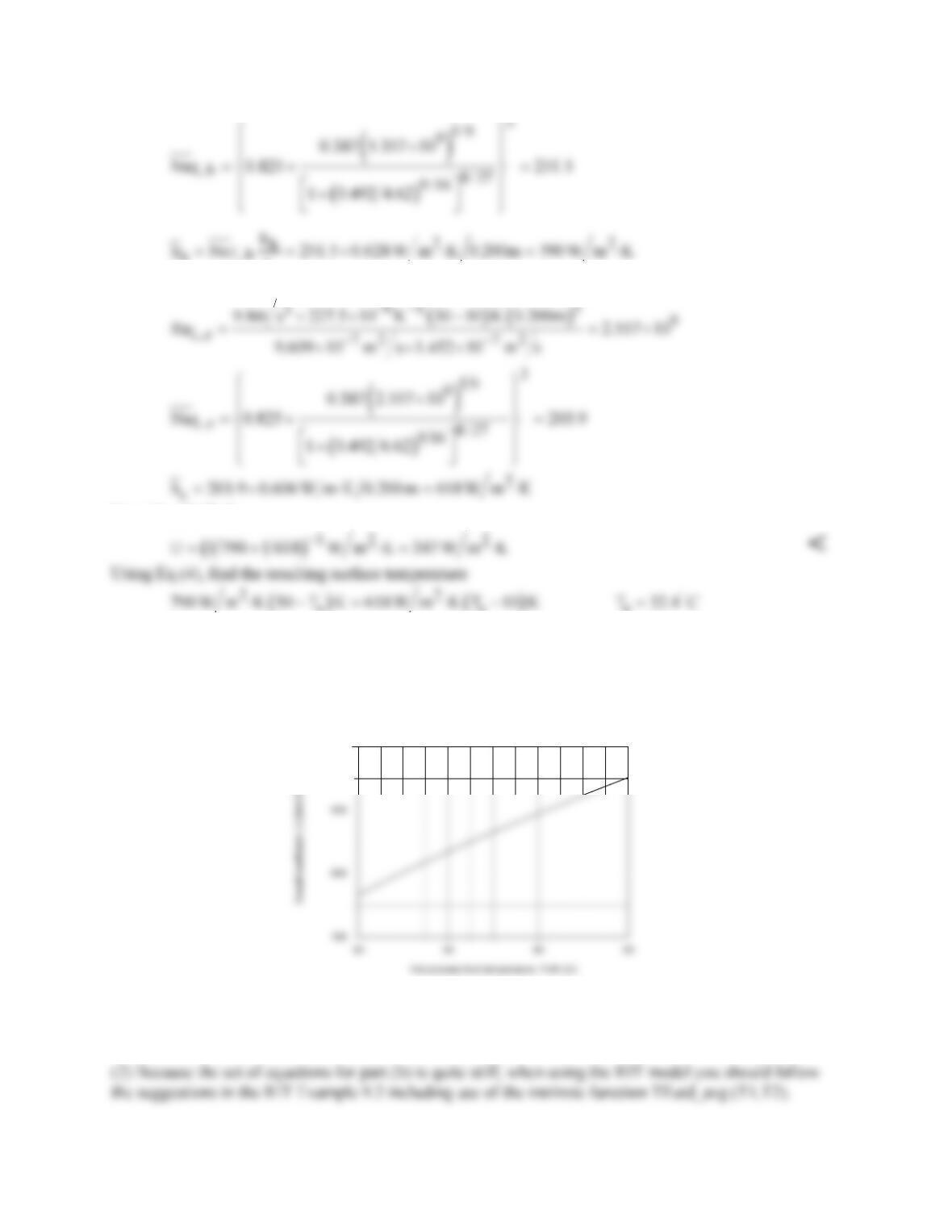
PROPERTIES: Table A.6, Water (assume Tf,h = 310 K): ρh = 1/1.007 × 10-3 = 993 kg/m3, cp,h = 4178
ANALYSIS: (a) The overall heat transfer coefficient between the hot process fluid, T∞,h, and the cold
water bath fluid, T∞,c, is
To affect a solution, assume
( )
s ,h ,c
T T T 2 30 C 303K
∞∞
=+==
, so that the hot and cold fluid film
temperatures are Tf,h = 313 K ≈ 310 K and Tf,c = 293 K ≈ 295 K. From an energy balance across the
container walls,
PROBLEM 9.20 (Cont.)
h
L
Cold water bath:
From Eq. (1) find
ss
s
Which compares favorably with our assumed value of 30°C.
(b) Using the IHT Correlations Tool, Free Convection, Vertical Plate and following the foregoing
approach, the overall coefficient was computed as a function of the hot fluid temperature and is plotted
below. Note that U increases almost linearly with
,h
T∞
.
400
COMMENTS: For the conditions of part (a), using the IHT model of part (b) with thermophysical
properties evaluated at the proper film temperatures, find U = 352 W/m⋅K with Ts = 32.4°C. Our
approximate solution was a good one.
PROBLEM 9.21
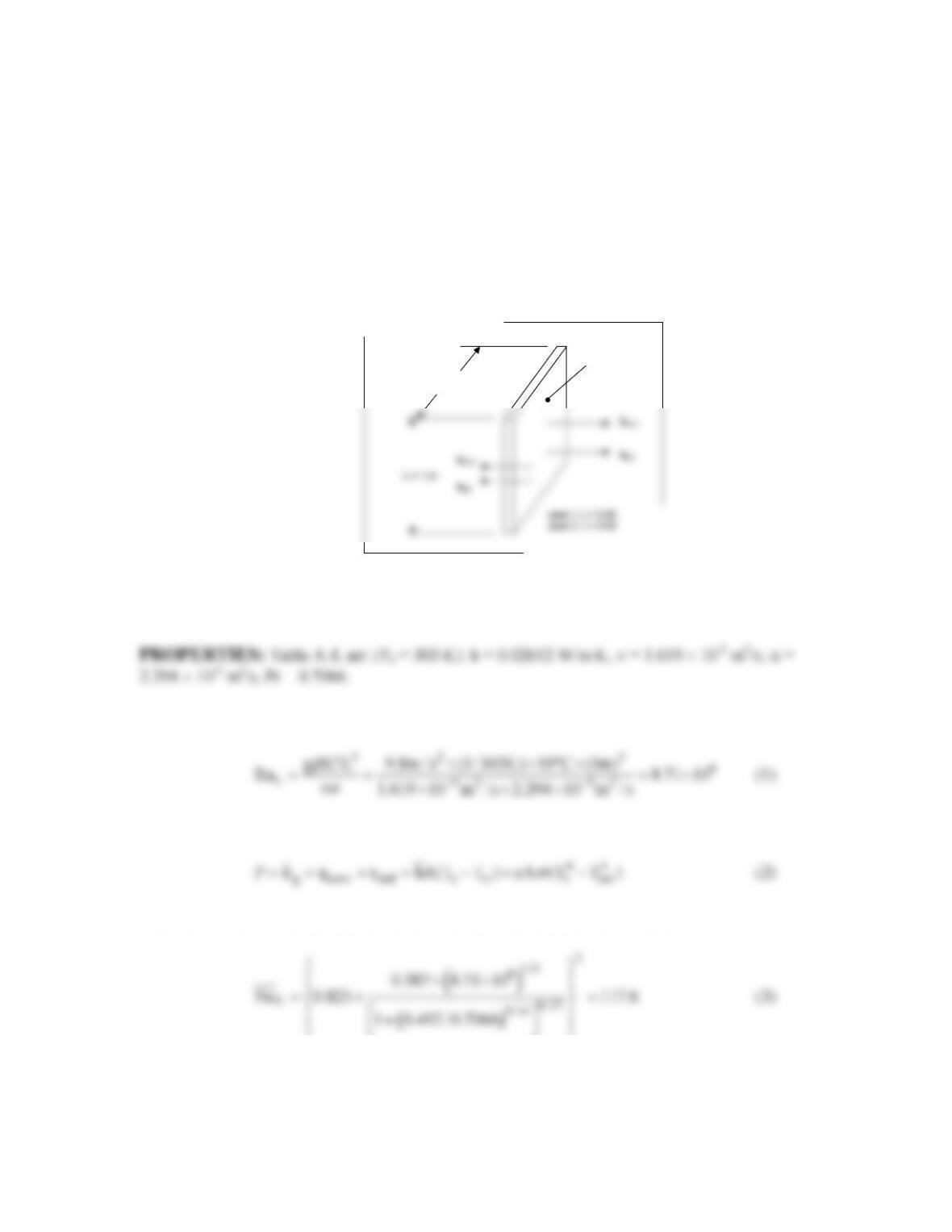
KNOWN: Size and emissivity of a vertical heated plate. Temperature of the ambient and
surroundings.
FIND: (a) Electrical power to be supplied to the plate in order to achieve a plate temperature of
Ts = 35°C for ε = 0.95. Fraction of the plate exposed to turbulent conditions, (b) Steady-state
plate temperature for ε = 0.05 and fraction of the plate exposed to turbulent conditions.
SCHEMATIC:
ASSUMPTIONS: (1) Constant properties and steady-state conditions, (2) Large surroundings,
(3) Isothermal plate, (4) Critical Rayleigh number of Rax,c = 109.
ANALYSIS: (a) The Rayleigh number is
Since Ra < Rax,c , the boundary layer is completely laminar. The electric power required is
The convection coefficient may be found from the Churchill and Chu correlation
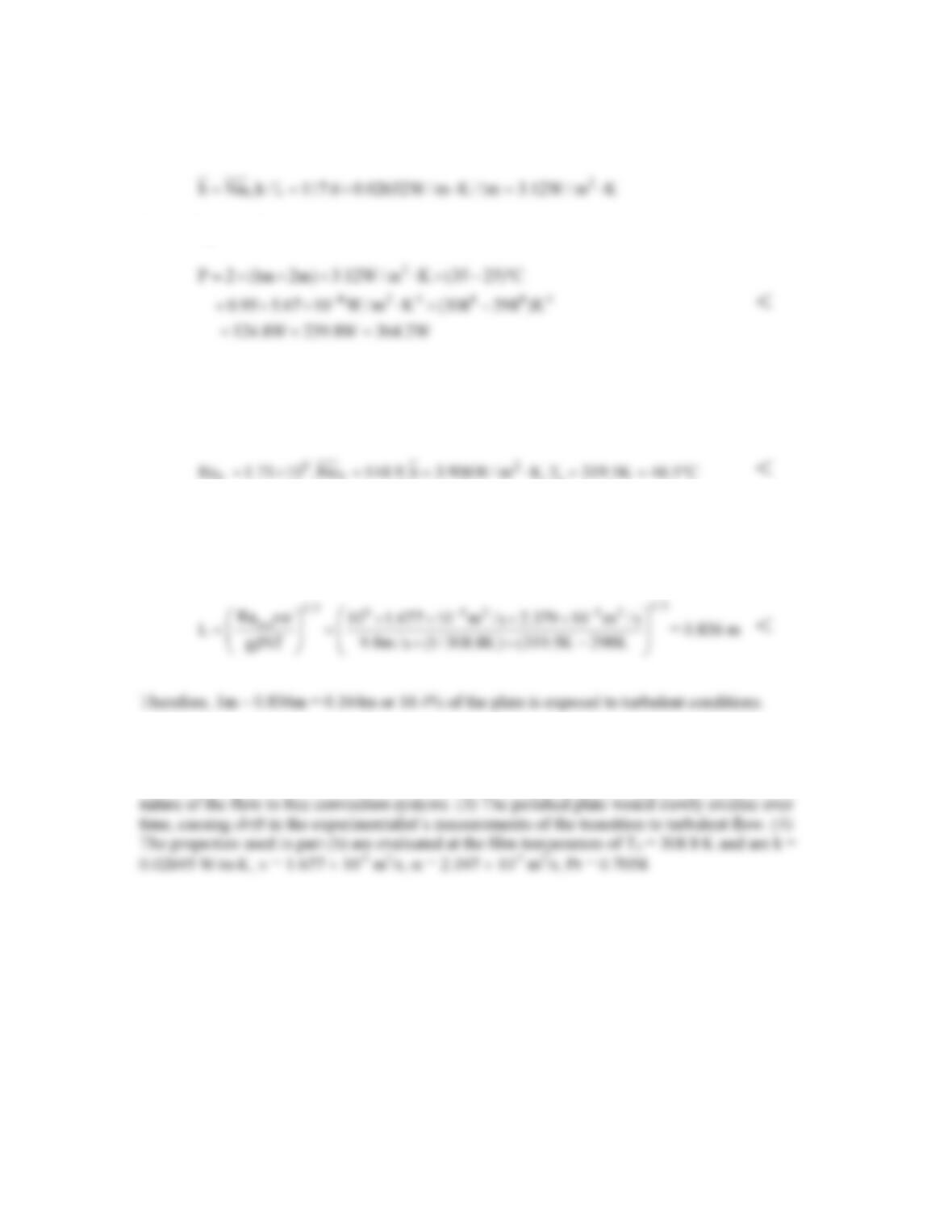
Thus, the convection coefficient is
Continued…
w = 2 m
Eg
•
Tsur = 25°C Tsur = 25°C
w = 2 m
Eg
•
Tsur = 25°C Tsur = 25°C
PROBLEM 9.21 (Cont.)
Hence, Equation 2 is written
(b) Equations 1, 2 and 3 may be solved simultaneously with the constraint that P = 364.6 W.
Property variations may be taken into account by using IHT. A simultaneous solution of
Equations 1 through 3 yields
Ls
The length of the plate that is subjected to laminar conditions may be found from the definition of
the Rayleigh number, RaL = gβ∆TL3/νa and the knowledge that Tf = (319.5 K = 298 K)/2 =
308.8 K.
COMMENTS: (1) In part (b), the convection and radiation heat rates are 335.9 W and 28.74
W, respectively. Convection dominates in part (b) while in part (a) radiation losses are
significantly larger than convection losses. (2) Radiation exchange can fundamentally alter the
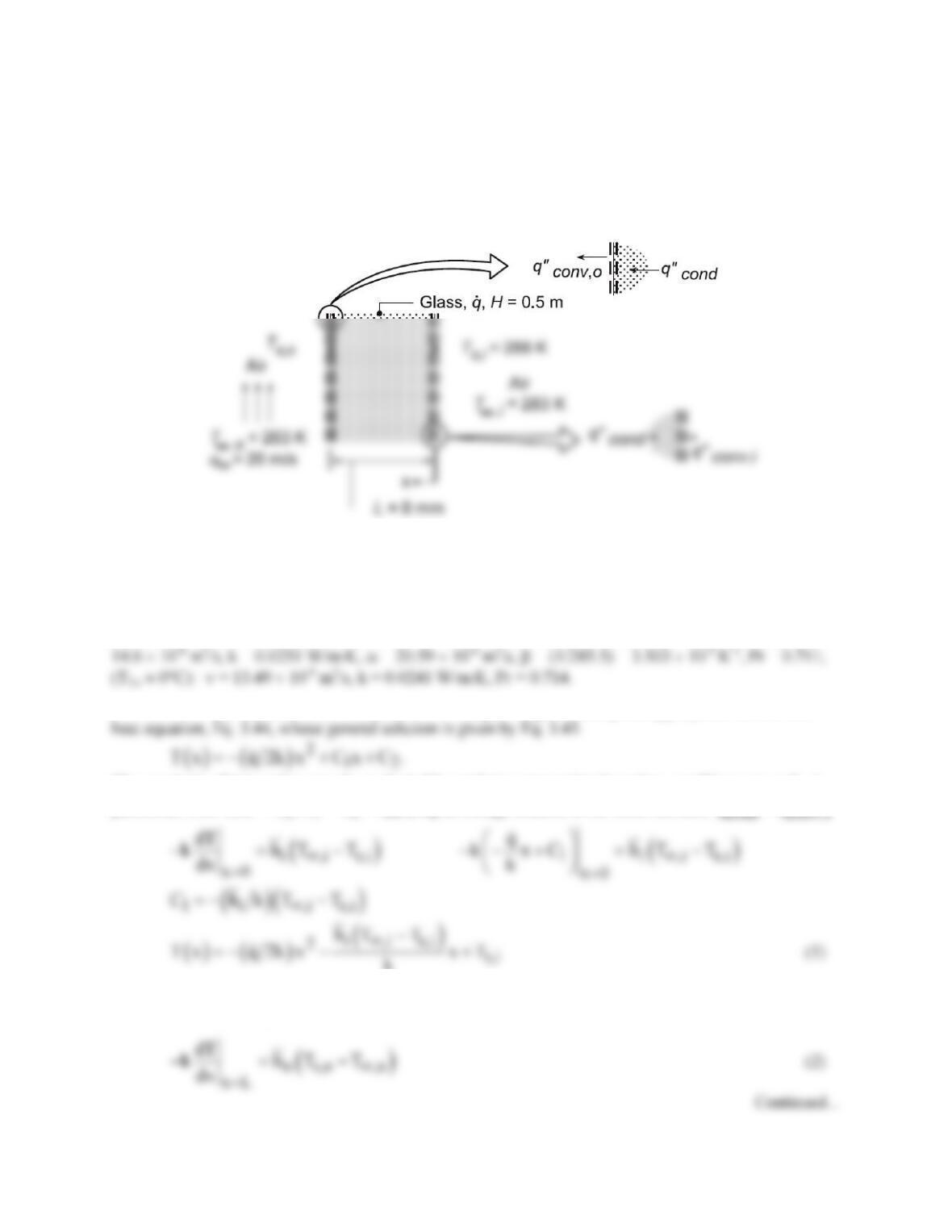
PROBLEM 9.22
KNOWN: Boundary conditions associated with a rear window experiencing uniform volumetric
heating.
FIND: (a) Volumetric heating rate
q
needed to maintain inner surface temperature at Ts,i = 15°C, (b)
Effects of
To∞,
,
u
∞
, and
T
i∞,
on
q
and Ts,o.
SCHEMATIC:
ASSUMPTIONS: (1) Steady-state, one-dimensional conditions, (2) Constant properties, (3) Uniform
volumetric heating in window, (4) Convection heat transfer from interior surface of window to interior
air may be approximated as free convection from a vertical plate, (5) Heat transfer from outer surface is
due to forced convection over a flat plate in parallel flow.
PROPERTIES: Table A.3, Glass (300 K): k = 1.4 W/m⋅K: Table A.4, Air (Tf,i = 12.5°C, 1 atm): ν =
ANALYSIS: (a) The temperature distribution in the glass is governed by the appropriate form of the
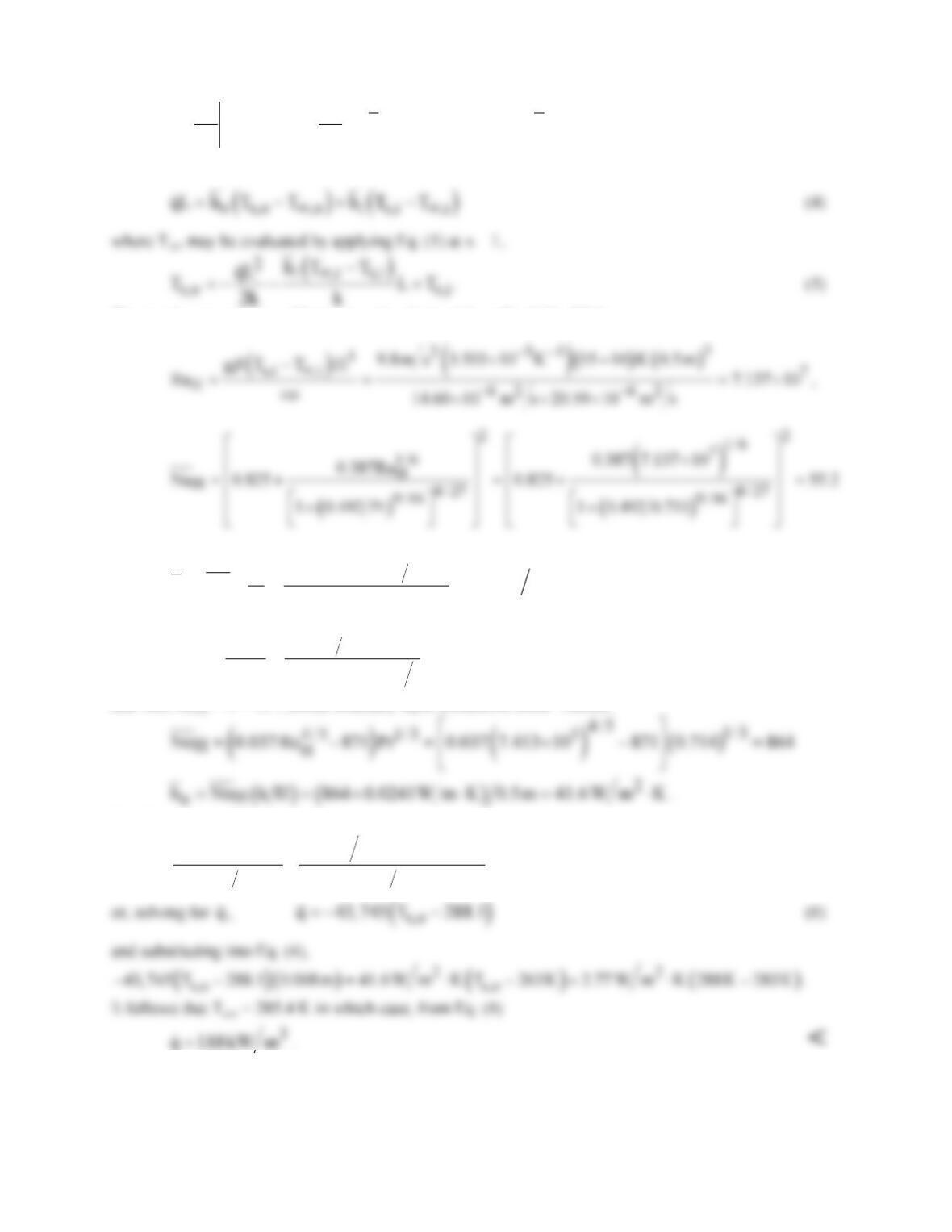
The constants of integration may be evaluated by applying appropriate boundary conditions at x = 0. In
particular, with T(0) = Ts,i, C2 = Ts,i. Applying an energy balance to the inner surface,
qq
′′ ′′
=
k
The required generation may then be obtained by formulating an energy balance at the outer surface,
where
cond conv,o
qq
′′ ′′
=
. Using Eq. (1),
PROBLEM 9.22 (Cont.)
( ) ( )
i ,i s,i i ,i s,i
xL
dT qL
k k hT T qLhT T
dx k ∞∞
=
− =−−+−=+−
(3)
Substituting Eq. (3) into Eq. (2), the energy balance becomes
The inside convection coefficient may be obtained from Eq. 9.26. With
2
H
i
k 55.2 0.0251W m K
h Nu 2.77 W m K
H 0.5m
×⋅
= = = ⋅
The outside convection coefficient may be obtained by first evaluating the Reynolds number. With
5
H62
u H 20 m s 0.5m
Re 7.413 10
13.49 10 m s
ν
∞−
×
= = = ×
×
and with Rex,c = 5 × 10⁵, mixed boundary layer conditions exist. Hence,
Eq. (5) may now be expressed as
( )
( )
( )
225
s,o
q 0.008 m 2.77 W m K 10 15 K
T 0.008 m 288 K 2.286 10 q 288.1K
2 1.4 W m K 1.4 W m K
−
⋅−
=− − × + =−× +
⋅⋅
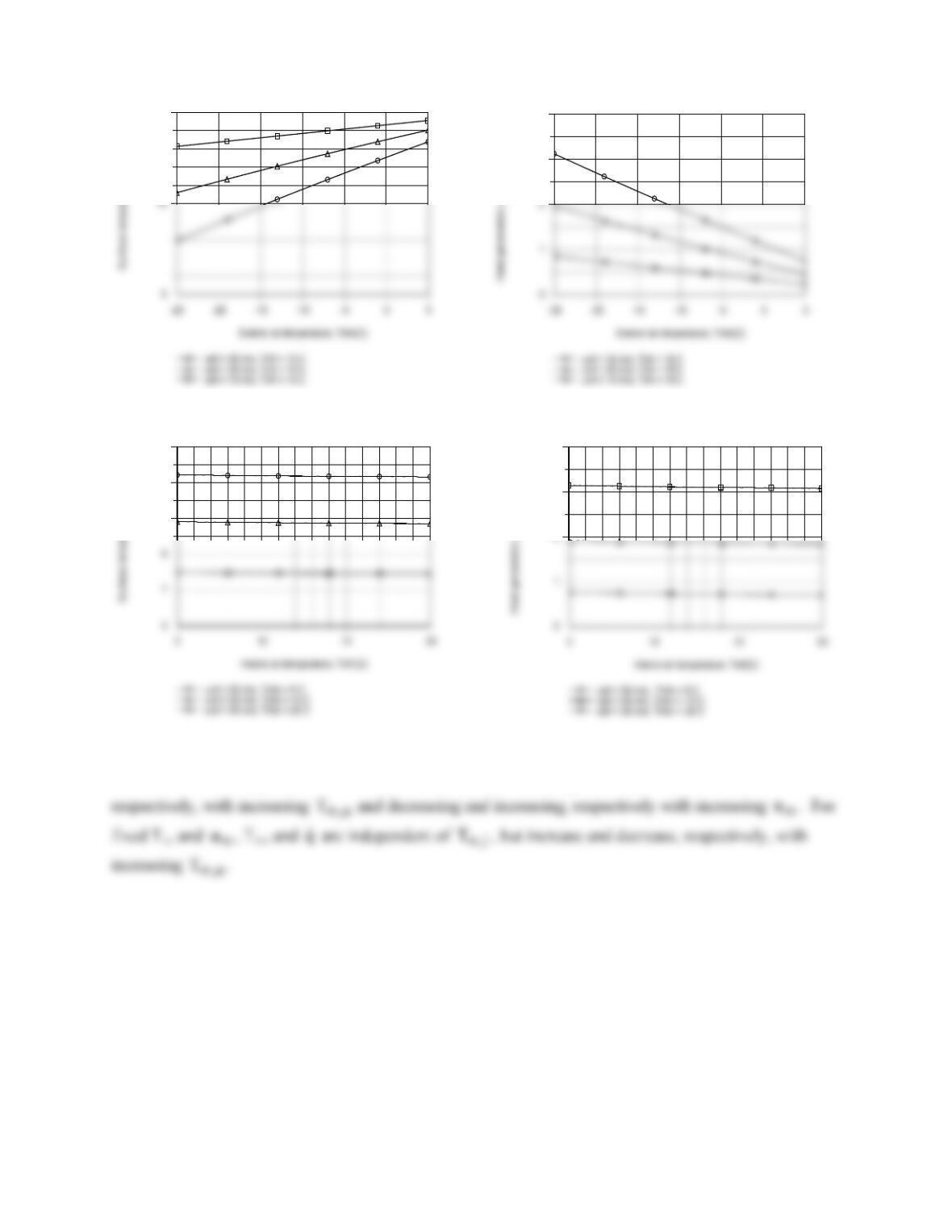
(b) The parametric calculations were performed using the One-Dimensional, Steady-state Conduction
Model of IHT with the appropriate Correlations and Properties Tool Pads, and the results are as follows.
Continued…
PROBLEM 9.22 (Cont.)
15
3
4
11
13
15
3
4
For fixed Ts,i and
,i
T
∞
, Ts,o and
q
are strongly influenced by
,o
T∞
and
u
∞
, increasing and decreasing,
COMMENTS: In lieu of performing a surface energy balance at x = L, Eq. (4) may also be obtained by
applying an energy balance to a control volume about the entire window.
PROBLEM 9.23
KNOWN: Vertical circuit board dissipating 5W to ambient air.
FIND: (a) Maximum temperature of the board assuming uniform surface heat flux and (b)
Temperature of the board for an isothermal surface condition.
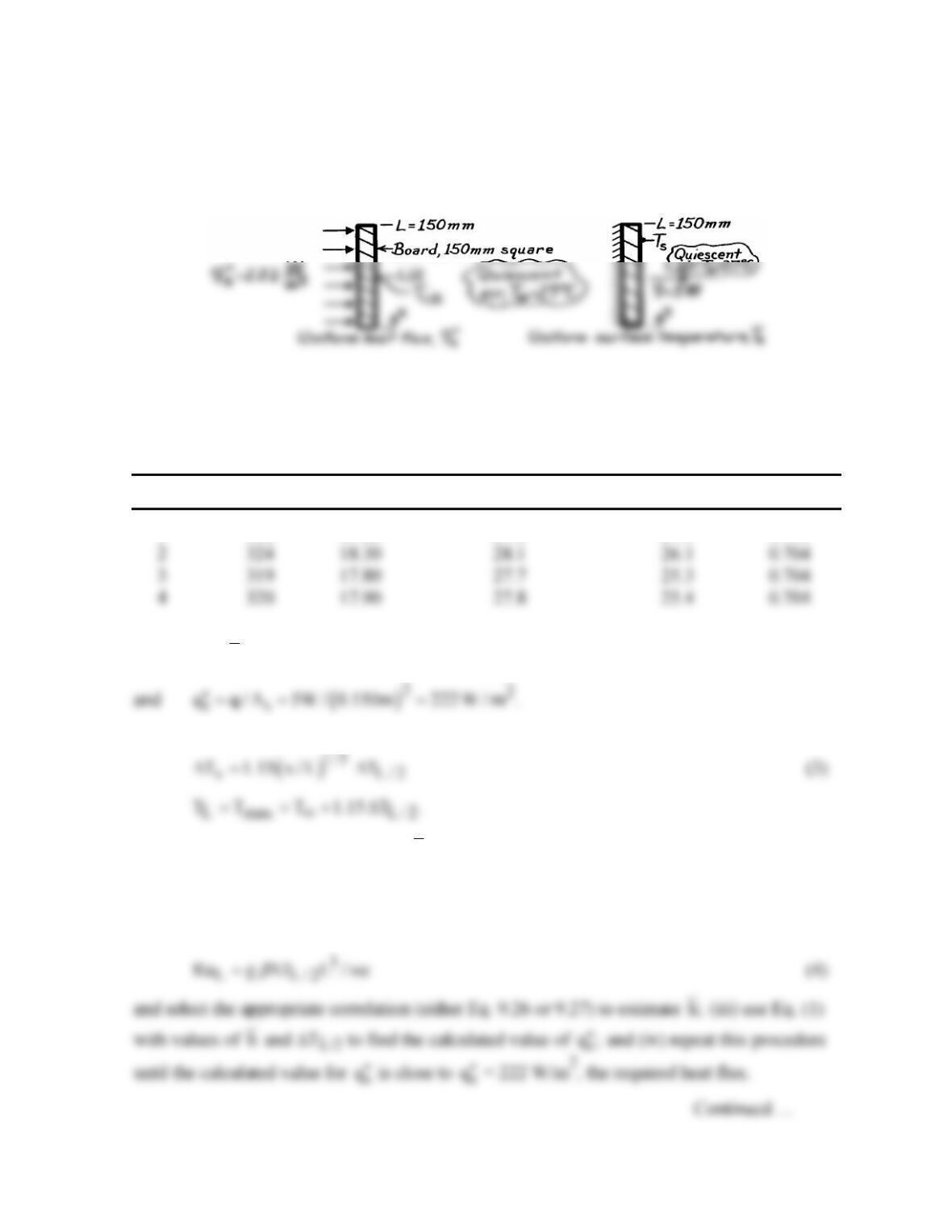
SCHEMATIC:
ASSUMPTIONS: (1) Either uniform
s
q′′
or Ts on the board, (2) Quiescent room air.
PROPERTIES: Table A-4, Air (Tf =(TL/2 + T∞)/2 or (Ts + T∞)/2, 1 atm), values used in
iterations:
Iteration Tf(K) ν⋅106(m2/s) k⋅103(W/m⋅K) a⋅106(m2/s) Pr
1 312 17.10 27.2 24.3 0.705
ANALYSIS: (a) For the uniform heat flux case (see Section 9.6.1), the heat flux is
s L/2 L/2 L/2
q h T where T T T
∞
′′ =∆ ∆= −
(1,2)
The maximum temperature on the board will occur at x = L and from Eq. 9.28 is
The average heat transfer coefficient
h
is estimated from a vertical (uniform Ts) plate
correlation based upon the temperature difference ∆TL/2. Recognize that an iterative
procedure is required: (i) assume a value of TL/2, use Eq. (2) to find ∆TL/2; (ii) evaluate the
Rayleigh number
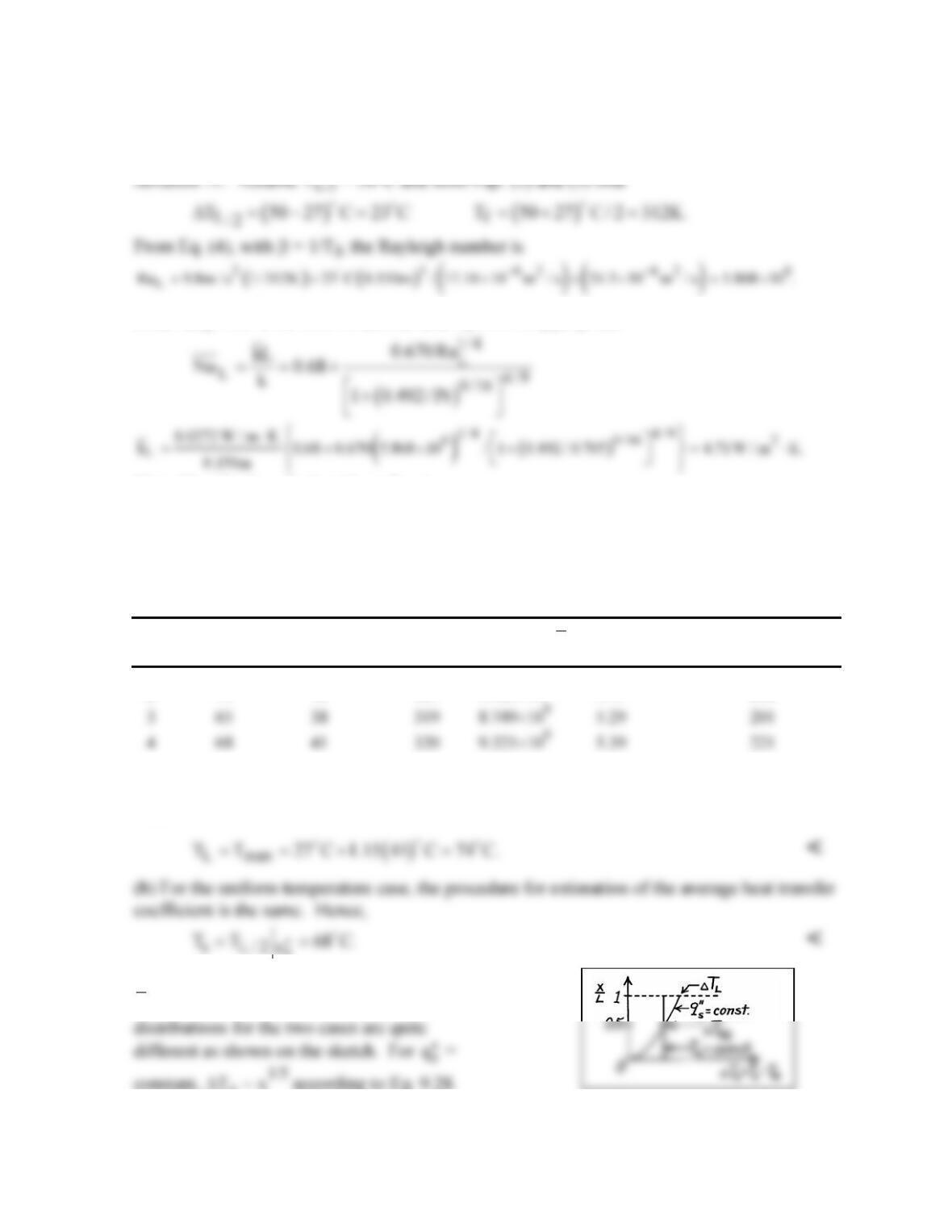
PROBLEM 9.23 (Cont.)
To evaluate properties for the correlation, use the film temperature,
( )
f L/2
T T T / 2.
∞
= +
(5)
Since
9
L
Ra 10 ,<
the flow is laminar and Eq. 9.27 is appropriate
Using Eq. (1), the calculated heat flux is
22
s
q 4.71W / m K 23 C 108 W / m .
′′ = ⋅× =
Since
s
q′′
< 222 W/m2, the required value, another iteration with an increased estimate for
TL/2 is warranted. Further iteration results are tabulated.
Iteration TL/2(°C) ∆TL/2(°C) Tf(K) RaL
()
2
h W/m K⋅
()
2
s
q W/m
′′
2 75 48 324 1.026×10⁷ 5.57 268
After Iteration 4, close agreement between the calculated and required
s
q′′
is achieved with
TL/2 = 68°C. From Eq. (3), the maximum board temperature is
s
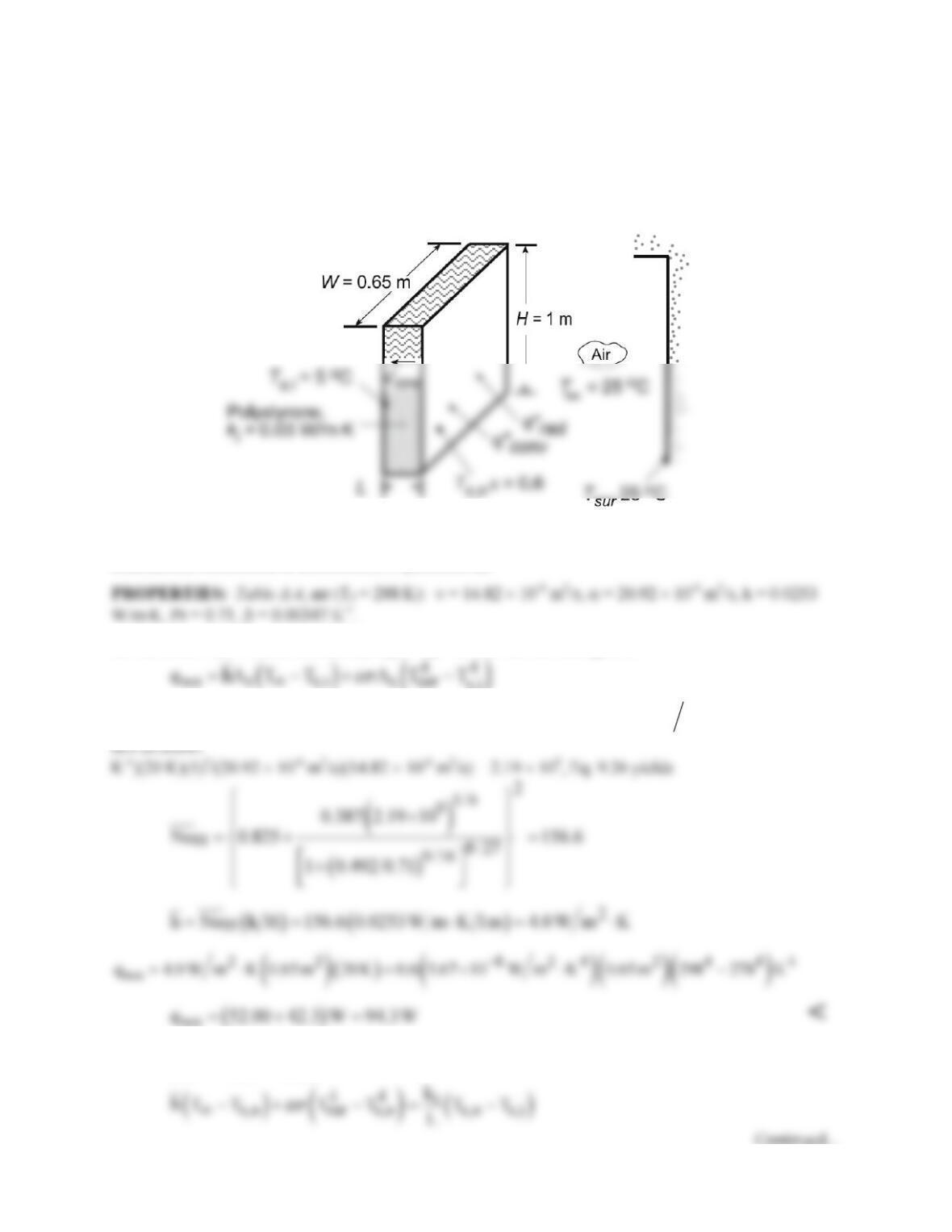
COMMENTS: In both cases, q = 5W and
2
h 5.38 W / m .=
However, the temperature
PROBLEM 9.24
KNOWN: Dimensions, interior surface temperature, and exterior surface emissivity of a refrigerator
door. Temperature of ambient air and surroundings.
FIND: (a) Heat gain with no insulation, (b) Heat gain as a function of thickness for polystyrene
insulation.
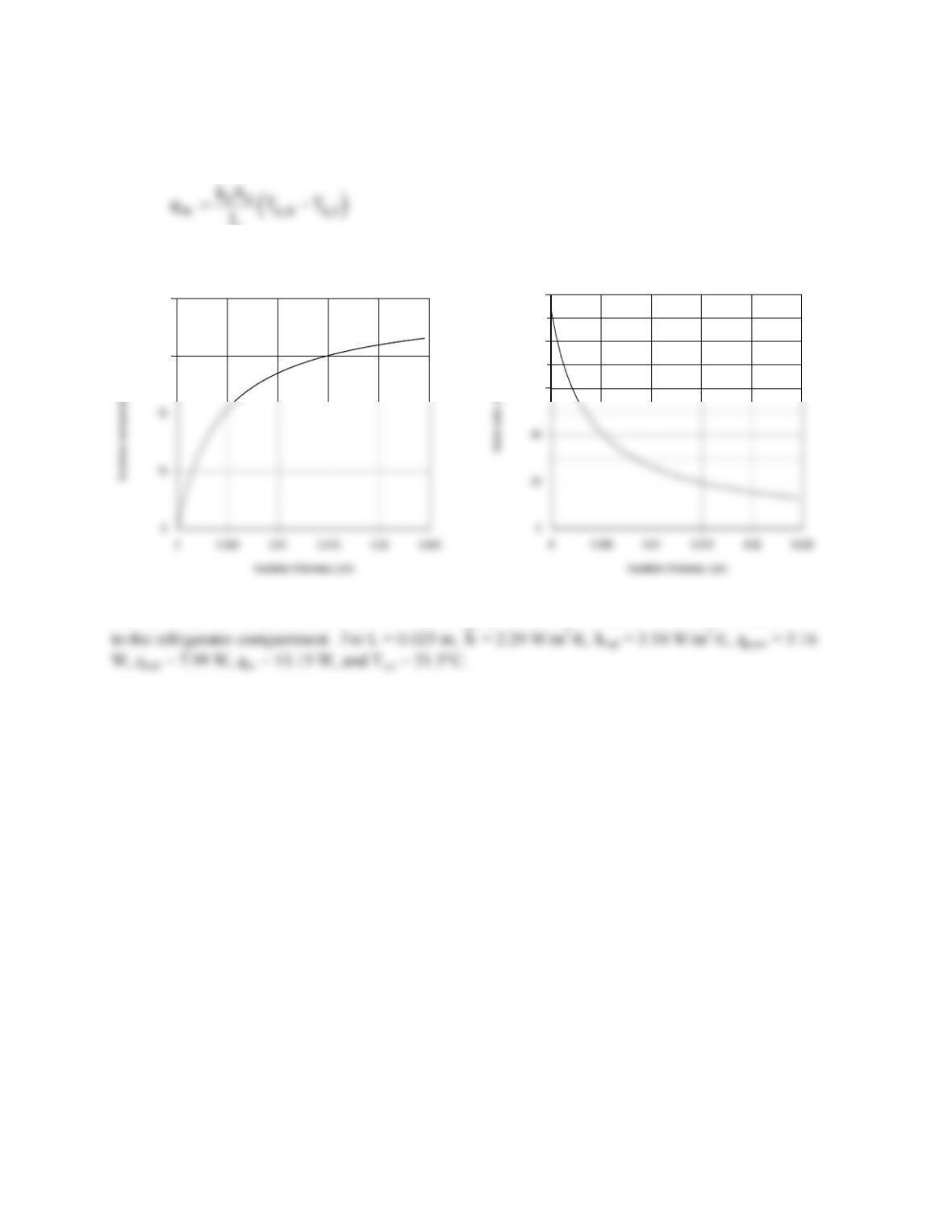
SCHEMATIC:
ASSUMPTIONS: (1) Steady-state conditions, (2) Negligible thermal resistance of steel and
polypropylene sheets, (3) Negligible contact resistance between sheets and insulation, (4) One–
dimensional conduction in insulation, (5) Quiescent air.
ANALYSIS: (a) Without insulation, Ts,o = Ts,i = 278 K and the heat gain is
where As = HW = 0.65 m2. With a Rayleigh number of RaH =
( )
3
s,i
gT T H
β aν
∞
−
= 9.8
wo
(b) With the insulation, Ts,o may be determined by performing an energy balance at the outer surface,
where
conv rad cond
q qq
′′ ′′ ′′
+=
, or
Continued…
PROBLEM 9.24 (Cont.)
Using the IHT First Law Model for a Nonisothermal Plane Wall with the appropriate Correlations and
Properties Tool Pads and evaluating the heat gain from
the following results are obtained for the effect of L on Ts,o and qw.
20
25
60
80
100
The outer surface temperature increases with increasing L, causing a reduction in the rate of heat transfer
COMMENTS: The insulation is very effective in reducing the heat load, and there would be little value
to increasing L beyond 25 mm.
PROBLEM 9.25
KNOWN: Dimensions and emissivity of cylindrical solar receiver. Incident solar flux. Temperature
of ambient air.
FIND: (a) Heat loss and collection efficiency for a prescribed receiver temperature, (b) Effect of
receiver temperature on heat losses and collector efficiency.
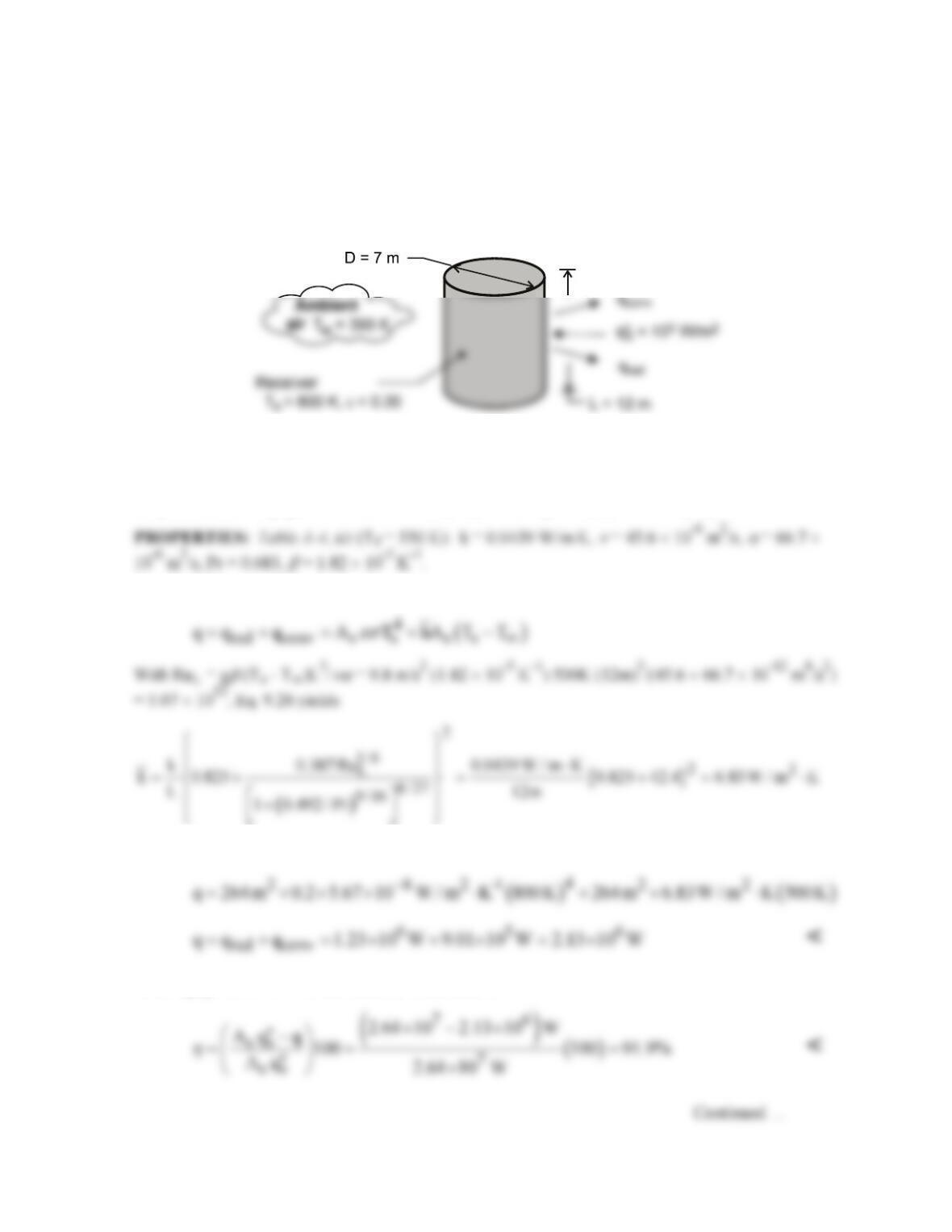
SCHEMATIC:
ASSUMPTIONS: (1) Steady-state, (2) Ambient air is quiescent, (3) Incident solar flux is uniformly
distributed over receiver surface, (4) All of the incident solar flux is absorbed by the receiver, (5)
Negligible irradiation from the surroundings, (6) Uniform receiver surface temperature, (7) Curvature
of cylinder has a negligible effect on boundary layer development, (8) Constant properties.
ANALYSIS: (a) The total heat loss is
Hence, with As = πDL = 264 m2
With
7
ss
A q 2.64 10 W,
′′ = ×
the collector efficiency is
PROBLEM 9.25 (Cont.)
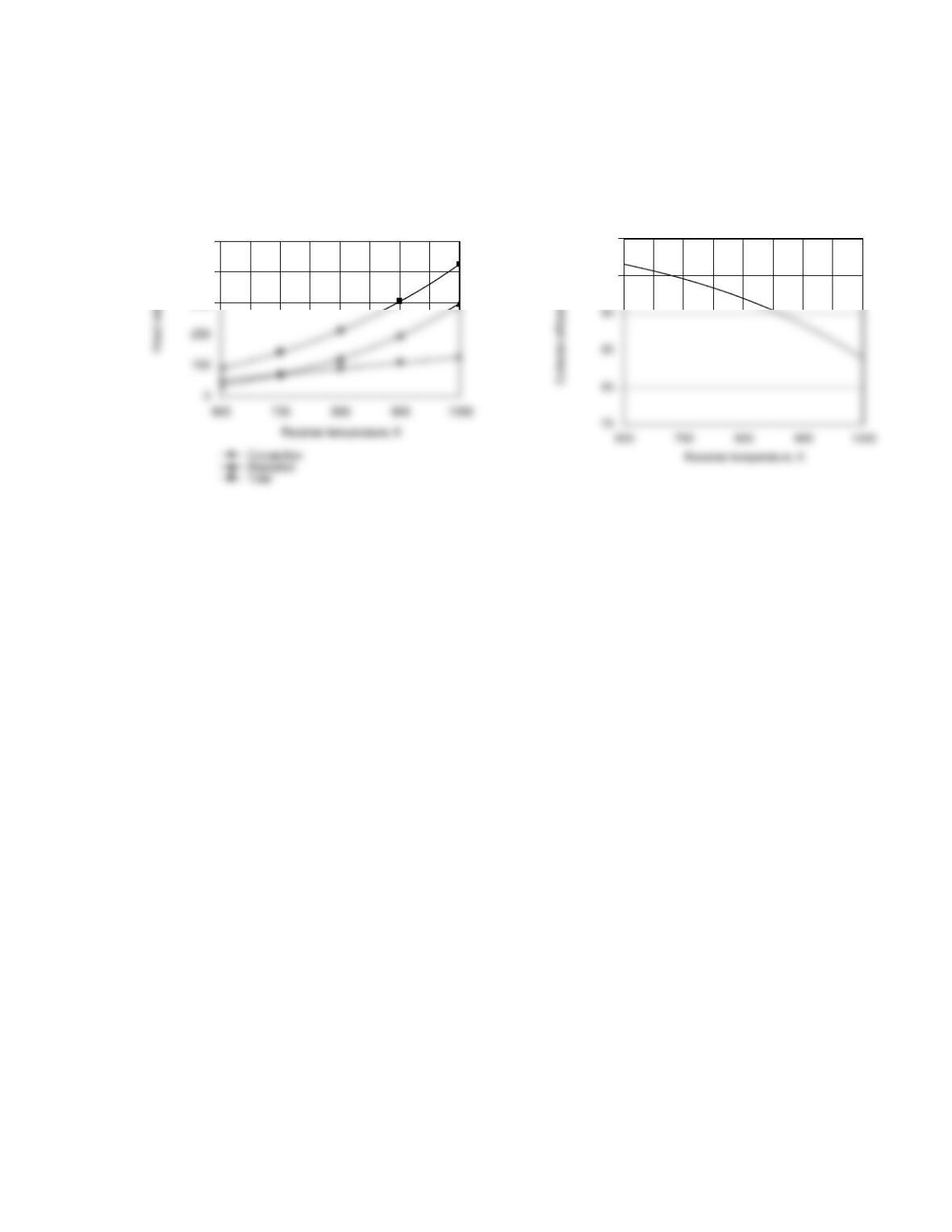
(b) As shown below, because of its dependence on temperature to the fourth power, qrad increases
more significantly with increasing Ts than does qconv, and the effect on the efficiency is pronounced.
COMMENTS: The collector efficiency is also reduced by the inability to have a perfectly absorbing
receiver. Partial reflection of the incident solar flux will reduce the efficiency by at least several
percent.
3E6
4E6
5E6
95
100
PROBLEM 9.26
KNOWN: Surface temperature of a long duct and ambient air temperature.
FIND: Heat gain to the duct per unit length of the duct.
SCHEMATIC:
W=0.3m
ASSUMPTIONS: (1) Surface radiation effects are negligible, (2) Ambient air is quiescent.
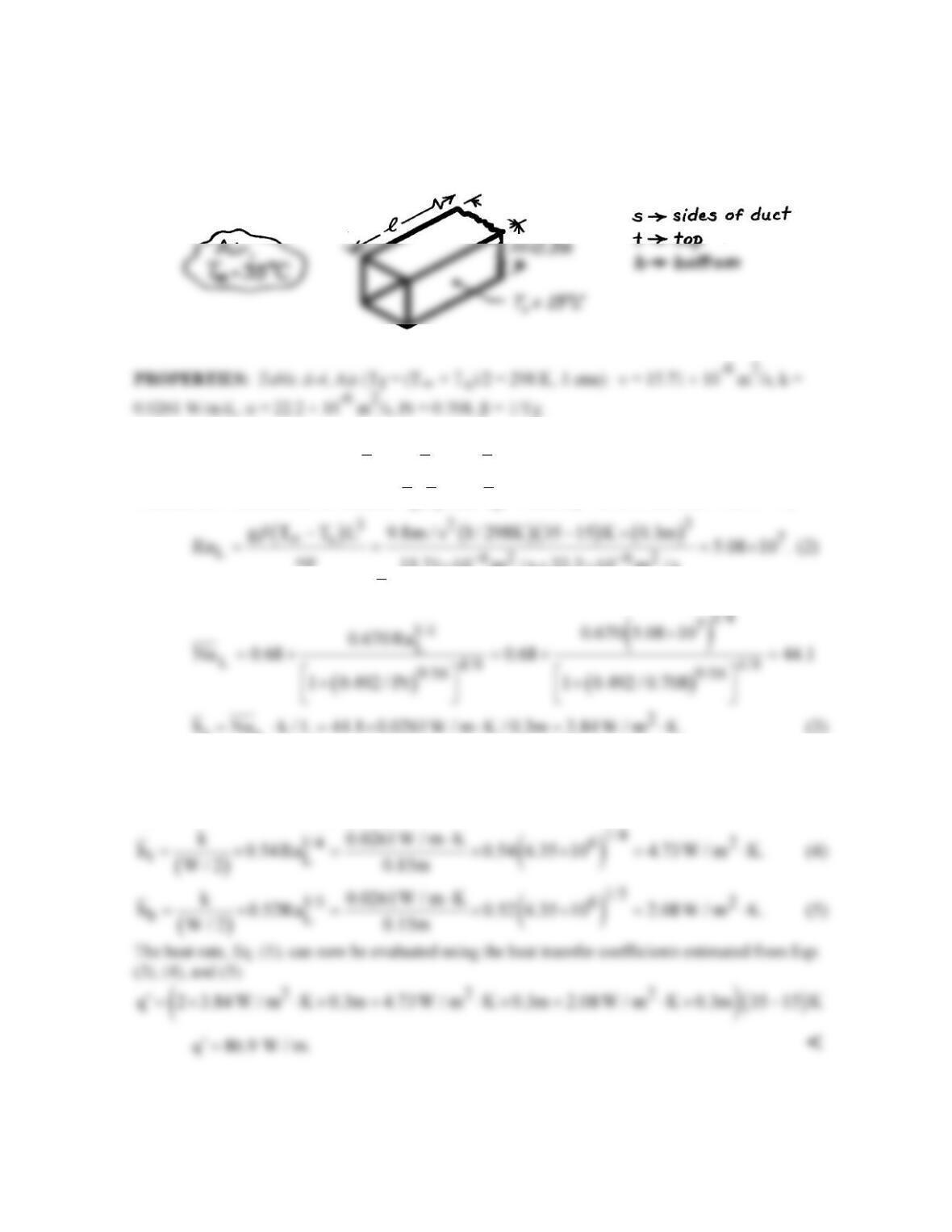
ANALYSIS: The heat gain to the duct can be expressed as
( )
( )
stb s t b s
q 2q q q 2 h H h W h W T T .
∞
′ ′′′
= + + = ⋅+ ⋅ + ⋅ −
(1)
Consider now correlations to estimate
st b
h , h , and h .
From Eq. 9.25, for the sides with L ≡ H,
15.71 10 m / s 22.2 10 m / s
νa
× ××
Eq. 9.27 is appropriate to estimate
s
h,
L
s
For the top and bottom portions of the duct, L ≡ As/P ≈ W/2, (see Eq. 9.29), find the Rayleigh number
from Eq. (2) with L = 0.15 m, RaL = 6.35 × 10⁶. From the correlations, Eqs. 9.30 and 9.32 for the
top and bottom surfaces, respectively, find
COMMENTS: Radiation surface effects will be significant in this situation. With knowledge of the
duct emissivity and surroundings temperature, the radiation heat exchange could be estimated.
PROBLEM 9.27
KNOWN: Inner surface temperature and dimensions of rectangular duct. Thermal conductivity,
thickness and emissivity of insulation.
SCHEMATIC:
ASSUMPTIONS: (1) Ambient air is quiescent, (2) One-dimensional conduction, (3) Steady-state.
PROPERTIES: Table A.4, air (obtained from Properties Tool Pad of IHT).
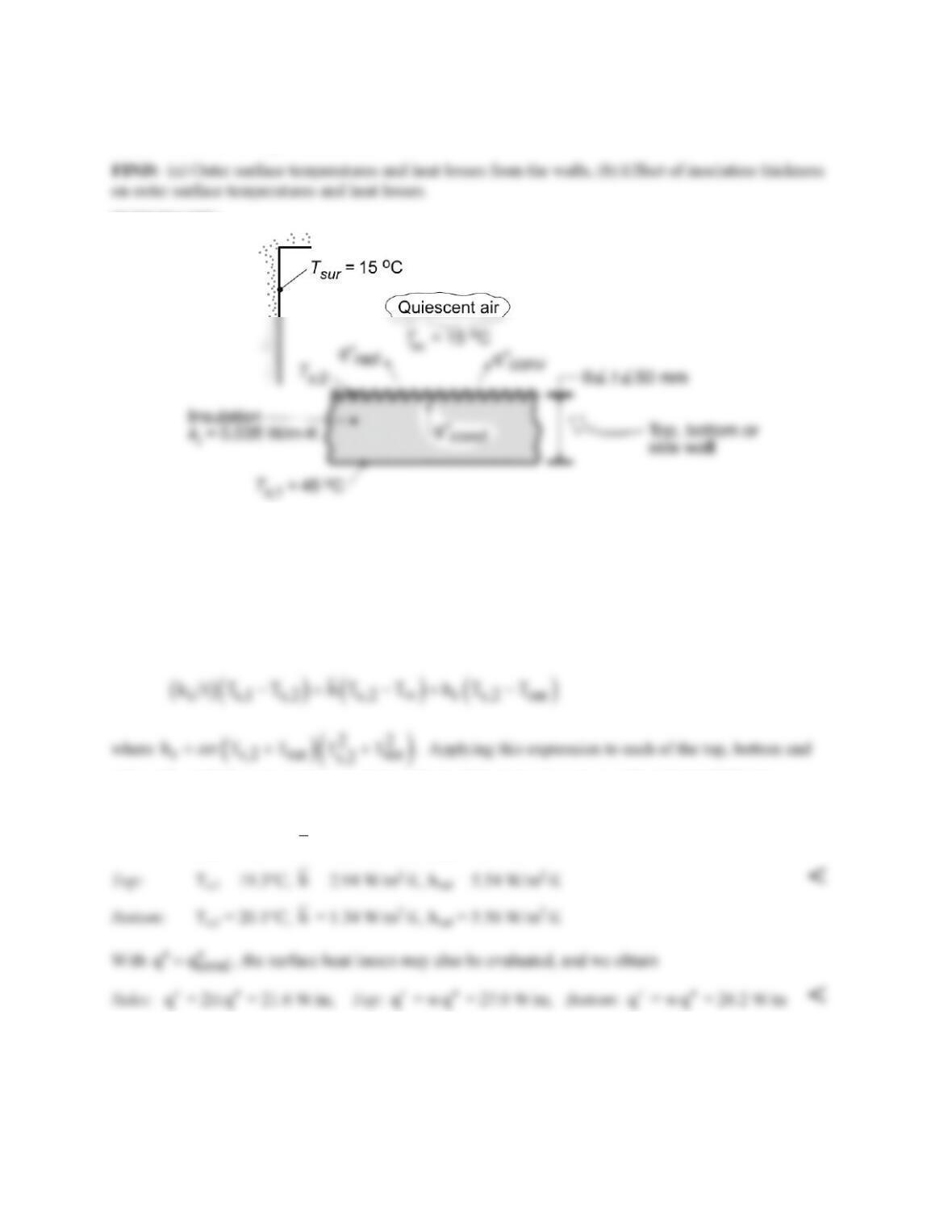
ANALYSIS: (a) The analysis follows that of Example 9.3, except the surface energy balance must now
include the effect of radiation. Hence,
cond conv rad
q qq
′′ ′′ ′′
= +
, in which case
side walls, with the appropriate correlation obtained from the Correlations Tool Pad of IHT, the
following results are determined for t = 25 mm.
Sides: Ts,2 = 19.3°C,
h
= 2.82 W/m2⋅K, hrad = 5.54 W/m2⋅K
h
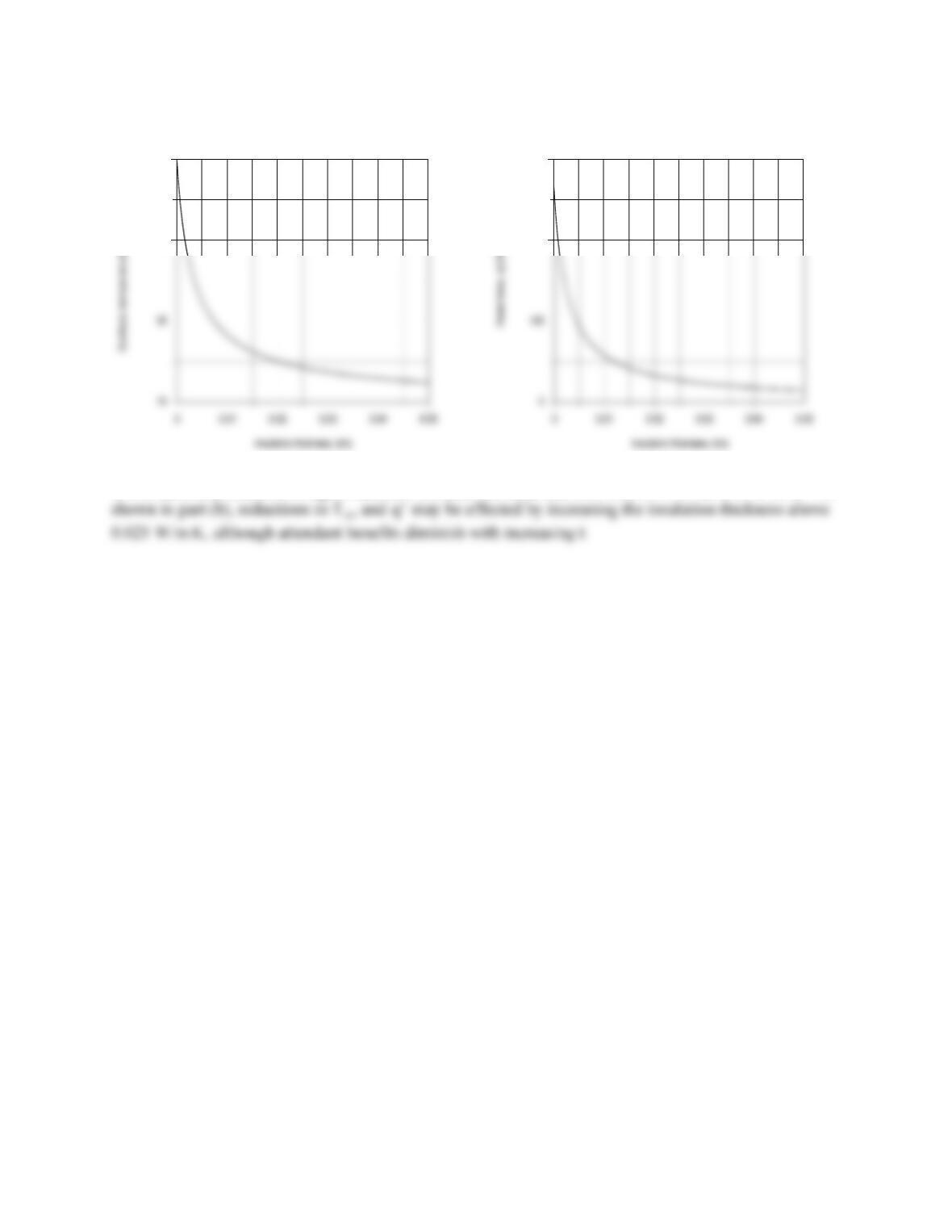
(b) For the top surface, the following results are obtained from the parametric calculations
Continued…
PROBLEM 9.27 (Cont.)
35
45
200
300
COMMENTS: Contrasting the heat rates of part (a) with those predicted in Comment 1 of Example 9.3,
it is evident that radiation is significant and increases the total heat loss from 57.6 W/m to 74.8 W/m. As