PROBLEM 9.71 (Cont.)
(b) The unit conduction resistance of a glass pane is
2
cond p p
R L / k 0.00429 m K / W,
′′ = = ⋅
and the
smallest convection resistance is
( )
conv,o o
R 1/ h 0.290 m .
2K/W
′′ = =
⋅
Hence,
COMMENTS: (1) Assuming a heat flux of 35.7 W/m2 through a glass pane, the corresponding
′′
PROBLEM 9.72
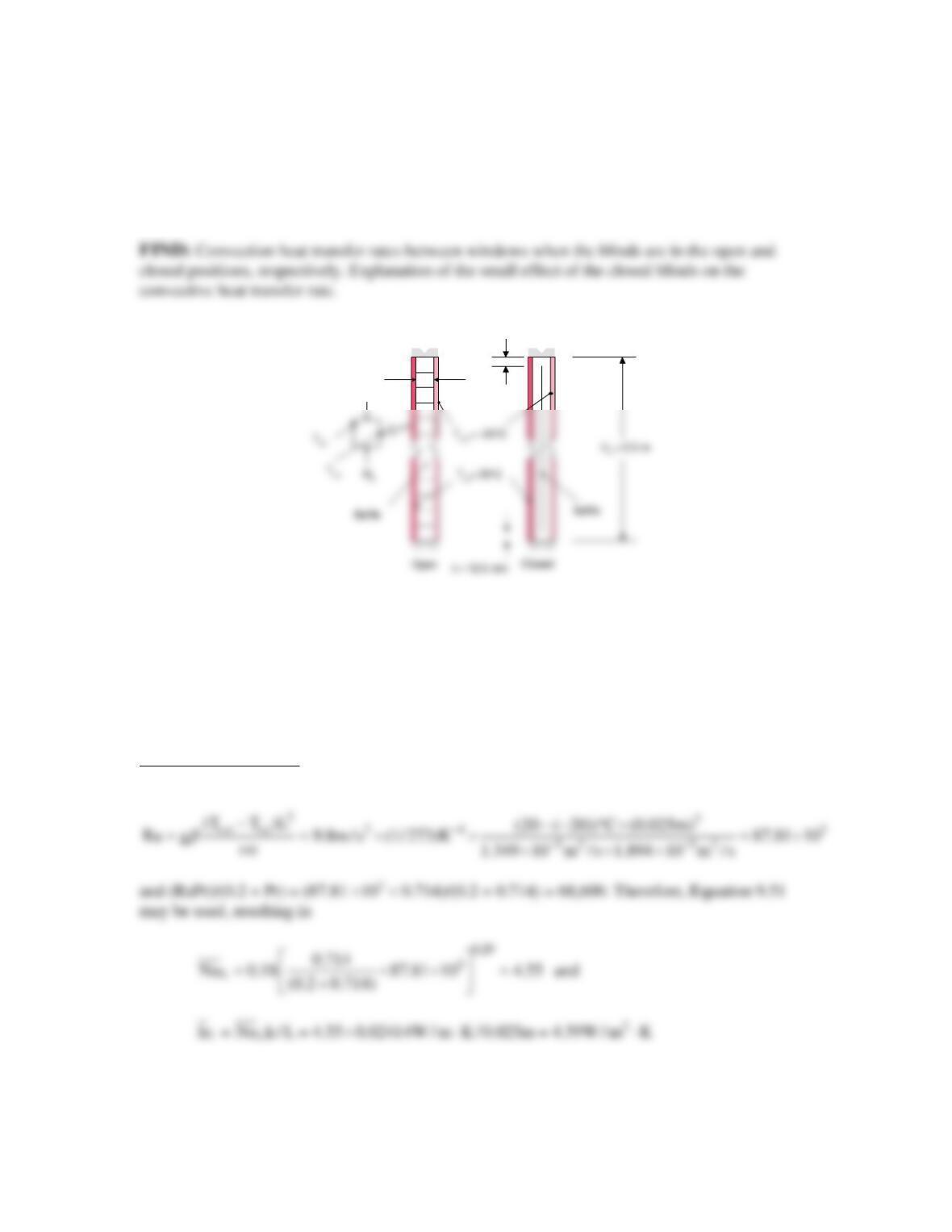
KNOWN: Dimensions of air space between windows, dimensions of individual blinds.
Temperatures of windows.
SCHEMATIC:
ASSUMPTIONS: (1) Constant properties, (2) Steady-state conditions, (3) Isothermal windows,
(4) Blinds are adiabatic, (5) Neglect presence of the blind when in the closed position.
PROPERTIES: Table A.4, air: (Tf = 273 K): k = 0.02414 W/m⋅K, ν = 1.349 × 10⁻⁵ m2/s, a =
1.894 × 10⁻⁵ m2/s, Pr = 0.714.
ANALYSIS:
Case A, Open Position The aspect ratio of a typical cell is Ho/L = 25/25 = 1. The Rayleigh
number is
The same value of the convection heat transfer coefficient exists for each cell. Hence,
Continued…
L = 25 mm
t = 12.5 mm
L = 25 mm
t = 12.5 mmt = 12.5 mm
PROBLEM 9.72 (Cont.)
Case B, Closed Position The aspect ratio of the cavity is Hc/L = 0.5 m/0.025 m = 20. The
Rayleigh number is 87.81 × 10³, as before. Therefore, select Equation 9.52, resulting in
The closed blinds may be neglected if the core of the air layer is nearly stagnant. <
COMMENTS: (1) Equation 9.52 has been extrapolated slightly outside of its range of
application with respect to the suggested Prandtl number limits. (2) In the open blind case,
PROBLEM 9.73
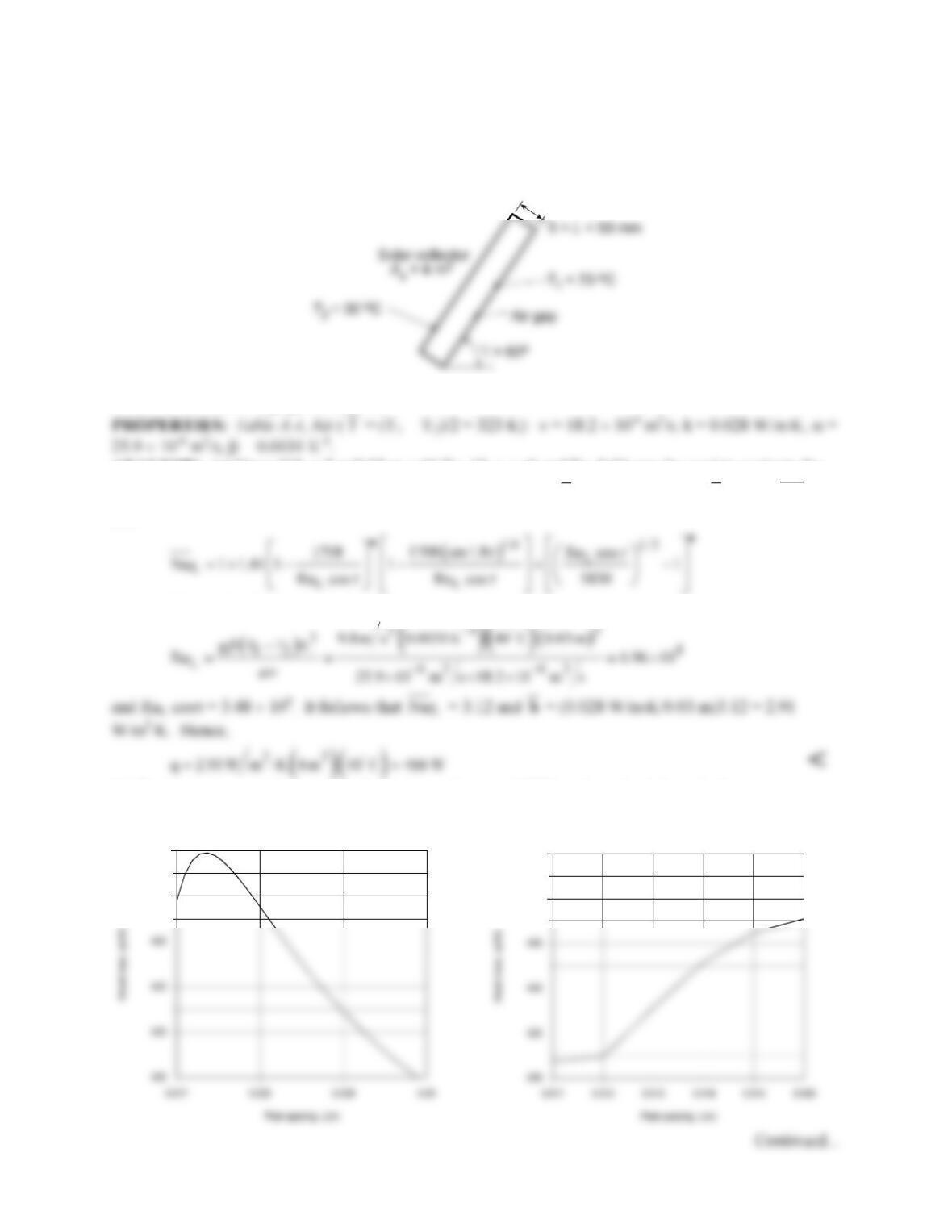
KNOWN: Dimensions and surface temperatures of a flat–plate solar collector.
FIND: (a) Rate of heat loss across collector cavity, (b) Effect of plate spacing on the heat loss rate.
SCHEMATIC:
ASSUMPTIONS: Negligible radiation.
ANALYSIS: (a) Since H/L = 2 m/0.03 m = 66.7 > 12, τ < τ* and Eq. 9.54 may be used to evaluate the
convection coefficient associated with the air space. Hence, q =
h
As(T1 – T2), where
h
= (k/L)
L
Nu
and
For L = 30 mm, the Rayleigh number is
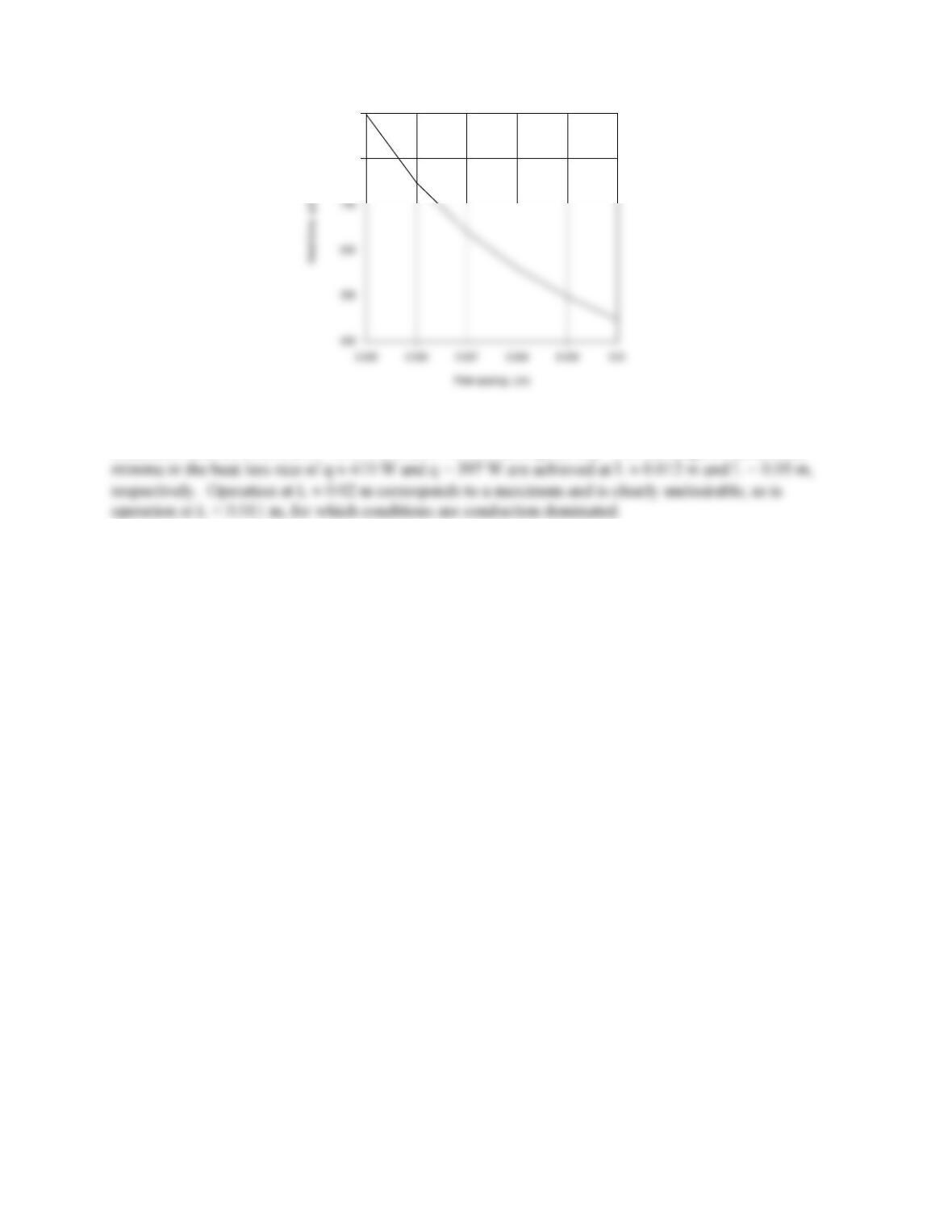
(b) The foregoing model was entered into the workspace of IHT, and results of the calculations are
plotted as follows.
480
500
480
500
PROBLEM 9.73 (Cont.)
800
900
The plots are influenced by the fact that the third and second terms on the right-hand side of the
correlation are set to zero at L ≈ 0.017 m and L ≈ 0.011 m, respectively. For the range of conditions,
COMMENTS: Because the convection coefficient is low, radiation effects would be significant.
PROBLEM 9.74
KNOWN: Cylindrical 120-mm diameter radiation shield of Example 9.5 installed concentric with a
100-mm diameter tube carrying steam; spacing provides for an air gap of L = 10 mm.
FIND: (a) Rate of heat loss per unit length of the tube by convection when a second shield of
diameter 140 m is installed; compare the result to that for the single shield calculation of the example;
and (b) The heat loss rate per unit length if the gap dimension is made L = 15 mm (rather than 10
mm). Do you expect the rate of heat loss to increase or decrease?
SCHEMATIC:
T , D
= 120 or 130 mm
1st shield
ASSUMPTIONS: (1) Steady-state conditions, and (b) Constant properties.
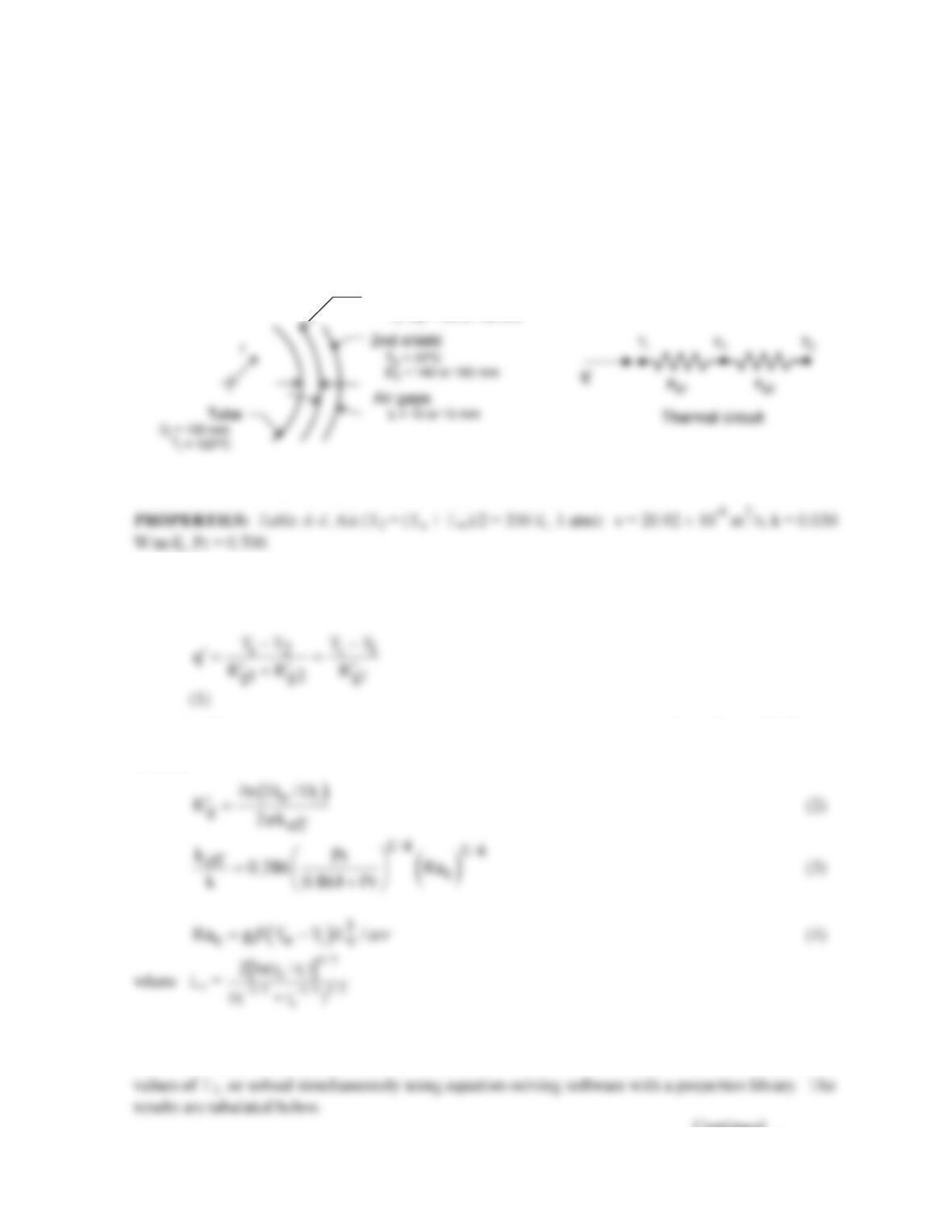
ANALYSIS: (a) The thermal circuit representing the tube with two concentric cylindrical radiation
shields having gap spacings L = 10 mm is shown above. The rate of heat loss per unit length by
convection is
where the
g
R′
represents the thermal resistance of the annular gap (spacing). From Eqs. 9.58, 59 and
60, find
where the properties are evaluated at the average temperature of the bounding surfaces, Tf = (Ti +
To)/2. Recognize that the above system of equations needs to be solved iteratively by initial guess
Continued …
PROBLEM 9.74 (Cont.)
(b) Using the foregoing relations, the analyses can be repeated with L = 15 mm, so that Di = 130 mm
and D2 = 160 mm. The results are tabulated below along with those from Example 9.5 for the single-
shield configuration. <
Shields
L(mm)
g1
R
′
(m⋅K/W)
g2
R′
(m⋅K/W)
tot
R′
(m⋅K/W) T1(°C)
q′
(W/m)
COMMENTS: (1) The effect of adding the second shield is to more than double the thermal
resistance of the shields to convection heat transfer.
PROBLEM 9.75
KNOWN: Concentric cylinders or concentric spheres of uniform inner and outer surface
temperatures.
FIND: Expressions for the critical Rayleigh numbers, Rac,crit and Ras,crit below which keff is
minimized. Evaluate Rac,crit and Ras,crit for air, water, and glycerin at a mean temperature of 300 K.
Comment on the convection heat transfer rate associated with Rac,crit and Ras,crit.
SCHEMATIC:
ASSUMPTIONS: (1) Constant properties.
ANALYSIS: When heat transfer across the gap is conduction–dominated, keff = k. When convection
becomes significant, keff/k > 1. Hence, the minimum heat transfer rate occurs when keff/k = 1.
Concentric Cylinders: (Equation 9.59)
Concentric Spheres: (Equation 9.62)
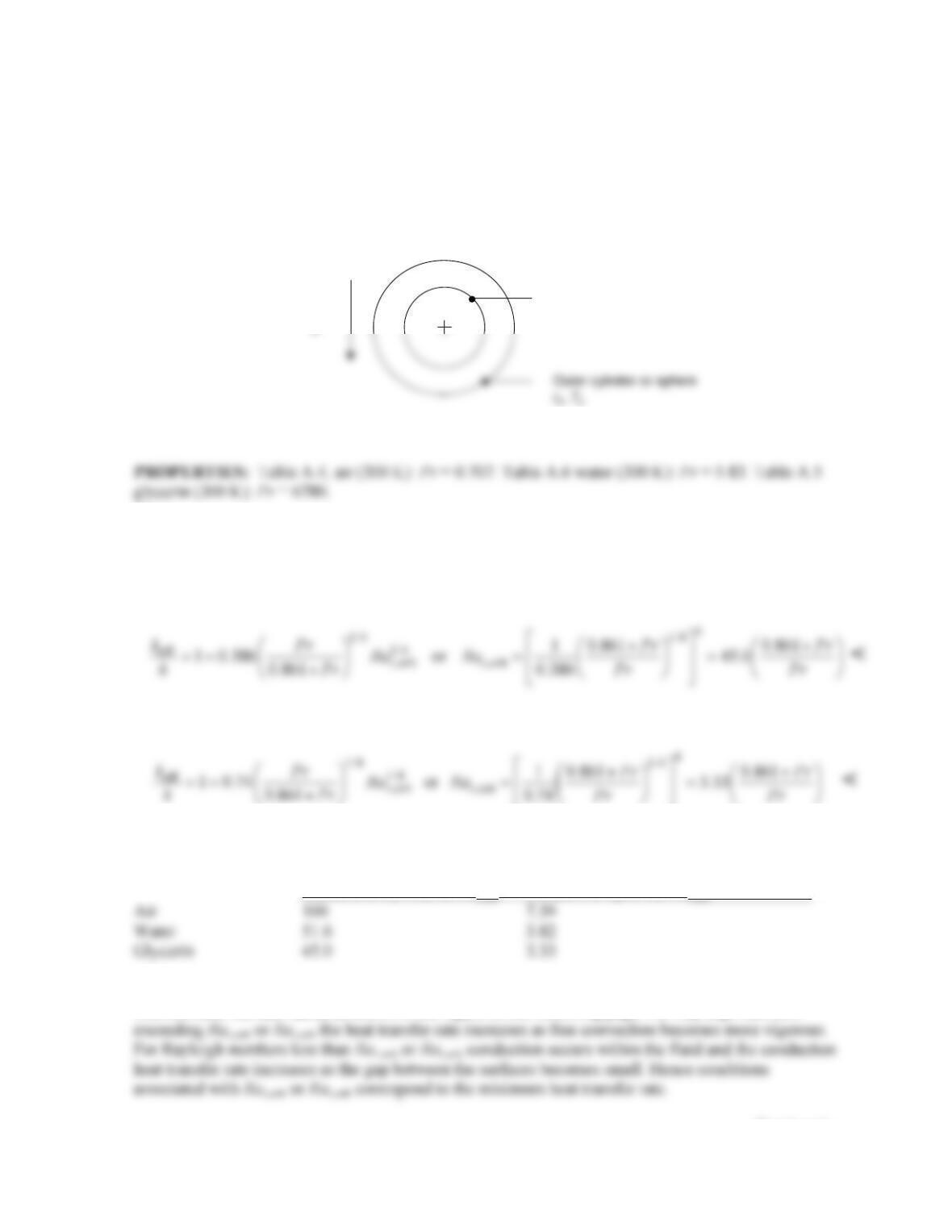
For the three fluids of interest the critical Rayleigh numbers, Rac,crit and Ras,crit are:
Concentric Cylinders, Rac,crit Concentric Spheres, Ras,crit <
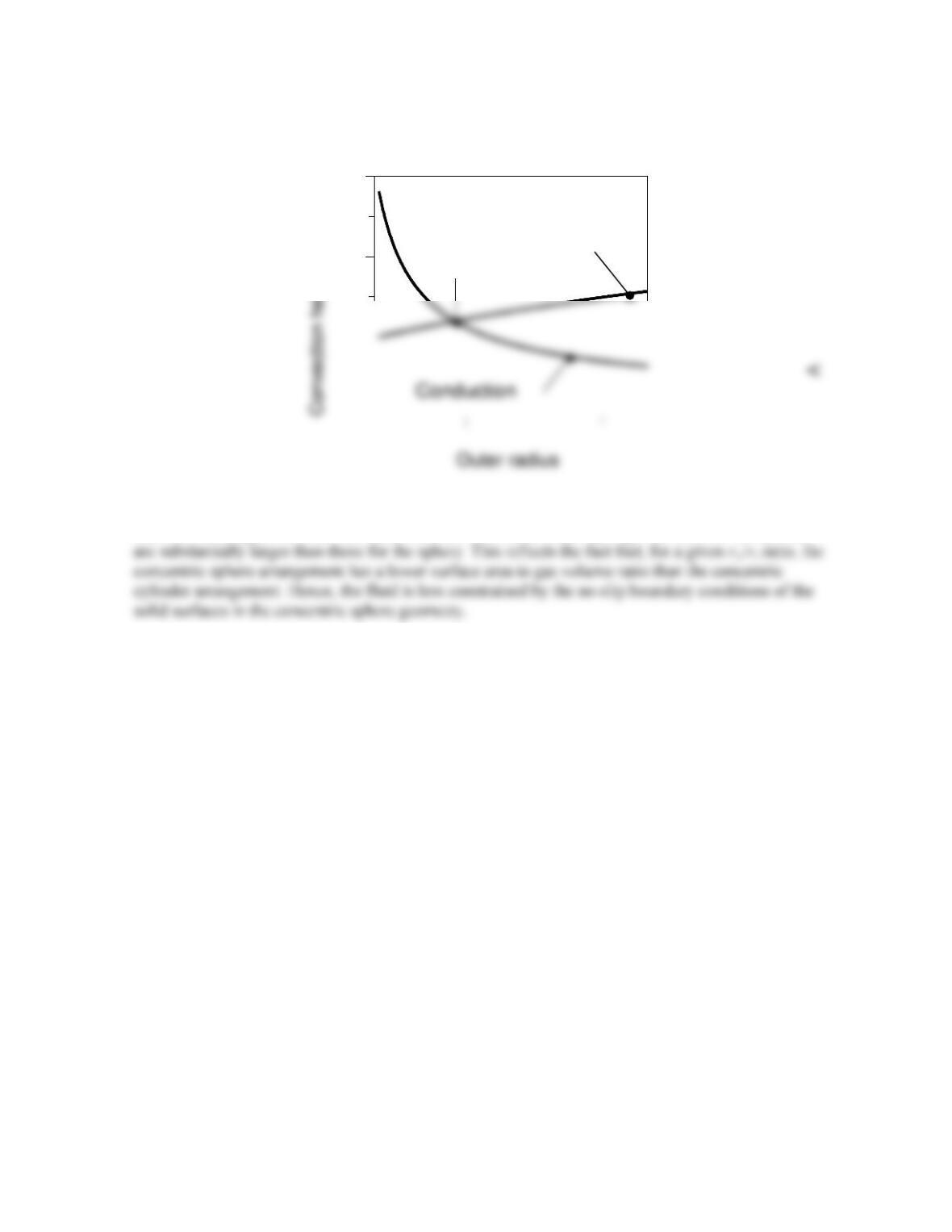
For specified inner and outer surface temperatures and inner surface radius, the heat transfer rates vary
with the outer surface radius as shown in the figure on the following page. For Rayleigh numbers
Continued…
Inner cylinder or sphere
ri, Ti
g
PROBLEM 9.75 (Cont.)
COMMENTS: (1) For glycerin, both correlations have been extrapolated slightly beyond the
recommended upper limit of the Prandtl number. (2) The critical Rayleigh numbers for the cylinder
Heat Loss per Unit Length versus Outer Radius
20
30
Convection
Optimum
Minimum
Heat Loss per Unit Length versus Outer Radius
20
30
Convection
Optimum
Minimum
PROBLEM 9.76
KNOWN: Operating conditions of a concentric tube solar collector.
FIND: Convection heat transfer rate per unit length across air space between tubes.
SCHEMATIC:
D
o
= 0.10m
i
ASSUMPTIONS: (1) Steady-state conditions, (2) Long tubes.
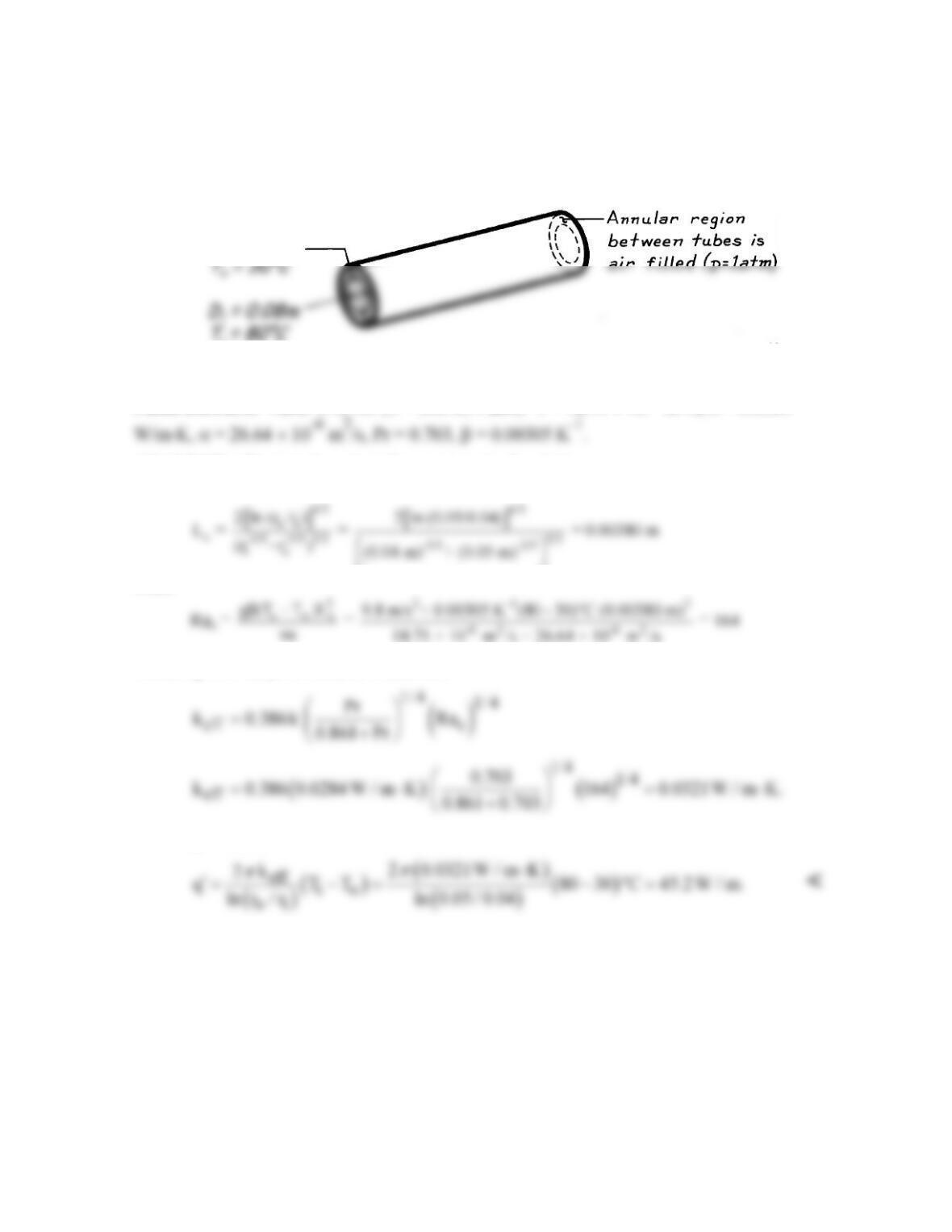
PROPERTIES: Table A-4, Air (T = 328 K, 1 atm): ν = 18.71 × 10⁻⁶ m2/s, k = 0.0284
ANALYSIS: The length scale in Rac is given by Eq. 9.60,
Then
Next, Eq. 9.59 may be used, in which case
From Eq. 9.58, it then follows that
COMMENTS: An additional heat loss mechanism is related to thermal radiation exchange
between the inner and outer surfaces.
PROBLEM 9.77
KNOWN: Operating conditions of a concentric tube solar collector. Tube diameter in the
range 0.1 ≤ Do ≤ 0.25 m.
FIND: Conduction and convection heat transfer rates per unit length across air space between
tubes. Outer diameter that yields minimum rate of heat loss per unit length. Minimum rate of
heat loss per unit length.
SCHEMATIC:
0.10m ≤ D
o
≤ 0.25m
ASSUMPTIONS: (1) Steady-state conditions, (2) Long tubes.
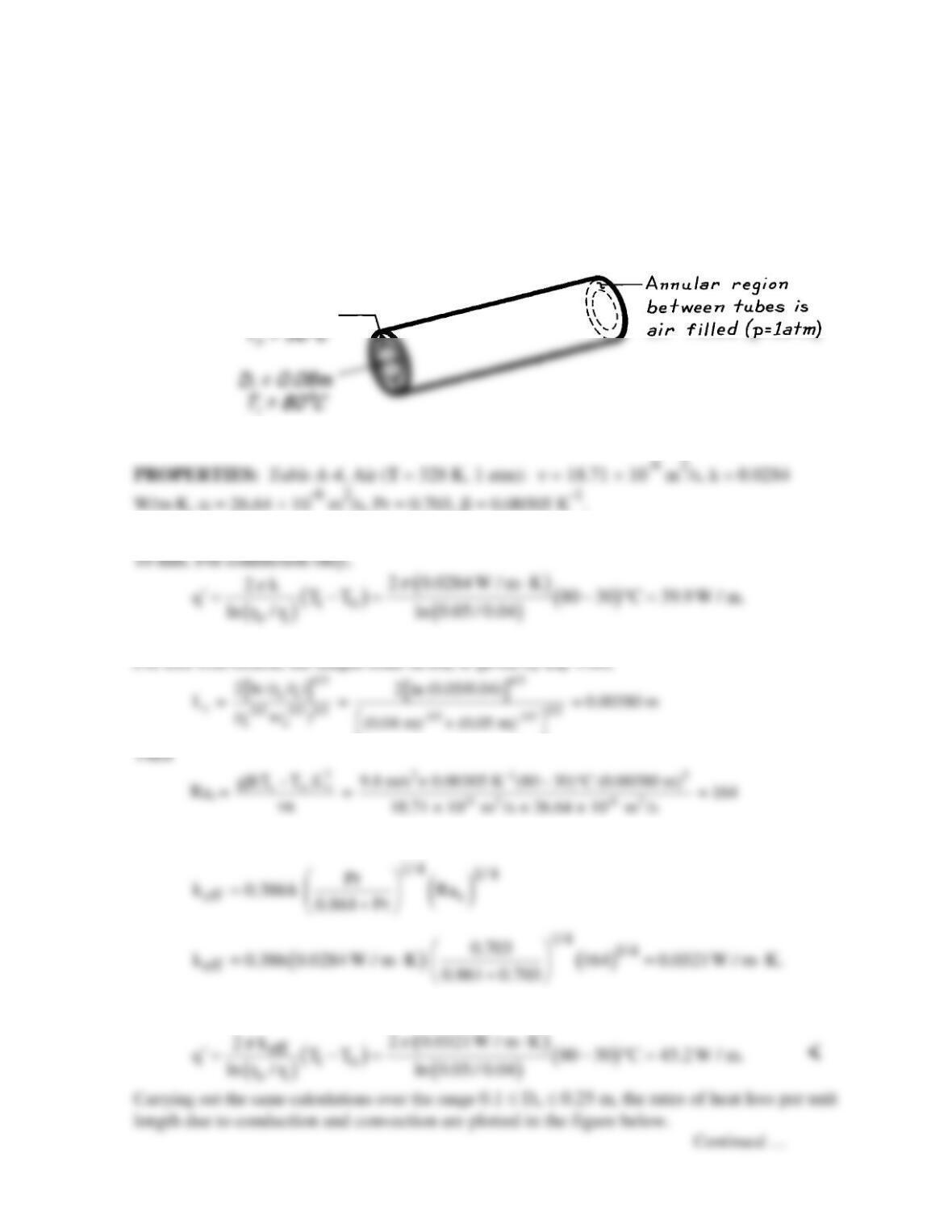
ANALYSIS: We begin with sample calculations for the tube diameter of Problem 9.76, Do =
Next, Eq. 9.59 may be used, in which case
From Eq. 9.58, it then follows that
PROBLEM 9.77 (Cont.)
q’cond
q’conv
55
50
45
40
35
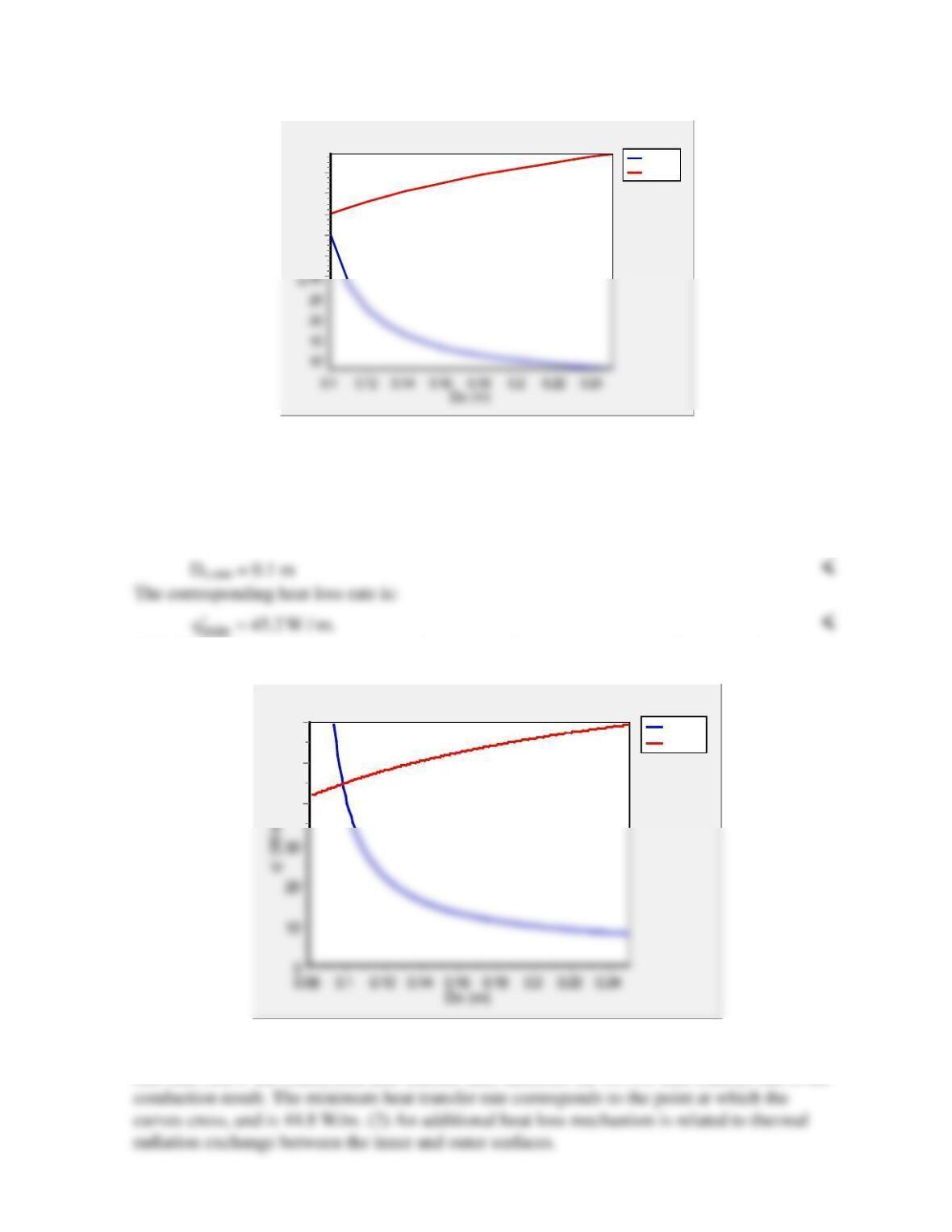
As explained in the text beneath Equation 9.60, the heat transfer rate cannot fall below the
conduction limit. We find that over the specified diameter range, the free convection heat
transfer rate always exceeds the conduction heat transfer rate. Therefore, within this tube
diameter range, the convection analysis is correct and the minimum heat loss rate is at the
minimum tube diameter:
COMMENTS: (1) If the outer tube diameter is allowed to be even smaller, the following
plot is obtained:
q’cond
q’conv
60
50
40
The curves cross at Do = 0.0976 m. For smaller tube diameters the convection heat transfer
rate falls below the conduction heat transfer rate, therefore the correct heat transfer rate is the
PROBLEM 9.78
KNOWN: Dimensions and heat generation rate associated with horizontally–oriented lithium
ion battery. Size of annulus filled with liquid paraffin. Properties and fusion temperature of the
paraffin.
FIND: (a) Battery surface temperature when ro = 19 mm, (b) Rate at which ro is increasing with
SCHEMATIC:
ASSUMPTIONS: (1) Constant properties and steady-state conditions, (2) Solid paraffin at
melting point temperature.
ANALYSIS: (a) The length scale used in the Rayleigh number is given by Equation 9.60.
The Rayleigh number is
Paraffin ( liquid)
k = 0.15 W/m·K
ρ= 770 kg/m
3
ν= 5×10
-6
m
2
/s
-8
2
r
o
= 19 mm
Paraffin ( liquid)
k = 0.15 W/m·K
ρ= 770 kg/m
3
ν= 5×10
-6
m
2
/s
-8
2
r
o
= 19 mm
PROBLEM 9.78 (Cont.)
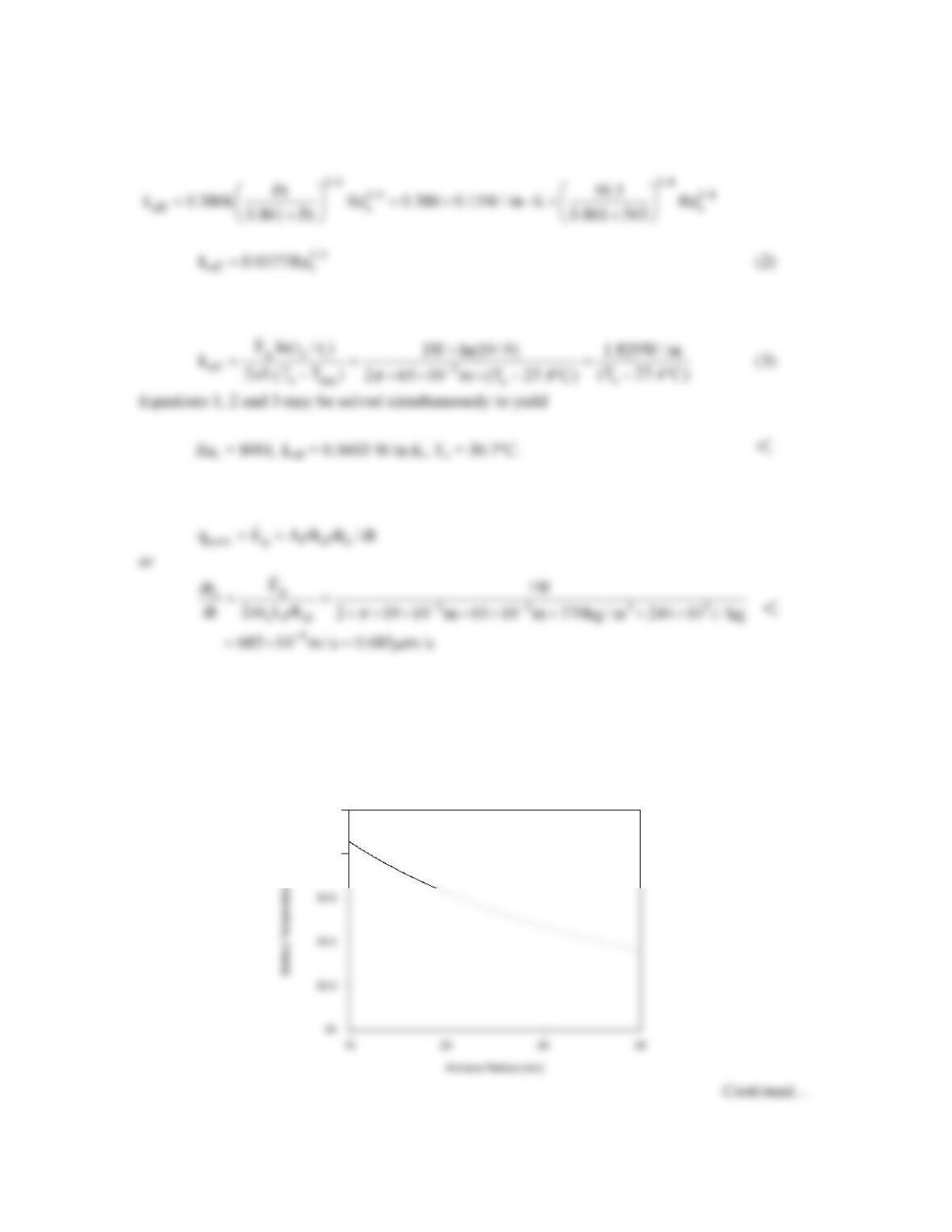
The effective thermal conductivity may also be expressed in terms of Equation 9.58,
(b) An energy balance on the control surface shown in the schematic yields
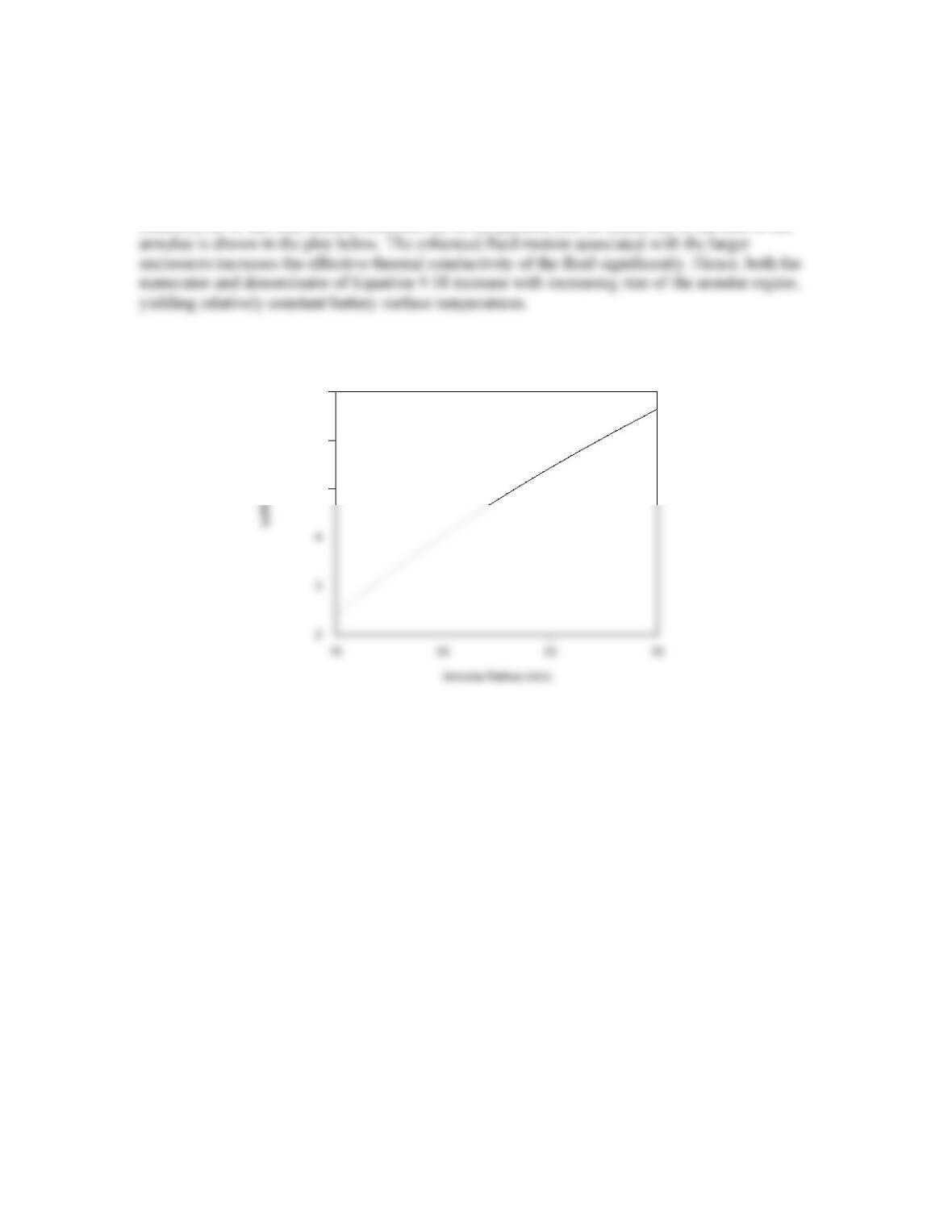
(c) Equations 1 through 3 may be re-solved for various outer radii of the annular region. As
evident, the battery surface temperature is very insensitive to the size of the annular region. If
heat transfer in the annulus were conduction–dominated, one would expect the battery surface
temperature to increase as the annulus becomes larger. The opposite trend is evident here.
Battery Temperature vs. Liquid Annulus Radius
30.8
31
PROBLEM 9.78 (Cont.)
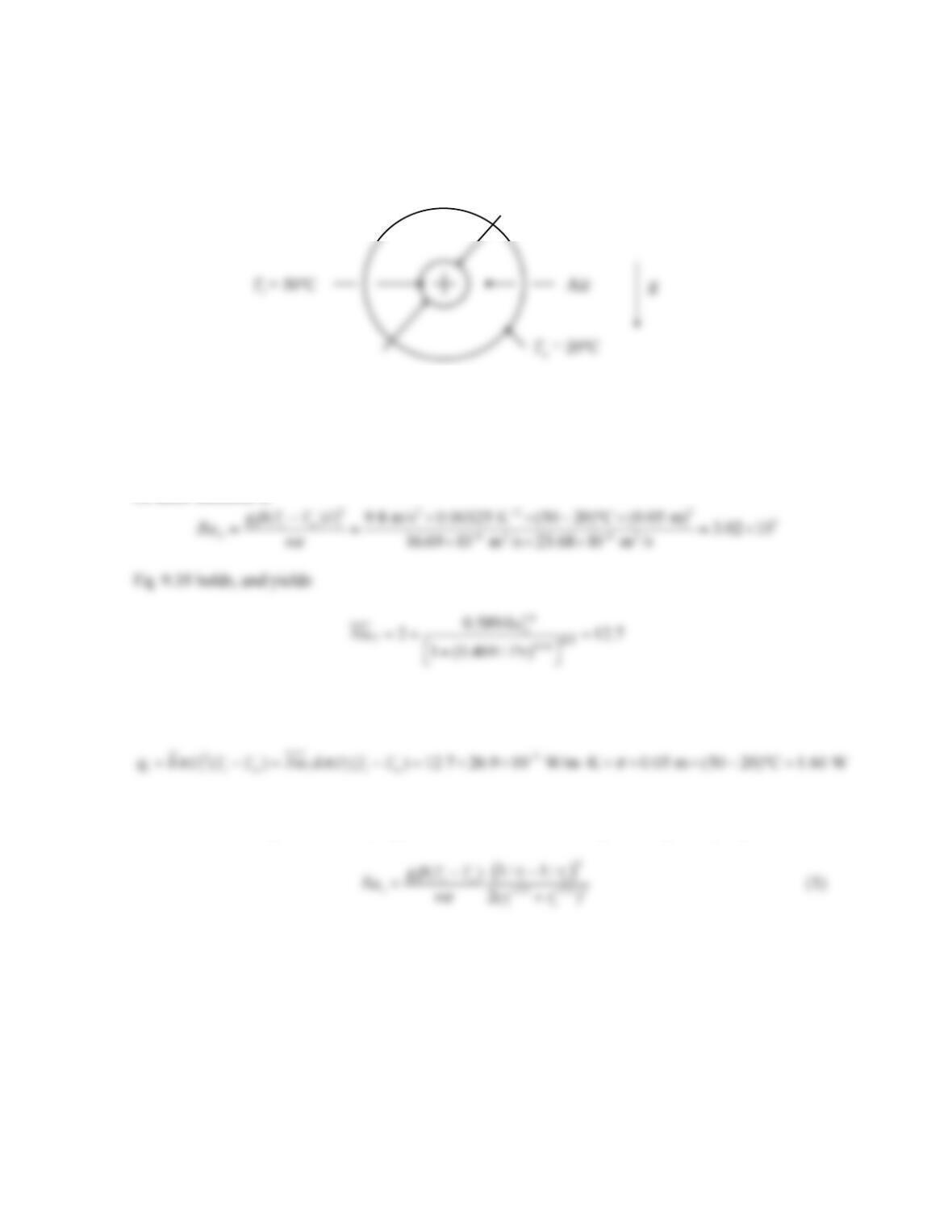
As the annulus becomes larger, fluid velocities associated with free convection increase and the
effective thermal conductivity is expected to increase as well. The ratio of the effective thermal
conductivity to the bulk thermal conductivity of the paraffin and its sensitivity to the size of the
keff/k vs. Liquid Annulus Radius
5
6
7
PROBLEM 9.79
KNOWN: Temperatures of concentric spheres and diameter of inner sphere.
FIND: Outer sphere diameter required so that convection heat transfer is same as for inner sphere in a
large, quiescent environment at 20°C.
SCHEMATIC:
ASSUMPTIONS: (1) Steady–state, (2) Uniform sphere surface temperatures, (3) Constant properties.
PROPERTIES: Table A-4, Air (T = 308 K):
ν
= 16.69 × 10⁻⁶ m2/s,
a
= 23.68 × 10⁻⁶ m2/s, k = 26.9 ×
10-3 W/m ⋅ K, Pr = 0.706,
β
= 1/T = 0.00325 K-1.
ANALYSIS: For the single inner sphere in a large quiescent enclosure, the Rayleigh number based
on inner diameter is
and
For the concentric spheres, the Rayleigh number is based on the length scale given by Eq. 9.63,
Substituting this into Eq. 9.62 and substituting Eq. 9.62 in Eq. 9.61 yields
Continued…
D
i
= 50 mm
PROBLEM 9.79 (Cont.)
Setting q2 = q1 = 1.60 W, and solving for ro yields
Thus the required diameter of the outer cylinder is
Do = 260 mm <
From Eq. (1), Ras = 5000, so the correlation for concentric spheres is within its range of applicability.
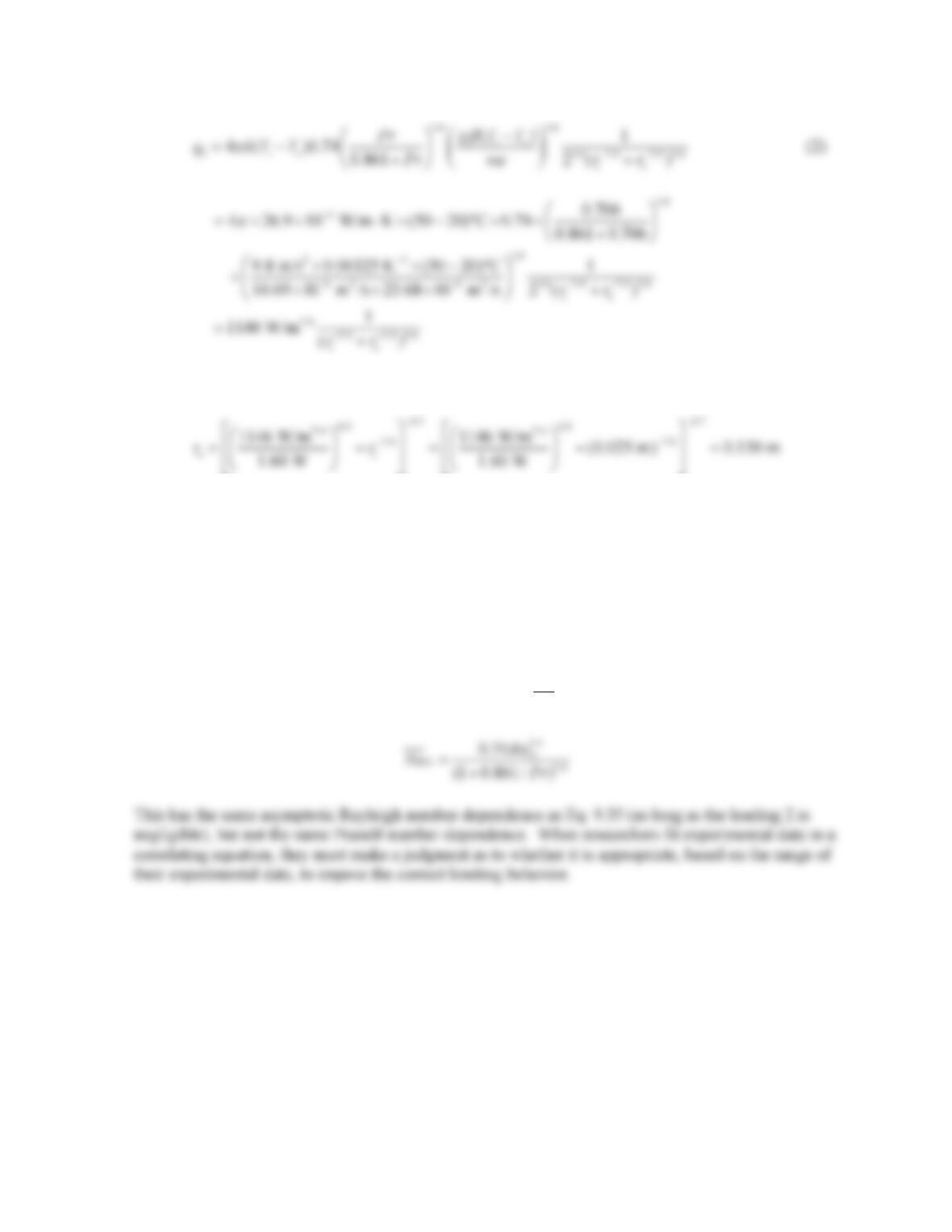
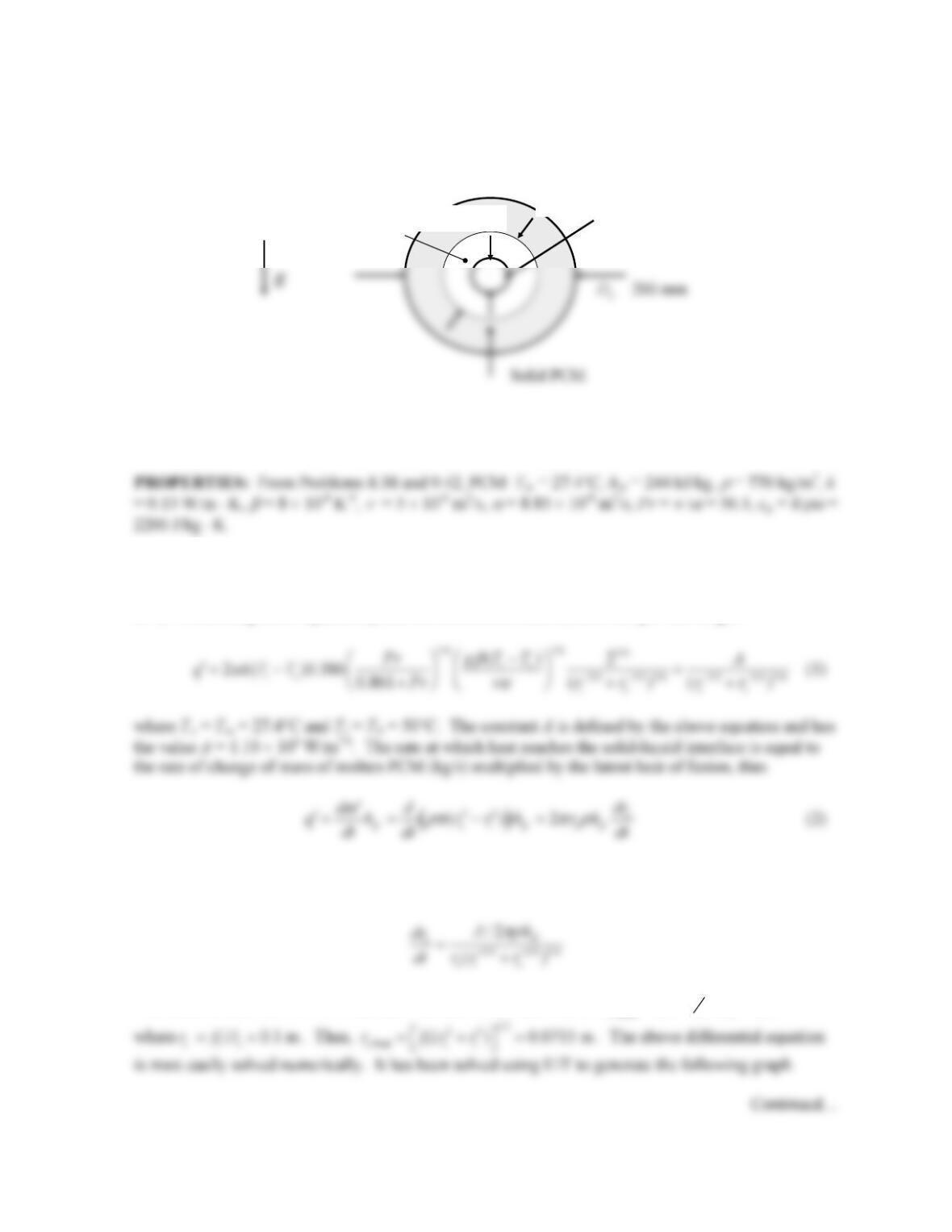
COMMENTS: It is of interest whether the concentric sphere correlation approaches the single sphere
limit as ro → ∞. From Eq. (2) above, it can be seen that q2 reaches an asymptote. This can be
rephrased in terms of a heat transfer coefficient for concentric spheres, h2, defined such that
2
22
( ).
ii o
q h DT T
π
= −
The corresponding Nusselt number,
2
/
Di
Nu h D k=
, is then
PROBLEM 9.80
KNOWN: Diameter of cylindrical enclosure housing solid PCM. Diameter and temperature of
heated inner concentric cylinder. Initial PCM temperature.
FIND: Time to melt half of PCM.
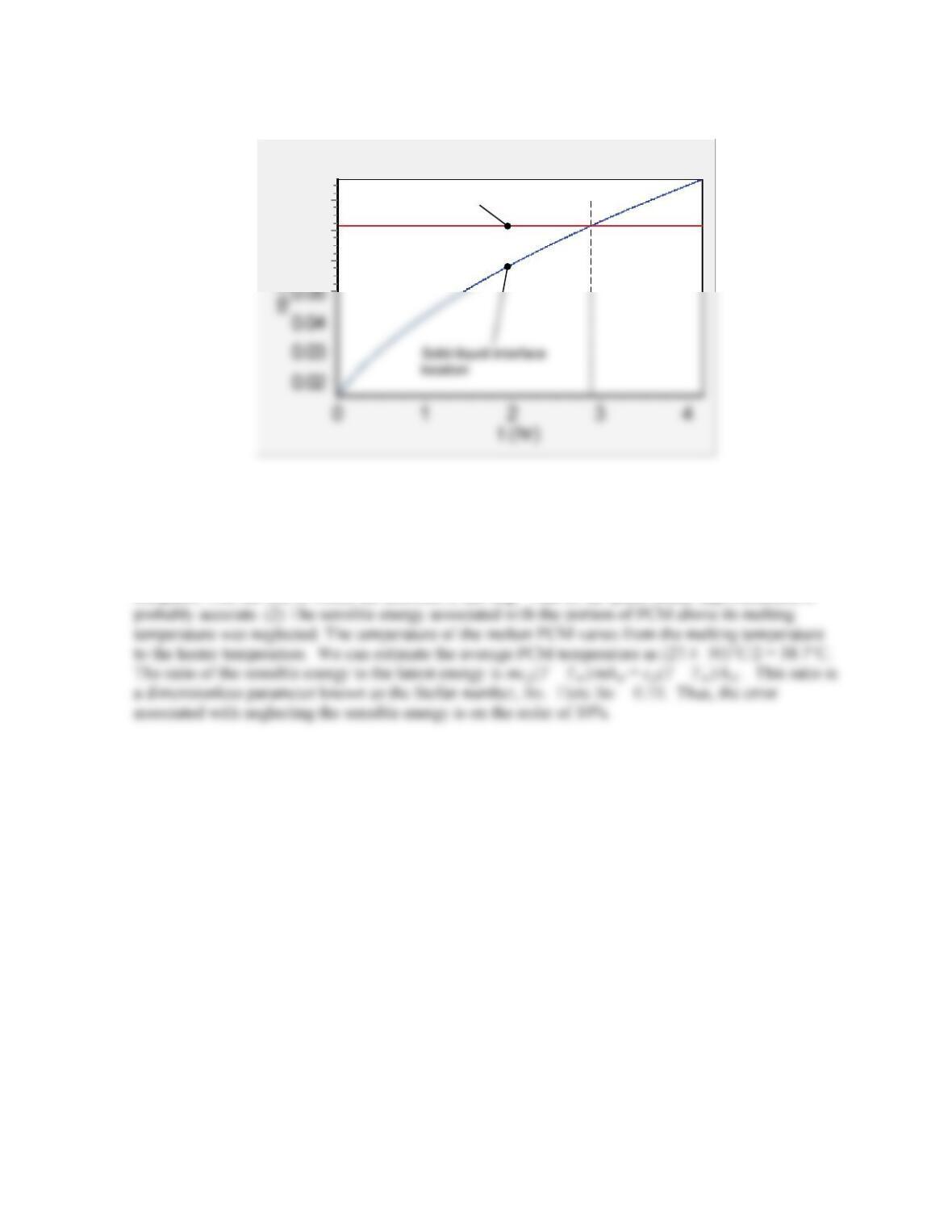
SCHEMATIC:
ASSUMPTIONS: (1) The quasi-steady approximation holds: the heat transfer coefficient can be
evaluated based on steady–state conditions, (2) Constant properties, (3) The sensible energy associated
with the portion of PCM above its melting temperature is negligible.
ANALYSIS: The molten PCM occupies the region between the heater radius, ri, and the solid-liquid
interface, ro. The latter radius is a function of time. According to the quasi-steady approximation, the
convection heat transfer rate can be found from Eqs. 9.58, 9.59, and 9.60 using the instantaneous value
of ro. Combining these equations yields the convection heat transfer rate per unit length:
Combining Eqs. (1) and (2) yields a differential equation for ro(t):
The criterion that half the PCM has been melted is satisfied when
2 2 22
12
,final
( )( )
o i ei
r r rr
ππ
−= −
,
D
i
= 30 mm 2r
o
T
h
= 50°C
Liquid PCM
PROBLEM 9.80 (Cont.)
0.08
0.07
0.06
Radius corresponding to
half–melted PCM
The final radius criterion, ro = 0.0715 m, is satisfied at t = 2.88 h. <
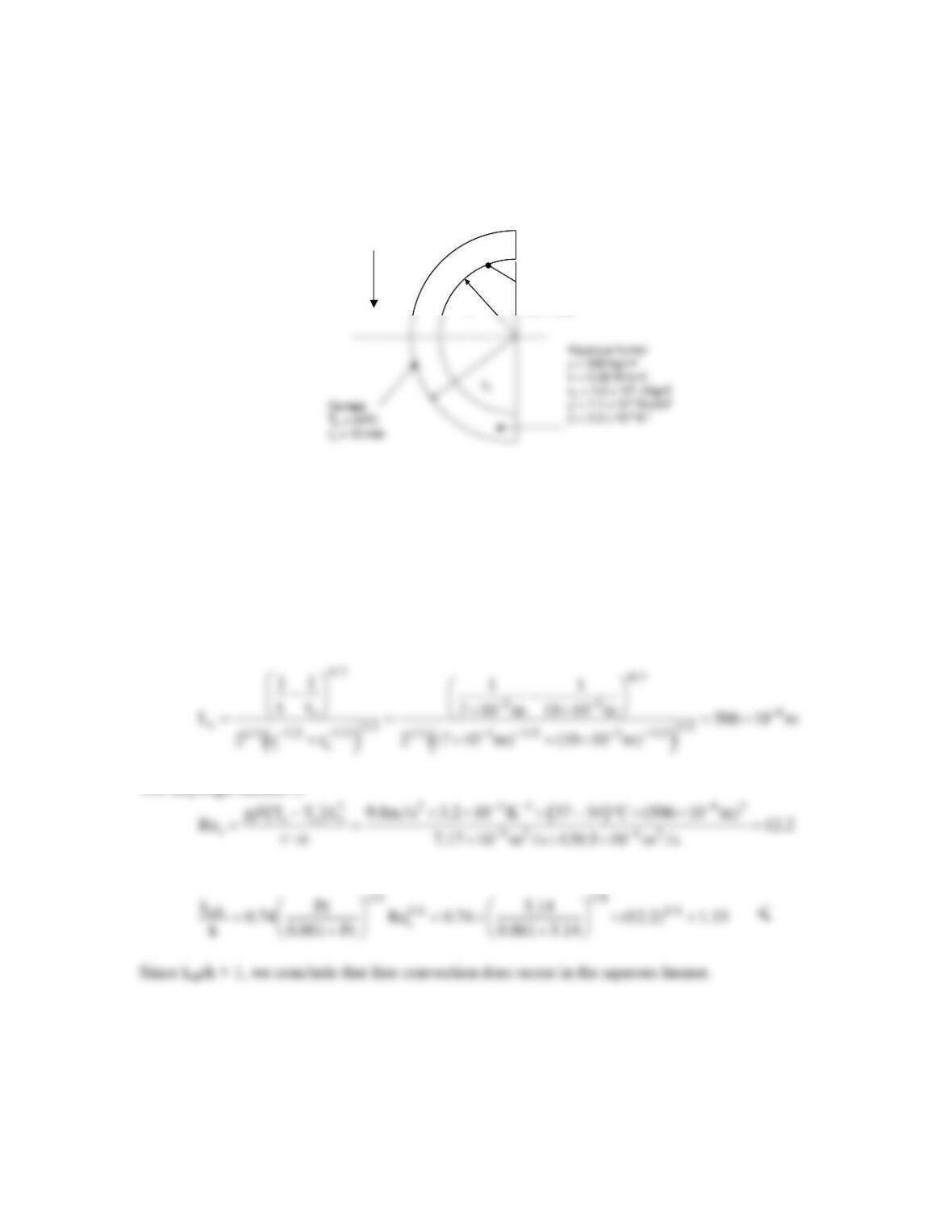
COMMENTS: (1) The solid–liquid interface moves slowly, traveling around 70 mm in 2.88 h. It is
likely that the free convection motion can adjust to the instantaneous conditions relatively quickly
compared with the rate at which the interface is moving. That is, the quasi-steady approximation is
PROBLEM 9.81
KNOWN: Dimensions of enclosure, surface temperatures, and properties of aqueous humor.
FIND: The ratio of the effective to the bulk thermal conductivity of the aqueous humor.
SCHEMATIC:
ASSUMPTIONS: (1) Constant properties, (2) Steady–state conditions, (3) Person is standing or
sitting vertically.
PROPERTIES: Given, see schematic.
ANALYSIS: The kinematic viscosity is ν = µ/ρ = 7.1 × 10⁻⁴ N⋅s/m2/990 kg/m3 = 7.17 × 10⁻⁹
m2/s. The thermal diffusivity is a = k/ρc = 0.58 W/m⋅K/(990 kg/m3× 4.2 × 103 J/kg⋅K) = 139.5 ×
10-4 m2/s, while the Prandtl number is Pr = ν/a = (7.17 × 10⁻⁹ m2/s)/(139.5 × 10-4 m2/s) = 5.14.
The characteristic length for use in Equation 9.61 is
The ratio of the effective thermal conductivity to bulk thermal conductivity is
COMMENTS: (1). The velocity of the aqueous humor could be estimated by performing a
detailed simulation using a CFD (computational fluid dynamics) tool. (2) Fluid motion is upward
near the iris and downward adjacent to the cornea when the person is standing or sitting
vertically.
r
i
g
Iris–lens
T
i
= 37ºC
r
= 7 mm
r
i
g
Iris–lens
T
i
= 37ºC
r
= 7 mm
r
i
g
Iris–lens
T
i
= 37ºC
r
= 7 mm