CHAPTER 9
Inventories: Additional Valuation Issues
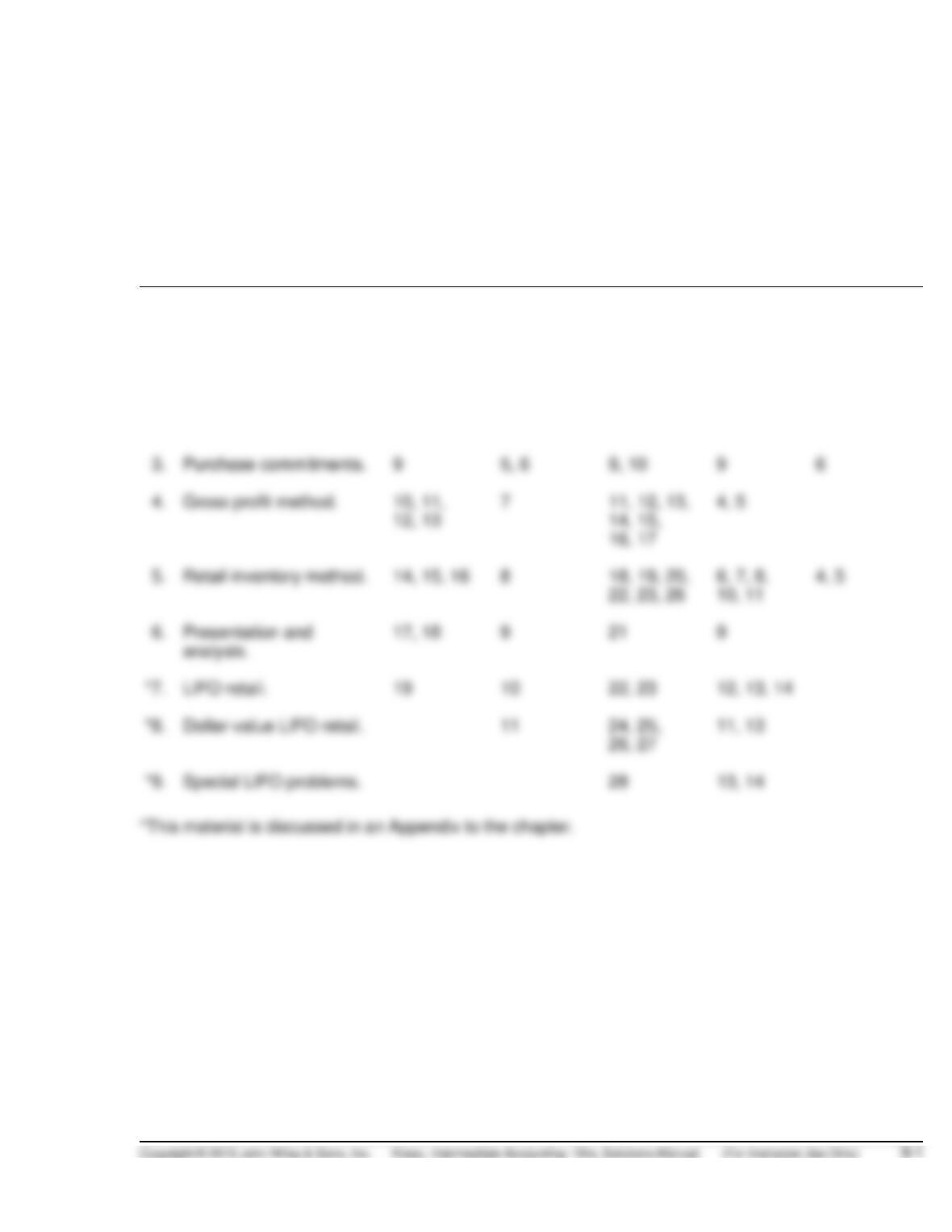
ASSIGNMENT CLASSIFICATION TABLE (BY TOPIC)
Topics
Questions
Brief
Exercises
Exercises
Problems
Concepts
for Analysis
1.
Lower-of-cost-or-market.
1, 2, 3,
4, 5, 6
1, 2, 3
1, 2, 3,
4, 5, 6
1, 2, 3,
9, 10
1, 2, 3, 5
2.
Inventory accounting
changes; relative sales
value method; net real-
izable value.
7, 8
4
7, 8
Purchase commitments.
9
5, 6
9, 10
9
6
12, 13
14, 15,
16, 17
5.
Retail inventory method.
14, 15, 16
8
18, 19, 20,
22, 23, 26
6, 7, 8,
10, 11
4, 5
LIFO retail.
22, 23
12, 13, 14
Dollar-value LIFO retail.
24, 25,
26, 27
11, 13
Special LIFO problems.
13, 14
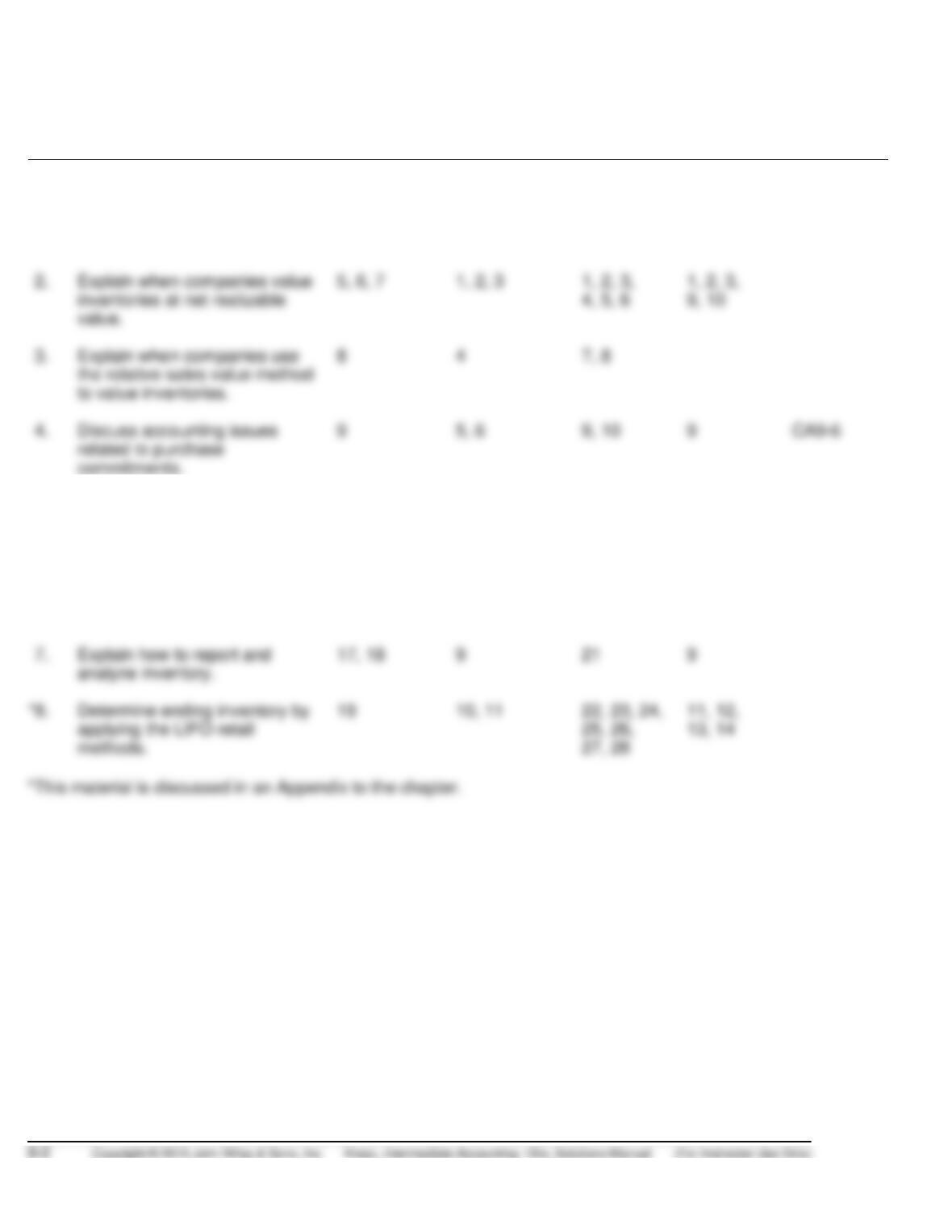
ASSIGNMENT CLASSIFICATION TABLE (BY LEARNING OBJECTIVE)
Learning Objectives
Questions
Brief
Exercises
Exercises
Problems
Concepts
for
Analysis
1. Describe and apply the lower-
of-cost–or-market rule.
1, 2, 3, 4
1, 2, 3
1, 2, 3,
4, 5, 6
1, 2, 3,
9, 10
CA9-1,
CA9-2,
CA9-3,
CA9-5
2. Explain when companies value
inventories at net realizable
value.
5, 6, 7
1, 2, 3
1, 2, 3,
4, 5, 6
1, 2, 3,
9, 10
4. Discuss accounting issues
related to purchase
commitments.
9
5, 6
9, 10
9
CA9-6
5. Determine ending inventory by
applying the gross profit
method.
10, 11, 12,
13
7
11, 12, 13,
14, 15, 16,
17
4, 5
6. Determine ending inventory by
applying the retail inventory
method.
14, 15, 16
8
18, 19, 20
6, 7, 8
CA9-4,
CA9-5
analyze inventory.
17, 18
9
21
9
applying the LIFO retail
methods.
10, 11
22, 23, 24,
25, 26,
11, 12,
13, 14
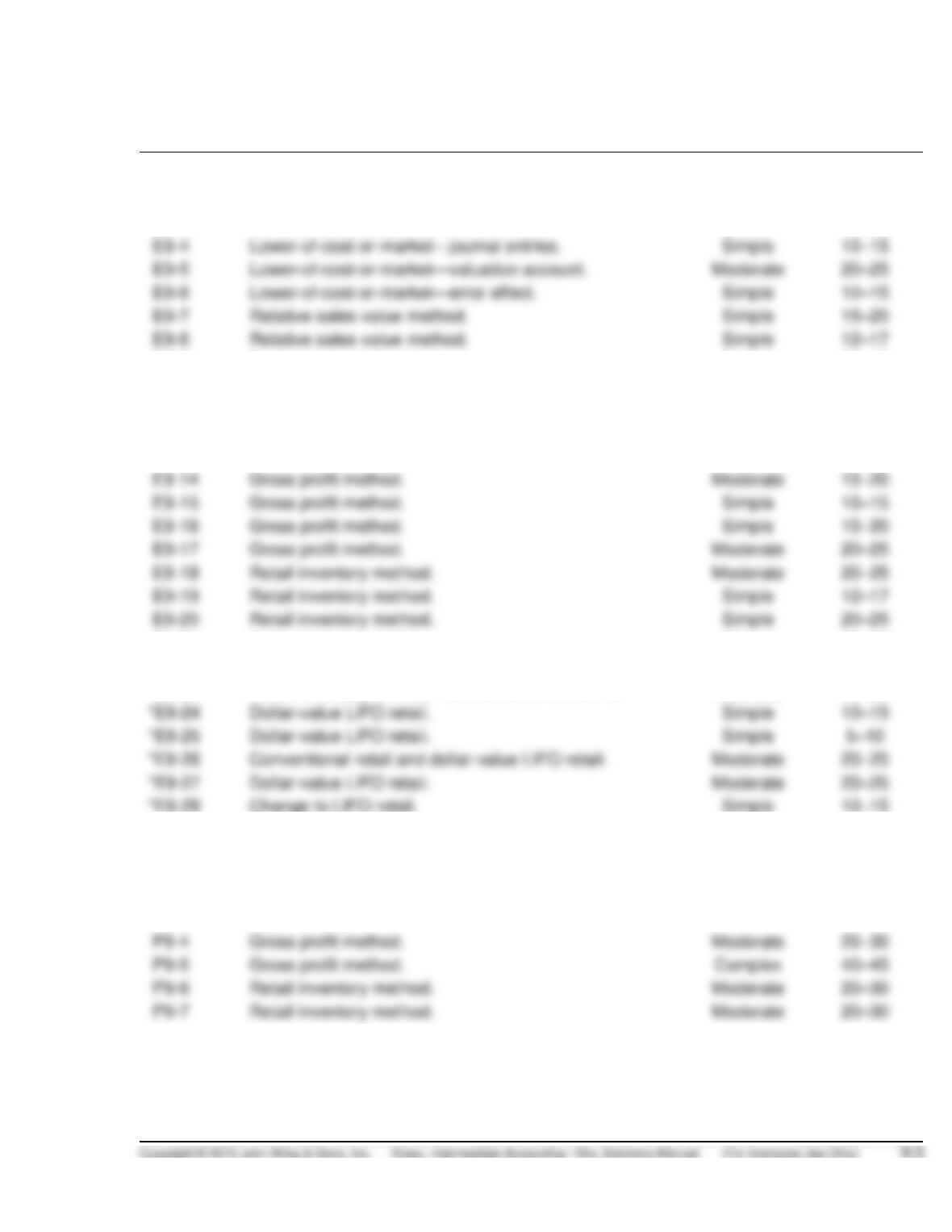
ASSIGNMENT CHARACTERISTICS TABLE
Item
Description
Level of
Difficulty
Time
(minutes)
E9-1
Lower-of-cost-or-market.
Simple
15–20
E9-2
Lower-of-cost-or-market.
Simple
10–15
E9-3
Lower-of-cost-or-market.
Simple
15–20
E9-4
Lower-of-cost-or-market—journal entries.
Simple
10–15
E9-5
Lower-of-cost-or-market—valuation account.
Moderate
20–25
E9-6
Lower-of-cost-or-market—error effect.
Simple
10–15
E9-7
Relative sales value method.
Simple
15–20
E9-8
Relative sales value method.
Simple
12–17
E9-9
Purchase commitments.
Simple
05–10
E9–10
Purchase commitments.
Simple
15–20
E9–11
Gross profit method.
Simple
8–13
E9–12
Gross profit method.
Simple
10–15
E9–13
Gross profit method.
Simple
15–20
E9–14
Gross profit method.
Moderate
15–20
E9–15
Gross profit method.
Simple
10–15
E9–16
Gross profit method.
Simple
15–20
E9–17
Gross profit method.
Moderate
20–25
E9–18
Retail inventory method.
Moderate
20–25
E9–19
Retail inventory method.
Simple
12–17
E9–20
Retail inventory method.
Simple
20–25
E9–21
Analysis of inventories.
Simple
10–15
*E9-22
Retail inventory method—conventional and LIFO.
Moderate
25–35
*E9-23
Retail inventory method—conventional and LIFO.
Moderate
15–20
*E9-24
Dollar-value LIFO retail.
Simple
10–15
*E9-25
Dollar-value LIFO retail.
Simple
5–10
*E9-26
Conventional retail and dollar-value LIFO retail.
Moderate
20–25
*E9-27
Dollar-value LIFO retail.
Moderate
20–25
*E9-28
Change to LIFO retail.
Simple
10–15
P9-1
Lower-of-cost-or-market.
Simple
10–15
P9-2
Lower-of-cost-or-market.
Moderate
25–30
P9-3
Entries for lower-of-cost-or-market—cost-of-good-
sold and loss.
Moderate
30–35
P9-4
Gross profit method.
Moderate
20–30
P9-5
Gross profit method.
40–45
P9-6
Retail inventory method.
Moderate
20–30
P9-7
Retail inventory method.
Moderate
20–30
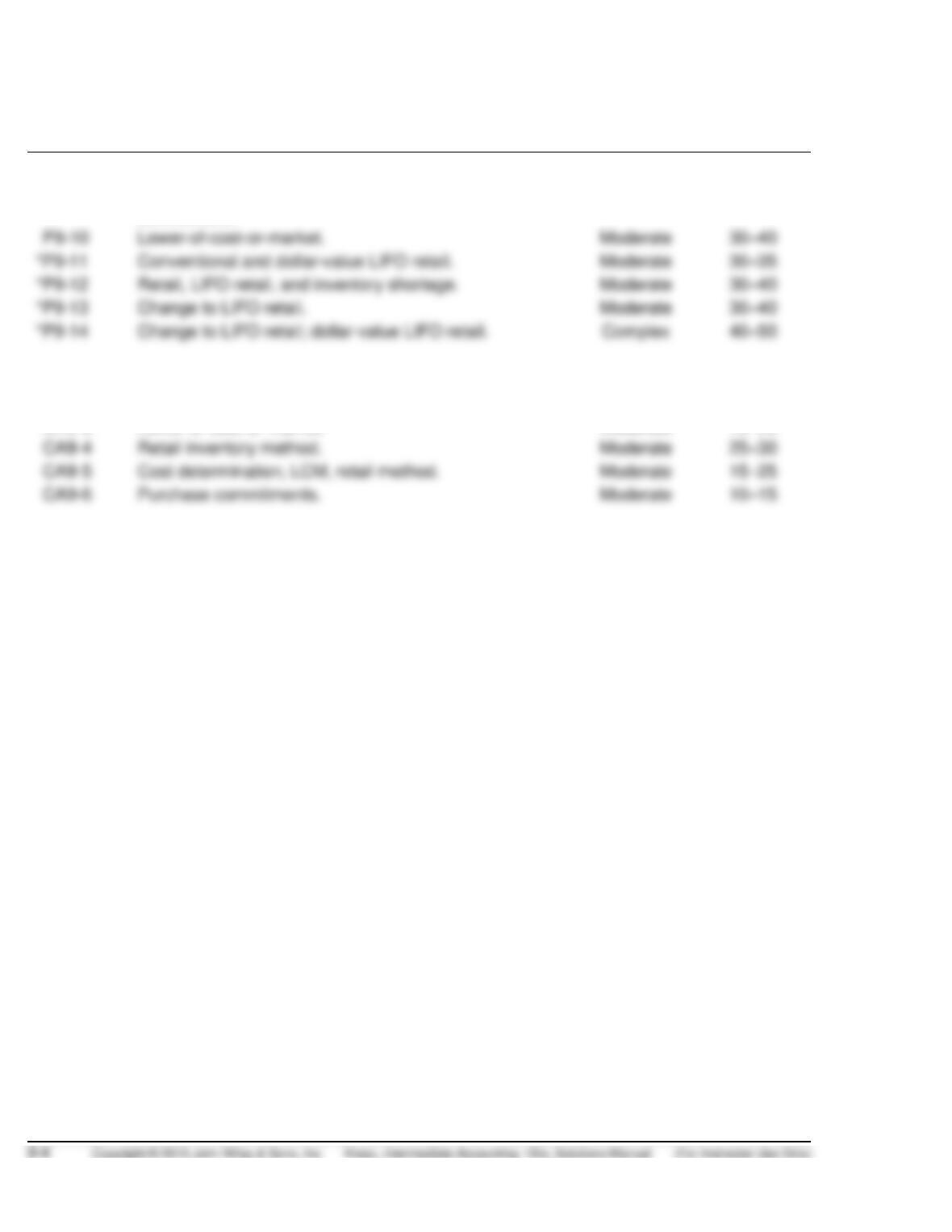
ASSIGNMENT CHARACTERISTICS TABLE (Continued)
Item
Description
Level of
Difficulty
Time
(minutes)
P9-8
Retail inventory method.
Moderate
20–30
P9-9
Statement and note disclosure, LCM, and purchase
commitment.
Moderate
30–40
P9–10
Lower-of-cost-or-market.
Moderate
30–40
*P9-11
Conventional and dollar-value LIFO retail.
Moderate
30–35
*P9-12
Retail, LIFO retail, and inventory shortage.
Moderate
30–40
*P9-13
Change to LIFO retail.
Moderate
30–40
*P9-14
Change to LIFO retail; dollar-value LIFO retail.
40–50
CA9-1
Lower-of-cost-or-market.
Moderate
15–25
CA9-2
Lower-of-cost-or-market.
Moderate
20–30
CA9-3
Lower-of-cost-or-market.
Moderate
15–20
CA9-4
Retail inventory method.
Moderate
25–30
CA9-5
Cost determination, LCM, retail method.
Moderate
15–25
CA9-6
Purchase commitments.
Moderate
10–15
SOLUTIONS TO CODIFICATION EXERCISES
CE9-1
(a) According to the Master Glossary, Inventory is defined as the aggregate of those items of tangible
personal property that have any of the following characteristics:
1. Held for sale in the ordinary course of business
2. In process of production for such sale
3. To be currently consumed in the production of goods or services to be available for sale.
The term inventory embraces goods awaiting sale (the merchandise of a trading concern and the
finished goods of a manufacturer), goods in the course of production (work in process), and goods
to be consumed directly or indirectly in production (raw materials and supplies). This definition of
(b) According to the Master Glossary, the phrase lower-of-cost-or-market, the term market means
current replacement cost (by purchase or by reproduction, as the case may be) provided that it
meets both of the following conditions.
1. Market shall not exceed the net realizable value
2. Market shall not be less than net realizable value reduced by an allowance for an approxi–
mately normal profit margin.
(c) According to the Master Glossary, two definitions are provided for the phrase net realizable value
1. Estimated selling price in the ordinary course of business less reasonably predictable costs of
Growing Crops
35-1 Costs of growing crops shall be accumulated until the time of harvest. Growing crops shall be
reported at the lower-of-cost-or-market.
> Developing Animals
35-2 Developing animals to be held for sale shall be valued at the lower-of-cost-or-market.
CE9-1 (Continued)
> Animals Available and Held for Sale
35-3 Animals held for sale shall be valued at either of the following:
(a) The lower-of-cost-or-market
(b) At sales price less estimated costs of disposal, if all the following conditions exist:
> Harvested Crops
35-4 Inventories of harvested crops shall be valued using the same criteria as animals held for sale in
the preceding paragraph.
CE9-2
According to FASB ASC 330-10–35-1 through 5: Adjustments to Lower-of-Cost-or-Market
A departure from the cost basis of pricing the inventory is required when the utility of the goods is no
longer as great as their cost. Where there is evidence that the utility of goods, in their disposal in the
ordinary course of business, will be less than cost, whether due to physical deterioration, obsolescence,
changes in price levels, or other causes, the difference shall be recognized as a loss of the current
Replacement or reproduction prices would not be appropriate as a measure of utility when the esti–
mated sales value, reduced by the costs of completion and disposal, is lower, in which case the realizable
value so determined more appropriately measures utility.
In addition, when the evidence indicates that cost will be recovered with an approximately normal profit
upon sale in the ordinary course of business, no loss shall be recognized even though replacement or
CE9-3
According to FASB ASC 330-10–35-6, if inventory has been the hedged item in a fair value hedge, the
the carrying amount of the hedged item and be recognized currently in earnings.
CE9-4
See FASB ASC 210-10-S99—Regulation S-X Rule 5-02, Balance Sheets
S99-1 The following is the text of Regulation S-X Rule 5-02, Balance Sheets.
The purpose of this rule is to indicate the various line items and certain additional disclosures
which, if applicable, and except as otherwise permitted by the Commission, should appear on
– (a) State separately in the balance sheet or in a note thereto, if practicable, the amounts of
major classes of inventory such as:
• 1. Finished goods;
– (b) The basis of determining the amounts shall be stated.
If cost is used to determine any portion of the inventory amounts, the description of this method
shall include the nature of the cost elements included in inventory. Elements of cost include,
among other items, retained costs representing the excess of manufacturing or production costs
CE9-4 (Continued)
– If any general and administrative costs are charged to inventory, state in a note to the
financial statements the aggregate amount of the general and administrative costs incurred in
each period and the actual or estimated amount remaining in inventory at the date of each
balance sheet.
– (c) If the LIFO inventory method is used, the excess of replacement or current cost over
– (d) For purposes of §§ 210.5–02.3 and 210.5–02.6, long-term contracts or programs include
• 1. all contracts or programs for which gross profits are recognized on a percentage-
of-completion method of accounting or any variant thereof (e.g., delivered unit,
be included, if deemed appropriate.
– For all long-term contracts or programs, the following information, if applicable, shall be stated
in a note to the financial statements:
(i) The aggregate amount of manufacturing or production costs and any related deferred
costs (e.g., initial tooling costs) which exceeds the aggregate estimated cost of all in–
process and delivered units on the basis of the estimated average cost of all units
ANSWERS TO QUESTIONS
1. Where there is evidence that the utility of goods to be disposed of in the ordinary course of
business will be less than cost, the difference should be recognized as a loss in the current period,
and the inventory should be stated at market value in the financial statements.
2. The upper (ceiling) and lower (floor) limits for the value of the inventory are intended to prevent the
inventory from being reported at an amount in excess of the net realizable value or at an amount
3. The usual basis for carrying forward the inventory to the next period is cost. Departure from cost is
required when the utility of the goods included in the inventory is less than their cost. This loss in
utility should be recognized as a loss of the current period, the period in which it occurred.
Furthermore, the subsequent period should be charged for goods at an amount that measures
their expected contribution to that period. In other words, the subsequent period should be
The arguments against the use of the lower-of-cost-or-market method of valuing inventories
include the following:
(a) The method requires the reporting of estimated losses (all or a portion of the excess of actual
cost over replacement cost) as definite income charges even though the losses have not been
sustained to date and may never be sustained. Under a consistent criterion of realization a
drop in replacement cost below original cost is no more a sustained loss than a rise above
cost is a realized gain.
(b) A price shrinkage is brought into the income statement before the loss has been sustained
reductions in sales prices do not materialize.
Questions Chapter 9 (Continued)
(f) In the application of the lower–of-cost-or–market rule a prospective “normal profit” is used in
determining inventory values in certain cases. Since “normal profit” is an estimated figure
based upon past experiences (and might not be attained in the future), it is not objective in
nature and presents an opportunity for manipulation of the results of operations.
4. The lower-of-cost-or-market rule may be applied directly to each item or to the total of the
inventory (or in some cases, to the total of the components of each major category). The method
5. (1) $14.50.
6. One approach is to record the inventory at cost and then reduce it to market, thereby reflecting a
loss in the current period (often referred to as the loss method). The loss would then be shown as
a separate item in the income statement and the cost of goods sold for the year would not be
distorted by its inclusion. An objection to this method of valuation is that an inconsistency is
7. An exception to the normal recognition rule occurs where (1) there is a controlled market with a
quoted price applicable to specific commodities and (2) no significant costs of disposal are
involved. Certain agricultural products and precious metals which are immediately marketable at
quoted prices are often valued at net realizable value (market price).
8. Relative sales value is an appropriate basis for pricing inventory when a group of varying units is
purchased at a single lump-sum price (basket purchase). The purchase price must be allocated in
9. The drop in the market price of the commitment should be charged to operations in the current year
if it is material in amount. The following entry would be made [($6.20 – $5.90) X 150,000] = $45,000:
Unrealized Holding Gain or Loss—Income (Purchase Commitments) …….
45,000
Estimated Liability on Purchase Commitments ………………………….
Questions Chapter 9 (Continued)
10. The major uses of the gross profit method are: (1) it provides an approximation of the ending
inventory which the auditor might use for testing validity of physical inventory count; (2) it means
that a physical count need not be taken every month or quarter; and (3) it helps in determining
damages caused by casualty when inventory cannot be counted.
11. Gross profit as a percentage of sales indicates that the markup is based on selling price rather
than cost; for this reason the gross profit as a percentage of selling price will always be lower than
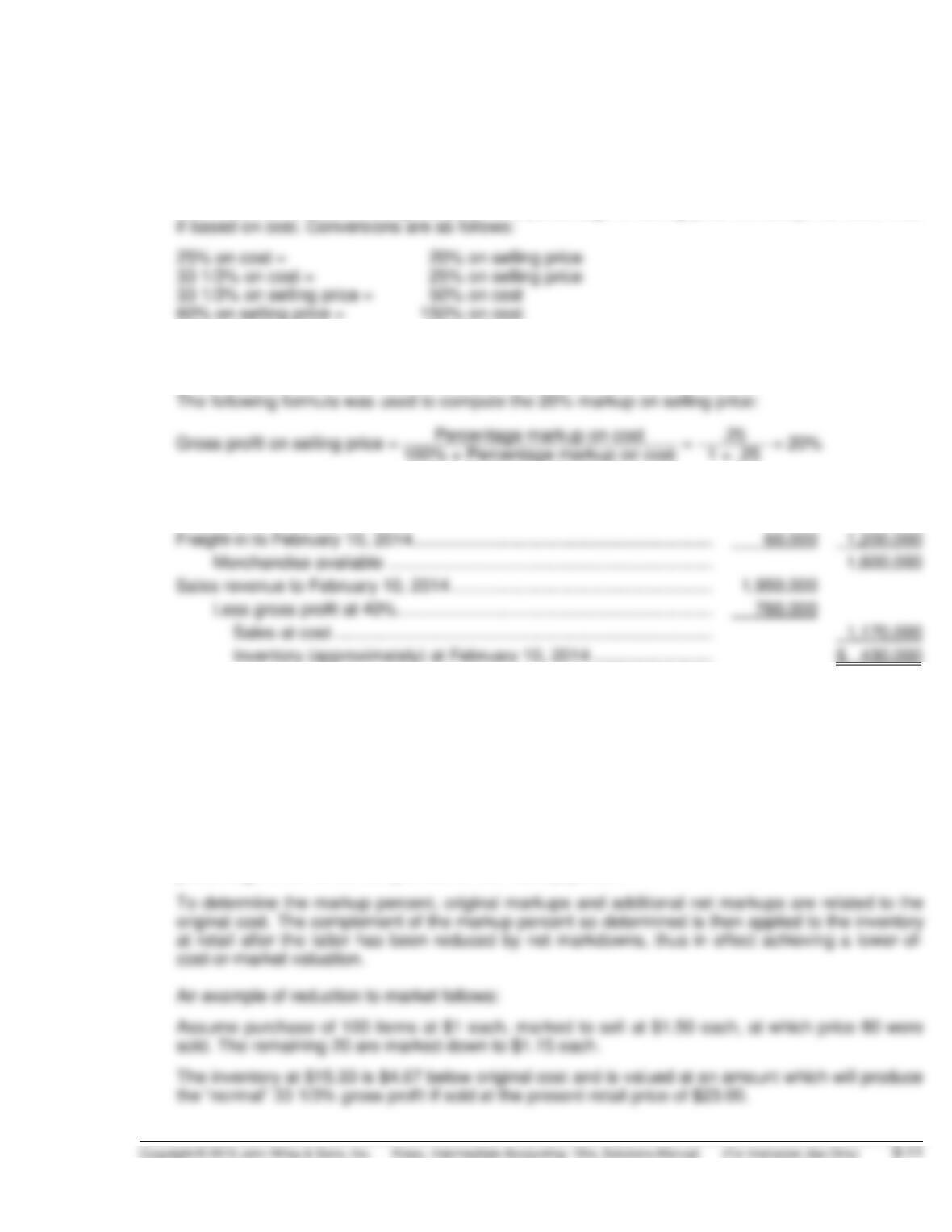
12. A markup of 25% on cost equals a 20% markup on selling price; therefore, gross profit equals
$1,000,000 ($5 million X 20%) and net income equals $250,000 [$1,000,000 – (15% X $5 million)].
13.
Inventory, January 1, 2014 …………………………………………………………..
$ 400,000
Purchases to February 10, 2014 ……………………………………………………
$1,140,000
Freight-in to February 10, 2014 ……………………………………………………..
60,000
Merchandise available ………………………………………………………….
Sales revenue to February 10, 2014 ………………………………………………
Less gross profit at 40% ………………………………………………………..
780,000
Sales at cost ……………………………………………………………………
14. The validity of the retail inventory method is dependent upon (1) the composition of the inventory
remaining approximately the same at the end of the period as it was during the period, and
(2) there being approximately the same rate of markup at the end of the year as was used
throughout the period.
The retail method, though ordinarily applied on a departmental basis, may be appropriate for the
business as a unit if the above conditions are met.
15. The conventional retail method is a statistical procedure based on averages whereby inventory
figures at retail are reduced to an inventory valuation figure by multiplying the retail figures by a
percentage which is the complement of the markup percent.
Questions Chapter 9 (Continued)
Computation of Inventory
Cost
Retail
Ratio
Purchases
$100
$150
66 2/3%
Inventory at retail
Inventory at lower-of-cost-or-market $23 X 66 2/3% = $15.33
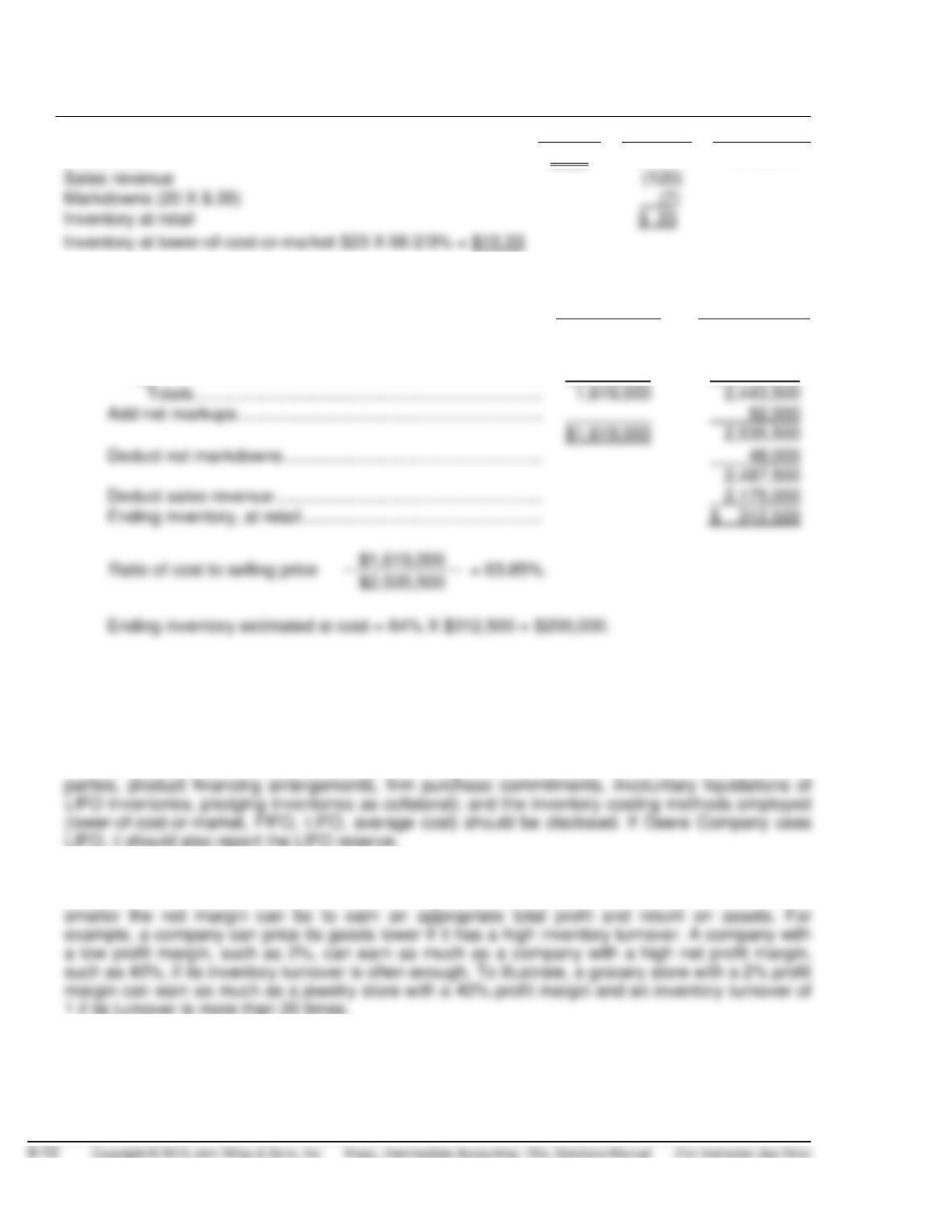
16. (a) Ending inventory:
Cost
Retail
Beginning inventory ………………………………………………….
$ 149,000
$ 283,500
Purchases ……………………………………………………………….
1,400,000
2,160,000
Freight-in ………………………………………………………………..
70,000
Add net markups ………………………………………………………
92,000
Deduct net markdowns ……………………………………………..
48,000
2,487,500
Deduct sales revenue …………………………..…………………..
2,175,000
(b) The retail method, above, showed an ending inventory at retail of $312,500; therefore, mer-
chandise not accounted for amounts to $17,500 ($312,500 – $295,000) at retail and $11,200
($17,500 X .64) at cost.
17. Information relative to the composition of the inventory (i.e., raw material, work–in-process, and
finished goods); the inventory financing where significant or unusual (transactions with related
18. Inventory turnover measures how quickly inventory is sold. Generally, the higher the inventory
turnover, the better the enterprise is performing. The more times the inventory turns over, the
19. Two major modifications are necessary. First, the beginning inventory should be excluded from the
numerator and denominator of the cost-to-retail percentage and second, markdowns should be
included in the denominator of the cost–to-retail percentage.
SOLUTIONS TO BRIEF EXERCISES
BRIEF EXERCISE 9-1
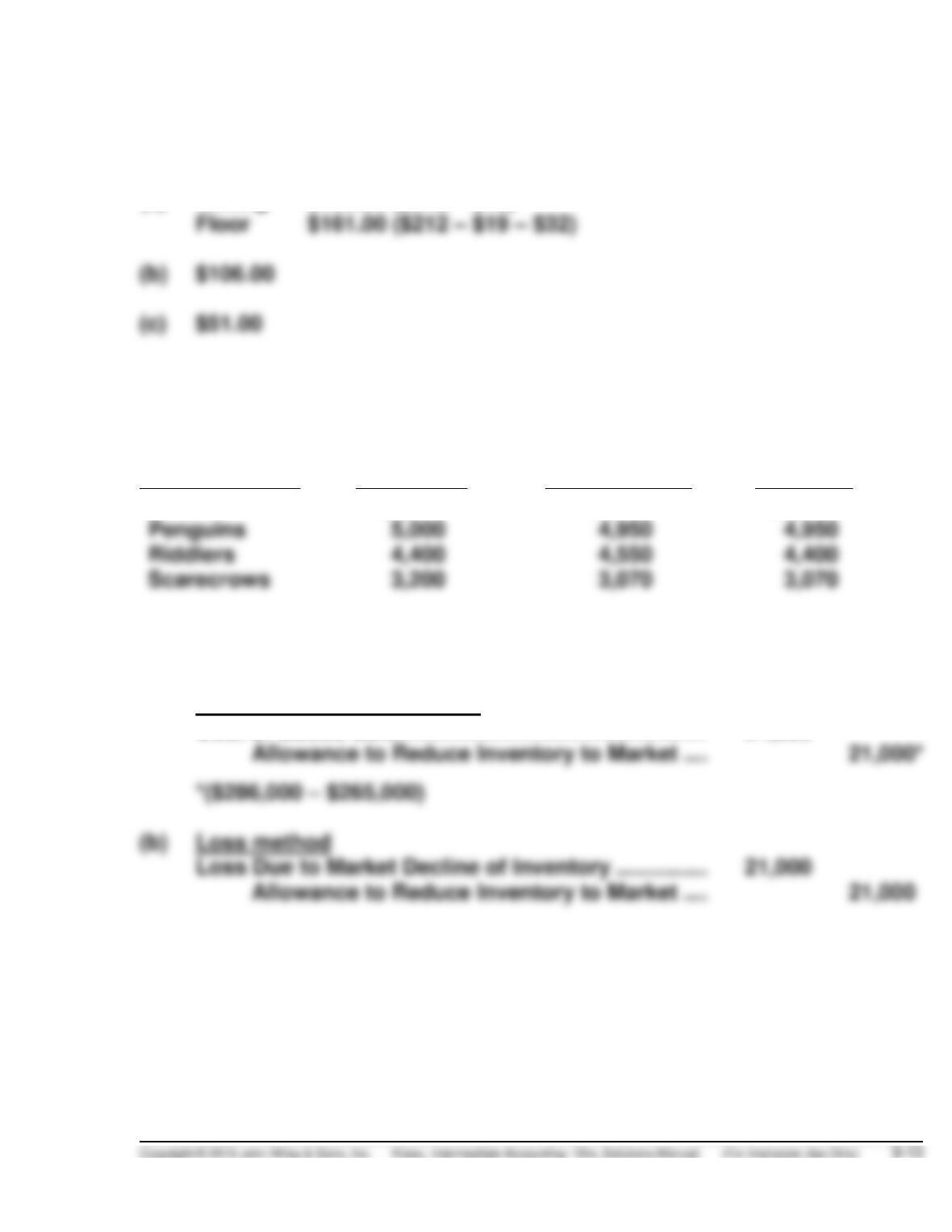
(a) Ceiling $193.00 ($212 – $19)
BRIEF EXERCISE 9-2
Item
Cost
Designated
Market
LCM
Jokers
$2,000
$2,050
$2,000
Penguins
Riddlers
Scarecrows
BRIEF EXERCISE 9-3
(a)
Cost-of–goods-sold method
Cost of Goods Sold …………………………………………………
21,000
Allowance to Reduce Inventory to Market ………..
(b)
Loss method
Loss Due to Market Decline of Inventory ………………….
21,000
Allowance to Reduce Inventory to Market ………..
BRIEF EXERCISE 9-4
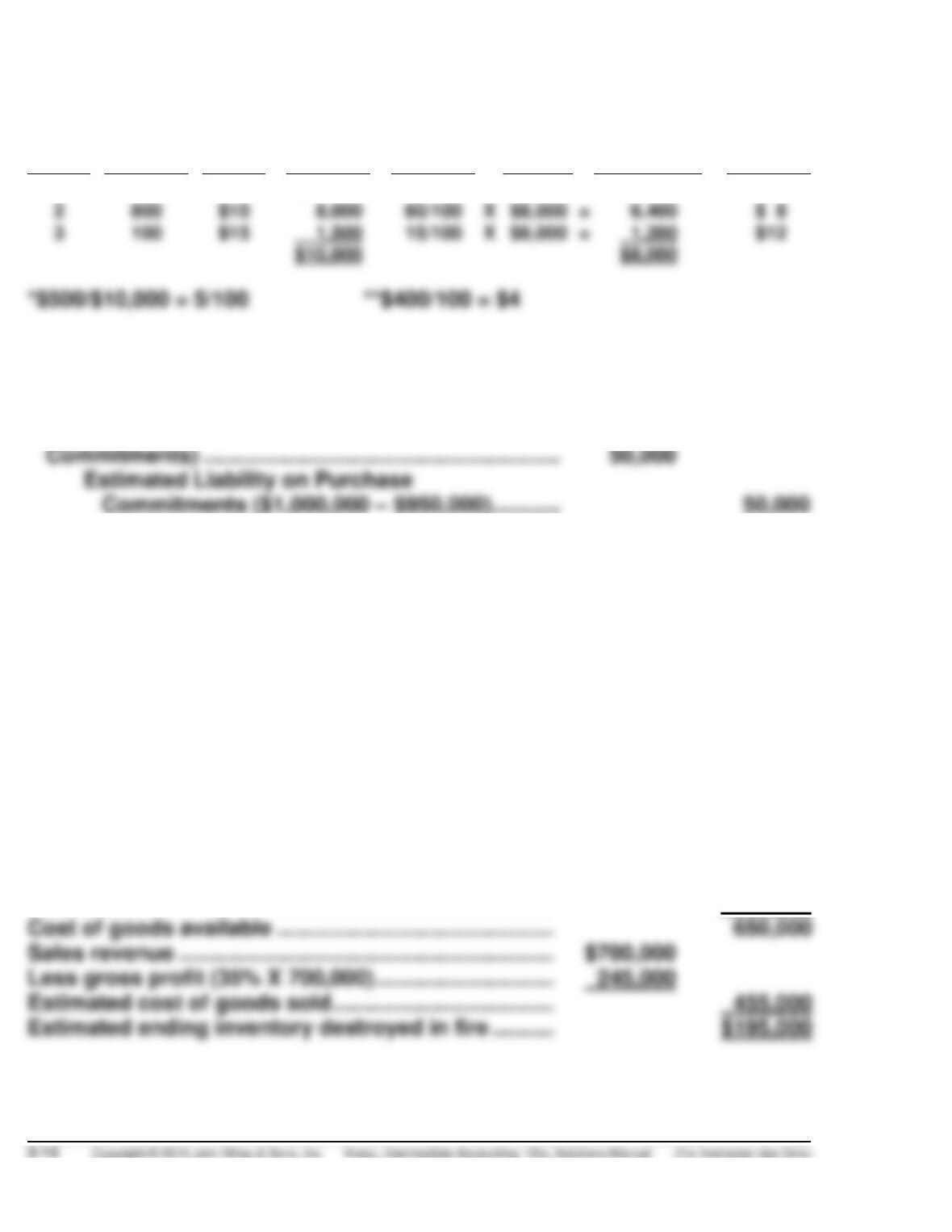
Group
Number
of CDs
Sales
Price
per CD
Total
Sales
Price
Relative
Sales
Price
Total
Cost
Cost
Allocated
to CDs
Cost
per CD
1
100
$ 5
$ 500
5/100*
X
$8,000
=
$ 400
$ 4**
BRIEF EXERCISE 9-5
Estimated Liability on Purchase
Unrealized Holding Loss—Income (Purchase
BRIEF EXERCISE 9-6
Purchases (Inventory) ……………………………………………..
950,000
Estimated Liability on Purchase Commitments …………
50,000
Cash ………………………………………………………………
1,000,000
BRIEF EXERCISE 9-7
Beginning inventory ……………………………………………
$150,000
Purchases ………………………………………………………….
500,000
Cost of goods available ………………………………………
Sales revenue …………………………………………………….
Less gross profit (35% X 700,000) ………………………..
Estimated cost of goods sold ………………………………
Estimated ending inventory destroyed in fire ……….
BRIEF EXERCISE 9-8
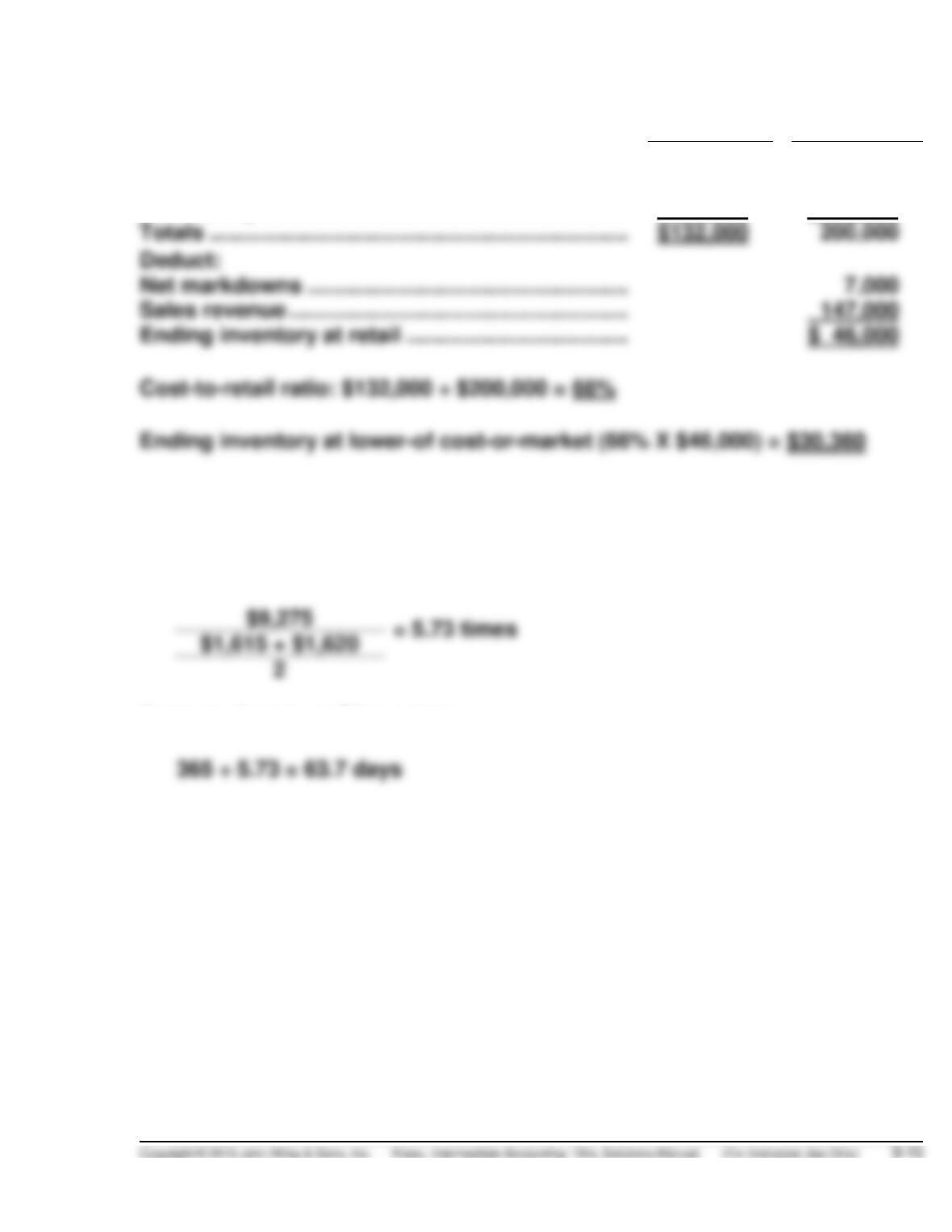
Cost
Retail
Beginning inventory ………………………………………
$ 12,000
$ 20,000
Net purchases ………………………………………………
120,000
170,000
Net markups …………………………………………………
10,000
Totals …………………………………………………………..
$132,000
Deduct:
Net markdowns …………………………………………….
Sales revenue ……………………………………………….
Ending inventory at retail ………………………………
BRIEF EXERCISE 9-9
Inventory turnover:
Average days to sell inventory:
*BRIEF EXERCISE 9-10
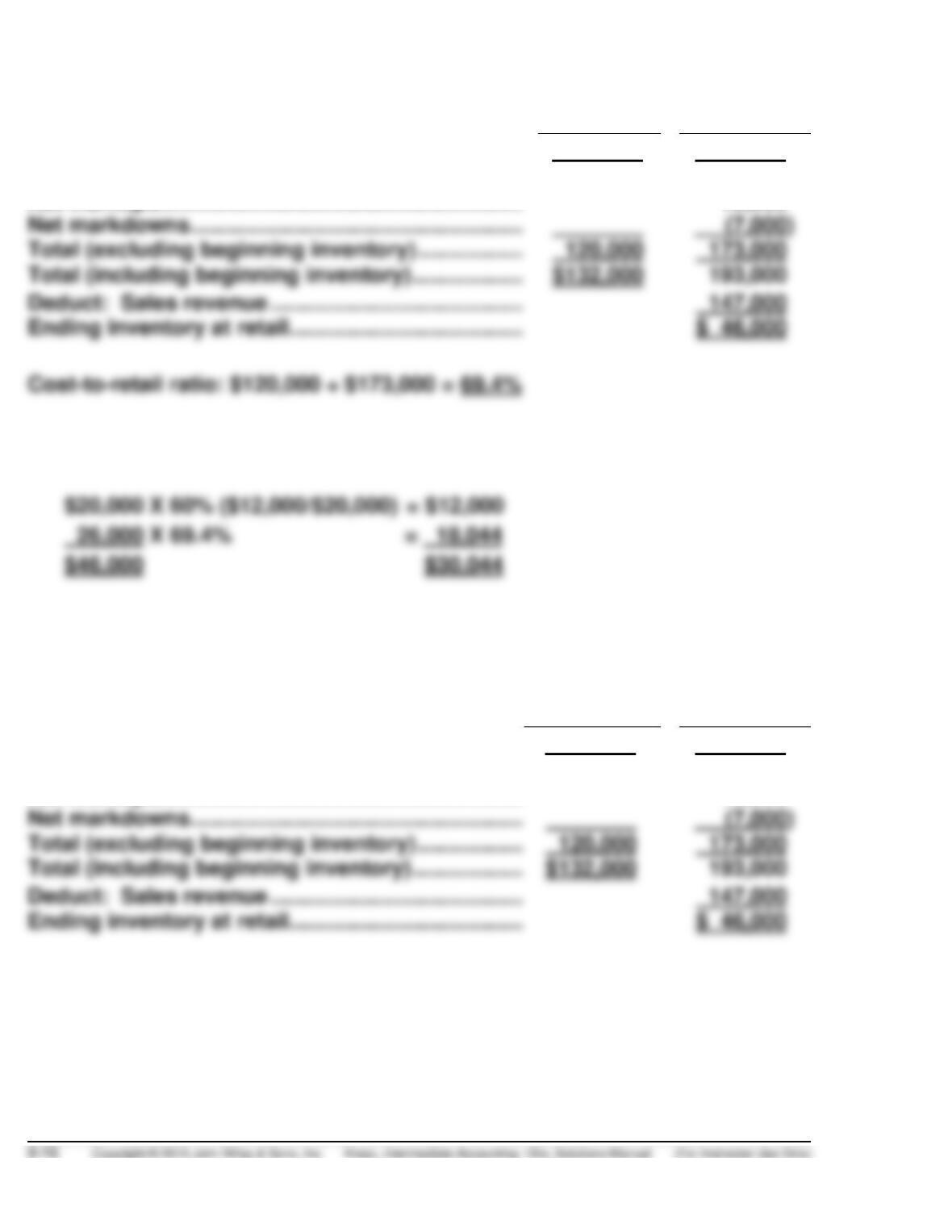
Cost
Retail
Beginning inventory ……………………………………….
$ 12,000
$ 20,000
Net purchases ………………………………………………..
120,000
170,000
Net markups …………………………………………………..
10,000
Net markdowns ………………………………………………
Total (excluding beginning inventory) ……………..
Total (including beginning inventory) ………………
Deduct: Sales revenue …………………………………..
Ending inventory at retail ………………………………..
Ending inventory at cost
*BRIEF EXERCISE 9-11
Cost
Retail
Beginning inventory ……………………………………….
$ 12,000
$ 20,000
Net purchases ………………………………………………..
120,000
170,000
Net markups …………………………………………………..
10,000
Net markdowns ………………………………………………
(7,000)
Total (excluding beginning inventory) ……………..
Total (including beginning inventory) ………………
Deduct: Sales revenue …………………………………..
Ending inventory at retail ………………………………..
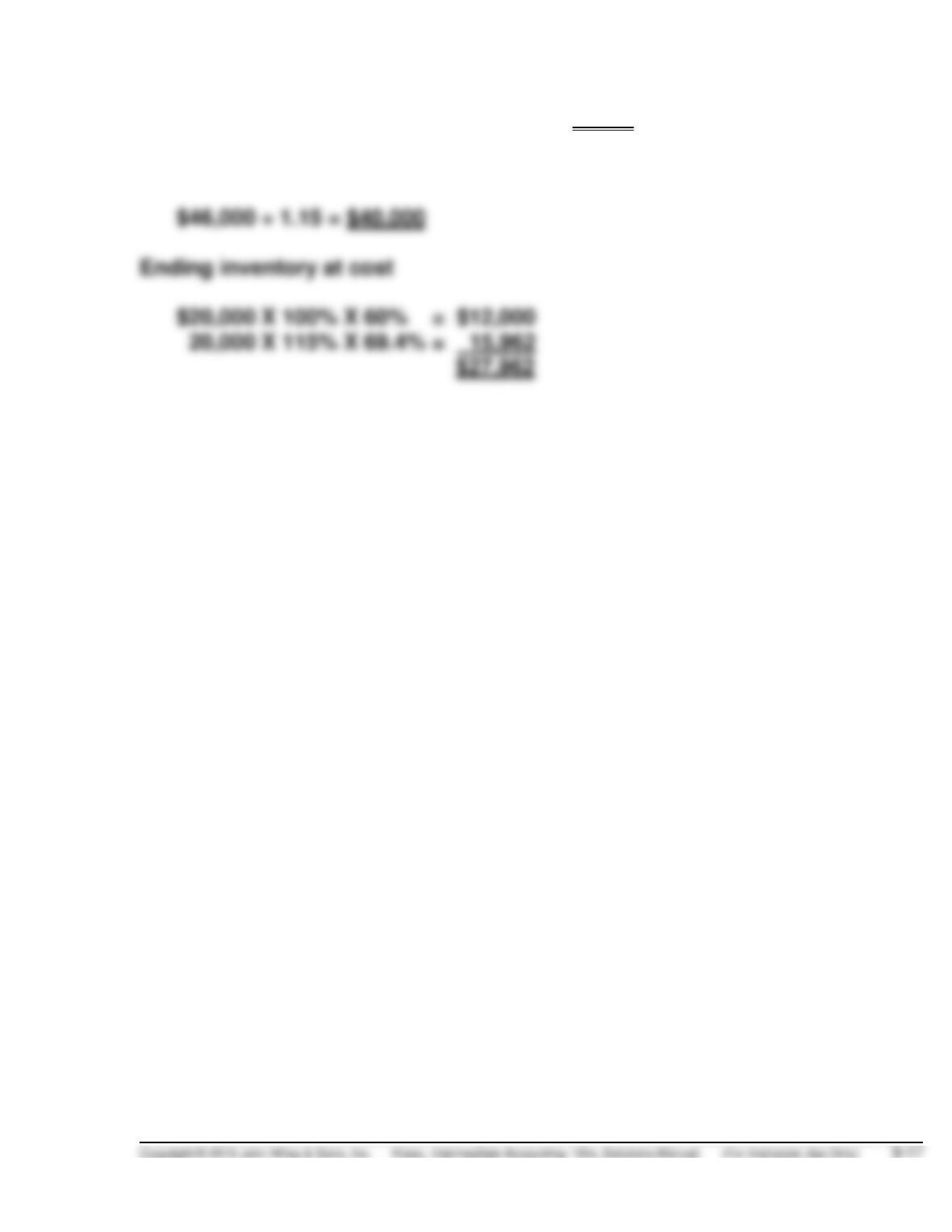
*BRIEF EXERCISE 9-11 (Continued)
Cost-to-retail ratio: $120,000 ÷ $173,000 = 69.4%
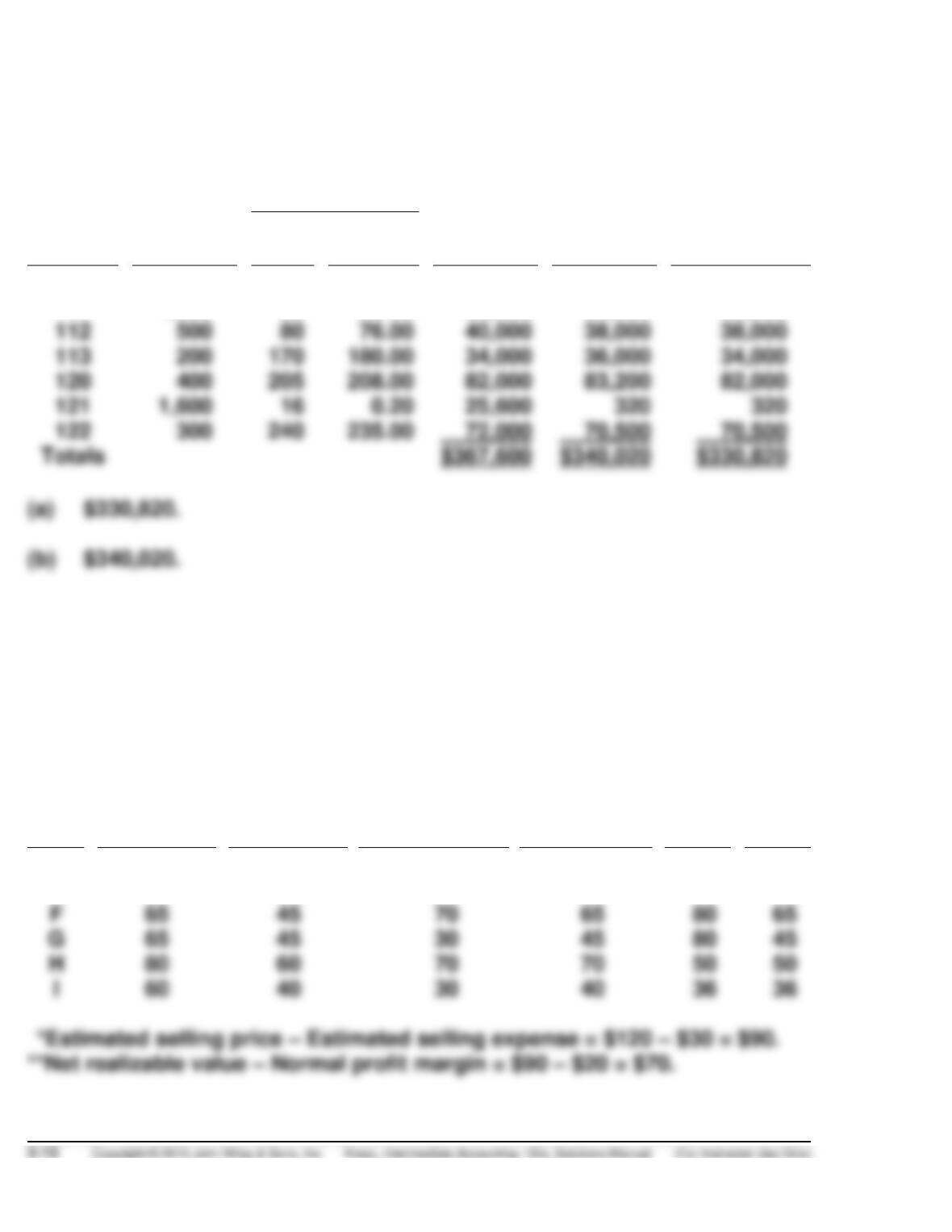
Ending inventory at retail deflated to base year prices
SOLUTIONS TO EXERCISES
EXERCISE 9-1 (15–20 minutes)
Per Unit
Lower-of–
Part No.
Quantity
Cost
Market
Total
Cost
Total
Market
Cost-or–
Market
110
600
$ 90
$100.00
$ 54,000
$ 60,000
$ 54,000
111
1,000
60
52.00
60,000
52,000
52,000
112
500
80
76.00
40,000
38,000
38,000
113
200
34,000
36,000
34,000
121
1,600
16
0.20
25,600
320
320
122
300
72,000
70,500
70,500
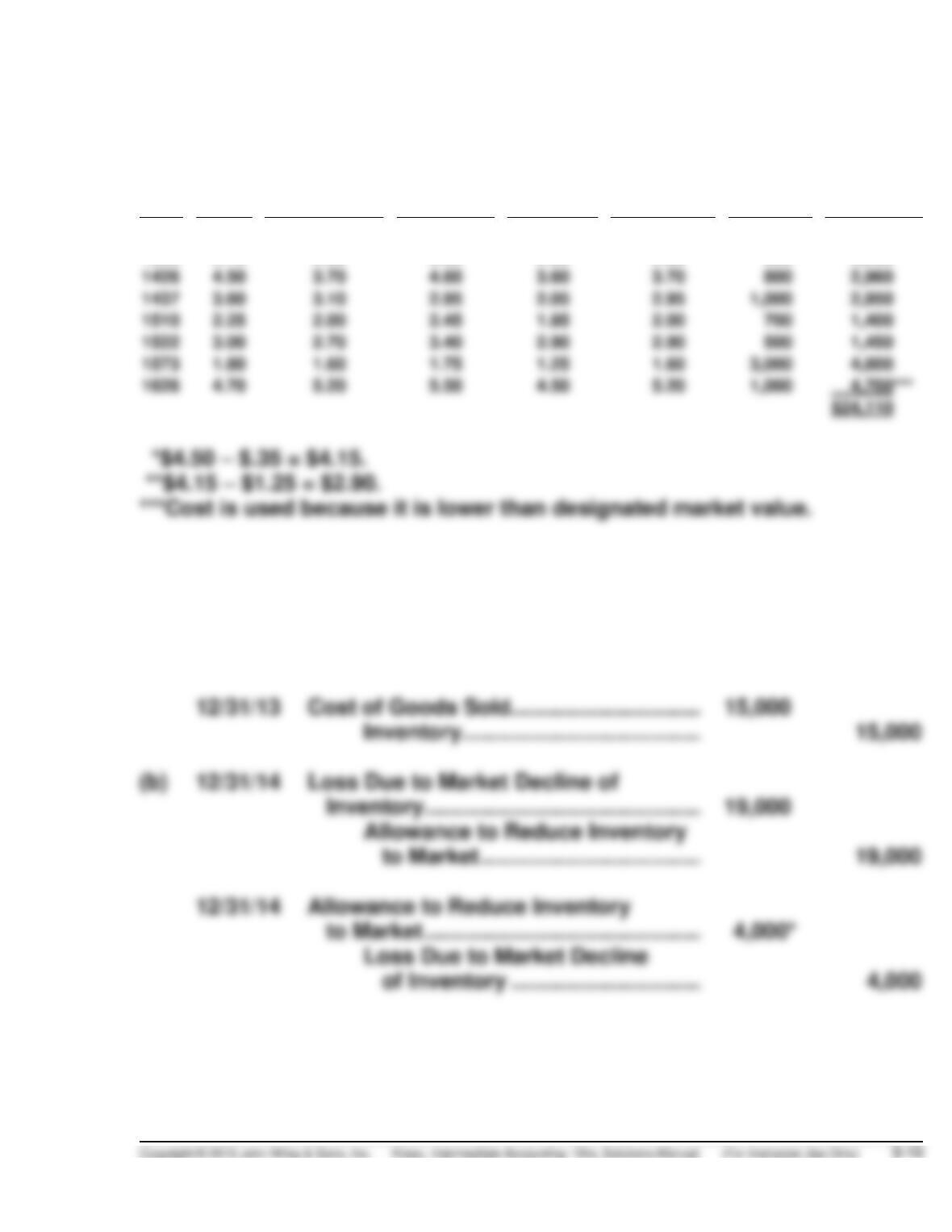
EXERCISE 9-2 (10–15 minutes)
Item
Net
Realizable
Value
(Ceiling)
Net
Realizable
Value
Less
Normal
Profit
(Floor)
Replacement
Cost
Designated
Market
Cost
LCM
D
$90*
$70**
$120
$90
$75
$75
E
80
60
72
72
80
72
H
80
60
70
70
50
50
I
EXERCISE 9-3 (15–20 minutes)
Item
No.
Cost
per
Unit
Replacement
Cost
Net
Realizable
Value
Net Real.
Value
Less
Normal
Profit
Designated
Market
Value
Quantity
Final
Inventory
Value
1320
$3.20
$3.00
$4.15*
$2.90**
$3.00
1,200
$ 3,600
1333
2.70
2.30
3.00
2.50
2.50
900
2,250
1426
4.50
3.70
4.60
3.60
3.70
800
2,960
1437
3.60
3.10
2.95
2.05
2.95
1,000
2,950
1510
2.25
2.00
2.45
1.85
2.00
700
1,400
1522
3.00
2.70
3.40
2.90
2.90
500
1,450
1573
1.80
1.60
1.75
1.25
1.60
3,000
4,800
1626
4.70
5.20
5.50
4.50
5.20
1,000
4,700***
EXERCISE 9-4 (10–15 minutes)
(a)
12/31/13
Cost of Goods Sold…………………………..
19,000
Inventory……………………………………………………….
19,000
12/31/13
Cost of Goods Sold…………………………..
15,000
Inventory……………………………………………………….
15,000
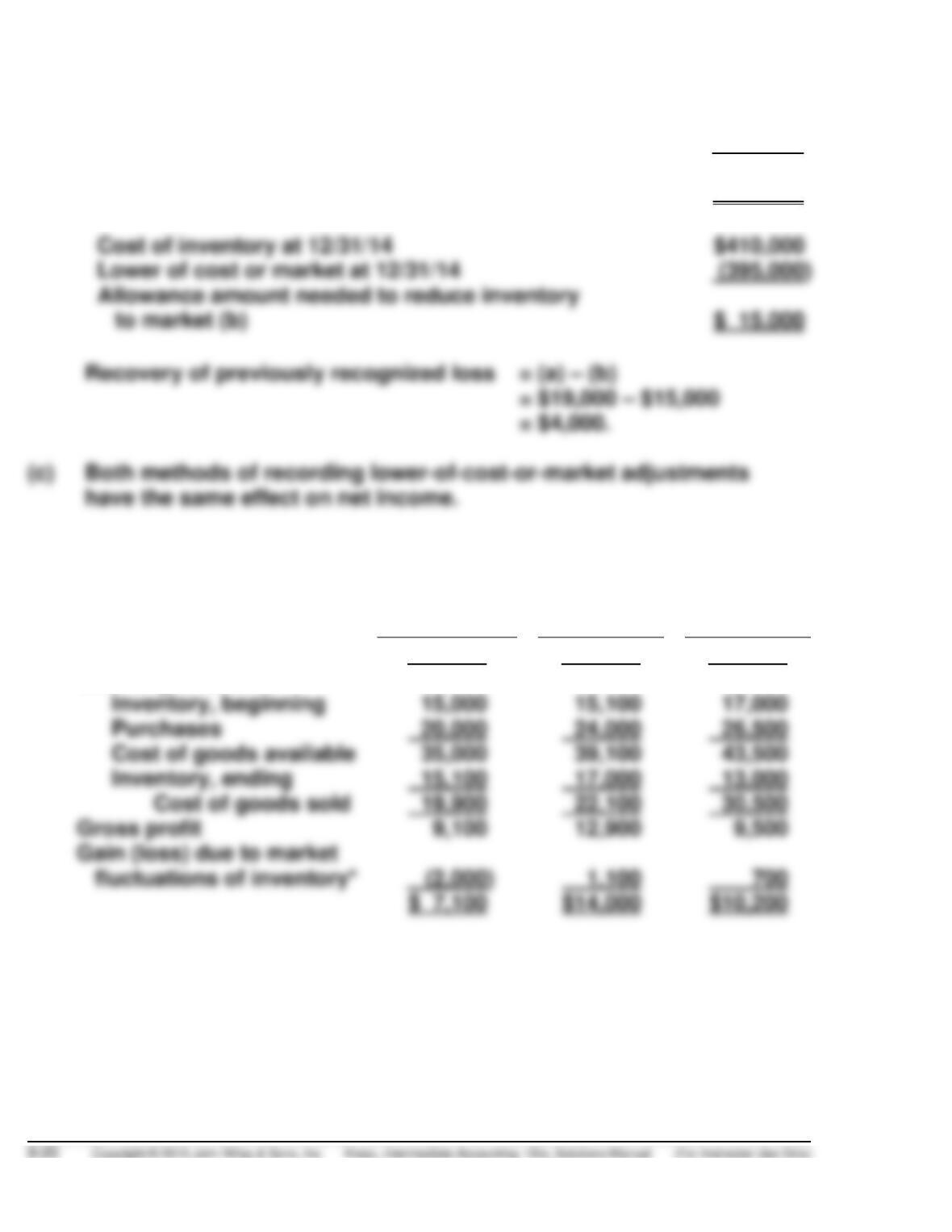
EXERCISE 9-4 (Continued)
*Cost of inventory at 12/31/13
$346,000
Lower of cost or market at 12/31/13
(327,000)
Allowance amount needed to reduce inventory
to market (a)
$ 19,000
Cost of inventory at 12/31/14
Lower of cost or market at 12/31/14
Allowance amount needed to reduce inventory
to market (b)
$ 15,000
Recovery of previously recognized loss
= (a) – (b)
= $19,000 – $15,000
= $4,000.
EXERCISE 9-5 (20–25 minutes)
(a)
February
March
April
Sales revenue
$29,000
$35,000
$40,000
Cost of goods sold
Inventory, beginning
Purchases
Cost of goods available
Inventory, ending
Cost of goods sold
Gross profit
Gain (loss) due to market
fluctuations of inventory*