Chapter 9: Capital Utilization and Unemployment
Chapter Summary:
This chapter provides a more realistic treatment of resource markets in relation to the
business cycle. The procyclical pattern of capacity utilization is explained in terms of a
depreciation function, where higher rates of capacity utilization are associated with higher
Chapter Outline:
I. Capital Input
A. The Demand for Capital Services
II. The Labor Force, Employment, and Unemployment
A. Basic Concepts and Empirical Patterns
B. A Model of Job Finding
C. Search by Firms
Teaching Tips:
1. The famous scene in “Gone with the Wind” in which Scarlett O’Hara whips her horse to
2. The “Back to Reality” feature on page 206 which provides many concrete examples of
how costs rise as capacity utilization approaches 100%. Instructors can generate a lively
3. A discussion of the search theory of labor markets can be energized by asking for a show
of hands of students who would like to be married. Then ask those whose hands are up to
keep them up if they currently are married. There will be a dramatic difference. Ask them if
4. A discussion of international differences in the natural rates of unemployment is a useful
way to help students distinguish between natural and cyclical unemployment. Explain why
5. The bathtub provides a suitable illustration for employment as a function of job finding
6. The “jobless recovery” is a term used to describe a period of expansion when
Answers to review questions, pg. 229
1. Machines are determined by the capital stock available during the period, and may be
considered a “fixed” input; but the number of hours used is a “variable” input and can be
2. a. An increase in R/P increases the value of each hour of capital supplied.
b. If the effects of capacity utilization rates on depreciation were to increase, then the net
rate of return would be reduced for all values of .
3. The unemployment rate is the number of unemployed/labor force. Since the labor force is
weakly pro-cyclical, the numbers will underestimate the true unemployment rate as the
42
4. The major reason a worker may reject an offer of employment which is greater than their
current income is that the offer is in the lower end of the distribution of expected offers. If
5. Job separations may have a variety of causes including:
– imperfect information: either the job or the employee mail fail to live up to the
expectations based on the original evaluation.
6. The natural rate of unemployment is the rate associated with a balanced flows of job
finding and job separations. The actual rate of unemployment will vary from the natural
rate when temporary “shocks” occur that temporarily change the rate of job finding, job
separation, or both. The natural rate will be affected by institutional changes that change the
Answers to problems for discussion, pg. 230
7:
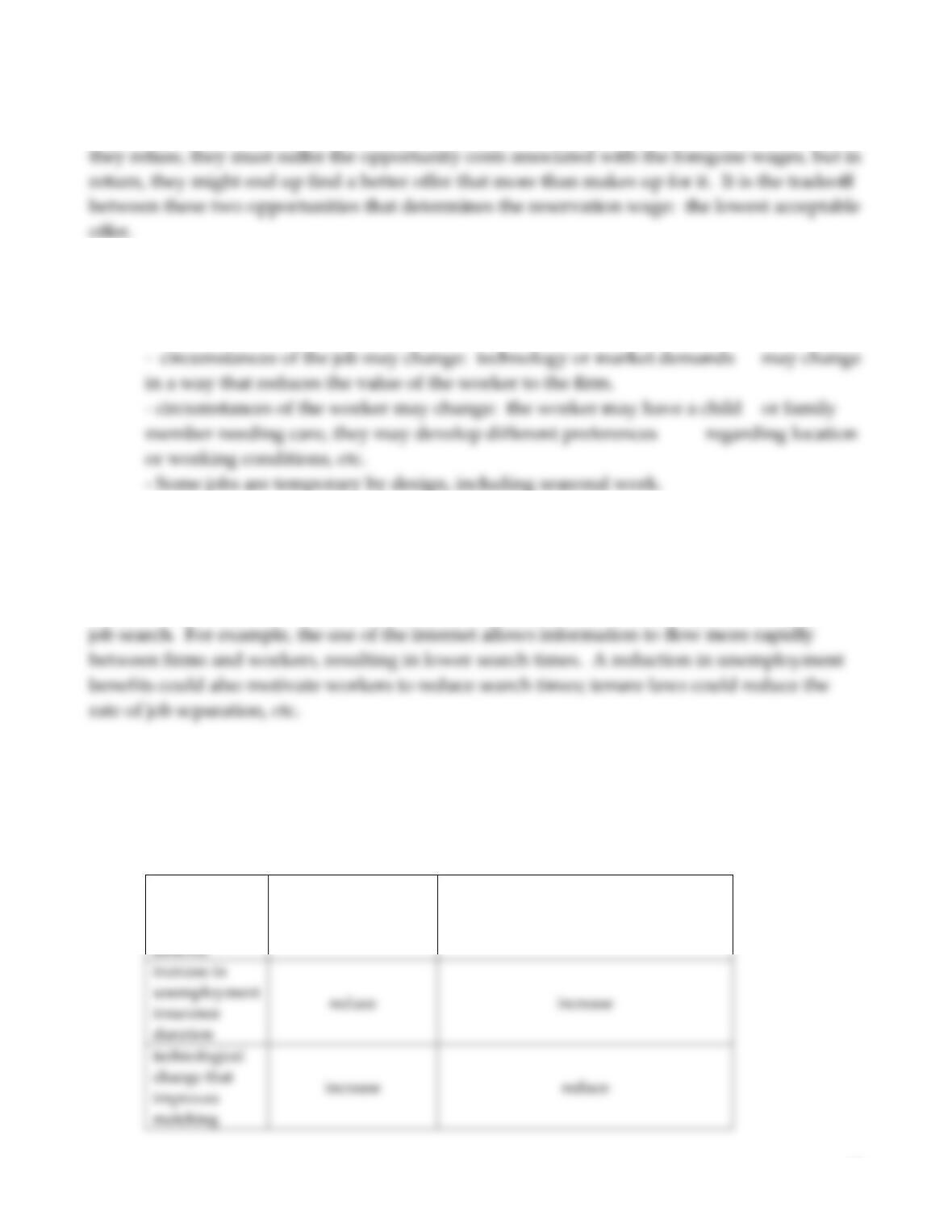
event:
effect on job-finding
rate:
effect on duration of unemployment:
benefits
unemployment
insurance
reduce
increase
improves
increase in
unemployment
insurance
reduce
increase
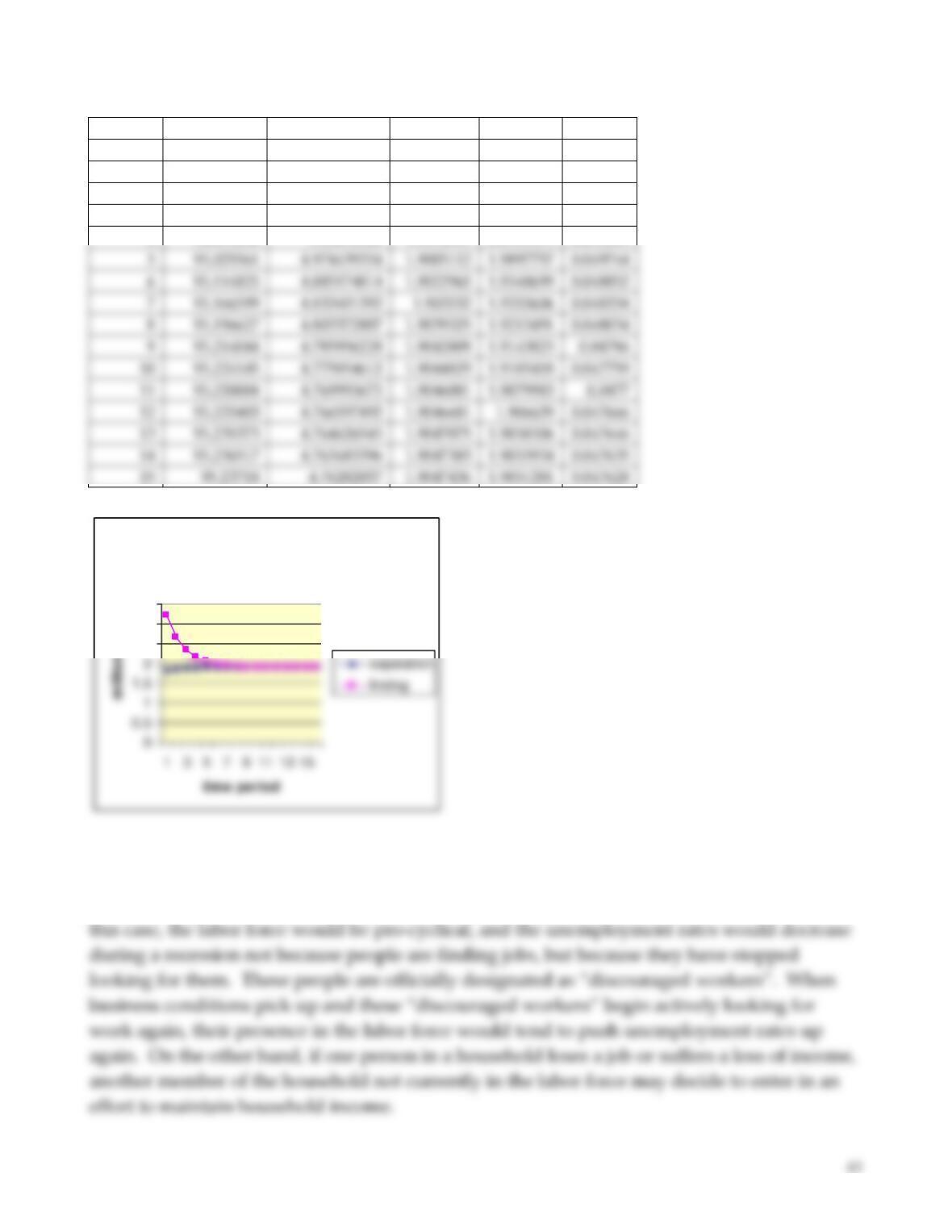
8. The natural rate of unemployment seems to be 4.76%, as seen in the following table:
time
employment
unemployment
separation
finding
u. rate:
0
92
8
1.84
3.2
0.08
1
93.36
6.64
1.8672
2.656
0.0664
2
94.1488
5.8512
1.882976
2.34048
0.058512
3
94.606304
5.393696
1.8921261
2.1574784
0.053937
4
94.871656
5.12834368
1.8974331
2.0513375
0.051283
5
95.025561
1.9005112
1.9897757
0.049744
6
95.114825
1.9022965
1.9540699
0.048852
7
95.166599
1.9333606
0.048334
8
95.196627
1.9039325
1.9213491
0.048034
9
95.214044
1.9042809
1.9143825
95.224145
1.9044829
1.9103418
0.047759
95.230004
1.9046001
1.9079983
0.0477
1.9046681
0.047666
95.235373
1.9047075
1.9058506
0.047646
95.236517
1.9047303
1.9053934
0.047635
1.9047436
1.9051281
0.047628
time paths of employment and
unemployment
2.5
3
3.5
9. Unemployed persons not “actively seeking work” are not counted in the labor force. It
may be that some of them are not seeking work until business conditions improve, that is,
until the expected probability (and therefore, the net benefits) of the job search increase. In

10. New technology should increase the marginal product of labor, creating new job offers.
Job offers would be pro-cyclical in this case. When there are more vacancies, the job search